









Introduction
Data Privacy Statistics: As the digital landscape continues to evolve, data privacy has become a paramount concern for individuals, organizations, and governments alike. The increase in cyber threats, coupled with the growing volume of personal and sensitive data being generated, has made safeguarding this information more critical than ever.
Data privacy statistics are essential for gaining a deeper understanding of current privacy practices, consumer perceptions, and the regulatory environment. These figures provide important insights into how businesses are addressing data protection challenges, the effectiveness of privacy regulations such as GDPR, and the public’s view on data security.
With incidents of data breaches and privacy violations on the rise, organizations face mounting pressure to implement robust security measures. By examining the latest data privacy statistics, we can better evaluate the risks, the advancements being made in data protection, and the influence of emerging technologies like AI and big data on privacy standards.
Editor’s Choice
- 91.1% of businesses are willing to prioritize data privacy if it would enhance customer trust and loyalty.
- 75% of consumers stated they would not make purchases from companies they do not trust with their data.
- 58% of users feel comfortable with their personal information being used transparently and for beneficial purposes.
- 62% of Americans believe it is impossible to go about their daily lives without companies collecting their data.
- 81% of users feel the potential risks of companies collecting data outweigh the benefits.
- 63% of internet users think most companies are not transparent about how their data is utilized, and 48% have stopped shopping with a company due to privacy concerns.
- 81% of users believe the way a company handles their data reflects how it views them as a customer.
- 37% of users have ended relationships with companies over data concerns, an increase from 34% just two years ago.
- Over 120 countries have introduced some form of international data protection laws to safeguard their citizens’ data better.
- 94% of organizations acknowledge that customers would not purchase from them if their data were not protected properly.
- 86% of the US general population regards data privacy as an increasing concern.
- 72% of Americans believe there should be stricter government regulations on the handling of personal data.
- Only 29% of consumers find it easy to understand how well companies protect their data.
- 48% of organizations are entering non-public company information into GenAI applications.
- Only 20% of privacy professionals express full confidence in their organization’s compliance with privacy laws.
- The average cost to manually process a single data subject request is $1,524.
- Large organizations are expected to spend over $2.5 million annually on privacy by the end of 2024.
- 95% of organizations agree that the aids of spending on data privacy outweighs the costs, with the average return on investment being 1.6x. Additionally, 30% of organizations estimate a 2x ROI from their data privacy investments.
(Source: Termly, Cisco, Tableau, Pew Research Center, Thales, KPMG, International Association of Privacy Professionals, Gartner)
General Data Privacy Statistics
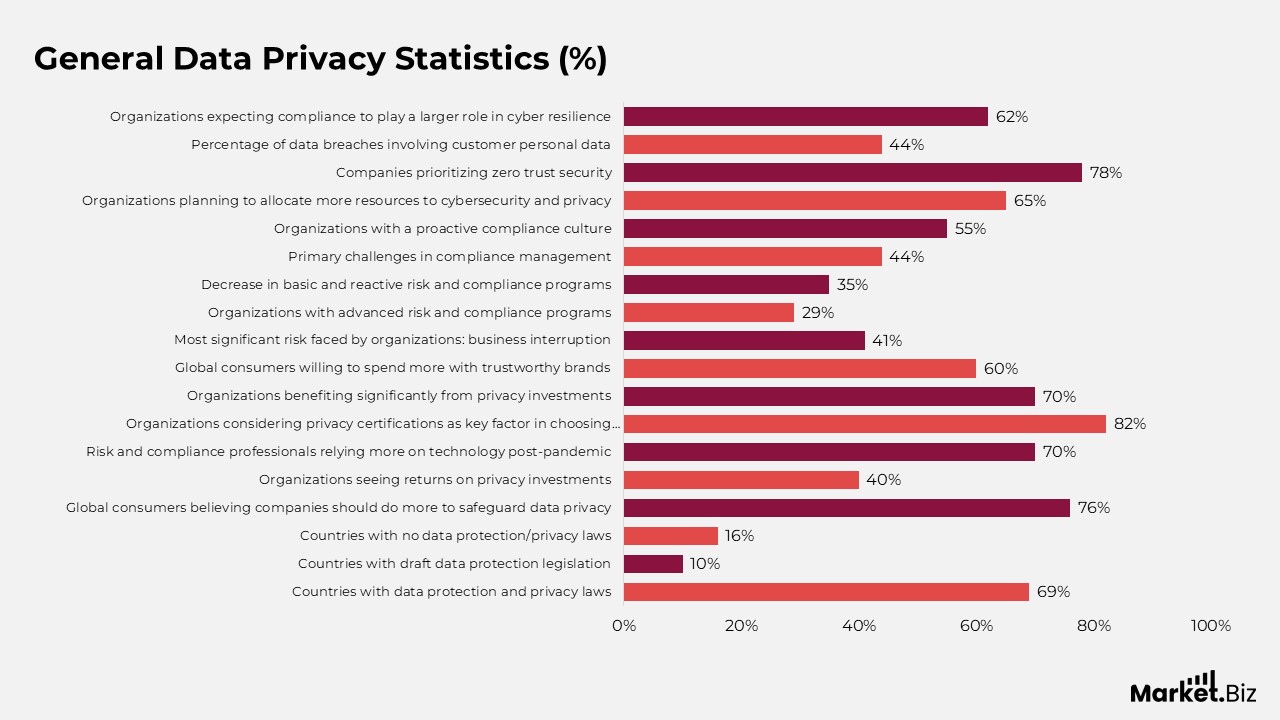
- 69% of countries worldwide have implemented data protection and privacy laws, while another 10% have draft legislation, 5% lack any data, and 16% still do not have any data protection or privacy laws.
- 76% of global consumers believe that companies should take more action to safeguard their data privacy online.
- The average cost of a data breach rose from $3.86 million in 2020 to $4.24 million in 2021. Healthcare is the most expensive sector for data breaches, with an average cost of $9.23 million.
- More than 40% of organizations report seeing returns on privacy investments that are at least double the amount spent on privacy.
- 70% of risk and compliance professionals indicated that the pandemic has increased their dependence on technology to enhance decision-making, performance monitoring, and risk management.
- 82% of organizations consider privacy certifications, such as Privacy Shield and ISO 27701, to be a key factor when choosing products or vendors for their supply chain.
- The percentage of organizations that gain significant business benefits from privacy has risen to over 70%.
- In recent years, threat actors have shifted from merely using ransomware to double extortion, where they threaten to leak or sell stolen data. The threat to release pilfered data increased dramatically from 8.7% in 2020 to 81% in the second quarter of 2021.
- 60% of global consumers stated they would be willing to spend more with brands they trust to handle their data responsibly.
- The most significant risk faced by organizations is business interruption (41%), including supply chain disruptions, followed by cyber incidents such as data breaches, cybercrime, and fines at 40%.
- The number of advanced and mature risk and compliance programs grew by 29%, while basic and reactive programs decreased by 35%, signalling a shift toward more developed risk management practices.
- 44% of organizations report that their primary challenges in compliance management include handling compliance assessments, undergoing control testing, and implementing policy updates.
- 55% of organizations indicated that their compliance culture is now more focused on a Can we? Approach rather than a Should we? Mindset, reflecting a more proactive and positive compliance culture.
- 65% of organizations predict they will be allocating more resources to cybersecurity and privacy in the coming years.
- 78% of companies globally have prioritized zero-trust security, with nearly 90% currently working on implementing a zero-trust initiative.
- A significant data privacy challenge highlighted by the rise in digital transformation is the risks associated with remote work. IBM found that data breaches are $1 million more expensive on average when remote work is a factor in the breach.
- 44% of data breaches involve customer personal data, including details such as name, email, and password.
- 62% of companies expect that compliance will play a larger role in cyber resilience in the years ahead.
(Source: Meetanshi Technologies LLP, Tech Target)
Business-Related Data Privacy Statistics
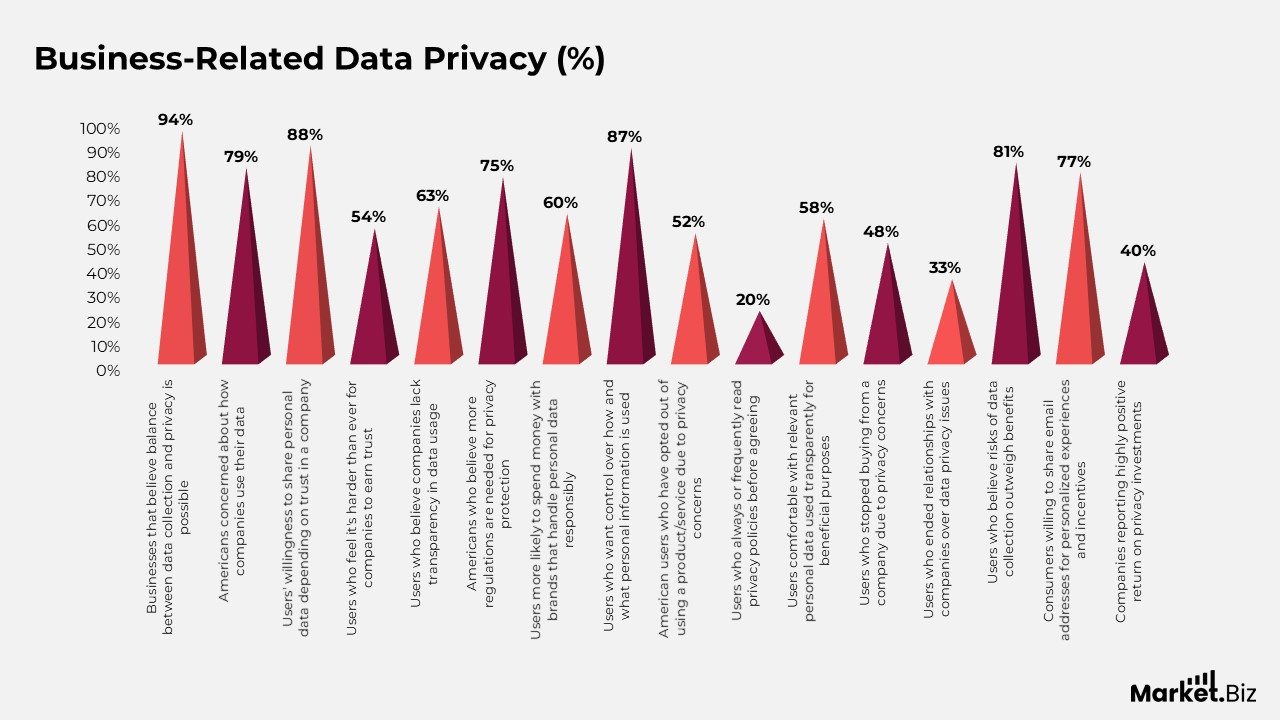
- 94.1% of businesses believe it is possible to strike a balance between data collection for marketing purposes and respecting customer privacy.
- 79% of Americans are concerned about how companies use their data.
- For 88% of users, their willingness to share personal data depends on the level of trust they have in a company.
- 54% of users feel that it is harder than ever for companies to earn their trust.
- 63% of users believe that most companies lack transparency regarding how their data is used.
- 75% of Americans believe more regulations are needed to protect their privacy from companies that collect consumer data without consent or awareness.
- 60% of users say they are more likely to spend money with a brand they trust to handle their data responsibly.
- 87% of users want control over how and what personal information is used by companies.
- 52% of American users have opted not to use a product or service due to concerns about the amount of personal data being collected.
- One in five users always or frequently reads a company’s privacy policy before agreeing to it.
- 58% of users are comfortable with their relevant personal data being used transparently and for beneficial purposes.
- 48% of users have stopped buying from a company due to privacy concerns.
- 33% of users have ended relationships with companies over data privacy issues, including social media companies, retailers, ISPs, banks and credit card providers.
- 81% of users believe the risks posed by companies collecting their data outweigh the benefits.
- 77% of consumers are prepared to share their email addresses in exchange for personalized involvement and additional encouragement.
- Many companies report a highly helpful return on their privacy investments, with over 40% seeing benefits that are at least double their privacy spend.
(Source: Termly, Pew Research Center, PwC, Salesforce, Tableau, LegalJobsIO, Global Consumer State of Mind Report, Statista, Cisco, Termly)
Cybersecurity Insurance Market Size
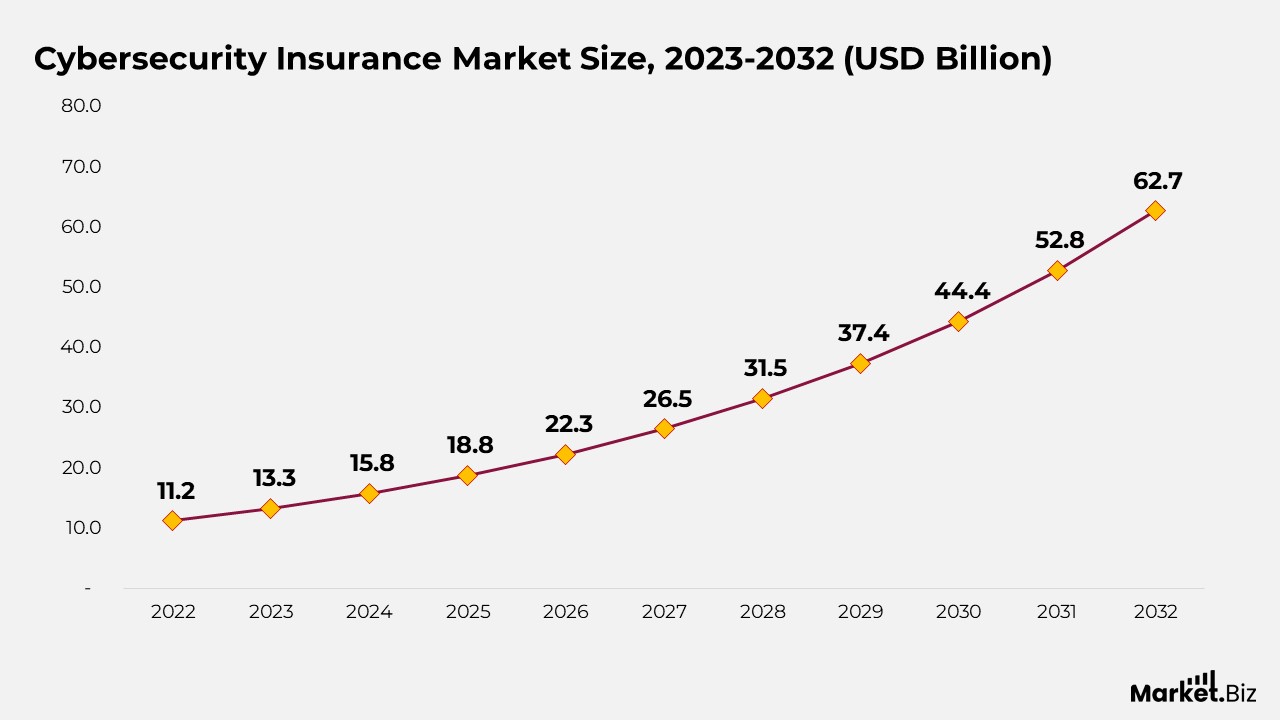
- According to Market.us, the cybersecurity insurance market is expected to rise from $13.3 billion in 2023 to $62.7 billion by 2032, representing a compound annual growth rate (CAGR) of 18.8% from 2023 to 2032.
- The growth of the cybersecurity insurance market is fueled by the increasing frequency and sophistication of cyber attacks, along with growing recognition of cyber risk as a major business threat.
- The cybersecurity liability segment holds a dominant share of 44.6%, highlighting its importance in protecting businesses against financial impacts from cyber incidents.
- Healthcare compliance is a leading segment, driven by the complex regulatory landscape and the need for healthcare organizations to ensure data privacy, patient care, and operational integrity.
- North America leads the global cybersecurity insurance market with a 39.6% revenue share, reflecting its proactive approach to managing cybersecurity risks.
(Source: Market.us)
Data Privacy and Artificial Intelligence Statistics
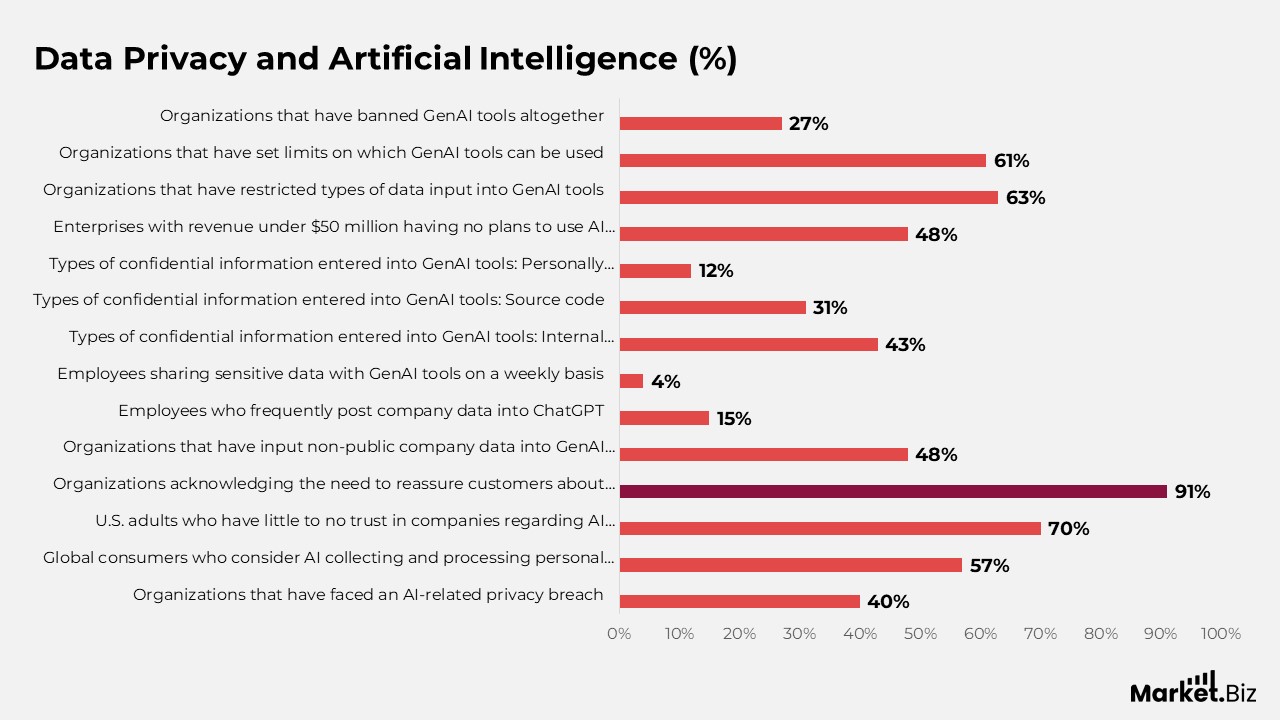
- 40% of organizations have faced an AI-related privacy breach.
- 57% of global consumers consider the use of AI to collect and process personal data a major threat to their privacy.
- 70% of US adults have little to no trust in companies to make responsible decisions regarding the use of AI in their products.
- 91% of organizations acknowledge the need to do more to reassure customers about how their data is being used in AI systems.
- 48% of organizations have input non-public company data into GenAI applications.
- 15% of employees frequently post company data into ChatGPT, with over a quarter of that information being classified as sensitive.
- 4% of employees share sensitive data with GenAI tools every week.
- The most common types of confidential information entered into GenAI tools include:
- 43% internal business data
- 31% source code
- 12% personally identifiable information (PII)
- Among enterprises with less than $50 million in revenue, 48% said they have no plans to use AI for privacy-related tasks, compared to just 24% of enterprises with more than $1 billion in revenue. This suggests that smaller enterprises may struggle to implement AI due to resource constraints and governance challenges.
- 63% of organizations have restricted the types of data that can be input into GenAI tools, 61% have set limits on which tools can be used, and 27% have banned GenAI tools altogether.
(Source: Gartner, International Association of Privacy Professionals, Secureframe, Pew Research Center, Cisco, LayerX, ISACA)
Data Privacy and Consumer Behavior Statistics
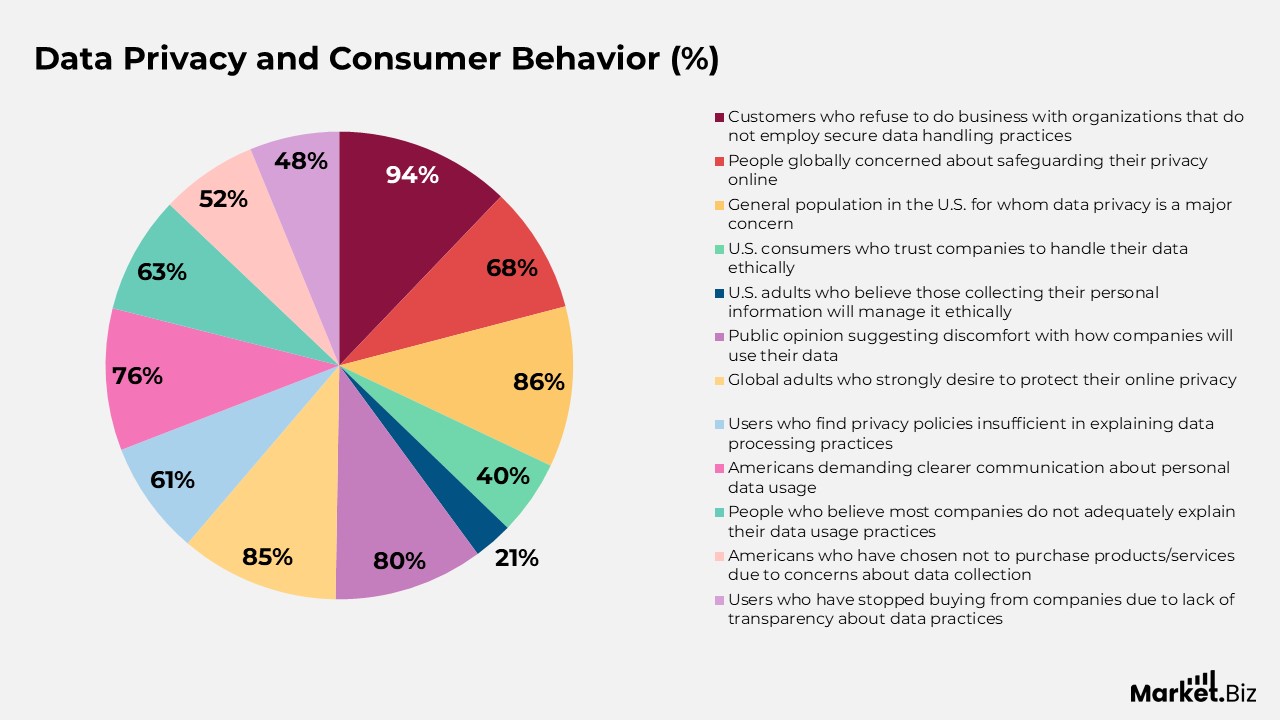
- 94% of customers refuse to do business with organizations that do not employ secure data handling practices.
- Global research indicates that 68% of people around the world are concerned about safeguarding their privacy online.
- Data privacy is a major concern for 86% of the general population in the United States.
- Only 40% of US consumers trust companies to handle their data ethically.
- A survey of US adults shows that just 21% believe individuals who collect their personal information will manage it ethically.
- Public opinion suggests that companies accessing data from US adults will use it in ways that make individuals uncomfortable.
- 80% of American adults predict that their data will be used in unintended ways.
- 85% of global adults strongly desire to protect their online privacy.
- 61% of users who review privacy policies find these documents insufficient in explaining how companies process their data.
- More than half of the US population regularly agrees to privacy policies without reading their content.
- 76% of Americans demand clearer communication from companies about how they use personal data.
- According to user surveys, 63% of people believe that most companies do not adequately explain their data usage practices.
- 52% of Americans have chosen not to purchase products or services due to concerns about how their data is being collected.
- 48% of users have stopped buying from companies due to a lack of transparency regarding their data practices.
(Source: Termly, International Business Machines Corporation, Pew Research Center, Statista)
Data Privacy and Consumer Trust
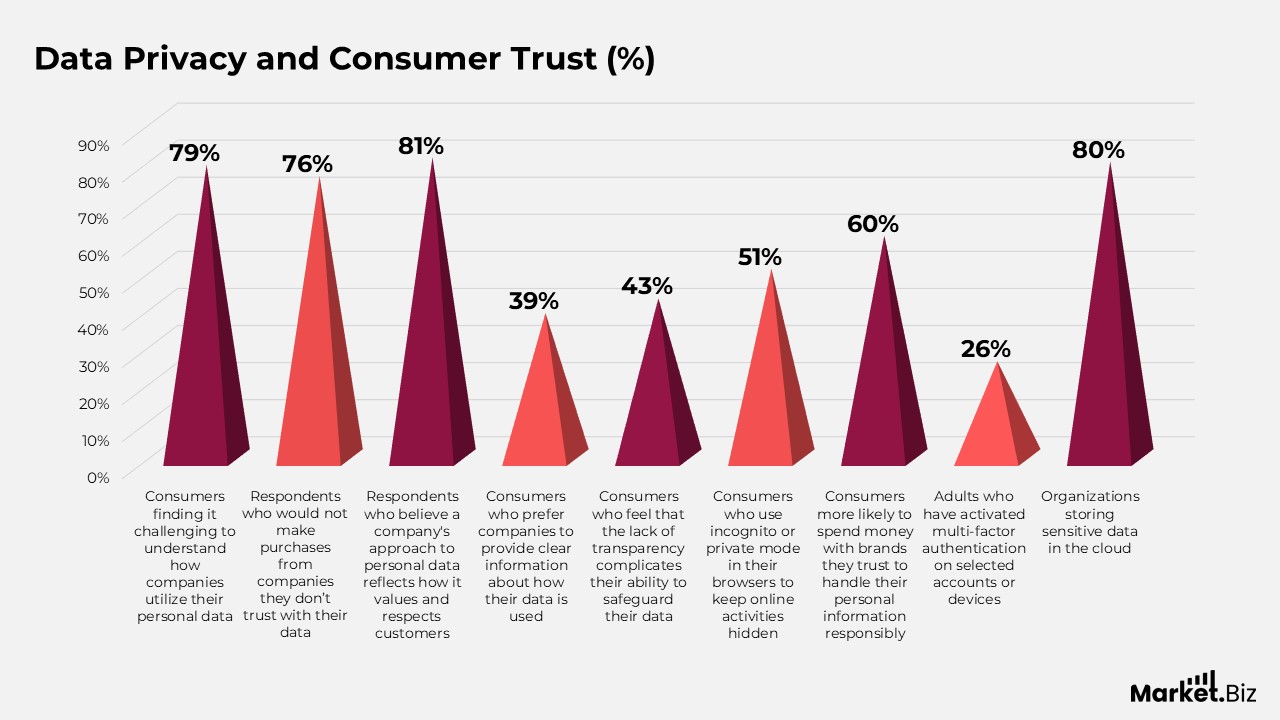
- 79% of consumers find it challenging to understand how companies utilize their data, according to Cisco’s 2022 Consumer Privacy Survey.
- 76% of respondents in the same survey indicated they would not make purchases from companies they don’t trust with their data. Additionally, 81% believe a company’s approach to personal data reflects how it values and respects its customers.
- 39% of consumers prefer companies to provide clear information about how their data is used, while 43% feel that the lack of transparency complicates their ability to safeguard their data.
- 51% of consumers use incognito or private mode in their browsers to keep their online activities hidden.
- 60% of consumers are more likely to spend money with brands they trust to handle their personal information responsibly.
- The Norton 2022 Cyber Safety Report reveals that 26% of adults have activated multi-factor authentication on selected accounts or devices.
- 80% of organizations store sensitive data in the cloud.
(Source: Gen Digital Inc., CISCO, IAPP, Consumer Cyber Readiness Report, Trūata Limited, Netwrix, JumpCloud Inc.)
Data Privacy and Cybercrime Statistics
- A study found that on average, a hacking attack occurs every 39 seconds on computers with internet access.
- The cost of data breaches rose from $3.86 million to $4.24 million in 2021, the highest average recorded to date.
- Data breach costs were $1.07 million higher when remote work was a factor compared to breaches where remote work was not involved.
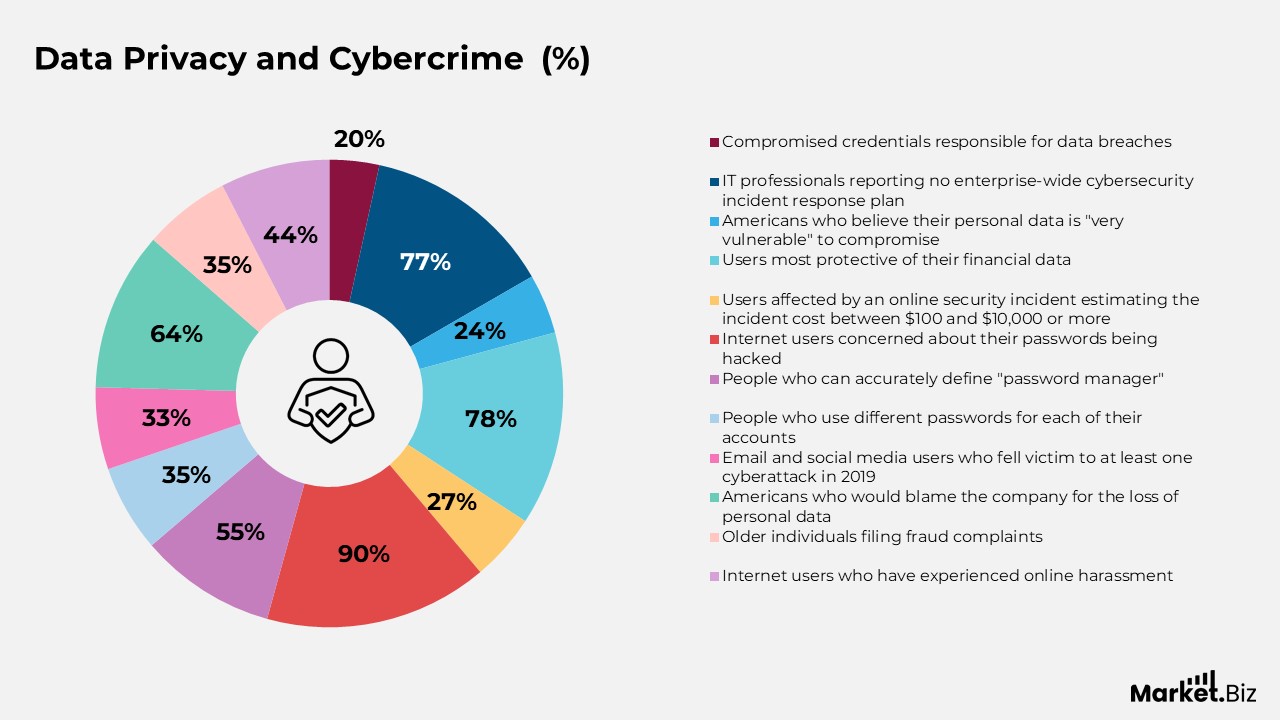
- The most common initial outbreak vector, compromised credentials, was responsible for 20% of breaches, with an average cost of $4.37 million.
- 77% of IT professionals report that their organization does not have an enterprise-wide cybersecurity incident response plan.
- The average company has 534,465 files containing sensitive data.
- 24% of Americans believe their data is “very vulnerable” to compromise, while only 2% feel their data is not at risk.
- 78% of users are most protective of their financial data, with concerns about it being hacked or shared being at the top of their list of data worries.
- The global information security market is projected to reach $170.4 billion by 2022.
- 27% of users affected by an online security incident estimate the incident cost them between $100 and $10,000 or more.
- 90% of internet users express concern about their passwords being hacked, with 46% being very worried and 44% a little worried.
- 55% of people can accurately define “password manager,” and 35% use different passwords for each of their accounts.
- Nearly 33% of email and social media users fell victim to at least one cyberattack in 2019, with more than half having personal data stolen.
- 64% of Americans would place the blame on the company, rather than the hacker, for the loss of personal data.
- 22 billion records were exposed in 2021 due to data breaches.
- Older individuals are more vulnerable to identity theft, with 35% of fraud complaints and 18.9% of identity theft complaints filed by older people in 2017.
- 44% of internet users have experienced some form of online harassment, with one in six women reporting such incidents compared to one in 19 men.
(Source: University of Maryland, International Business Machines Corporation, Varonis, Statista, Figaro Digital, Gartner, Secure Swiss Data, Termly, Avast, Google/Harris Poll, LegalJobsIO, Skyflow, Flashpoint, Experian, LegalJobsIO)
Data Privacy Compliance
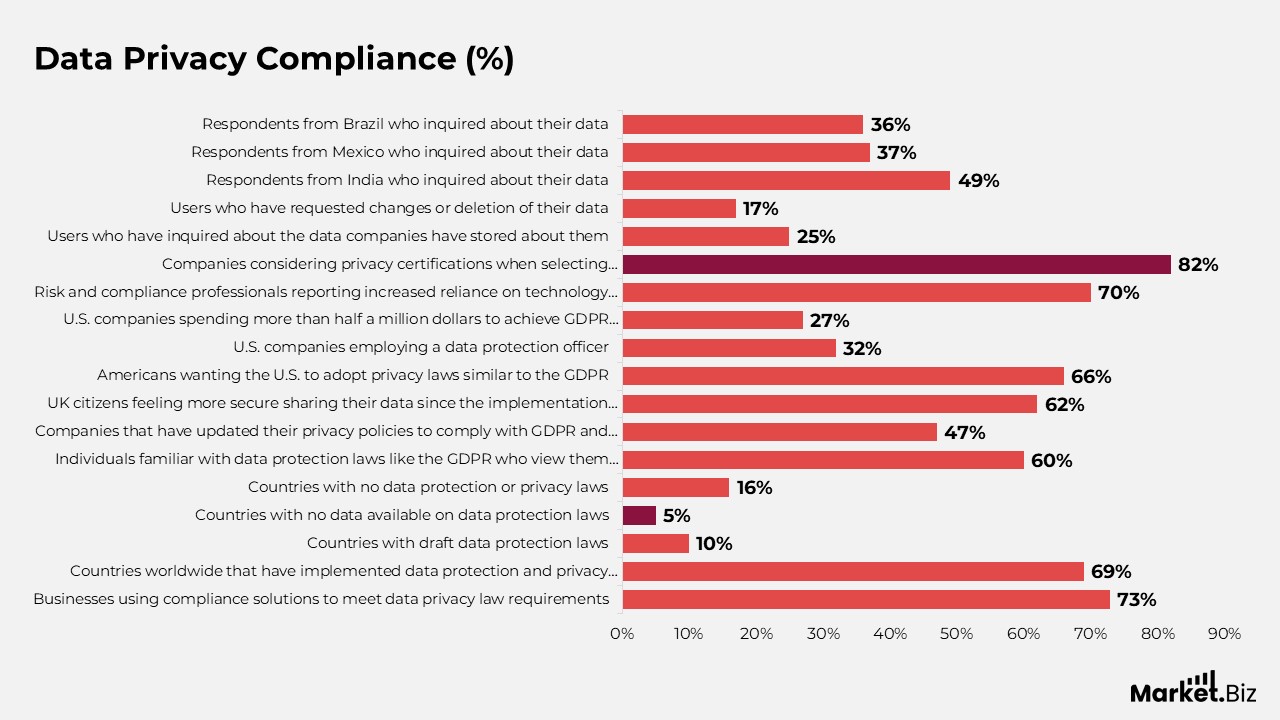
- 72.9% of businesses use compliance solutions to help meet data privacy law requirements.
- 69% of countries worldwide have implemented data protection and privacy legislation.
- An additional 10% of countries have draft laws, 5% have no data available, and 16% lack any data protection or privacy laws.
- At least 20 countries (excluding EU member states) have enacted laws similar to the GDPR, with these countries spanning across all continents.
- 60% of individuals familiar with data protection laws, such as the GDPR, view them favorably.
- 47% of companies have updated their privacy policies to comply with the GDPR and other privacy regulations, with 80% having updated their policies multiple times in the past year.
- 62% of UK citizens feel more secure sharing their data since the implementation of the GDPR.
- 66% of Americans want the US to adopt privacy laws similar to the GDPR.
- 32% of US companies now employ a data protection officer, and 27% have spent more than half a million dollars to achieve GDPR compliance.
- 70% of risk and compliance professionals report that the pandemic has improved their reliance on technology for better performance monitoring, decision-making, and risk management.
- Between January 2021 and January 2022, nearly €1.1 billion in fines were issued for GDPR violations, marking a 594% annual increase in fines.
- 82% of companies consider privacy certifications such as ISO 27701 and Privacy Shield when selecting products or vendors in their supply chain.
- 25% of users have inquired about the data companies have stored about them, and 17% have requested that the data be changed or deleted.
- 49% of respondents from India inquired about their data, followed by 37% from Mexico and 36% from Brazil.
- The highest GDPR fine to date was $1.2 billion, announced in May 2023.
(Source: CISCO, CNBC, DLA Piper, Thomson Reuter, Persona, LegalJobsIO, UN, Termly)
Data Privacy Practices Statistics
- 6% of organizations consider data privacy a critical business priority.
- 70% of business leaders report that their companies have increased the collection of consumer personal data over the past year.
- 97% of organizations acknowledge their responsibility to handle data ethically, a significant increase from 92% in 2021.
- Over the past five years, total spending on data privacy has more than doubled.
- It is forecasted that by the end of 2024, large organizations will allocate more than $2.5 million annually for privacy initiatives.
- 80% of organizations observe enhanced customer loyalty and trust as a result of their investments in data privacy, with 78% also noting improved operational efficiency, agility, and innovation.
- 95% of organizations assert that the benefits of investing in data privacy outweigh the costs, with the average organization seeing a 1.6x return on investment in privacy. 30% estimate a 2x return on their privacy investments.
- For every dollar invested in privacy, the average company gains $2.70 in associated benefits.
- More than 70% of business professionals report getting very significant benefits from their data privacy efforts.
- Nearly 93% of organizations regard privacy as one of their top 10 organizational risks, with 36% considering it among the top five.
- 62% of business leaders believe their companies should take stronger actions to reinforce their existing data protection measures.
- 53% of companies have over 1,000 sensitive files accessible to every employee.
- 25% of employees feel that their workplace does not prioritize data privacy and security.
- Only 50% of organizations have a well-defined privacy risk appetite.
- 17% of privacy professionals report that their organizations do not implement privacy by design when developing new applications and services.
(Source: Cisco, KPMG, Gartner, International Association of Privacy Professionals, Varonis, Zipdo, ISACA, Secureframe)
Conclusion
Data privacy continues to be a critical concern in today’s digital world, with both consumers and organizations acknowledging its increasing significance. The statistics presented highlight a clear shift in how data protection is viewed, with more consumers demanding greater transparency and accountability from companies regarding the safeguarding of their data.
The escalating costs of data breaches, particularly in industries like healthcare, emphasize the substantial financial and reputational risks businesses face when privacy is not prioritized. As technology advances, so do the complexities surrounding data privacy, particularly with the rise of remote work and emerging threats like double extortion ransomware. Companies that treat privacy as a strategic asset rather than just a regulatory requirement are more likely to see greater returns and enhanced customer loyalty.
Despite this, there is still considerable work to be done in building trust and ensuring compliance, with both businesses and governments expected to continue enhancing privacy regulations. Moving forward, data privacy will undoubtedly remain a key issue, shaping how digital interactions evolve between businesses and consumers.
FAQ’s
Data privacy is vital as more sensitive and personal information is being exchanged and stored online. With the increasing threats of cyberattacks, data breaches, and privacy violations, safeguarding personal data helps protect individuals’ rights, secure businesses’ reputations, and maintain compliance with growing global regulations.
As of now, 69% of countries have implemented data protection and privacy laws, while 10% have draft legislation in place. However, 16% of countries still do not have any form of data protection or privacy regulations.
The average cost of a data breach rose from $3.86 million in 2020 to $4.24 million in 2021. Sectors such as healthcare experience even higher costs, with breaches in this industry averaging $9.23 million.
A significant 76% of consumers worldwide believe that companies should take further steps to protect their data privacy online. Furthermore, 60% of consumers are willing to spend more on brands they trust to handle their personal information responsibly.
The main risks faced by businesses include business interruptions (41%), cyber incidents like data breaches and cybercrime (40%), and privacy violations, all of which can significantly harm a company’s reputation and financial health.

