









Introduction
Cybersecurity in Healthcare Statistics: As the healthcare sector increasingly integrates digital technologies, the need for robust cybersecurity measures has become more critical than ever. Adopting electronic health records (EHRs), telemedicine, and connected medical devices has significantly enhanced patient care and operational efficiency.
However, this digital shift has also exposed healthcare organizations to a rising tide of cyber threats, including data breaches, ransomware attacks, and hacks of medical devices. The sensitive nature of the data fuels these threats, such as personal health information (PHI) and payment records, making healthcare one of the most targeted cyberattack industries.
In response to these growing risks, healthcare providers must prioritize implementing stringent cybersecurity policies and embrace cutting-edge technologies like encryption, artificial intelligence, and multi-factor authentication. The sector is grappling with challenges such as outdated security systems, inadequate staff training, and the complexities of safeguarding networks of interconnected devices.
As cyberattacks become more frequent and sophisticated, understanding cybersecurity statistics within healthcare is essential for identifying vulnerabilities, assessing risks, and strengthening defenses to protect sensitive patient data and maintain trust within the industry.
Editor’s Choice
- The frequency of data breaches in healthcare organisations increased by 50% compared with the previous year, underscoring the growing threat to patient data.
- A recent survey found that nearly 66% of healthcare providers were targeted by cyberattacks over the past year.
- Internal threats, such as employee errors or intentional misconduct, caused more than 74% of data breaches in healthcare.
- On average, resolving a data breach in healthcare costs more than $9.77 million, including fines, legal expenses, and reputational repair.
- In response to escalating cyberattacks, healthcare organisations increased their cybersecurity budgets by 25% year over year.
- As healthcare adopts more digital solutions, the risk of cyberattacks, including data breaches, ransomware, and the hacking of medical devices, has significantly increased.
- The continuous evolution of cyber threats has intensified the need for cutting-edge cybersecurity technologies to protect sensitive healthcare data.
- The evolving threat landscape is driving the widespread adoption of stronger encryption and multi-factor authentication to ensure patient data security.
- The healthcare sector is increasingly utilizing artificial intelligence-powered security tools to address more complex and advanced cyber threats.
(Source: ASTRA IT, Inc., Breachsense)
Healthcare Cybersecurity Market Size
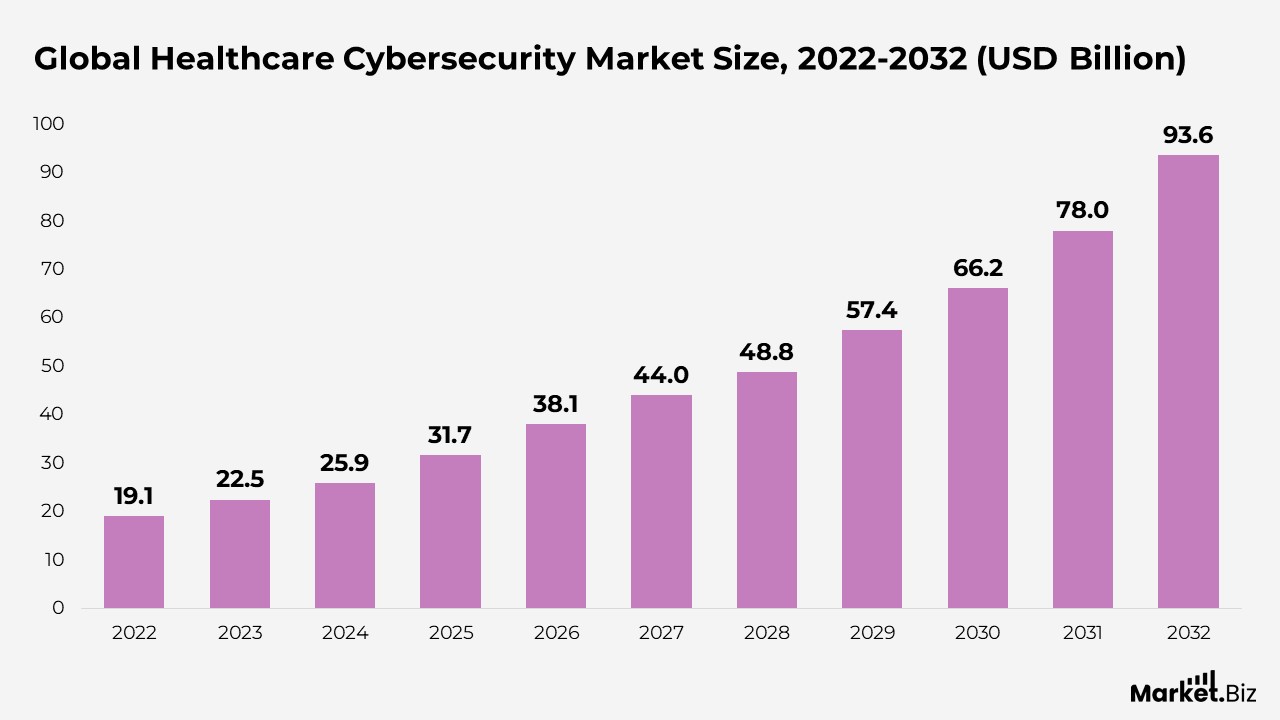
- According to Market.us, the global healthcare cybersecurity market is projected to grow from $31.7 billion in 2025 to $93.6 billion by 2032, reflecting a compound annual growth rate (CAGR) of 17.7% from 2022 to 2032.
- The healthcare cybersecurity market is expanding due to rising demand for cybersecurity solutions, a surge in cyberattacks targeting healthcare organisations, the digital transformation of healthcare, and technological advancements in security solutions.
- The malware and spyware segment holds the largest market share, as these threats compromise patient privacy and system integrity. Distributed Denial-of-Service (DDoS) attacks also hinder healthcare professionals’ ability to provide high-quality patient care.
- Cloud-based deployment is the leading deployment model for healthcare cybersecurity solutions, enabling organisations to scale their security measures more efficiently and reduce upfront costs. However, this deployment model raises concerns regarding data privacy and security.
- The solutions segment is expected to capture the largest share of the healthcare cybersecurity market, driven by the increasing need for advanced security operations, rising data security concerns, and the demand for reliable, cost-effective security solutions to strengthen cybersecurity infrastructure.
- The cloud security segment is growing at the highest compound annual growth rate (CAGR), driven by the increasing use of Internet of Things (IoT) devices and the increasing volume of sensitive data in the healthcare industry.
- Healthcare payers account for the largest share of market revenue, supported by increasing adoption of electronic health records, heightened data security concerns, and government initiatives and regulations aimed at protecting patient data from cyber threats.
- North America accounts for over 41% of the healthcare cybersecurity market, with major companies and healthcare organisations’ growing adoption of cybersecurity solutions driving market growth. Investments in technological advancements and healthcare infrastructure development are key drivers of this dominance.
(Source: Market.us)
Healthcare Data Breaches
Healthcare data breaches continue to pose a major threat, as the increasing volume of sensitive patient data attracts the attention of cybercriminals. These breaches can have far-reaching consequences for individuals and healthcare organisations, including the exposure of confidential health data, financial repercussions, and damage to reputation.
- In 2023, healthcare data breaches affected more than 540 organisations and 112 million individuals, as reported to the HHS Office for Civil Rights (OCR), compared with 590 organisations and 48.6 million individuals in 2022.
- In January 2024, 24 breaches were reported, each involving more than 10,000 records, including one that exposed 500,000 records and another that affected more than 2 million.
- The largest breach compromised 11.27 million records, while another major breach affected 4 million in 2023.
- According to HIPAA, there has been a 48% reduction in healthcare data breaches in the U.S. However, this drop should not be mistaken for a complete resolution, as the sector still faces significant cybersecurity risks.
- Approximately 36% of healthcare facilities have reported an increase in medical complications due to ransomware attacks, underscoring the critical impact of cyber threats on patient care and medical outcomes.
Moreover
- Despite the escalating cyber risks, only 4-7% of the IT budgets of healthcare organisations are allocated to cybersecurity. This limited funding leaves many healthcare systems vulnerable to attacks and data breaches.
- Internal threats remain a primary cause of healthcare data breaches, accounting for 61% of incidents. This includes errors such as mishandling sensitive data or falling prey to phishing scams.
- The healthcare sector experienced nearly 337 data breaches in the first half of 2022, according to Fortified Health Security. This underscores the persistent frequency of cyber incidents within the healthcare industry.
- The U.S. Department of Health and Human Services reported that these 337 breaches affected nearly 20 million individuals, underscoring the large-scale nature of the data exposures.
- A significant 80% of healthcare breaches in the U.S. are attributed to hacking, emphasising the growing trend of cybercriminals targeting healthcare organisations for sensitive data. Unauthorized access constitutes the remaining 15%, further highlighting the need for enhanced security measures within healthcare systems..
(Source: ASTRA IT, Inc., TechTarget, Inc. The HIPAA Journal)
Cybersecurity Coverage and Premiums
- In the past year, large organisations faced a 46% increase in cyber insurance premiums, reflecting the growing risk and costs associated with cyber threats.
- Medium-sized businesses also experienced a notable 50% rise in cyber insurance premiums, underscoring the broader impact of cybersecurity challenges across organisations of all sizes.
- Only 52% of Healthcare Delivery Organisations (HDOs) include medical device security in their insurance policies, highlighting a coverage gap for critical healthcare infrastructure.
- HDOs with a Chief Information Security Officer (CISO) overseeing medical device security report an 18% increase in their Healthcare Industry Cybersecurity Practices (HICP) coverage, demonstrating the importance of dedicated leadership in improving security posture.
- Under the leadership of a CISO, HICP coverage in healthcare organisations increased from 45% to 63%, indicating the positive impact of executive oversight on cybersecurity practices.
(Source: Market.us, Offensive Security Services)
Cybersecurity Investment and Resource Distribution
- Biden administration allocates $800 million for hospital cybersecurity: As part of its 2025 budget, the Biden administration has proposed an $800 million investment to bolster cybersecurity measures in hospitals.
- Healthcare sector to invest $125 billion in cybersecurity by 2025: From 2020 to 2025, the healthcare industry is projected to invest $125 billion in cybersecurity solutions, reflecting a consistent 15% annual growth in spending.
- Blockchain adoption is projected to drive $5.61 billion in cybersecurity expenditure by 2025: the healthcare sector’s cybersecurity spending is expected to reach $5.61 billion, largely driven by the increasing adoption of blockchain technology.
- Healthcare cybersecurity budgets grew by 12% in 2024, averaging $66 million, with nearly 19% allocated to information security initiatives.
(Source: dialog health)
Financial and Insurance Implications
- In 2024, 67% of healthcare organisations were targeted by ransomware attacks, increasing from 60% in 2023 to nearly double the 34% reported in 2021.
- Only 47% of ransomware payments made by healthcare organisations were covered by cybersecurity insurance policies.
- Healthcare organisations incurred an average recovery cost of $2.57 million due to ransomware attacks in 2024, up from $2.2 million in 2023.
- Healthcare organisations with compromised backups faced a median recovery cost of $750,000, double the $375,000 cost for those with secure backups.
- In 2024, only 22% of healthcare ransomware victims fully recovered within a week or less, a significant decline from 47% in 2023 and 54% in 2022.
- The percentage of healthcare organizations requiring more than a month to recover from ransomware attacks rose to 37% in 2024, up from 28% in 2023..
(Source: dialog health)
Cybersecurity Training, Policies, and Incident Response in Healthcare
- More than 75% of healthcare employees have reported receiving cybersecurity awareness training, indicating an effort to equip staff with the knowledge to mitigate cyber risks.
- Despite the training efforts, 25% of healthcare workers who recognized the need for cybersecurity training were not provided with any, highlighting a gap in addressing the training needs of critical staff.
- 41% of healthcare providers regularly simulate phishing attacks as part of their cybersecurity training to raise awareness of the sector’s most common cyber threats.
- Nearly half (48%) of healthcare providers have incorporated phishing attack prevention and response measures into their cybersecurity strategies, showcasing an active approach to counteracting one of the most prevalent cyber threats.
- Only 37% of hospitals conduct annual cybersecurity incident response drills, indicating that many institutions may not be adequately prepared to respond to cyberattacks.
- Just 50% of healthcare organizations perform regular cybersecurity audits, revealing that many are not consistently evaluating and improving their security posture.
(Source: dialog health)
Vulnerabilities in the Healthcare Sector
- In 2023, 88% of healthcare organisations reported at least one cyberattack, with an average of 40 attacks per organisation.
- Hacking was responsible for 80% of all data breaches in 2023, underscoring the persistent threat posed by cybercriminals targeting healthcare systems.
- Cyber incidents worldwide increased dramatically from 32 in 2022 to 121 in 2023, with the European Repository of Cyber Incidents highlighting a notable surge in attacks specifically targeting the healthcare sector.
(Source: Market.us, Healthcare Dive, Market.us)
Training and Workforce Issues
- As of July 2022, the healthcare industry reported a shortage of 78,000 staff members compared to February 2020.
- Between 2020 and 2030, the healthcare sector will require an additional 275,000 nurses, with nursing employment projected to grow by 9% between 2016 and 2026.
- 61% of healthcare cybersecurity professionals identify staff shortages as the primary obstacle to strengthening cybersecurity measures.
- 84% of healthcare organisations struggle to attract qualified cybersecurity professionals due to the high demand and competitive market.
- 67% of healthcare organisations report difficulties in retaining skilled cybersecurity professionals.
- 55% of healthcare organisations face budget limitations that hinder their ability to hire necessary cybersecurity staff, while 43% cite non-competitive compensation as a challenge…
(Source: Market.us)
Emerging Trends
- The rapid integration of the Internet of Things (IoT) and the Internet of Medical Things (IoMT) into healthcare systems has introduced benefits and challenges. These technologies are essential for remote monitoring and data collection, but also create new vulnerabilities. The growing number of connected devices increases the complexity of securing each endpoint against cyber threats, posing a significant challenge for IT security teams.
- Blockchain is emerging as a powerful tool for enhancing cybersecurity in healthcare. While it’s widely known for securing financial transactions, its application in healthcare offers stronger data protection and privacy. Blockchain ensures the integrity and traceability of patient records, providing an effective defence against data manipulation and unauthorised access.
- With healthcare providers’ increasing reliance on cloud computing, robust cloud security has become a priority. This includes implementing advanced penetration testing, data loss prevention measures, and end-to-end encryption. These strategies are critical to safeguarding sensitive patient information from cyber threats such as phishing and malware.
- The healthcare sector remains a key target for ransomware attacks due to the critical nature of its services. To address this risk, healthcare organisations focus on continuous vulnerability assessments, enforcing strict access controls, and developing comprehensive incident response plans. These initiatives are designed to minimise the impact of cyberattacks and ensure service continuity.
- Healthcare organisations are increasingly adopting biometric authentication to enhance security protocols. Using unique biological identifiers, such as fingerprints or facial recognition, biometric systems offer a more secure and user-friendly alternative to traditional password-based access methods.
- Navigating the complex regulatory landscape, including HIPAA and the FTC Act laws, is critical for healthcare organisations. Compliance not only protects patient data but also helps avoid legal repercussions. As data privacy regulations evolve, healthcare providers must remain vigilant and adaptable to maintain compliance and secure sensitive information.
(Source: Market.us, ScienceDirect, National Institute of Health)
Recent Developments
New Product Launches
- In November 2024, Health Catalyst, Inc. introduced BluePrint Protect, an AI-powered cybersecurity platform designed to identify and assess risks associated with third-party cybersecurity threats.
- In May 2024, the HHS agency rolled out a new cybersecurity initiative to automate hospital cybersecurity processes..
Use Cases
- With the growth of telehealth services, ensuring the security of these platforms has become critical. Healthcare providers must implement secure communication channels and strong authentication protocols to prevent unauthorised access and protect sensitive patient data from breaches. Securing telehealth services ensures regulatory compliance and fosters trust among patients who rely on these remote services for their healthcare needs.
- As the use of connected medical devices increases, robust cybersecurity measures are essential. Healthcare facilities must adopt regular software updates and comprehensive risk assessments to protect devices and data from cyber threats. These protocols are vital to maintaining patient safety and ensuring the reliable operation of medical devices..
Conclusion
Cybersecurity in Healthcare Statistics: Cybersecurity remains a critical challenge in healthcare as the industry embraces digital transformation. With the increasing adoption of telehealth services, connected medical devices, and cloud computing, the attack surface for cyber threats continues to expand.
The statistics reveal that healthcare organisations face growing cyberattacks, with ransomware and data breaches posing significant risks to patient safety and organisational integrity. While the sector has made strides in enhancing cybersecurity measures, such as investing in AI-driven solutions and improving incident response protocols, gaps persist in staff training, cybersecurity budgets, and the retention of skilled professionals.
As the threat landscape evolves, it is essential for healthcare organisations to continuously update their cybersecurity strategies, invest in robust security infrastructure, and ensure compliance with ever-changing regulatory requirements. Strengthening healthcare cybersecurity is crucial for protecting sensitive patient data, maintaining trust, improving care quality, and safeguarding the healthcare industry against increasingly sophisticated cyber threats.
FAQ’s
Cybersecurity is essential in healthcare to protect sensitive patient information, maintain the accuracy of medical records, and preserve the confidentiality of healthcare services. Cybercriminals often target healthcare organisations due to the high value of healthcare data and the essential nature of healthcare operations.
Healthcare faces several key cybersecurity threats, including ransomware, phishing scams, data breaches, and attacks on connected medical devices. These risks can lead to unauthorised data access, interruptions, and significant financial losses.
To mitigate ransomware risks, healthcare organisations should implement regular software updates, conduct thorough vulnerability assessments, apply strong encryption, enforce strict access controls, and have a well-defined incident response plan. Ongoing staff training on phishing prevention and data protection practices is vital.
While connected medical devices enhance patient care through remote monitoring, they also introduce new cybersecurity risks. Healthcare providers should conduct routine security assessments, ensure timely software updates for devices, and implement robust protocols to manage devices and secure data transmissions.
Artificial intelligence (AI) is becoming an integral component of healthcare cybersecurity, enabling organisations to detect and respond to cyber threats more efficiently. AI-powered tools can analyse data patterns to anticipate and prevent potential security breaches, adding a proactive layer of protection against evolving threats.
Healthcare organisations often struggle to recruit skilled cybersecurity professionals due to high demand and stiff competition from other industries. Budget constraints and uncompetitive compensation packages further complicate efforts to attract and retain top-tier cybersecurity experts.