









Introduction
Music Streaming Statistics: The music streaming sector has significantly transformed how people discover and enjoy music, providing seamless, on-demand access across various digital devices. As the industry moves away from physical formats and downloads toward cloud-based services, streaming has emerged as the primary method of music consumption worldwide.
Its continued expansion is fueled by mobile convenience, curated content, and intelligent recommendation algorithms that boost user interaction. Streaming platforms are also introducing features such as social sharing, live audio, and tailored user experiences to strengthen engagement and loyalty.
Moreover, increasing smartphone adoption and improved internet infrastructure in developing regions are driving broader access to these services. Monitoring shifts in user behavior, platform usage, and demographic engagement is essential to understanding the evolving landscape of the music streaming industry.
Editor’s Choice
- Streaming platforms contribute approximately 84% of total revenue in the global music sector.
- The music streaming market has witnessed an annual growth rate exceeding 10% in the past year.
- Around 78% of global listeners access their music through streaming platforms.
- Global revenue generated by music streaming services currently stands at US$17.5 billion.
- Only 23% of streaming activity comes from paid users, indicating continued dominance of free, ad-supported platforms.
- During the COVID-19 pandemic, global music streaming subscriptions jumped 26.4%, reaching 523.9 million.
- There are now over 600 million paid subscribers using music streaming services worldwide.
- In the United States alone, streaming contributes to 84% of all music industry earnings.
- On average, users in the U.S. spend 75 minutes daily streaming music.
- Over 82.1 million Americans have subscribed to paid, on-demand music streaming services.
- For every paid music subscriber, there are roughly 3.6 users streaming content without a subscription.
- Hip-hop/R&B remains the top-streamed genre in the U.S. music landscape.
- With 180 million paid subscribers, Spotify leads the global subscription-based music streaming market.
- The primary motivation behind opting for paid plans is the desire to enjoy music without ad interruptions.
- Individuals who game frequently are 14% more likely to pay for music streaming services than the general population.
- Nearly one-third of global app-based music streaming revenue was derived from the U.S. market.
- Spotify ranks highest among music streaming platforms when it comes to total subscriber count.
- Although Spotify leads in subscriptions, YouTube surpasses all platforms in usage, boasting 2.1 billion users.
- Approximately 80% of recorded music income worldwide is now attributed to streaming platforms.
General Music Streaming Statistics
- Leading platforms such as YouTube Live, Twitch, Facebook Gaming, and several services operated by major Chinese tech companies currently dominate the live streaming landscape.
- In the U.S., around 85% of Prime Video users opted for ad-supported plans, while only 15% preferred the ad-free version; Netflix saw a 22% to 78% split between ad-supported and ad-free subscribers, respectively.
- Globally, 35% of video and TV streamers have paid to avoid advertisements, whereas 48% of music streamers have made similar ad-skipping purchases.
- Approximately 12% of adults aged 18 to 34 engage in live-stream viewing multiple times each day.
- On average, Americans dedicate around 8 hours daily to streaming digital media content across platforms.
- U.S. consumers typically spend close to US$46 per month on subscription-based streaming services.
- Nearly 45% of people have cancelled at least one streaming subscription in the past year due to rising prices or unaffordable costs.
- A staggering 99% of households in the U.S. subscribe to one or more digital streaming platforms.
- Nearly 48% of paying users continue to be subscribed to platforms they don’t actively use.
- 32% of global users turn to streaming services primarily for listening to music, followed by radio at 17%, video content at 31%, purchased music at 9%, and other forms at 7%.
- Last year, music was streamed an estimated 7.1 trillion times worldwide, highlighting the immense scale of digital audio consumption.
(Source: Forbes, Statista, IFPI, Tone Island, Semrush Inc, G2.com, Inc)
Apple Music Streaming Statistics
- As of June 2023, Apple Music had reached 93 million subscribers globally, ranking as the 2nd largest streaming platform in the U.S. and 3rd in Europe.
- Hip-hop and R&B stand out as top-performing genres on the platform, which hosts a massive collection of 90 million tracks and 30,000 curated playlists.
- Apple Music is recognized for having one of the largest music libraries among streaming services, though availability may differ by region, with some areas providing access to around 75 million tracks.
- With a library exceeding 90 million songs, Apple Music offers a broader catalog than Spotify.
(Source: Statista, Spotify)
Music Streaming Market Size
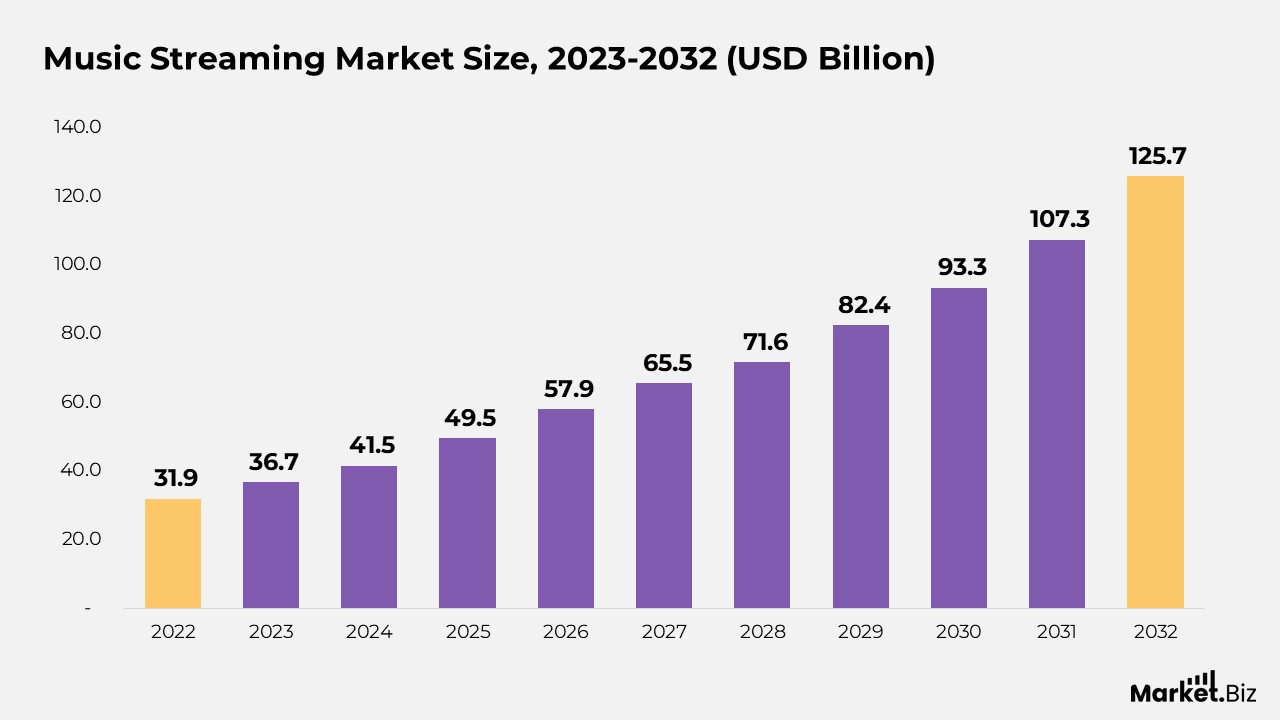
- According to Market.us, the music streaming market is expected to rise from $36.7 billion in 2023 to $125.7 billion by 2032, representing a compound annual growth rate (CAGR) of 15.1% from 2023 to 2032.
- The market is expanding due to a blend of digital innovation, evolving user preferences, and strategic efforts by major players.
- Improved internet access and widespread smartphone usage are pivotal to the industry’s global adoption.
- In 2022, the free music streaming segment led the market due to its accessibility and appeal to cost-sensitive users.
- The on-demand streaming segment also dominated in 2022, favored for its personalized and flexible listening experience.
- In 2023, the app segment secured a strong lead, driven by mobile integration, offline access, and smart recommendations.
- Individual users accounted for the largest share at 59.8%, with streaming becoming part of everyday routines like commuting or exercising.
- Commercial users are increasingly utilizing streaming services to enhance customer engagement and ambience.
- North America captured over 31% of the market in 2022, supported by digital maturity, high-income levels, and platform availability.
(Source: Market.us)
Music App Market Size
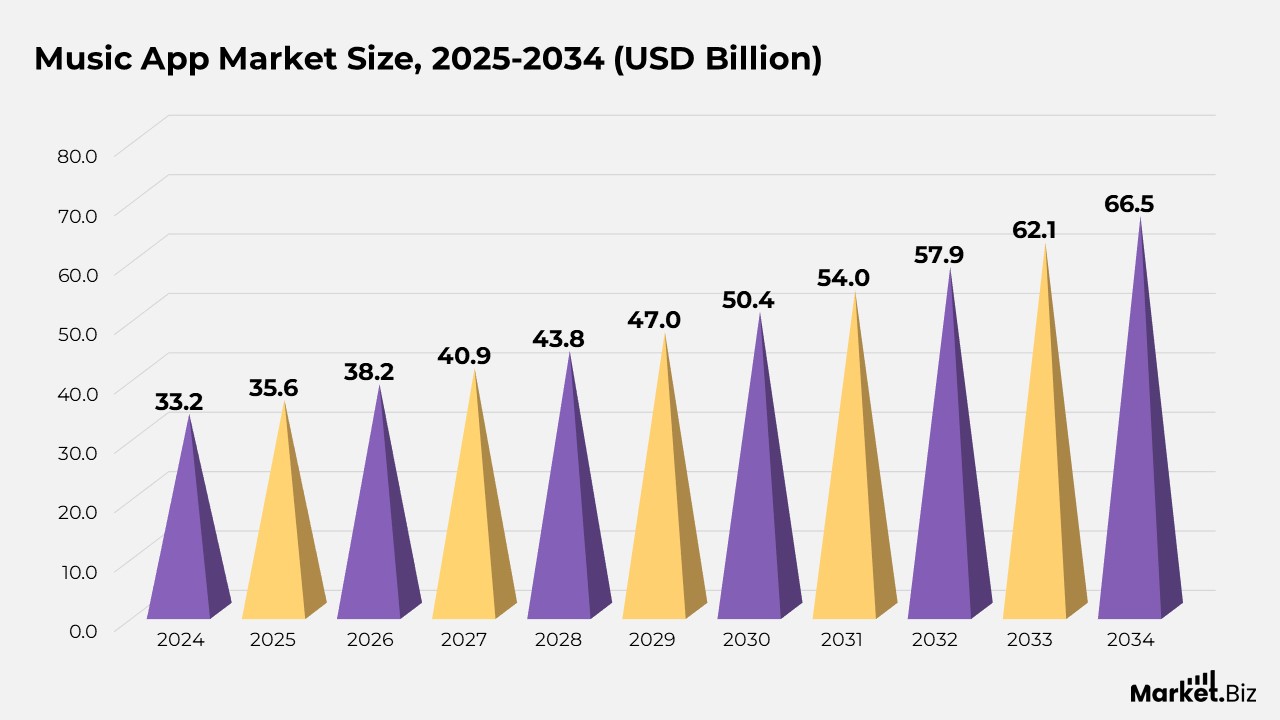
- According to Market.us, the global music app market is expected to grow from $35.6 billion in 2025 to $57.9 billion by 2032, representing a compound annual growth rate (CAGR) of 7.9% from 2025 to 2034.
- According to Market.us, the music app market is expected to grow from $35.6 billion in 2025 to $66.5billion by 2034, representing a compound annual growth rate (CAGR) of 7.20% from 2025 to 2034.
- The surge in mobile device usage and improved data infrastructure globally has significantly fueled music app adoption.
- In 2024, the subscription-based segment led with over 56% share, reflecting consumer preference for ad-free and unlimited music access.
- The android segment dominated in 2024 with a share exceeding 74%, driven by global affordability and device availability.
- Individual users captured more than 90% of the market in 2024, as music apps continue to be a daily entertainment staple.
- North America held over 35% of the market in 2024, generating US$11.6 billion in revenue, backed by strong digital engagement.
- The U.S. music app market is projected to reach US$10.7 billion in 2024, growing at a 5.7% CAGR, fueled by rising demand for streaming services.
- Streaming now contributes 84% of total music industry revenue, with the sector growing by over 10% annually, according to Exploding Topics.
- Only 23% of music streaming activity is paid, while 78% of people stream music overall, and over 600 million users subscribe to paid services.
(Source: Market.us)
Music Video Streaming Statistics
- YouTube’s Billion Views Club features over 450 music videos, showcasing tracks from a diverse mix of global artists and genres. According to estimates, approximately 317 videos have reached this milestone, many of which are likely playing on repeat in your head.
- The top 5 most-watched music videos on YouTube include:
- Baby Shark Dance – Pinkfong Kids’ Songs & Stories (13.9 billion views)
- Shape of You – Ed Sheeran (6.2 billion views)
- Despacito – Luis Fonsi ft. Daddy Yankee (8.5 billion views)
- Uptown Funk – Mark Ronson ft. Bruno Mars (5.1 billion views)
- See You Again – Wiz Khalifa ft. Charlie Puth (6.2 billion views)
- Music videos account for 25% of all content consumed on YouTube, underscoring the platform’s critical role in music distribution.
- YouTube has paid out over US$4 billion annually to the music industry and aims to become the leading global licensing partner for music rights holders by 2025.
- BTS Butter set a record by hitting 100 million views faster than any other video on YouTube, propelled by their intensely loyal fan base. Other fast-rising videos to reach this benchmark include:
- Lisa – Lalisa
- BLACKPINK – Kill This Love
- Psy – Gentleman
(Source: Filmora, Gitnux, Daily Brit, Metal Injection, Headphone’s Addict, Musical Pursuits)
Music Streaming Users Statistics
- Nearly two-thirds of the global population now uses music streaming platforms as their primary listening method.
- Roughly 67.3% of individuals access music through some streaming service, highlighting the widespread shift from traditional formats.
- Since Q4 2015, the global subscriber base for music streaming has skyrocketed from 68 million to 616.2 million by Q2 2022, marking an almost tenfold surge in just under seven years.
- Fast forward to Q2 2022, the user base surged to 616.2 million, marking an impressive 17.6% year-over-year growth.
- By Q1 2021, the number of users rose to 487 million, reflecting a 9.9% quarter-on-quarter growth.
- The growth continued into Q2 2021, with user figures climbing to 523.9 million, indicating a 7.6% increase.
- In Q4 2020, the global music streaming audience reached 443 million, showing a healthy 10.7% increase compared to the previous quarter.
(Source: IFPI, MIDiA Research Ltd.)
Most Used Music Streaming Apps Across the Globe
- Spotify remains the global leader in music streaming, boasting over 350 million users, including 150 million paying subscribers, making it the most dominant platform worldwide.
- Apple Music, once at the forefront of digital music, now trails Spotify in total users but holds a stronger presence in select markets globally.
- Amazon Music has steadily grown its user base by leveraging Amazon Prime memberships, now reaching 55 million listeners.
- YouTube leads all platforms in sheer volume, with 2 billion users engaging with music content, though it lags behind Spotify and Apple Music in terms of premium subscribers.
- Pandora, one of the oldest names in streaming, continues to thrive in the U.S., particularly among car listeners, serving as a modern alternative to traditional radio.
- SoundCloud stands out as a hub for emerging and independent artists, though it has yet to achieve substantial commercial success compared to mainstream rivals.
- Deezer, based in France, has carved out a niche in other international and Latin American markets, building a loyal regional user base.
- Tidal, once promoted as an artist-friendly platform, is now owned by Square and continues to attract audiophiles with its high-fidelity streaming quality.
- Tencent Music dominates the Chinese music streaming space through its trio of apps KuGou, QQ Music, and Kuwo, which collectively lead the local market.
- Gaana is the top streaming choice in India, with an impressive 185 million monthly active users, catering to a wide spectrum of regional languages and tastes.
(Source: Business of Apps, Statista, Music App Report, RIAA)
Podcast Streaming Statistics
- In 2024, global podcast listenership climbed to 546 million, a sharp rise from 82 million in 2021.
- Norway and Sweden lead globally in podcast consumption as a percentage of internet users.
- Average listeners spend about 7 hours per week on podcast apps.
- Apple and Spotify podcasts remain the top platforms preferred by global users.
- Roughly 50% of people aged 12–34 have listened to podcasts, compared to only 20% of those 55 and older.
- Episodes lasting 20–40 minutes are the most popular, aligning with listeners’ limited attention spans.
- Men slightly outpace women in podcast consumption, with a 45% vs. 48% split.
- Video podcasts are gaining popularity, adding visual appeal to traditional audio formats.
- Morning hours are peak listening times, with mobile phones being the primary device used.
- Niche categories such as self-help, education, and business are attracting growing interest.
- Around 68% of music streaming users also tune into podcasts through those platforms.
(Source: Statista, G2.com, Inc.)
Top Worldwide Music Streams
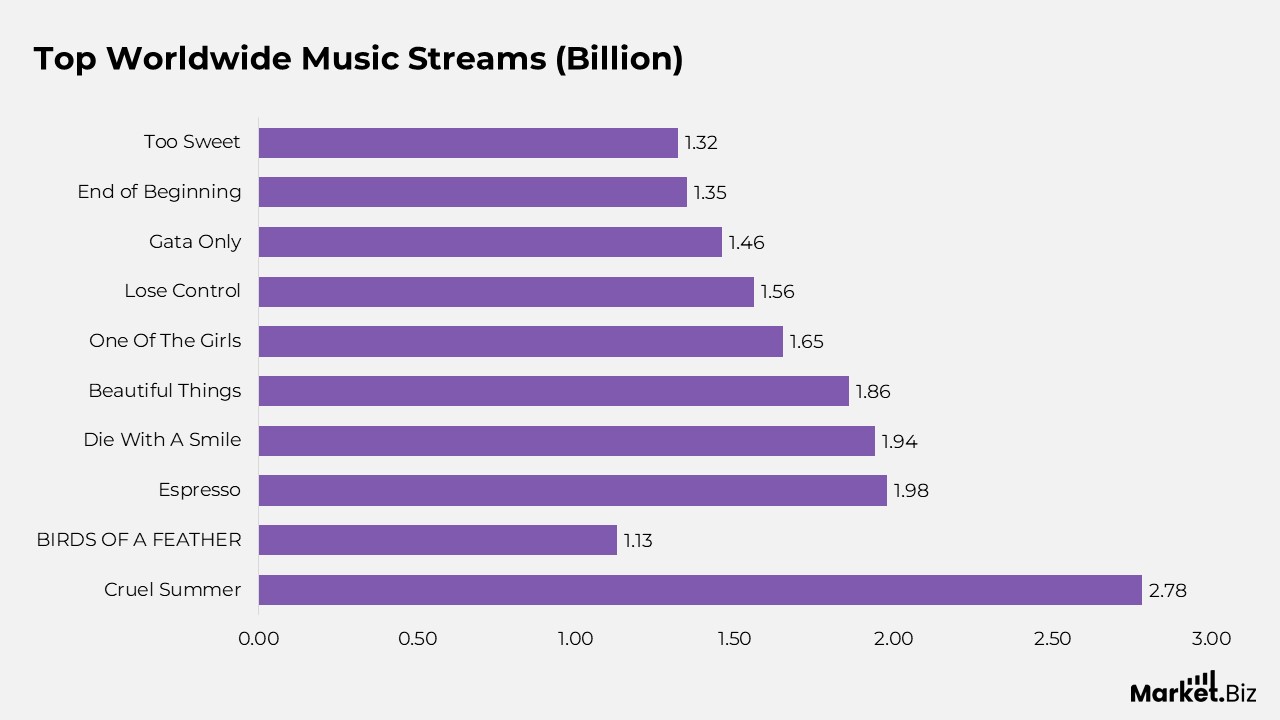
- Taylor Swift’s Cruel Summer, originally released in 2019 on the album Lover, led the global charts in 2024 with 2,780,065,266 streams.
- Billie Eilish’s 2024 track BIRDS OF A FEATHER from the album HIT ME HARD AND SOFT secured the second position with 2,132,707,542 streams.
- Sabrina Carpenter’s catchy single Espresso garnered 1,980,592,769 streams, making it one of the year’s most played songs.
- Lady Gaga’s title track Die With A Smile captured listeners worldwide, pulling in 1,947,313,698 streams.
- Benson Boone’s heartfelt ballad Beautiful Things collected 1,867,374,758 plays globally in 2024.
- The Weeknd’s One Of The Girls, featuring JENNIE and Lily Rose Depp, from The Idol Episode 4, achieved 1,654,394,533 streams.
- Teddy Swims’ soulful Lose Control, released in 2023, continued strong with 1,565,750,446 streams.
- FloyyMenor’s Gata Only, a standout Latin hit of 2024, amassed 1,462,343,586 streams worldwide.
- Djo’s End of Beginning, from the 2022 album DECIDE, maintained momentum with 1,359,620,407 streams in 2024.
- Hozier’s Too Sweet, off his 2024 album Unheard, rounded out the top ten with 1,329,741,892 streams.
(Source: Spotify, Simple Been)
Artificial Intelligence Music Streaming Statistics
- Features powered by artificial intelligence, such as annual recaps like Spotify Wrapped and personalized playlists like Discover Weekly, are key tools in enhancing user engagement and loyalty on music streaming platforms.
- As companies seek more affordable audio options, AI-generated compositions are anticipated to replace up to 60% of conventional stock music libraries, reshaping the production landscape for commercial use.
- Platforms like Boomy have already contributed significantly to the AI music boom, with over 14.4 million songs generated through automation, while newer entrants such as Suno and Udio are rapidly gaining traction.
(Source: CISAC, Statista)
Digital Streaming vs. Conventional Music Platforms
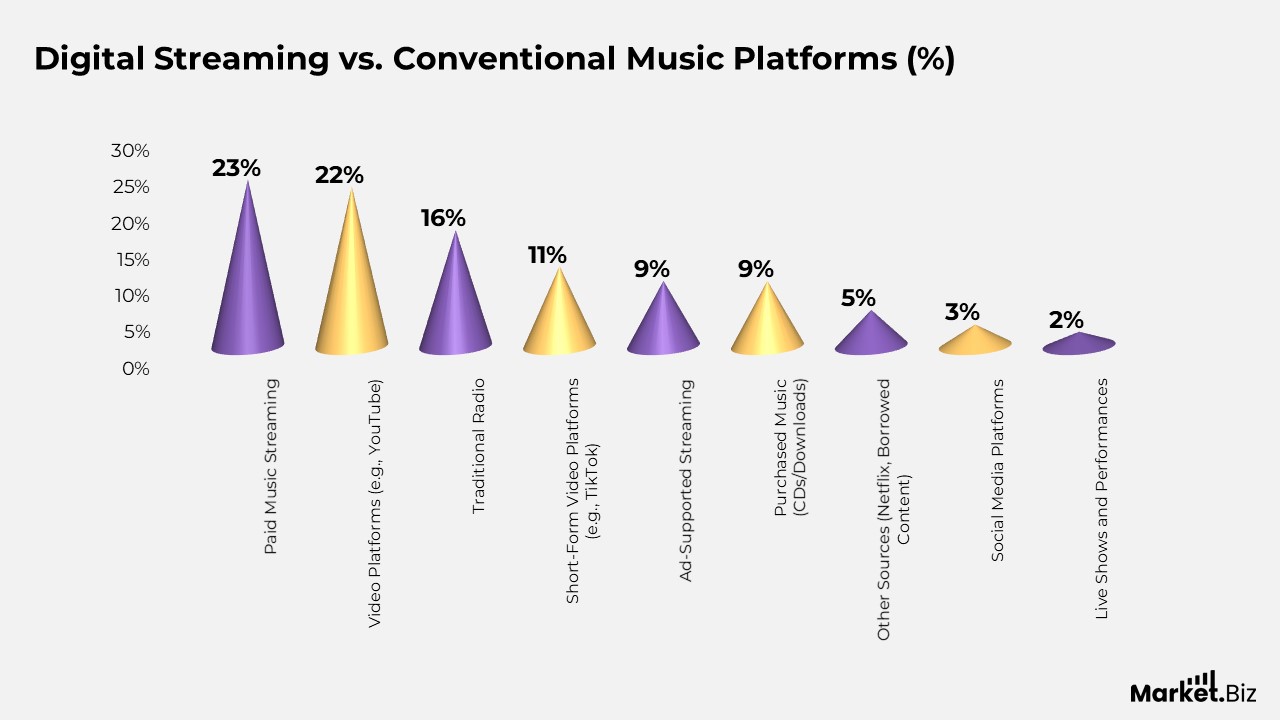
- 23% of listeners prefer paid music streaming services, making them the top choice for music consumption.
- 22% of users turn to video platforms like YouTube to access their favourite tracks.
- Traditional radio still holds ground, accounting for 16% of music listening habits.
- Short-form content platforms such as TikTok contribute 11% to total music engagement.
- 9% of users rely on free, ad-supported streaming options for their music fix.
- Another 9% still opt to buy music through CDs or digital downloads.
- 5% of music consumption comes from miscellaneous sources, including Netflix and borrowed content.
- Social media platforms make up 3% of the music listening share.
- Live concerts and performances account for the smallest share, with just 2% participation.
(Source: IFPI, Statista, HeadphonesAddict)
Conclusion
Music Streaming Statistics: The global music streaming industry is undergoing significant transformation, fueled by evolving consumer preferences, innovative monetization models, and advancing digital technologies. An increasing demand for ad-free experiences, a greater readiness to invest in premium features, and heightened engagement among younger demographics are intensifying market competition and personalization.
Streaming platforms are reshaping music consumption by leveraging AI-driven suggestions, offering exclusive content, and forming strategic collaborations. As this digital ecosystem matures, future growth will hinge on the ability to provide secure, intuitive, and consistently engaging experiences across different regions and devices.
FAQ’s
Around 48% of music streamers globally are open to paying for services that let them bypass ads, highlighting a strong preference for seamless and ad-free listening experiences.
In the United States, about 85% of Prime Video users choose the ad-supported version, whereas only 15% prefer an ad-free experience. On Netflix, 22% of users opt for the ad-supported plan, while 78% go ad-free.
Approximately 12% of individuals aged between 18 and 34 watch live-streamed videos several times daily, suggesting a strong interest in real-time digital content among younger viewers.
Yes, music streaming audiences show a 13% higher likelihood of paying for premium options like ad-free access or advanced playback features when compared to video streaming users.
The global landscape is led by platforms such as Twitch, YouTube Live, Facebook Gaming, and major services run by Chinese tech firms, all of which serve vast audiences with a mix of music and live-stream content.

