








Introduction
5G Statistics: In recent years, 5G technology has emerged as a key enabler of the next generation of mobile networks, revolutionizing industries and driving innovation across various sectors. As the fifth generation of mobile networks, 5G offers ultra-fast data speeds, low latency, and massive connectivity, making it a crucial component for technologies such as IoT, autonomous vehicles, and smart cities.
The global rollout of 5G is expected to create new business opportunities, enhance customer experiences, and transform sectors such as healthcare, manufacturing, and entertainment. Industry projections indicate that the widespread adoption of 5G will result in increased mobile broadband speeds and capacity. The implementation of 5G networks is also expected to drive the growth of 5G-enabled devices, further accelerating the shift toward a more connected world.
Editor’s Choice
- By 2022, the number of connected devices is expected to surpass 3 times the global population, with 5G capable of supporting up to 1 million devices per square kilometer.
- 5G networks can offer peak data rates of up to 20 Gigabits per second (Gbps) and average data rates exceeding 100 Megabits per second (Mbps), significantly outperforming 4G.
- Human eyes typically respond to visual stimuli with a latency of around 250ms, making 5G’s 1 millisecond (ms) latency a technological leap ahead in responsiveness.
- 5G networks are designed to deliver up to 1,000 times more capacity than 4G, paving the way for a more connected and efficient world.
- With latencies as low as 1 millisecond, 5G can drastically enhance real-time communications and applications.
- The implementation of edge computing with 5G can further reduce latency, offering a range of 1 to 5 milliseconds for more responsive services.
(Source: Intel Corporation, Qualcomm, PatentPC, Thales, Veri
General 5G Statistics
- Global 5G subscriptions are projected to reach 6.3 billion by 2030, accounting for 67% of all mobile subscriptions.
- As of April 2021, there have been 683 5G and LTE network deployments worldwide.
- 5G smartphones are expected to make up 40% of global smartphone shipments by 2021, with this share rising to 69% by 2025.
- In the US, Samsung holds a dominant 74% market share in 5G smartphones.
- Sales of 5G smartphones are forecast to reach 100 million units in 2021, with over 10 billion mobile phones expected to be shipped globally over the next five years.
- By 2025, consumer electronics and automotive applications are forecast to capture 21.7% of the 5G infrastructure market, while industrial applications are expected to account for 20.1% and energy and utilities for 15.7%.
- The adoption of 5G is expected to drive a significant increase in global data usage, with mobile data traffic projected to surpass 300 exabytes per month by 2030, more than double the volume in 2024.
- In 2024, there were a projected 2.27 billion 5G mobile subscriptions globally, up from 1.6 billion the previous year, and this number is expected to grow to nearly 5.65 billion by the end of the decade, with 5G surpassing 4G as the dominant mobile network technology.
- By 2023, connected cars are expected to represent the largest segment of 5G IoT endpoints, with over 19 million installed endpoints globally.
(Source: Statista, Ericsson, 5G America, International Data Corporation, CCS Insights).
5G Investment
- Governments are heavily investing in 5G to enable hyperconnected public services. For instance, China has committed over $30 billion to 5G research and development over the next five years, while the European Commission has allocated $1 billion for 5G through its Horizon 2020 project.
- The US government recognizes the strategic importance of 5G for economic and technological growth, committing $42.5 billion to expand broadband and 5G networks, especially in rural and underserved regions, as part of the Infrastructure Investment and Jobs Act.
- Europe is a major player in the 5G sector, with EU nations investing over $50 billion in network rollouts. Countries like Germany, the UK, and France lead the charge, with telecom giants such as Vodafone, Deutsche Telekom, and Orange spearheading investments.
- China is outpacing the globe in 5G investments, allocating more than $58 billion in 2023 alone. The country has aggressively deployed 5G infrastructure, covering over 90% of urban areas.
- China’s three major telecom operators, China Mobile, China Telecom, and China Unicom, remain at the forefront of 5G investments, spending $45 billion in 2023 alone.
- South Korea was one of the first countries to launch nationwide 5G and has invested over $24 billion to expand coverage. Telecom leaders like SK Telecom, KT, and LG Uplus have been instrumental in driving 5G deployment.
- Japan, a global leader in technological innovation, has invested over $20 billion into 5G infrastructure as of 2023, laying the foundation for a digitally advanced economy.
- India’s 5G investment is expected to exceed $30 billion by 2026, marking a significant shift towards next-generation technology adoption.
- By 2025, businesses are expected to invest $10 billion annually in private 5G networks, marking a significant shift in how enterprises approach digital transformation.
- India’s first major 5G spectrum auction in 2022 raised $19 billion, with Bharti Airtel and Reliance Jio securing the lion’s share, marking a key milestone in India’s digital transformation.
- Governments globally have raised over $200 billion from 5G spectrum auctions as telecom companies compete fiercely to secure frequencies that will allow them to deliver high-speed, low-latency services.
- The Middle East and Africa (MEA) region is set to invest over $60 billion in 5G by 2030, with these regions quickly catching up to the US and China despite initially slower adoption.
(Source: PatentPC, GSMA)
Available 5G Technologies
- As of March 2021, T-Mobile leads the US in the number of total 5G points of presence (POPs), with coverage reaching 287 million POPs, surpassing the other top US telecom providers.
- 5G has the potential to revolutionize the cinematic experience through technologies such as ultra-high-definition scanning and capturing, extended reality (XR), real-time rendering, and interactive AI. 58% of consumers express excitement about experiencing a fully connected, end-to-end XR experience, and 84% are willing to pay for it.
- Experts predict significant growth in 5G applications beyond smartphones during the second wave of its rollout. For example, automotive applications are projected to experience a 285% compound annual growth rate (CAGR) from 2021 to 2023.
- 49% of eSports enthusiasts are eager to switch to a 5G network as soon as it becomes available, even without a phone upgrade.
- 55% of consumers are enthusiastic about the integration of augmented reality (AR) in music and concert events, indicating 5G’s potential to reshape live entertainment.
- A survey reveals that 57% of consumers are most excited about watching UHD videos (4K and 8K) on mobile devices. Meanwhile, 45% are eager to explore VR entertainment applications, and 44% are keen on experiencing 3D video or movies.
(Source: International Business Machines Corporation, T-Mobile, Accenture)
5G Infrastructure Market Size
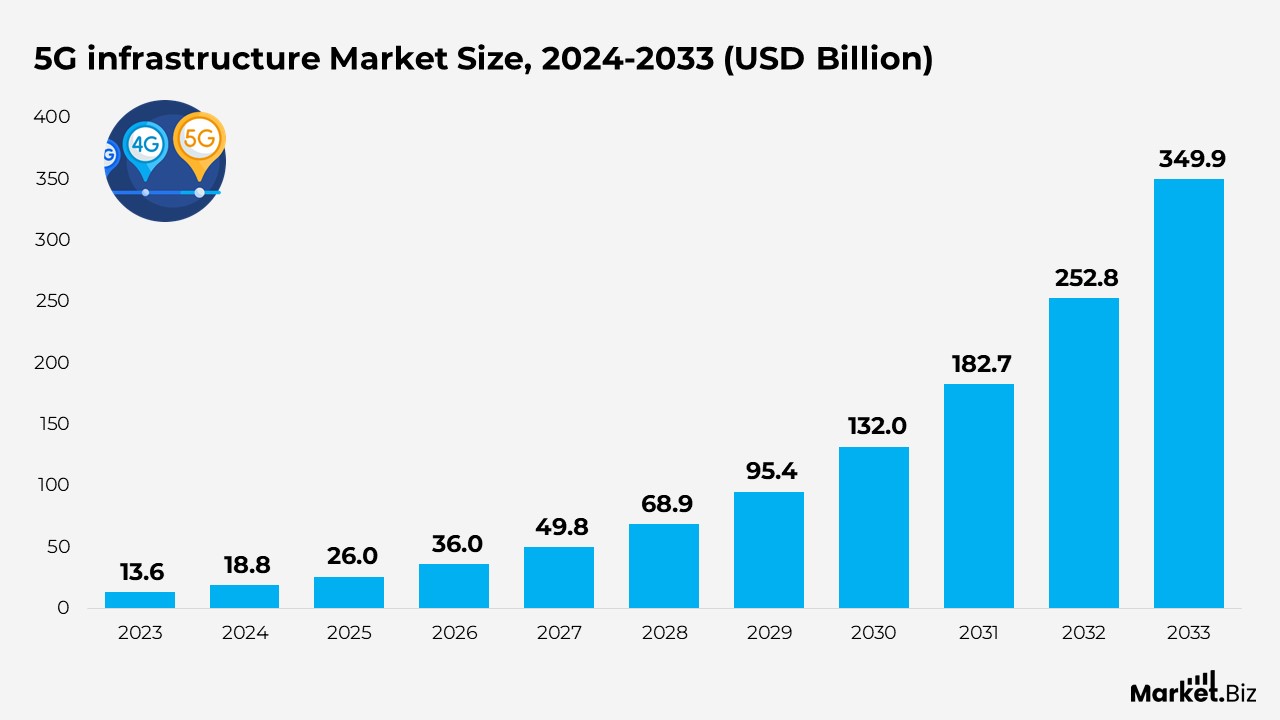
- According to Market.us, the 5G Infrastructure market is projected to grow from $18.8 billion in 2024 to $349.9 billion by 2033, representing a compound annual growth rate (CAGR) of 38.4% from 2023 to 2032.
- The demand for high-speed internet and data-intensive applications in autonomous vehicles, the Internet of Things (IoT), and smart cities is driving market growth.
- The Hardware segment dominated the market in 2023, capturing over 80.5% of the market share, driven by infrastructure upgrades.
- The Sub-6 GHz frequency band led the market in 2023, holding 86.3% of the share due to its balance of speed and coverage.
- The Non-Standalone (NSA) architecture was the top deployment mode in 2023, securing more than 61% of the market share.
- The Manufacturing sector was the leading industry vertical in 2023, accounting for 23.8% of the market share, driven by the adoption of smart factories and automation.
- APAC led the market in 2023, holding over 42.1% of the global share, with revenues totalling USD 5.7 billion, driven by technological advancements and government support for 5G deployment.
(Source: Market.us)
Standalone 5G Network Market Size
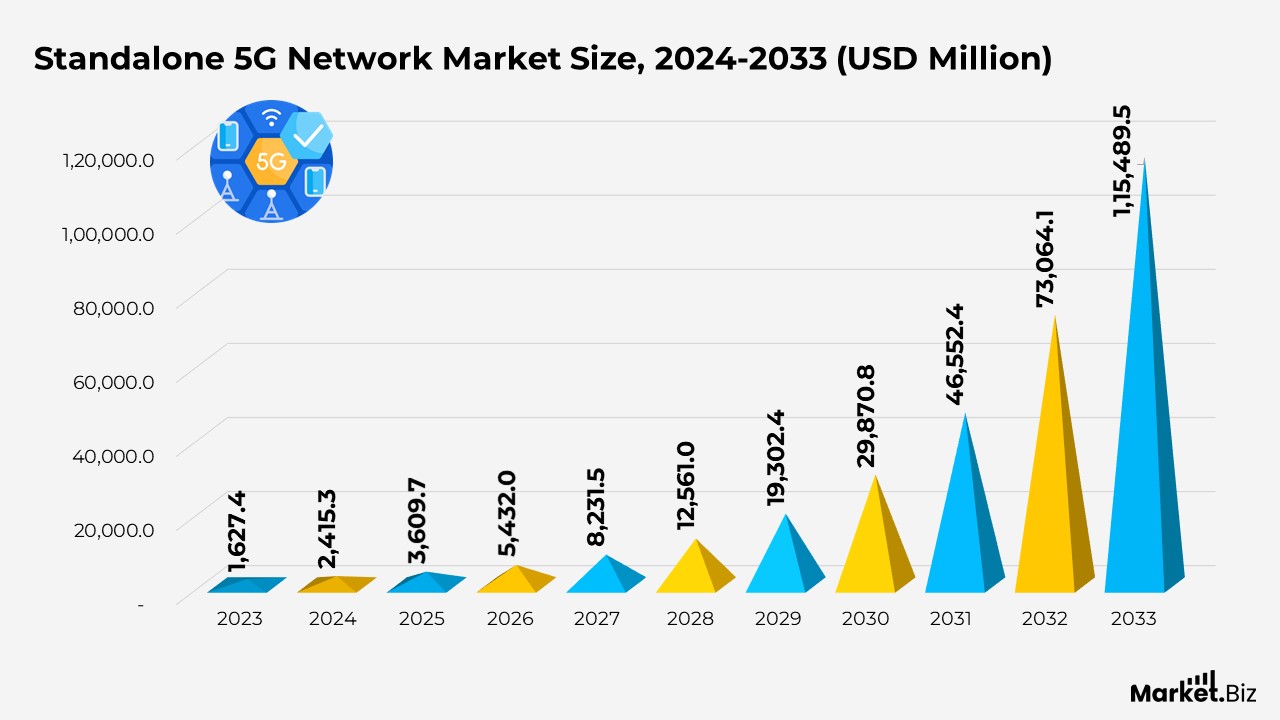
- According to Market.us, the standalone 5G network market is projected to grow from $2,415.3 million in 2024 to $115,489.5 million by 2033, representing a compound annual growth rate (CAGR) of 53.6% from 2024 to 2033.
- The market growth is driven by the demand for higher data speeds and more reliable connections, which are essential for autonomous vehicles, industrial automation, and IoT deployments.
- APAC led the market in 2023, capturing over 42% of the market share, which equates to USD 683.5 million in revenue, driven by early 5G deployments and large-scale infrastructure investments.
- The Solutions segment dominated with an 81.23% share in 2023, reflecting the growing demand for tailored 5G solutions for various industries.
- The Sub-6 GHz segment led the spectrum category, accounting for 86.11% of the market share, emphasizing its broad adoption for balanced coverage and speed.
- The Public segment held an 86.83% share in 2023, driven by the rollout of standalone 5G networks and government initiatives aimed at enhancing connectivity.
- Manufacturing dominated the industry verticals in 2023, with a 23.52% market share, driven by advancements in smart manufacturing, automation, and enhanced supply chain efficiency.
- Global 5G connections reached 1 billion by the end of 2022, with projections to rise to 1.5 billion by 2023 and 2 billion by 2025, marking the fastest rollout for a new mobile technology.
- As per the Global Mobile Suppliers Association (GSA) report, there is significant investment in public 5G Standalone (SA) networks.
- 115 operators across 52 countries are progressing with 5G-related activities such as trials, deployments, and securing licenses.
- Out of these, 36 operators have launched or are deploying public 5G SA networks, with 24 operators involved in active trials or deployments.
- 31 operators have outlined plans for future 5G SA deployments.
- By July 2023, the market saw over 1,750 devices announced as compatible with 5G SA, showing strong growth from previous years.
(Source: Market.us)
5G Expectations Statistics
The introduction of 5G technology has generated significant excitement among consumers, who are eager for faster speeds, improved connectivity, and new services. As 5G continues to be rolled out globally, expectations are high, particularly regarding faster data speeds, wider coverage, and enhanced user experiences. However, while many are optimistic, there is also a mix of confidence and uncertainty about whether 5G will meet these expectations.
- 27% of US consumers anticipate paying an additional 1% to 10% for 5G services compared to their current plans, while 21% expect an increase of 11% to 20%, and 21% to 30% expect to pay 14% more.
- Among US consumers, 26% who believe 5G will greatly exceed expectations think it will significantly improve connectivity. Similarly, 28% of those who expect a moderate improvement believe the same.
- In emerging markets, 38% of consumers are willing to “certainly switch and pay extra” for superior video streaming quality via 5G, compared to just 12% in more mature markets.
- 7 out of 10 consumers express excitement about the upcoming availability of 5G in their area, while 4 out of 10 expect 5G to be available within the next year.
- 72% of individuals expect 5G to significantly improve mobile data speeds, while 49% anticipate better mobile service coverage, and 36% look forward to the launch of innovative new services.
(Source: Accenture, International Business Machines Corporation, GSM Association, Ericsson)
5G Spectrum Auction in India
India’s 5G spectrum auction commenced on July 26, 2022, and concluded on August 1, 2022, after 40 rounds of bidding over seven days.
- Jio secured 24.740 GHz of airwaves across multiple bands, including 700MHz, 1800MHz, 800MHz, 3300MHz, and 26GHz.
- Airtel acquired 19.867 GHz of spectrum in the 1800MHz, 900MHz, 3300MHz, 2100MHz, and 26GHz bands.
- Vi won 6.228 GHz of airwaves, spanning the 2100 MHz, 800 MHz, 2500 MHz, 3300 MHz, and 26 GHz bands.
- Adani acquired 1.26 GHz of spectrum for the establishment of a private telecom network for its organizational use.
(Source: Mobile Broadband Index, India Brand Equity Foundation, Jio Platforms Ltd., Statista, WPBeginner LLC, VIAVI Solutions, 5G Americas, FinancesOnline, The University of Maine)
jio’s Role in Global 5G Data Consumption Trends
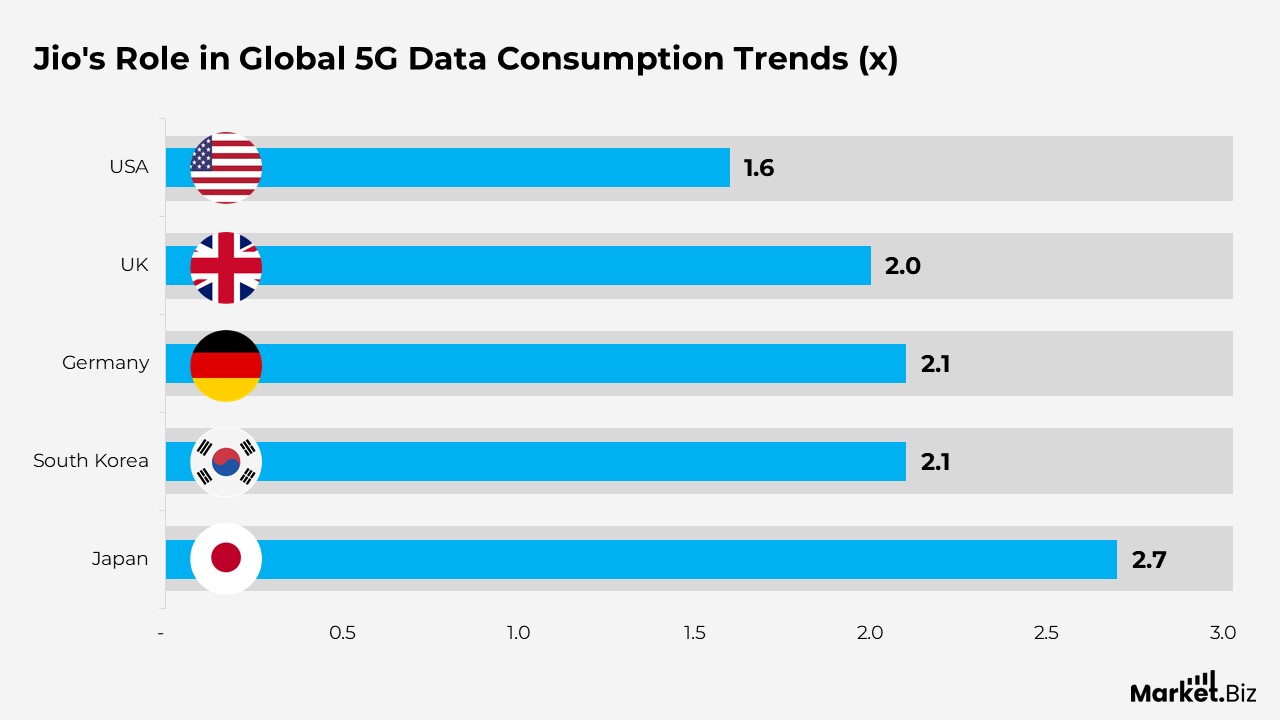
5G Statistics – by Country/Region
- The global rollout of 5G networks is gaining momentum, with 2.27 billion 5G mobile subscriptions expected in 2024, and this number is forecast to reach almost 5.65 billion by the end of the decade, surpassing 4G as the dominant technology.
- Adoption rates differ significantly across regions, with North America expected to achieve nearly 97% population coverage by 2023, while East Asia and the Pacific are projected to reach about 73% coverage.
- North America is projected to have the highest 5G adoption rate globally in 2030, with 89% adoption, followed closely by Greater China at 88%.
- South Korea leads the 2025 global ranking for 5G download speeds, boasting an average of 435 Mbps, significantly ahead of Bulgaria, which comes in second place at nearly 199 Mbps.
- India’s 5G subscriber base is projected to grow by 2.65 times, reaching 770 million by 2028, up from 290 million in 2024, with average 5G data consumption per user increasing to 40 GB per month.
- The number of 5G devices in India is expected to double annually, reaching 271 million by 2024, and nearly 90% of smartphones replaced in 2025 are expected to be 5G-capable.
- The compound annual growth rate (CAGR) of data consumption across 5G and 4G networks has been 19.5% over the past five years, with average data usage increasing to 27.5 GB per user in 2024.
- As of July 30 2023, a total of 308,466 5G sites/BTS were deployed across India.
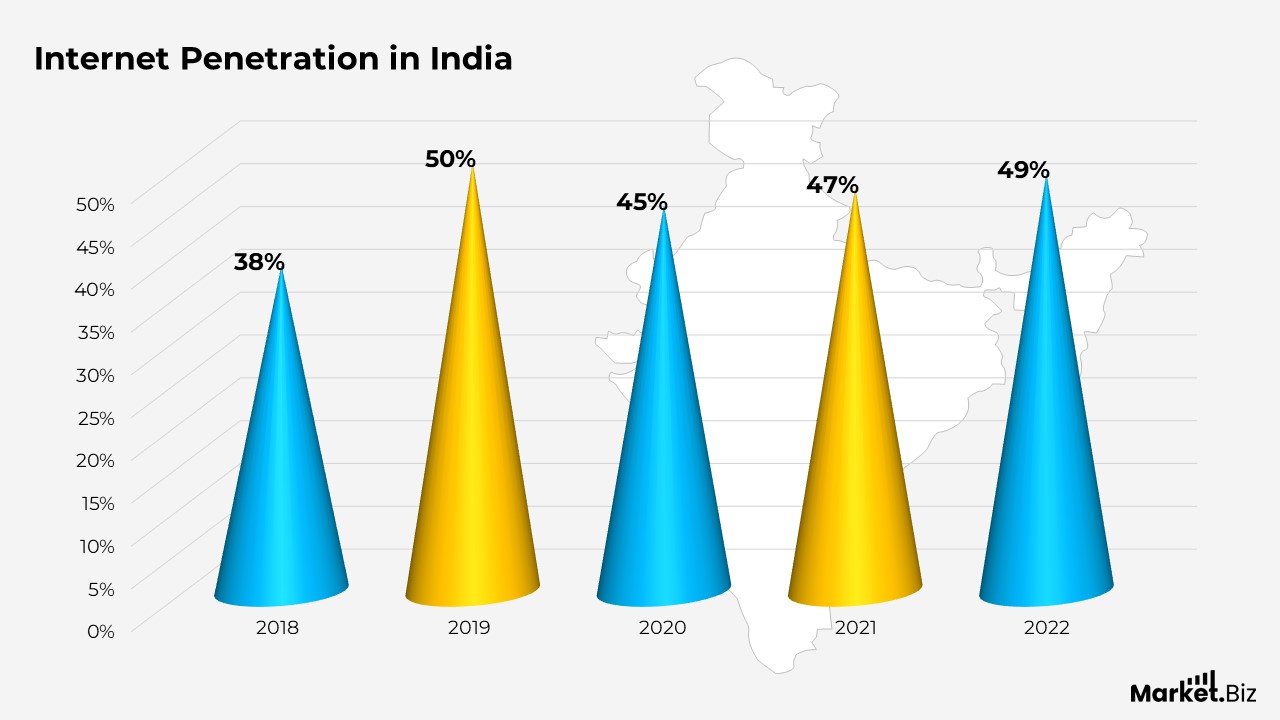
- By early 2023, digital adoption in India is expected to include 1.1 billion mobile subscriptions (77% of the population), 692 million internet users (48.7%), and 467 million social media users (32.8%).
- The Netherlands boasts the fastest 5G upload speed at 32.5 Mbps.
- By 2021, commercial 5G services were available in 1,336 cities across 62 countries.
- In Asia, 528 cities are covered by 5G, while 459 cities in EMEA (Europe, the Middle East, and Africa) and 349 cities in the Americas have 5G coverage.
- China leads with the highest number of 5G-enabled cities, at 341 cities, followed by the US with 279 cities, and South Korea with 85 cities.
(Source: Mobile Broadband Index, India Brand Equity Foundation, Jio Platforms Ltd., Statista, WPBeginner LLC, VIAVI Solutions, 5G Americas, FinancesOnline, The University of Maine)
Challenges in 5G Deployment
- 24% of respondents in the telecommunications industry cited excessive proprietary technology as the main barrier to delivering 5G services, resulting in vendor lock-in.
- 48% of telecom industry respondents identified virtualization as the most significant operational challenge to 5G technologies, followed by 36% who pointed to edge computing and 34% who mentioned open Radio Access Network (RAN).
- 60% of technology firms in Europe said that the required Investment in business infrastructure is one of the biggest challenges in implementing 5G. Other concerns include the rising cost of connectivity (53%) and the development of use cases (51%).
- 53% of respondents from the telecommunications industry believe that mobile network operators are best suited to address 5G security challenges. Meanwhile, 45% believe network equipment providers should take the lead, and 43% think digital security specialists should handle the responsibility.
- 45% of consumers say that not having a 5G-capable phone is a major barrier to using 5G in areas where it’s available. Additionally, 44% feel that 4G service is sufficient for their needs, while 38% believe that 5G data plans are too expensive.
- 45% of respondents pointed to ensuring compatibility with 4G and other existing services as the biggest obstacle to 5G edge adoption, followed by 41% who cited the unified management of hybrid or multi-cloud environments.
(Source: DLA Piper, Telecoms Intelligence, Futurum, Nokia)
Recent Developments
Service Launch and Expansion:
- In June 2025, Vi launched its 5G commercial service in Bengaluru, leveraging Samsung’s versatile solutions to enhance the consumer experience with greener and more sustainable approaches for its customers.
- In March 2025, the Indian government expanded 5G network services to meet the growing demand from users.
Regulatory Updates:
- The Federal Communications Commission (FCC) auctioned critical spectrum bands for 5G deployment, such as the C-band, generating over $81 billion from telecom companies eager to enhance their 5G infrastructure.
Technological Advancements:
- Samsung Electronics has introduced its 5G Multi-Access Edge Computing (MEC) solution, offering ultra-low latency and high-speed connectivity for applications such as autonomous vehicles and augmented reality.
Conclusion
The 5G revolution is poised to transform industries and redefine consumer experiences globally. With rapid advancements in network infrastructure and significant investments from both governments and telecommunications companies, 5G is poised to drive substantial growth across key sectors, including entertainment, automotive, healthcare, and eSports.
Beyond enhancing mobile connectivity, 5G will enable the emergence of groundbreaking applications such as augmented reality, virtual reality, and ultra-high-definition video, fundamentally altering how we interact with the world around us. As nations like the US, China, and India make notable progress in deploying 5G, the future looks bright for faster, more reliable, and immersive experiences that will benefit both consumers and businesses.
The continued expansion and evolution of 5G technologies will pave the way for a more connected and innovative digital future.
FAQ’s
5G is the fifth generation of mobile network skills intended to offer quicker speeds, lower latency, and improved connectivity compared to 4G. It supports a higher number of connected devices simultaneously, making it ideal for advanced applications such as autonomous vehicles, the Internet of Things (IoT), and immersive technologies like augmented and virtual reality.
5G can deliver peak data speeds of up to 20 Gbps, far exceeding 4G’s maximum speed of 1 Gbps. Additionally, 5G features significantly reduced latency, reaching as low as 1 millisecond, which enhances real-time applications.
The US, China, and South Korea are at the forefront of 5G deployment. China leads with its aggressive rollout, covering over 90% of urban areas, while South Korea was among the first nations to launch 5G nationwide.
In 2024, there will be approximately 2.27 billion 5G subscriptions worldwide, with expectations to grow to 5.65 billion by the end of the decade.
Key sectors benefiting from 5G include entertainment, automotive, healthcare, eSports, and manufacturing. Applications such as ultra-high-definition video, virtual reality, and augmented reality are transforming consumer experiences and business operations.
North America is predicted to have the highest 5G adoption rate, reaching 89% by 2030, with Greater China following closely at 88%. By 2025, businesses will also make significant investments in private 5G networks.