








Introduction
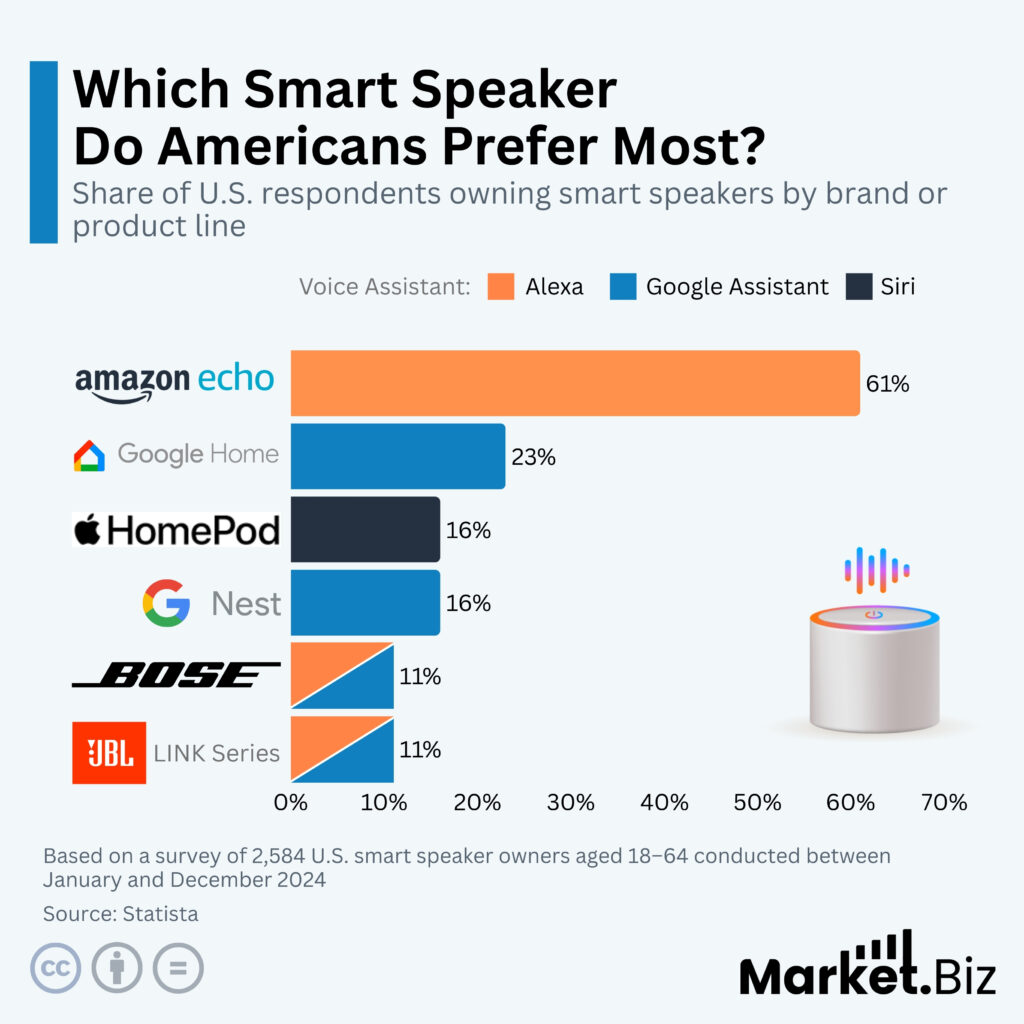
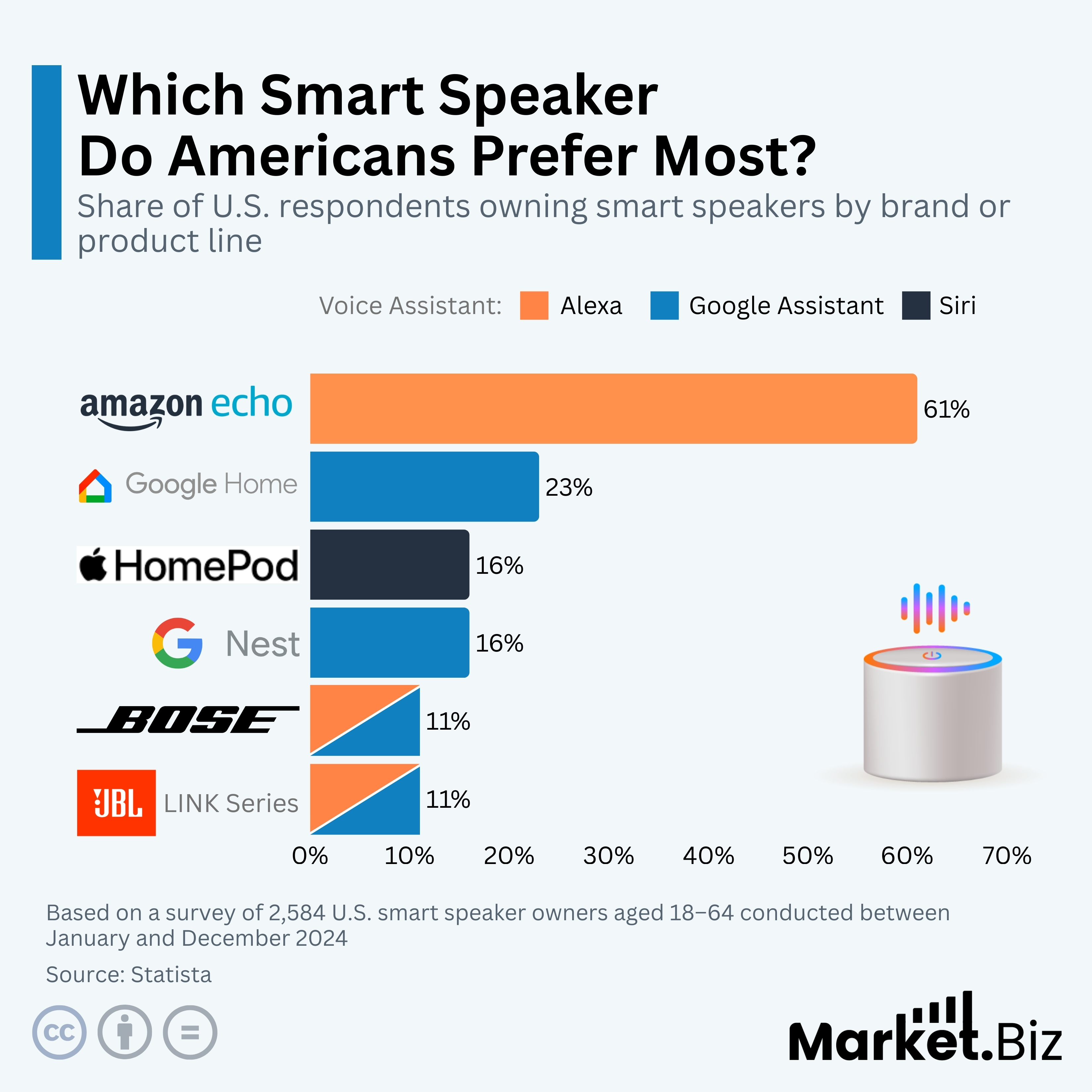
Are you wondering which smart speaker dominates the American household as we move deeper into the AI era? According to a comprehensive consumer survey conducted by Statista, encompassing 2,584 U.S. smart speaker owners aged 18 to 64, the Amazon Echo remains the undisputed king of the living room. The data reveals that a staggering 61% of respondents own an Amazon Echo device powered by Alexa. Despite fierce competition and the rapid integration of advanced Generative AI across all major tech platforms, Amazon has successfully maintained its early-mover advantage.
Trailing behind Amazon is Google, which splits its user base between the legacy Google Home brand (preferred by 23% of users) and the newer Google Nest lineup (16%). Apple’s HomePod secures a respectable 16% share, catering primarily to a demographic heavily invested in the iOS ecosystem. Meanwhile, third-party audio manufacturers like Bose and the JBL Link Series hold 11% each, bridging the hardware gap by offering high-fidelity audio powered by licensed voice assistants. As we transition from simple voice commands to complex, generative AI—marked by the recent launches of Alexa+, Gemini for Home, and Apple Intelligence—this market is experiencing its most significant technological shift in a decade.
Key Takeaways
- Amazon Echo holds a commanding 61% market share among U.S. smart speaker owners.
- The legacy Google Home product line is still utilized by 23% of respondents.
- Newer Google Nest devices account for 16% of the smart speaker market share.
- Apple HomePod matches Google Nest, capturing a 16% share of U.S. respondents.
- Premium third-party audio brand Bose holds an 11% share in the smart speaker space.
- The JBL Link Series also captures an 11% market share, tying with Bose.
- The data is based on a robust sample size of 2,584 U.S. smart speaker owners.
- The demographic surveyed spans adults aged 18 to 64 years old.
- The survey data was collected over a 12-month period between January and December 2024.
- The combined Google ecosystem (Home + Nest) touches roughly 39% of users, assuming minimal hardware overlap.
- 100% of the top 3 first-party smart speaker brands are actively transitioning to generative LLM infrastructures (Alexa+, Gemini, Apple Intelligence) in 2025/2026.
- Third-party devices (Bose and JBL) make up a combined 22% footprint, relying entirely on Amazon and Google’s voice assistant APIs.
Deep Dive into Market Preferences
When analyzing the current landscape of smart speaker ownership in the United States, the Statista data paints a clear picture of brand loyalty and ecosystem lock-in. Amazon Echo’s massive 61% share highlights a sustained dominance that stems from aggressive pricing strategies, deep integration with Amazon Prime services, and an extensive catalog of compatible third-party smart home devices. For six out of ten smart speaker owners, the wake word “Alexa” is synonymous with voice assistance itself.
Google’s strategy has historically been fragmented between two branding tiers: the older Google Home and the smart-display-heavy Google Nest. With 23% of users still holding onto Google Home devices and 16% adopting Google Nest, Google maintains a formidable 39% presence. However, this split branding occasionally confuses consumers, even as Google aggressively pushes its unified “Gemini for Home” AI replacement to supersede the classic Google Assistant.
Apple’s HomePod, sitting at a 16% adoption rate, illustrates an entirely different market approach. Apple has never competed in the ultra-budget smart speaker category (unlike the sub-$40 Echo Dot or Nest Mini). Instead, the HomePod appeals to a premium demographic deeply entrenched in the iOS and Apple Music ecosystem. The 16% share is a testament to Apple’s brand power, especially as Siri undergoes its massive “Apple Intelligence” overhaul.
Finally, the chart highlights a critical sub-segment: audiophile and third-party hardware. Bose and the JBL Link Series, each securing an 11% share, cater to consumers who prioritize audio fidelity over proprietary first-party hardware. These brands smartly hedge their bets by supporting both Amazon Alexa and Google Assistant, ensuring they do not alienate potential buyers. Collectively, these numbers reveal a mature hardware market where platform stickiness dictates future upgrades.
Why Is This Happening?
Amazon’s 61% stronghold isn’t accidental; it results from years of selling Echo hardware at or below cost during prime shopping holidays to build an impenetrable user base. Furthermore, Amazon’s seamless integration with its retail ecosystem creates a frictionless user experience that competitors struggle to replicate. Google and Apple entered the smart speaker market later, focusing on search supremacy and premium audio/privacy, respectively.
However, the landscape is currently shifting from hardware wars to AI monetization. We are seeing a major pivot because basic, script-based voice assistants are becoming obsolete. To offset heavy AI compute costs, companies are introducing paid subscriptions. Amazon recently introduced the Generative AI-powered “Alexa+” ($19.99/mo, or free for Prime members), while Google brought “Gemini Live” to Nest via a $20/mo Premium plan. Consumers are effectively locking into the hardware ecosystem that aligns with their preferred $20-a-month AI ecosystem, giving Amazon an edge due to its existing Prime subscriber base.
Will This Trend Change?
The future of the smart speaker market will be shaped by “Agentic AI”—assistants that don’t just answer trivia questions but also autonomously execute multi-step tasks across apps and services. While Amazon currently leads with 61% hardware penetration, its software moat is vulnerable. Google’s Gemini 3 Pro and Apple Intelligence offer deep, systemic integrations with smartphones and laptops, potentially pulling users away from standalone Echo devices.
As Apple brings highly contextual, on-device processing to the HomePod, and Google leverages “Agentic Vision” and complex reasoning in its Nest cameras and displays, hardware market share will likely begin to equalize. Over the next 36 months, we project that Amazon’s lead in sheer volume will erode slightly as Apple and Google leverage their smartphone duopoly to drive tighter smart-home integration. The smart speaker is becoming a mere endpoint; the real battle in the late 2020s is over the underlying agentic AI ecosystem.
Competitive Comparison
| Feature/Metric | Amazon Echo (Alexa+) | Google Nest (Gemini 3 Pro) | Apple HomePod (Siri w/ Apple Intelligence) |
| Context Window | ~100K Tokens (Optimized for persistent household context & routines) | Up to 2M Tokens (Gemini 1.5/3 Pro architecture for deep recall) | Personal Context (On-device semantic index + Private Cloud Compute) |
| Pricing per 1M Tokens | N/A (Consumer model: $19.99/mo or bundled with Amazon Prime) | $2.00 Input / $12.00 Output (API) or $20/mo (Consumer Google One AI) | Free for end-users (On-device processing / Developer API not public) |
| Multimodal Support | Audio, Camera (Echo Show), Smart Home Telemetry | Native Audio, Advanced Agentic Vision, Iterative Code Execution | Audio, Screen Awareness (via Handoff), Visual Intelligence |
| Agentic Capabilities | High (Cross-surface smart home automation, 3rd-party API booking) | Very High (Multi-step reasoning, logical math, verifiable execution) | Moderate/High (Cross-app orchestration, highly personalized user data) |
While Google Nest (Gemini 3 Pro) leads in sheer reasoning power and large context windows suitable for complex multimodal tasks, Amazon Echo (Alexa+) remains more cost-effective and more deeply entrenched among high-volume smart home users due to its Prime-bundled model. Conversely, Apple HomePod excels in data privacy and personal ecosystem orchestration, though it currently lacks the broader, third-party-agency web-scraping capabilities of its direct rivals.
Conclusion
In conclusion, the American smart speaker market is currently defined by Amazon’s overwhelming 61% hardware footprint, supported by aggressively priced Echo devices. However, the paradigm is rapidly shifting from hardware sales to the deployment of sophisticated, multimodal AI agents. As Google Nest transitions to Gemini and Apple injects Apple Intelligence into the HomePod, the metric for industry success will change from “devices sold” to “daily agentic tasks completed.” Consumers will ultimately gravitate toward the ecosystem that offers the most seamless, privacy-respecting, and capable AI assistant, setting the stage for a highly competitive future in which software intelligence trumps hardware presence.