









Introduction
Online gaming statistics present a clear, data-focused overview of the rapid evolution of the digital gaming landscape across platforms, regions, and user groups. These metrics measure critical aspects such as player growth, revenue trends, device preferences, engagement intensity, and monetization models, helping to define the overall scale and direction of the industry.
By examining performance across mobile, PC, console, and cloud gaming environments, these statistics reveal changing consumer behavior and regional adoption patterns driven by connectivity and digital readiness. Collectively, online gaming statistics form a reliable basis for understanding market dynamics, tracking industry progress, and informing strategic decisions within the global gaming ecosystem.
Editor’s Choice
- In 2024, online gameplay participation reached 80% among gamers aged 16–24, reflecting strong digital engagement in younger demographics.
- Despite being the least active age group, 48% of gamers aged 65 and above still engage in online gaming activities.
- In the UK, 50% of women identify as gamers, compared with 57% of men, indicating a narrowing gender participation gap.
- Smartphones dominate gaming access, with 34% of players reporting mobile devices as their primary gaming platform.
- Approximately 60% of gamers in the UK state that gaming positively contributes to their happiness and emotional well-being.
- Dota 2 ranks as the leading esports title globally, generating a cumulative prize pool of USD 6.84 million between January and June 2025.
- Esports professionals from China collectively lead global earnings, surpassing USD 320 million in total winnings.
- Worldwide, the active gaming population stands at approximately 3.32 billion players across platforms.
- The US esports ecosystem includes more than 3,000 professional players.
- Asia remains the largest gaming region, hosting close to 1.5 billion gamers.
- Male gamers account for 53% of the global gaming population.
- Around 52% of gamers subscribe to at least one gaming service.
Moreover
- India recorded 488 million online gamers in 2024, projected to rise to 517 million by 2025.
- Mobile gamers represented 89.92% of India’s total gamer base of 591 million in 2024.
- India leads the global mobile gaming market by volume, recording 8.45 billion game downloads.
- Although India accounts for 20% of the global gaming population, it captures only 1.1% of total industry revenue.
- Simulation games led downloads with a 22% market share in FY 2024–25.
- Shooter titles generated 50% of the total in-app gaming revenue.
- Gender representation remains balanced, with 55% male and 45% female gamers worldwide.
- Less than 10% of gamers globally experience gaming addiction, with higher prevalence among males.
- Mobile gaming revenue in the US reached USD 41.7 billion.
- In the US, 70% of gamers play games primarily on smartphones.
- PC gaming maintains a large user base, with approximately 1.8 billion active players globally.
- Asia contributes 33% of the worldwide PC gaming population.
- The PlayStation 2 remains the best-selling gaming console of all time.
- Gamers logged over 4.6 billion hours of gameplay within the first year of the PS5 launch.
- Professional esports athletes typically retire at an average age of 26 years.
- China became the first country to establish video game addiction clinics in July 2005.
Global Gamer Population Expansion Driven by Digital Adoption
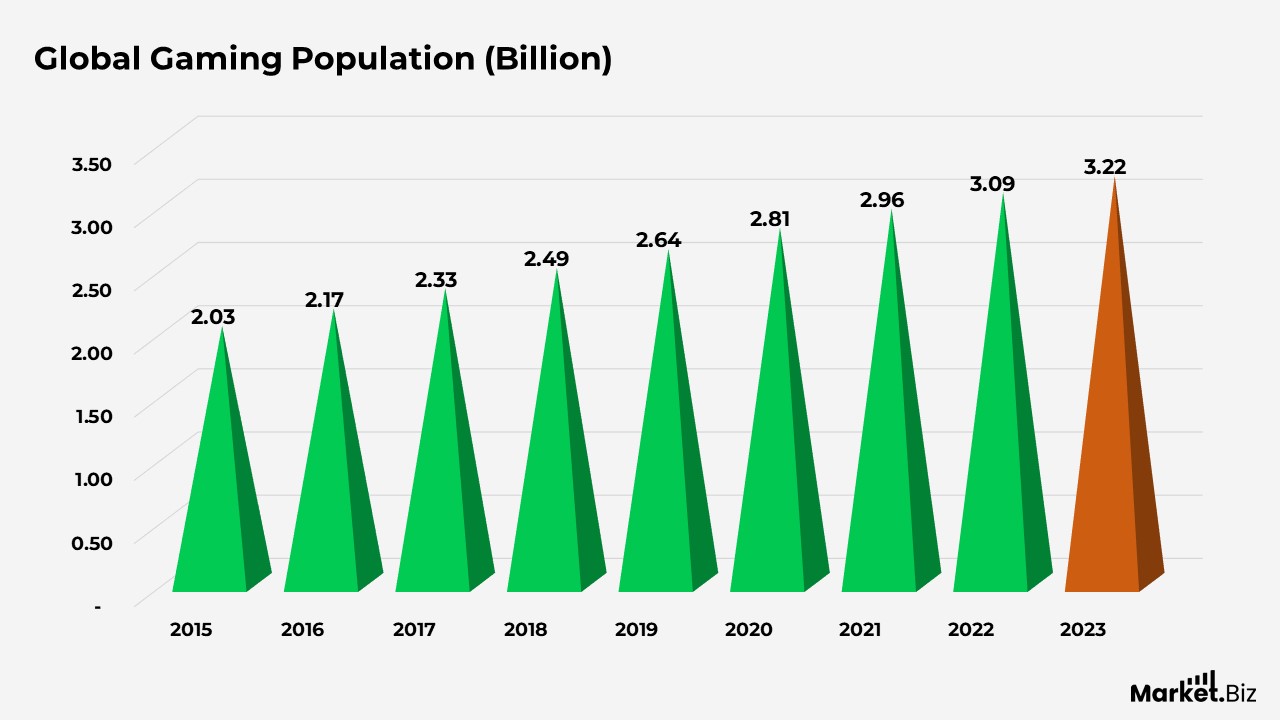
- In 2015, the worldwide gaming population stood at approximately 2.03 billion, reflecting the early phase of large-scale digital gaming adoption.
- The global gamer base increased to around 2.17 billion in 2016, supported by rising smartphone penetration and online connectivity.
- By 2017, the number of gamers expanded further to about 2.33 billion, indicating steady year-on-year growth.
- In 2018, global gamers reached nearly 2.49 billion, driven by mobile gaming and live-service game models.
- The gamer population grew to approximately 2.64 billion in 2019, as multiplayer and social gaming gained traction.
- During 2020, the total number of gamers climbed to around 2.81 billion, supported by increased at-home entertainment demand.
- In 2021, the global gaming audience rose to about 2.96 billion, reflecting sustained engagement across platforms.
- The upward trend continued in 2022, with the gamer population reaching approximately 3.09 billion worldwide.
- By 2023, the number of gamers globally peaked at around 3.22 billion, highlighting the strong long-term expansion of the gaming industry.
(Source: Broadband Search, Statista)
Genre-wise Distribution of Mobile Game Downloads in India
- Simulation games emerged as the most downloaded category in India, accounting for 22% of total game downloads, driven by high user engagement and casual gameplay appeal.
- Arcade games followed closely, capturing 19% of downloads, supported by their easy accessibility and short play sessions suited to mobile users.
- Puzzle games represented 16% of total downloads, reflecting strong demand for cognitive and skill-based entertainment across age groups.
- Tabletop games contributed 9% of overall downloads, indicating steady interest in digital adaptations of traditional board and card games.
- Action games accounted for 7% of downloads, supported by improved mobile graphics and performance capabilities.
- Shooter games held a 6% share of downloads, showing moderate adoption despite higher device and data requirements.
- Lifestyle-based games also represented 6% of total downloads, driven by customization, simulation of daily activities, and social interaction features.
- Racing games captured 5% of downloads, supported by competitive gameplay formats and franchise-based titles.
- Other niche gaming genres collectively accounted for the remaining 4% of downloads, highlighting the presence of diversified but smaller market segments within India’s mobile gaming ecosystem.
(Source: Broadband Search, DemandSage)
Gamer Demographics by Age Group
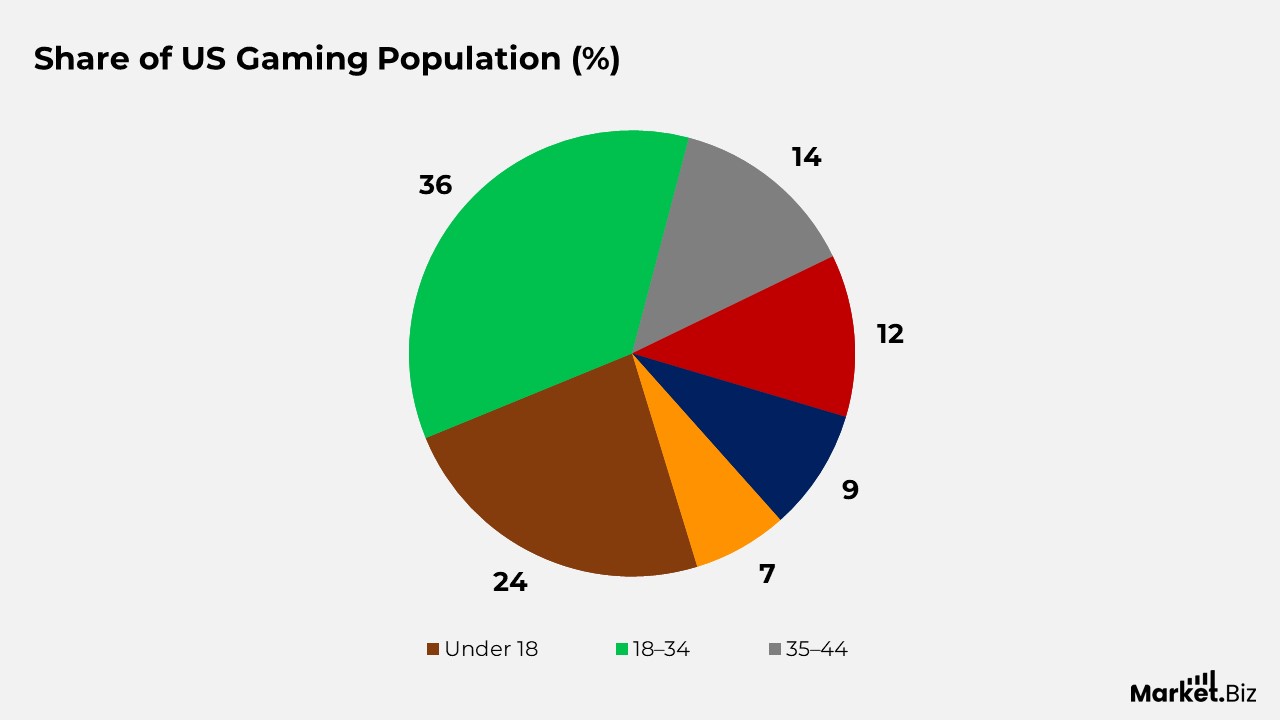
- Gamers under the age of 18 account for 24% of the total gaming population in the United States, indicating strong early adoption.
- The 18–34 age group represents the largest share, comprising 36% of US gamers and driving overall engagement levels.
- Players aged 35–44 make up 14% of the gaming audience, reflecting sustained participation beyond younger demographics.
- The 45–54 age segment contributes 12% of total gamers, highlighting growing engagement among middle-aged users.
- Gamers between 55–64 years represent 9% of the US gaming population, showing steady adoption among older age groups.
- Players aged 65 and above account for approximately 6–7% of gamers, marking gradual expansion in senior participation.
(Source: Broadband Search, DemandSage)
Gamer Demographics by Gender
- Male gamers constitute 54% of the gaming population in the United States.
- Female gamers represent 46%, underscoring a relatively balanced gender distribution within the US gaming landscape.
(Source: Broadband Search, DemandSage)
Regional Distribution of the Global Gamer Population
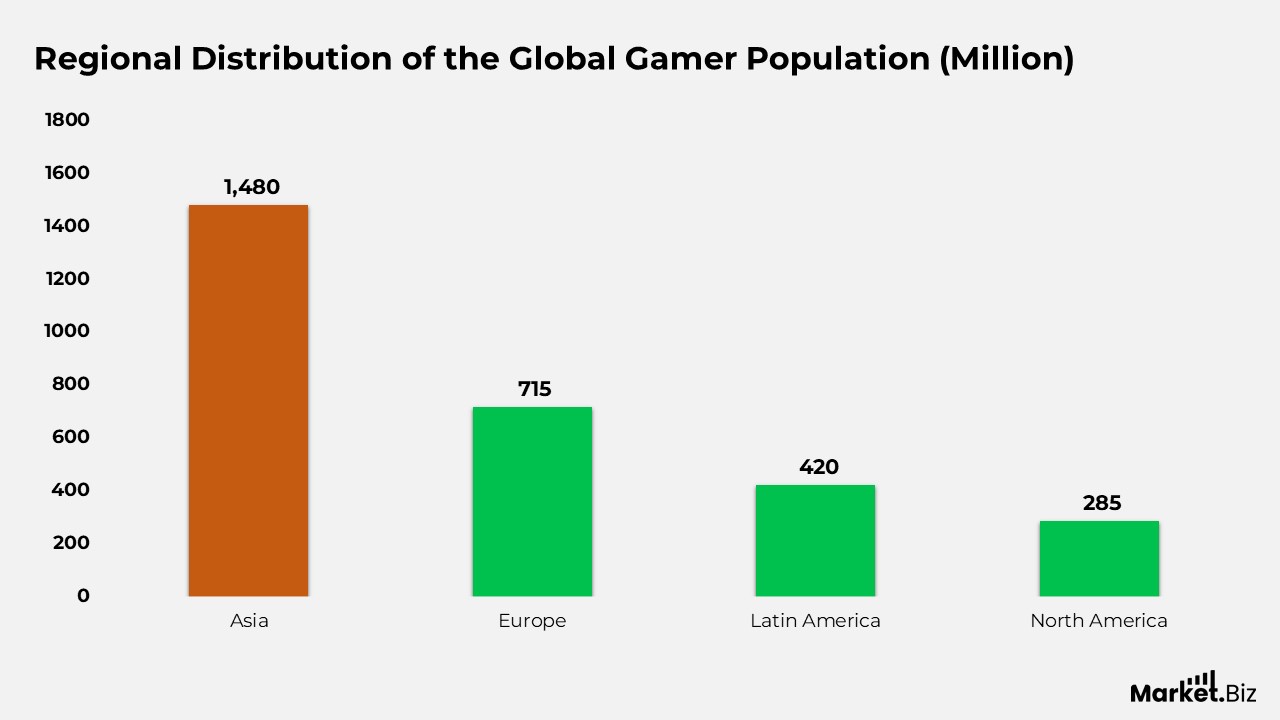
- Asia leads the global gaming landscape with approximately 1.48 billion gamers, reflecting its large population base and strong mobile gaming adoption.
- Europe represents a significant gaming market, with around 715 million players driven by high internet penetration and console and PC gaming popularity.
- Latin America accounts for nearly 420 million gamers, supported by rapid smartphone usage growth and expanding online access.
- North America contributes about 285 million gamers, characterized by high spending levels and strong engagement across premium gaming platforms.
(Source: Broadband Search, DemandSage)
Leading Countries by Number of Esports Players Worldwide
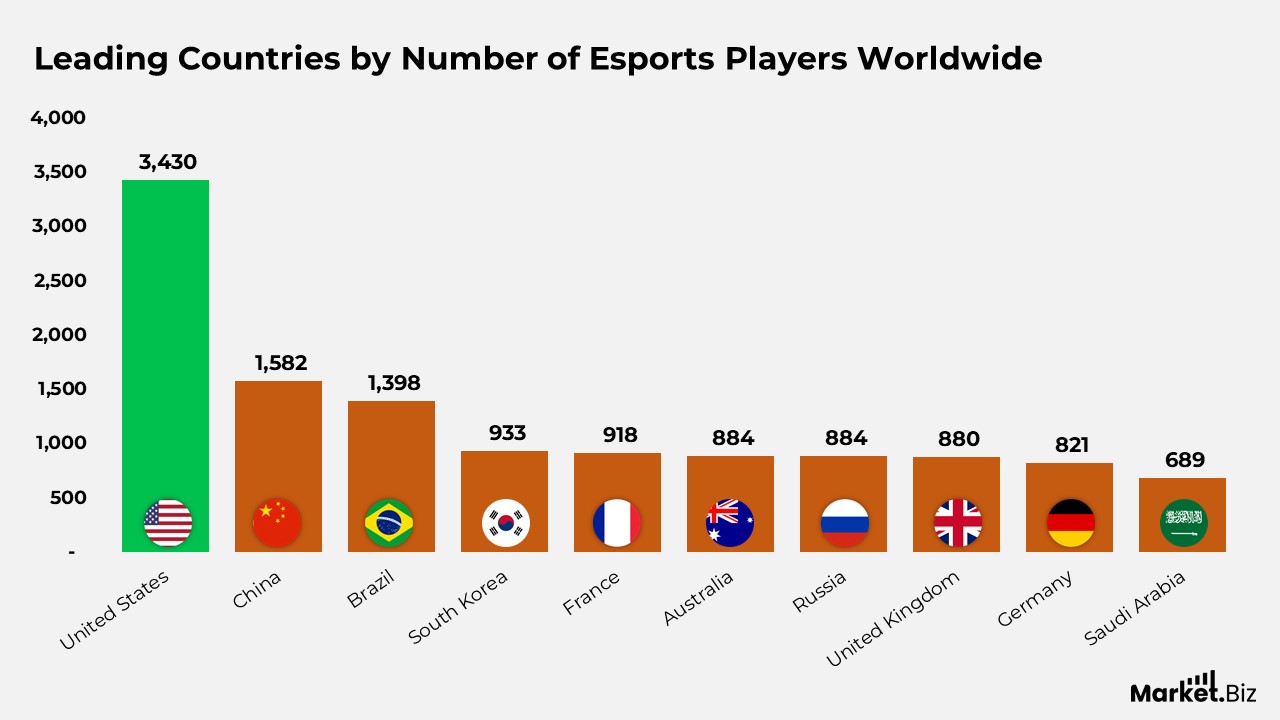
- The United States ranks first globally, with 3,430 registered esports players, reflecting a highly developed competitive gaming ecosystem.
- China follows with 1,582 esports players, supported by strong institutional backing and a large domestic gaming base.
- Brazil holds the third position, recording 1,398 esports players, driven by the growing popularity of competitive titles and esports events.
- South Korea accounts for 933 esports players, maintaining its long-standing reputation as a global esports powerhouse.
- France has approximately 918 esports players, highlighting steady growth in professional gaming participation.
- Australia records 884 esports players, indicating expanding engagement within the competitive gaming community.
- Russia also reports 884 esports players, matching Australia in total professional participation.
- The United Kingdom contributes 880 esports players, supported by increasing investment in esports infrastructure.
- Germany has around 821 esports players, reflecting a stable and organized competitive gaming market.
- Saudi Arabia rounds out the list with 689 esports players, driven by rising government and private sector investment in esports.
(Source: VentureBeat, Exploding Topic, Statista, IBISWorld, eSportsEarnings)
Gaming User Penetration Trends Across Major Countries
- In 2017, gaming user penetration in Japan stood at 53%, rising to 58% in 2022 and projected to reach 67% by 2027.
- The UK recorded 50% gaming penetration in 2017, increased to 58% by 2022, and is expected to climb to 70% in 2027.
- Sweden reported a penetration rate of 47% in 2017, which grew to 51% in 2022 and is projected to reach 64% by 2027.
- South Korea showed 45% gaming penetration in 2017, expanding to 57% in 2022, with projections indicating 64% by 2027.
- France recorded a gaming penetration level of 43% in 2017, reflecting early market maturity among major gaming nations.
- Mexico reached a gaming user penetration rate of 53% in 2022, highlighting strong mid period adoption.
- Nigeria is projected to achieve a gaming penetration rate of 63% by 2027, indicating rapid growth in emerging markets.
(Source: Exploding Topic, Statista, DFC Intelligence)
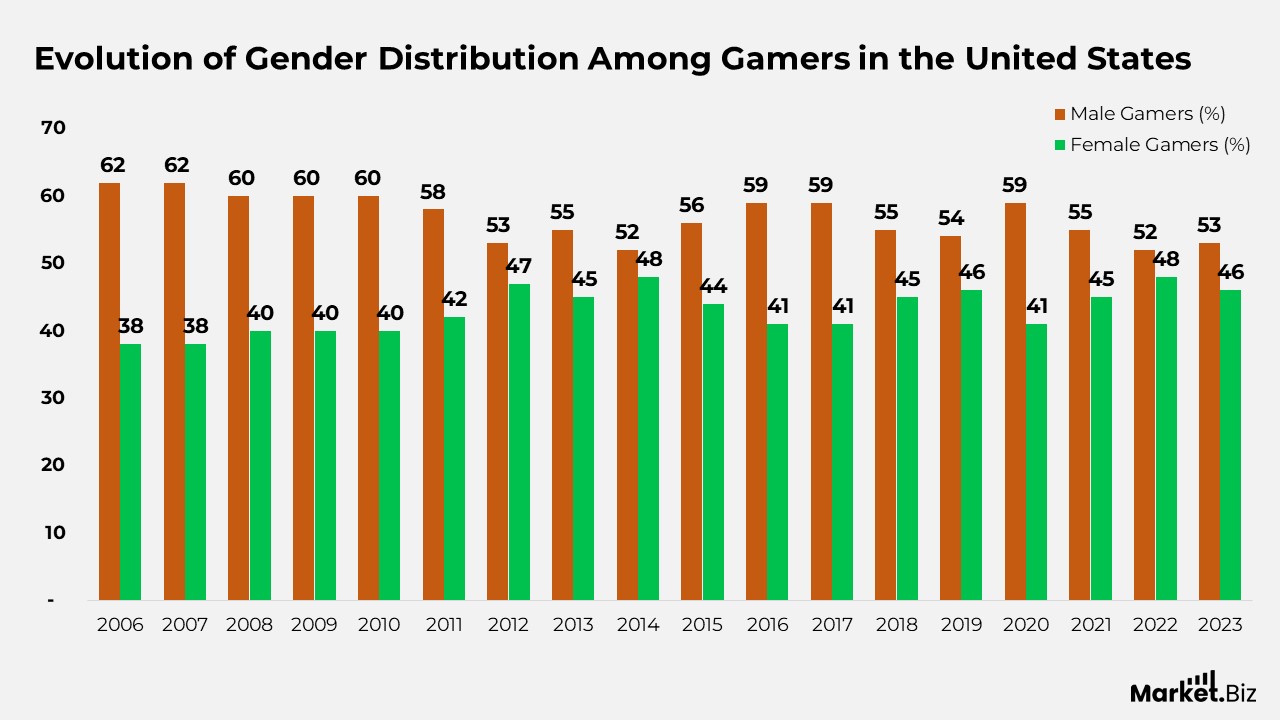
Evolution of Gender Distribution Among Gamers in the United States
- In 2006 and 2007, male gamers dominated the US gaming population at 62%, while female gamers accounted for 38%, reflecting a pronounced gender gap in the early years.
- By 2008, 2009, and 2010, the share of male gamers declined slightly to 60%, with female participation increasing to 40%, indicating gradual diversification.
- In 2011, male representation reduced further to 58%, while female gamers rose to 42%, continuing the narrowing trend.
- A notable shift occurred in 2012, when male gamers dropped to 53% and female gamers increased to 47%, approaching near parity.
- During 2013, male participation rebounded to 55%, while female gamers accounted for 45% of the total base.
- In 2014, the gender gap narrowed significantly, with 52% male gamers and 48% female gamers.
- The year 2015 saw male gamers increase to 56%, while female participation adjusted to 44%.
- In both 2016 and 2017, male gamers represented 59%, compared to 41% female gamers, indicating a temporary widening of the gap.
- By 2018, the distribution shifted again to 55% male and 45% female gamers.
- In 2019, male gamers accounted for 54%, while female gamers increased to 46%, reinforcing long-term convergence.
- The year 2020 recorded 59% male gamers and 41% female gamers, influenced by broader changes in gaming engagement patterns.
- In 2021, the split adjusted to 55% male and 45% female gamers.
- By 2022, the gender distribution reached one of its most balanced points, with 52% male and 48% female gamers.
- In 2023, male gamers accounted for 53%, while female gamers represented 46%, highlighting sustained near parity in the US gaming population.
(Source: Exploding Topic, DemandSage)
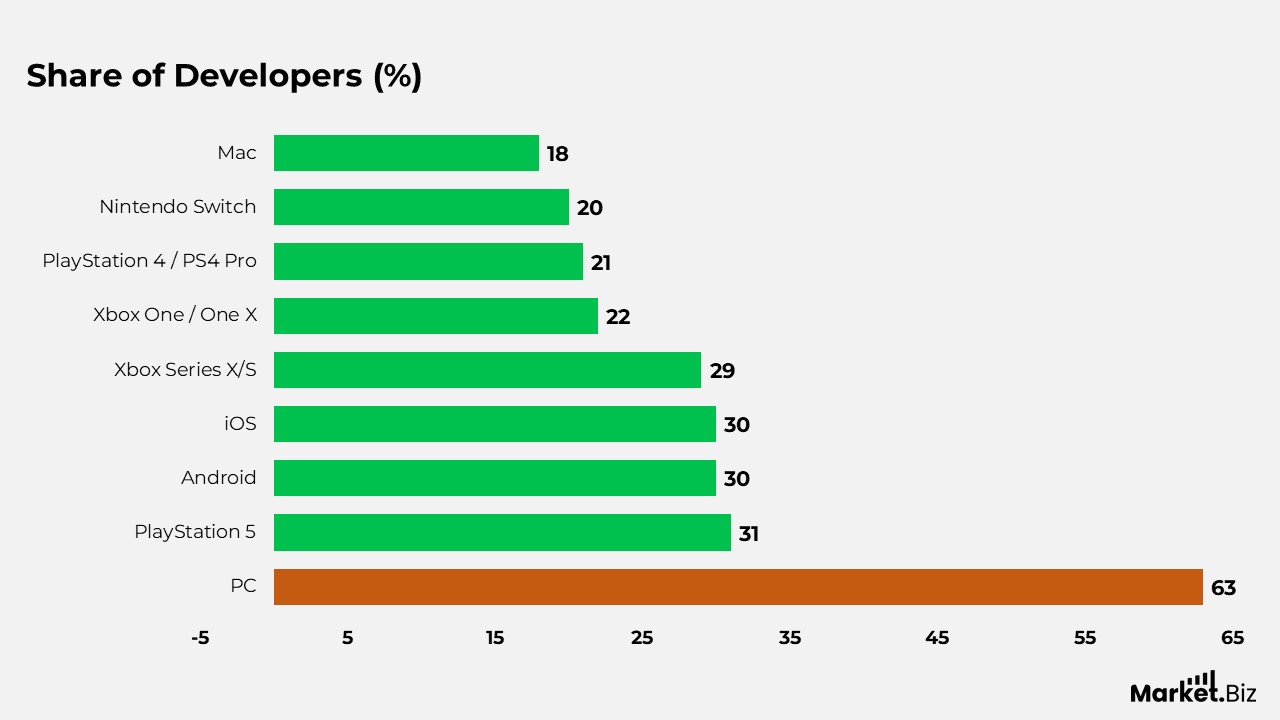
Game Developer Platform Preferences Across Major Gaming Systems
- PC dominates game development priorities, with 63% of developers selecting it as their main platform due to flexibility and broad user reach.
- PlayStation 5 ranks as the second most targeted platform, attracting 31% of developers focused on next-generation console experiences.
- Mobile development remains strong, as Android and iOS are equally preferred by 30% of developers for smartphone-based gaming projects.
- Xbox Series X/S continues to gain traction, with 29% of developers actively building titles for Microsoft’s latest consoles.
- Legacy console development persists, as 22% of developers still support Xbox One and One X platforms.
- PlayStation 4 and PS4 Pro retain relevance, with 21% of developers continuing to develop games for the older Sony console generation.
- Nintendo Switch is targeted by 20% of developers, supported by its large user base despite hardware constraints.
- Mac platforms receive attention from 18% of developers, primarily for indie, casual, and creative gaming titles.
- Web browser-based games remain a niche area, with only 10% of developers focusing on browser-compatible titles.
- Virtual reality platforms attract 7% of developers, reflecting gradual but cautious adoption of immersive technologies.
- Linux and Google Stadia record the lowest developer interest, each supported by just 3% of creators.
(Source: True List, SQ Magazine)
Global Online Gaming Trends by Genre Popularity and Player Engagement
- Shooter games remain the leading genre globally, with 29% of players identifying them as their preferred gaming category.
- Battle royale titles continue to attract massive audiences, surpassing 441 million combined monthly active users across leading games.
- MMORPGs sustain high engagement levels, particularly in Asia, generating approximately USD 16.8 billion in total revenue.
- Sports-based games recorded renewed momentum, expanding by 11.2% worldwide in 2025.
- Casual and puzzle games dominate mobile gaming behavior, accounting for 43% of total gameplay sessions.
- Simulation games saw rising demand, with downloads increasing by 9%, supported by popular life and strategy-driven titles.
- Card and casino-style games represent 8.6% of total mobile gaming playtime, reflecting steady casual engagement.
- Real-time strategy games achieved strong expansion, posting 22.4% year over year growth in active users.
- Roguelike and dungeon crawler genres gained traction, with engagement levels rising by 6.1% compared to 2024.
- Asymmetrical multiplayer games emerged as the fastest-growing genre in 2025, expanding by 28.7% due to increased interest in cooperative competitive play.
(Source: True List, SQ Magazine)
Online Gaming Preferences and Time Spent Patterns Worldwide
- The average gamer spent 9.4 hours per week on online gaming in 2025, up from 8.6 hours the previous year.
- The top 10% of gamers exceed 20 hours of gameplay per week, largely concentrated in competitive and immersive titles.
- In the US, 65% of gamers primarily play during weekday evenings between 6 PM and 10 PM.
- Weekend sessions account for 42% of total gaming hours across all age groups.
- Around 45% of gamers report playing for more than 1 hour per gaming session.
- Teen gamers aged 13–17 average 13.8 hours of weekly playtime, including 3.1 hours per day on weekends.
- Cloud gaming users spend 22% more time playing compared to traditional platform users, supported by flexible device access.
- Parents in dual income households spend an average of 2.5 hours per week gaming with their children.
- Live service games with regular seasonal updates generate sessions that are 30% longer than static titles.
- Social gaming platforms record high engagement, with average daily usage exceeding 67 minutes per player.
(Source: True List, SQ Magazine)
Conclusion
Online gaming statistics underscore the industry’s continued momentum, marked by expanding participation, diversified audiences, and rising engagement across devices and regions. Growth in the global player base, higher penetration across age groups, and a steadily narrowing gender gap confirm gaming’s position as a mainstream digital activity rather than a niche form of entertainment.
Platform and genre trends point to strong preference for mobile, PC, and live service driven experiences, while engagement metrics show longer play sessions supported by cloud accessibility, multiplayer interaction, and frequent content updates.
Overall, these insights reflect a mature and evolving gaming ecosystem with durable growth prospects, increasing economic impact, and a growing role in shaping digital entertainment and social interaction worldwide.
FAQ’s
Online gaming statistics consist of systematically organized quantitative measures used to examine user participation, engagement intensity, and economic activity within digital gaming systems. In theoretical terms, they serve as empirical instruments for analyzing how interactive media platforms expand, diffuse across populations, and reach equilibrium over time.
From a theoretical viewpoint, online gaming statistics are significant because they enable the evaluation of core concepts such as digital adoption patterns, media usage behavior, network effects, and platform driven value creation. They provide measurable evidence explaining how user interaction, technological availability, and content structures contribute to long term engagement.
Online gaming statistics directly support digital adoption and diffusion frameworks by illustrating how gaming usage penetrates different demographic and geographic segments. Indicators such as user growth and penetration levels reflect sequential stages of adoption, including introduction, rapid expansion, and market maturity.
Demographic data within online gaming statistics helps interpret behavioral differences across age groups, gender categories, and socio economic segments. Theoretically, these patterns align with behavioral and cultural models that explain how diverse populations engage with digital entertainment platforms.
Platform oriented gaming statistics reveal the functioning of multi sided digital ecosystems where developers, players, advertisers, and service providers interact. Data across PC, mobile, console, and cloud platforms illustrates key economic concepts such as network externalities, user lock in, and competitive platform dominance dynamics.