









Introduction
Rum Statistics: Rum is a distilled alcoholic beverage made from by-products of sugarcane, and it has a rich history that traces back to the Caribbean in the 17th century. The process of producing rum includes the fermentation of sugarcane by-products, followed by distillation, ageing in wooden barrels, and blending to create the desired flavour profiles.
There are several varieties of rum, such as light rum, which is recognized for its mild flavour, and gold rum, which offers a richer taste. Dark rum presents deep complexities, while spiced rum is enhanced with aromatic spices, and over-proof rum contains a higher alcohol concentration.
Rum is utilised in cocktails, culinary dishes, and can be enjoyed neat, showcasing its versatility and wide range of flavours, which contribute to its lasting popularity around the globe, particularly as the interest in premium and craft rums continues to rise.
Editor’s Choice
- The worldwide revenue for the rum market is expected to hit USD 20.4 billion by 2028.
- In 2017, offline sales represented 98.9% of the market share, whereas online sales made up only 1.1%.
- Private Label dominates the market with a 9% share, trailed by Bacardi at 7% and Tanduay at 6%.
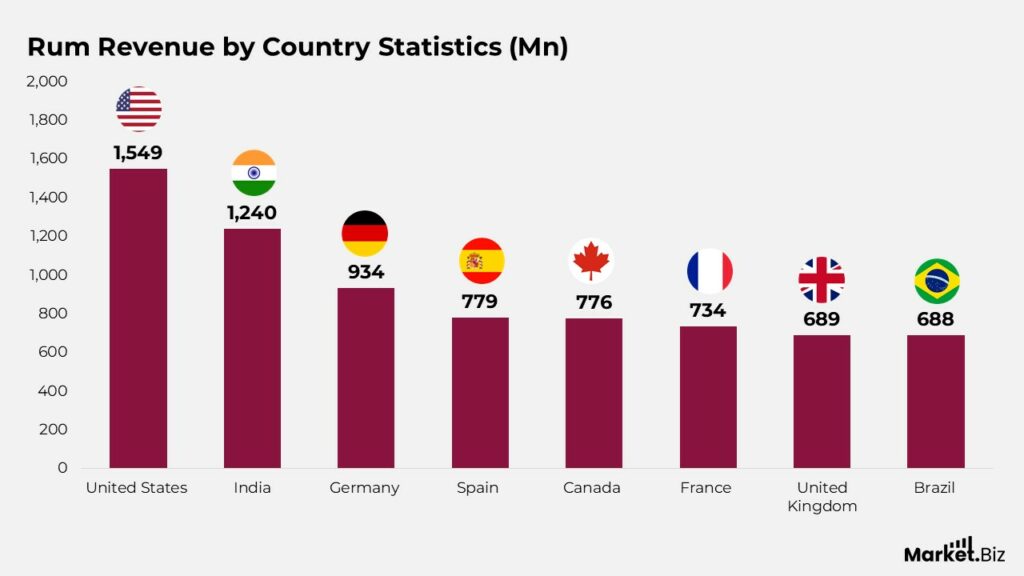
- The United States stands at the forefront with a considerable market revenue of USD 1,549 million, trailed by India, which produces USD 1,240 million.
- In 2018, the out-of-home revenue per capita was USD 0.78, which saw a slight decline to USD 0.77 in 2019.
- In 2018, the price of rum was USD 15.84, which saw a slight decrease to USD 15.73 in 2019.
General Rum Statistics
- The worldwide revenue for the rum market is expected to hit USD 20.4 billion by 2028.
- Projections for 2025 and subsequent years suggest a stable environment, with offline sales anticipated to maintain 97.7% of the market share, while online sales are likely to stay at 2.6% until 2027.
- The global rum market features a wide array of companies, with private labels dominating the sector at 9%.
- The United States stands out with a significant market revenue of USD 1,549 million.
- Global consumption figures for rum in out-of-home venues are expected to reach 111.4 million liters by 2028.
- In 2022, Italy emerged as the leader in the global rum export market, achieving a total export value of USD 226 million, which represents 11.20% of the market.
Rum Market Size Statistics
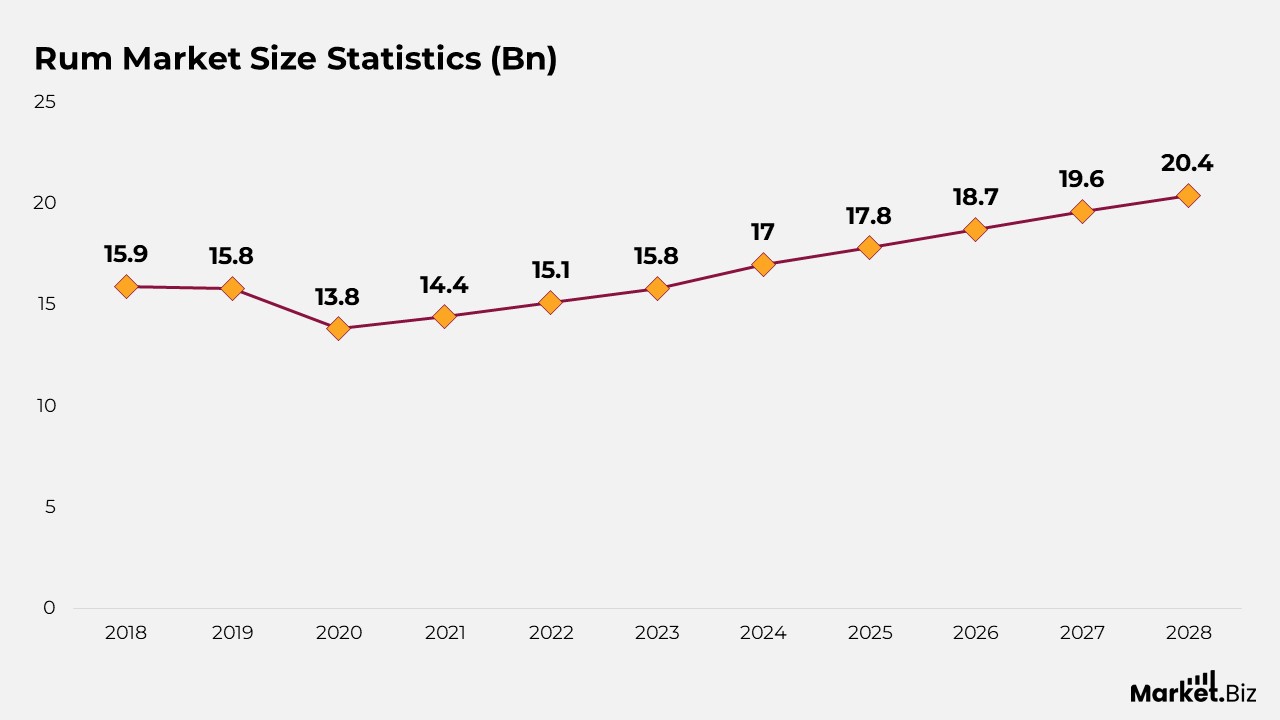
- In 2018, the market revenue was recorded at USD 15.9 billion, experiencing a slight decrease to USD 15.8 billion in 2019.
- A significant decline was observed in 2020, as revenue fell to USD 13.8 billion, likely due to the global economic repercussions of the COVID-19 pandemic.
- Nevertheless, the market started to rebound in 2021, with revenue rising to USD 14.4 billion.
- The positive trend is anticipated to continue, with projections indicating that the market will reach USD 17.0 billion in 2024, USD 17.8 billion in 2025, USD 18.7 billion in 2026, USD 19.6 billion in 2027, and USD 20.4 billion in 2028.
Market Statistics by Sales Channel
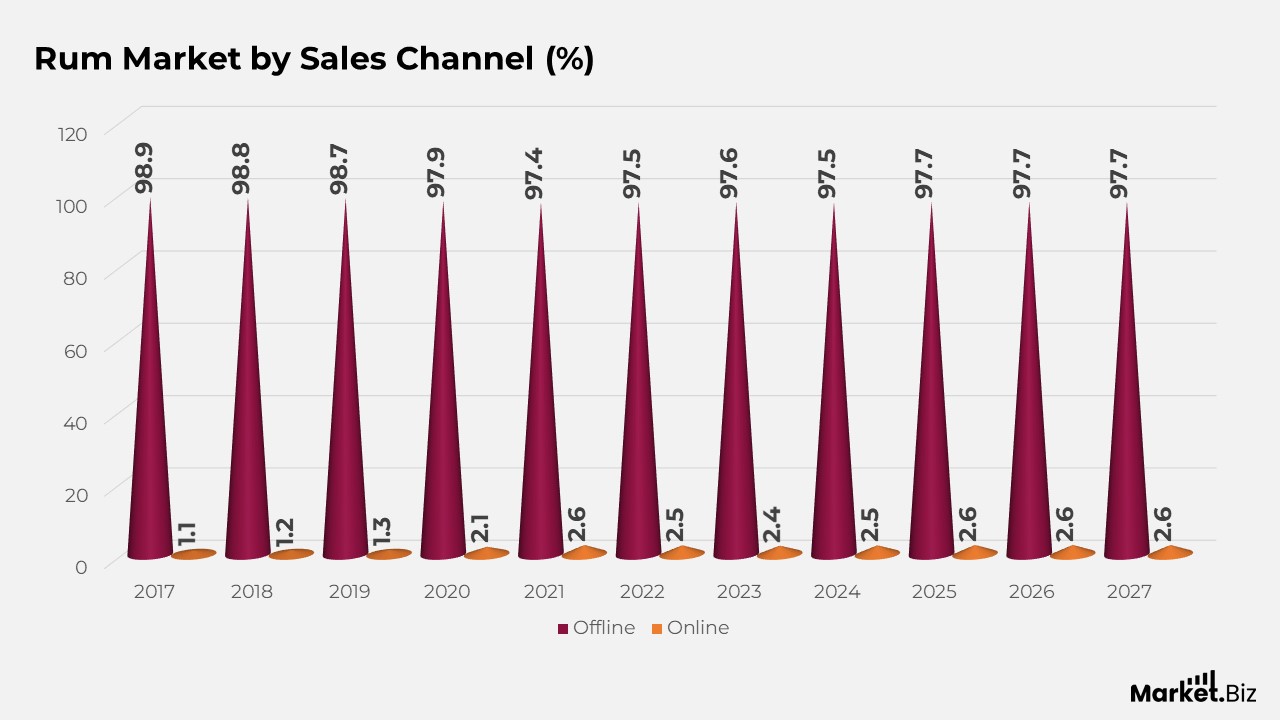
- In 2017, offline sales represented 98.9% of the market share, whereas online sales made up only 1.1%.
- A notable transformation took place in 2020 when the COVID-19 pandemic expedited the rise of online sales, resulting in a reduction of offline sales to 97.9% and an increase in online sales to 2.1%.
- By 2022, the market experienced a slight adjustment, with offline sales rising to 97.5% and online sales falling to 2.5%. This minor variation persisted into 2023, where offline sales constituted 97.6% and online sales accounted for 2.4%.
- The projections for 2025 and beyond suggest a stable condition, with offline sales anticipated to maintain 97.7% of the market share and online sales expected to stabilise at 2.6% through 2027.
Rum Market Competitors Statistics
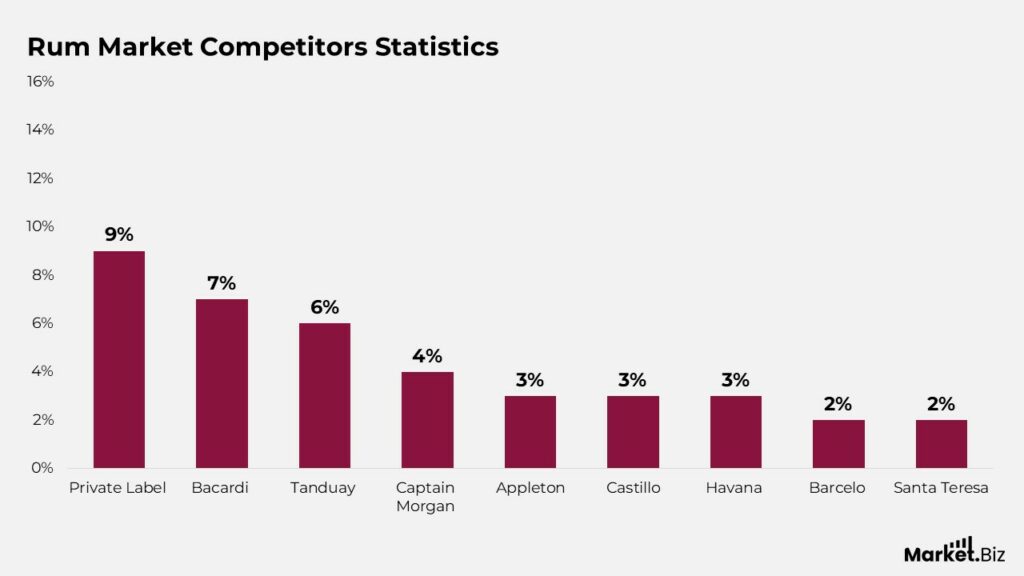
- Private Label dominates the market with a 9% share, trailed by Bacardi at 7% and Tanduay at 6%.
- Captain Morgan possesses a 4% market share, whereas Castillo, Appleton, and Havana Club each secure a 3% share.
- Santa Teresa and Barcelo each account for a 2% market share, while Banks retains a 1% share.
- Significantly, the remaining 60% of the market is held by various other brands.
Rum Market Size Statistics
- The United States stands at the forefront with a considerable market revenue of USD 1,549 million, trailed by India, which produces USD 1,240 million.
- Germany also occupies a significant position with a market revenue of USD 934 million.
- Spain and Canada make substantial contributions to the market, with revenues of USD 779 million and USD 776 million, respectively.
- France is not far behind, reporting a revenue of USD 734 million.
- The United Kingdom and Brazil both exhibit considerable market revenues, with the UK at USD 689 million and Brazil at USD 688 million.
Revenue Per Capita Out of Home Statistics
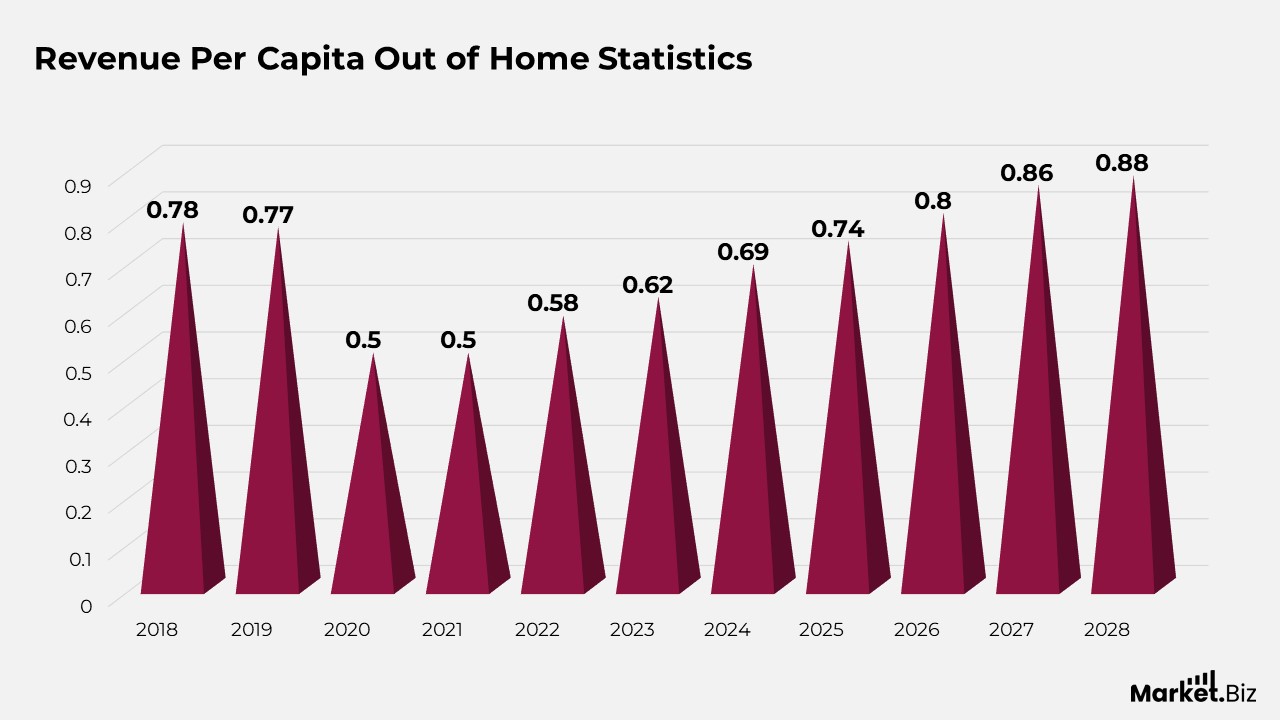
- The revenue per capita for the global rum market in the out-of-home sector has undergone significant fluctuations over the years.
- In 2018, the out-of-home revenue per capita was USD 0.78, which saw a slight decline to USD 0.77 in 2019.
- The COVID-19 pandemic’s effects in 2020 caused a considerable decrease, reducing the revenue to USD 0.50, a level that persisted in 2021.
- A recovery commenced in 2022, with the revenue per capita rising to USD 0.58.
- Further growth is expected, with forecasts indicating USD 0.86 in 2027 and USD 0.88 in 2028.
Rum Consumption Statistics
- In 2018, households consumed a total of 119.7 million liters, which saw a slight increase to 120.3 million liters in 2019.
- The year 2020 experienced a significant drop to 77.4 million liters, primarily due to the extensive effects of the COVID-19 pandemic on social and recreational activities.
- Nevertheless, a recovery commenced in 2022, with out-of-home consumption climbing to 80.7 million liters and further increasing to 83.0 million liters in 2023.
- The growth trend is expected to persist, with consumption projected to reach 110.1 million liters in 2027 and 111.4 million liters in 2028.
Statistics of Rum Prices
- In 2018, the price of rum was USD 15.84, which saw a slight decrease to USD 15.73 in 2019.
- The year 2020 witnessed a considerable decline to USD 14.47, likely influenced by market disruptions caused by the COVID-19 pandemic.
- However, a recovery was noted in 2021, as prices rose to USD 15.35.
- Anticipated price increases are on the horizon, with forecasts suggesting USD 20.14 in 2027 and USD 20.38 in 2028.
Rum Exporting Nations Statistics
- In 2022, Italy dominated the global rum export market, achieving a total export value of USD 226 million, which constituted 11.20% of the market share.
- The United States ranked second, with rum exports valued at USD 199 million, accounting for 9.88% of the overall exports.
- The Dominican Republic maintained a substantial share, with exports amounting to USD 162 million, or 8.05%.
- The Netherlands and France contributed USD 127 million (6.31%) and USD 124 million (6.15%), respectively.
- Spain’s rum exports reached USD 119 million, representing 5.19% of the market, while Venezuela exported rum worth USD 103 million, which corresponds to 5.13%.
- Cuba and Guatemala also reported significant export figures, with USD 90.5 million (4.50%) and USD 89.1 million (4.43%), respectively.
Conclusion
According to recent industry reports, the global rum market is undergoing a notable transformation, shifting from a conventional, high-volume spirit to a more premium and varied category.
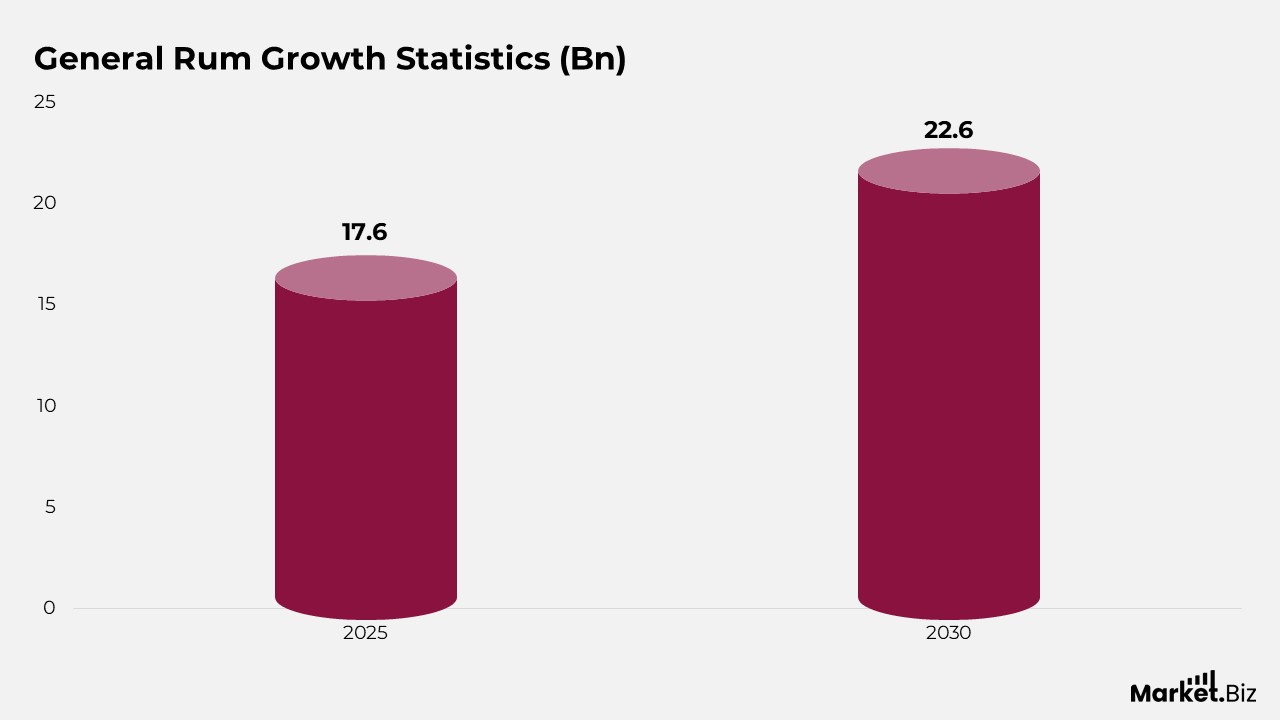
It is anticipated that the market will expand from an estimated USD 17 billion in 2024 to more than USD 23 billion by 2030, fueled by the rising popularity of cocktails and the trend of “premiumization,” in which consumers favour higher-quality, aged, and artisanal products.
FAQs
Rum is a distilled spirit derived from byproducts of sugarcane, usually molasses or sugarcane juice, which undergoes fermentation and ageing in barrels. With an alcohol by volume (ABV) ranging from 35% to 80%, it is celebrated for its sweet, caramelized flavour and is commonly classified into white, gold, dark, and spiced categories.
Moderate consumption of rum may provide slight, short-term advantages such as an increase in HDL (‘good’) cholesterol, lower stress levels, and enhanced blood circulation. Nevertheless, it is largely regarded as detrimental to health due to the potential risks of liver damage, cancer, addiction, and weight gain, particularly when consumed excessively.
Although there are some lesser-known variations, the most recognised types of rum include spiced rum, white rum, dark rum, navy strength rum, gold rum, overproof rum, and rhum Agricole. Similar to other aged spirits, the ageing process contributes to a range of aromas and flavours.