









Introduction
Public speaking statistics: It offers valuable insights into the importance of strong communication skills across different contexts. These figures demonstrate how effectively public speaking contributes to success in personal, academic, and professional realms, underscoring its role in leadership, career progression, and societal impact.
Public speaking data covers various trends, such as the growing demand for speaking skills in education, the rise of digital platforms for presentations, and the link between speaking proficiency and career growth. By analyzing these statistics, both individuals and organizations can better understand the significance of public speaking in developing impactful and influential communicators in today’s fast-paced world.
Editor’s Choice
- Only 10% of the population enjoys speaking in front of others, while another 10% experience fear, and the remaining 80% fall somewhere in between.
- Research indicates that communication in public speaking is composed of 55% non-verbal cues, 38% vocal delivery, and only 7% actual words (Open Library).
- According to surveys, 92% of respondents believe that strong presentation skills are essential for professional success.
- The fear of public speaking can reduce wages by 10% and limit opportunities for career advancement by 15%.
- 71% of people prefer learning about a brand through live presentations rather than reading blog posts.
- Approximately 15 million people experience glossophobia (fear of public speaking) daily (Anxiety and Depression Association of America).
- 46% of presenters identify creating a compelling story as the most difficult aspect of preparation.
- 91% of presenters feel more confident when using a well-crafted slide deck during their presentation.
- 59% of hiring managers consider public speaking skills to be an important factor when evaluating job candidates.
Podcasting Microphone Market Size
- The podcasting microphone market has seen rapid growth in recent years, fueled by the rising popularity of podcasts as a medium.
- The rise of podcasting, remote work, and content creation fuels market growth.
- Advancements in microphone technology have led to more compact, powerful devices with enhanced features.
- Unidirectional microphones dominate the market due to their noise-canceling abilities and clear audio capture.
- Live streaming is a key application segment, driven by the demand for professional-grade microphones.
- Content creators, gamers, and influencers prefer microphones with noise cancellation and superior sound quality.
- Manufacturers are focusing on innovations tailored to meet the needs of live streamers.
(Source: Market.us)
English Language Training (ELT) Market Size
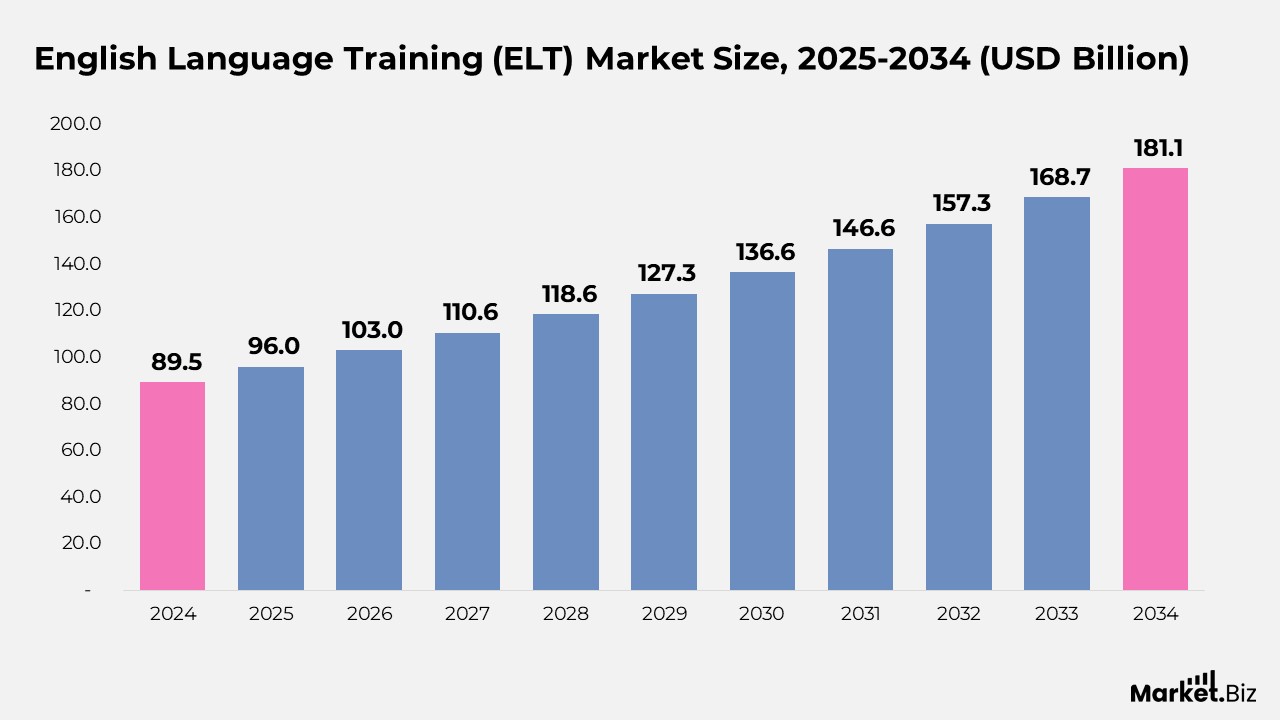
- According to Market.us, the English Language Training (ELT) market is expected to rise from $96.0 billion in 2025 to $181.1 billion by 2034, representing a compound annual growth rate (CAGR) of 7.3% from 2025 to 2034.
- Market growth is driven by rising demand for English fluency for academic, career, and migration purposes, spurred by globalization and urbanization.
- Online learning represents 48% of the English Language Training market, reflecting a strong shift towards digital platforms.
- The K-12 and higher education segment accounts for 41% of the market, highlighting the importance of English proficiency in formal education.
- In 2024, APAC dominates the market, capturing over 42% of the share, generating around USD 37.4 billion in revenue.
- The China English Language Training market was valued at USD 35.6 billion in 2024 and is expected to reach approximately USD 62.56 billion by 2034, growing at a 5.8% CAGR.
- Nearly 1.5 billion people worldwide are learning or speaking a new language, with 60% of the global population bilingual.
- In the U.S., the number of people speaking a second language at home has increased by nearly 30% since 1980.
- Mandarin Chinese is the most studied language globally, with over 100 million learners, while English continues to dominate with over 1.5 billion learners.
- In Europe, nearly 90% of citizens speak at least one foreign language, primarily English.
- In Japan, 82% of university students study English, reinforcing its status as a global lingua franca.
(Source: Market.us)
Public Speaking Anxiety Statistics
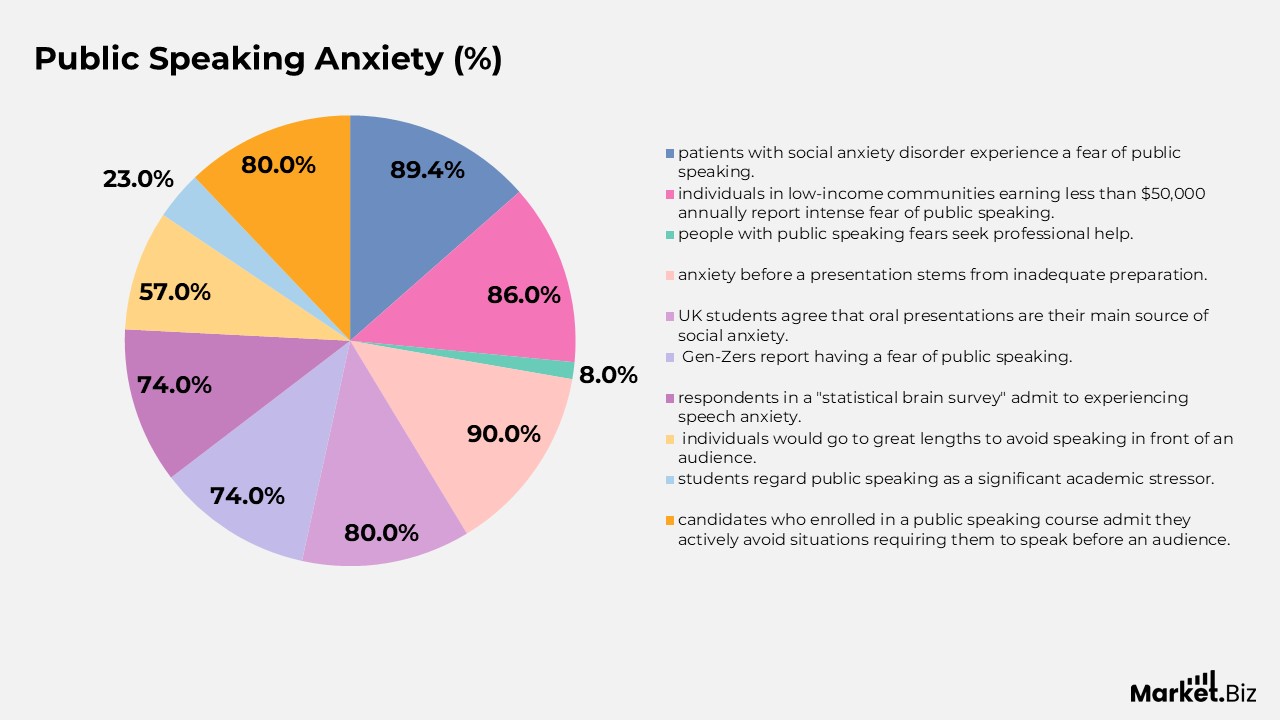
- 89.4% of patients with social anxiety disorder experience a fear of public speaking.
- 40 million adults in the U.S. suffer from various forms of anxiety related to public speaking.
- 86% of individuals in low-income communities making less than $50,000 annually report intense fear of public speaking.
- Despite its documented negative impact, only 8% of people with public speaking fears seek professional help.
- Public speaking anxiety affects 44% of women, compared to 37% of men.
- 90% of the anxiety before a presentation stems from inadequate preparation.
- Around 80% of UK students agree that oral presentations are their main source of social anxiety.
- 74% of Gen-Zers report having a fear of public speaking.
- One in three Finnish students considers public speaking a severe problem.
- People typically spend an average of 3-4 weeks annually worrying about speaking in front of an audience.
- 74% of respondents in a “statistical brain survey” admit to experiencing speech anxiety.
- 57% of individuals would go to great lengths to avoid speaking in front of an audience.
- Around 23% of students regard public speaking as a significant academic stressor.
- 80% of candidates who enrolled in a public speaking course admit they actively avoid situations requiring them to speak before an audience.
- Research estimates that the cost of treating anxiety disorders and phobias, such as glossophobia, ranges between $42.3 billion and $46.6 billion per year.
(Source: National Library of Medicine, National Institutes of Health, Science Direct, Novorésumé ApS)
Power of Public Speaking Statistics
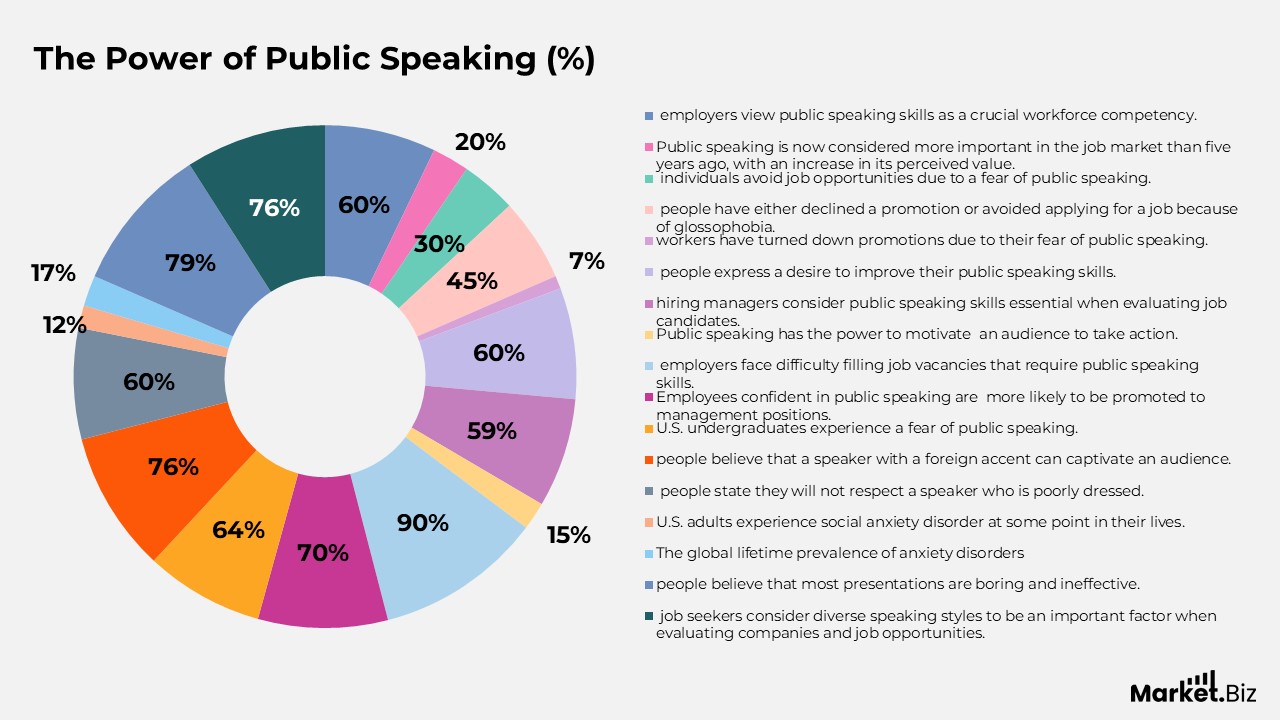
- 60% of employers view public speaking skills as a crucial workforce competency.
- It takes just 27 seconds to make a strong first impression as a speaker.
- Public speaking is now considered more important in the job market than five years ago, with a 20% increase in its perceived value.
- 30% of individuals avoid job opportunities due to a fear of public speaking.
- 45% of people have either declined a promotion or avoided applying for a job because of glossophobia.
- 7% of workers have turned down promotions due to their fear of public speaking.
- More than 60% of people express a desire to improve their public speaking skills.
- The fear of public speaking can result in a 10% reduction in wages.
- 59% of hiring managers consider public speaking skills essential when evaluating job candidates.
- Public speaking training can increase a person’s annual salary by 10%.
- Public speaking has the power to motivate 15% of an audience to take action.
- 90% of employers face difficulty filling job vacancies that require public speaking skills.
- Employees confident in public speaking are 70% more likely to be promoted to management positions.
- 24% of college graduates report fear of public speaking, while 52% of individuals with a high school diploma or less also experience this fear.
- 43% of white individuals report fear of public speaking, compared to 34% of people from other racial backgrounds.
- Confidence in public speaking increases with age, with 69% of individuals aged 45 and over feeling confident, compared to just 25% of those aged 16 to 24.
- 64% of U.S. undergraduates experience a fear of public speaking.
- 76% of people believe that a speaker with a foreign accent can captivate an audience.
- 60% of people state they will not respect a speaker who is poorly dressed.
- Social anxiety disorder typically begins before the age of 20.
- Individuals with a high school diploma or less tend to express more fear than college graduates.
- Millennials face the most difficulty maintaining presentations and connecting with audiences during public speaking.
- Around 12.1% of U.S. adults experience social anxiety disorder at approximately point in their lives.
- The global lifetime prevalence of anxiety disorders is 16.6%.
- About 79% of people believe that most presentations are boring and ineffective.
- 76% of job searchers consider diverse speaking styles to be an important factor when evaluating companies and job opportunities.
(Source: Novorésumé ApS, Statista)
Impact of Public Speaking Fear Statistics
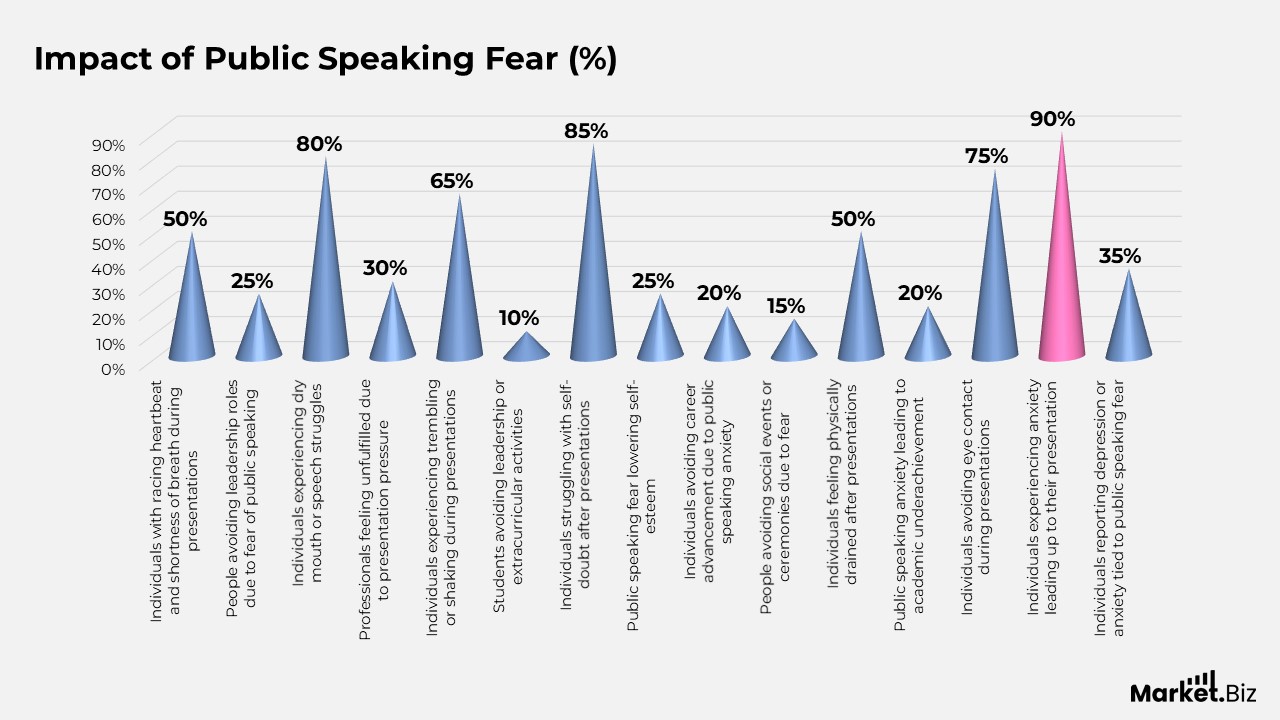
- Up to 50% of persons with public speaking anxiety experience a racing heartbeat and shortness of breath during their presentations.
- The fear of public speaking can discourage people from taking on leadership roles, with approximately 25% opting out of leading meetings or projects.
- Around 80% of those with public speaking anxiety involvement dry mouth or struggle to speak clearly while presenting.
- Public speaking anxiety can negatively affect career satisfaction, with 30% of professionals feeling unfulfilled due to the pressure of presentations.
- Roughly 65% of persons with public speaking anxiety experience trembling or shaking while speaking in front of an audience.
- The fear of public speaking can prevent students from pursuing leadership roles or extracurricular activities, with approximately 10% avoiding such opportunities.
- About 85% of people with public speaking anxiety struggle with negative thoughts or self-doubt after delivering a presentation.
- Public speaking fear can lower self-esteem, with 25% of people feeling less confident globally due to their anxiety.
- 20% of individuals with public speaking anxiety avoid career advancement opportunities that require public speaking.
- The fear of public speaking can impact personal life decisions, with 15% of people avoiding social events, weddings, or public ceremonies.
- About 50% of individuals with public speaking anxiety report feeling physically drained after their presentations.
- Public speaking anxiety can lead to academic underachievement, with 20% of students receiving lower grades on presentations due to their fear.
- 75% of individuals with public speaking anxiety avoid making eye contact with their audience during presentations.
- Nearly 90% of persons with public speaking anxiety experience delicate anxiety in the days leading up to their presentation.
- The fear of public speaking can harm mental health, with 35% of individuals reporting symptoms of depression or anxiety tied to their fear.
(Source: Total Care ABA, Statista)
How Public Speaking Drives Leadership and Career Advancement
- 69% of employees are more inclined to follow a leader who communicates effectively.
- Speakers who exude confidence can significantly sway audience opinions, with 63% of people admitting that a speaker’s assurance influences them.
- 75% of employees feel their communication abilities are insufficient for career growth.
- 62% of executives consider presentation skills to be the most crucial ability for leadership.
- Up to 90% of communication occurs non-verbally, including body language, gestures, and facial expressions.
- 57% of employers believe poor communication skills negatively affect employee performance.
- On average, a person speaks around 7,000 words daily.
- Using visual aids in presentations can enhance audience understanding by as much as 43%.
- In public speaking evaluations, women outperform men by an average of 12%.
- In face-to-face communication, 70% of the message is conveyed visually, 23% vocally, and only 7% verbally.
- 73% of people prefer written communication over speaking in surveys.
- 78% of speakers view storytelling as a key component of effective communication.
- 45% of respondents identify public speaking as the most important skill for advancing in their careers.
- Watching videos of skilled speakers can enhance one’s own public speaking abilities by up to 20%.
- The typical successful business presenter speaks for about 18 minutes.
- 54% of employees believe that managers who communicate effectively are seen as more trustworthy.
- 91% of individuals consider presentation visuals essential for effective communication.
- 52% of companies offer public speaking training to boost leadership skills.
- 78% of learners say watching or listening to experienced speakers improves their own skills.
- 53% of professionals agree that storytelling is a necessary leadership skill.
(Source: ZipDo.co, Statista)
Conclusion
Public speaking is an essential skill that plays a key role in personal, academic, and professional success. Although fear and anxiety surrounding public speaking are common, particularly among younger individuals and those with lower education levels, the value of effective communication is clear.
The statistics show that strong public speaking skills can impact career growth, job opportunities, and even earning potential. As the demand for these skills continues to rise across industries, overcoming the fear of speaking in public can lead to significant rewards. By focusing on training and building confidence, individuals can enhance their career prospects and improve their ability to engage and influence audiences.
FAQ’s
The fear of public speaking is often rooted in factors like self-doubt, fear of being judged, inexperience, and societal pressures to perform well in front of others. Psychological theories suggest this fear arises from a deep-seated fear of embarrassment or failure, which manifests as anxiety when faced with an audience.
Confidence in public speaking generally increases with age. Older individuals, especially those over 45, tend to have more experience with various forms of communication, resulting in higher self-assurance. Younger people, particularly those in their teens and early twenties, may have less experience and feel more self-conscious, contributing to heightened anxiety in public speaking situations.
Yes, fear of public speaking can vary by race or ethnicity, influenced by cultural differences in socialization, communication styles, and exposure to public speaking opportunities. These differences may be linked to societal norms and expectations about who is encouraged or discouraged from speaking publicly, as well as personal experiences in diverse environments.
Individuals with higher levels of education typically have more opportunities to practice public speaking, gaining exposure to environments where communication skills are valued. In contrast, those with lower levels of education may not have had as many opportunities to develop these skills, leading to increased anxiety when speaking publicly.
Public speaking skills play a crucial role in career progression, as they are closely tied to leadership, influence, and the ability to communicate ideas effectively. Research shows that individuals who conquer their fear of public speaking are more likely to experience career advancement, secure promotions, and earn higher wages due to the high value placed on these skills across many industries.
Public speaking has become increasingly essential in today’s job market, driven by the demand for communication-focused roles across business, education, and media. Employers prioritize individuals who can articulate ideas clearly, inspire others, and represent their organizations in public settings. As a result, the ability to speak confidently in public is now seen as a fundamental skill for success in most industries.

