









Introduction
Home Decor Statistics: The home decor market represents a substantial and growing global sector, valued at over $750 billion in 2024 and anticipated to exceed $1 trillion by 2032. This growth is fueled by increasing disposable incomes, urbanization, and a heightened consumer focus on personalization and sustainability. Major segments encompass furniture and textiles, with specialty stores and online platforms dominating the distribution channels.
Regional expansion is particularly strong in the Asia Pacific, while North America continues to exhibit significant consumer expenditure on home improvement. Home decor integrates various design principles and elements that influence the aesthetic and functionality of interior spaces. The fundamental principles include balance, harmony, proportion, rhythm, contrast, and emphasis, which together create visually attractive and cohesive environments.
Key design elements consist of color, texture, pattern, line, shape, and space, each playing a vital role in shaping the overall appearance and ambiance of a room. In this article, we will explore Home Decor Statistics in greater detail.
Editor’s Choice
- AI In Interior Design Market size is expected to be worth around USD 7,299 Million by 2033, from USD 829 Million in 2023.
- In 2020, the global market for interior design services was estimated to be worth $150.7 billion.
- China’s interior design sector is anticipated to reach $57.6 billion by 2027, with an annual growth rate of 11.9%.
- The global wall decor market is expected to grow at a rate of 3.5% from 2023 to 2030.
- In 2021, sales from furniture and home furnishing outlets in the United States reached nearly $136.47 billion.
- The home decor market is primarily dominated by the US, which makes USD 35,440 million in revenue, establishing it as the largest contributor.
- Home décor statistics indicate that the wall décor market in the United States is anticipated to grow by $8.1 billion from 2020 to 2024.
- By 2028, the global floor-covering market is anticipated to generate USD 9.14 billion in revenue, with further growth expected to elevate it to USD 9.56 billion by 2029.
General Home Decor Statistics
- In 2020, the global market for interior design services was estimated to be worth $150.7 billion.
- Projections indicate that it may increase to $255.4 billion by 2027.
- The global home decor sector was valued at $616.6 billion in 2019.
- In 2020, the U.S. interior design industry had a valuation of $40.7 billion.
- China’s interior design sector is anticipated to reach $57.6 billion by 2027, with an annual growth rate of 11.9%.
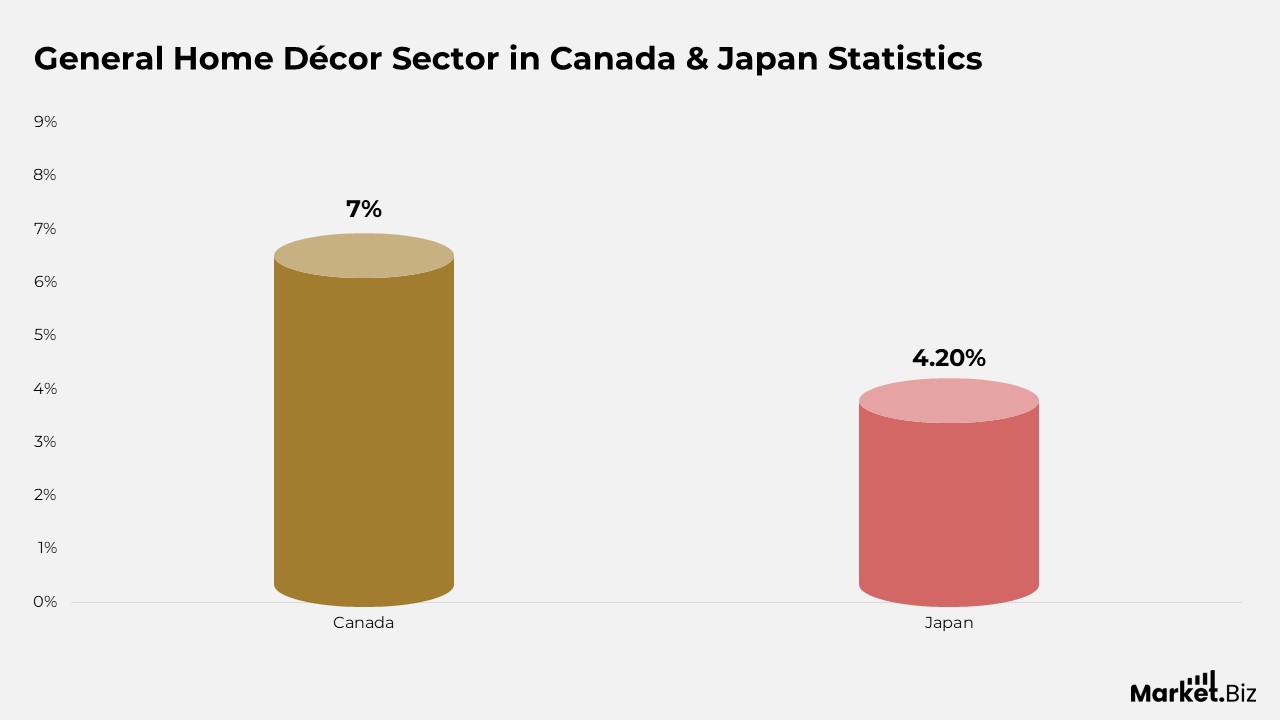
- Home Décor Statistics stated, Canada’s interior project market is expected to grow by 7%.
- Japan’s interior design sector is expected to expand by 4.2%.
- The global market is forecasted to grow at a compound annual growth rate (CAGR) exceeding 4%.
- The chart above illustrates the home décor market statistics categorized by product type, including floor coverings, home textiles, and furniture.
- The Asia-Pacific region, spearheaded by China, is predicted to play a significant role in this growth, as reported by Home Décor Statistics.
Moreover
- Canada’s industry experienced a 2% growth from 2015 to 2020, reaching a total of $1 billion. It encompasses 7,572 businesses and employs 6,135 individuals.
- The U.K.’s interior design sector saw an annual growth of 11.2% from 2017 to 2018, driven by the proliferation of mobile devices, increased internet usage, and real estate transactions.
- The industry is projected to grow at an annual rate of 4.8% from 2022 to 2027, potentially achieving a market size of $898.3 billion by 2027.
- The global wall decor market is expected to grow at a rate of 3.5% from 2023 to 2030.
- The U.S. wall decor market is forecasted to rise by $8.19 billion from 2020 to 2024, propelled by the growing demand for personalized and customized products.
- The U.S. home decor market is on the rise, driven by increasing homeownership rates across the country.
- North America leads the world in wall decorations, accounting for over 40% of the market’s revenue.
Home Decor Industry Statistics
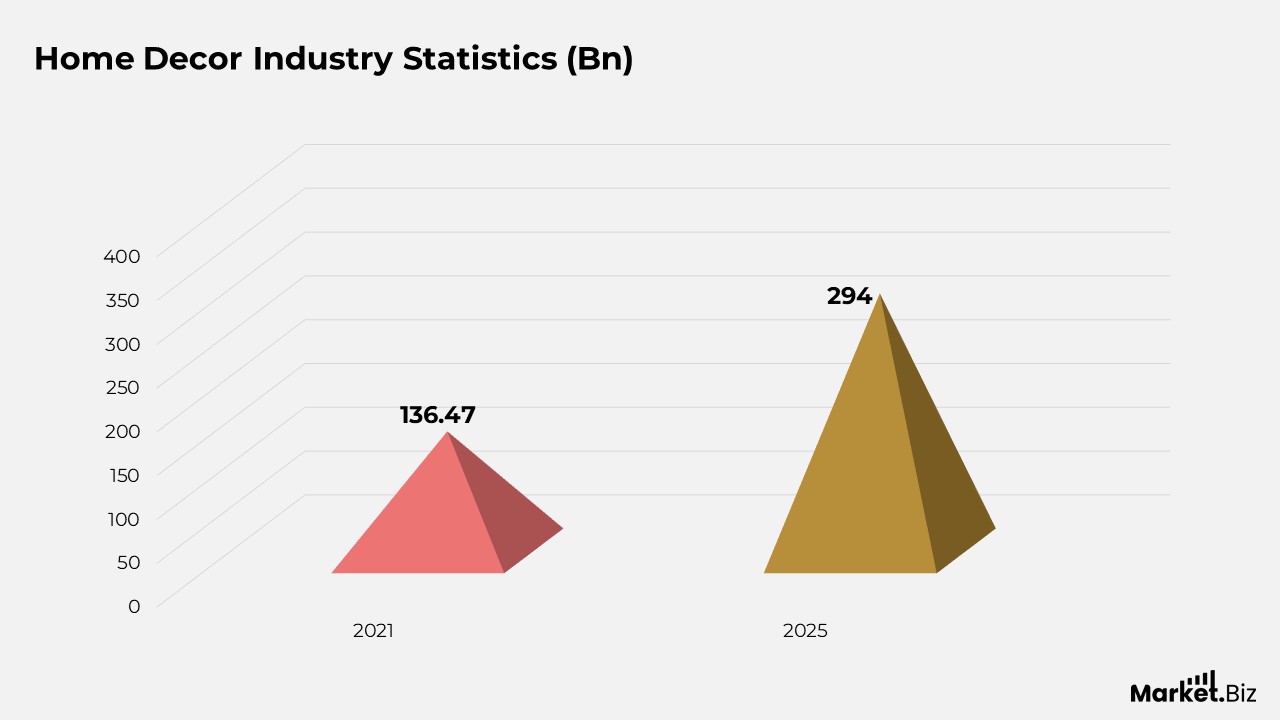
- In 2021, sales from furniture and home furnishing outlets in the United States reached nearly $136.47 billion.
- The global e-commerce sector for furniture and home furnishings is projected to be valued at $294 billion by 2025, with China being the leading contributor.
- In 2020, the revenue generated by interior designer services in the United States was approximately $10.5 billion.
- The indoor furniture category represents the largest segment of the home décor market in the United States, with sales totaling $113.5 billion in recent years.
- The global wallpaper industry is valued at $29.15 billion and is expected to grow at a compound annual growth rate (CAGR) of 4.2% from 2019 to 2025.
- Millennials account for nearly 37% of all households buying home décor and furniture.
- The luxury home furnishing sector in the United States is anticipated to grow at a CAGR of 4.8% through 2024.
- The value of imported home textiles worldwide exceeded $80 billion.
- According to Home Decor statistics, the home decor market in the United Kingdom was valued at $9.91 billion in 2020.
- By 2025, the home decor market in the United States is projected to be valued at $224 billion.
Moreover
- In 2020, the European home decor market held a share of 32.4%.
- From 2021 to 2028, the Asia Pacific home décor industry is estimated to experience a CAGR of 4.4%.
- The floor covering segment within home decor is forecasted to achieve a CAGR of 3.8% from 2021 to 2028.
- In 2020, the textile home design segment accounted for nearly 30.9% of the industry share, according to home décor statistics.
- The global lighting sector is projected to reach an industry size of $130.1 billion by 2028.
- The online sales network for home decor is expected to achieve a CAGR of nearly 4.6% between 2021 and 2028.
- The home decor industry is forecasted to grow at a CAGR of 3.9% from 2021 to 2028.
- By 2028, the global home décor market size is estimated to reach $792.6 billion, according to home décor statistics.
Growth Statistics of Home Decor Market
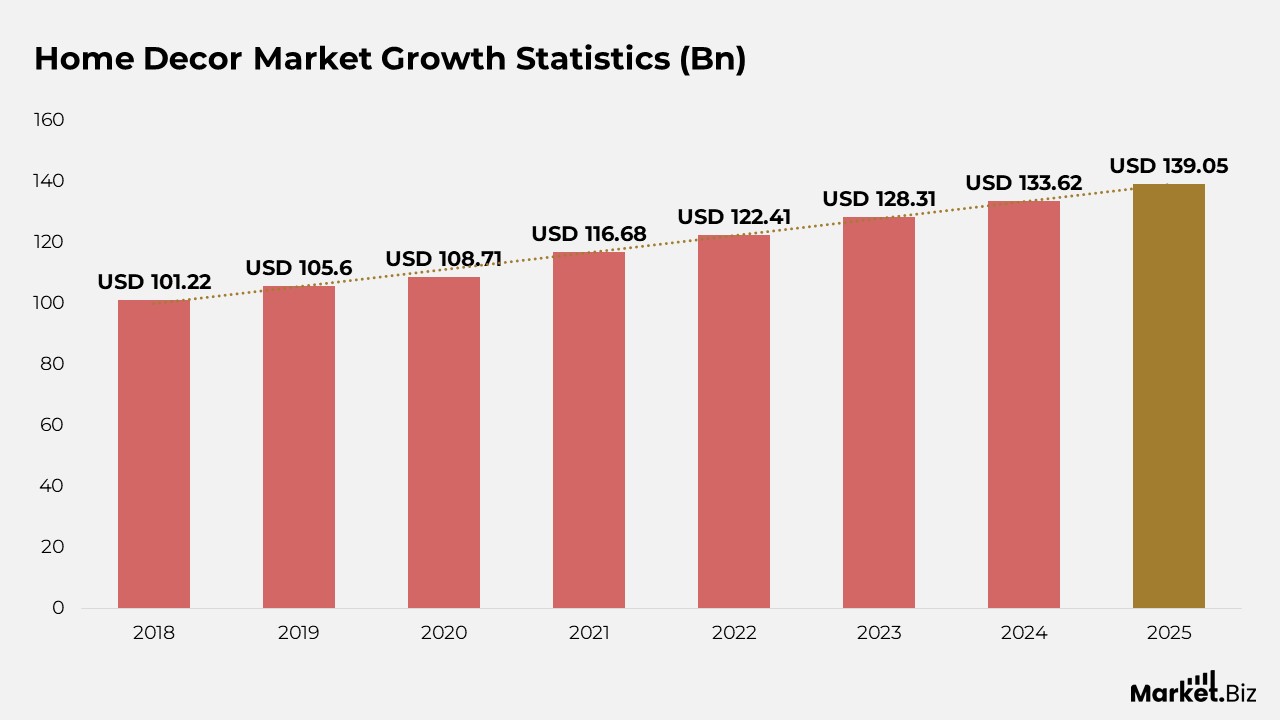
- The global home decor market has shown steady growth over the years, achieving a compound annual growth rate (CAGR) of 3.89%. It began at USD 101.22 billion in 2018 and increased to USD 105.60 billion in 2019.
- This positive trend persisted in 2020, with the market reaching USD 108.71 billion. This was followed by notable growth in 2021, where revenue rose to USD 116.68 billion.
- In 2022, the market further grew to USD 122.41 billion, and forecasts for 2023 predict a revenue of USD 128.31 billion.
- The anticipated growth is expected to continue in the upcoming years, with revenues projected to reach USD 133.62 billion in 2024, USD 139.05 billion in 2025, and USD 144.63 billion in 2026.
- By 2027, the market is expected to generate USD 150.27 billion, followed by USD 156.01 billion in 2028, ultimately reaching USD 161.68 billion by 2029.
Home Decor Statistics by Country
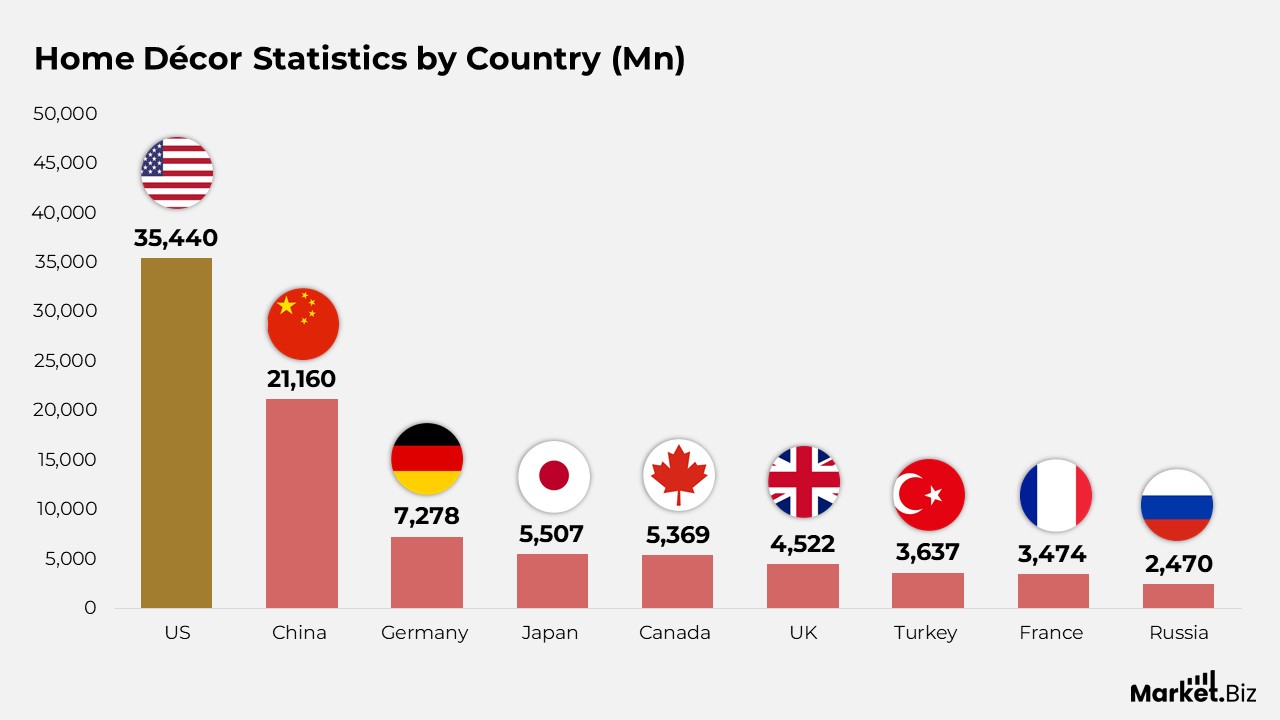
- The home decor market is primarily dominated by the US, which makes USD 35,440 million in revenue, establishing it as the largest contributor.
- China closely follows with USD 21,160 million, reflecting its robust position in the market.
- Germany secures the third position with USD 7,278 million, while Canada and Japan contribute USD 5,369 million and USD 5,507 million, respectively.
- The United Kingdom possesses a notable share of USD 4,522 million, followed by France at USD 3,474 million and Turkey at USD 3,637 million.
- Include Russia, other significant countries in the home decor market, which generate USD 2,470 million, including Brazil, at USD 2,121 million, and South Korea, contributing USD 2,199 million.
- The Netherlands adds USD 2,111 million, while India and Italy are nearly on par, with revenues of USD 1,961 million and USD 1,953 million, respectively.
- Mexico generates USD 1,760 million, and Australia contributes USD 1,800 million.
- Spain follows with USD 1,725 million, while Poland and Saudi Arabia contribute USD 1,410 million and USD 1,402 million, respectively.
- Finally, Sweden accounts for USD 1,047 million in revenue, completing the list of key players in the global home decor market.
Custom Decor Products Statistics
- At present, personalized cushions and pillows are gaining popularity as they add a soft touch to any room.
- Tailored wall art, which encompasses canvases and framed prints, allows homeowners to display their photographs or choose from a diverse array of artistic designs that reflect their personal style.
- Another emerging trend is customized furniture, which provides options such as engraved wooden pieces and exquisite items featuring distinctive fabric designs.
- The chart above illustrates the home furnishing websites and applications along with the visit indices in the United Kingdom, Spain, Italy, Germany, and France.
- As per Business Research statistics, the global decorative pillow market was valued at nearly $3.4 billion in 2022 and is projected to expand to $4.83 billion by 2028.
- Home décor statistics indicate that the wall décor market in the United States is anticipated to grow by $8.1 billion from 2020 to 2024.
- The mug market in the United States is forecasted to rise from $7.6 billion in 2023 to $10.9 billion by 2031.
- The global market for rugs and carpets was valued at approximately $78.1 billion in 2021 and is projected to grow to $120 billion by 2030, with an annual growth rate of 5.5% from 2022 to 2030 (CAGR 2022–2030), according to Market Research Store.
- The worldwide market for blankets was valued at around $8.3 billion in 2023 and is expected to reach about $9.9 billion by 2027, as reported by Statista.
- Customized decorative items, vases, and sculptures are favored choices for homeowners seeking to incorporate a unique and personal artistic flair into their home décor.
- The global decorations market is anticipated to reach $29.1 billion in 2024 and grow at an annual rate of 5.70% from 2024 to 2028 (CAGR 2024–2028), according to Statista.
Revenue from Home Decor Products Statistics
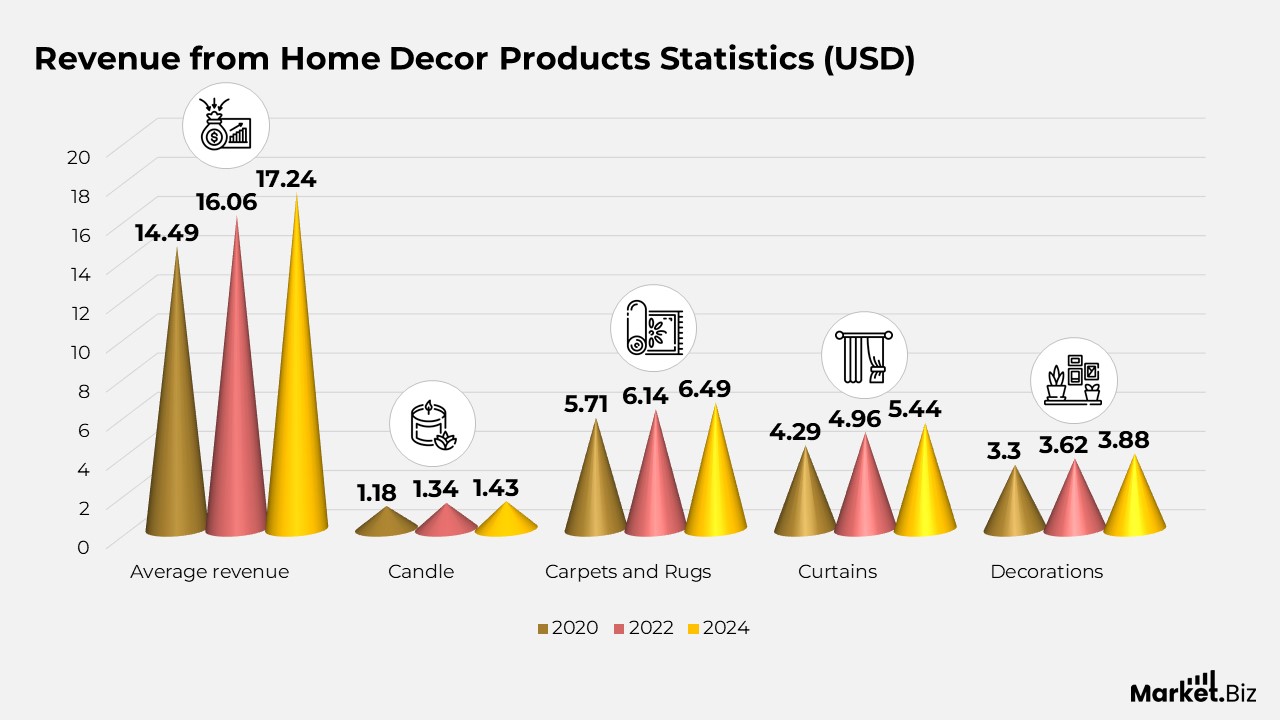
- By the year 2019, the overall average revenue increased to USD 14.20, influenced by modest rises across all categories, which included candles priced at USD 1.21, carpets and rugs at USD 5.53, curtains at USD 4.27, and decorations at USD 3.19.
- In 2020, the average revenue per capita saw an increase to USD 14.49. Although there was a slight decrease in candles to USD 1.18, carpets and rugs experienced growth, reaching USD 5.71, while curtains and decorations were priced at USD 4.29 and USD 3.30, respectively.
- A significant increase was noted in 2021, with the total average rising to USD 15.42, as candles climbed to USD 1.37, carpets and rugs to USD 5.92, curtains to USD 4.66, and decorations to USD 3.47.
- By 2022, the average per capita revenue advanced to USD 16.06, with candles at USD 1.34, carpets and rugs at USD 6.14, curtains at USD 4.96, and decorations at USD 3.62.
- The upward trend persisted in 2023, with a total average of USD 16.70, and further increases are anticipated for 2024. The projected total is USD 17.24, with candles, carpets, curtains, and decorations contributing USD 1.43, USD 6.49, USD 5.44, and USD 3.88, respectively.
- Forecasts for 2025 indicate a total average revenue of USD 17.80, continuing to rise steadily to USD 20.06 by 2029. During this timeframe, candles are expected to reach USD 1.63, carpets and rugs USD 7.26, curtains USD 6.66, and decorations USD 4.51, reflecting a consistent growth trajectory across all product categories in the home décor market.
Home Decor Floor Covering Statistics
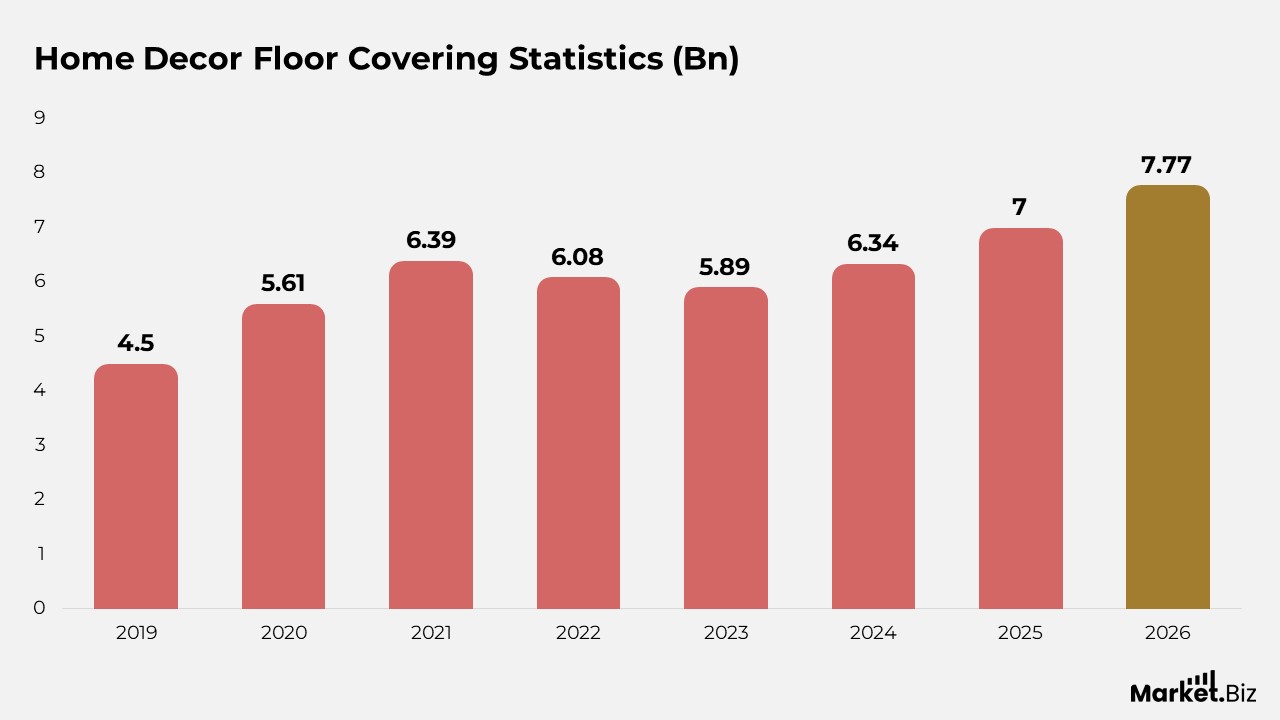
- In 2017, the market revenue was recorded at USD 3.85 billion, increasing to USD 4.15 billion in 2018 and achieving USD 4.50 billion in 2019.
- A significant increase was noted in 2020 when the market expanded to USD 5.61 billion. This was followed by additional growth in 2021, with revenues reaching USD 6.39 billion.
- Nevertheless, a minor decline was noted in 2022, as the market fell to USD 6.08 billion.
- In 2023, the market is anticipated to undergo a slight decrease, reaching USD 5.89 billion. However, it is expected to rebound in 2024 with an estimated revenue of USD 6.34 billion.
- The upward trajectory is projected to persist, with forecasts indicating the market will reach USD 7.00 billion in 2025, USD 7.77 billion in 2026, and USD 8.54 billion in 2027.
- By 2028, the global floor-covering market is anticipated to generate USD 9.14 billion in revenue, with further growth expected to elevate it to USD 9.56 billion by 2029.
Recent Development
- In 2023, Pepperfry, an Indian online retailer specializing in furniture and home decor, raised $40 million to broaden its operations and enhance its offline presence by establishing more physical experience centers throughout India.
- In 2024, Made.com, a UK-based online retailer of furniture and home decor, obtained $70 million in funding to expedite its international expansion across Europe and to penetrate new markets in the United States.
- In 2025, it is anticipated that over 40% of home decor retailers will provide AR features on their websites or applications, thereby improving the shopping experience and decreasing return rates.
- In 2025, smart home decor products are expected to represent 25% of the home decor market, propelled by advancements in lighting, furniture, and accessories.
Conclusion
Home Decor Statistics: The home decor sector has shown steady growth, influenced by changing consumer preferences, advancements in technology, and a rising demand for sustainable, customized, and practical living environments.
As trends increasingly favor natural elements, eco-friendly designs, and the incorporation of smart technology, the sector is anticipated to keep growing.
Nonetheless, emerging themes such as personalization, hybrid living spaces, hybrid work environments, and sustainability underscore a consumer demographic that values both aesthetics and environmental awareness.
Additionally, the consistent growth of the global market is driven by a mix of economic factors and evolving lifestyles. The home decor industry continues to be a vibrant and promising field for future growth.
FAQs
North America, Europe, and the Asia-Pacific region are at the forefront. North America stands as the largest regional market, attributed to its substantial consumer spending capacity and a cultural emphasis on home aesthetics and comfort.
Launching an online home decor business is not only feasible but also highly impactful. With an effective strategy, a well-defined niche, and appealing products, you can transform your passion for design into a successful brand. Each phase, from planning and establishing your store to its marketing, brings you closer to achieving a profitable enterprise.
Fabrics such as velvets, cottons, and canvas rank among the most favored materials for styling a classic, timeless interior, as they exude elegance without excessive ornamentation. A timeless, classic interior is characterized by balance, often featuring a play of symmetry. Rooms typically revolve around a central focal point, such as a fireplace.

