








Introduction
Biometric Technology Statistics: Biometric technology, which identifies individuals based on unique physical and behavioral traits, has seen remarkable growth and widespread adoption across various industries. As businesses and governments seek more secure, efficient, and reliable methods of user authentication, biometric systems have emerged as a critical solution. These technologies are applied in numerous fields, including mobile devices, border security, banking, healthcare, and corporate environments.
Technological advancements, rising concerns over security threats, and growing consumer demand for seamless authentication methods fuel the expansion of biometric systems. The global biometric technology market is poised for further growth, with innovations in fingerprint recognition, facial recognition, iris scanning, and voice recognition driving the sector.
Additionally, the integration of AI and machine learning into biometric systems promises to improve their accuracy and functionality. Statistical data on market growth, adoption trends, and emerging technologies highlight biometrics’ increasing influence on the future of security and identity verification.
Editor’s Choice
- By 2022, 81% of smartphones were equipped with biometric features.
- In 2023, 46% of air travelers used biometric systems at airports, up from 34% in 2022.
- Over 176 million people in the United States have adopted facial recognition technology.
- Approximately 245 million Americans utilize biometric features on their smartphones.
- Fingerprint recognition is the most widely used biometric technology, with 70% of Americans employing it.
- The primary use of biometrics is device unlocking, with 42% of Americans using it for this purpose.
- The public sector leads as the largest consumer of biometric technologies, holding around 32% of the market share.
- Facial recognition systems exhibit significant demographic biases, with false match rates being 10 to 100 times higher for Black individuals compared to White individuals.
General Biometric Technology Statistics
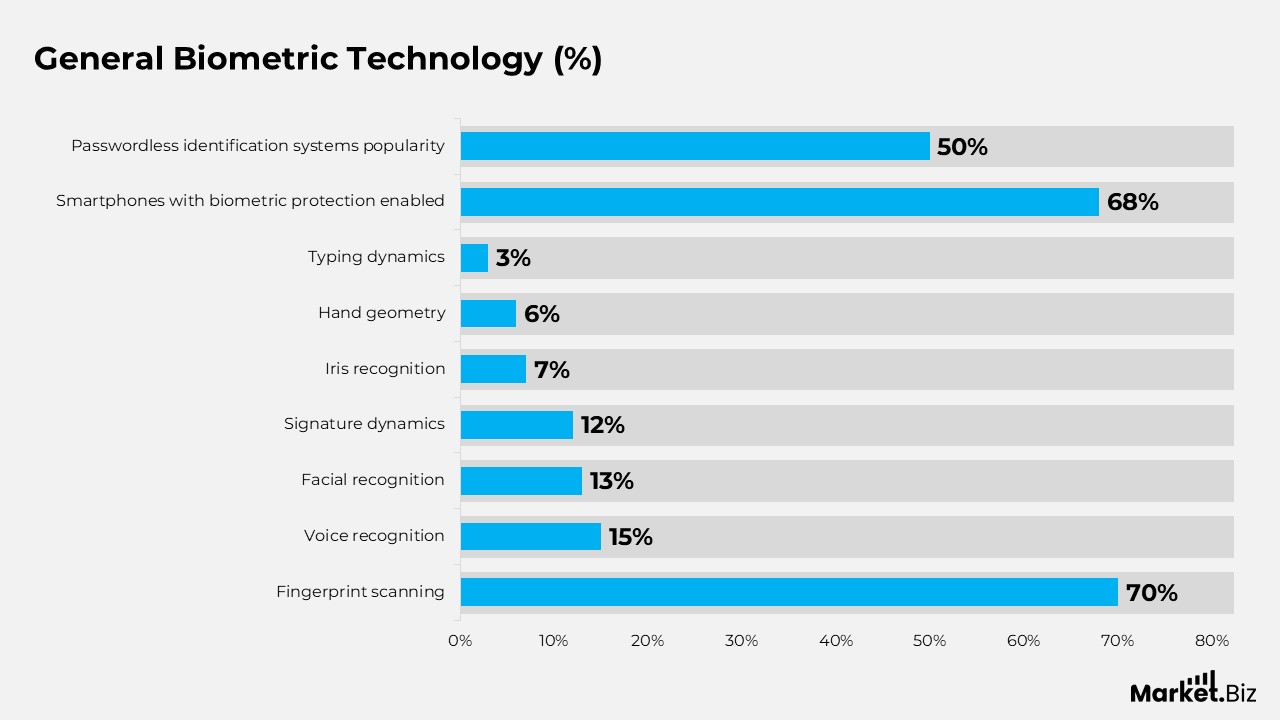
- 70% of Americans have used fingerprint scanning.
- 15% of Americans have used voice recognition.
- 13% of Americans have used facial recognition.
- 12% of Americans have used signature dynamics.
- 7% of Americans have used iris recognition.
- 6% of Americans have used hand geometry.
- 3% of Americans have used typing dynamics.
- Fingerprint scanning is the most accepted biometric technology, with 86% of Americans feeling comfortable using it.
- Facial recognition is the least favored, with 30% of Americans expressing concerns about it.
- The percentage of smartphones with biometric protection aided grew from 68% in 2016 to 80% in 2020, but has remained stable at about 80% since.
- Passwordless identification systems have gained 50% in popularity since 2019.
(Source: passport-photo.online, Statista, DemandSage)
Biometric Technologies User Adoption
- 70% of Americans use fingerprint scanning, making it the most widely adopted biometric technology.
- Out of 307 million smartphone users in the U.S., approximately 245 million have integrated biometrics into their devices.
- Individuals who have used fingerprint recognition are more likely to adopt facial recognition in the future.
(Source: passport-photo.online, Statista, DemandSage)
Biometrics as a Service in the Healthcare Market Size
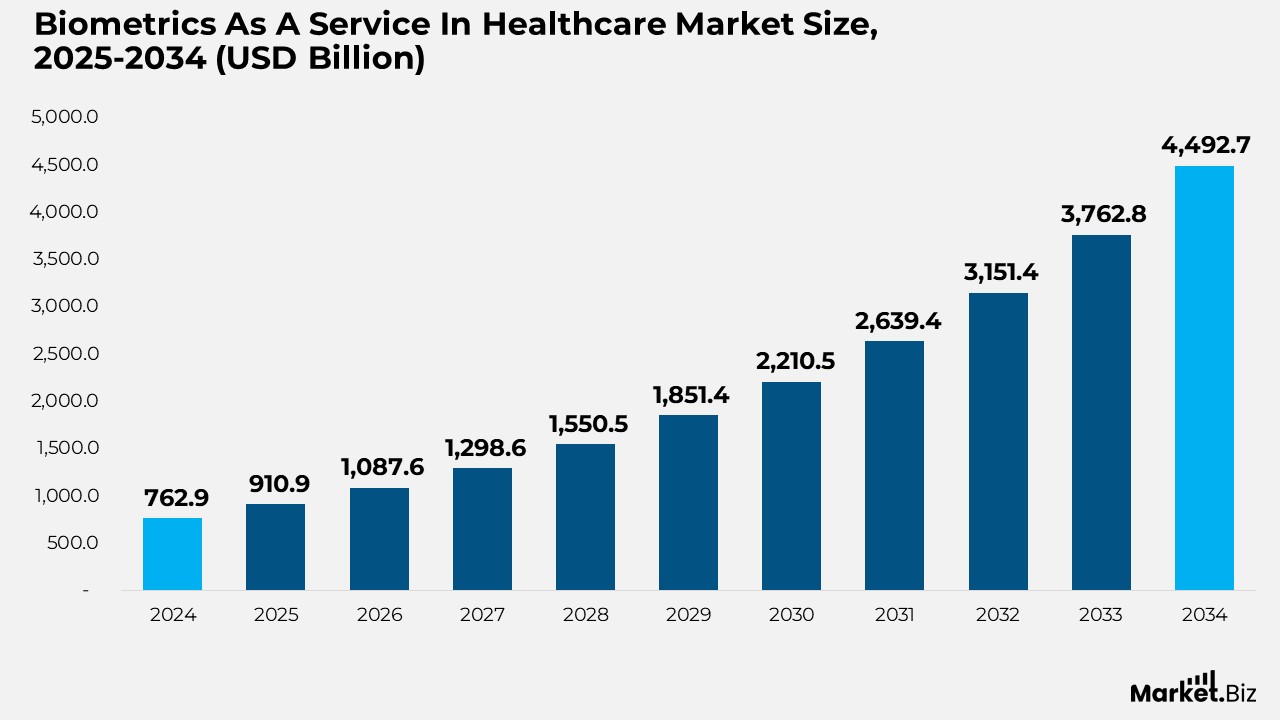
- According to Market.us, the biometrics as a service in the healthcare market is expected to rise from $910.9 million in 2025 to $4,492.7 billion by 2034, representing a compound annual growth rate (CAGR) of 19.4% from 2025 to 2034.
- The market growth is fueled by the digital transformation of healthcare, with telemedicine, mobile health apps, and e-prescriptions increasing demand for secure patient verification.
- Multimodal systems dominated the Type segment in 2024, holding over 54.2% share due to higher accuracy and reliability using multiple biometric traits.
- Mobile applications led the Application segment in 2024, capturing more than 41.6% share, driven by smartphone-based biometric logins for patient portals and telemedicine.
- Fingerprint recognition was the leading Scanner Type in 2024, with over 48.3% share, favored for its cost-effectiveness and integration with healthcare systems.
- North America held the largest regional share in 2024, exceeding 47.1%, with a market value of US$359.3 million, supported by healthcare adoption and data protection priorities.
- Public sector programs have enrolled over 1.2 billion people in low- and middle-income countries in biometric identification initiatives.
(Source: Market.us)
Biometric Technology Use Cases
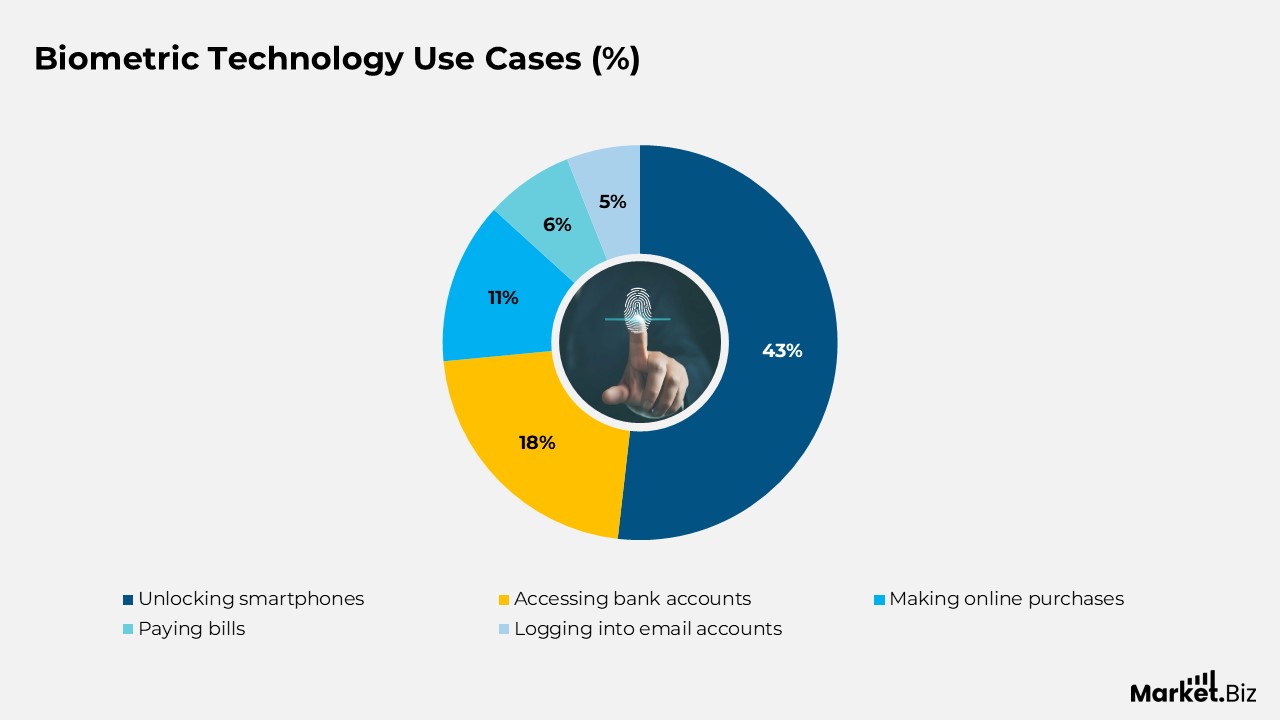
- 43% of Americans use biometrics to unlock their smartphones.
- 18% use it for accessing bank accounts.
- 11% use it for making online purchases.
- 6% use it to pay bills.
- 5% use it for logging into email accounts.
(Source: passport-photo.online, Statista, DemandSage)
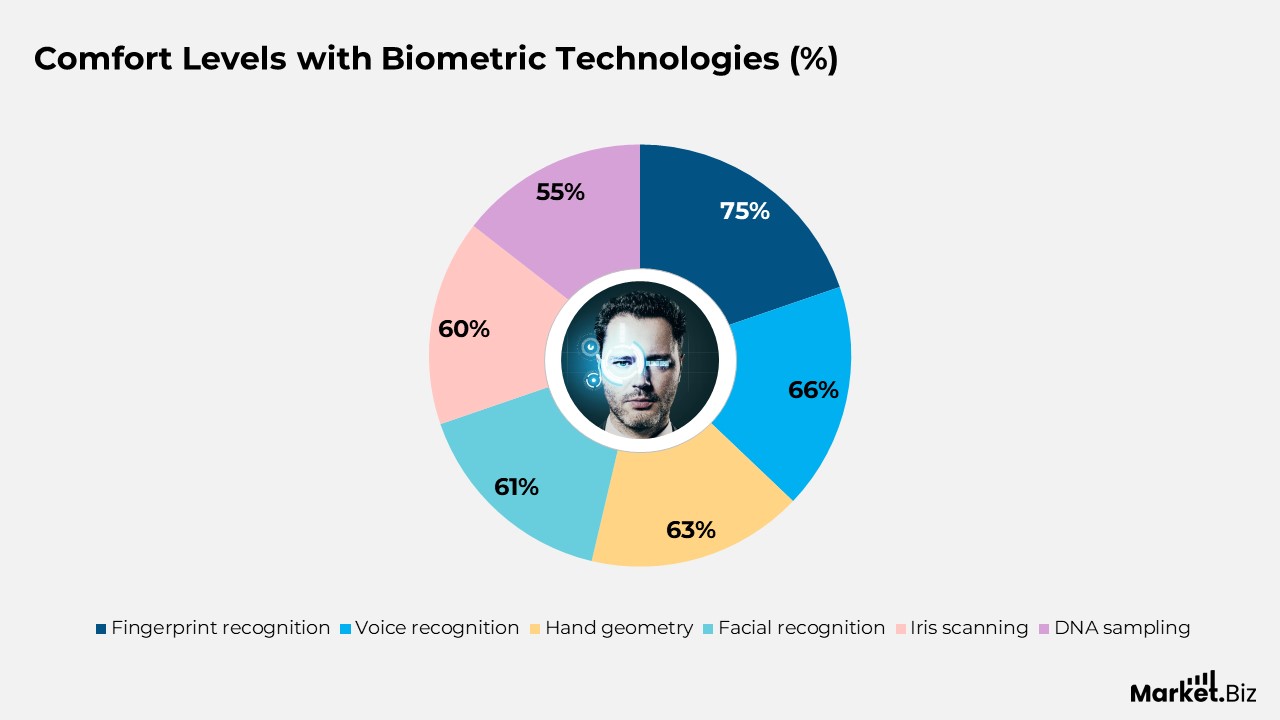
Comfort Levels with Biometric Technologies
- 75% of Americans are comfortable with fingerprint recognition.
- 66% are comfortable with voice recognition.
- 63% are comfortable with hand geometry.
- 61% are comfortable with facial recognition.
- 60% are comfortable with iris scanning.
- 55% are comfortable with DNA sampling.
(Source: passport-photo.online, Statista, DemandSage)
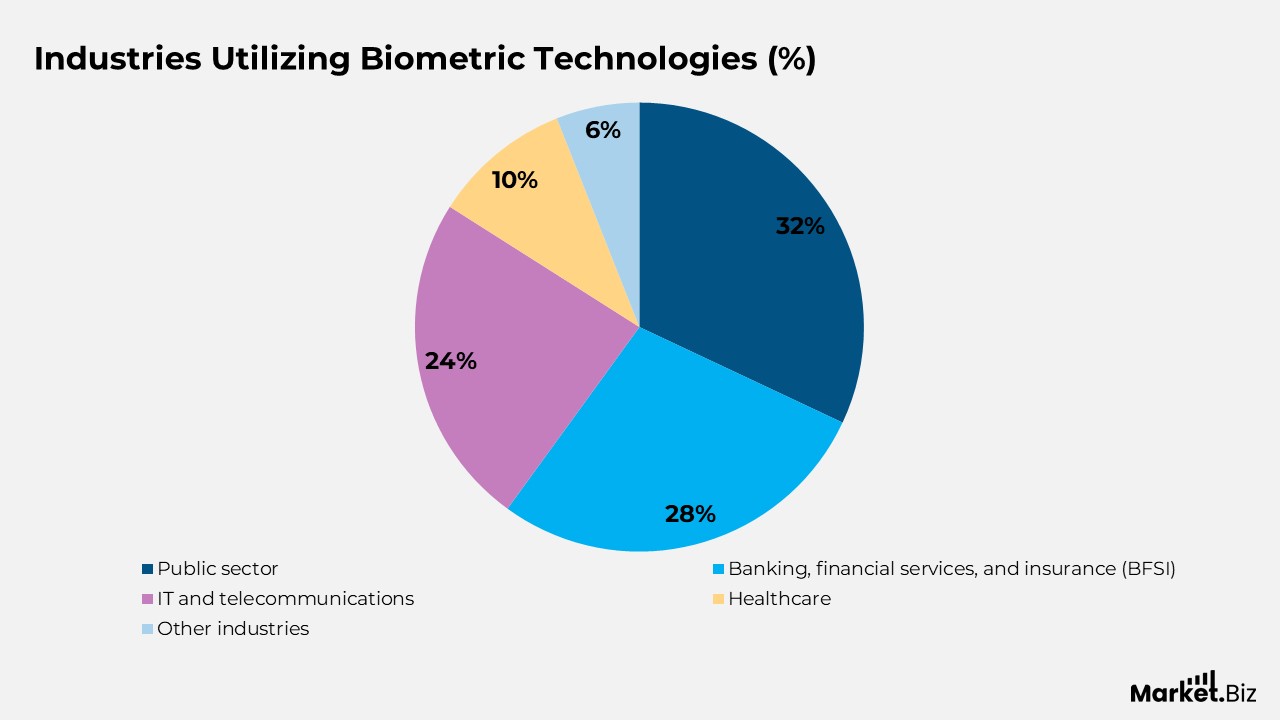
Industries Utilizing Biometric Technologies
- 32% of biometric technology is used in the public sector.
- 28% is used by the banking, financial services, and insurance industries.
- The IT and telecommunications sectors use 24%.
- 10% is used in healthcare.
- 6% is used by other industries.
(Source: passport-photo.online, Statista, DemandSage)
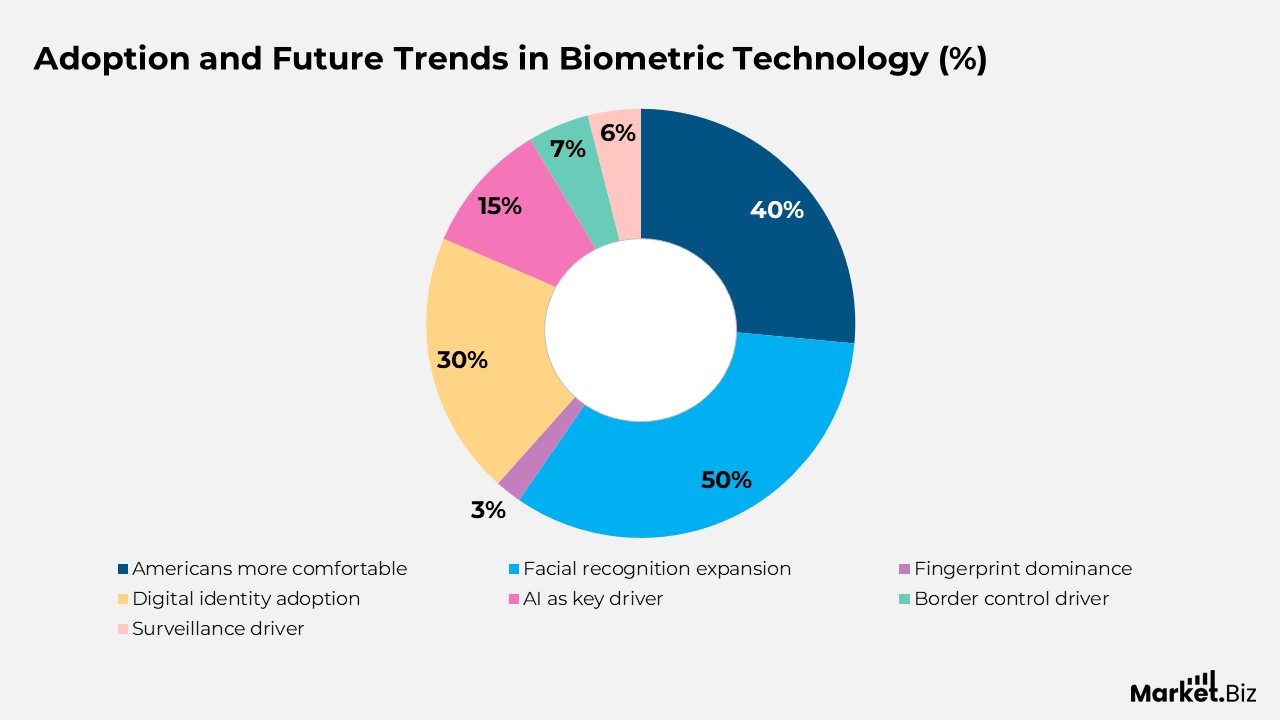
Adoption and Future Trends in Biometric Technology
- Over 40% of Americans feel more comfortable using new biometric technologies today compared to two years ago.
- 50% of industry experts believe that facial recognition will significantly expand biometric tech applications over the next five years.
- Only 3% of industry professionals think fingerprint authentication will dominate the biometric market.
- 30% of biometric experts predict that the digital identity sector will be the largest adopter of biometric technologies in the next five years.
- 15% of professionals identify artificial intelligence as the key driver for biometric use cases, followed by 7% pointing to border control and 6% to surveillance.
(Source: passport-photo.online, Statista, DemandSage)
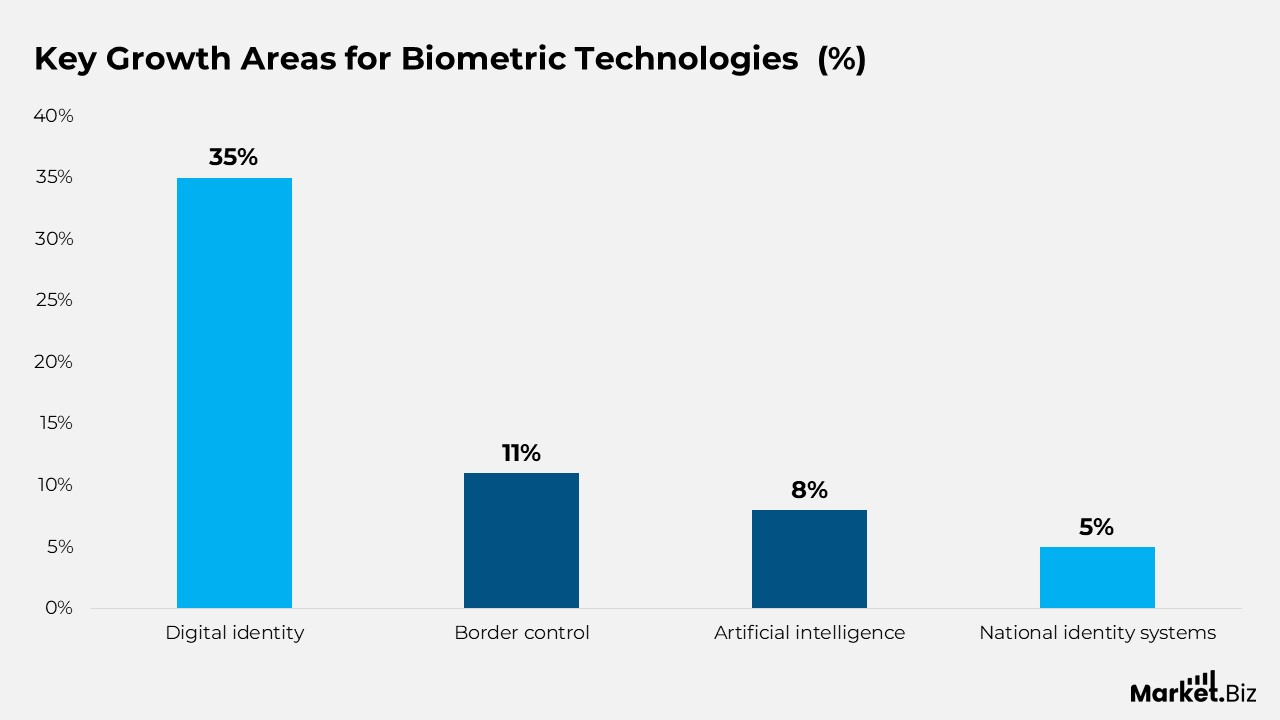
Key Growth Areas for Biometric Technologies
- 35% of industry experts agree that digital identity will see the highest increase in biometric technology use.
- 11% see border control as a major area for biometric growth.
- 8% highlight artificial intelligence as a rapidly growing area for biometric technology adoption.
- 5% believe national identity systems will be the leading sector for biometric technology implementation.
(Source: passport-photo.online, Statista, DemandSage)
Passengers’ Perspectives on Biometric Technology at Airports
- Many passengers believe that biometric technology can accelerate processes, with a strong agreement from most.
- A majority feel comfortable with biometrics being used for security checks, expressing strong approval.
- However, some passengers express concerns about privacy risks, though they still agree with the overall use of biometrics.
- There is a consensus that biometrics at airports is a good idea, with positive feedback.
- Many travelers are open to using biometrics in airports, with a significant share showing agreement.
- A portion of travelers (somewhat agreeing) say they would still use biometrics even if other options are available.
(Source: passport-photo.online, Statista, DemandSage)
Biometric Adoption at Airports
- 36% of travelers have already experienced biometric-powered processes at airports, and 88% of them were satisfied with the experience.
- 75% of airport passengers prefer using biometrics instead of traditional passports and boarding passes.
- 73% of travelers are willing to share their biometric data to speed up airport procedures.
- 25% of Americans are against the use of facial recognition for domestic flights.
(Source: passport-photo.online, Statista, DemandSage)
Biometric Technology Adoption Across Industries
- The government has an adoption rate of 70% to 85%, primarily using biometric technology for national security and citizen services.
- Financial services have an adoption rate of 60% to 75%, focusing on fraud prevention and transaction security.
- In healthcare, biometric adoption ranges from 50% to 60%, with applications in patient record security and identity verification.
- The manufacturing sector adopts biometrics at a rate of 35% to 45%, primarily for access control and time and attendance tracking.
- Retail adoption is between 30% and 40%, aimed at enhancing customer experience and enabling secure payments.
(Source: Zoe Talent Solutions, Statista)
Trends in Biometric Technology Adoption
- A Visa poll revealed that 86% of participants prefer using biometrics over traditional passwords for identity authentication.
- Spiceworks found that 24% of businesses surveyed in 2018 planned to implement biometric technology within the next two years, in addition to the 62% already using it.
- Over 75% of Americans have used biometric technology, ranging from fingerprint scans to facial recognition, signature dynamics, and hand geometry.
- Millennials are 34% more likely than individuals over 17 to use password managers, making them the leading generation in this trend.
- 42% of millennials use complex passwords with special characters, numbers, and letters, while 49% of those over 55 do so. Furthermore, 41% of millennials reuse passwords, compared to 31% of those over 55.
- 75% of millennials are comfortable using biometrics, a higher rate than 58% of individuals over 55.
- 67% of people are currently comfortable with biometric identification, and 87% believe they will be in the near future.
- Despite feeling comfortable using biometrics, less than 50% of millennials between 20 and 36 use complex passwords, and 41% reuse passwords across multiple accounts.
- Juniper Research projects that over 18 billion transactions will use biometrics in 2021, growing at a compound annual growth rate of 83.7% from 2016 levels.
- 57% of businesses surveyed by Spiceworks use fingerprint scanning as their primary biometric authentication method.
- 48% of respondents in the same survey cited the potential for biometric data theft as the biggest security concern regarding the technology.
Moreover
- 62% of businesses already use biometric identification, with an additional 24% planning to adopt it within the next two years.
- 28% of businesses use biometrics for internal operations, while 22% use it for cloud applications.
- 67% of respondents indicated that costs are a significant barrier to adoption, followed by 59% who mentioned reliability concerns.
- Other image-based biometric techniques, such as iris/retinal scanning, palm vein recognition, ear recognition, and hand geometry, are used by 5% of businesses.
- According to NIST, biometric accuracy improved from 96% to 99.8% between 2014 and 2018.
- In 2021, the demand for facial biometric technology services increased by 41% compared to the previous year.
- 13% of facial biometric validations in 2021 were flagged as fraud attempts during business onboarding procedures.
- Market Research anticipates the face biometrics market will reach $96 billion by 2022.
- 20% of processes could only be completed in-person or over the phone, making full online onboarding impossible.
- 31% of Americans admitted to driving with an expired license to avoid visiting the DMV in person.
- According to iProov, 32% of customers globally reported losing their passwords in the past 24 hours.
- 50% of people abandon online purchases due to forgotten passwords or the time-consuming process to retrieve them.
- 70% of respondents would be willing to use facial identification for mobile banking.
Further
- 72% of people think it’s more important than ever to verify someone’s identity online, and 81% believe biometrics will play a key role in online identity verification in the future.
- 72% of global customers prefer facial biometrics over passwords for secure online transactions.
- 77% of financial sector cybersecurity professionals express concerns about deep fake fraud attempts.
- 78% of businesses admit they cannot provide an optimal digital experience for customers.
- 80% of customers are more likely to engage with companies that have effective identity verification processes.
- 81% of customers believe biometrics is a more secure method for identity verification.
- 86% of those surveyed would either definitely or possibly pay for an online driver’s license or ID renewal.
- 88% of respondents believe there are increased security risks online, with 51% able to distinguish between a real video and a deep fake, compared to 37% in 2019.
- 330 million new bank accounts are expected to be established digitally by 2025, a significant rise from 184 million in 2020.
- 30% of consumers use mobile devices exclusively for remote banking.
- By 2024, 60% of biometrically confirmed payments will be made remotely, according to Juniper Research.
- 36% of financial institutions have lost a customer or potential client due to inefficient or slow onboarding procedures, as reported by Fenergo.
- McKinsey suggests that digitally enabled procedures could reduce onboarding costs by up to 90%.
- Contactless mobile transactions protected by biometrics are expected to rise by over 520% from 2020 to 2025.
- Only 12% of respondents think the DMV should offer digital identity services to citizens.
- According to iProov, 45% of the largest U.S. banks can onboard a client online in 30 minutes, while the remaining 45% take two days or longer.
(Source: passport-photo.online, Statista, DemandSage)
Conclusion
Biometric technology is advancing quickly, becoming a crucial component of modern security and identification systems across various industries. The increasing use of biometric solutions in sectors such as mobile devices, healthcare, banking, and border control highlights the rising need for secure, efficient, and user-friendly authentication methods.
Innovations in fingerprint recognition, facial recognition, and other biometric techniques, combined with the integration of AI and machine learning, are enhancing the accuracy and capabilities of these systems.
As the global biometric technology market continues to grow, it is evident that biometrics will play a central role in the future of security and identity management, providing both convenience and improved protection. The ongoing progress and innovation in this field are expected to accelerate its adoption further, making biometric systems a fundamental aspect of the digital world.
FAQ’s
Biometric technology uses unique physical and behavioral traits, such as fingerprints, facial recognition, iris scans, and voice patterns, to identify and authenticate individuals. It provides a secure, efficient, and dependable method of personal identification for various applications.
The main types of biometric systems include: Fingerprint recognition, Facial recognition, Iris scanning, Voice recognition, Hand geometry recognition, Signature verification, Behavioral biometrics (e.g., typing patterns, gait analysis)
Biometric technology is utilized in multiple sectors, including:
Mobile devices: For unlocking smartphones and verifying user identity.
Banking and finance: For secure online transactions and ATM access.
Healthcare: To safeguard patient data and ensure proper identity verification. Border control: For enhancing security at immigration checkpoints.
Corporate security: For employee access control and secure login systems.
AI and machine learning enhance biometric systems by increasing accuracy, speeding up processing times, and improving adaptability to changing environments. These technologies help biometric systems recognize patterns, minimize errors, and adjust to variations, such as aging or environmental conditions, ensuring more reliable identification.
Key challenges include: Privacy concerns surrounding the storage and usage of personal biometric data.
High implementation costs for businesses and government entities.
Errors in biometric identification, leading to false positives or negatives, could cause security issues or inconvenience for users.
Regulatory challenges, with the need to comply with diverse national and international data protection laws.