









Introduction
Robotic Process Automation (RPA) Statistics: Process Automation (RPA) is a game-changing technology that uses software robots, or bots, to automate repetitive, manual tasks across a variety of industries. RPA aims to boost efficiency, cut operational costs, and reduce human errors by automating tasks usually performed by employees. By mimicking human actions, RPA handles a diverse array of activities such as data entry, invoice processing, and customer service interactions, all without the need for human involvement.
The RPA market has experienced substantial growth as businesses in numerous sectors recognize the potential to enhance operations. Recent reports indicate that the RPA market is set to grow rapidly, fueled by advances in AI, machine learning, and cloud computing technologies. As more organizations adopt RPA to optimize workflows and increase scalability, the technology is expected to reshape how companies manage their business processes.
Editor’s Choice
- According to Deloitte’s third annual RPA survey, 53% of respondents are beginning their RPA journey.
- Among those currently implementing RPA, 78% plan to increase their investments in the next 3 years.
- Deloitte predicts that, if this trend continues, RPA will achieve near universal adoption within the next 5 years.
- RPA is meeting and exceeding expectations in areas such as compliance, quality, accuracy, productivity, and cost reduction.
- Employee resistance to RPA adoption is low, with only 17% of organizations reporting resistance from employees.
- Despite growth, scaling RPA remains a challenge, with only 3% of organizations having scaled to 50 or more robots.
- A case study by SSCON found that RPA scalability is unbeatable, with the robotic workforce able to be doubled almost instantly before product launches.
Why is Robotic Process Automation (RPA) Important?
- Employees dedicate 10%-25% of their time to repetitive computer chores.
- IT departments apply 30% of their time to simple, low-level tasks.
- 50% of companies incur costs between $5-$25 per manual invoice processing.
- A typical rules-based process can be automated by 70%-80%.
(Source: Statista, Deloitte, DemandSage)
RPA Adoption Across Industries
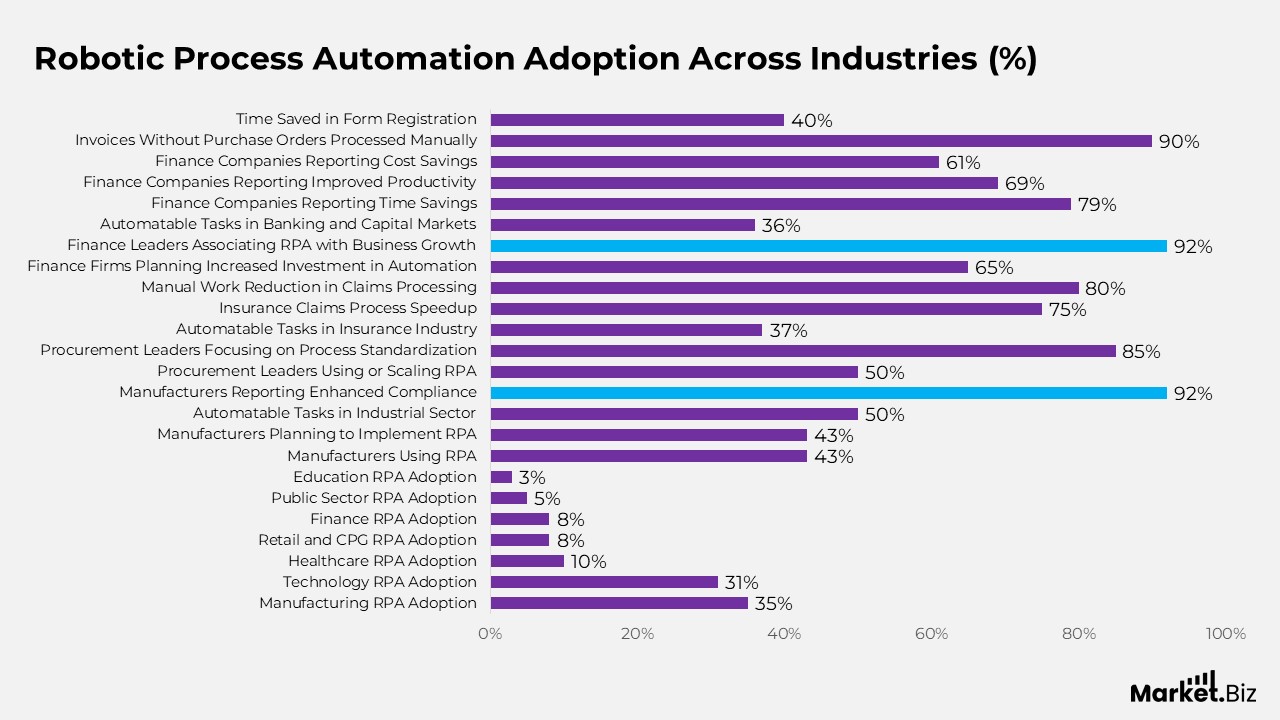
- Manufacturing leads RPA adoption with 35%, driven by efforts to optimize production processes.
- Technology follows with 31% adoption, focusing on improving efficiency and innovation.
- Healthcare accounts for 10% of RPA adoption, aiming to streamline administrative tasks and improve patient care.
- Retail and Consumer Packaged Goods (CPG)represent 8% of adoption, enhancing customer service and supply chain operations.
- Finance also holds 8% of adoption, leveraging RPA for financial operations and compliance.
- The public sector contributes 5%, using RPA to improve service delivery and reduce costs.
- Education accounts for 3% of RPA adoption, focusing on administrative process automation.
- 43% of manufacturers are already using RPA, and another 43% plan to implement it in the near future.
- More than 50% of tasks in the industrial sector can be automated.
- 92% of manufacturers have reported enhanced compliance through the use of RPA.
- Over half of procurement leaders have either deployed RPA or are in the process of scaling it.
- 85% of procurement leaders view process standardization as the primary strategy for managing workloads.
- RPA can automate up to 37% of tasks within the insurance industry.
- RPA can process insurance claims up to 75% faster than manual methods.
- Automated claims processing reduces manual work by 80%.
- 65% of finance firms plan to increase their investment in automation.
- 92% of finance leaders associate RPA with professional growth.
- 36% of tasks in banking and capital markets are suitable for automation.
- 79% of finance companies report significant time savings, 69% have seen improved productivity, and 61% have experienced cost savings.
- 90% of invoices that are not attached to a purchase order are processed manually, presenting a clear opportunity for automation.
- RPA can complete form registrations 40% faster, requiring about half the staff.
(Source: Statista, AIMultiple, DemandSage, Accenture, Deloitte, EY Report, Gartner)
Financial RPA Benefits
- By 2024, organizations are expected to reduce operational costs by 30% by integrating hyper-automation technologies with optimized operational processes.
- An RPA bot typically costs one-third of an offshore employee’s cost and one-fifth of an onshore employee’s cost.
- Robots are anticipated to take over a significant portion of current transactional activities, with the expectation that robots could handle 20% of Full-Time Equivalent (FTE) capacity.
- Organizations that have piloted RPA expect an average payback period of 9 months, with those who have implemented and scaled RPA achieving a 12-month payback period.
- This expectation aligns with the experience of companies that have scaled RPA, where those companies now believe robots could handle 52% of FTE capacity, allowing human workers to focus on higher-value tasks.
- RPA has the potential to reduce labour-intensive tasks by up to 80%.
- Top-performing companies saw nearly 4 times the return on their RPA investments, while other businesses achieved nearly double the returns.
(Source: Statista, AIMultiple)
Robotic Process Automation Market Size
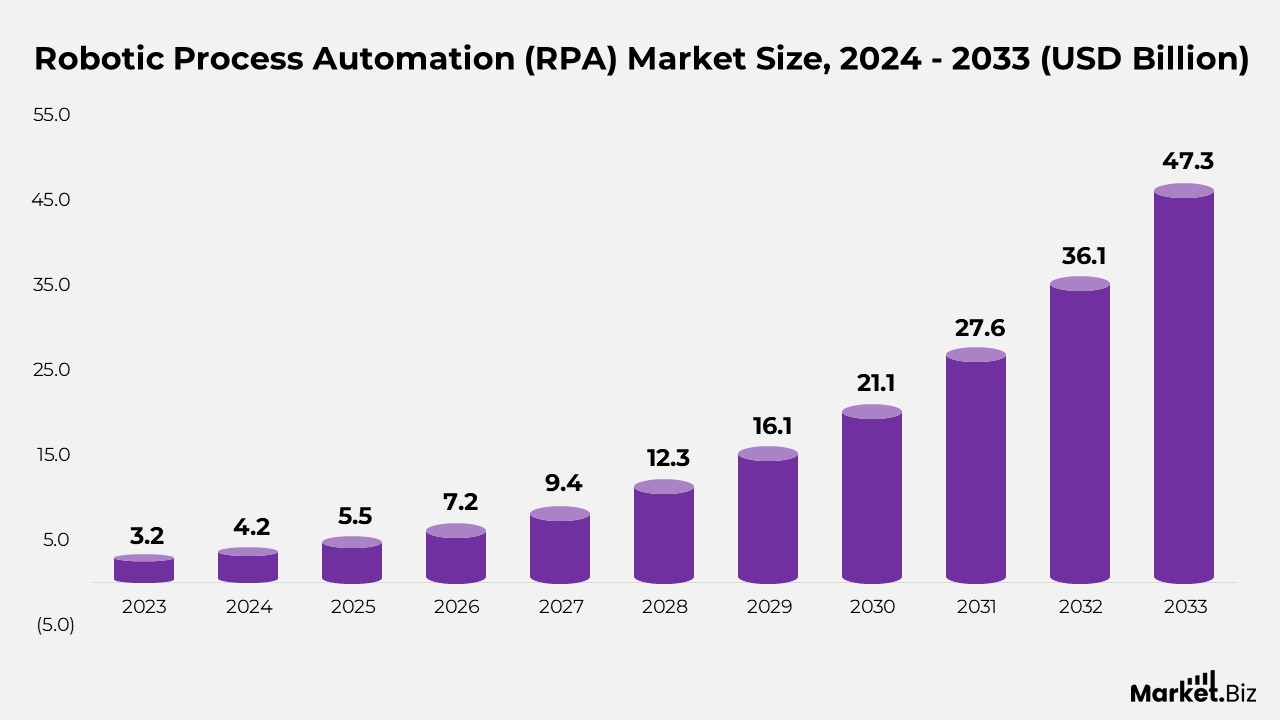
- According to Market.us, the robotic process automation market is expected to rise from $4.2 billion in 2024 to $47.3 billion by 2033, representing a compound annual growth rate (CAGR) of 30.9% from 2024 to 2033.
- The RPA market growth is driven by the rising demand for automation to reduce operational costs and improve accuracy, with AI and machine learning integration enhancing decision-making and expanding automation capabilities.
- In 2023, the by component segment of the RPA market was led by Service, capturing a 63.4% share, driven by the need for ongoing support and optimization in complex enterprise environments.
- In 2023, Large Enterprises held a dominant market position in the by organization segment, with a 66.5% share, due to their capacity to scale RPA deployments globally.
- In 2023, Rule-Based automation dominated the by operation segment of the RPA market with a 67.3% share, owing to its simplicity and ease of implementation with structured data.
- In 2023, Administration and Reporting led the by application segment with a 26.4% share, reflecting RPA’s role in automating routine administrative tasks.
- In 2023, the BFSI sector held the largest share in the by end-use segment of the RPA market with a 28.4% share, driven by the sector’s need for automation in operations, compliance, and customer service.
- North America leads the RPA market with a 37.8% share and a valuation of USD 1.2 billion, supported by a strong presence of key players and significant uptake in sectors like finance, healthcare, and telecommunications.
- Stringent regulations and precision requirements in the manufacturing and logistics industries drive Europe’s RPA market. At the same time, the Asia Pacific experiences rapid growth due to digital transformation and AI integration in countries like India, Japan, and China.
(Source: Market.us)
Cognitive Process Automation Market Size
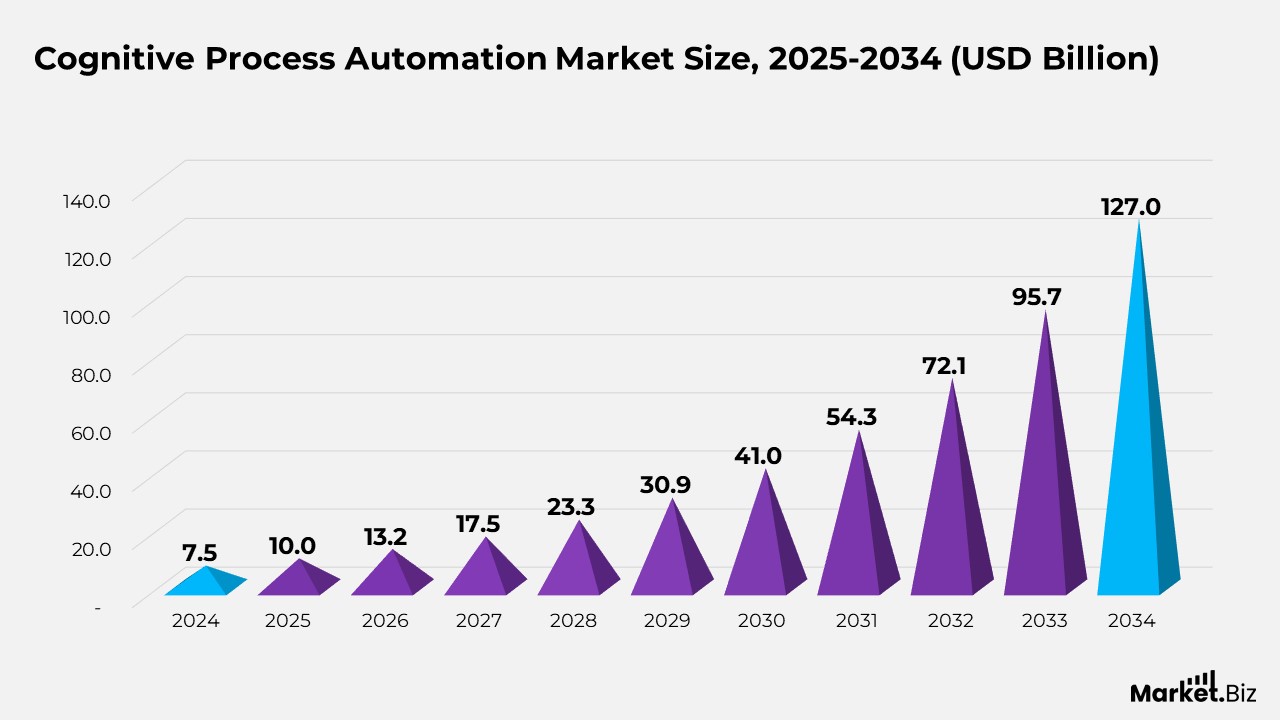
- According to Market.us, the cognitive process automation market is expected to rise from $10.0 billion in 2025 to $127.0 billion by 2034, representing a compound annual growth rate (CAGR) of 32.7% from 2025 to 2034.
- The Cognitive Process Automation (CPA) market growth is driven by the increasing demand for efficient, error-free automation solutions, combining AI, machine learning, NLP, and RPA to automate cognitive tasks previously performed by humans.
- The US Cognitive Process Automation market was appreciated at USD 2.08 billion in 2024, growing at a robust CAGR of 30.4%, driven by the need for cost-effective, efficient operations across industries.
- In 2024, the Robotic Process Automation segment dominated the global CPA market with more than 65.7% share, largely due to its widespread adoption in industries such as finance, healthcare, and manufacturing.
- In 2024, the Finance segment captured more than 40.5% of the global CPA market, reflecting the growing reliance on AI-driven solutions within the sector.
- In 2024, the Machine Learning segment held more than 26.7% share of the global CPA market, driven by its ability to enable self-learning automation, predictive analytics, and intelligent decision-making.
- In 2024, the BFSI sector led the global CPA market with more than 68.4% share, due to its extensive use of cognitive automation to enhance efficiency, reduce costs, and improve customer experiences.
(Source: Market.us)
Robotic Process Automation Adoption
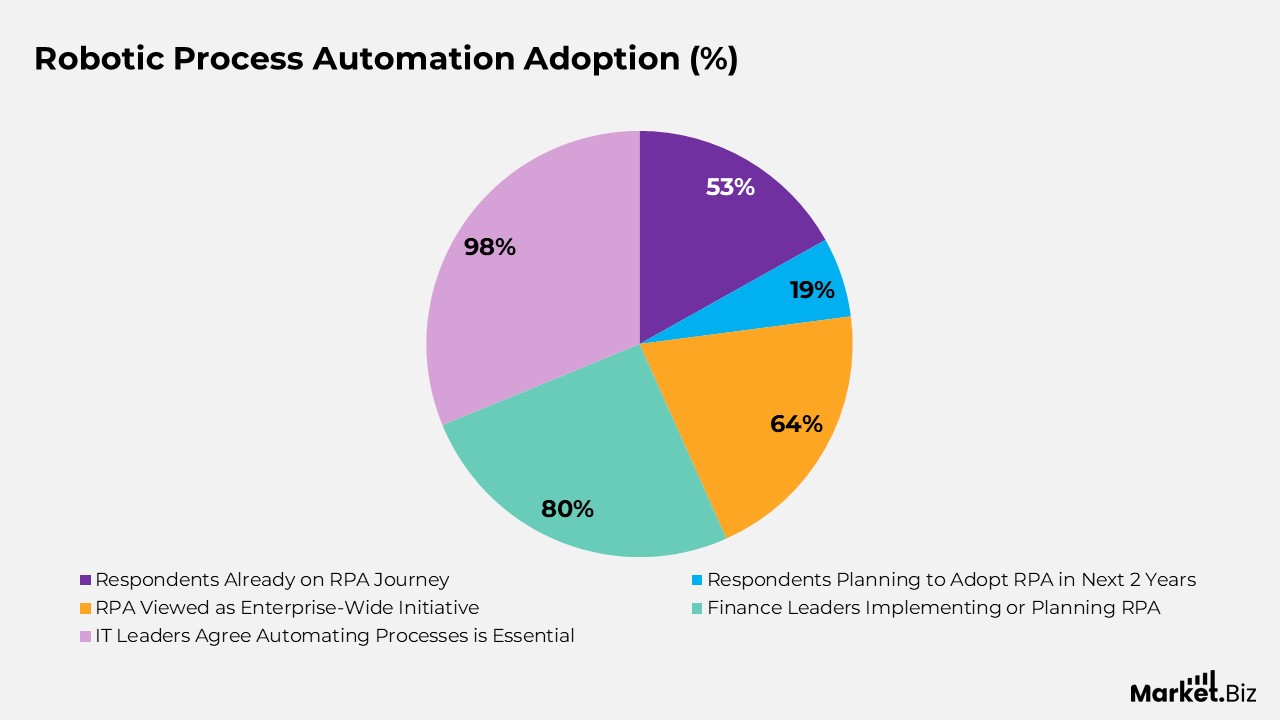
- 53% of respondents have already begun their RPA journey, with an additional 19% planning to adopt RPA within the next two years.
- RPA is increasingly viewed as an enterprise-level opportunity, with 64% of respondents on the RPA journey considering it a strategic or organisation-wide initiative. This marks a significant increase from just 12 months ago, when only 15% saw RPA as part of a broader corporate strategy.
- Approximately 80% of finance leaders have either implemented or are planning to implement RPA in their operations.
- An overwhelming 98% of IT leaders agree that automating business processes is essential for achieving significant business benefits.
(Source: Statista, AIMultiple, Automation Anywhere)
Future of Robotic Process Automation in the Public Sector
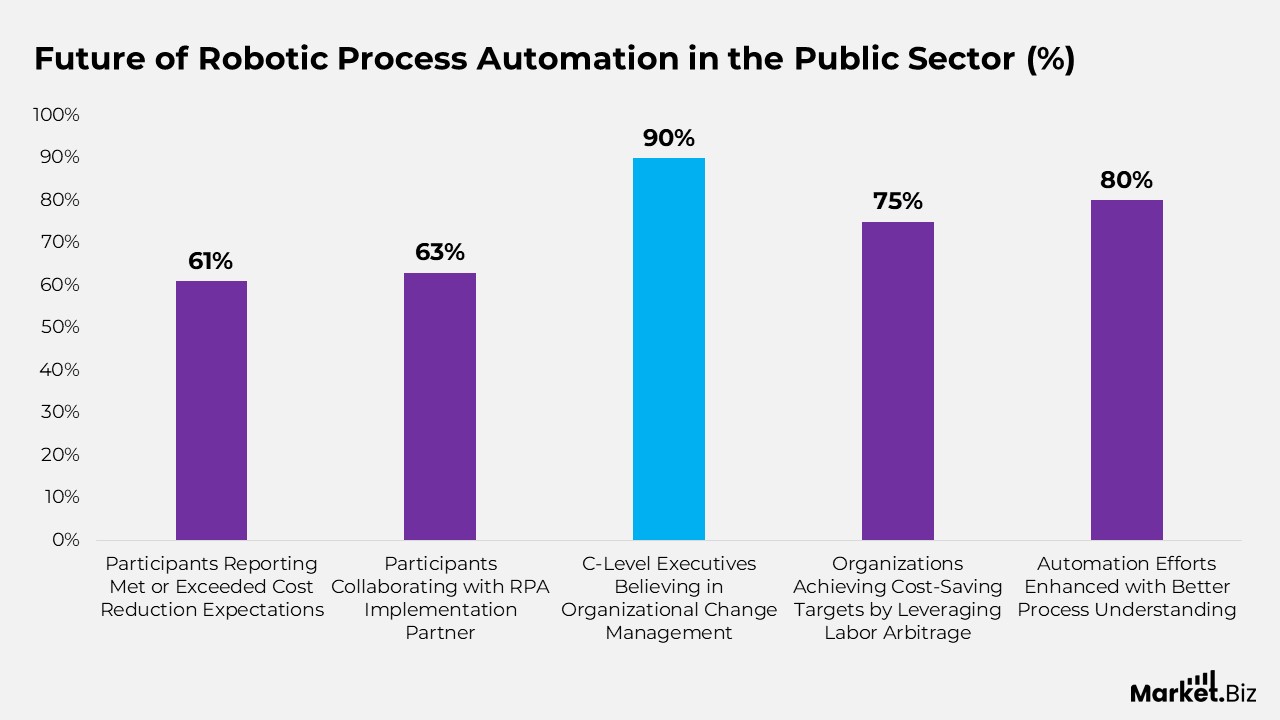
- 61% of participants reported that their expectations for cost reduction have either been met or exceeded.
- 63% of participants plan to collaborate with an RPA implementation partner for support, 19% intend to use RPA vendors, and 15% will manage RPA internally.
- Over 90% of C-level executives using intelligent automation believe their organization excels in managing change and adapting to emerging business trends.
- 75% of organizations surveyed have already achieved cost-saving targets by leveraging labor arbitrage as of 2016.
- 80% of automation efforts, particularly in exception handling, can be enhanced with a better understanding of the processes involved.
- While automation is not expected to displace employees entirely, it is predicted that 861,000 public sector jobs will be lost to automation by 2030, resulting in £17 billion in savings for public sector payments compared to 2015 levels.
(Source: Statista, DemandSage, Automation Anywhere)
Robotic Process Automation Challenges
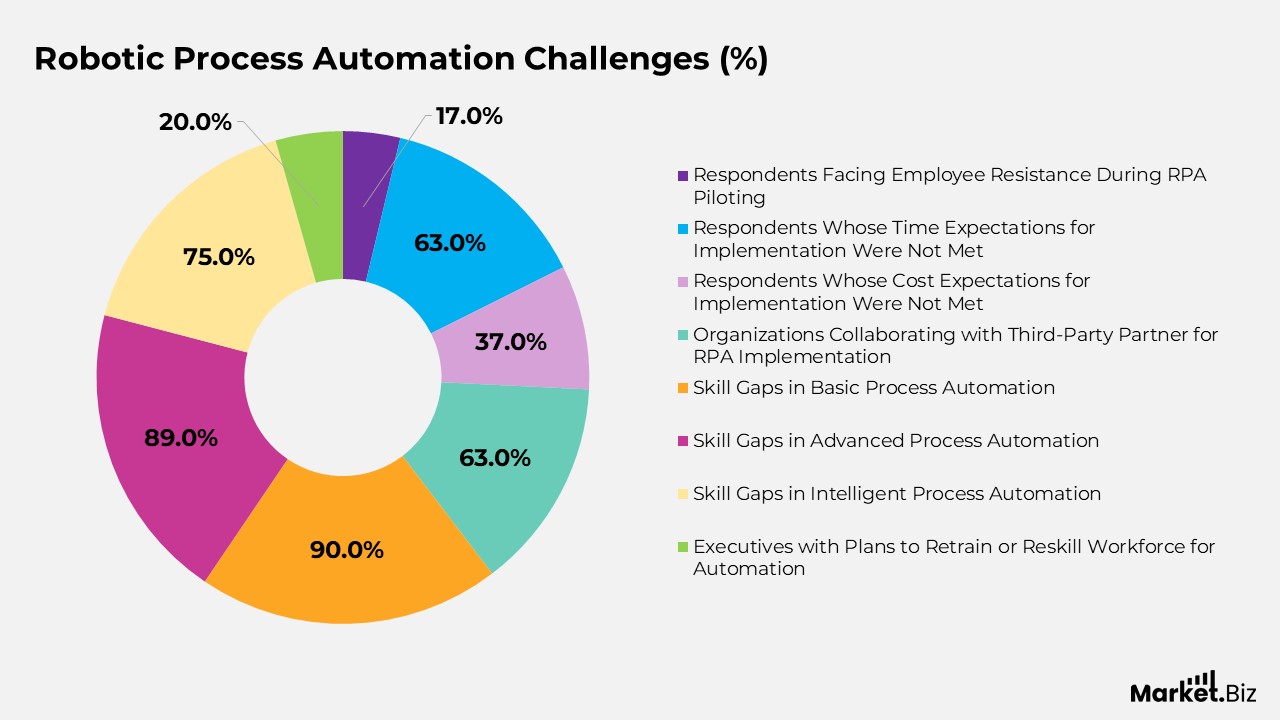
- Only 17% of respondents experienced employee resistance when piloting RPA, a figure that dropped to just 3% for those who were implementing or scaling RPA.
- Organizations often underestimate the time and cost required to deliver RPA. 63% of respondents reported that their time expectations for implementation were not met, while 37% stated the same for cost expectations.
- The majority of organizations (63%) will collaborate with a dedicated third-party partner for RPA implementation due to a lack of in-house expertise.
- Most executives believe their organizations lack the necessary skills in data science, machine learning, and other AI/cognitive technologies needed for process automation. The skill gaps identified include:
- 90% for basic process automation
- 89% for advanced process automation
- 75% for able process automation
- Only 20% of managers have plans in place to retrain or reskill their workforce for automation initiatives.
(Source: Deloitte, Statista, DemandSage, Automation Anywhere)
RPA’s Impact & Effectiveness
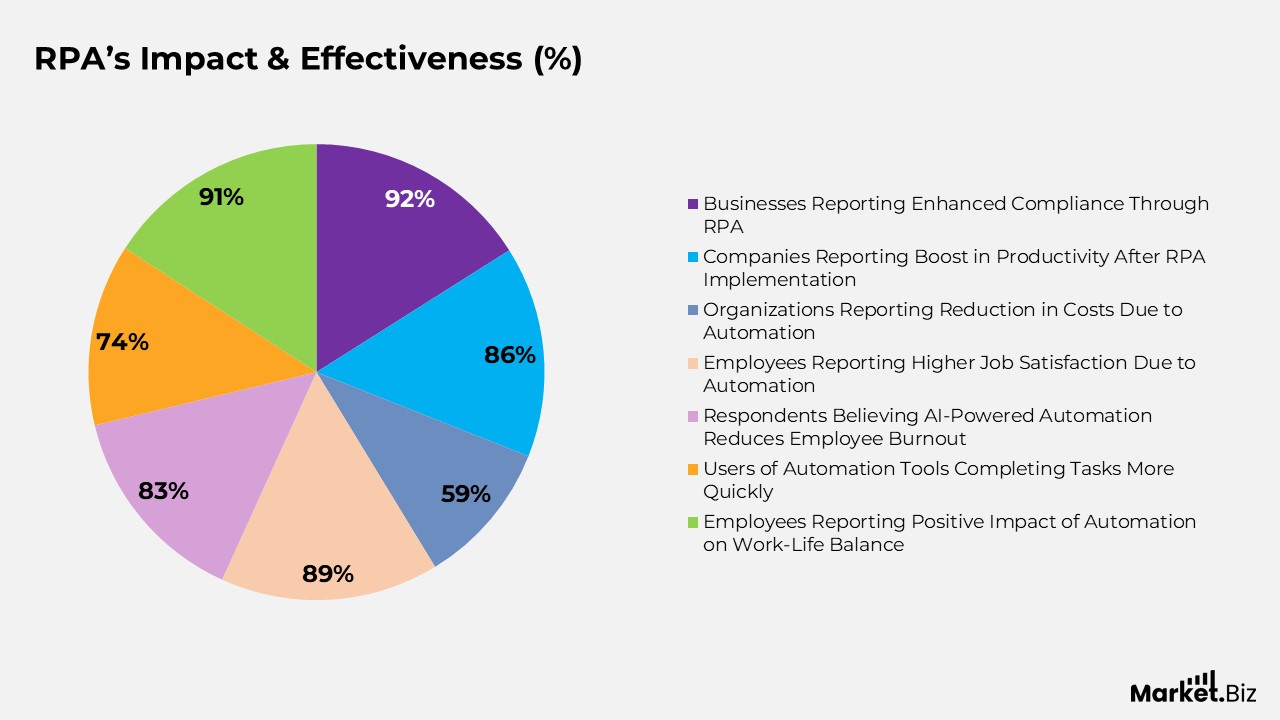
- 92% of businesses reported enhanced compliance through the use of RPA.
- 86% of companies experienced a boost in productivity after implementing RPA.
- 59% of organizations saw a reduction in costs due to automation.
- 89% of employees reported higher job satisfaction as a result of automation.
- 83% believe that AI-powered automation plays a significant role in reducing employee burnout.
- 74% of users of automation tools indicated they are able to complete tasks more quickly.
- 91% of employees stated that automation has a positive impact on their work-life balance.
(Source: Deloitte, Statista, DemandSage, Automation Anywhere, Flobotics)
RPA Industry Funding
- UiPath secured $1.2 billion in funding across 6 rounds.
- Automation Anywhere raised $840 million in 4 funding rounds.
- Blue Prism Group raised $182 million in 5 funding rounds.
- Workfusion garnered $180 million in 6 funding rounds.
- UiPath has raised nearly $450 million in funding.
- Automation Anywhere has accumulated $550 million in funding.
- Blue Prism, the company that helped coin the term RPA, will issue new stock to raise $130 million in funds.
- Workfusion has received over $121 million in total funding.
- Other companies, such as SaltStack and Antworks, have raised approximately $15 million and $28 million, respectively.
(Source: Deloitte, Statista, Walk Me Blog)
Conclusion
The Process Automation (RPA) market is witnessing substantial growth, driven by the increasing demand for automation to enhance efficiency, lower operational costs, and reduce human errors. The integration of cutting-edge technologies like AI, machine learning, and natural language processing is accelerating this growth, broadening the range of tasks that can be automated.
As sectors such as finance, healthcare, and manufacturing continue to embrace RPA solutions, the market is expected to expand significantly. With strong footholds in regions such as North America and the Asia Pacific, the future of RPA looks promising, providing organizations with the opportunity to optimize operations, boost productivity, and stay competitive in an ever-changing business environment.
FAQ’s
Robotic Process Automation (RPA) is a technology that operates software robots, or bots, to automate uninteresting, rule-based tasks in various business operations. The primary goal is to enhance efficiency, reduce operational costs, and minimize human errors.
The growth of the RPA market is mainly driven by the growing demand for automation to improve operational efficiency, reduce costs, and eliminate errors. Additionally, the integration of advanced technologies such as AI, machine learning, and natural language processing is expanding the scope of tasks that RPA can handle.
Key industries leading the adoption of RPA include finance, healthcare, manufacturing, and telecommunications. These industries utilize RPA to automate processes such as data entry, invoice processing, and customer service.
Implementing RPA in businesses offers several benefits, including reduced operational costs, improved efficiency, enhanced accuracy, and scalability. By mechanizing repetitive tasks, employees can focus on more strategic and high-value work, boosting overall productivity.
The RPA market is rapidly expanding, with strong projections for continued growth in the coming years. As more businesses adopt RPA solutions across industries, the market size is expected to experience significant expansion.