









Introduction
Marketing Technology Statistics: Marketing technology (MarTech) encompasses a wide range of tools and software designed to help businesses manage, analyze, and enhance their marketing strategies. By integrating technology with marketing efforts, it aims to improve customer engagement, optimize processes, and increase effectiveness.
MarTech includes platforms like customer relationship management (CRM) systems, analytics tools, social media management, automation software, and AI-driven technologies. With the growing demand for personalized experiences and data-driven strategies, businesses are increasingly adopting these technologies to engage customers across multiple channels.
The continued advancements in artificial intelligence, machine learning, and automation are transforming the landscape, making marketing more targeted and efficient, while also focusing on data privacy and customer-centric approaches.
Editor’s Choice
- Artificial intelligence (AI) is the third most popular emerging marketing strategy in the United States.
- Only 10% of marketers have no intention of incorporating AI into their marketing strategies.
- Around 70% of sales-as-a-service (SaaS) and technology companies rely on integrated MarTech tools to enhance operational efficiency.
- 80% of businesses believe that MarTech provides a competitive edge.
- Companies that adopt data-driven marketing strategies experience a 15-20% higher return on investment.
- 44% of marketers use five or more tools in their MarTech stack.
- Only 28% of B2B marketers report having the required technology to achieve success.
- 48% of B2B marketers identify technological challenges as their primary obstacle.
- 78% of marketers consider marketing analytics tools essential to their MarTech stack.
- 50% of content writers use AI tools to improve their content performance.
- 48% of social media marketers repurpose or adjust content slightly for various platforms, while 34% create entirely new content for each platform, and 17% share identical content across multiple platforms.
- TikTok videos over 54 seconds received an average of 38,000 views, whereas shorter videos had fewer views, with videos under 10 seconds generating the least engagement, averaging around 19,000 views.
- YouTube Shorts had 2 billion average monthly viewers as of July 2023.
- Most YouTube Shorts are between 30 and 40 seconds in length, with 50-60 second videos garnering the highest viewership.
Technology & AI Martech Statistics
- Over 9,500 MarTech tools are currently available globally, offering a wide range of marketing solutions.
- Artificial intelligence (AI) ranks as the third most popular emerging marketing strategy in the United States.
- A mere 10% of marketers have no plans to incorporate AI into their marketing strategies.
- Approximately 70% of sales-as-a-service (SaaS) and tech companies utilize integrated MarTech tools to streamline their operations.
- Email marketing is the leading channel for automation, with 65% of marketers automating their email campaigns.
(Source: Statista, American Marketing Association)
MarTech Adoption Statistics
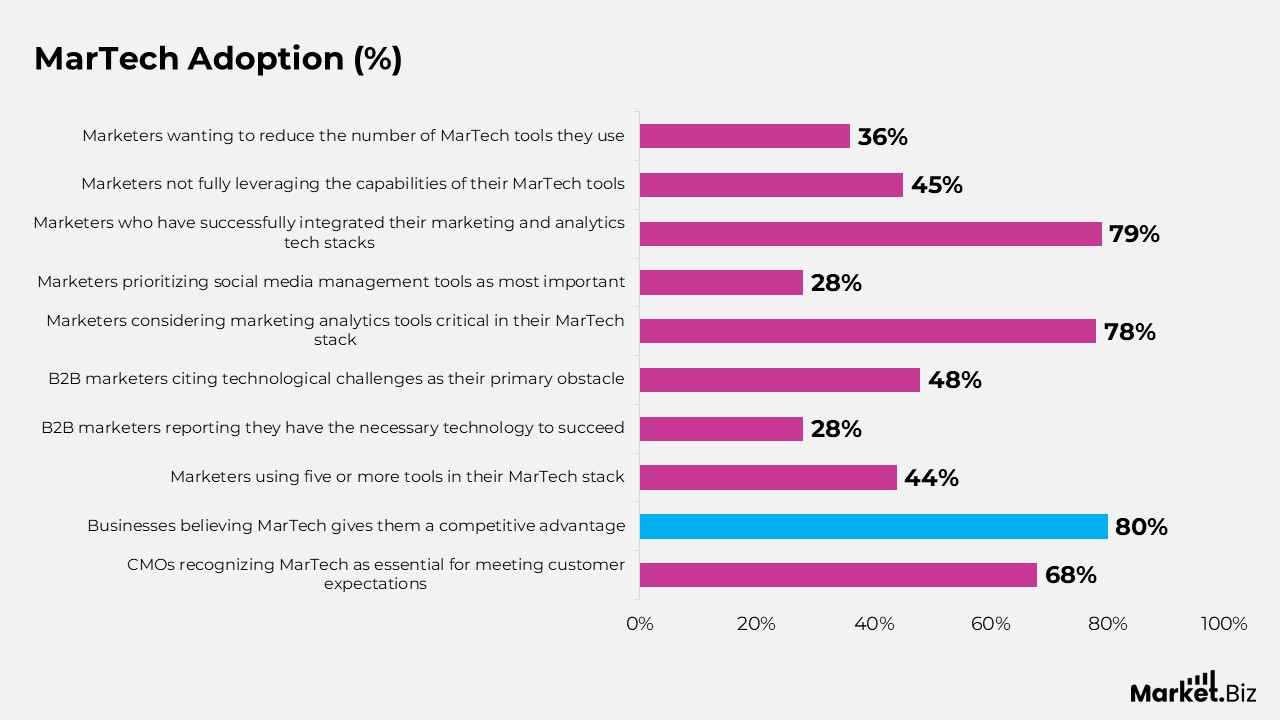
- 68% of Chief Marketing Officers (CMOs) recognize MarTech as essential for meeting customer expectations.
- On average, enterprise companies utilize 91 different marketing cloud services.
- 80% of businesses believe that MarTech gives them a competitive advantage.
- Companies adopting a data-driven marketing approach see a 15–20% higher return on investment.
- 44% of marketers use five or more tools within their MarTech stack.
- Only 28% of B2B marketers report having the necessary technology to succeed.
- 48% of B2B marketers cite technological challenges as their primary obstacle.
- 78% of marketers consider marketing analytics tools to be among the most critical components of their MarTech stack.
- 28% of marketers prioritize social media management tools as the most important in their MarTech stack.
- More than 60% of brands are unprepared for Google’s plan to phase out cookies and lack an alternative strategy for tracking customer data.
- 79% of marketers have successfully integrated their marketing and analytics tech stacks.
- 45% of marketers acknowledge that they’re not fully leveraging the capabilities of their MarTech tools.
- 36% of marketers express a desire to reduce the number of MarTech tools they use.
(Source: Statista, WebFX)
Marketing Technology (MarTech) Market Size
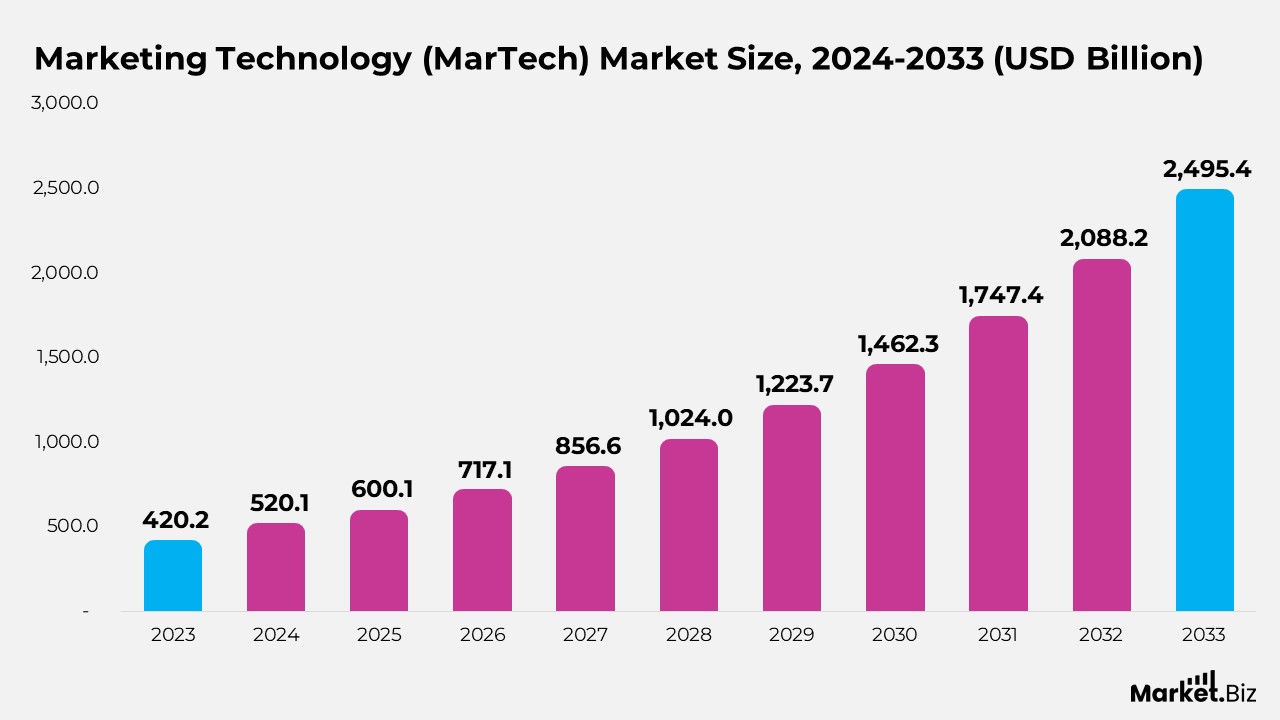
- According to Market.us, the Marketing Technology (MarTech) market is expected to rise from $520.1 billion in 2024 to $2,495.4 billion by 2033, representing a compound annual growth rate (CAGR) of 19.5% from 2024 to 2033.
- The MarTech market is expanding due to the increasing demand for personalized marketing strategies and a growing reliance on data-driven decision-making, as businesses seek more effective ways to tailor messages to individual consumer preferences.
- In 2023, the Social Media Tools segment captured 37.8% of the market share, supported by the ongoing rise in social media usage, as companies leverage these platforms to connect with a broader, more diverse audience.
- The Digital Marketing segment dominated in 2023 with 60.4% market share, driven by businesses’ growing dependence on digital channels to engage a tech-savvy consumer base and improve their online presence.
- The Healthcare segment accounted for 32.8% of the MarTech market in 2023, supported by the accelerated digital transformation in the industry, especially post-pandemic, with more healthcare organizations adopting digital marketing tools.
- Marketing automation has proven effective in boosting sales productivity by 14.5% and reducing marketing costs by 12.2%, with 80% of companies using these tools seeing an increase in leads and 77% reporting higher conversion rates, highlighting its growing impact on marketing efficiency.
(Source: Market.us)
AI in Digital Marketing Market Size
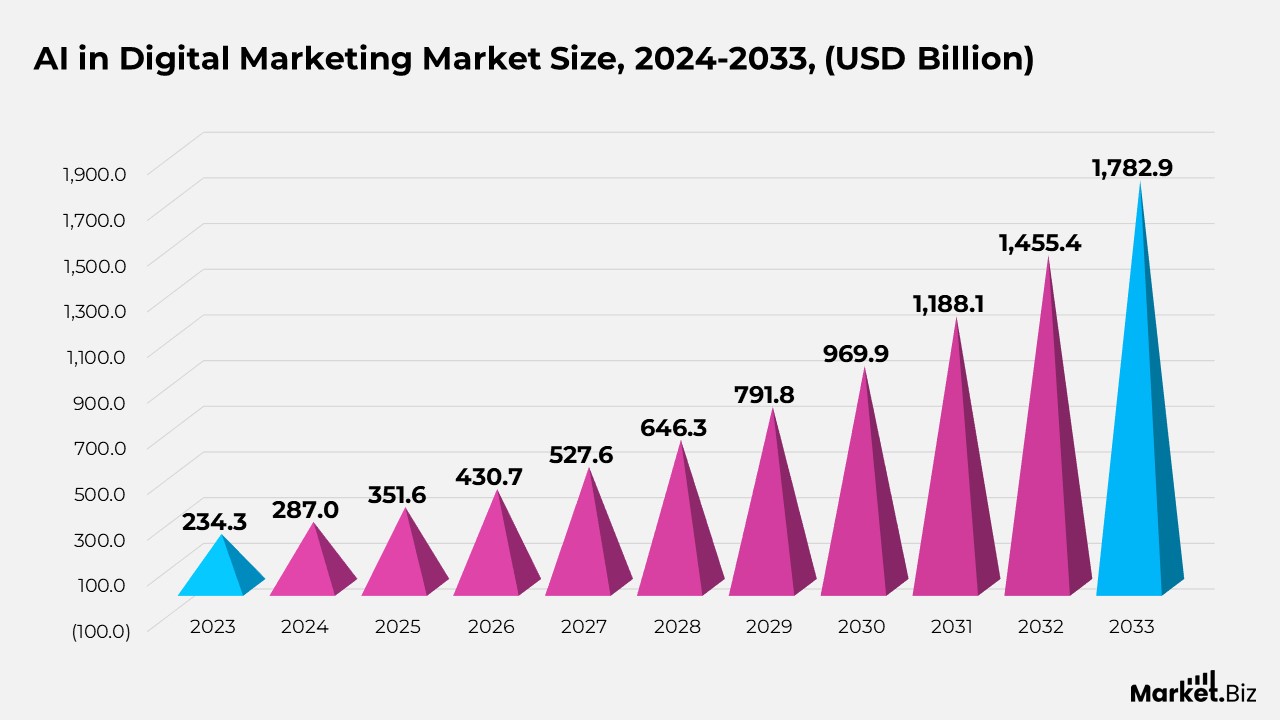
- According to Market.us, the global AI in digital marketing market is expected to rise from $351.6 billion in 2025 to $1,782.9 billion by 2033, representing a compound annual growth rate (CAGR) of 22.5% from 2024 to 2033.
- The growth of AI in the digital Marketing market is driven by advancements in artificial intelligence. This enhances marketing efficiency and enables highly personalized customer interactions through data insights.
- In 2023, the Data Analysis segment dominated the Application category, capturing 24.7% of the market share, as AI’s ability to process vast data improves strategy refinement and user engagement.
- In 2023, the Retail and Consumer Goods sector led the Industry Vertical segment with 20.5% market share, benefiting from AI’s role in personalizing shopping experiences and optimizing inventory management.
- North America commanded 38.1% of the AI in Digital Marketing market in 2023, valued at USD 89.2 billion, driven by high technological integration and investments in AI startups.
- AI integration is vital in mobile marketing, with 5.22 billion unique mobile users worldwide, emphasizing the need for SEO strategies to enhance content visibility, as reported by 61% of digital marketers.
- The rise of mobile-optimized marketing is reflected by 53% of emails being opened on mobile devices. Highlighting the importance of adapting campaigns to mobile platforms, alongside 86% of businesses using video content.
(Source: Market.us)
Content Marketing Statistics
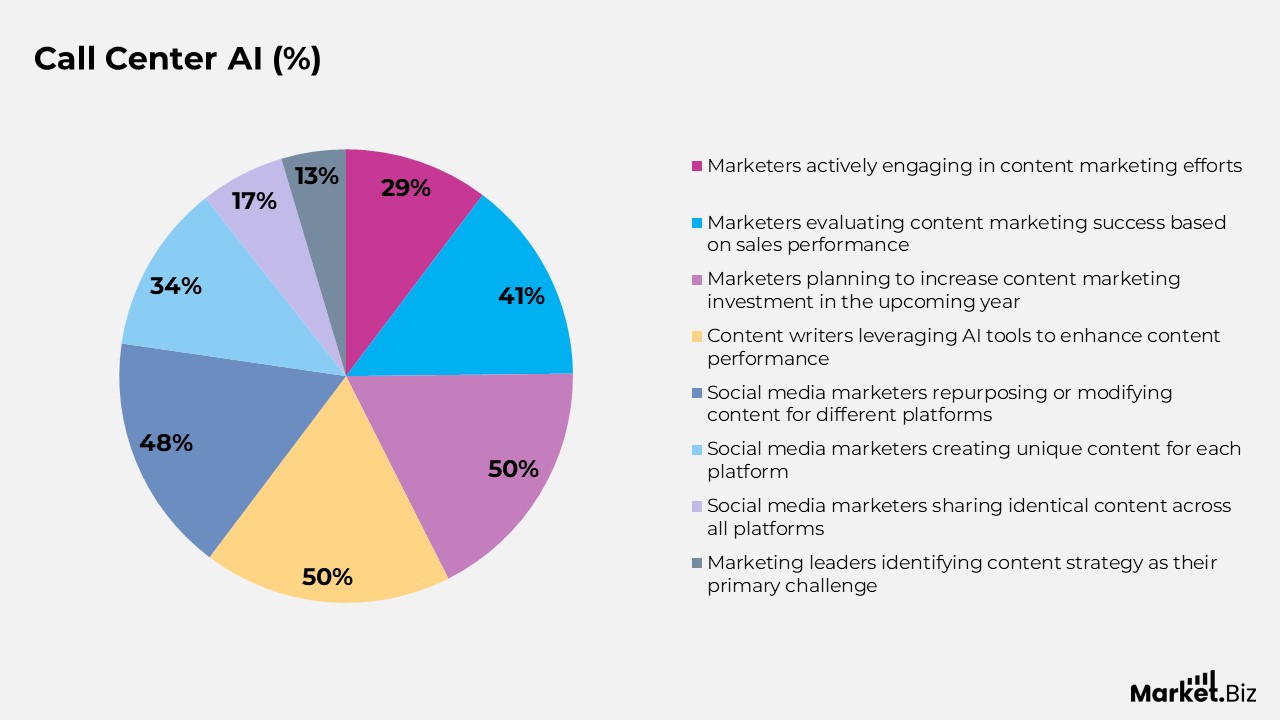
- 29% of marketers are actively involved in content marketing efforts.
- Over 41% of marketers evaluate the success of their content marketing strategies based on sales performance.
- Web traffic ranks as one of the top two most common metrics for measuring the success of content marketing campaigns.
- Half of marketers plan to increase their content marketing investment in the upcoming year.
- 50% of content writers leverage AI tools to enhance the performance of their content.
- 48% of social media marketers repurpose or slightly modify content for different platforms, while 34% create unique content for each platform, and 17% share identical content across all platforms.
- 13% of marketing leaders identify content strategy as their primary challenge.
(Source: Statista, WebFX, HubSpot State of Marketing Report)
Conversion Rate Optimization (CRO)
- Over one-third of marketing leaders prioritize tracking conversion rates as a key performance indicator (KPI).
- Nearly two-thirds of marketers report that their average landing page conversion rate is below 10%.
- In 2024, the top marketing channels driving return on investment (ROI) for B2B brands were (1) website, blog, and SEO efforts, (2) paid social media content, and (3) social media shopping tools.
- For B2C brands, the channels with the best ROI were paid social media content, email marketing, and content marketing.
- The average website has a bounce rate of 37% and an SEO clickthrough rate of 13%.
- The average conversion rate across all e-commerce sites is below 2%.
- Conversion rates are highest in health and beauty online shopping at 2.7%, while they are lowest for luxury handbags at just 0.4%.
- Email marketing proves to be one of the most effective channels for driving conversions, with a 2.8% conversion rate for B2C brands and 2.4% for B2B brands.
(Source: HubSpot State of Marketing Report; Statista; Statista; FirstPageSage)
Video Marketing Statistics
- Short-form videos, such as TikTok, Instagram Reels, and YouTube Shorts. are the most widely adopted video formats by marketers, with 29.18% including them in their strategies.
- 21% of marketers believe short-form videos provide the highest return on investment (ROI).
- Short-form video is the top content format that marketers intend to prioritize, with 17.13% planning to increase their investment in it.
- Over one-third of video marketers agree that the ideal video length is between one and three minutes, with 96% agreeing that videos should be kept under 10 minutes.
- 73% of consumers choose to watch short-form videos to learn about a product or service.
- YouTube Shorts achieved the highest engagement rate at 5.91% among short-form video platforms in Q1 2024, followed by TikTok at 5.75%, and Facebook Reels at approximately 2%.
- The average length of TikTok videos increased to 42.7 seconds in 2024, up from 39 seconds in 2023.
- TikTok videos longer than 54 seconds garnered an average of 38,000 views, while shorter videos received fewer views, with videos under 10 seconds seeing the final engagement, averaging around 19,000 views.
- YouTube Shorts had an average of 2 billion monthly viewers as of July 2023.
- Most YouTube Shorts are between 30 and 40 seconds long, with 50-60 second Shorts receiving the highest viewership.
(Source: HubSpot State of Marketing Report; Statista; INFLOW Network)
Email Marketing Statistics
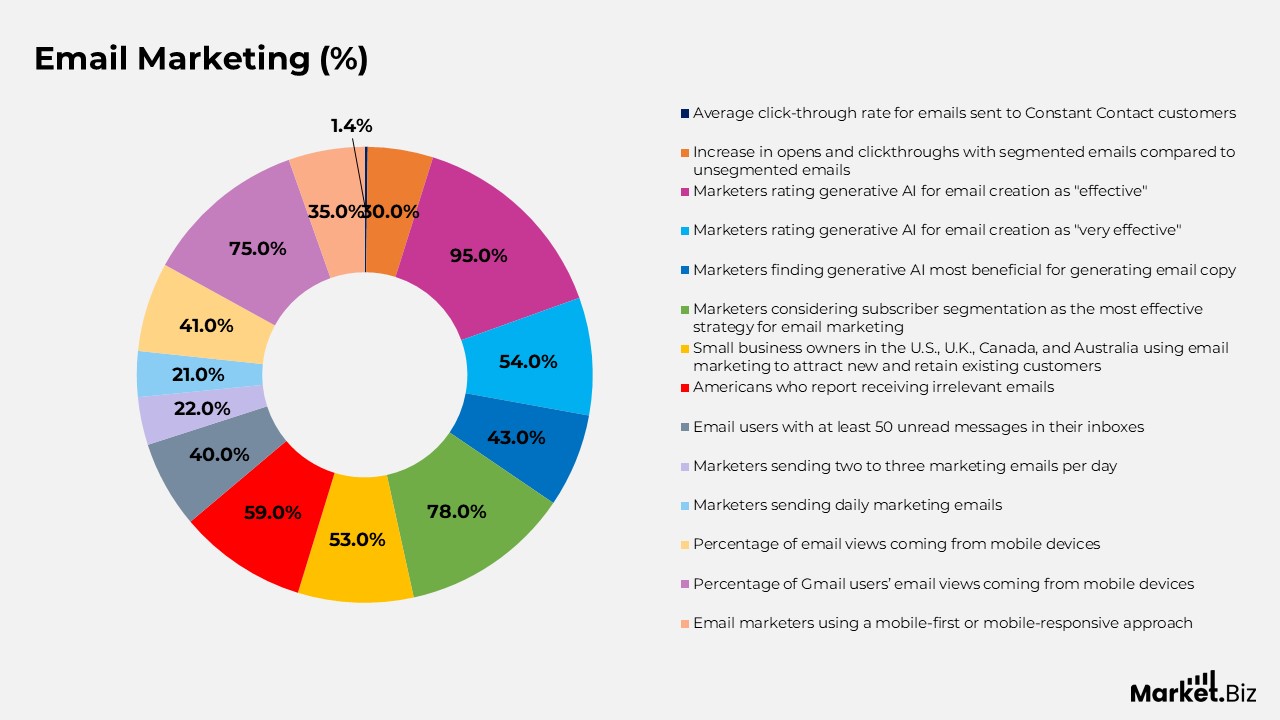
- The regular clickthrough rate for emails sent to Constant Contact customers stands at 1.36%.
- Marketers find that segmented emails result in 30% more opens and 50% more clickthroughs compared to unsegmented emails.
- The clickthrough rate is the leading metric used by marketers to assess the success of their email marketing campaigns.
- 95% of marketers using generative AI for email creation rate it as “effective,” with 54% considering it “very effective.”
- 43% of marketers using generative AI find it most beneficial for generating email copy.
- Personalizing email content by including customers’ names is the most commonly used strategy for marketers to enhance their email campaigns.
- Segmented emails lead to 30% more opens and 50% more clickthroughs than unsegmented ones.
- 78% of marketers consider subscriber segmentation the most effective strategy in their email marketing campaigns.
- 53% of small business owners in the U.S., U.K., Canada, and Australia rely on email marketing as their primary method to attract new customers and retain existing ones.
- 59% of Americans report that most emails they receive are irrelevant to them.
- Consumers unsubscribe mainly due to receiving excessive emails.
- 40% of email users have at least 50 unread messages in their inboxes.
- The number of global email users reached 4.37 billion in 2023 and is expected to grow to 4.89 billion by 2027.
- 22% of marketers send two to three marketing emails per day, while 21% send daily emails.
- 41% of email views, and 75% of Gmail users’ email views, come from mobile devices.
- 35% of email marketers employ a mobile-first or mobile-responsive approach in their campaigns.
(Source: HubSpot State of Marketing Report, HubSpot, Inc.; HubSpot State of Generative AI Report, Constant Contact; Edison Mail; Gartner; MailButler; Statista; HubSpot Research)
Marketing Technology Statistics
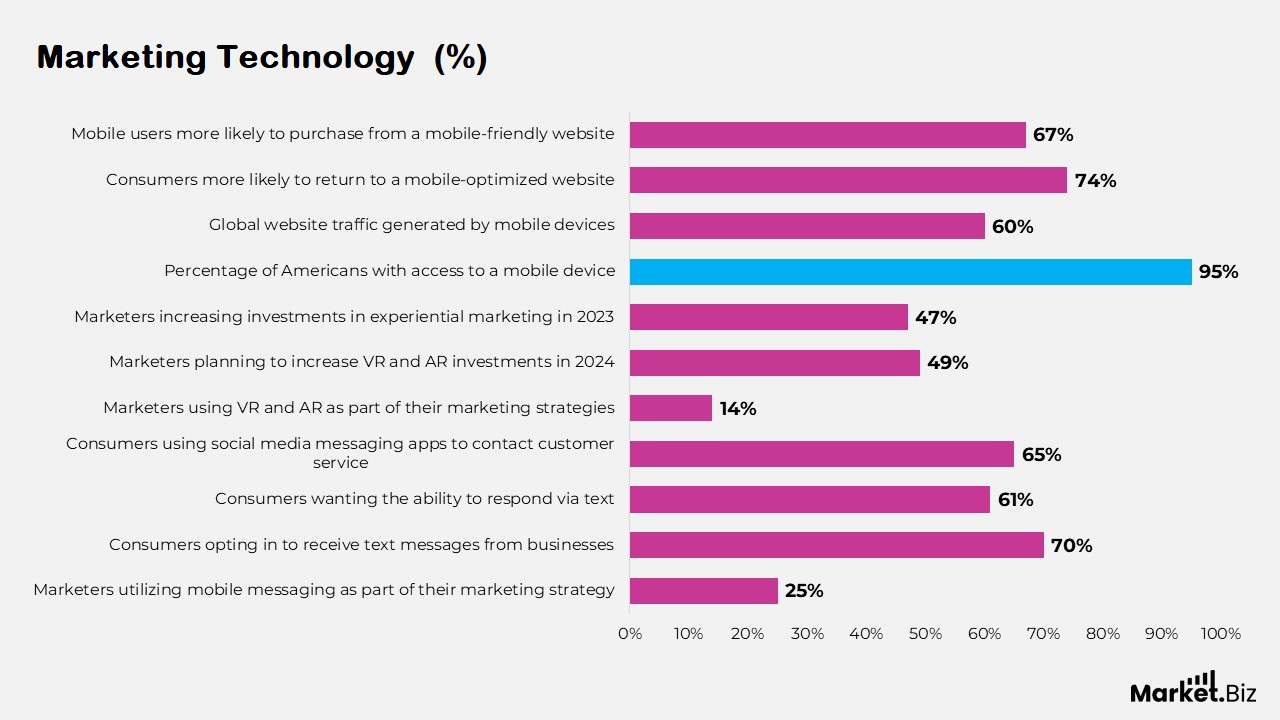
- 25% of marketers are utilizing mobile messaging as part of their marketing strategy.
- There are over 3 billion active users on messaging apps worldwide.
- Each month, 2 billion users engage with WhatsApp, the leading messaging app.
- 70% of consumers have opted in to receive text messages from businesses, and 61% want the ability to respond via text.
- The majority of consumers check their text messages within five minutes of receiving a notification, with one in three checking within a minute.
- 65% of consumers use social media messaging apps to contact a company’s customer service team.
- 14% of marketers are using virtual reality (VR) and augmented reality (AR) as part of their marketing strategies, and 49% plan to increase these investments in 2024.
- 47% of marketers increased their investments in experiential marketing in 2023.
- Nearly 7 billion smartphones exist worldwide, and 95% of Americans have access to a mobile device.
- Over 60% of global website traffic is generated through mobile devices.
- 74% of people are more likely to return to a website if it’s mobile-optimized.
- 67% of mobile users are more inclined to purchase a product or service from a mobile-friendly website.
- Over half of all digital ad spending is directed toward mobile ads.
- Mobile social media ads dominate global mobile advertising savings, with marketers spending a total $140 billion on mobile social media ads.
(Source: HubSpot, Inc.; HubSpot Blog Marketing Trends Report; HubSpot State of Marketing Report; Exploding Topics; SimpleTexting; SimilarWeb; WebFX; Statista)
Role of Data in Modern Marketing
- 98% of sales leaders believe that reliable data becomes even more crucial during periods of change.
- 88% of marketers actively utilize analytics and measurement tools to inform their strategies.
- 86% of marketers rely on CRM systems to manage customer relationships effectively.
- 84% of marketers leverage first-party data to drive their campaigns.
- Only 31% of marketers report complete satisfaction with their ability to unify their data.
- The proportion of marketing budgets relative to total company revenues fluctuates year-over-year from 2014 to 2024.
- 78% of US B2C marketing executives acknowledge that their marketing and loyalty systems operate in silos.
(Source: State of Sales, State of Marketing, Statista, Forrester Q3 B2C Marketing CMO Pulse Survey 2024)
Challenges of MarTech Adoption
- The number of MarTech solutions skyrocketed from 150 in 2011 to over 11,000 in 2023, reflecting an increase of over 7,000%.
- A survey revealed that 100% of teams where marketing and sales collaborate effectively use MarTech solutions.
- According to a recent American Marketing Association (AMA) survey, 89% of marketers reported that the tools they utilize are fully integrated into a single platform.
- A survey conducted among marketing professionals in the U.S., Canada, and the U.K. found that 44% rely on more than five tools within their marketing tech stack.
- A study of MarTech decision-makers identified platform integration as the primary obstacle to achieving a successful MarTech solution stack.
(Source: Statista, WebFX)
Conclusion
The Marketing Technology (MarTech) landscape is evolving at a rapid pace, fueled by the growing demand for personalized marketing and data-driven strategies. As businesses increasingly incorporate advanced tools such as AI, automation, and social media platforms, they can develop more targeted and effective marketing approaches.
The dominance of segments like Social Media Tools, Digital Marketing, and Healthcare highlights the expanding role of technology across various sectors. Additionally, the proven effectiveness of marketing automation in boosting productivity and improving conversion rates underscores its essential role in modern marketing practices.
As technology continues to transform the MarTech industry. Companies that adopt these innovations will be better equipped to engage with their audiences and optimize their marketing efforts in a constantly changing digital landscape.
FAQ’s
MarTech refers to a set of technologies and tools that businesses use to enhance their marketing strategies. It encompasses solutions for customer relationship management (CRM), automation, analytics, artificial intelligence (AI), and social media management, all designed to improve marketing effectiveness and customer engagement.
AI is transforming MarTech by boosting marketing efficiency. It enables businesses to analyze large datasets, personalize customer experiences, and optimize marketing budgets. Through machine learning and predictive analytics, AI helps marketers craft more impactful, data-driven campaigns.
The sectors at the forefront of MarTech adoption include Retail, Consumer Goods, Healthcare, and Digital Marketing. Retail and Consumer Goods utilize MarTech for personalized shopping experiences, while Healthcare leverages AI-driven digital marketing tools to engage patients effectively.
The key segments within the MarTech market include social media tools, digital marketing, data analytics, automation, and industry-specific applications, such as those tailored to healthcare and retail sectors.
Social media tools play a crucial role in the MarTech landscape, capturing a significant market share. Businesses use these platforms to engage with large, diverse audiences and build brand awareness, making social media an integral part of digital marketing strategies.
Marketing automation enhances business performance by increasing sales productivity and reducing marketing expenses. It streamlines tasks, tracks customer behavior, and allows businesses to optimize campaigns, resulting in more efficient lead generation and higher conversion rates.