









Introduction
Quantum Computing Statistics: Quantum computing is advancing as one of the most transformative technologies of this century, delivering capabilities that far exceed those of traditional computing systems. Governments, academic institutions, and global enterprises are channeling significant resources into this field to drive breakthroughs in cryptography, material innovation, pharmaceutical research, and financial modeling.
According to the US Department of Energy, quantum machines are expected to complete tasks in minutes that would otherwise take classical supercomputers thousands of years. A steady rise in patents, funded research initiatives, and cross-sector collaborations highlights the rapid pace of development.
As countries race to develop scalable processors and broaden access through quantum cloud platforms, statistics on workforce skills, R&D investments, and publication output showcase the swift expansion of this ecosystem. These insights offer a clear view of global preparedness, scientific progress, and strategic priorities shaping the future of quantum computing.
Editor’s Choice
- D-Wave stands as the top-funded private quantum computing firm, having secured $216 million across 19 funding rounds.
- Rigetti Computing has attracted $198.5 million in funding over 9 rounds.
- The finance sector leads quantum computing adoption, accounting for 28% of all use cases.
- The energy and materials sector represents 16% of global quantum applications.
- Germany has invested USD 720.5 million to accelerate the integration of quantum technologies into its industries.
- France has pledged approximately USD 1.8 billion under its National Quantum Strategy to strengthen technological advancement.
Quantum Computing Market Size
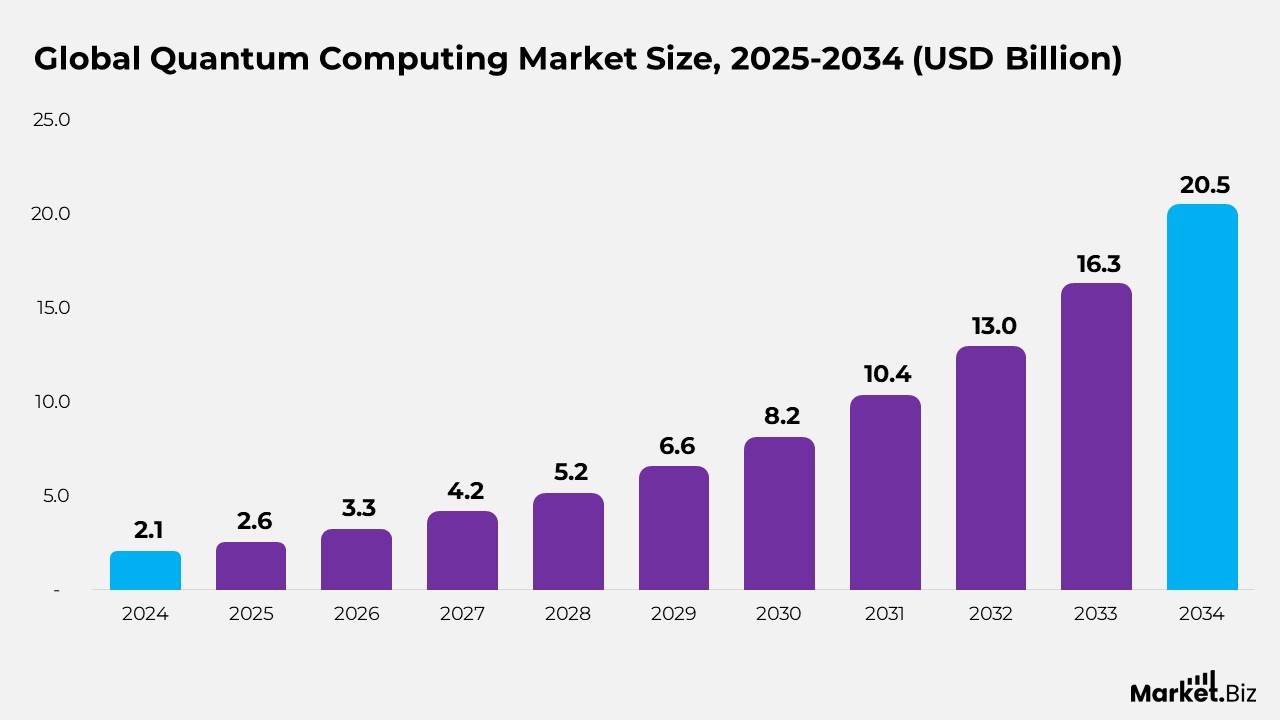
- According to Market.us, the global quantum computing market is expected to rise from $2.6 billion in 2025 to $16.3 billion by 2032, representing a compound annual growth rate (CAGR) of 25.6% from 2025 to 2034.
- The market is expanding due to rapid technological progress and rising public–private investments, supported by continuous R&D funding and global collaborations.
- The System segment dominated with a 64.6% share in 2024, driven by heavy hardware investments and advancements in scalable quantum processors.
- The On-Premises segment led with 60.2% share in 2024, supported by organizations prioritizing data security, compliance, and custom configurations.
- The Optimization segment held a 40.5% share in 2024, fueled by demand for solving complex supply chain, logistics, and portfolio management problems.
- The Aerospace & Defense sector captured a 32.6% share in 2024, supported by requirements in cryptography, national security, and advanced simulations.
- North America led with a 37.6% share in 2024, backed by early government investments, advanced research infrastructure, and tech giants driving adoption.
- The US market stood at USD 0.7 billion in 2024, projected to grow to USD 5.5 billion by 2034 at a CAGR of 23.5%, supported by DOE and NSF initiatives.
- Government agencies such as the DOE and NSF are key drivers through funding, policy support, and fostering public–private partnerships.
- The finance sector is set to adopt quantum computing in 28% of operations, supported by needs in risk modeling, fraud detection, and algorithmic trading.
- The energy and materials sector accounts for 16% adoption, driven by the simulation of materials and optimization of energy systems.
- D-Wave leads private quantum investments with $216 million raised across 19 funding rounds, supported by strong investor confidence in its annealing-based solutions.
(Source: Market.us)
Quantum Computing in Healthcare Market
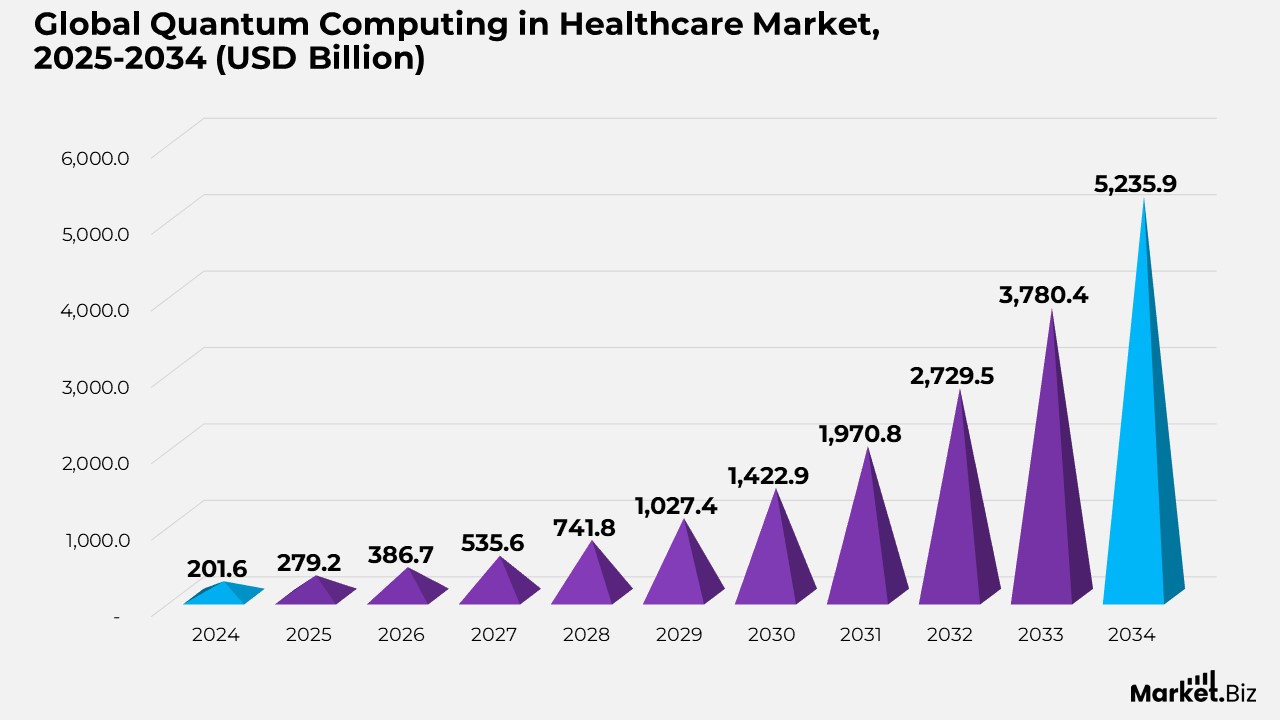
- According to Market.us, the global quantum computing in healthcare market is expected to rise from $279.2 billion in 2025 to $2,729.5 billion by 2032, representing a compound annual growth rate (CAGR) of 38.5% from 2025 to 2034.
- Market growth is primarily driven by the increasing application of quantum computing in drug discovery.
- The Software segment led with 39.7% share in 2024, supported by its role in algorithms, platforms, and applications for genomics, diagnostics, and personalized medicine.
- The Superconducting Qubits segment dominated with a 44.4% share, favored for scalability, performance, and adoption by leaders like IBM, Google, and Rigetti.
- The Drug Discovery & Development application accounted for a 32.3% share, driven by the ability to simulate molecular interactions and accelerate compound testing.
- Pharmaceutical & Biopharmaceutical companies held 30.5% share, leveraging quantum computing to optimize trials, process biological data, and speed up R&D.
- North America captured a 39.6% share, supported by strong investments, advanced infrastructure, and the leadership of US tech giants in healthcare-focused quantum projects.
(Source: Market.us)
Quantum Computing Use Cases
- A significant share of innovation in quantum computing comes from startups (40%) and universities (33%).
- IBM has successfully developed a quantum processor exceeding 1000 qubits.
- Quantum computing is finding its strongest applications in finance (28%), global energy and materials (16%), and advanced technology sectors.
(Source: PwC, Scientific American, McKinsey, Consultancy.co)
General Quantum Computing Statistics
- The perception of quantum computing as an alternative to classical computing was first introduced in the initial 1980s by physicist Richard Feynman and mathematician Yuri Manin.
- Quantum computers require extremely cold operating environments, with chips functioning at temperatures as low as -272°C to maintain particle stability.
- In 2011, D-Wave developed the world’s first commercial quantum annealing machine with 128 qubits, priced at approximately US$10 million.
- By 2018, China led globally in quantum computing research output with around 3,000 scientific publications, followed by the United States with about 2,500 publications.
- Google’s latest quantum computers can complete tasks that would take classical Boolean logic computers 10 years in just 3 seconds.
- Google Willow performed a benchmark computation in under 5 minutes, a task that would take Today’s fastest supercomputers nearly 10 septillion years (10^25 years), while also demonstrating exponential error reduction as qubits increased.
(Source: HandWiki, BCG, Seed Scientific)
Quantum Computing Funding
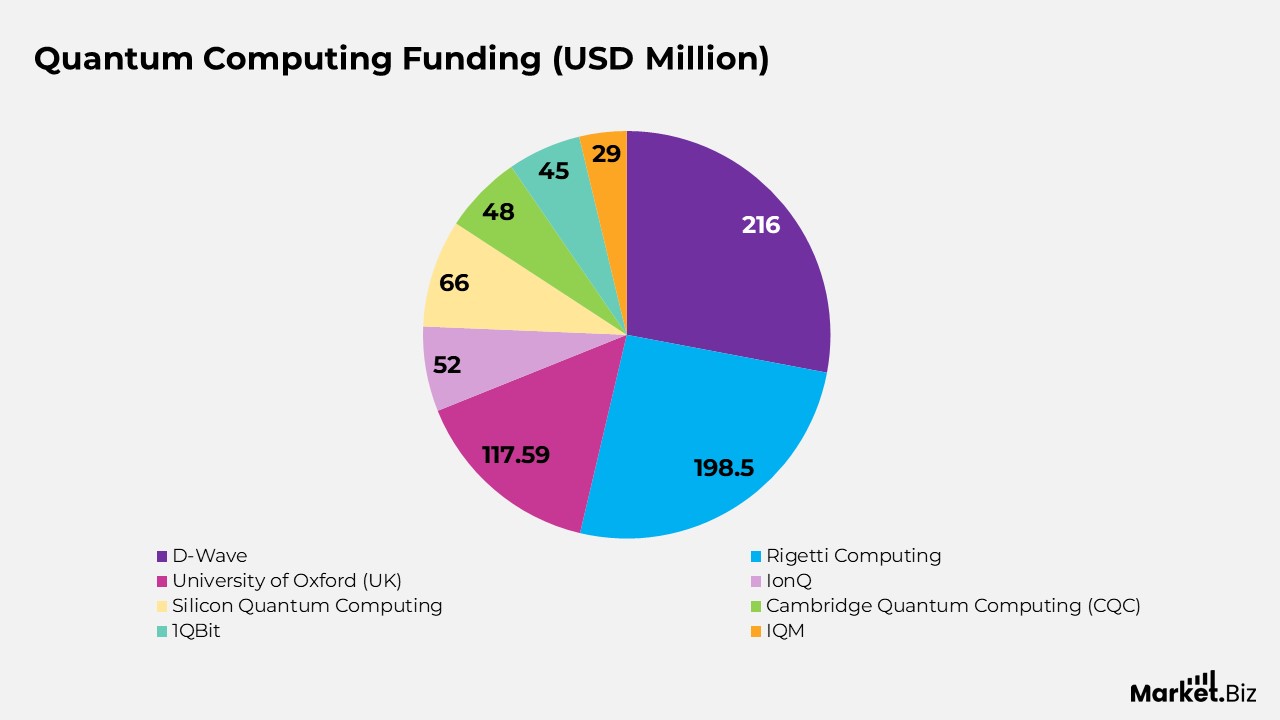
- D-Wave is the highest-funded private quantum computing company, securing $216 million across 19 funding rounds.
- Rigetti Computing has raised $198.5 million through 9 funding rounds.
- The University of Oxford (UK) leads in public funding, receiving approximately $117.59 million across 62 research grants.
- IonQ has obtained $52 million in 3 funding rounds.
- Silicon Quantum Computing has attracted about $66 million in funding.
- Cambridge Quantum Computing (CQC) has raised $48 million across 7 funding rounds.
- 1QBit has secured CA$45 million through 4 funding rounds.
- IQM has raised €29 million in 3 funding rounds.
(Source: Crunchbase, PwC, AIMultiple)
Advantages of Quantum Computing
- Widely adopted in the financial sector to build smarter and more efficient portfolios for both institutional and retail clients.
- Applied in healthcare to advance genetically tailored treatments and accelerate the development of new medicines.
- Utilized for creating advanced data encryption methods, strengthening online security, detecting intrusions through light-based signals, and enhancing safety in traffic management and aviation systems.
(Source: PwC, Enterprise Apps Today)
Applications of Quantum Computing
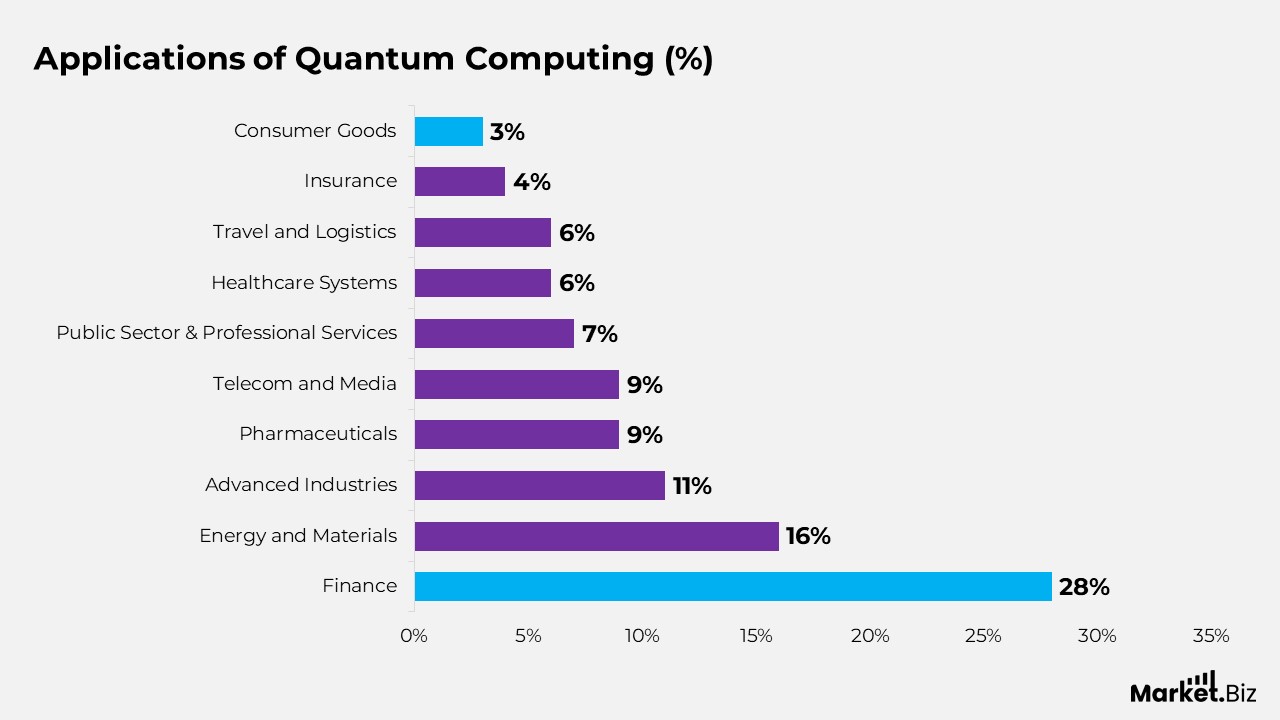
- Finance leads the adoption of quantum computing, representing 28% of total use cases.
- The energy and materials sector accounts for 16% of applications.
- Advanced industries apply quantum computing in 11% of cases.
- Pharmaceuticals represent 9% of overall adoption.
- Telecom and media also utilize quantum computing in 9% of cases.
- The public sector and professional services hold a 7% share.
- Healthcare systems contribute 6% to adoption.
- Travel and logistics account for another 6% of use cases.
- The insurance industry represents 4% of applications.
- Consumer goods have the smallest presence, with 3% adoption.
(Source: PwC, Statista, DemandSage)
Advances in Quantum Computing
- Germany has allocated USD 720.5 million to drive quantum integration across key industries.
- France has committed nearly USD 1.8 billion through its National Strategy for Quantum Technologies to accelerate development.
- In healthcare, more than 80% of data remains unstructured, creating major obstacles for conventional computing methods.
- Health insurance premiums saw notable decreases in Alabama (8.36%), Georgia (9.47%), and Arizona (7.92%).
- Significant premium hikes occurred in Vermont (12.46%), West Virginia (13.32%), and Minnesota (11.65%).
- In 2021, IBM introduced a quantum system with 127 qubits, followed by the 1,121-qubit Condor processor planned for 2023.
- IBM also unveiled the Heron processor in 2023, incorporating 133 high-quality qubits.
- Google Quantum AI and Quantinuum achieved breakthroughs in error correction by grouping qubits into ensembles that surpassed individual qubit performance.
- Emerging economies are stepping up, with China investing about USD 10 billion in large-scale quantum initiatives.
- India launched its National Mission on Quantum Technologies & Applications, backed by USD 1 billion over five years, to strengthen quantum research.
(Source: PwC, Statista, DemandSage)
Challenges in Quantum Computing Deployment
- One of the biggest hurdles in quantum computing adoption is ensuring system compatibility and ease of access for organizations.
- Globally, 43% of organizations express concern over the difficulty of integrating quantum solutions within their existing IT frameworks.
- Nearly 48% of respondents highlight security challenges as a key obstacle when deploying quantum technologies in their operations.
(Source: Crunchbase, Kooc Media Ltd.)
Conclusion
Quantum computing is advancing from a conceptual stage to real-world implementation, driving rapid transformation across industries and research domains. Statistics reveal that progress in hardware, software, and applications, combined with growing public–private investments, is accelerating adoption.
With strong momentum in healthcare, finance, and defense, quantum computing is emerging as a critical driver of innovation and competitiveness. Regional strengths, government initiatives, and industry partnerships continue to reinforce growth, while leading segments highlight the market’s strategic evolution.
Collectively, quantum computing statistics reflect a transformative path that is set to revolutionize problem-solving and establish new standards in global technological advancement.
FAQ’s
Growth is being propelled by advancements in quantum hardware and software, strong public and private sector investments, and the rising need for advanced computational capabilities in industries such as healthcare, finance, aerospace, and defense.
The system and superconducting qubits segments lead the market, supported by heavy investments in hardware innovation and their scalability in delivering high-performance computing.
In healthcare, it is applied in areas such as drug discovery, genomics, diagnostics, and personalized medicine, offering the ability to conduct rapid simulations and analyze complex biological data sets.
North America holds the lead, driven by significant government funding, advanced technological infrastructure, and the presence of leading players, including IBM, Google, and Microsoft.
Healthcare, finance, aerospace & defense, and energy are the leading adopters, leveraging quantum computing for drug discovery, fraud detection, cryptography, simulations, and optimization in material sciences.
Governments are accelerating growth through research funding, national quantum strategies, and public–private partnerships aimed at fostering innovation and adoption.