








Introduction
Voice AI Agents Statistics: Voice AI agents are increasingly becoming a core component of digital ecosystems, revolutionizing how individuals and businesses engage with technology. Powered by natural language processing (NLP), speech recognition, and machine learning, these systems enable human-like conversations, enhance accessibility, and optimize operations across multiple sectors.
Adoption is fueled by the growing preference for personalized, hands-free experiences and the rising need for automation in areas such as customer support, healthcare, retail, and financial services. The expansion of smartphone usage further reinforces this momentum, the popularity of smart speakers, and advancements in cloud-based voice platforms.
Alongside this, governments and enterprises are making strategic investments in AI-driven solutions to strengthen efficiency and user engagement. Market statistics on adoption rates, usage patterns, and revenue growth highlight both the depth of integration and the significant potential for disruption in the years ahead.
As companies focus on delivering superior customer experiences and streamlining workflows, voice AI agents are poised to become a defining force in digital transformation, making the analysis of market statistics essential for understanding evolving consumer behavior, enterprise strategies, and technological progress.
Editor’s Choice
- A major telecom operator achieved a 35% reduction in call handling time through the integration of Voice AI.
- Customer satisfaction levels improved by 30% following the adoption of Voice AI solutions.
- Certain Voice AI tools have the potential to cut customer service queue times by up to 50%.
- Nearly 50% of consumers have already interacted with voice assistants for customer service needs.
- By 2026, around 80% of companies are expected to integrate AI-powered voice technology into their service operations.
- Businesses adopting AI-driven customer service solutions experience an operational cost reduction of 20–30%.
- About 71% of users rely on voice assistants for product searches and research before making a purchase.
- A significant 89% of customers favor brands that provide support through Voice AI technologies.
- Around 85% of large enterprises and 78% of SMBs are actively deploying AI agents.
- Nearly 90% of organizations see AI agents as a strategic edge rather than just operational tools.
- By 2027, AI agents are expected to automate between 15% and 50% of business tasks.
Moreover
- Companies leveraging AI agents report a 55% boost in efficiency alongside a 35% reduction in costs.
- Only 2% of businesses express no interest in autonomous agents, showing near-universal engagement.
- Developers using GitHub Copilot code 126% faster, highlighting the productivity impact of AI agents in software.
- About 40% of Fortune 500 companies already integrate CrewAI’s autonomous agents into operations.
- The AI agents market is projected to hit USD 103.6 billion by 2032, growing at a strong 44.9% CAGR.
- In healthcare, AI agents could save up to USD 150 billion annually by 2026.
- Roughly 70% of manufacturers embed AI agents into workflows, cutting downtime by 50%.
- Amazon attributes 35% of its online sales to its AI-driven recommendation engine, showing tangible business value.
- AI agents now manage 80% of customer support queries, accelerating response times by 52%.
- In HR, 47% of teams use AI agents for recruitment, with 65% reporting significant onboarding improvements.
- About 83% of executives expect AI agents to surpass human performance in repetitive tasks.
General Voice AI Statistics
- A leading telecom provider reduced call handling time by 35% after adopting Voice AI solutions.
- Customer satisfaction rose by 30% in service operations after implementing Voice AI, according to industry findings.
- Advanced Voice AI systems can slash waiting times by up to 50%, delivering smoother customer interactions.
- Nearly 50% of consumers have already engaged with voice assistants for customer support needs.
- By 2026, about 80% of companies are expected to deploy AI-driven voice tools in customer service.
- Organizations utilizing AI-powered support solutions report a 20–30% reduction in operational costs from efficiency gains.
- Around 71% of shoppers use voice assistants for product discovery and research before purchasing.
- Nearly 89% of customers prefer brands that provide Voice AI-powered support options.
- In the U.S., more than 62% of adults consistently use a voice assistant in their daily lives.
- Roughly 100 million Americans own a smart speaker, while 20% of households in the UK and India use voice-enabled devices.
- Globally, about 20.5% of internet users conduct searches via voice commands.
- In the U.S., over 58.6% of people have tried voice search or spoken commands at least once.
(Source: Market.us, tenet)
Voice AI & Shopping Statistics
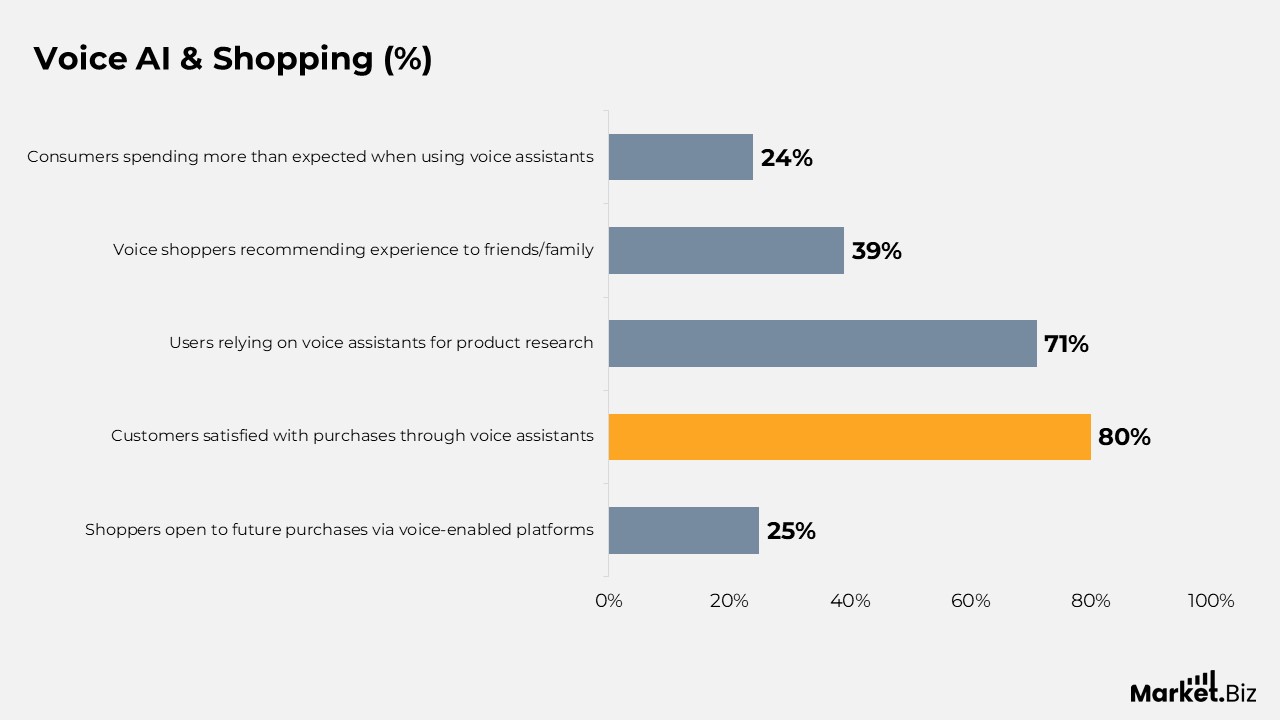
- By 2025, half of consumers will have completed purchases using voice assistants.
- Nearly 25% of shoppers are open to making future purchases through voice-enabled platforms.
- Around 80% of customers who buy via voice assistants report high satisfaction with the experience.
- About 71% of users rely on voice assistants to explore and compare products before making a purchase.
- Close to 39% of voice shoppers share and recommend their positive experiences with friends and family.
- Nearly 24% of consumers shopping with voice assistants spend more than they initially planned.
(Source: Magiclane App Services Private Limited, Inc., Statista)
AI Agents Adoption Trends
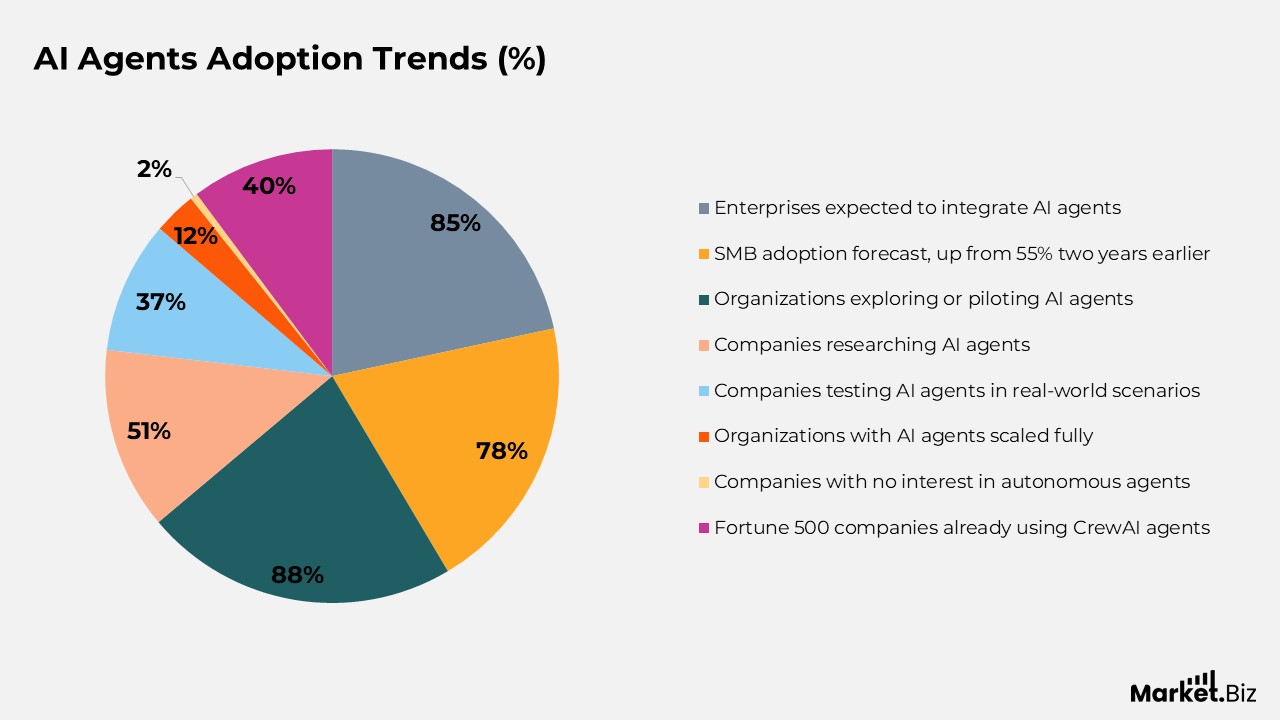
- By 2025, around 85% of enterprises are expected to integrate AI agents into their operations, signaling rapid mainstream adoption.
- AI uptake among SMBs is forecast to hit 78% in 2025, narrowing the adoption gap with larger corporations, rising sharply from 55% just two years ago.
- Nearly 88% of organizations are currently exploring or piloting AI agents, underscoring the widespread strategic focus.
- About 51% of companies worldwide are researching AI agents, while 37% are already experimenting with real-world use cases.
- Only 12% of organizations have scaled AI agents fully, highlighting that large-scale deployment is still in its early stages.
- A minimal 2% of companies report no interest in autonomous agents, showing that 98% are engaged at some level.
- Roughly 40% of Fortune 500 companies have already adopted CrewAI’s agents, demonstrating leadership from top enterprises.
(Source: tenet, Statista)
Global Voice Search Statistics
- Roughly 20.5% of internet users worldwide rely on voice commands to perform online searches.
- In the U.S., about 58.6% of people have tried voice search or spoken commands at least once.
- Younger demographics lead adoption, with 77% of Americans aged 18–34 using voice search on smartphones, compared to 63% for ages 35–54 and about one-third of those 55 and older.
- The most common uses include checking the weather (75%) and playing music (71%), alongside news updates, quick facts, and navigation directions.
- Among mobile users in the U.S., Google Assistant has around 88.8 million active users, followed by Apple Siri with 84.2 million, and Amazon Alexa with 75.6 million.
(Source: Big Sur AI, Statista)
Voice AI Agents Market Size
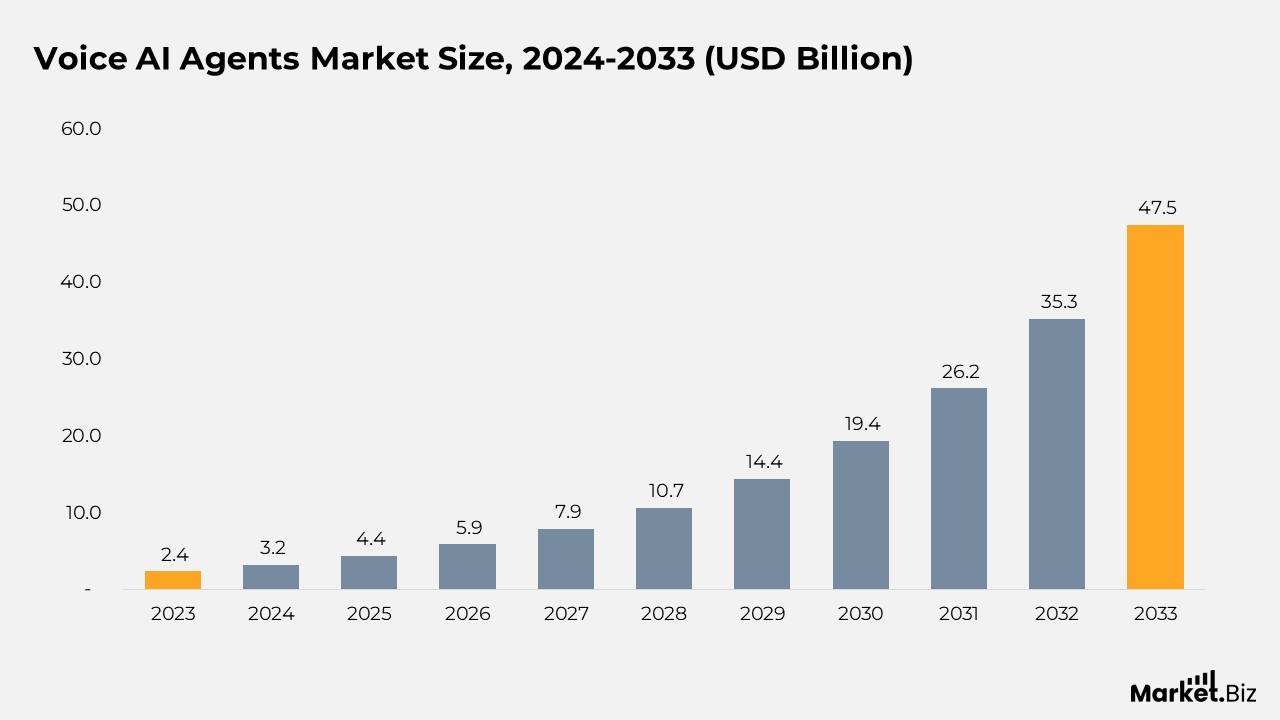
- According to Market.us, the voice AI agents market is expected to rise from $3.2 billion in 2025 to $47.5 billion by 2034, representing a compound annual growth rate (CAGR) of 34.8% from 2024 to 2033.
- Continuous advancements in AI and machine learning are enhancing speech recognition accuracy and driving market growth.
- In 2024, the Voice AI Platform segment dominated with a 76.4% share, driven by demand for scalable conversational interfaces across industries.
- The On-Premises segment held a 62.6% share in 2024, supported by strong demand for secure and compliant solutions in banking, government, and healthcare.
- Large Enterprises captured a 70.5% share in 2024, reflecting their ability to invest heavily in advanced Voice AI technologies.
- The BFSI sector led with a 32.9% share in 2024, showcasing Voice AI’s role in transforming customer service and operational efficiency.
- North America dominated with a 40.2% share in 2024, generating USD 0.9 billion in revenue, backed by robust infrastructure and key AI players.
- The U.S. recorded over 24,000 mentions of AI agents between October and November 2024, with 96% of discussions occurring on X (formerly Twitter).
- About 87% of U.S. consumers report frustration with traditional service transfers, where AI agents are helping reduce dissatisfaction (Salesforce, 2024).
- By 2025, nearly 90% of hospitals are projected to adopt AI agents, highlighting strong uptake in healthcare services.
(Source: Market.us)
AI Market Market Size
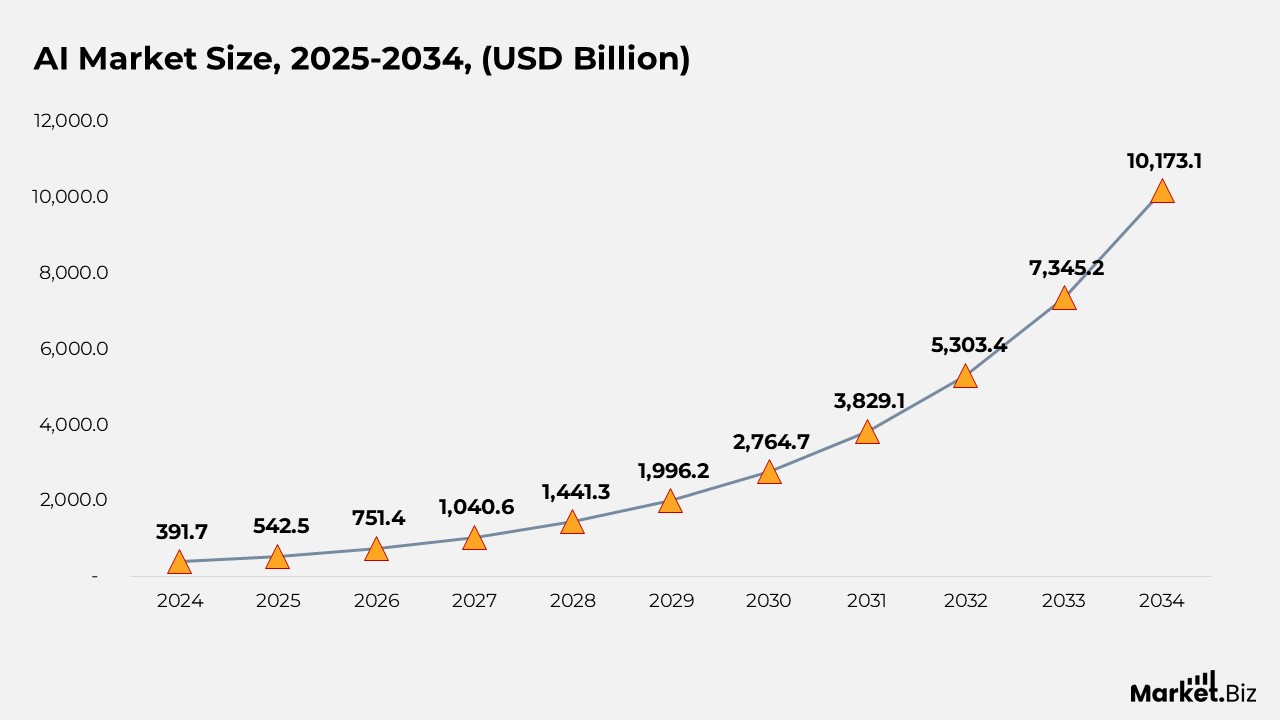
- According to Market.us, the AI market is expected to rise from $542.5 billion in 2025 to $10,173.1 billion by 2034, representing a compound annual growth rate (CAGR) of 38.5% from 2025 to 2034.
- Market growth is fueled by large data availability, advanced computing power, and rising demand for automation across industries.
- In 2024, the Hardware segment led with a 45.6% share, highlighting its essential role in enabling AI capabilities.
- The Cloud-based segment dominated with a 67.8% share in 2024, driven by scalability, flexibility, and cost-efficiency.
- Machine Learning held a 43.5% share in 2024, reflecting its foundational role in powering diverse AI applications.
- North America captured a 34.6% share in 2024, supported by strong AI research and public-private innovation initiatives.
- The U.S. AI market reached USD 122.19 billion in 2024, expanding at a robust 35.3% CAGR, fueled by startups and venture capital.
- AI is projected to boost U.S. GDP by 21% by 2030, highlighting its transformative economic impact.
- The AI industry is forecasted to grow 13x in six years, with 97 million jobs expected by 2025.
- At least 120% annual growth is anticipated for the AI market, with 83% of companies prioritizing AI in strategic planning.
(Source: Market.us)
Consumer Perceptions of AI and Voice Technology
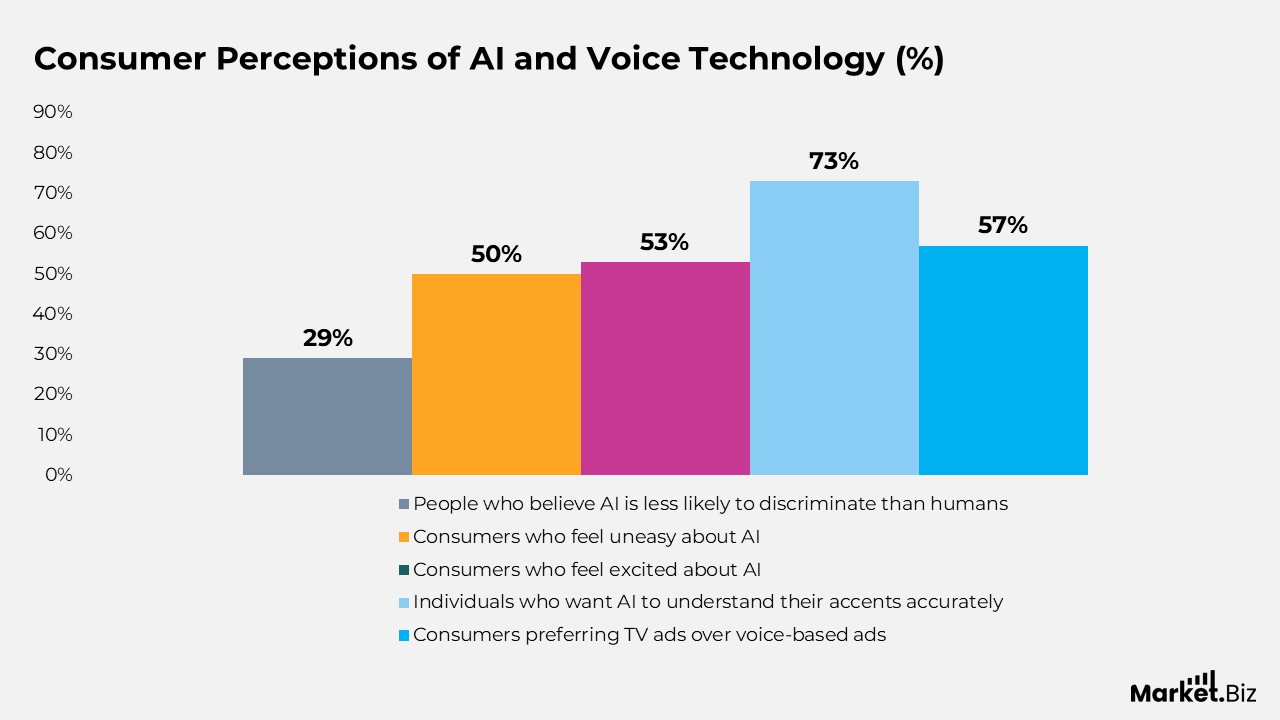
- Around 29% of people feel AI is less prone to discrimination compared to humans.
- Nearly 50% admit AI makes them uneasy, while 53% say it also excites them.
- About 73% of individuals want AI systems to recognize and interpret their accents accurately.
- Roughly 57% of consumers prefer watching television ads instead of listening to voice-based ads.
(Source: Ipsos AI Monitor, PwC, Magiclane App Services Private Limited, Inc.)
Voice AI Agents Usage
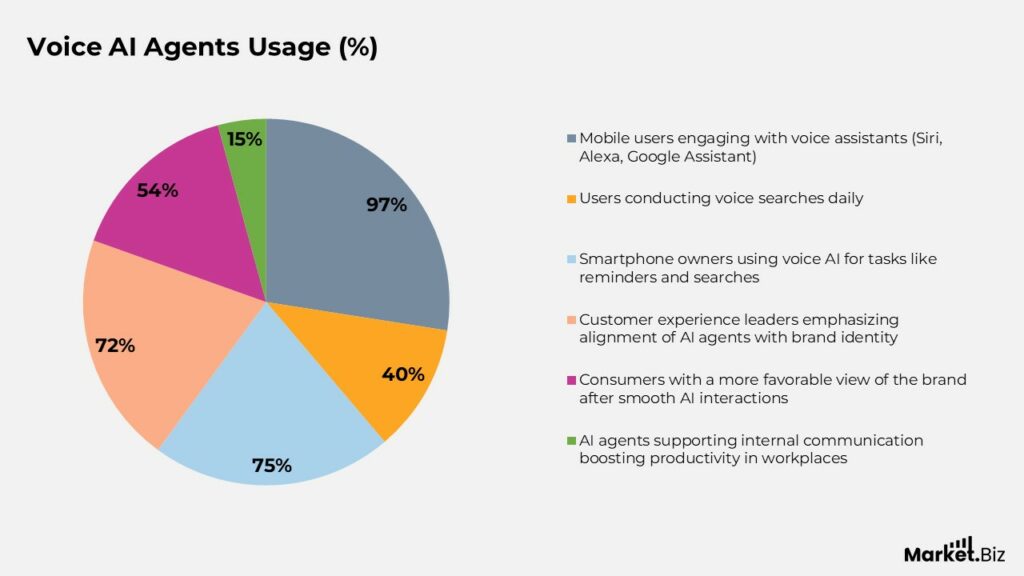
- Early 97% of mobile users have engaged with voice assistants such as Siri, Alexa, or Google Assistant.
- About 40% of users conduct voice searches daily, highlighting how AI agents have become a routine tool.
- By 2025, Google Assistant led the market with 88.8 million active users, ahead of Alexa (36%) and Siri (29%).
- Around 75% of smartphone owners use voice AI for tasks like reminders, online searches, and smart home management.
- Roughly 72% of customer experience leaders emphasize that AI agents must align with brand identity, making them part of the brand experience.
- Smooth interactions with AI agents leave 54% of consumers with a more favorable view of the brand.
- Within workplaces, AI agents supporting internal communication have boosted productivity by 15%, indirectly enhancing customer support outcomes.
(Source: PwC, Tenet, Statista)
Voice AI Advertising
- Around 82% of users prefer being asked for permission before an ad plays on their voice assistant.
- Nearly 73% of people are comfortable receiving personalized voice ads tailored to their past interactions.
- About 88% of consumers are open to ads if they have the option to skip them.
(Source: PwC)
Conclusion
Voice AI agents have evolved into a mainstream business necessity, with enterprises, SMBs, and consumers widely adopting voice-driven interactions to enhance customer service, improve efficiency, and influence purchasing decisions.
Their adaptability is evident across industries such as healthcare, BFSI, retail, and manufacturing, while regions like North America and Asia continue to lead global adoption. Growing trust and satisfaction further demonstrate their role as everyday tools for tasks like search, shopping, and support.
Additionally, ongoing advancements in AI, machine learning, and natural language processing will sharpen accuracy, boost personalization, and elevate efficiency. As businesses pursue competitive advantages and consumers seek seamless digital experiences, voice AI agents are set to become central to engagement strategies.
These statistics highlight the current scale of adoption and the transformative potential of voice AI agents to drive innovation, productivity, and growth worldwide.
FAQ’s
Voice AI agents are intelligent digital tools built to interpret and respond to spoken commands. They integrate artificial intelligence, speech recognition, and natural language processing to facilitate natural and interactive communication between humans and machines.
Their importance is rising as both consumers and businesses demand faster, hands-free, and personalized interactions. By automating routine processes, Voice AI agents enhance convenience and deliver seamless digital experiences.
These agents are widely adopted across industries such as healthcare, financial services, retail, telecom, and manufacturing. They support tasks like patient assistance, banking transactions, customer service, and powering smart devices.
They improve customer engagement by offering immediate responses, reducing wait times, and tailoring services to individual needs. At the same time, they allow organizations to manage higher query volumes efficiently without reducing service quality.
Users are increasingly relying on voice assistants for daily tasks such as shopping, product searches, entertainment, and navigation. As usage grows, voice-based interactions are transitioning from optional conveniences to expected features.
Future adoption will see deeper integration into everyday life and enterprise systems. With advancing AI and machine learning, voice agents are expected to become more precise, context-aware, and personalized, solidifying their role in digital transformation.

