









Introduction
Data Loss Statistics: Data loss has become an increasingly urgent concern for both businesses and individuals in today’s interconnected world. As the amount of sensitive information stored and exchanged across various platforms continues to grow, so too does the risk of data loss. The statistics surrounding this issue highlight its seriousness, shedding light on the prevalence of cyberattacks, system failures, and human mistakes that contribute to data breaches and loss.
These incidents can result in significant financial and reputational damage, emphasizing the critical need for strong data protection strategies. In this regard, comprehending the scale and consequences of data loss is crucial for implementing preventive measures and ensuring long-term organizational resilience.
Editor’s Choice
- 67.7% of businesses report experiencing significant data loss.
- 27.1% view cloud storage as a secure data storage solution.
- 85.6% of data loss incidents occur within cloud storage environments.
- 31.2% of data loss incidents are attributed to malware attacks.
- Ransomware attacks cause 36.7% of data loss.
- 48.5% of all organizations use off-site backup as part of their storage strategy.
- 26.7% prioritize cloud security as their top short-term investment.
- 30.2% of organizations rank essential data backup as their highest priority.
- 41.4% of organizations focus on healthcare data security.
- The Pacific region leads in cloud storage adoption with 31.3% of U.S. tech professionals.
- Over 70% of data breaches are linked to organized crime groups.
- More than 70% of users have experienced data loss at some point, making it a common issue for most people.
- The primary causes of data loss are 34% from accidental deletion and 30% from hardware failures, highlighting the significant role of both human mistakes and technical issues.
- Nearly 60% of users who have never experienced data loss rely on cloud storage for data protection.
Moreover
- Over half of users attempt DIY data recovery first, with 79% of them successfully restoring their lost files.
- 45% of Americans have experienced the compromise of their personal information within the past five years.
- In 2024, one-third of all data breaches involved shadow data information stored outside a company’s main systems.
- 82% of data breaches are connected to cloud-based data.
- 46% of breaches involve customer Personally Identifiable Information (PII), and 40% target employee PII.
- Stolen credentials are involved in 86% of all data breaches.
- The U.S. reported over 4,608 data breaches between September 2022 and September 2023, compromising more than 5 billion records.
- 32% of cyber incidents are related to data theft and leakage.
- More than half of compromised organizations are dealing with security staffing shortages, marking a 26.2% increase compared to 2023.
- 98% of organizations have third-party vendors who have experienced data breaches.
General Data Loss Statistics
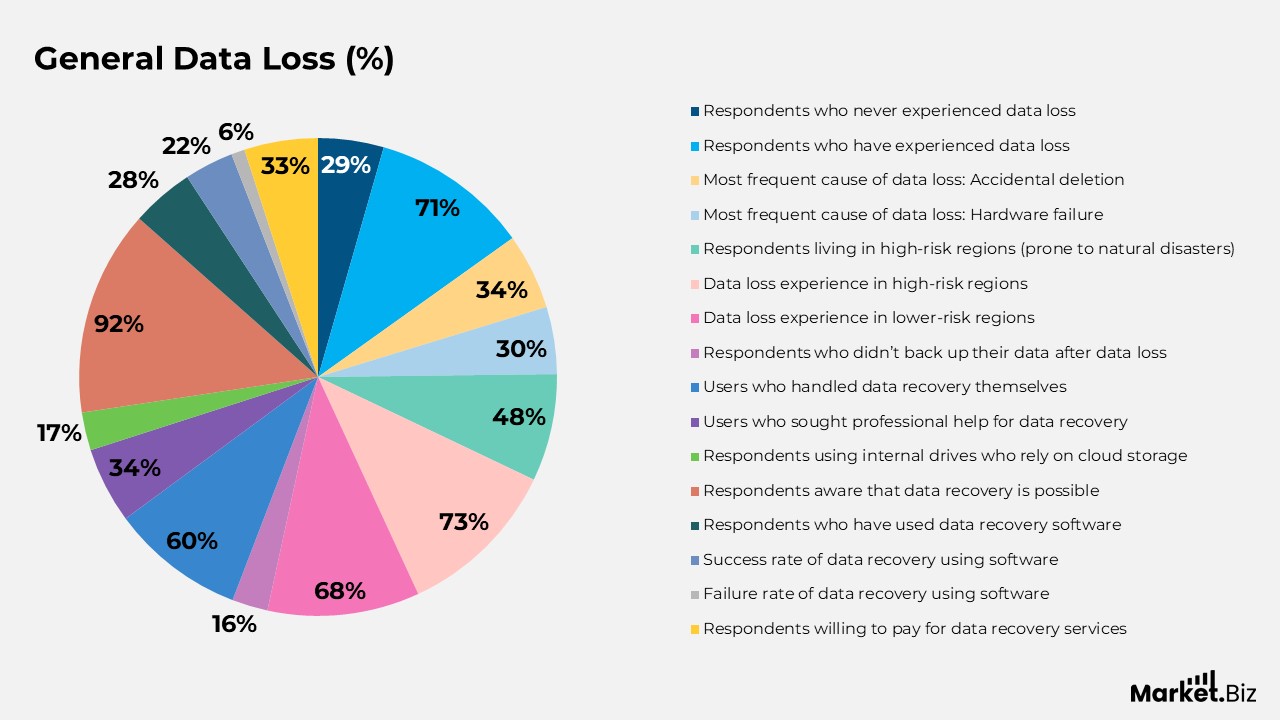
- Of the 1,000 people we surveyed, only 293 reported never losing data, meaning 70.7% have experienced some form of data loss, whether due to accidental deletion, hardware failure, or syncing issues.
- The most frequent cause of data loss is accidental deletion, responsible for 34% of cases, followed by hardware failure at 30%. Together, these two factors account for two-thirds of all data loss incidents.
- When asked about living in areas prone to natural disasters, 52% of respondents said they don’t reside in high-risk regions. However, in areas more vulnerable to disasters (such as wildfires, floods, or frequent power outages), 73% had experienced data loss, compared to 68% in lower-risk regions.
- Mac users experience data loss 30% more frequently than Windows users.
- Among those who experienced data loss, 16% reported not backing up their data.
- Of the 339 users who successfully recovered their lost data, 60% handled the recovery themselves, either by seeking online solutions or using recovery software, while only 34% sought professional help.
- Nearly 60% of respondents rely on cloud storage for their data, while only 17% of those using internal drives can say the same.
- A remarkable 92% of respondents are aware that data recovery is possible.
- Only 28% of those surveyed have used data recovery software, which seems low considering the frequency of data loss. Among them, 22% successfully retrieved their files, while 6% found the software ineffective.
- About 33% of respondents would be willing to pay for data recovery services if the lost data is valuable.
(Source: Handy Data Services, LLC, Statista)
Costs of Data Loss and Cybersecurity Breaches
- The global average cost of a data breach is approximately $4.45 million.
- In the United States, the cost of a data breach is notably higher, reaching around $8.19 million.
- Wealthier nations tend to experience greater financial losses due to cybercrime, with losses scaling alongside a country’s wealth.
- Healthcare organizations bear the highest average costs of data breaches, averaging $6.45 million per incident.
- Cybercrime results in losses nearing $600 billion annually, which accounts for nearly 1% of global GDP.
- The cost per compromised record is roughly $150 on average.
- Experts predicted that by 2020, the average cost of a data breach for large businesses would exceed $150 million, driven by the increase in digitalization and global connectivity.
- Companies that experience a data breach typically see their stock prices hit their lowest point about 14 market days after the breach. On average, stock prices fall by 7.27%, underperforming the NASDAQ by -4.18%.
- The cost of a Business Email Compromise (BEC) hack averages $24,439 per case.
- In a 2019 study, the lost business costs resulting from data breaches were approximately $1.42 million, representing 36% of the total average cost of a breach.
- While not as costly as malicious attacks, breaches caused by system glitches and human errors still incur significant losses, averaging $3.24 million and $3.5 million, respectively.
Moreover
- In 2019, breaches led to a 3.9% turnover rate of customers.
- Large organizations with more than 25,000 employees experience an average data breach cost of $5.11 million, equating to $204 per employee.
- Smaller organizations with 500 to 1,000 employees experience an average data breach cost of $2.65 million, or $3,533 per employee.
- If a third-party vendor is responsible for the data breach, the cost increases by over $370,000, raising the average total cost to $4.29 million.
- Data breaches caused by malware are the most expensive, with an average cost of $2.6 million, followed by web-based attacks and denial of service attacks.
- In 2018, the downtime cost associated with internet service outages due to DDoS attacks was approximately $221,836.80.
- Organizations that implement encryption, data loss prevention, threat intelligence sharing, and security integration into software development (DevSecOps) tend to incur lower-than-average breach costs. Encryption alone reduced breach costs by an average of $360,000.
- Companies that regularly test their incident response plans experienced an average breach cost of $1.23 million, less than those without an incident response plan or team.
- After a data breach, hospitals spent 64% more on advertising to mitigate reputational damage.
Further
- Around 1 in 100 hard drives fail each year, highlighting the risk of hardware failure.
- 27% of malware activity is attributed to ransomware attacks, demonstrating the prevalence of this cyber threat.
- 28% of ransomware attacks result in data loss, emphasizing the potential for significant damage.
- 22% of data outages and losses are caused by software failures, making it the most common reason for disruptions.
- 33% of company folders remain inadequately protected, leaving organizations vulnerable to breaches.
- Only 45% of companies believe their security budget is adequate for their needs.
- Following a ransomware attack, 97% of data is typically recoverable, offering some hope for recovery.
- 69% of all data breaches are attributed to external attacks, underscoring the threat from outside sources.
- In 2020, the U.S. saw over 1,000 registered data breaches, revealing the widespread nature of the problem.
- In 2020, the Dutch government lost two external hard drives containing the personal data of over 6.9 million organ donors, highlighting significant data handling failures.
(Source: IBM, CSIS, Info Mineo, Wired, ZDNet, Statista, Duo, Comparitech, InvenioIT, PNC, Cybercrime Magazine, McAfee, Accenture, NETSCOUT, UpGuard, Inc., American Journal of Medical Care)
Data Loss Prevention Market Size
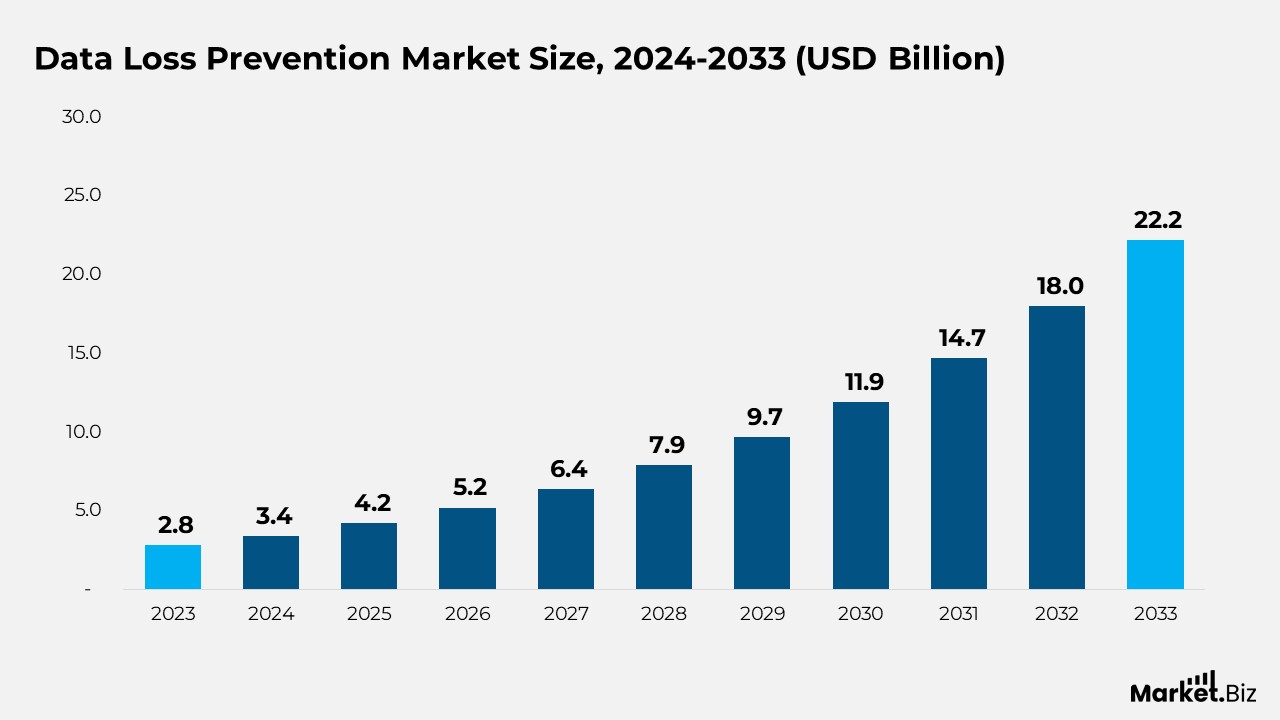
- According to Market.us, the data loss prevention market is expected to rise from $3.4 billion in 2024 to $22.2 billion by 2033, representing a compound annual growth rate (CAGR) of 23% from 2024 to 2033.
- The Data Loss Prevention (DLP) market growth is driven by increasing data generation, cloud storage adoption, and rising regulatory requirements across industries.
- In 2023, the Storage/Data Centre DLP segment captured more than 37.2% of the global market share due to growing concerns over data security.
- The Cloud-Based segment dominated the DLP market in 2023, with a 60.5% market share, attributed to widespread cloud computing adoption.
- Large Enterprises held a 58.4% market share in 2023, driven by the need to protect large volumes of sensitive data and comply with regulations.
- The Encryption segment represented 23.3% of the DLP market in 2023, underlining its critical role in securing data.
- The BFSI sector dominated the DLP market in 2023, with a 21% share, driven by the sensitivity of financial data.
- North America held the largest DLP market share in 2023 with 35.9%, valued at USD 1.0 billion, due to strict regulatory requirements.
Moreover
- 60% of small businesses experiencing significant data loss close within six months, while 72% fail within two years.
- Small businesses incur an average data breach cost between $36,000 and $50,000, highlighting the economic impact on them.
- In 2023, there were 3,205 data compromises in the U.S., affecting over 353 million people.
- 60% of businesses facing data loss close within six months, and 70% of small businesses go out of business within a year.
- The average global cost of a data breach is $3.86 million, with a loss of $150 per compromised record.
- 75% of data breaches are caused by external attackers, with 52% of breaches from malicious or criminal attacks.
- Over 25% of data breaches are caused by internal employees, with 55% of organizations experiencing incidents due to malicious or negligent employees.
- The healthcare sector experiences the highest data breach cost at $7.13 million, followed by the financial sector at $5.86 million.
(Source: Market.us)
Forecasting the Impact of Data Breaches
- 29.6% of companies are predicted to experience a data breach within the next two years, highlighting the increasing vulnerability of businesses.
- The financial toll from deepfake scams is projected to surpass $250 million by 2020, showcasing the growing threat of AI-generated fraud.
- A business is expected to fall victim to a ransomware attack every 11 seconds in 2021, indicating the escalating pace of cyberattacks.
- Global cybersecurity spending is forecasted to exceed $1 trillion over the five years from 2017 to 2021, reflecting the mounting investment in defense against cyber threats.
- Cybercrime is predicted to cost $6 trillion by 2021, underscoring the immense financial burden on organizations globally.
- A leading cloud vendor is anticipated to suffer a breach that compromises sensitive data from hundreds of Fortune 1000 companies, signaling vulnerabilities in cloud services.
Moreover
- Attackers are expected to increasingly target biometric systems, focusing on exploiting vulnerabilities in touch ID, facial recognition, and passcodes.
- Due to growing concerns over data privacy, one in five enterprise customers will take measures to protect their data from artificial intelligence technologies.
- 69% of security professionals agree that staying ahead of attackers is an ongoing struggle, and the cost of doing so is becoming unsustainable.
- A major wireless carrier is projected to be attacked, potentially compromising the personal data of millions of consumers and disrupting wireless communications across the United States.
- Skimming attacks are expected to evolve, with the next major threat being large-scale enterprise attacks targeting national networks of financial institutions, leading to significant financial losses.
- Gaming platforms are predicted to be exploited to gain unauthorized access to computers and personal data, taking advantage of trusting players.
- The increasing number of unsecured IoT devices suggests that IoT botnets will continue to thrive. At the same time, the challenge of protecting DNS resolvers and the proliferation of DDoS-for-hire services make it easier for cybercriminals to launch massive attacks.
(Source: IBM, Forrester Research, Herjavec Group, Experian, Accenture, Nexusguard, UpGuard, Inc)
The Financial and Operational Impact of Data Loss and Security Breaches
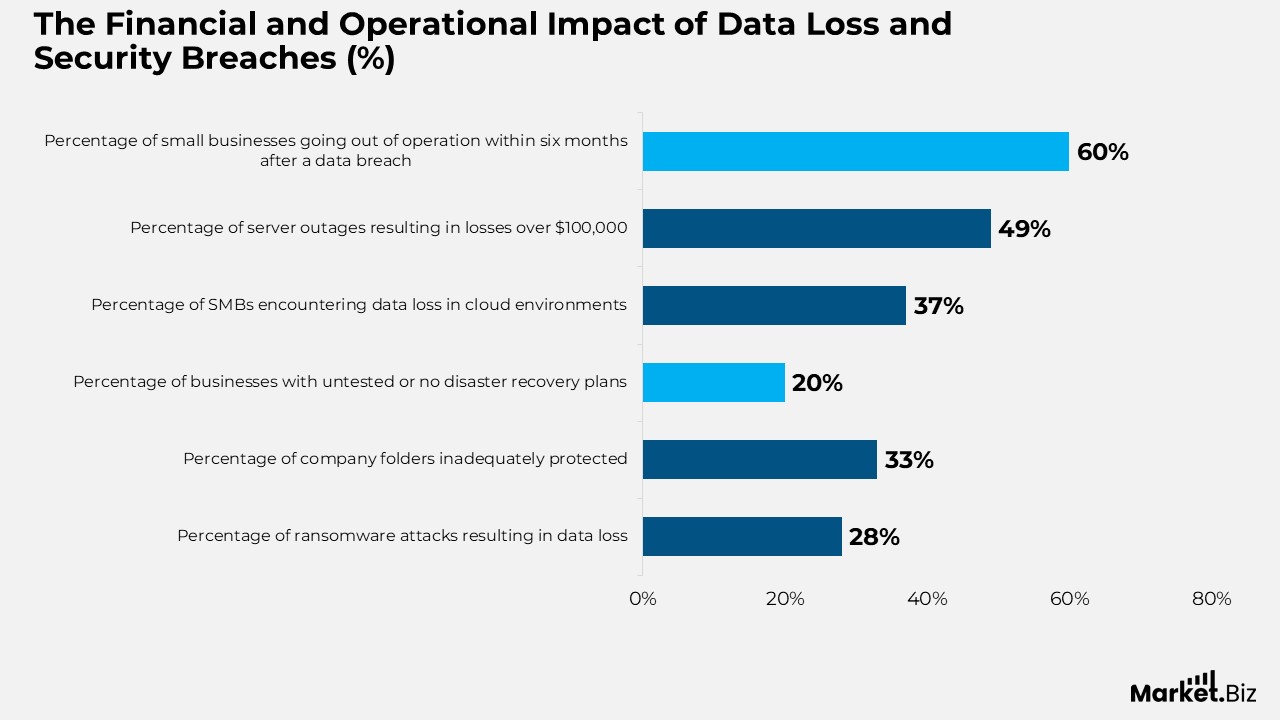
- 28% of ransomware attacks result in data loss, underscoring the severe consequences of such cyberattacks.
- 33% of company folders remain inadequately protected, exposing organizations to potential security breaches.
- 20% of businesses report either not having tested their disaster recovery plans or lacking them entirely, which puts them at significant risk in the event of a breach.
- 37% of small and medium-sized businesses (SMBs) have encountered data loss in cloud environments, indicating vulnerabilities in cloud data management.
- 49% of server outages result in financial losses exceeding $100,000, demonstrating the high costs associated with operational disruptions.
- 60% of small businesses go out of operation within six months following a data breach, highlighting the critical impact of security incidents on their survival.
(Source: InvenioIT, 99Firms.com, Cybercrime Magazine)
Business Data Loss Statistics
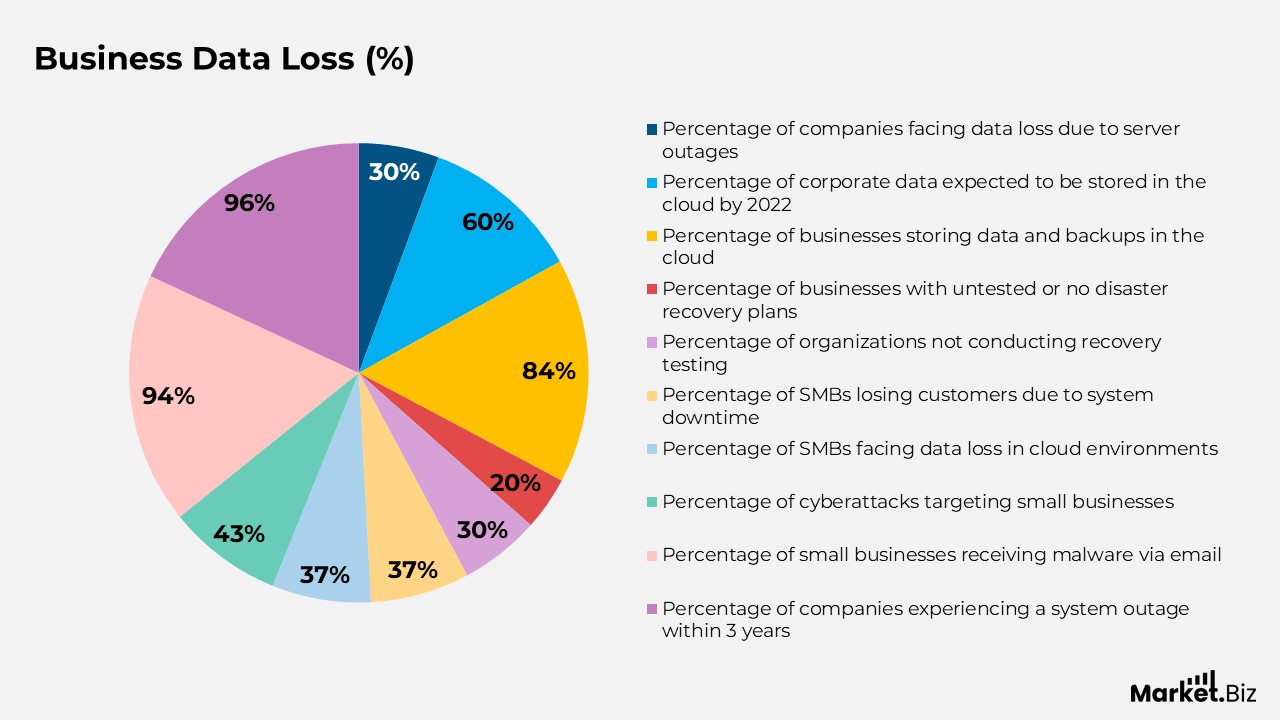
- 30% of companies face data loss as a result of server outages, highlighting the risks of system disruptions.
- By 2022, 60% of all corporate data is expected to be stored in the cloud. Showing the growing reliance on cloud storage.
- 84% of businesses store data and backups in the cloud, underscoring the cloud’s significance in modern data management strategies.
- 20% of respondents reported not having tested their disaster recovery plans or lacking them altogether, leaving them unprepared for data loss incidents.
- Approximately 30% of organizations do not conduct recovery testing. Which could jeopardize their ability to recover from data breaches or system failures.
- 37% of small and medium-sized businesses (SMBs) lost customers due to system downtime, emphasizing the impact of outages on business relationships.
- 37% of SMBs have faced data loss in cloud environments, revealing vulnerabilities in cloud data management.
- 43% of cyberattacks target small businesses, making them a significant target for cybercriminals.
- 94% of small businesses report receiving malware through email. Indicating that it is the primary method of cyberattacks.
- 96% of companies experienced a system outage within 3 years. Highlighting the frequency of operational disruptions.
(Source: InvenioIT, Statista, Infrascale, OSIbeyond, Fundera, Comparitech)
Conclusion
Data loss continues to be a prevalent issue, impacting a large number of individuals and businesses. The statistics reveal that most people have encountered some form of data loss, with accidental deletion and hardware failure being the primary causes. Although cloud storage adoption is on the rise, many users still neglect regular data backups, leaving them exposed to potential loss.
While many turn to DIY recovery methods, professional recovery services remain essential for more complicated cases. Though awareness of data recovery options is widespread, the actual use of recovery tools is relatively low.
These insights highlight the critical need for proactive data protection measures, such as consistent backups and dependable recovery solutions. To reduce the risks associated with data loss in both personal and business environments.
FAQ’s
Data loss can result in the loss of important information, financial losses, legal issues, and damage to an organization’s reputation. It impacts personal data, sensitive business information, and customer trust, making it essential to have effective prevention and recovery measures in place.
Data loss can occur due to several factors, including human mistakes (such as accidental deletions), technical failures (like hardware malfunctions), cyberattacks (ransomware, malware), and environmental risks (such as natural disasters). These causes require different strategies for prevention and recovery.
Several factors contribute to data backup neglect, including a lack of awareness, complacency, or underestimating the risks of data loss. Additionally, individuals and businesses may face obstacles such as limited time, insufficient technical knowledge, or difficulty setting up backup systems.
Cloud storage provides a remote and scalable solution for data backup, making it accessible from anywhere and safeguarding against local hardware failures. However, relying solely on cloud storage may not be enough, as it can still be vulnerable to data breaches, outages, and security threats.