









Introduction
ebooks Statistics: eBooks have emerged as a fundamental segment of modern publishing, supported by rapid digitalization and evolving reader behavior. The widespread use of smartphones, tablets, and dedicated eReaders has made digital reading more convenient and flexible across daily routines, including travel and leisure time. eBooks statistics reflect a growing preference for instant access, portability, and affordability, especially among digitally engaged and younger audiences.
The expansion of subscription-based reading services, online libraries, and self-publishing platforms continues to strengthen adoption. In parallel, advancements in display technology, formatting, and accessibility tools are improving reader comfort and inclusivity.
eBook statistics offer a structured, data-driven perspective on market growth, reader profiles, content demand, pricing trends, and geographic penetration, underscoring the growing influence of digital formats on the global publishing landscape.
Editor’s Choice
- The United Kingdom leads Europe in eBook adoption, with approximately 72 million eBooks purchased in 2021. Indicating that nearly every resident bought at least one digital book during the year.
- Germany follows closely, where about 50% of the population purchased an eBook, reflecting strong penetration among readers.
- Denmark and Spain rank next, with nearly one in two individuals in each country buying eBooks, placing them among Europe’s most active digital reading markets.
- Poland shows lower penetration, with roughly 1 in 13 people purchasing eBooks. Though the market recorded a sharp 177% growth in sales, signaling rapid catch-up potential.
- Adoption of dedicated reading devices positively impacts reading habits. As 53% of eReader buyers report reading more books than before purchasing their device.
- Purchasing behavior has also intensified, with 51% of eReader owners increasing their eBook purchases over the past year.
- Engagement among device owners remains high, with 86% reading on their eReaders more than once per week and 51% using their devices daily.
- eReaders are now owned by roughly 1 in 10 Americans, and an additional 12% plan to purchase one within the next six months, indicating continued demand.
- Device ownership drives higher overall book consumption, as the average Amazon customer purchases 3.3 times more books after acquiring a Kindle.
- eBook usage extends beyond dedicated devices, with 20% of Kindle store digital book buyers not owning a Kindle, instead reading on tablets or smartphones.
- Apple’s iPad holds around 16% of the global eReader and tablet reading market, with its share continuing to expand.
- iPad shipments are projected to reach 15.6 million units in the current year and rise sharply to 46 million units the following year, further supporting digital reading growth.
Evolution of eBooks
- In 1993, BiblioBytes emerged as one of the earliest platforms dedicated to distributing both free and paid eBooks, marking an early step in digital publishing.
- The standardization of HTML in 1995 laid the technical foundation for web-based content and early eBook formatting.
- Project Gutenberg reached a major milestone in 1996 by publishing its 1,000th digital book, significantly expanding public access to electronic texts.
- E Ink display technology, later adopted by devices such as Kindle, Kobo, and Nook, was invented and commercialized in 1997, enabling paper-like digital reading.
- In 1998, the first handheld eReaders were launched, alongside the introduction of library eBook lending and the assignment of ISBNs to eBooks.
- An important interoperability milestone occurred in 1999 with the release of the Open eBook Publication Structure, designed as a universal eBook format.
- In 2004, the Open Ebook Forum evolved into the International Digital Publishing Forum. Strengthening global governance around digital publishing standards.
- The release of Open Publication Structure 2.0 in 2007, later renamed EPUB, established a widely adopted standard for modern eBooks.
- Also in 2007, Amazon introduced the Kindle, accelerating mainstream adoption and transforming the commercial eBook market.
(Source: Whop)
Annual eBook Sales Trend Over Time
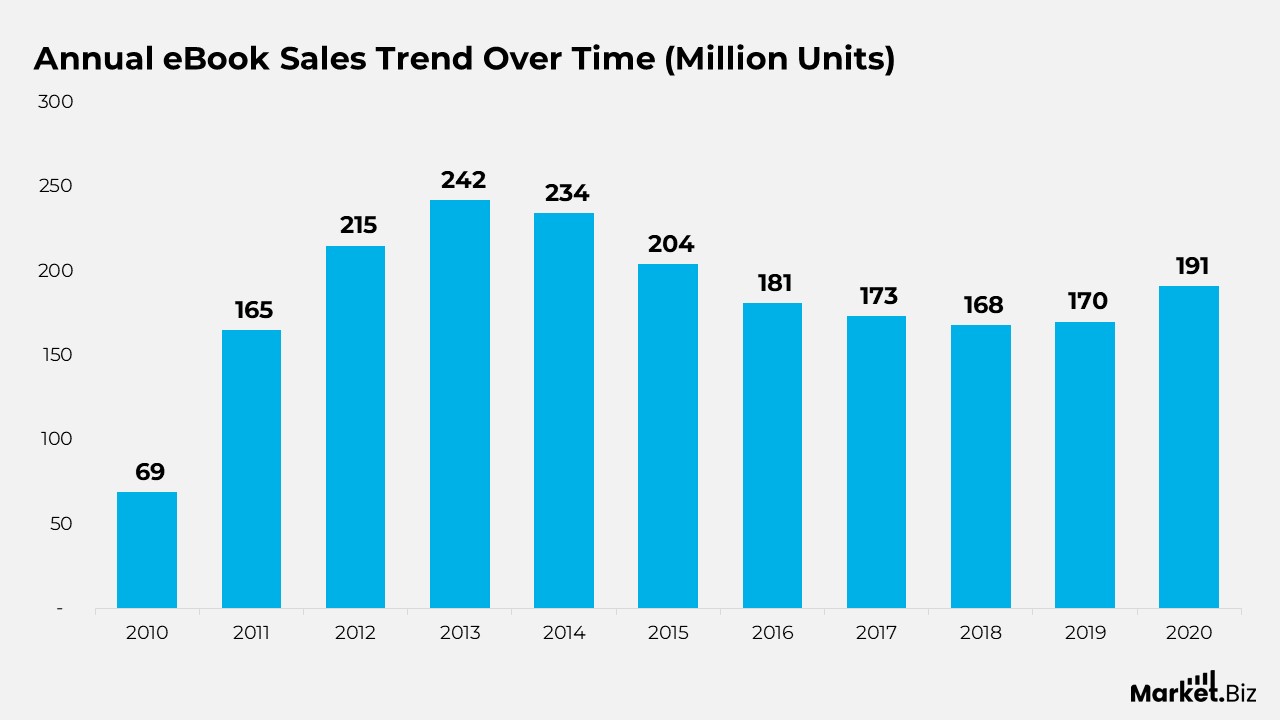
- eBook sales reached 191 million units in 2020, reflecting renewed growth in digital reading adoption.
- In 2019, total eBook sales stood at 170 million, showing stable demand ahead of the subsequent rise.
- Sales volumes in 2018 were recorded at 168 million, indicating a largely flat market year over year.
- In 2017, eBook sales reached 173 million, maintaining consistent consumer interest.
- In 2016, digital book sales totaled 181 million, marking a modest decline from earlier peak years.
- eBook purchases amounted to 204 million units in 2015, highlighting stronger market performance during the mid-decade period.
- The market reached one of its highest points in 2014, with 234 million eBooks sold globally.
- In 2013, sales peaked at approximately 242 million units, representing the highest volume in the historical series.
- During 2012, eBook sales were reported at 215 million, reflecting rapid expansion in early adoption years.
- In 2011, digital book sales increased to 165 million, driven by growing e-reader adoption.
- The early growth phase is evident in 2010, when eBook sales totalled 69 million, underscoring the rapid scaling that followed.
- eBook sales reached 191 million units in 2020, a 12.35% increase from 2019.
- Despite recent gains, total eBook sales remain 21.07% below the market’s historical peak recorded in 2013.
- During the first half of 2021, eBook sales declined by 8% compared to the same period in 2020, yet volumes stayed 8% higher than pre-pandemic levels seen in 2019.
- Over the past decade, annual eBook sales expanded nearly threefold, rising from 69 million units in 2010 to 191 million units by 2020.
- Adult fiction continues to dominate the eBook category, accounting for 41% of total digital book sales in 2021.
(Source: Words Rated)
eBook Sales Frequency Breakdown Based on Annual Volume
- With annual eBook sales of 191 million units in 2020, average monthly sales are estimated at approximately 15.92 million eBooks.
- Every week, this translates to around 3.67 million eBooks sold across the year.
- Daily sales volume averages roughly 524.72 thousand eBooks, highlighting consistent day-to-day demand.
- At an hourly level, eBook purchases equate to nearly 21.86 thousand units sold.
- On a minute-by-minute basis, an estimated 364.38 eBooks are purchased, underscoring the continuous pace of digital book consumption.
(Source: Words Rated, Statista)
Shifting Revenue Share Trends Across Digital Reading Formats
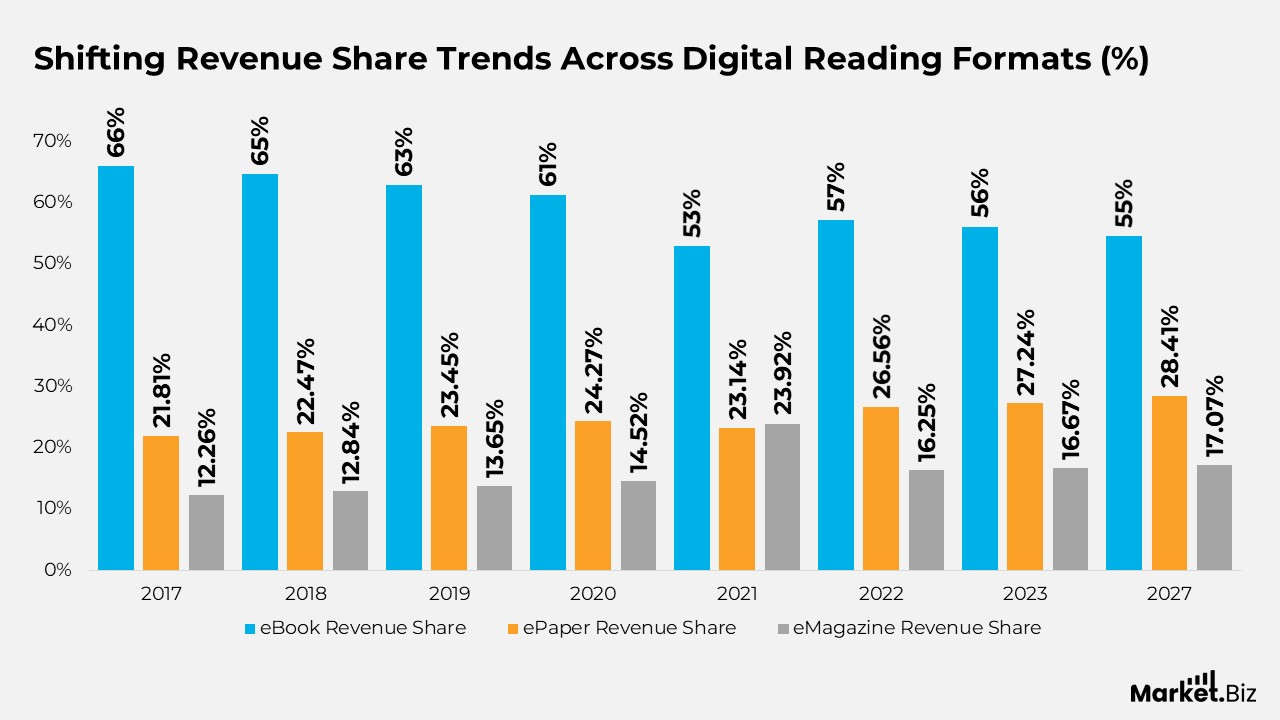
- In 2017, ebooks accounted for 65.94% of digital reading revenues, e-papers for 21.81%, and e-magazines for 12.26%.
- The ebook share eased slightly to 64.69% in 2018, as e-paper revenues increased to 22.47% and e-magazines rose to 12.84%.
- By 2019, ebooks continued their gradual decline to 62.89%, alongside steady gains for e-papers at 23.45% and e-magazines at 13.65%.
- In 2020, the ebook revenue share further decreased to 61.21%, while e-papers increased to 24.27% and e-magazines increased to 14.52%.
- A notable shift occurred in 2021, when e-books dropped to 52.94%, as e-magazines surged to 23.92%, nearly matching e-papers at 23.14%.
- The market rebalanced in 2022, with ebooks recovering to 57.19%, e-papers rising to 26.56%, and e-magazines settling at 16.25%.
- In 2023, e-books maintained a majority share at 56.09%, supported by continued growth in e-paper at 27.24% and stable e-magazine revenues at 16.67%.
- Looking ahead to 2027, projections indicate e-books retaining leadership at 54.52%, while e-papers expand further to 28.41% and e-magazines increase modestly to 17.07%, signalling ongoing diversification within digital publishing revenues.
(Source: Audio Publishers Association)
Fastest Growing Digital Publishing Companies by Growth Rate
- Microcosm Publishing recorded the strongest expansion, posting a 207% growth rate, significantly outpacing peers.
- Blue Star Press followed with robust momentum, achieving 120% growth during the same period.
- Media Lab Books demonstrated solid performance. Registering a 70% increase in growth.
- Wolfpack Publishing maintained steady upward movement, with growth reaching 67%.
- Ulysses Press showed moderate but consistent expansion, recording 52% growth.
- 1517 Media continued its growth trajectory with a 49% increase.
- Kogan Page Inc. rounded out the group, posting 47% growth, reflecting stable progress in digital publishing activities.
(Source: Statista, Bloggingwizard)
Income Distribution and Monetization Models for eBook Authors
- As of 2025, self-published authors earn an average of USD 1-5 per eBook sold on major online marketplaces.
- Authors working under traditional publishing models typically receive lower per-book earnings, averaging USD 0.50-2 per eBook.
- First-time authors signed with traditional publishers often receive advance payments ranging from USD 1,000 to USD 10,000, along with royalty rates of 5% to 18%, payable after the advance is recovered.
- Independent authors benefit from higher revenue retention, with royalty shares reaching up to 80%, depending on distribution channels and pricing strategies.
- Several self-published authors have achieved large-scale commercial success. With individual eBook sales surpassing multiple million copies globally.
- eBook royalty structures in 2025 varied by publishing model: self-publishing offered 35% to 70%, small presses 25% to 50%, and major traditional publishers averaged around 25%.
- In April 2025, KDP Select distributed USD 61.3 million in royalties to authors, representing a 9% increase from USD 56.1 million in June 2024.
- The leading self-publishing platform offers two primary royalty options: a 35% rate available globally and a 70% rate applicable across 42 key international markets.
- Income distribution among independent authors varies widely, with 54% earning more than USD 100 per month from writing activities.
- Approximately 17% of indie authors report monthly earnings between USD 251 and USD 1,000, while a similar share generate income ranging from USD 2,500 to over USD 20,000 per month.
(Source: Statista)
Author Marketing Challenges and Promotional Effectiveness in Self-Publishing
- In 2024, nearly 80% of authors identified marketing as the most difficult aspect of the self-publishing process.
- Authors devoted an average of 8 hours per week to marketing activities and spent roughly USD 700 per month on promotional efforts.
- Marketing investment increased compared to 2023, when authors spent about USD 617 per month and dedicated more than 31 hours monthly to eBook promotion.
- Among promotional strategies in 2024, BookBub featured deals ranked as the most effective, achieving an average score of 3.4 out of 5.
- Promotional platforms such as Freebooksy and Bargain Booksy followed closely, each earning an average effectiveness rating of 3.3 out of 5.
- Author newsletters also performed strongly, with an average rating of 3.3, highlighting the value of direct reader engagement.
- Additional marketing tactics showed moderate effectiveness. Including lead magnets (3.0), Facebook advertising (2.9), and Amazon ads (2.7).
- Lower-rated but still utilised approaches included newsletter swaps (2.6), BookBub ads (2.2), and Kickstarter campaigns (2.1).
- Social media advertising reach remained substantial. With YouTube leading at 2.54 billion monthly users.
- Facebook followed with a potential reach of 2.34 billion users, while Instagram and TikTok each reached approximately 1.84 billion users per month.
(Source: Statista, Whop)
Impact of Digital Piracy in the Publishing Industry
- Between 2020 and 2024, global publishing piracy activity exceeded 261 billion total website visits. Underscoring the scale of unauthorized access to content.
- In 2024, publishing piracy increased by 4.3%, with manga accounting for more than 70% of all piracy-related activity across publishing formats.
- Other publishing categories accounted for smaller shares of piracy demand, including general publishing at 15%, web fiction at 7%, books at 5%, and audiobooks at 2%.
- Geographic analysis shows that the highest concentration of publishing piracy traffic originates in the US, accounting for over 12% of total demand.
- Indonesia accounted for approximately 10% of global publishing piracy traffic, while Russia contributed more than 7%.
- Long-term trends indicate a sharp rise in digital piracy. With demand for pirated eBooks increasing by 189% between 2017 and 2023.
- Monthly traffic to publishing piracy websites doubled by 2023, signalling widening consumer exposure to unauthorized platforms.
- Total visits to publishing piracy websites reached 60.8 billion. A 27% increase from 2022.
- Country-level demand remained highest in the US at 12.8%, followed by Vietnam at 6.8%, reflecting regional consumption patterns.
- Publishing surpassed film in 2020 to become the second-most-demanded media category for digital piracy.
- Economic losses remain significant, as the US publishing industry was estimated to have lost more than USD 2.9 billion to piracy in 2020, underscoring the financial impact on publishers and authors.
(Source: Statista, Whop)
Conclusion
eBook statistics show that digital reading has firmly established itself as a stable and integral part of the publishing landscape. Moreover, consistent sales volumes, widespread device usage, and strong reader engagement underscore a lasting shift toward digital formats.
Although total eBook sales remain below earlier peak levels, reading frequency and consumption depth continue to be supported by subscriptions, library access, and cross-platform availability.
Revenue share trends confirm that eBooks remain the leading digital reading format, even as complementary formats gain momentum. In parallel, evolving royalty structures and self-publishing models are improving authors’ earning potential.
Overall, eBook statistics point to a durable, accessible, and scalable market that continues to shape how written content is produced, distributed, and consumed.
FAQ’s
In theoretical terms, eBook statistics are structured quantitative indicators used to analyse digital reading behaviour, technology adoption cycles, content consumption intensity, and long-term transformations within the publishing ecosystem.
eBook statistics are applied to diffusion and media substitution theories, illustrating how digital reading formats move from early adoption to mainstream acceptance through device availability, pricing efficiency, and lifestyle integration.
Long-term sales data helps evaluate market maturity, saturation points, and cyclical demand, offering insight into whether growth reflects structural change or short-term disruption.
Demographic analysis enables researchers to assess generational differences in digital literacy, economic access, and life-stage effects, thereby explaining variations in adoption across age groups and regions.
Genre data reveals cultural consumption preferences and format suitability, helping explain why narrative-driven and leisure-oriented content often performs more strongly in digital formats.