








Introduction
Digital Signage Statistics: Digital signage has become a key element of modern communication strategies, reshaping how businesses and institutions engage with audiences across retail, transportation, hospitality, education, and corporate settings. With advancements in display technology, cloud-managed content, and real-time data integration, digital signage now delivers highly dynamic, interactive, and targeted visual experiences.
Adoption continues to accelerate as organizations deploy LED walls, interactive kiosks, wayfinding systems, and programmatic digital out-of-home networks to improve customer engagement and streamline operations. Innovations such as AI-driven content automation, sensor-powered personalised displays, and integration with IoT ecosystems are further expanding its capabilities.
Examining digital signage statistics offers valuable insight into usage trends, investment patterns, and the growing influence of digital displays in shaping audience experience and communication effectiveness.
Editor’s Choice
- Digital signage content reaches around 135 million viewers each week, showing strong weekly audience engagement.
- North America remains the largest market and is expected to grow the fastest at 42%, followed by Asia at 17%, while Africa and Australia/New Zealand expand more slowly at 2% and 1%, respectively.
- Adoption continues to rise, with 60% of retailers without digital signage planning to invest in the next two years.
- More than 67% of businesses anticipate increased digital out-of-home advertising activity over the next two years.
- The global market value expanded by over 13.2 billion dollars, reflecting accelerating industry momentum.
- Screen deployment varies: 33% of users have 1–24 screens, 15% operate 15–99, 12% manage 100–149, 8% run 250–999, and 9% use more than 1000 screens.
- Nearly 80% of brands using digital signage report sales lifts of up to 33%, especially in impulse-driven product categories.
- Public venue signage reaches up to 10% of Americans aged 12 and older, compared to 41% on Facebook and 43% on the internet.
- Digital signage enhances queue management by reducing perceived wait times by more than 35%.
Further
- Around 53% of end users expect to increase their digital signage budgets within 2 years.
- Investment priorities include 65% planning to buy new displays and 42% intending to boost spending on content production.
- About 51% of users deploy screens for customer-facing communication, while 9% utilize digital signage for employee-facing messaging.
- Between 2004 and 2010, the cost of running a 100-node digital signage network for three years dropped by 50% due to technology advancements.
- The average attention span ranges from 2.8 to 8 seconds, underscoring the importance of quick visual engagement.
- Approximately 90% of the information the brain receives is visual.
- The human brain processes images in as little as 13 milliseconds, reinforcing the power of visual content.
- Visuals attract 94% more views than text information.
- People retain 65% of visual information after three days.
- Digital signage achieves an 83% recall rate, nearly twice that of traditional advertising.
- It contributes to a 47.7% improvement in brand awareness.
- Digital screens capture 400% more views than static signage.
- Nearly 75% of travellers recall seeing a digital billboard in the past month.
Role of Digital Signage in Modern Workforce Engagement
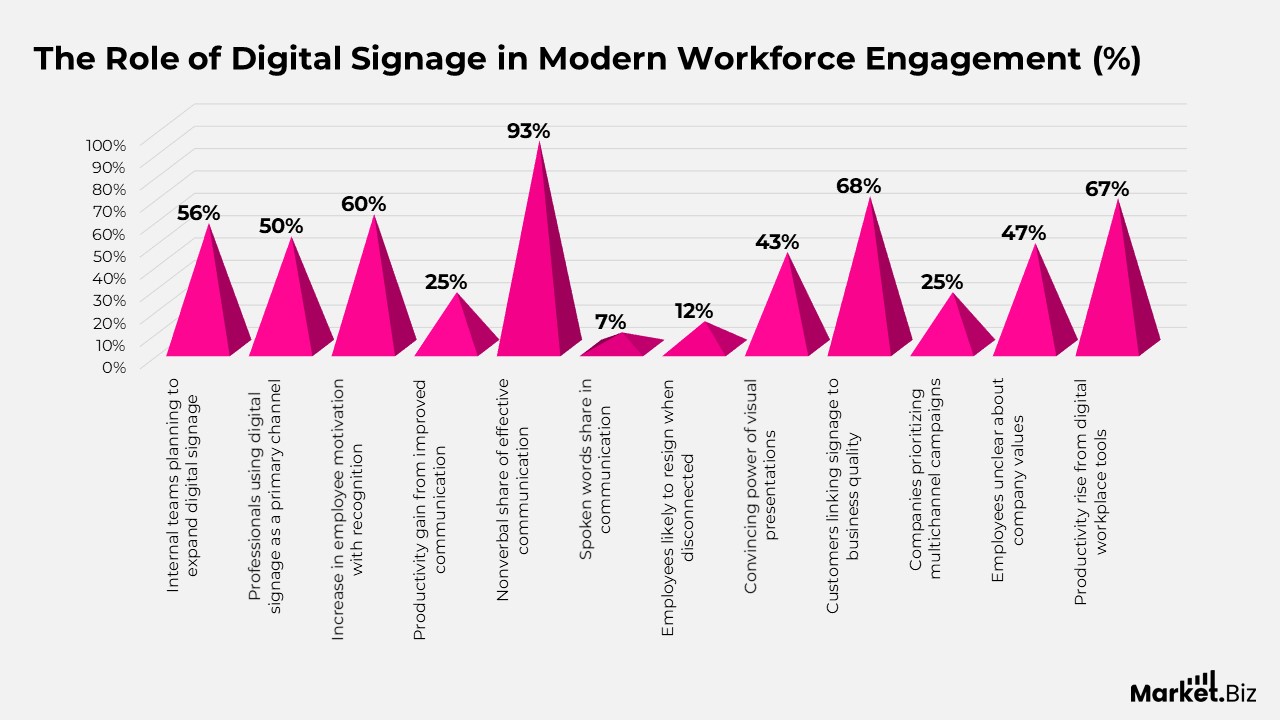
- Around 56% of internal communication teams plan to expand their use of digital signage across their organizations.
- Nearly 50% of communication professionals already rely on digital signage as one of their primary messaging channels.
- Supporting employee recognition becomes easier with digital signage, and employees who are recognized are 60% more motivated to perform better.
- Improved internal communication through digital signage contributes to 25% higher employee productivity, and companies with strong communication practices are 4x more likely to achieve strong engagement levels.
- About 93% of an effective message is nonverbal, while verbal words explanation for only 7%, reinforcing the value of visual workplace tools.
- Employees who feel disconnected from their workplace are 12 times more likely to resign that year.
- Presentations enriched with visual elements are 43% more convincing compared to those without visual support.
- Nearly 68% of US customers perceive signage as a reflection of a business’s quality and the products it offers.
- More than 25% of US companies prioritize multichannel campaign management, including digital signage initiatives.
- Approximately 47% of employees admit they do not clearly understand their company’s core values, making digital signage a strong tool for continuous reinforcement of those values.
- Organizations adopting digital tools for flexible workplaces have seen productivity rise by 67%, highlighting the impact of visual and digital communication methods.
(Source: Mvix, Statista)
Healthcare Digital Signage Statistics
- IoT-backed healthcare tools have the potential to save the US more than $ 300 billion.
- Digital communication systems are now deployed in 70% of hospitals.
- Roughly 64% of physicians believe IoT reduces workload pressures on healthcare staff.
- Around 75% of caregivers and patients say hospital digital content improves the overall care experience.
- About 78% of patients actively seek digital health solutions whenever available.
- Digital signage serves as a source of health information for 52% of patients.
- Nearly 75% of hospital visitors recall at least one message from digital screens.
- Around 83% of patients spend meaningful time engaging with digital hospital displays.
- Digital messaging helps 27% of patients discover medical professionals.
- Clinics using displays experience growth of 15% to 150%.
- Ineffective communication in hospitals contributes to losses of 12 billion dollars annually.
- According to a Deloitte study, nearly 92% of healthcare professionals and institutions reported improved performance after adopting digital signage solutions.
Retail Digital Signage Statistics
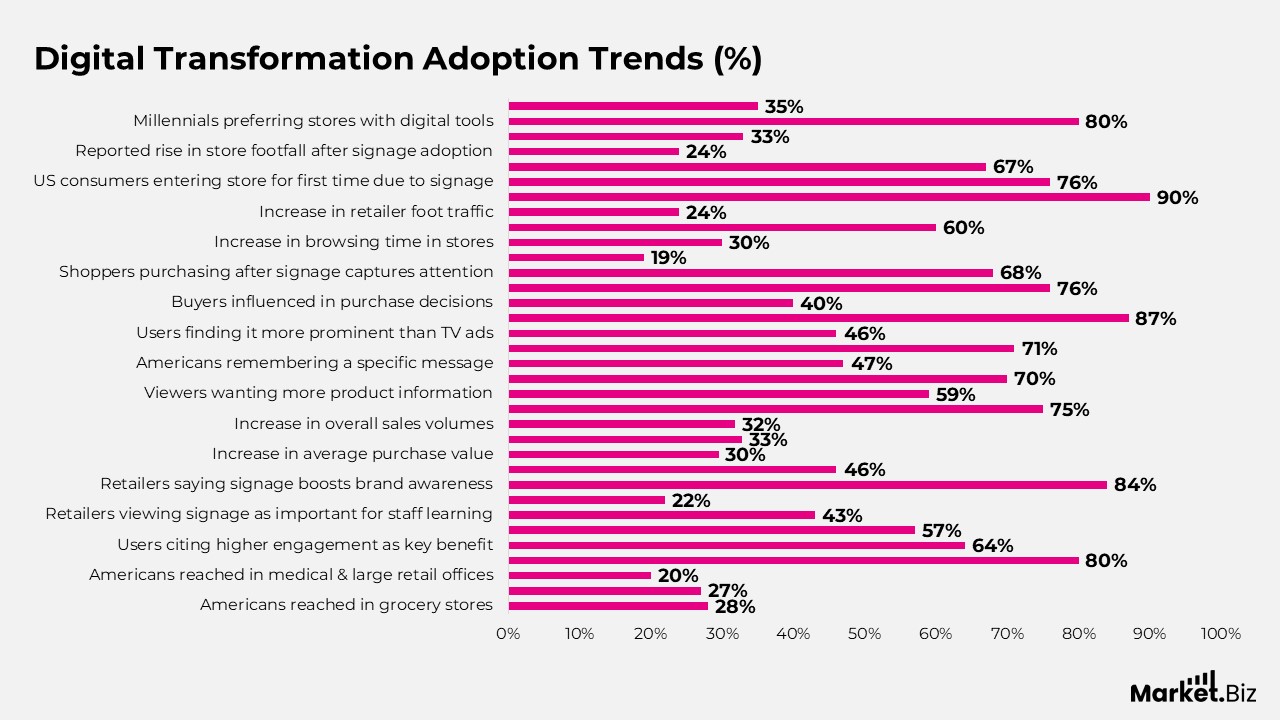
- Grocery stores reach 28% of Americans through digital signage, followed by shopping malls at 27%, and both medical offices and large retail stores at 20%.
- About 80% of shoppers enter a store after noticing its digital signage.
- Nearly 64% of users identify higher customer engagement as the leading advantage of digital signage.
- Around 57% report better customer service outcomes after adopting digital displays.
- Digital signage supports staff learning, with 43% of retailers viewing it as important and 22% regarding it as essential.
- Close to 84% of retailers believe digital signage boosts brand awareness more than conventional channels.
- Customer satisfaction increases by 46% when digital signage is used effectively.
- Average purchase amounts rise by 29.5%, supporting stronger in-store conversions.
- Repeat buyer activity grows by 32.8% when digital displays are part of the retail experience.
- Overall sales volumes can increase by 31.8% due to the influence of digital displays.
Further
- Nearly 75% agree that digitally displayed promotional and personalized content drives the strongest results.
- Digital signage sparks curiosity, with 59% of viewers wanting more information about the displayed product.
- About 70% of Americans recall seeing digital signage within the past month, and 47% remember a specific message.
- Compared to online ads, 71% find digital signage more noticeable, and 46% see it as more prominent than television ads.
- Product placements in videos gain high approval from 87% of millennials.
- More than 40% of buyers say digital signage shapes their purchasing decisions.
- Around 76% of American shoppers have entered an unfamiliar store because the signage attracted them.
- Nearly 68% have purchased something after a sign caught their attention.
- Digital ads lead 19% of customers to make impulse purchases.
- Shoppers spend 30% more time browsing stores with digital signage.
- Over 60% of purchases are made at the point of sale, where digital signage significantly influences choices.
Moreover
- Retailers can see up to 24% higher foot traffic after adopting digital display systems.
- Around 90% of shoppers say that video content displayed on screens helps them make better purchasing decisions.
- Nearly 76% of US consumers enter a store for the first time because the digital signage captures their attention.
- About 67% of buyers often make purchase decisions influenced by digital signage visuals.
- Retailers have reported a 24% rise in store footfall after adopting digital signage solutions.
- Among brands already using digital displays, 80% have experienced sales growth reaching up to 33%.
- Close to 80% of millennials prefer shopping at locations offering digital tools such as mobile service portals or interactive kiosks.
- Digital signage reduces perceived wait times by 35%, enabling smoother, more efficient queue management.
Restaurant Digital Signage Statistics
- Effective menu visibility is vital, with 74% of diners prioritizing easily readable menu boards.
- About 73% of customers believe restaurant technology improves their dining experience.
- Nearly 95% of restaurant owners agree that digital tools strengthen business operations.
- Digital signage contributes to an average 3% increase in transaction margins.
- Around 59% of users want to learn more about advertised items after seeing digital displays.
- Quick-service restaurants represent up to 20% of the digital signage market through digital menu board adoption.
- Digital menus influence the buying decisions of 29.5% of customers.
- Reports show that nearly 30% of diners consider digital menus to be impactful in their purchase decisions.
- Eight out of ten customers make unplanned purchases after seeing restaurant-based digital promotions.
Manufacturing Digital Signage Statistics
- Injuries, illnesses, and workplace fatalities cost the US approximately 170 billion dollars annually.
- Safety communication delivered through digital signage contributes to reductions of 20% or more in injuries and illnesses.
- About 93% of manufacturers use digital signage to showcase products at trade shows.
- Nine out of ten manufacturers rely on digital displays for reinforcing employee training.
- Digital signage enhances workplace engagement by 22%, resulting in 41% fewer quality defects.
- Every dollar invested in safety solutions generates between 4 and 6 dollars in benefits.
- Around 67% of workers perform tasks better when information includes visuals such as images or videos.
- A McKinsey survey shows 90% of manufacturing leaders plan to strengthen their talent pool for digital initiatives.
- Roughly 61% intend to implement a stronger system integration, supported by more automated processes, in which digital signage and IoT devices enhance workflow communication.
- Nearly 58% of manufacturers aim to invest in solutions that improve customer engagement, making digital signage a core component of their digital journey.
- Around 85% of manufacturing firms accelerated their digital transformation programs in 2020, showcasing rapid technology adoption.
Banking Digital Signage Statistics
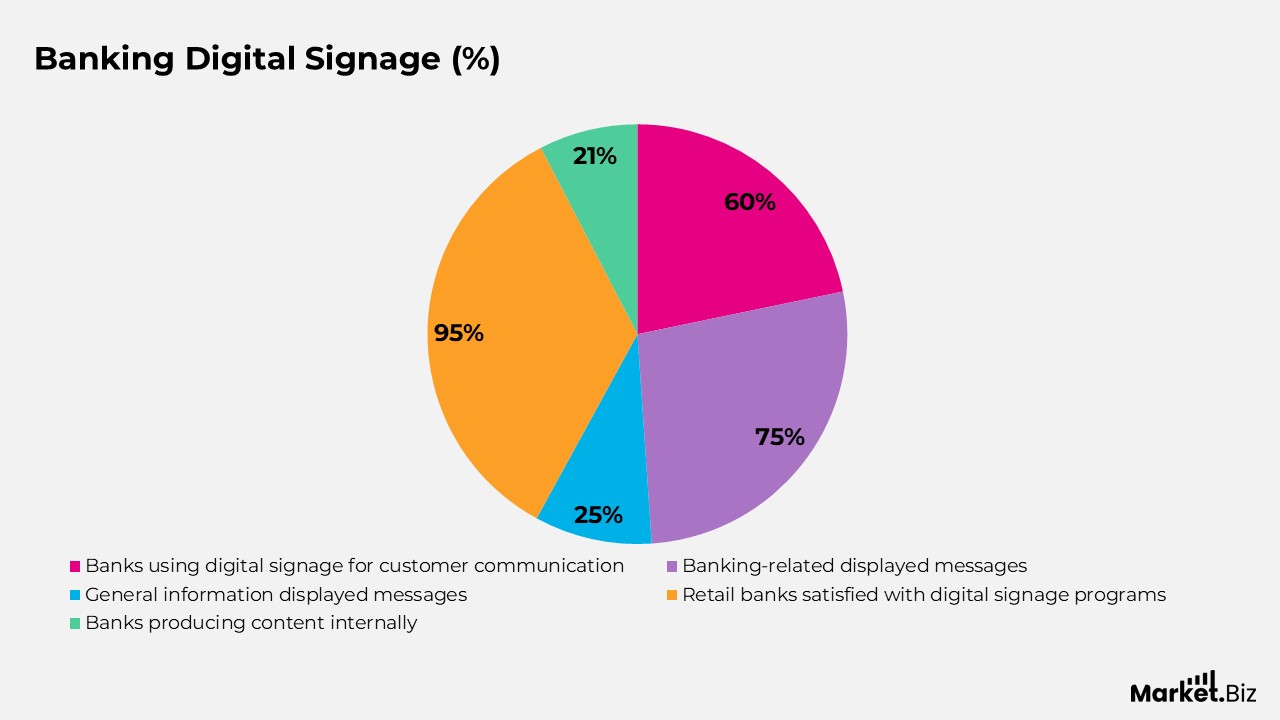
- Over 60% of banks use digital signage for customer-facing communication.
- Around 75% of displayed messages relate to banking, while 25% cover general information.
- Nearly 95% of retail banks express satisfaction with their digital signage programs and note that ROI can be achieved in as little as 18 months.
- Only 21% of banks produce content internally, while the remaining institutions outsource to improve efficiency.
- Approximately 70% of banks now target messaging to improve relevance and customer engagement.
Digital Signage & Entertainment
- A PwC analysis shows global entertainment and media revenues could reach 2.6 trillion dollars by 2023 due to widespread digitization.
- Since the pandemic, the gaming sector has expanded significantly, recording over 1.6 billion video game purchases as screen-based entertainment boomed.
- Many industries now integrate gaming elements into digital signage systems to offer more immersive customer experiences.
- Nearly 40% of millennials and Gen Z consumers are willing to pay extra for personalized entertainment content.
- By 2023, media marketers were expected to allocate around 50% of their budgets to digital advertising, with entertainment-focused digital signage contributing to this shift.
(Source: Mvix, Digital Journal.com, Deloitte, McKinsey, PwC, Pickcel)
Digital Signage Adoption Trends
- Churches can spend as much as $6,500 annually on printing and photocopying, and adopting digital signage cuts these expenses by nearly 76%.
- Technology adoption in Boomer-pastored churches has increased by 72%, showing a stronger shift toward modern communication tools.
- Around 52.9% of religious institutions now use projectors or digital signage to support sermon delivery and visual engagement.
- Four out of five worship venues have websites and continue to implement modern technology to reach larger and younger audiences, often displaying their web content through digital signage.
- Seven in ten practicing Christian millennials read scripture on screens, making digital signage a valuable tool for enhancing participation during services.
- About 46.1% of churches consider social media their most effective outreach channel, and displaying social feeds on digital signage helps amplify message visibility within the congregation.
(Source: Mvix, Digital Signage Today)
QR Codes & Digital Signage
- Around 46.81% of consumers feel QR codes simplify their daily tasks, making interactions smoother.
- Nearly 38.99% of consumers would like to see broader use of QR codes in the future.
- A Statista study in Canada found strong engagement with food QR codes: 57% scanned them for detailed product information, and 43% used them to access brand websites.
- In the US, the number of smartphone operators scanning QR codes is projected to grow from 83.4 million to 99.5 million over the next few years.
- Approximately 57% of mobile users scan QR codes on food packaging to learn about product attributes, indicating rising trust in scannable information.
- Integrating QR codes into digital signage screens can drive higher customer interaction and support business expansion.
(Source: Pickcel, Digital Signage Today, Peerbits, Risevision)
Social Media & Digital Signage
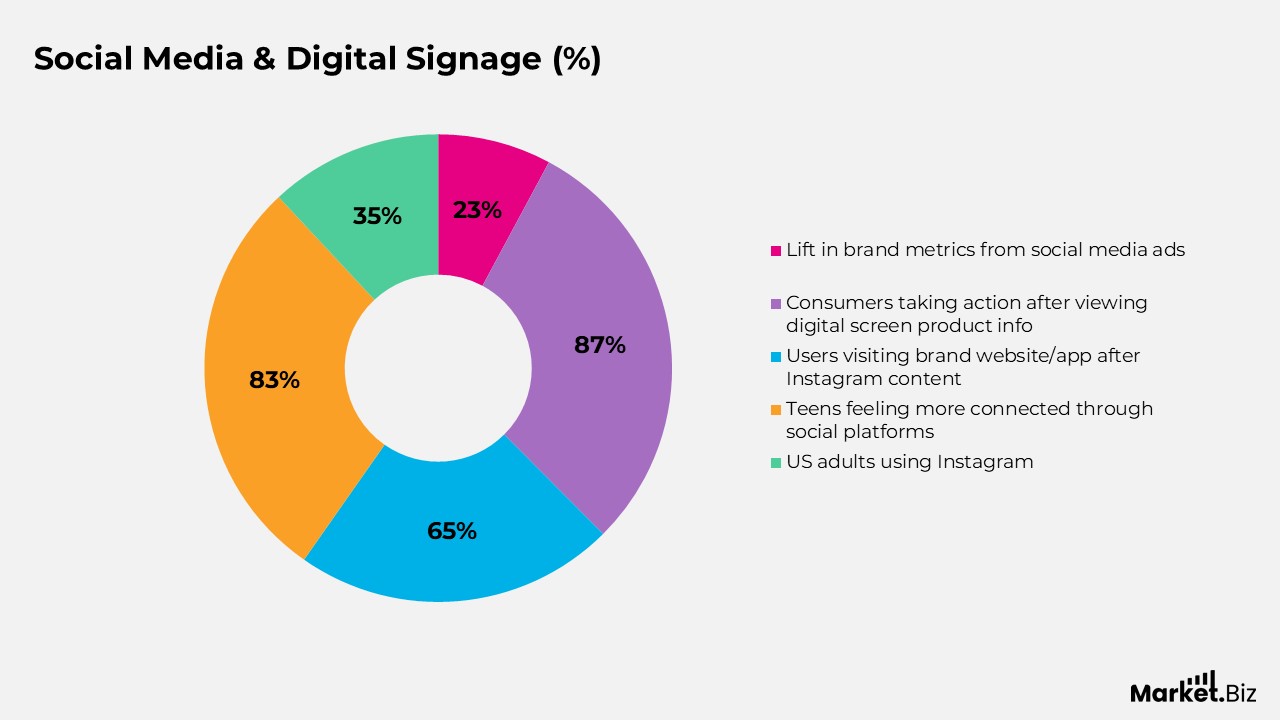
- Social media advertising campaigns deliver a 23% lift in brand-related metrics, such as awareness and emotional response.
- After viewing product information through digital screens, 87% of consumers take action, whether by following the brand, visiting a store, or completing a purchase.
- About 65% of users visit a brand’s website or app after seeing relevant content on Instagram.
- Nearly 83% of teens say social platforms help them feel more connected and informed.
- The share of US adults using Instagram has grown to 35%, enabling digital signage to reach a wider age range.
- Displaying social walls on interactive digital signage displays improves engagement and supports sales growth.
(Source: Pickcel, Digital Signage Today, Peerbits, Risevision)
Digital Signage, Visual Processing & Interactive Kiosks
- The human brain processes images and videos far faster than text, up to 60,000 times, making dynamic visuals critical for effective messaging.
- Roughly 30% of US consumers view chatbots as efficient tools for customer service.
- People retain about 80% of what they see, compared to only 20% of what they read or hear, emphasizing the impact of visual storytelling.
- Nearly 60% of food and beverage manufacturers deploy digital signage and IoT systems to trace ingredients and ensure transparency.
- Digital signage used for safety communication can lower workplace injuries by 20%.
- Videos shared on social media generate 1200% more shares than text or static images combined.
- Digital signage content influences buying decisions 2.5 times more effectively than static displays.
- About 59% of shoppers believe brands must deliver advanced digital experiences to maintain their interest.
- Around 42% of shoppers prefer to buy from stores that feature in-store video displays as part of their shopping environment.
(Source: Pickcel, Digital Signage Today, Peerbits, Risevision)
Conclusion
Digital Signage Statistics: It has become a powerful catalyst for enhancing communication, engagement, and decision-making across multiple industries. The insights gathered throughout this report highlight how effectively visual content influences customer behavior, strengthens brand presence, and improves operational performance.
From retail environments and healthcare facilities to manufacturing floors and places of worship, organizations are recognising the value of delivering dynamic, real-time information via digital displays. As businesses advance toward more connected and experience-driven ecosystems, digital signage plays a central role in supporting omnichannel strategies, modern workplace communication, and immersive customer journeys.
With continuous advances in cloud technology, interactive interfaces, and IoT integration, digital signage stands out as a future-ready solution that elevates both the customer experience and organizational efficiency.
FAQ’s
Digital signage is a communication medium that combines display technology with dynamic content delivery. It operates on the principle that visual stimuli capture human attention more efficiently than static or text-heavy formats, making it a strategic tool for information dissemination and behavioral influence.
Its effectiveness stems from cognitive and perceptual theories suggesting that the human brain processes visual information rapidly and retains it for longer periods. By integrating motion, color, and context-relevant messaging, digital signage enhances recall, improves comprehension, and strengthens message impact.
Digital signage operates on the foundations of attention economics and persuasive communication. It reduces cognitive load by presenting clear visual cues, supports decision-making through contextual prompts, and shapes consumer perception by reinforcing brand narratives in real time.
From an organizational theory standpoint, digital signage acts as a unifying channel that streamlines internal communication, aligns teams around shared goals, and reduces information asymmetry. It promotes transparency and supports a continuous flow of relevant updates across hierarchical structures.
Industries with high levels of customer interaction, service complexity, or information variability, such as retail, healthcare, transportation, and education, derive the greatest value. This is due to the medium’s capacity to adapt content rapidly and maintain relevance in dynamic environments.