








Introduction
HR Analytics Statistics describe how organizations are leveraging workforce data to move away from instinct-driven HR decisions toward evidence-based approaches. By collecting and analyzing data across hiring, performance, engagement, retention, diversity, and labour costs, HR analytics enables businesses to gain deeper visibility into employee behaviour, uncover patterns, and enhance productivity.
In an increasingly competitive and digital labor market, these statistics offer actionable insights into recruitment effectiveness, attrition risks, skill shortages, and overall employee experience.
From an analytical perspective, HR analytics statistics enable strategic workforce planning, improve the efficiency of talent investments, support regulatory compliance, and elevate HR into a core business intelligence function aligned with enterprise objectives.
Editor’s Choice
- Only 29% of respondents indicate strong capability in driving positive workforce changes using people analytics. While an additional 35% assess their maturity at a moderate level.
- Nearly 33% of organizations acknowledge limited effectiveness, rating themselves poor or very poor in translating people analytics into meaningful action.
- Just 36% of respondents agree that their people analytics platforms consistently generate actionable insights that support decision-making.
- Perceived effectiveness of HR analytics varies by leadership level: 38% report strong insight delivery to HR leaders, compared with 29% for senior executives, 19% for middle management, and only 13% for frontline managers or the broader employee base.
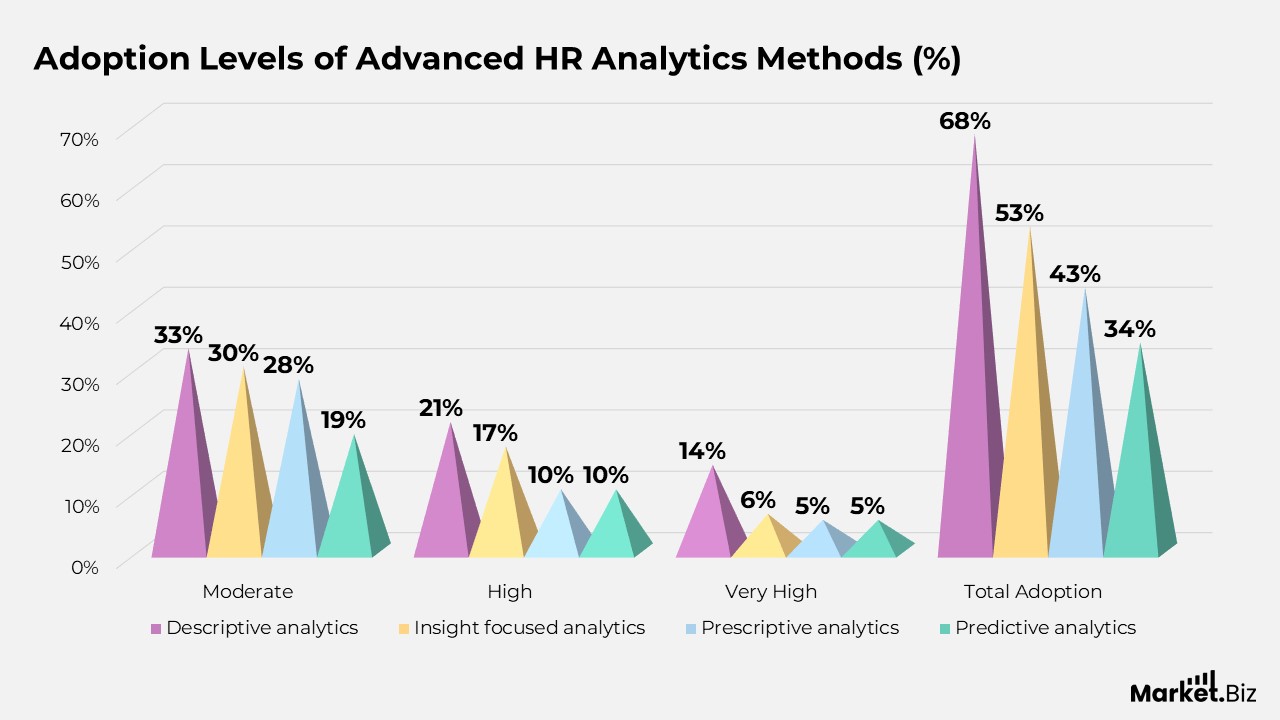
- Descriptive analytics remains the most widely adopted approach, with 68% of organizations using it at least to a moderate extent.
- Advanced analytics adoption is significantly lower, as only 34% of organizations report moderate or higher use of predictive analytics. While 43% report similar usage of prescriptive analytics.
- High maturity in advanced analytics is limited, with only 15% of organizations reporting high or very high usage of predictive analytics and an equal 15% for prescriptive analytics.
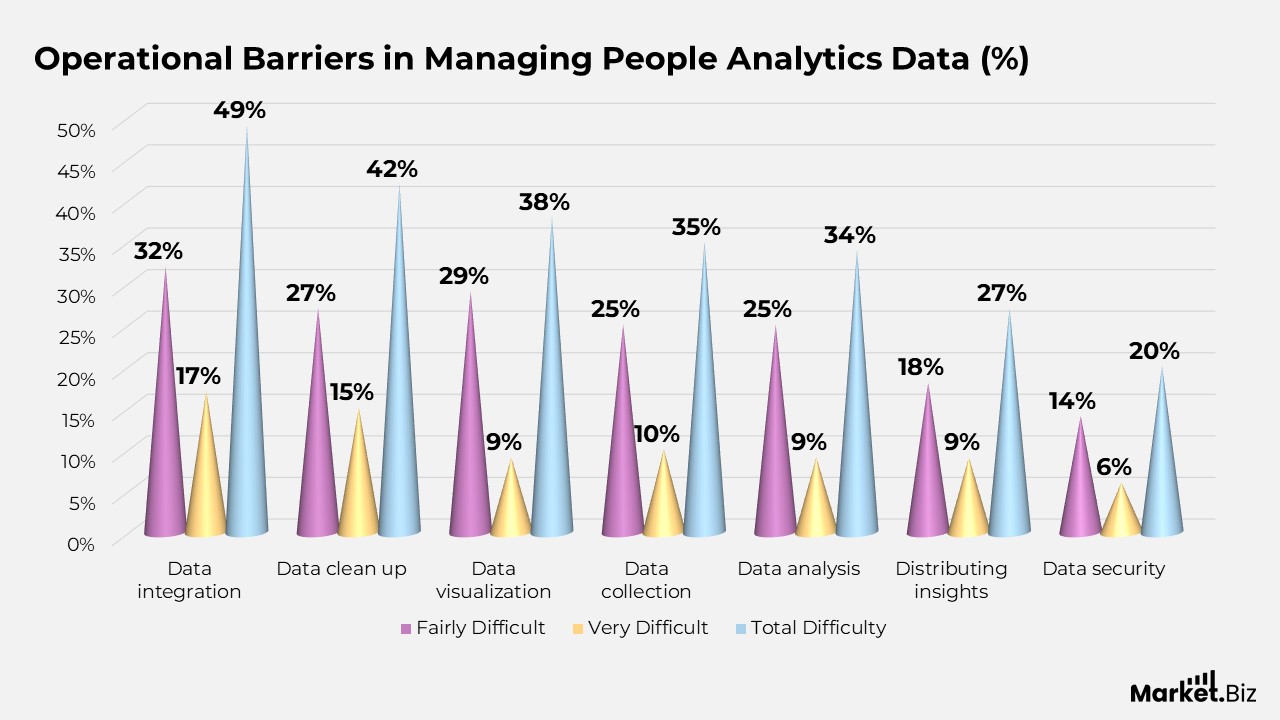
- Data management challenges remain substantial, as 49% of organizations report difficulty integrating data from multiple sources.
- Data preparation remains a barrier, with 42% finding data cleansing processes fairly or very difficult.
- Visualization and presentation of analytics insights also pose challenges, with 38% of respondents reporting difficulty in effectively visualizing HR data.
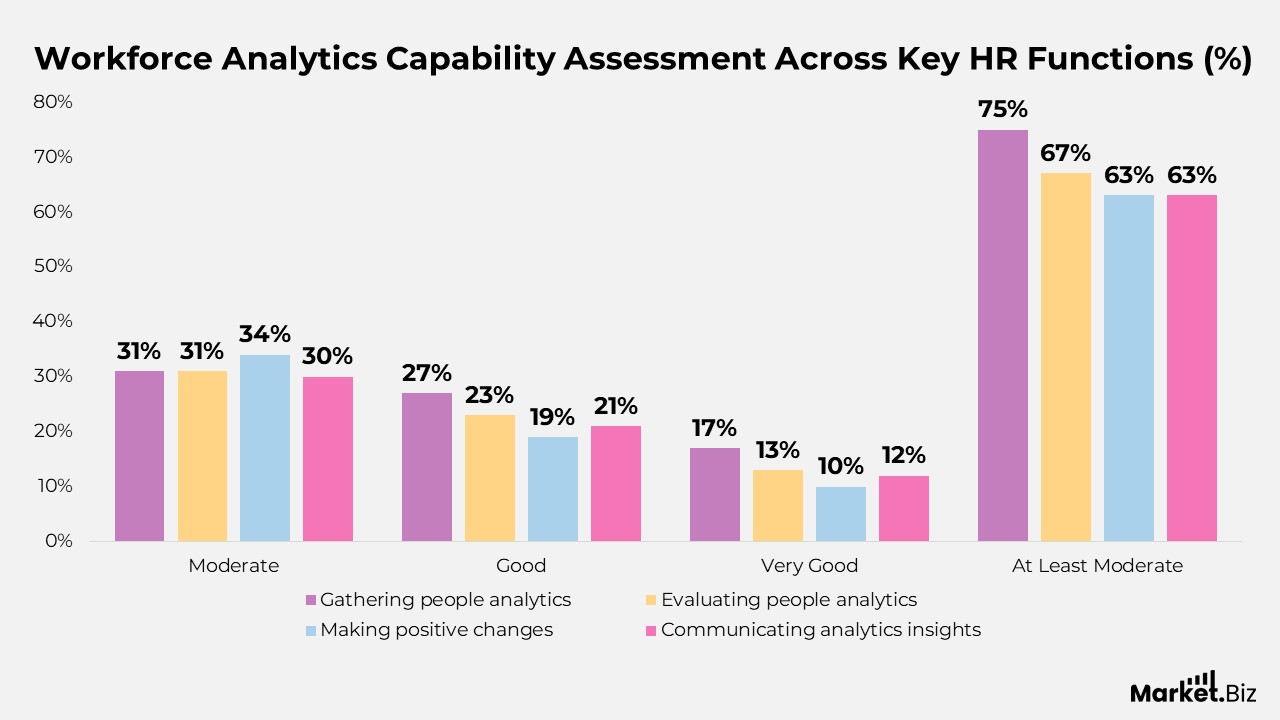
Workforce Analytics Capability Assessment Across Key HR Functions
- In gathering people analytics, 31% of organizations rate themselves at a moderate level, 27% at a good level, and 17% at a very good level, resulting in a combined 75% showing at least basic effectiveness in collecting workforce data.
- For evaluating people analytics, 31% report moderate capability, 23% indicate good capability, and 13% describe their proficiency as very good. Bringing the overall effectiveness to 67%.
- When it comes to making positive changes using people analytics, 34% assess their ability as moderate, 19% as good, and only 10% as very good, totalling 63% with some level of execution capability.
- When communicating people analytics insights, 30% consider their approach moderate, 21% good, and 12% very good, totalling 63% who feel reasonably confident in sharing analytics outcomes.
(Source: Oracle, The State of HR Analytics, HR.Com)
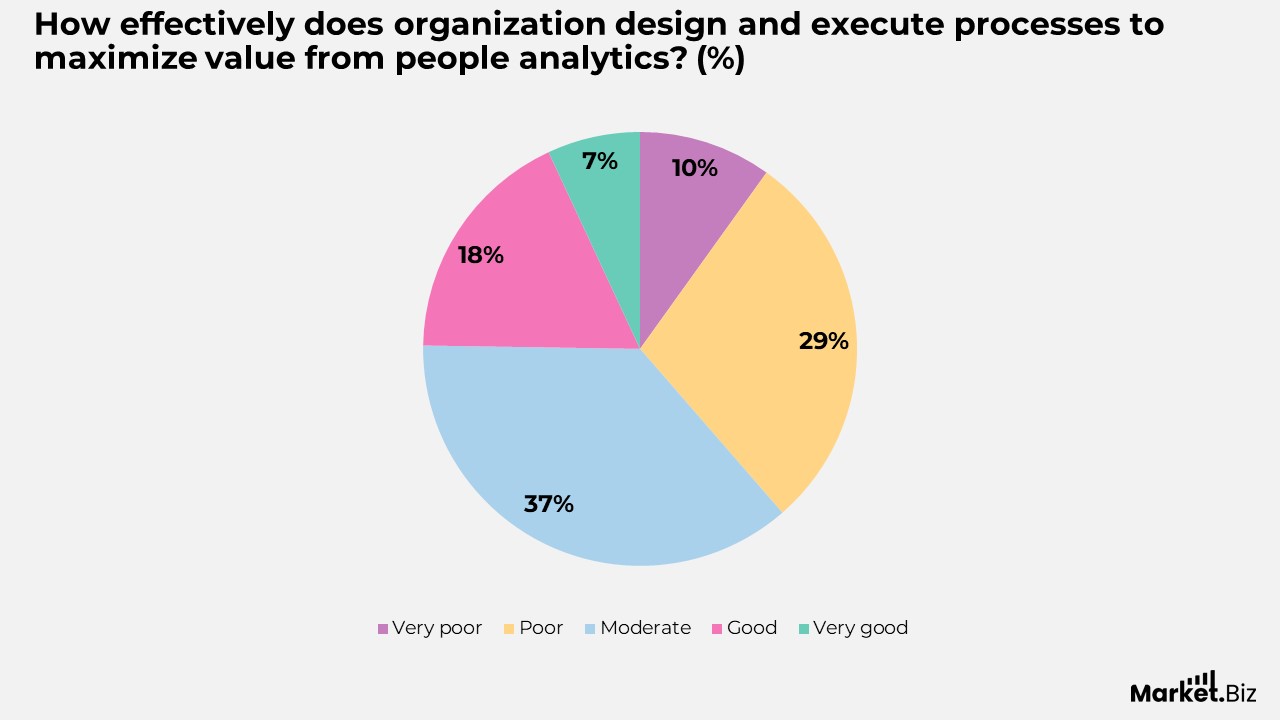
How effectively does the organization design and execute processes to maximize value from people analytics?
- A combined 39% of organizations report limited capability in designing and implementing people analytics processes. With 10% rating their approach as very poor and 29% as poor.
- The largest share of respondents, 37%, place themselves at a moderate level. Indicating partial adoption of structured processes without full optimization.
- Only 18% of organizations believe they are good at implementing people analytics processes that consistently deliver value.
- Advanced maturity remains uncommon, as just 7% rate their people analytics processes as very good.
(Source: Oracle, The State of HR Analytics, HR.Com)
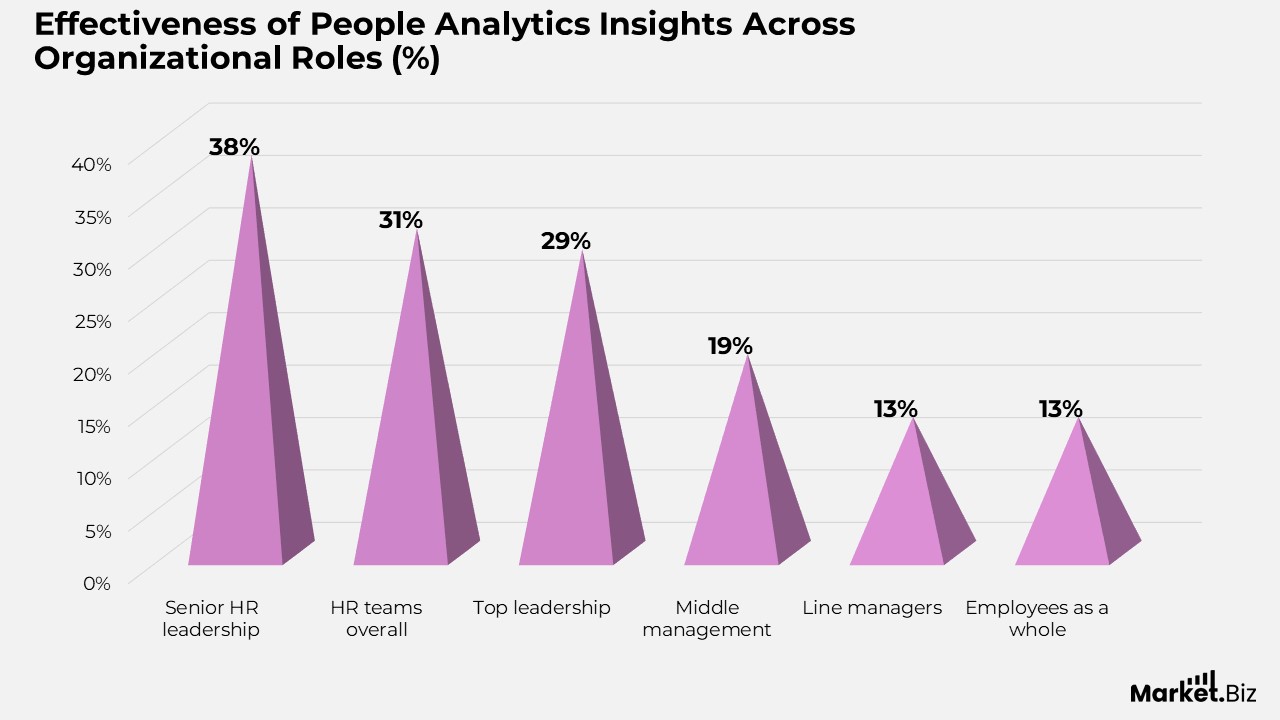
Effectiveness of People Analytics Insights Across Organizational Roles
- People analytics is perceived as most effective for HR leadership. With 38% of respondents stating it provides very effective insights for senior HR decision-makers.
- Overall, 31% of HR teams report that people analytics delivers very effective insights that support day-to-day workforce decisions.
- Effectiveness declines at the executive level, where 29% of respondents believe people analytics provides very effective insights to top leadership.
- Insight delivery is more limited for operational management. As only 19% report very effective support for middle management decision-making.
- Frontline impact remains relatively low, with just 13% reporting very effective people analytics insights for line managers.
- Similarly, a low 13% believe people analytics delivers very effective insights to employees as a whole. Highlighting a significant gap in the distribution of insights beyond leadership roles.
(Source: Oracle, The State of HR Analytics, HR.Com)
Adoption Levels of Advanced HR Analytics Methods
- Descriptive analytics dominates HR reporting, with 33% of organizations using it at a moderate level, 21% at a high level, and 14% at a very high level, for a combined 68% adoption.
- Insight-focused analytics shows lower penetration, as 30% report moderate use, 17% high use, and 6% very high use, bringing overall adoption to 53%.
- Prescriptive analytics remains less established, with 28% indicating moderate usage, 10% high usage, and 5% very high usage, totaling 43%.
- Predictive analytics shows the lowest level of adoption: 19% report moderate use, 10% high use, and 5% very high use, for an overall 34% usage rate.
- Overall, organizations rely more heavily on backwards-looking analytics, while advanced predictive and prescriptive approaches remain at an early stage of adoption.
(Source: Oracle, The State of HR Analytics, HR.Com)
Where People Analytics Matters Most Across HR Functions
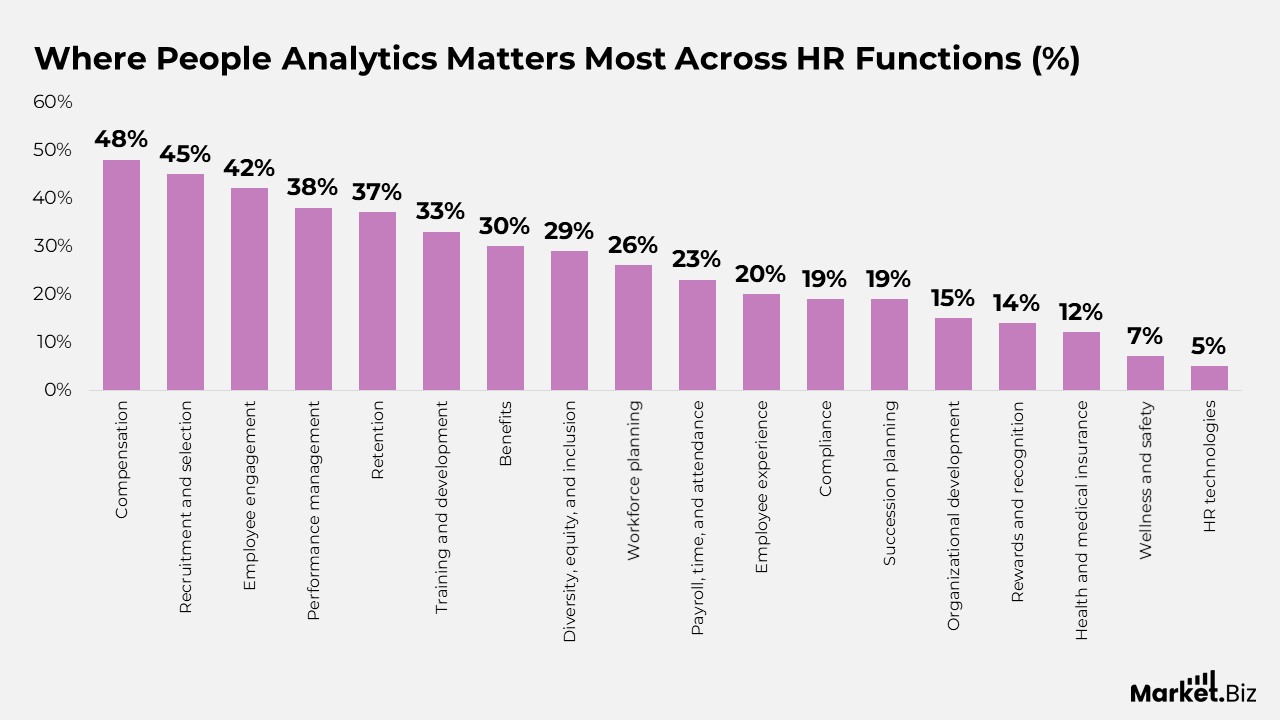
- Compensation emerges as the top area for people analytics applications, with 48% of organizations identifying it as a priority use case.
- Recruitment and selection closely follow, as 45% of respondents highlight the importance of analytics in improving hiring decisions.
- Employee engagement is another major focus area, with 42% of organizations relying on people analytics to understand and improve workforce sentiment.
- Performance management remains a key application, cited by 38% of respondents as a critical area for analytics-driven insights.
- Retention strategies benefit strongly from analytics, with 37% of organizations emphasizing their role in reducing employee turnover.
- Training and development is supported by people analytics in 33% of organizations, reflecting its role in skill development and capability building.
- Benefits optimization is identified by 30% of respondents as an area where analytics supports cost and value alignment.
- Diversity, equity, and inclusion initiatives leverage people analytics in 29% of organizations to monitor representation and inclusion outcomes.
- In 26% of organizations, workforce planning is informed by analytics, supporting future talent and capacity planning.
Further
- Payroll, time, and attendance analytics are important to 23% of respondents, helping improve operational accuracy and compliance.
- In 20% of organisations, employee experience improvement is driven by analytics, focusing on the lifecycle and workplace satisfaction.
- Compliance and succession planning are each supported by people analytics in 19% of organizations, reflecting governance and leadership continuity needs.
- In 15% of organisations, organisational development relies on analytics to support structural and cultural initiatives.
- In 14% of organizations, rewards and recognition programs use analytics to improve fairness and motivation.
- Health and medical insurance decisions are influenced by people analytics in 12% of organizations, mainly for cost control and coverage analysis.
- Wellness and safety initiatives apply analytics in 7% of organizations, indicating lower adoption of preventive workforce health initiatives.
- HR technologies represent the least prioritized area, with only 5% of respondents citing people analytics as critical in this function.
(Source: Oracle, The State of HR Analytics, HR.Com)
Operational Barriers in Managing People Analytics Data
- Data integration is identified as the most difficult process, with 32% finding it fairly difficult and 17% very difficult, resulting in a combined difficulty level of 49%.
- Maintaining data quality and integrity remains a major concern, as 27% report cleanup activities to be fairly difficult and 15% very difficult, totalling 42%.
- Visualizing people analytics insights presents notable challenges: 29% rate it fairly difficult and 9% very difficult, for an overall difficulty rate of 38%.
- Data collection processes are challenging for 35% of organizations, including 25% who find them fairly difficult and 10% who find them very difficult.
- Analytical processing of people data shows similar strain: 25% report fair difficulty and 9% report high difficulty, together accounting for 34%.
- Distributing analytics insights across the organization is problematic for 27%, with 18% citing fair difficulty and 9% citing very great difficulty.
- Security is comparatively less challenging but still significant, as 14% report fair difficulty and 6% very difficulty, resulting in 20% experiencing issues in safeguarding people analytics data.
(Source: Oracle, The State of HR Analytics, HR.Com)
Frequency of Integrating Non HR Data into People Analytics
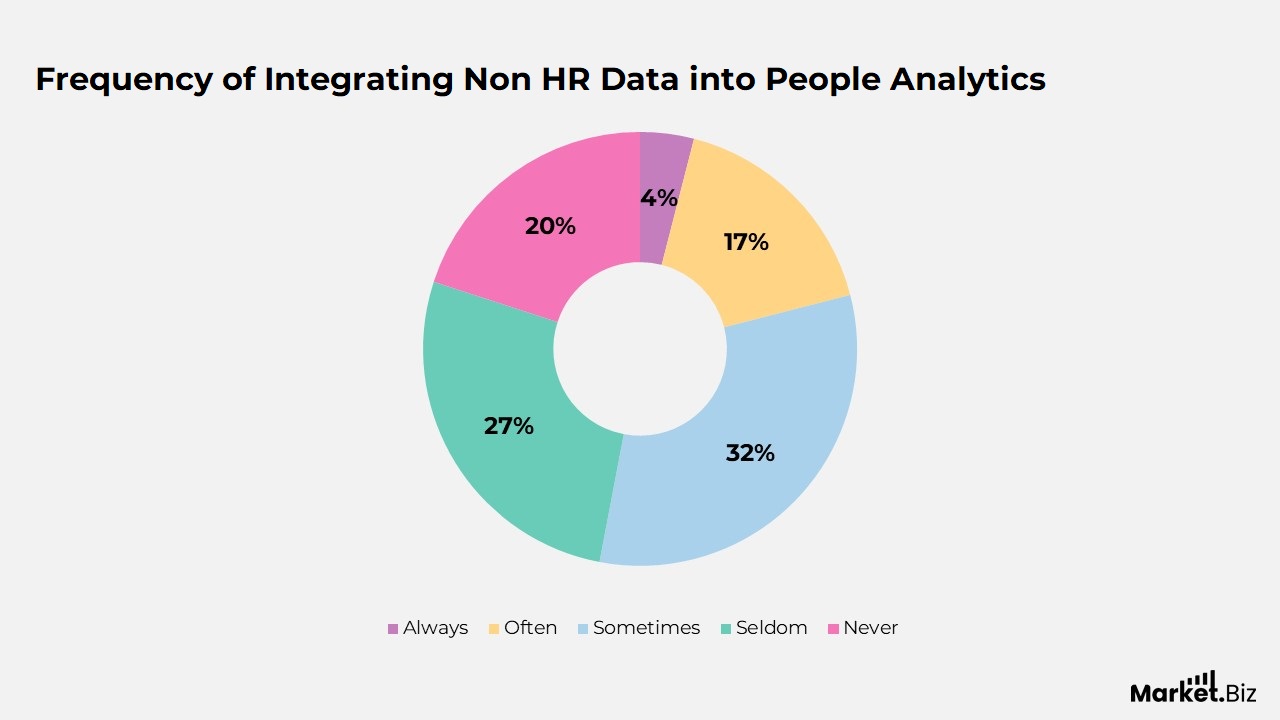
- Integration of non HR data with HR analytics is inconsistent, as 32% of organizations report doing so only sometimes.
- A significant share, 27%, indicates that non-HR data is seldom combined with HR data for analytical purposes.
- One fifth of organizations, representing 20%, state that they never integrate non HR data into HR analytics workflows.
- More regular integration remains limited, with 17% of organizations reporting that they often combine non HR and HR data.
- Continuous and systematic integration is rare, as only 4% of organizations say they always integrate non HR data with HR data for analytics.
(Source: Oracle, The State of HR Analytics, HR.Com)
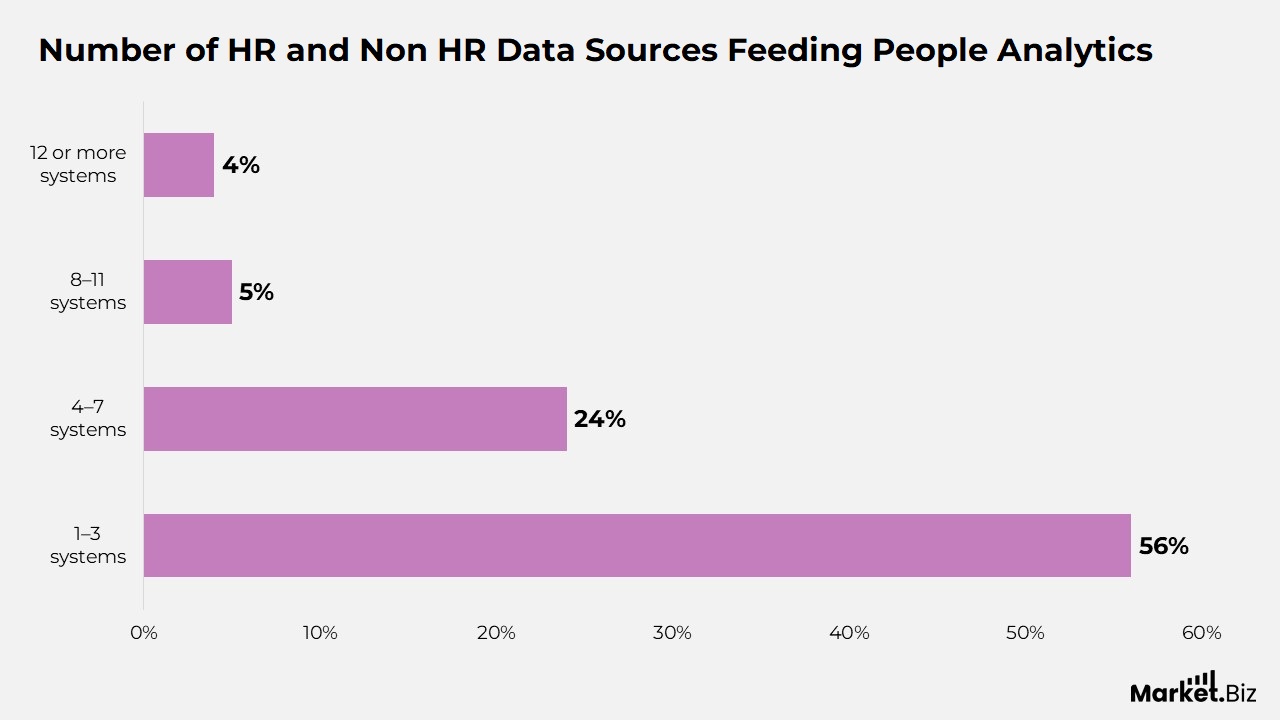
Number of HR and Non HR Data Sources Feeding People Analytics
- Most organizations rely on a limited number of systems. With 56% pulling data from only 1 to 3 HR and non HR sources to build people analytics reports.
- A smaller but notable group, representing 24%, aggregates data from 4 to 7 systems, indicating moderate data integration maturity.
- Advanced data sourcing remains uncommon, with just 5% of organizations drawing insights from 8 to 11 different systems.
- Highly complex analytics environments are rare, with only 4% reporting the use of 12 or more HR and non HR systems.
(Source: Oracle, The State of HR Analytics, HR.Com)
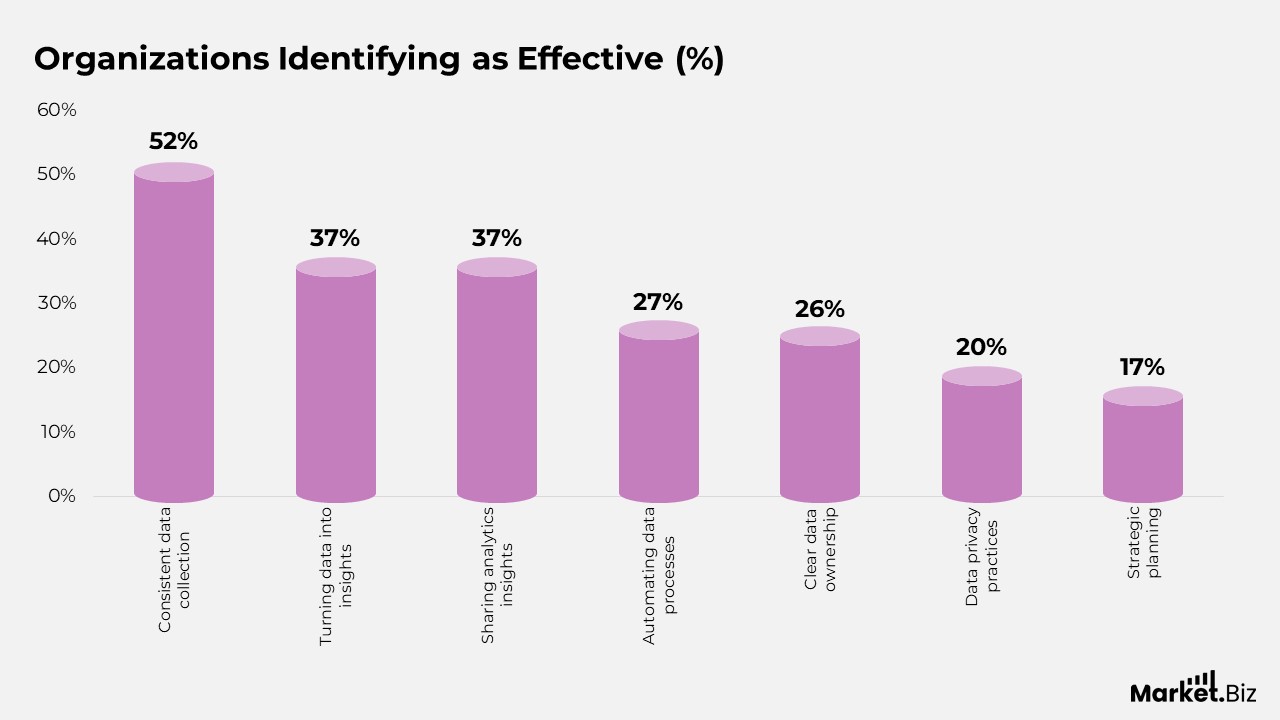
Organizational Practices Enhancing People Analytics Value
- Consistent and regular data collection is viewed as the most impactful practice, with 52% of organizations identifying it as a key driver of improved people analytics.
- Converting raw workforce data into meaningful insights is prioritized by 37%, highlighting the importance of analytical interpretation over data volume.
- Knowledge sharing and collaboration around data is equally valued, as 37% report benefits from openly sharing analytics insights across teams.
- Automation of data aggregation, cleaning, and importing is recognized by 27% as a valuable practice for improving efficiency and reliability.
- Clear data ownership structures contribute to stronger analytics maturity, with 26% emphasizing the need for accountability over people’s data.
- Privacy management remains a consideration, as 20% of organizations cite data protection practices as important to analytics improvement.
- Strategic planning supports analytics success in 17% of organizations, underscoring the importance of foresight and structured execution.
(Source: Oracle, The State of HR Analytics, HR.Com)
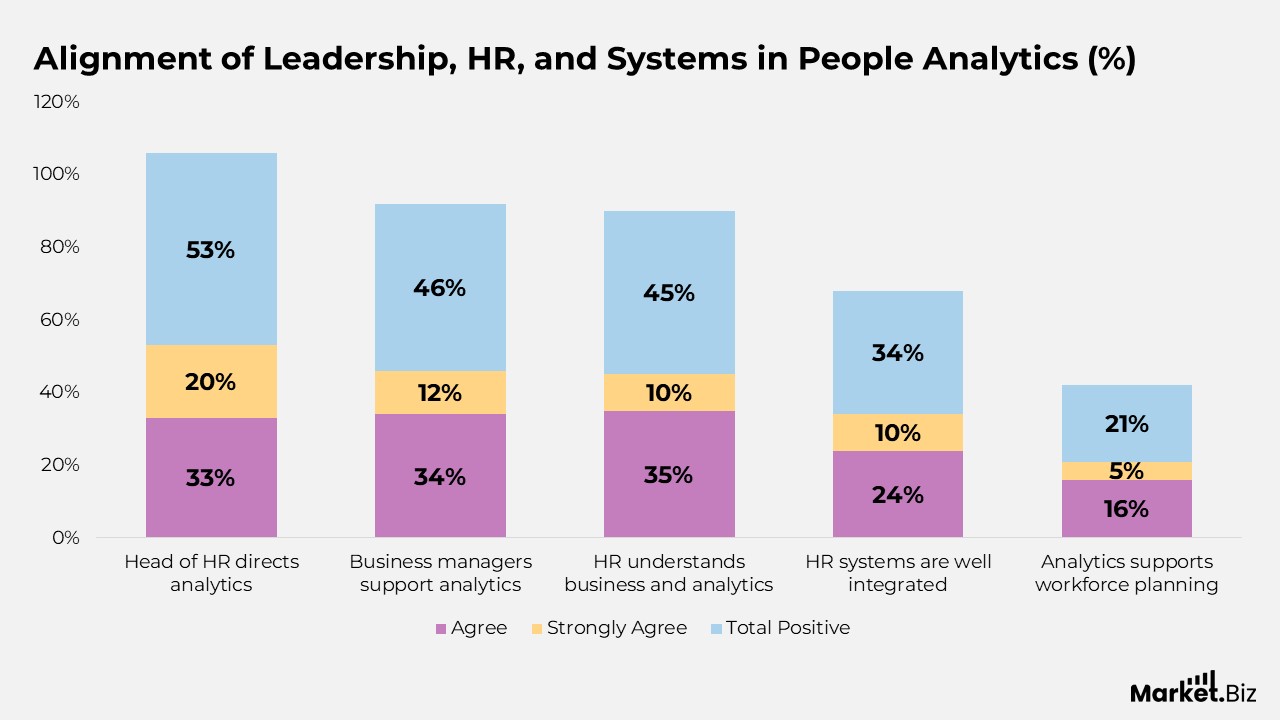
Alignment of Leadership, HR, and Systems in People Analytics
- Senior HR leadership shows the highest level of engagement, with 33% agreeing and 20% strongly agreeing that the head of HR actively directs people analytics initiatives, for a total alignment of 53%.
- Support from business managers is evident but less pronounced: 34% agree, and 12% strongly agree that managers actively back people analytics, for a total of 46% support.
- Capability within HR teams reflects moderate maturity: 35% agree, and 10% strongly agree that HR professionals understand both business needs and HR analytics, for a total of 45%.
- System integration remains a challenge, as only 24% agree and 10% strongly agree that HR systems are well integrated for easy data analysis, leading to 34% positive sentiment.
- Advanced use of analytics for workforce planning is limited: 16% agree, and 5% strongly agree that analytics supports sophisticated planning, resulting in just 21% endorsement.
(Source: Oracle, The State of HR Analytics, HR.Com)
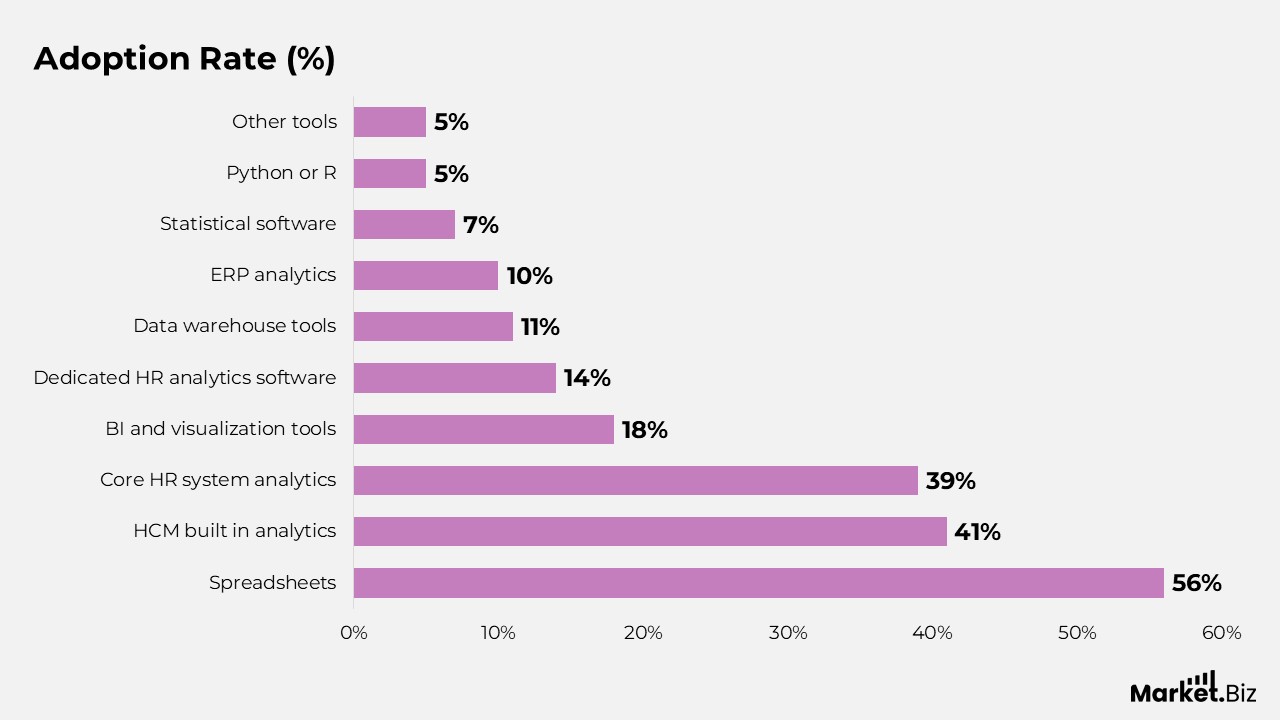
Adoption Landscape of HR and Business Analytics Tools
- Spreadsheet software remains the most widely used analytics tool, with 56% of organizations relying on it for HR and business analytics.
- Built-in analytics within Human Capital Management systems are used by 41%, reflecting moderate adoption of embedded HR reporting capabilities.
- Analytics features integrated into core HR systems, such as payroll and time management, are used by 39% of organizations.
- Business intelligence and data visualization platforms are used by 18%, indicating selective adoption of advanced reporting and dashboarding tools.
- Dedicated HR analytics software is adopted by 14%, suggesting limited penetration of specialized analytics platforms.
- Tools that integrate HR data into centralized data warehouses are used by 11%, highlighting early-stage data consolidation efforts.
- Enterprise Resource Planning systems contribute analytics capabilities in 10% of organizations.
- Statistical analysis software packages are used by 7%, reflecting niche adoption among analytically mature teams.
- 5% of organizations leverage programming languages such as Python or R, indicating minimal use of advanced custom analytics.
- Other tools are reported by 5%, indicating a small share of users using alternative or organization-specific solutions.
(Source: Oracle, The State of HR Analytics, HR.Com)
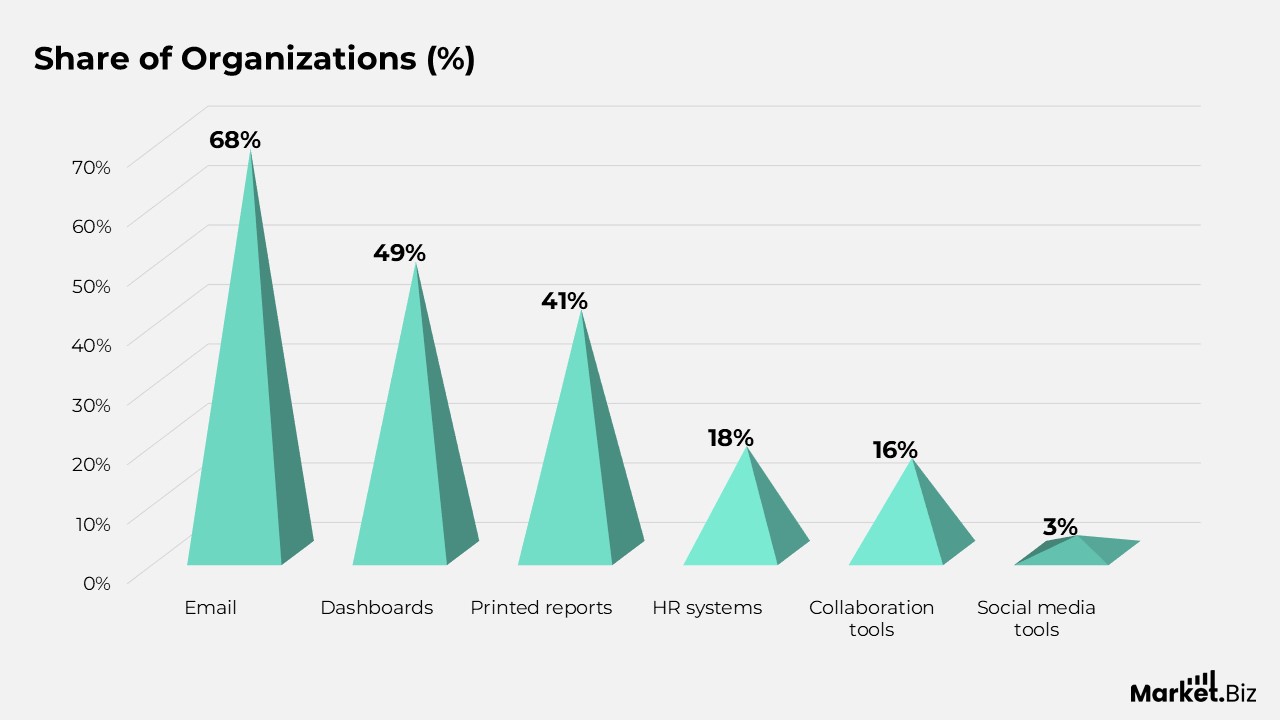
Methods Used to Deliver People Analytics Reports to Senior Leadership
- Email attachments remain the primary delivery method, with 68% of organizations sharing people analytics reports through email.
- Interactive dashboards are used by 49%, reflecting the growing adoption of visual and self-service analytics among senior leaders.
- Traditional printed reports continue to play a role, as 41% of organizations still rely on physical documents for executive reporting.
- Integrated HR platforms are less commonly used, with only 18% delivering analytics through HCM or other HR systems.
- Collaboration and project management tools support analytics sharing in 16% of organizations, indicating limited use of collaborative digital channels.
- Social media-based tools are rarely used for analytics delivery, with just 3% reporting their use for sharing people analytics insights.
(Source: Oracle, The State of HR Analytics, HR.Com)
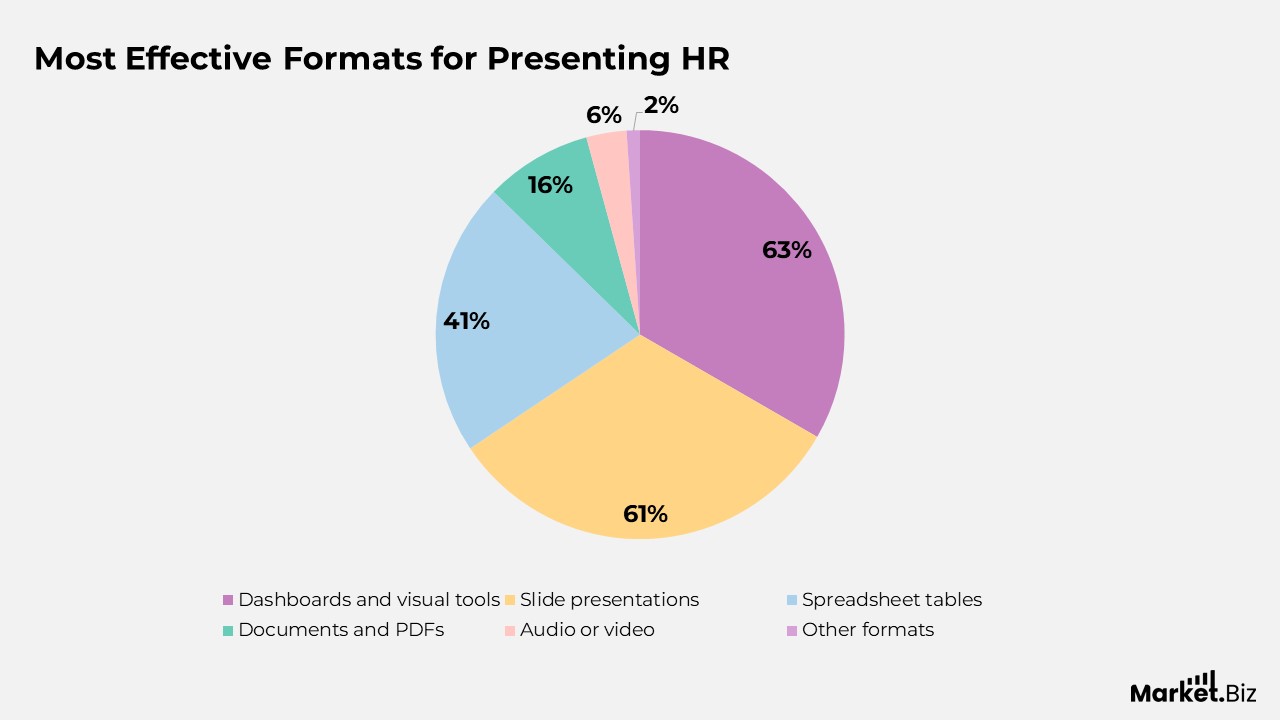
Most Effective Formats for Presenting HR
- Interactive visual formats lead in effectiveness, with 63% of respondents favouring dashboards and tools like Tableau for presenting HR analytics.
- Graphical slide-based presentations are nearly as effective, as 61% identify formats like PowerPoint as a preferred method for communicating insights.
- Spreadsheet-based tables remain relevant, with 41% considering Excel-style data tables an effective way to present HR analytics.
- Traditional document formats have limited appeal, as only 16% prefer written reports such as Word documents or PDFs.
- Multimedia approaches combining audio and video are rarely used, with only 6% finding them effective for HR analytics communication.
- Alternative presentation methods are minimal, with only 2% selecting other formats for delivering HR analytics insights.
(Source: Oracle, The State of HR Analytics, HR.Com)
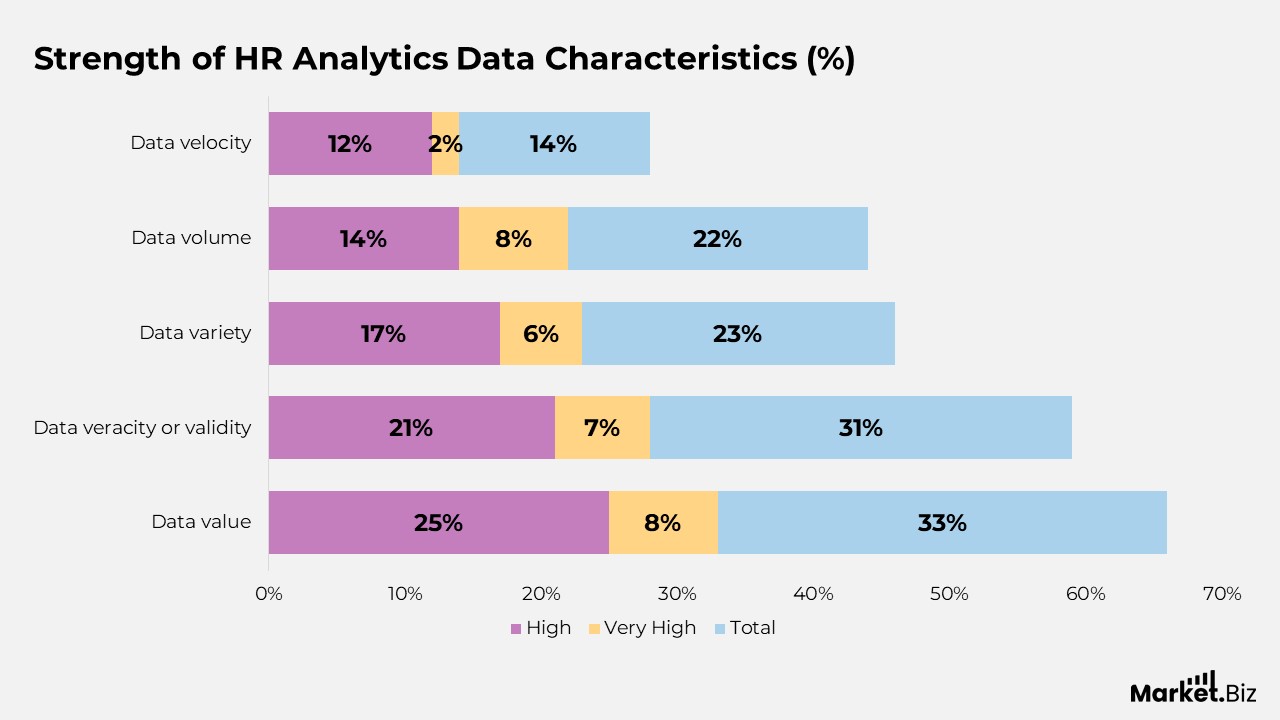
Strength of HR Analytics Data Characteristics
- Data value is viewed as the strongest characteristic, with 25% rating it high and 8% very high, resulting in 33% overall agreement on its importance.
- Trust in data accuracy and reliability is moderately strong. With 21% rating veracity or validity as high and 7% as very high, totalling 31%.
- Data variety and overall completeness receive limited recognition. With 17% rating them high and 6% very high, resulting in 23% combined agreement.
- The data volume shows a similar perception: 14% view it as high and 8% as very high, for a total of 22%.
- Data velocity is the least developed attribute, with only 12% rating it high and 2% very high. Resulting in 14% acknowledging strong data speed and timeliness.
(Source: Oracle, The State of HR Analytics, HR.Com)
Conclusion
HR analytics statistics reveal that although organizations increasingly acknowledge the importance of workforce data. Overall maturity remains inconsistent across analytics capabilities, technologies, and applications.
Many organizations are still anchored in descriptive and insight-oriented analytics. Supported by basic reporting tools and dashboards, while the adoption of predictive and prescriptive analytics remains limited.
Ongoing challenges related to data integration, data quality, visualization, and system connectivity continue to restrict the effective use of analytics. The data further indicate that the value of HR analytics is most visible at senior leadership levels. With significantly lower impact at the managerial and employee levels.
While interest in analytics-driven workforce planning is growing, practical implementation is often hindered by fragmented data environments, unclear ownership, and skill gaps within HR teams.
Overall, HR analytics statistics suggest that organizations are in an intermediate phase of evolution. Gradually moving from report-driven analytics toward outcome-focused, decision-enabling people analytics that require stronger foundations and broader adoption.
FAQ’s
HR analytics statistics refer to the systematic use of quantitative and qualitative workforce data to study patterns, relationships, and trends in human resources. These statistics form the analytical foundation for understanding workforce behavior, organizational dynamics, and HR outcomes.
Traditional HR reporting focuses on historical metrics and routine summaries, whereas HR analytics emphasizes interpretation, comparison, and insight generation to support strategic and predictive decision-making.
HR analytics statistics support strategic management by linking people-related data with business objectives, enabling leaders to assess workforce risks, plan talent needs, and evaluate the effectiveness of HR interventions.
HR analytics statistics draw on employee demographics, performance data, engagement indicators, compensation records, learning metrics, and, increasingly, non-HR data such as financial or operational information.
HR analytics employs descriptive approaches to summarize data, diagnostic approaches to understand causes, predictive approaches to anticipate outcomes, and prescriptive approaches to recommend actions.

