









Introduction
Business Process Automation (BPA) statistics highlight how organizations streamline workflows, reduce operational costs, and improve efficiency through digital tools such as robotic process automation, workflow engines, and AI-driven decision systems. These data points reveal rising adoption across finance, HR, supply chain, IT operations, and customer service as companies pursue faster turnaround times, fewer manual errors, and greater process consistency.
The statistics also reflect growing investments in automation to modernise legacy systems, enhance compliance, support distributed teams, and improve customer satisfaction and employee experience. Collectively, BPA statistics demonstrate how automation has become a core driver of operational excellence and competitive advantage in an increasingly competitive business environment.
Editor’s Choice
- More than 40% of finance teams and about one-third (33%) of accounting teams now identify automation of purchasing and procurement workflows as a key operational priority.
- Nearly 44% of procurement leaders report that process efficiency and rising complexity remain their most significant challenges.
- Around 63% of finance professionals indicate that workflow-related issues continue to be their biggest barrier to smoother operations.
- Close to 27% of organizations have integrated business process automation as part of their broader digital transformation strategy.
- Business adoption of AI has grown sharply, rising 22% in 2023-2024.
- Over 80% of decision-makers are familiar with business process automation and understand its organizational importance.
(Source: Zip, Amazon Business, FinancialCents, Camunda, McKinsey, Regina Corso Consulting)
Automation Impact Insights for Modern Businesses
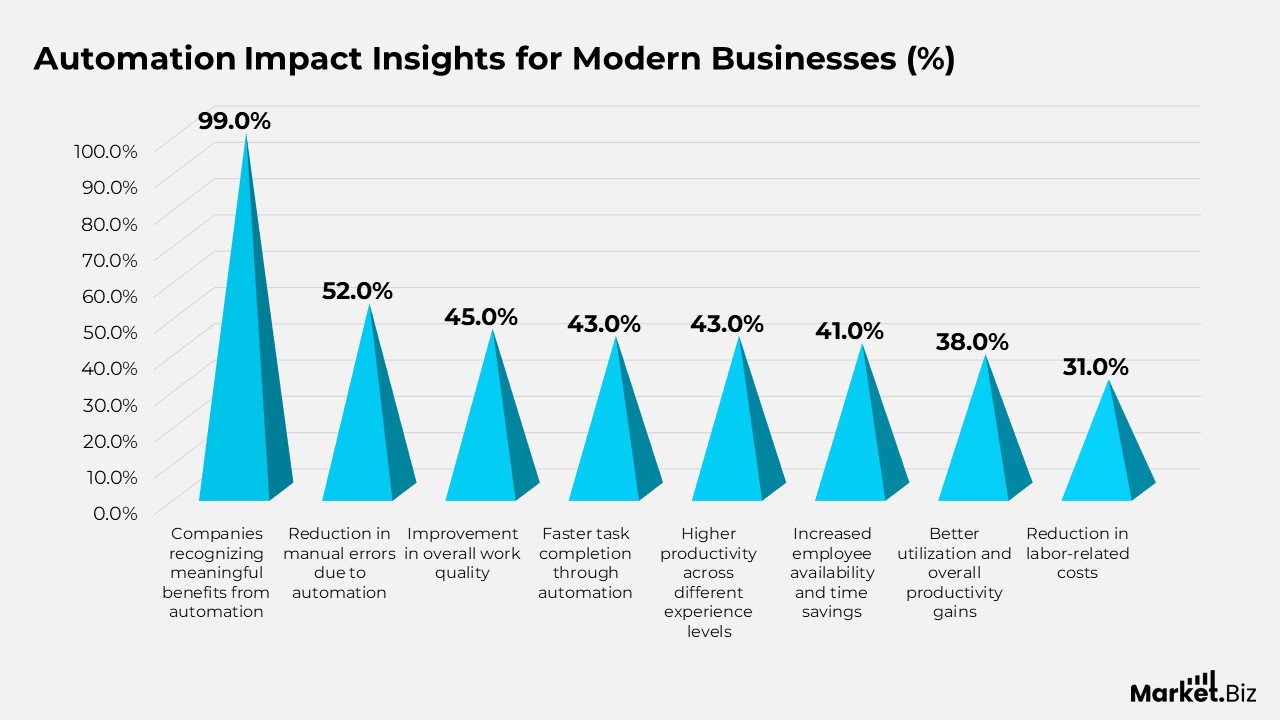
- Nearly 99% of companies recognise that automation delivers meaningful operational advantages.
- Around 52% report that automating tasks has noticeably lowered the frequency of manual errors.
- Close to 45% of organizations say automation enhances overall work quality across teams.
- Roughly 43% of businesses experience faster task completion after adopting automated workflows.
- Another 43% report higher productivity across employees with varying levels of experience.
- About 41% highlight that automation frees up more time and improves employee availability.
- Nearly 38% note higher utilization rates and better productivity as automated processes take hold.
- Approximately 31% of companies experience a decline in labour-related expenses from automation.
(Source: Statista)
Executive Perspectives on Automation Adoption
- Nearly 80% of senior executives believe automation holds value across every major business decision, reflecting strong confidence in its strategic role.
- A recent 2024 academic study shows that nearly 60% of surveyed companies have already deployed automation tools in their operations.
- Around 58% of CFOs are directing increased budgets toward technology-driven initiatives compared with the previous year.
- Nearly 28% of CFOs currently use AI to automate forecasting activities, while another 39% intend to adopt such tools within the next year.
- More than 40% of finance leaders are prioritizing automation and related technologies to enhance workforce capabilities and operational efficiency.
- Emerging AI systems have the potential to automate work equivalent to nearly 300 million full-time jobs globally, signalling a significant shift in the workforce.
- Automation continues to be viewed positively in supply chain operations, with 70% reporting improved retention and over half noting its role in upskilling and new job creation.
- Corporate strategy teams estimate that roughly 50% of planning and execution tasks could eventually be automated, compared with only 15% currently automated.
- Forecasts indicate that by 2026, around 30% of enterprises will automate more than half their network operations, a sharp rise from under 10% in mid-2023.
How Automation Is Transforming Operations, Productivity, and Workforce Efficiency
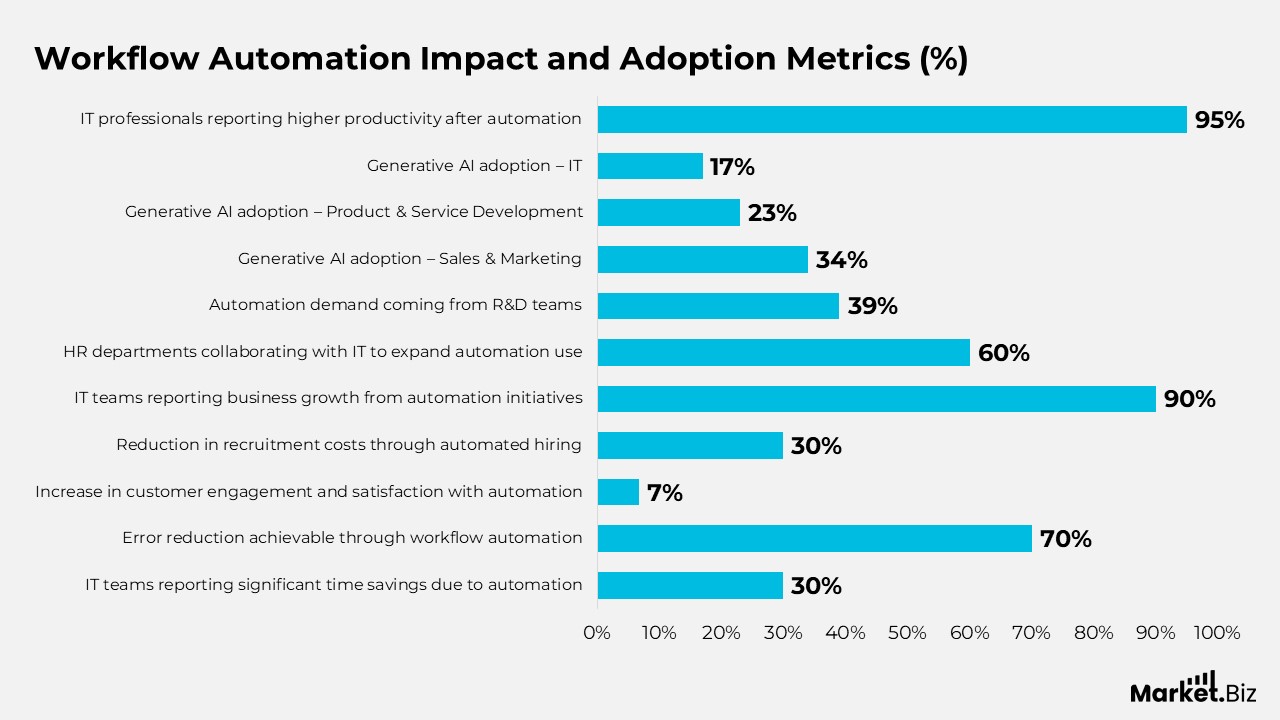
- Nearly 30% of IT teams report that employees across their organizations save significant time through automation tools and software.
- Workflow automation can reduce operational errors by as much as 70%, thereby strengthening accuracy and consistency.
- Companies experience about a 6.7% boost in customer engagement and satisfaction in areas where automated processes are deployed.
- More than 90% of IT professionals say automation enables employees to shift toward higher-value, strategic responsibilities.
- Automating candidate screening and hiring helps companies cut recruitment costs by roughly 30%.
- Close to 90% of IT teams report noticeable business growth as a direct result of process automation initiatives.
- Nearly 60% of HR departments now work with IT leaders to explore expanded automation use cases.
- The healthcare automation space is projected to exceed $110 billion by 2034, reflecting strong industrywide transformation.
- Over 75% of accounts payable teams rely on automation to streamline invoice handling and reduce manual workload.
- Research and development functions show the highest demand for automation, accounting for 39% of total interest.
- Generative AI sees its highest adoption in sales and marketing (34%), followed by product and service development (23%) and IT (17%).
- Around 95% of IT professionals observed measurable productivity gains after implementing automated processes.
(Source: IBM, Gitnux, Capgemini, Camunda, Deloitte, Stampli, Salesforce, McKinsey, Regina Corso Consulting)
Measuring the Success of Business Process Automation Initiatives Statistics
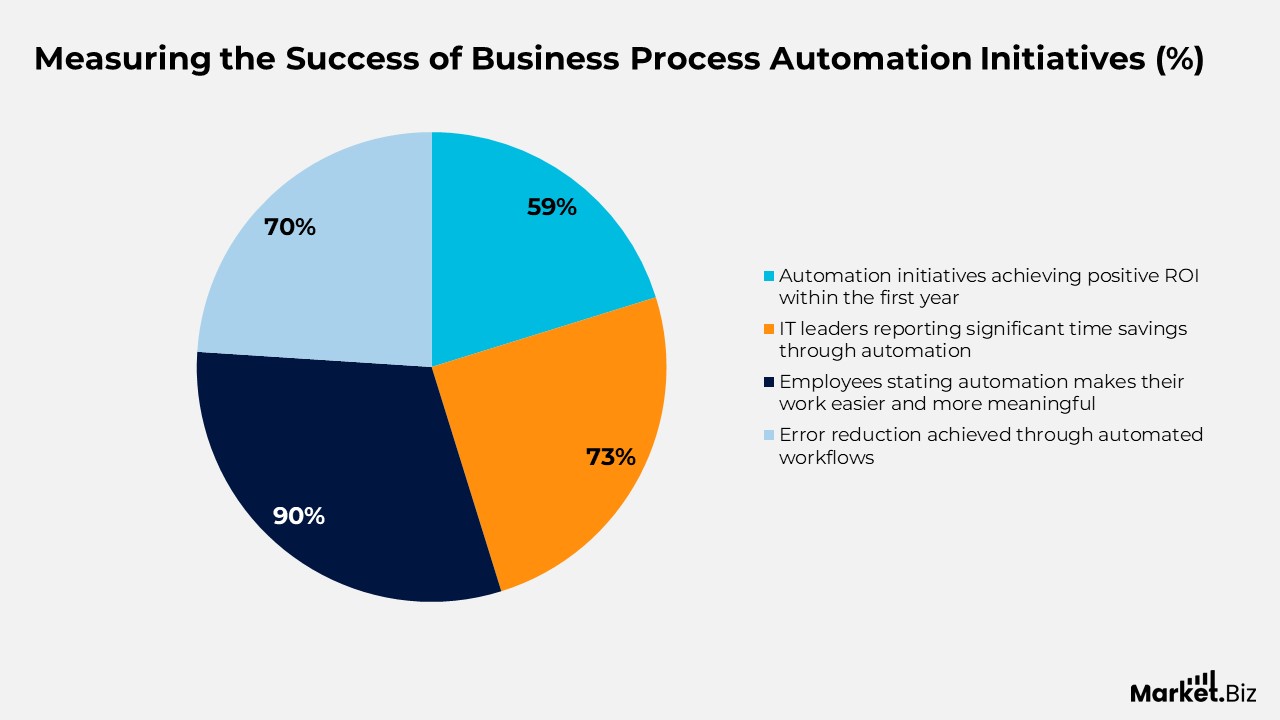
- Nearly 59% of automation initiatives deliver a positive return on investment within the first year of deployment.
- Around 73% of IT leaders report that automation has helped teams reclaim nearly half of their operational time.
- Close to 90% of employees say automated tools have made their roles easier and more meaningful.
- Automated workflows reduce errors by roughly 70%, significantly improving process reliability.
(Source: Vegam AI)
Workforce Shifts and AI Adoption Trends in Business Process Automation Statistics
- An estimated 83 million jobs are projected to disappear within the next five years as automation reshapes global labor needs.
- Deploying automation systems to handle repetitive manual tasks can require an investment ranging from $30,000 to $250,000, depending on complexity.
- More than 7.5 million data entry roles are expected to be eliminated in the coming years, marking the largest job displacement among all categories.
- Nearly 45% of companies foresee workforce reductions driven by AI adoption.
- The sector most impacted by job displacement and new job creation is projected to be media, entertainment, and sports, with a 35% transformation rate.
- Business leaders anticipate that by 2028, around 70% of employees will rely on AI tools to automate or support day-to-day tasks.
- Close to 90% of automation professionals have already integrated or plan to integrate AI technologies within the next year.
(Source: World Economic Forum, SMA Technologies, ResumeBuilder, UKG, UiPath)
Global Workforce Transformation Driven by Automation and Digital Adoption
- A global survey indicates that nearly 74% of respondents expect 11% to 50% of their workforce to be affected by the rise of intelligent automation technologies.
- Over 80% of business leaders have already accelerated automation efforts and expanded remote-work capabilities across operations.
- Around 50% of leaders are prepared to fast-track the digitalization of roles within their organizations.
- Technology dependence continues to rise in workplaces, prompting companies to invest in skill development, with 49% creating their own training programs to support employees.
- Nearly 43% of organizations anticipate workforce reductions due to technological adoption, while 34% expect to increase hiring as new tech-driven roles emerge.
- Day-to-day managerial tasks are projected to be 69% automated, reflecting a major shift in supervisory functions.
- Research suggests that one-third of work activities could be automated across roughly 60% of occupations globally.
- More than 51% of companies adopt automation primarily to enhance employee efficiency and performance.
- About 31% of businesses express heightened concerns regarding potential job losses linked to automation.
- To manage displacement, organizations are exploring ways to internally redeploy nearly 50% of affected employees.
- Companies achieving strong automation outcomes are more likely to scale these initiatives using “human-in-the-loop” approaches that blend automation with employee oversight.
- Talent shortages remain the biggest barrier to IT automation adoption, cited by 75% of respondents, and affect nearly 40% of digital workplace technologies.
(Source: World Economic Forum, Gartner, McKinsey, various global workforce surveys)
Workforce Automation Trends in Human Resources
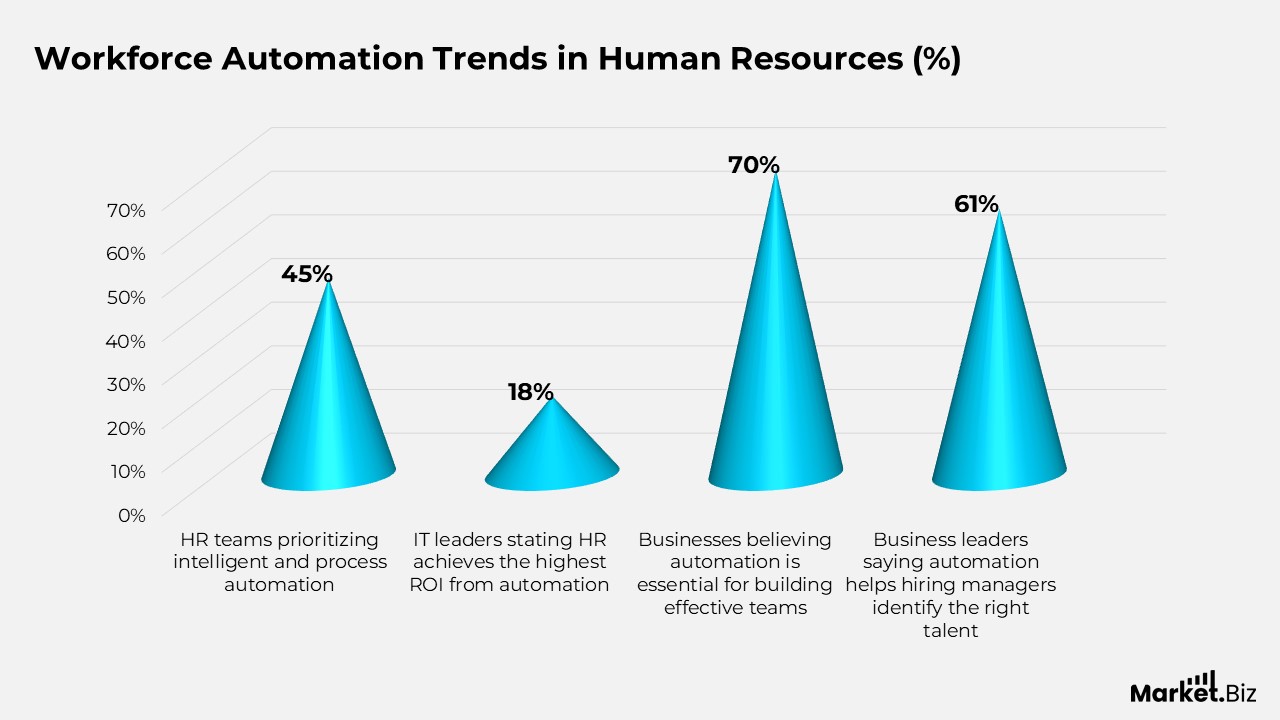
- Nearly 45% of HR teams are increasingly prioritising intelligent and automated processes within their departments.
- Around 18% of IT leaders say HR delivers the highest return on investment when automation is applied effectively.
- About 70% of businesses believe automation tools are essential for building stronger and more efficient teams.
- Close to 61% of business leaders view automation as a valuable enabler for helping hiring managers identify the right talent for open roles.
(Source: HR automation surveys, IT leadership insights, Forbes hiring trends)
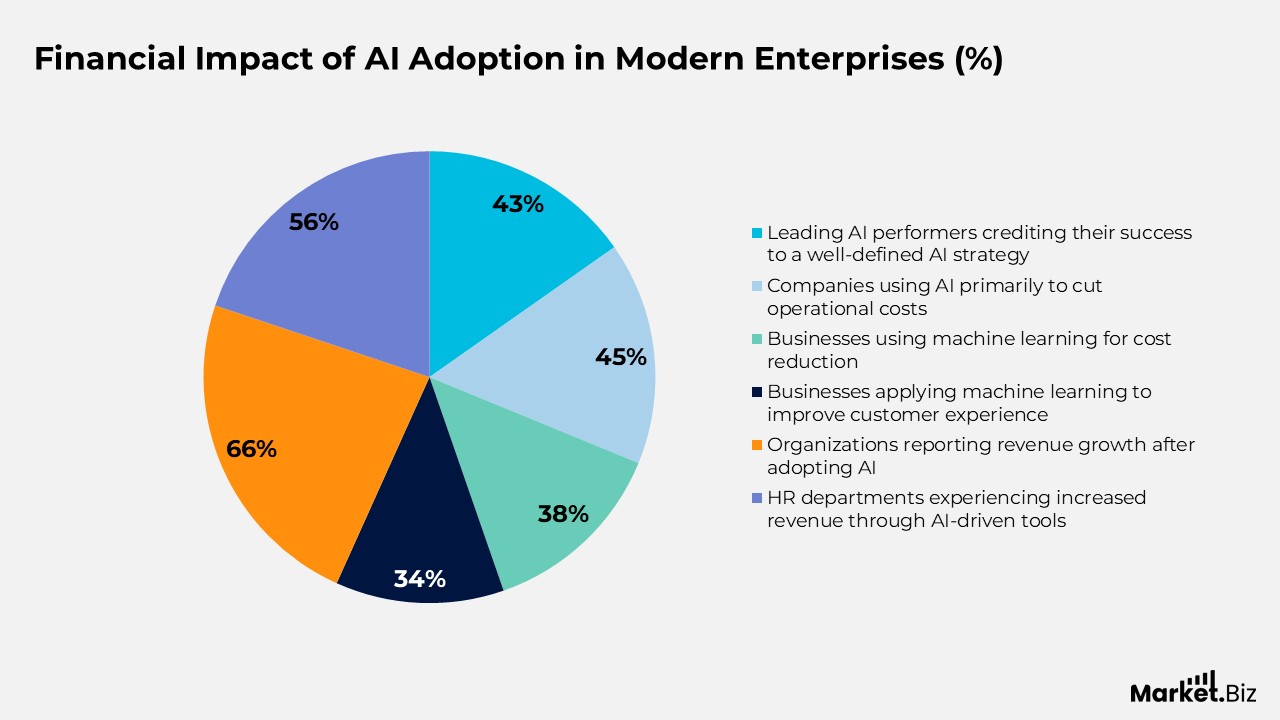
Financial Impact of AI Adoption in Modern Enterprises
- Nearly 43% of top-performing AI organizations attribute their success to a clearly articulated, structured AI strategy.
- Around 45% of companies rely on AI solutions to reduce operational expenses directly.
- Approximately 38% of businesses use machine learning to reduce costs, while 34% use it to enhance the customer experience.
- Nearly 66% of organizations report revenue growth as a result of adopting AI technologies.
- More than 56% of HR departments have witnessed higher revenue outcomes following the integration of AI-driven tools.
(Source: Imaginoation)
Influence of AI and Machine Learning Across Global Industries
- AI now automates roughly 10–25% of banking operations, helping streamline financial workflows and reduce operational expenditures.
- Nearly 84% of intellectual property professionals in the U.S. and Japan view AI-enabled criminal activity as a major threat to their sector.
- AI adoption in retail has surged, with 60% of retailers now using AI tools, up from 35% the previous year.
- About 43% of leading AI-driven organizations credit their progress to having a clearly defined, long-term AI strategy.
- Research shows that 56% of companies are redesigning HR programs with digital and mobile technologies, while 33% already employ AI-based HR applications.
- Machine learning technologies have delivered an average 40% boost in operational efficiency, significantly lowering costs and increasing productivity.
- Almost 30% of IT professionals report that employees are already saving time through AI-powered automation tools.
- Around 49% of organizations use AI and ML in marketing and sales to identify prospects and strengthen customer engagement.
- ML-driven clinical trial applications now account for 24.2% of the overall AI healthcare market, underscoring their growing importance in medical research.
(Source: Cflow, Statista)
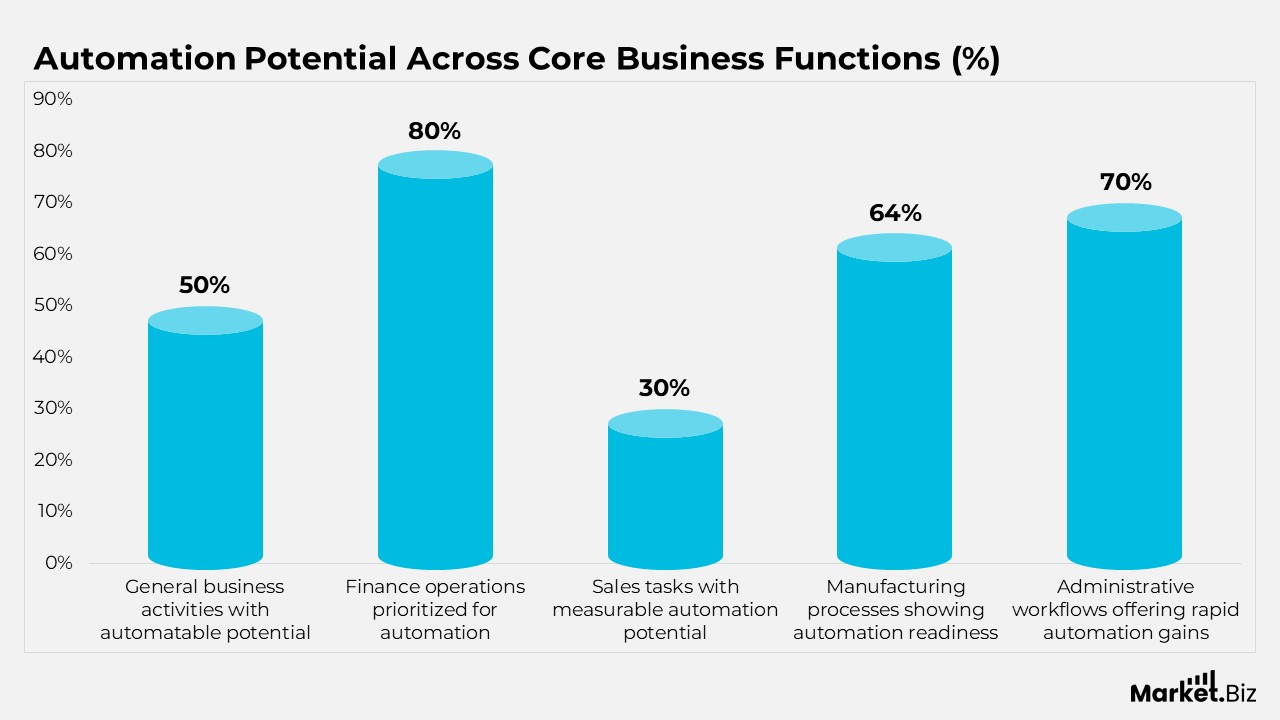
Automation Potential Across Core Business Functions
- Nearly 50% of general business activities are considered automatable, indicating substantial room for efficiency improvements.
- Finance functions show an automation potential of about 80%, making them a top priority for implementation.
- Sales-related tasks have roughly 30% automation potential, reflecting steady adoption growth.
- Manufacturing operations demonstrate an automation readiness of around 64%, placing the sector among the fastest adopters.
- Administrative workflows have an automation potential of nearly 70%, offering organizations quick and achievable efficiency gains.
(Source: Vegam AI)
Global Momentum and Adoption Trends in Marketing Automation
- Around 40% of organizations not currently using marketing automation plan to adopt it in the near future.
- Nearly 77% of marketers report higher conversion rates after implementing marketing automation platforms.
- About 51% of companies have already integrated marketing automation into their operations.
- More than half of B2B firms (58%) are planning to introduce marketing automation tools to strengthen campaign performance.
- Approximately 80% of marketers experienced a rise in lead volume after deploying automation technologies.
- B2B marketers using automation observed an average 10% improvement in sales pipeline growth.
- Over 60% of businesses outsource at least some portion of their marketing automation activities.
- Nearly 43% of marketers identify productivity optimization as the primary goal of their automation strategies.
- About 63% of marketing professionals anticipate increasing their investment in automation tools in the coming years.
- At least 75% of companies use one or more marketing automation tools to support their campaigns and workflows.
(Source: Cflow, Statista)
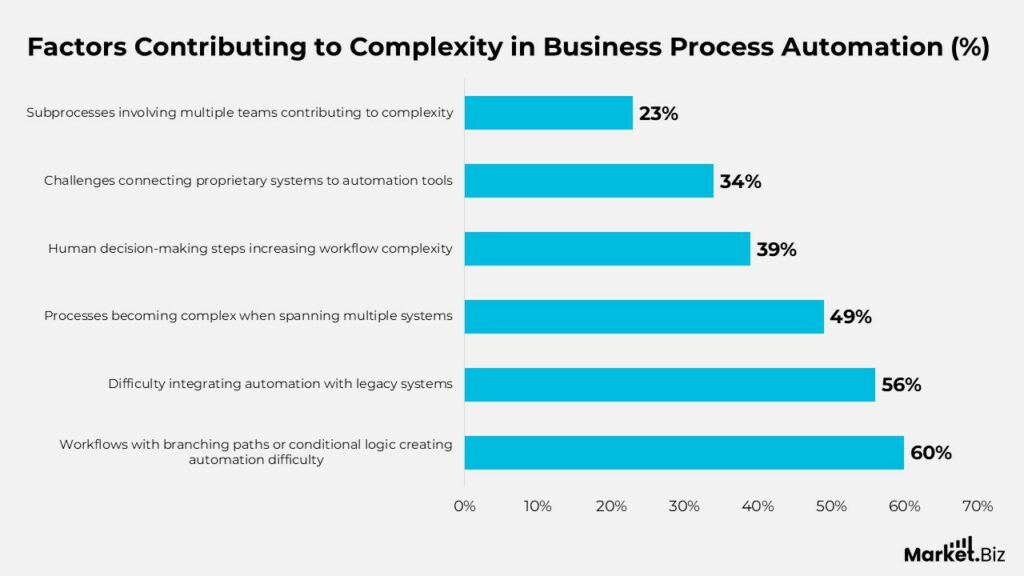
Factors Contributing to Complexity in Business Process Automation Statistics
- Around 60% of automation challenges stem from workflows with intricate branching or conditional rules.
- Nearly 56% of organizations struggle to integrate automation with legacy systems, making projects more difficult to execute.
- Close to 49% report that automation becomes complex when processes must operate across multiple systems simultaneously.
- About 39% find that handling human decision-making patterns adds significant complexity to automated workflows.
- Roughly 34% face obstacles when attempting to connect proprietary systems to automation platforms.
- Nearly 23% indicate that complexity occurs when subprocesses fall under the responsibility of different teams.
(Source: Camunda Analysis, DOIT Software, Deloitte)
Core Challenges Organizations Face During Process Automation Initiatives
- Nearly 54% of organizations find it difficult to map and understand complex workflows before automation begins.
- Roughly 17% encounter difficulties securing active engagement and support from management.
- Nearly 15% worry that the automation solution does not fully address their operational needs.
- Around 8% face limitations tied to low-code or limited customization capabilities.
- Approximately 37% express concerns about the overall cost of implementing automation solutions.
- Nearly 29% experience obstacles related to employee training and resistance to new technologies.
- Around 24% report challenges in designing user-friendly interfaces to initiate automated processes.
(Source: Salesforce, BusinessDasher)
Conclusion
Business Process Automation Statistics: The statistics on business process automation demonstrate a strong global shift toward digitizing operations to enhance efficiency, accuracy, and performance. Organizations are increasingly adopting automated tools to eliminate repetitive tasks, accelerate workflows, and support smarter decision-making.
As AI and intelligent automation mature, employees gain more time for strategic work, even as businesses navigate challenges such as workforce transitions, skill gaps, and hurdles to technology adoption. Collectively, these insights show that automation is becoming a foundational driver of operational resilience, competitive advantage, and future-ready workforce development across industries.
FAQ’s
Business process automation refers to the deliberate application of digital technologies to restructure operational activities, reduce manual involvement, improve procedural accuracy, and create consistent, scalable workflows across an organization.
BPA statistics offer quantifiable insights that reinforce digital transformation theories, illustrating how enterprises evolve from manual, effort-intensive operations to automated, algorithm-driven systems.
Departments such as finance, HR, procurement, and IT naturally align with automation due to their rule-based, repetitive tasks, positioning them as primary beneficiaries of digitally optimized workflows.
Theoretically, automation shifts employee effort from repetitive tasks to higher-order, analytical activities, ultimately enhancing productivity, decision-making effectiveness, and organizational learning outcomes.
Artificial intelligence serves as a transformative layer, elevating basic automation into intelligent, adaptive systems by enabling predictive analytics, contextual understanding, and autonomous decision-making.