









Introduction
Internet of Everything Statistics: The Internet of Everything (IoE) refers to the widespread integration of people, processes, data, and connected systems into a unified digital environment that supports continuous data exchange and real-time intelligence.
Internet of Everything statistics are essential for measuring the scale and impact of this shift, capturing trends such as the expansion of connected devices, rising data volumes, increasing network activity, and the growing use of cloud, edge, and AI-enabled analytics across industries.
These indicators help explain how IoE is influencing digital infrastructure requirements, operational performance, cybersecurity considerations, and productivity improvements across sectors, including smart cities, manufacturing, healthcare, and transportation.
Editor’s Choice
- Cellular-based technologies now account for about 21% of all global IoT connections, highlighting the growing role of mobile networks in device connectivity.
- Nearly 81% of individuals believe that the development of smart cities is achievable through the widespread adoption of IoT and connected infrastructure.
- Around 54% of enterprises report using IoT solutions primarily to reduce operational and project-related costs.
- The consumer segment is projected to generate approximately 27% of total global IoT revenue, reflecting strong adoption of personal and home connected devices.
- About 57% of households in the United States are anticipated to adopt smart home devices by the end of 2025, driven by convenience and automation trends.
- According to PwC, roughly 93% of executives agree that the advantages of IoT implementation outweigh the associated risks.
- IoT Analytics indicates that nearly 54% of IoT initiatives are motivated by direct cost-saving objectives.
Moreover
- Cisco projects that nearly 500 billion devices will be connected to the internet by 2030.
- Insights from Tech Jury suggest that approximately 127 new IoT devices connect to the internet every second.
- Global consumer spending on smart home-related devices is forecast to reach nearly USD 88 billion by 2025, reflecting rising household adoption.
- Outdoor surveillance currently represents the largest IoT use case by market value, estimated at USD 7.6 million.
- The worldwide installed base of IoT-connected devices is projected to reach nearly 30.9 billion units by 2025.
- IoT devices using cellular connectivity reached approximately 2 billion units globally in 2021, underscoring the rapid adoption of mobile IoT standards.
- Fifth-generation mobile networks are expected to accelerate IoT growth, with global 5G cellular subscriptions projected to reach about 1.9 billion by 2024.
- Ongoing semiconductor supply constraints are expected to limit the pace of IoT expansion for another 2 years.
- Enterprise spending on IoT-focused cybersecurity solutions reached nearly USD 631 million in 2021, reflecting rising concerns about connected device security.
(Source: Cisco, PwC, Exploding Topics)
Evolution of IoT Connected Device Volumes Worldwide
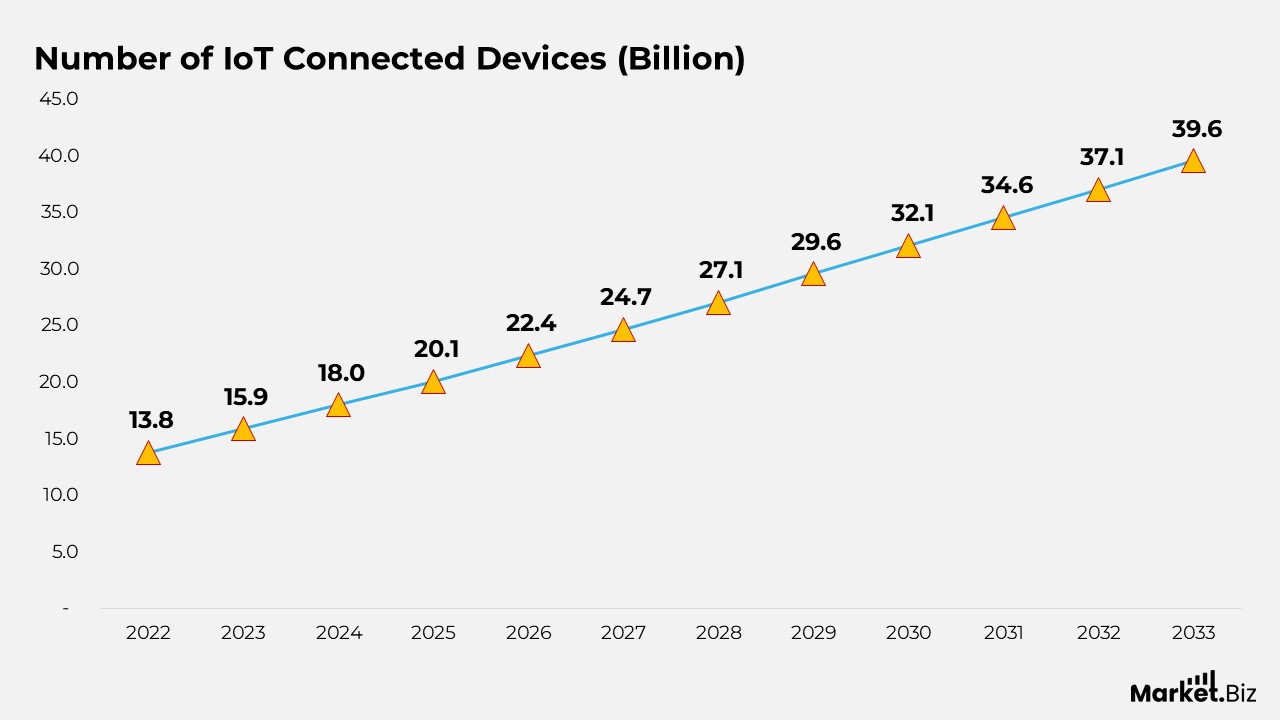
- The global installed base of IoT-connected devices is estimated to reach 18 billion in 2024, reflecting a year-on-year growth rate of 13.21% compared with the previous year.
- In 2023, the total number of IoT-connected devices stood at approximately 15.9 billion. Indicating steady acceleration in adoption across consumer and enterprise applications.
- The worldwide IoT ecosystem is projected to expand significantly over the long term. Connected device volumes are expected to reach nearly 39.6 billion by 2033.
- IoT device deployments increased from 13.8 billion units in 2022 to 15.9 billion units in 2023, highlighting strong momentum entering the mid-decade period.
- Annual device counts are forecast to rise to about 20.1 billion in 2025 and to 22.4 billion in 2026. Supported by expanding use cases in industrial and smart infrastructure.
- By 2027, global IoT connected devices are anticipated to reach around 24.7 billion, followed by 27.1 billion in 2028. Driven by broader integration of connected sensors and platforms.
- The number of IoT devices is projected to cross 29.6 billion in 2029 and 32.1 billion in 2030. Reflecting deeper penetration across mobility, energy, and smart city networks.
- Continued growth is expected through the early 2030s, with device volumes estimated at 34.6 billion in 2031, 37.1 billion in 2032, and peaking at approximately 39.6 billion by 2033.
(Source: DemandSage, Statista)
Global Adoption Patterns Across Key IoT Use Cases
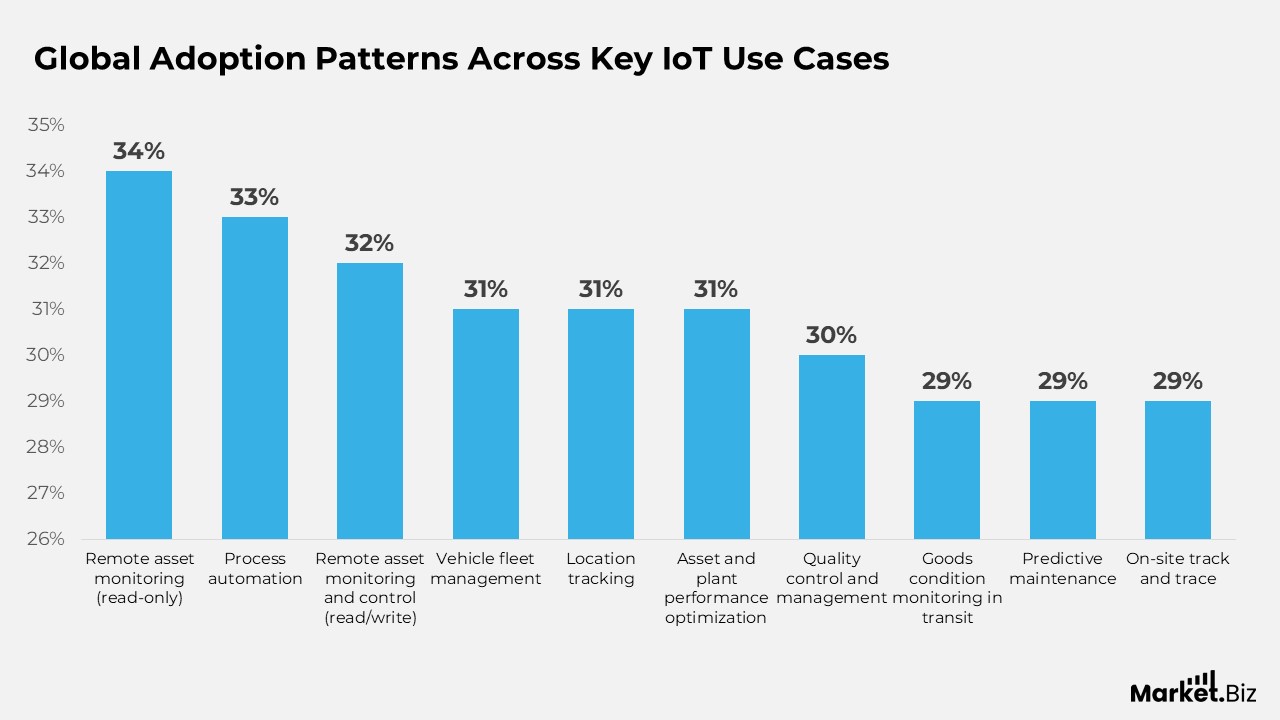
- Remote asset monitoring focused on read-only data access is the most widely adopted IoT use case globally, with an adoption rate of 34%, driven by low implementation complexity and rapid visibility gains.
- Process automation follows closely, with an estimated 33% global adoption rate, as organisations prioritise efficiency, consistency, and reduced manual intervention.
- Remote asset monitoring, combined with active control capabilities, has achieved global adoption of around 32%, reflecting growing confidence in bidirectional IoT systems.
- Vehicle fleet management solutions are used by approximately 31% of organizations worldwide, supported by rising demand for route optimization, fuel efficiency, and compliance monitoring.
- Location-tracking applications also show strong penetration, with nearly 31% global adoption, particularly in logistics, warehousing, and asset-intensive industries.
- Asset and plant performance optimization initiatives account for about 31% adoption globally, as manufacturers increasingly rely on real-time operational intelligence.
- IoT-enabled quality control and management solutions have reached an estimated 30% adoption rate, helping companies improve consistency and reduce production errors.
- Monitoring the condition of goods during transit is adopted by roughly 29% of global users, reflecting growing emphasis on supply chain visibility and product integrity.
- Predictive maintenance applications account for nearly 29% global adoption, as enterprises seek to minimize downtime and extend asset lifecycles.
- On-site track-and-trace solutions also achieve an adoption rate of about 29%, supporting inventory accuracy and operational transparency across facilities.
(Source: DemandSage, Statista)
Key Security and Risk Challenges in IoT Deployments
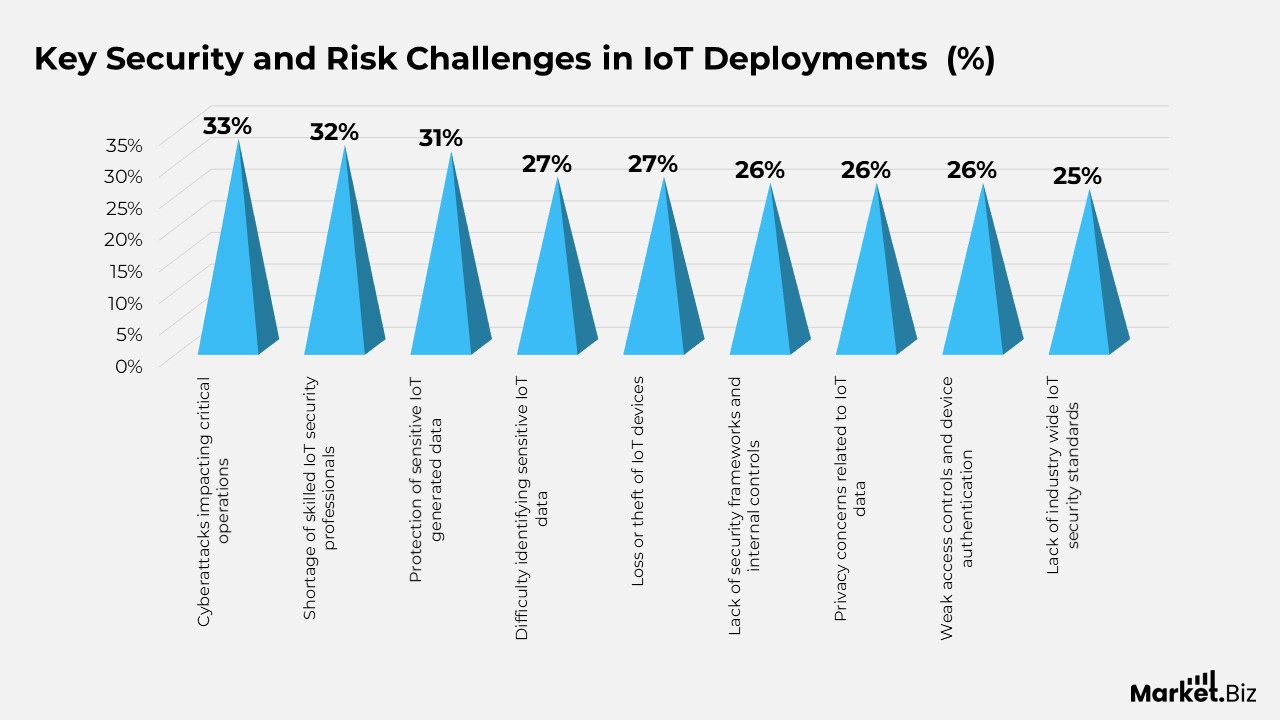
- About 33% of survey respondents identify cyberattacks on IoT devices that could disrupt critical operations as their primary security concern.
- Nearly 32% of participants cite the shortage of skilled professionals capable of implementing and managing IoT security systems as a major challenge.
- Protecting sensitive information produced by IoT devices is a concern for approximately 31% of respondents, reflecting growing data exposure risks.
- Around 27% of respondents report difficulty in identifying and classifying sensitive data generated by connected IoT devices.
- About 27% of surveyed organizations highlight the loss or theft of IoT devices as a security risk.
- A lack of established security frameworks and internal controls within IoT environments is noted by nearly 26% of respondents.
- Privacy issues associated with data produced by IoT devices are a concern for roughly 26% of survey participants.
- Insufficient access control mechanisms and weak device authentication practices are cited by about 26% of respondents as limiting effective IoT security.
- Approximately 25% of respondents cite the absence of consistent industry-wide security standards for IoT devices as an ongoing challenge.
(Source: DemandSage, Statista)
IoT Implementation and Adoption Indicators
- Between 20.4 billion and 31 billion IoT devices were estimated to be online globally by December 2020, indicating that large-scale deployment is mature.
- Around 93% of IT enterprises reported adopting IoT technologies in 2020, highlighting widespread enterprise acceptance.
- The United States currently represents the largest industrial IoT market, accounting for nearly 45% of the global market.
- Asia Pacific is expected to capture the largest market share in the IoT healthcare segment, driven by expanding healthcare infrastructure and digitisation.
- Building automation solutions were projected to grow by approximately 42% in 2021, reflecting demand for smart commercial and residential infrastructure.
- Nearly 17% of total IoT projects are concentrated in connected industrial environments, underscoring industrial digitisation trends.
- As of 2019, about 82% of industrial companies were either using or planning to deploy IoT solutions across operations.
- An estimated 127 new IoT devices continue to connect to the internet every second, underscoring the accelerating proliferation of devices.
- More than 40% of all IoT devices are currently deployed within industrial and manufacturing environments.
- Experts estimated that approximately 31 billion IoT devices were installed globally in 2020, marking a major milestone in scale.
(Source: Gartner, Security Today, IoT Now, IoT Analytics, Tech Pro, McKinsey Global Institute, Intel, Leftronic)
IoT User Perception and Enterprise Impact Statistics
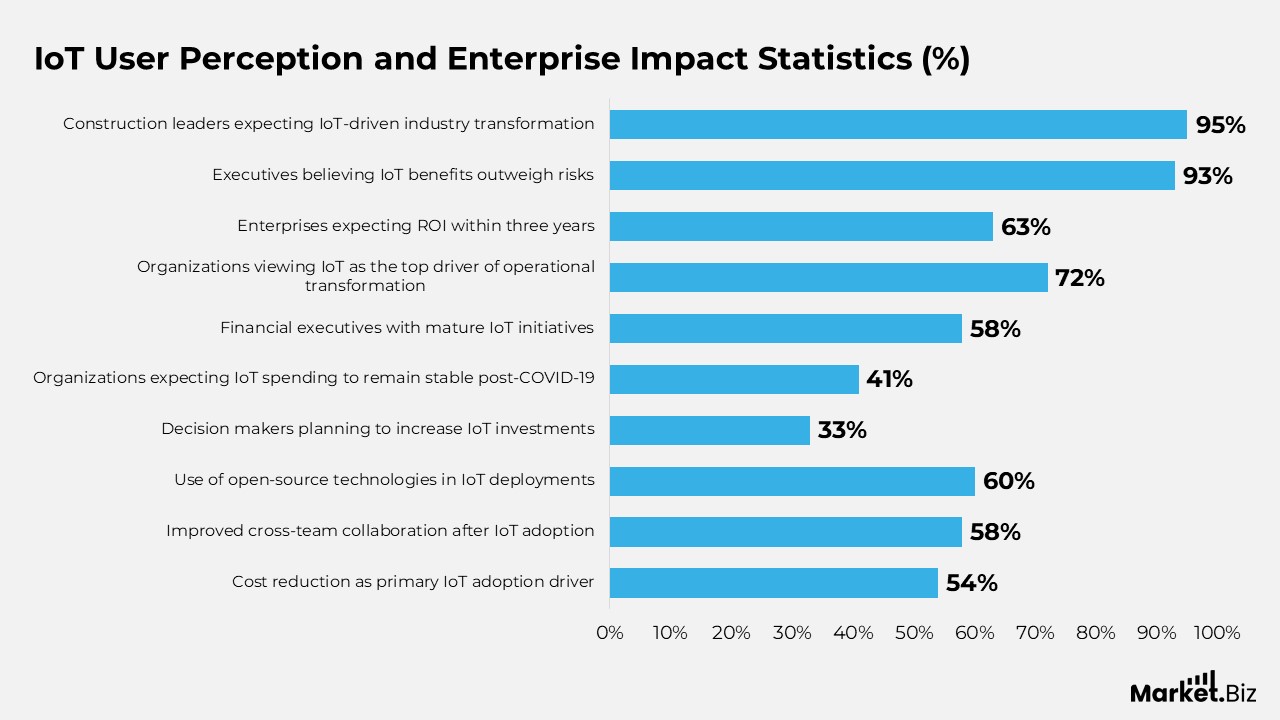
- In surveys covering over 1,600 enterprises globally, around 54% identified cost reduction as the primary motivation for adopting IoT projects.
- About 58% of surveyed organizations reported improved collaboration across teams following IoT implementation.
- Open source technologies were incorporated into nearly 60% of IoT deployments, reflecting flexibility and ecosystem-driven development.
- Nearly one in three decision-makers plan to increase IoT investments, while 41% expect spending levels to remain unchanged following the COVID-19 period.
- Approximately 58% of financial executives report having mature or well-developed IoT initiatives in place.
- Around 72% of organisations view IoT as having the greatest impact on overall operational transformation.
- Nearly 63% of enterprises expect to achieve financial payback within three years of deploying IoT solutions.
- About 93% of executives believe the benefits of IoT adoption outweigh the associated risks.
- Companies anticipate IoT-driven efficiency improvements of roughly 12% across operations.
- Approximately 95% of construction industry leaders believe IoT will fundamentally transform their sector over time.
(Source: IoT Analytics, Harvard Business Review, Eclipse Foundation, Microsoft, Forbes, Deloitte, PwC, KPMG)
Escalating Security, Privacy, and Trust Concerns Across the IoT Landscape
- Fewer than 42% of organisations can accurately detect or identify insecure IoT devices operating within their networks, indicating limited visibility.
- Once an IoT device is connected to the internet, it takes an average of just 5 minutes to face its first attempted cyberattack, highlighting the extreme exposure levels.
- Nearly 90% of risk and security professionals believe that IoT deployments significantly increase an organisation’s vulnerability to cyber threats.
- IoT-focused malware attacks surged sharply in 2018 and continued to rise through the first quarter of 2020, reflecting the persistent escalation of threats.
- Around 83% of medical imaging devices are reported to run unsupported operating systems, posing serious risks of device compromise in healthcare environments.
- Approximately 98% of IoT device network traffic remains unencrypted, exposing sensitive and personal data to interception and misuse.
- About 92% of global consumers express a strong desire to control what types of personal data organizations automatically collect through connected devices.
- Nearly 63% of consumers describe connected devices as “creepy” due to concerns around continuous data collection and monitoring.
- Roughly 55% of companies do not enforce security and privacy compliance requirements for third-party IoT solution providers.
- Around 74% of consumers worldwide worry that IoT-related data breaches could threaten their civil rights and personal freedoms.
(Source: Ponemon Institute, Threat Intelligence Report, SonicWall, Palo Alto Networks, Economist Intelligence Unit, CISS)
Global Internet of Things Expansion and Technology Trends
- By 2026, nearly 45% of all cellular IoT connections are expected to rely on NB-IoT and CAT-M technologies, reflecting a shift toward low-power wide-area networks.
- The real-time location system market expanded from USD 3.19 billion in 2018 to approximately USD 8.79 billion by 2023, highlighting strong demand for asset-tracking solutions.
- Global IoT networks were estimated to generate around 847 zettabytes of data by 2021, underscoring the scale of machine-generated information flows.
- Data generated by IoT devices alone is projected to reach nearly 79.4 zettabytes by 2025, reflecting rapid growth in connected sensors and endpoints.
- By 2030, the average number of connected devices per person worldwide is expected to rise to about 15, indicating deep integration of IoT into daily life.
- Global IoT device volumes are projected to climb to nearly 75 billion units by 2025, driven by consumer, industrial, and infrastructure deployments.
- By 2023, close to 70% of all newly produced vehicles worldwide were expected to be connected to the internet, accelerating the shift toward smart mobility.
- By 2025, an estimated 152,200 new IoT devices are expected to connect to networks every minute, emphasizing the speed of ecosystem expansion.
(Source: Accenture, Cisco, IDC, MTA, Statista)
Conclusion
Internet of Everything statistics clearly demonstrate the accelerating shift toward a fully connected digital ecosystem in which devices, data, people, and processes operate in continuous coordination. The expanding volume of connected devices, rising data generation, and broadening range of real-world applications reflect how deeply connected intelligence is being embedded across industries and societies.
These trends point to measurable economic and operational benefits driven by automation, efficiency, and real-time insights, while also highlighting persistent challenges around security, privacy, and infrastructure readiness.
Overall, the data shows that the Internet of Everything is moving from experimentation to large-scale deployment, making thoughtful investment, strong security practices, and policy alignment critical to unlocking sustainable, long-term value from connected systems.
FAQ’s
Internet of Everything statistics provide numerical insights into the size, growth, and impact of connected ecosystems that combine devices, data, people, and processes. These metrics commonly cover connected device volumes, data creation levels, adoption patterns, application areas, economic value, and security-related trends.
Internet of Things statistics primarily measure connected hardware and sensor deployments, whereas Internet of Everything statistics go beyond devices to include human participation, data intelligence, and integrated workflows. This broader scope explains how connectivity translates into practical outcomes and business value.
IoE statistics enable businesses to assess their digital readiness, pinpoint high-return use cases, estimate investment benefits, and compare adoption progress against industry benchmarks. They also guide decisions related to infrastructure upgrades, automation initiatives, and cybersecurity priorities.
Sectors such as manufacturing, healthcare, transportation, utilities, logistics, smart cities, and consumer electronics are among the most affected. IoE data highlights strong traction across applications such as industrial automation, asset monitoring, predictive maintenance, and connected healthcare systems.
IoE statistics consistently indicate sustained long-term expansion in connected devices, data output, and real-time analytics usage. These projections suggest that connected technologies will become increasingly embedded in daily life, enterprise operations, and public infrastructure in the coming years.