









Introduction
Luxury Travel Statistics: Luxury Travel represents a segment of tourism that focuses on lavish experiences, exceptional comfort, and exclusivity. This industry serves travelers who desire premium lodging, fine dining options, and tailored services that surpass typical offerings.
The Global Luxury Travel Market is projected to reach approximately USD 3,064.1 billion by 2033, up from USD 1,432.5 billion in 2023, with a compound annual growth rate (CAGR) of 7.9% anticipated during the forecast period from 2024 to 2033. In 2023, North America accounted for a 31.5% share of the market, generating USD 451.2 billion in revenue from the Luxury Travel sector.
Factors such as economic conditions, technological progress, and changing consumer preferences play a significant role in shaping market dynamics. Projecting players in this industry include luxury travel agencies, upscale hospitality brands, and exclusive travel providers.
Editor’s Choice
- The global luxury travel market generated a revenue of USD 1,432 billion in 2023.
- In 2020, the most costly holiday destinations globally were ranked according to the average daily price in British Pounds (GBP).
- The global luxury travel market is anticipated to undergo significant expansion over the forthcoming decade. With a compound annual growth rate (CAGR) of 7.80%.
- Europe takes the lead with a 33.8% market share, demonstrating its strong status as a top destination for luxury travel.
- By 2029, the global travel and tourism sector is expected to accommodate approximately 2,672.22 million users. Indicating strong and sustained growth in user engagement throughout the industry.
- China is also expected to witness significant growth. Its revenue increased from $85.8 billion in 2020 to $177.9 billion in 2024.
- Germany is anticipated to achieve an impressive CAGR of 35.80% from 2020 to 2024. This is in stark contrast to the modest CAGR of 2.30% projected for the period from 2019 to 2024.
- Oman experienced a 35% rise in high-end tourist arrivals in 2023.
- Since 2020, the average online order value for mobile users has increased by 29%.
General Luxury Travel Statistics
- The global luxury travel market generated a revenue of USD 1,432 billion in 2023.
- The market is characterized by several key players, each with different market shares. Cox & Kings Ltd. commands the largest share at 15%, establishing itself as a leading entity in the industry.
- Key regions significantly influence the global luxury travel market, with each contributing a notable share. Europe is at the forefront, holding a 33.8% share, which underscores its status as a top destination for luxury travel.
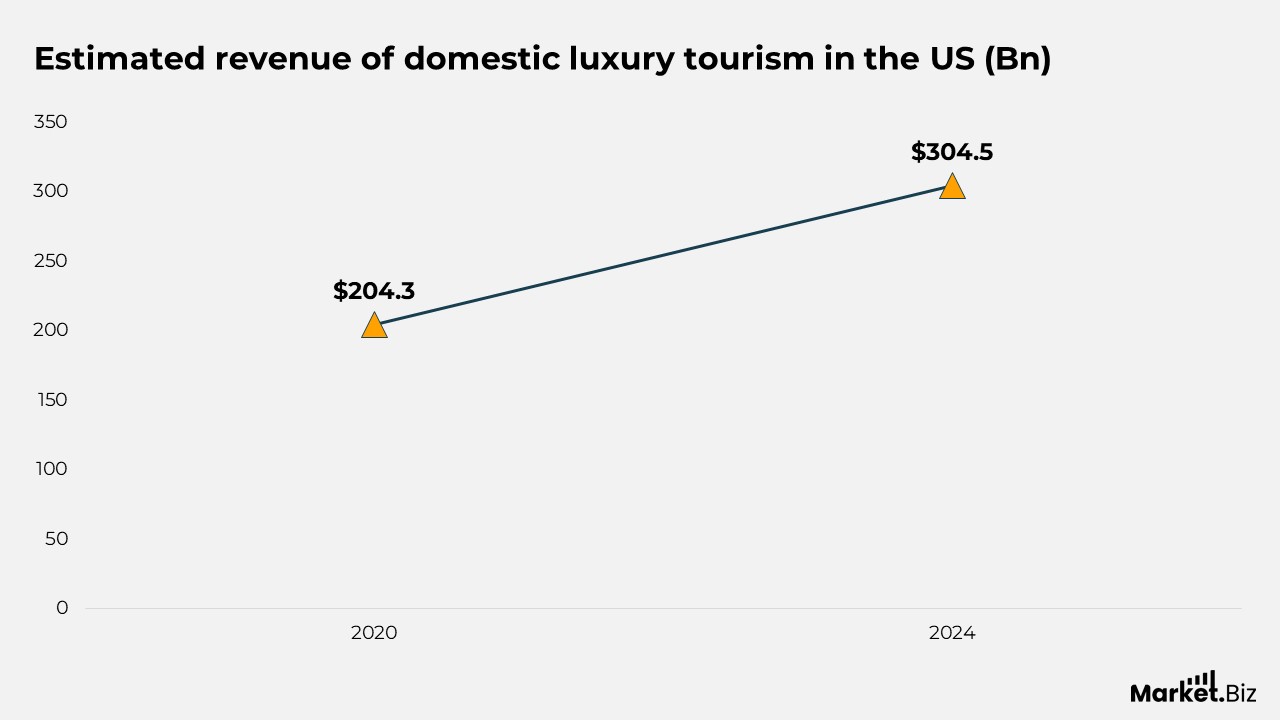
- The United States is projected to retain its leading role in domestic luxury tourism, with revenue anticipated to rise from $204.3 billion in 2020 to $304.5 billion by 2024.
- As of August 2014, numerous luxury travel destinations worldwide saw substantial year-over-year growth in visitor numbers.
- Becoming the fastest-growing luxury destination during this timeframe, Greece topped the list with an extraordinary 57% growth in the travel industry.
- In 2020, the most costly holiday destinations globally were ranked according to the average daily price in British Pounds (GBP).
- Grand Cayman in the Cayman Islands led this ranking, with the average daily expense for travelers reaching £459.58.
- As of May 2020, Indian luxury travelers reported various uncomfortable experiences during the coronavirus (COVID-19) pandemic.
- The primary concern, highlighted by 75% of respondents, was the uncertainty regarding the adherence to proper cleaning protocols.
Luxury Travel Market Statistics
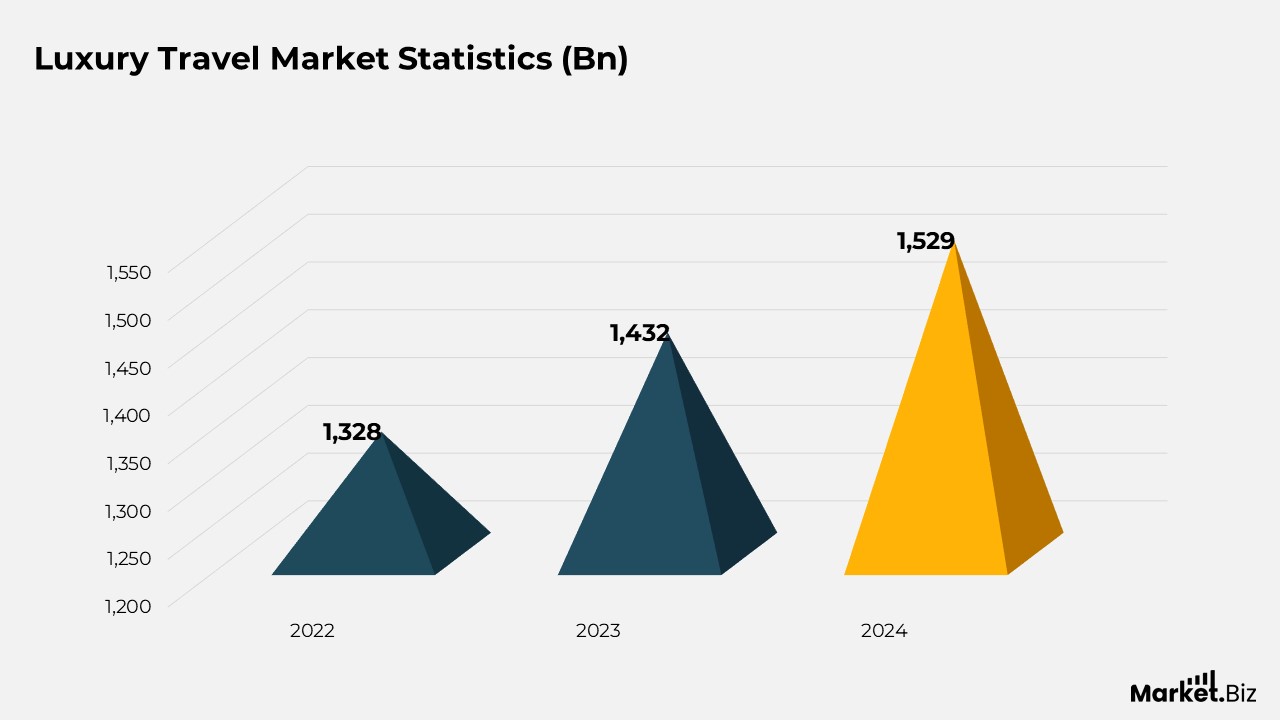
- The global luxury travel market is anticipated to undergo significant expansion over the forthcoming decade, with a compound annual growth rate (CAGR) of 7.80%.
- In 2022, the market was assessed at USD 1,328 billion.
- This amount is expected to increase each year consistently, reaching USD 1,432 billion in 2023, USD 1,529 billion in 2024, and USD 1,679 billion in 2025.
- By 2026, the market is projected to exceed USD 1,828 billion and maintain its upward trend. With a forecasted value of USD 1,952 billion in 2027.
- The growth pattern is predicted to continue until the end of the decade. The market is anticipated to reach USD 2,045 billion in 2028 and USD 2,205 billion in 2029.
- As we enter the 2030s, the market is expected to expand further. Achieving USD 2,355 billion in 2030 and USD 2,538 billion in 2031.
- By 2032, the global luxury travel market is expected to reach a remarkable milestone. With an estimated revenue of USD 2,762 billion.
Luxury Travel Market by Regional Statistics
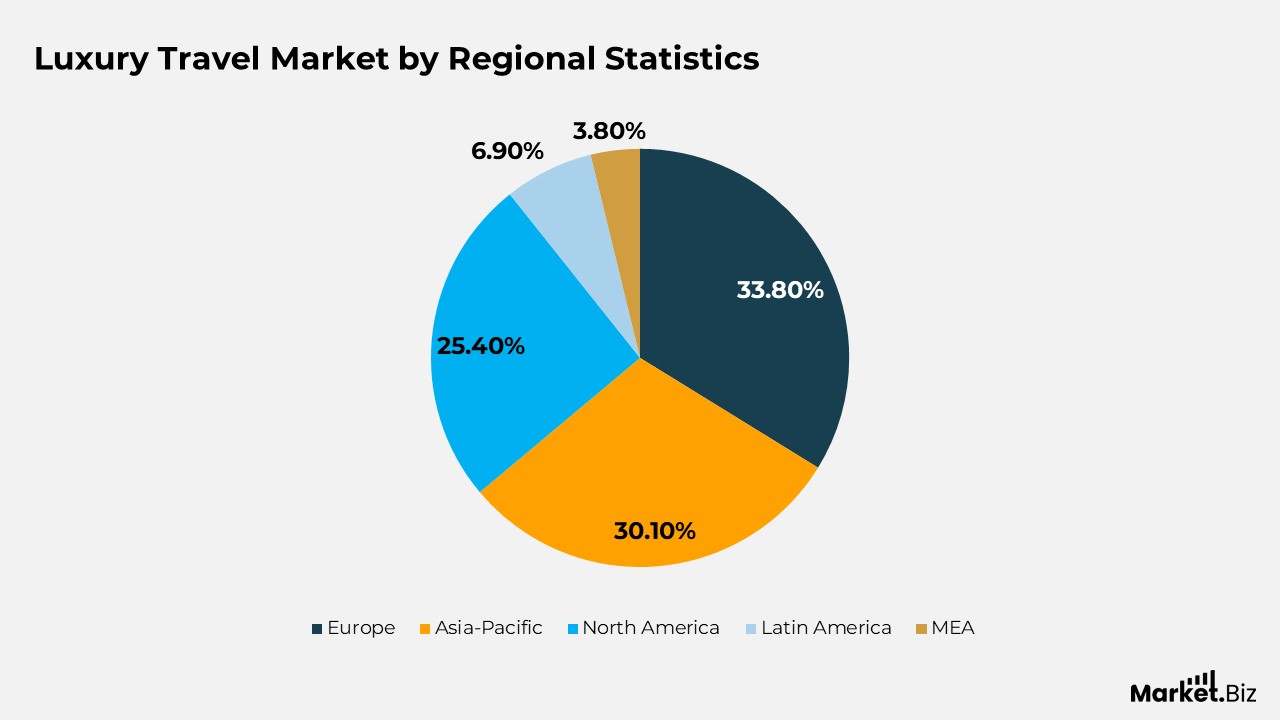
- Several projecting regions play an important role in the global luxury travel market, each making a notable contribution.
- Europe takes the lead with a 33.8% market share, demonstrating its strong status as a top destination for luxury travel.
- The Asia-Pacific (APAC) region closely follows with a 30.1% share, showcasing its increasing influence and attractiveness in the luxury travel industry.
- North America represents 25.4% of the market, highlighting its strong demand and well-developed infrastructure for premium travel experiences.
- Latin America captures a smaller segment of the market at 6.9%, while the Middle East and Africa (MEA) region accounts for 3.8%, indicating a more modest role in the global luxury travel market.
Hotel Market Statistics
- The exact number of hotels and hotel rooms globally remains uncertain. According to STR, there are approximately 17.5 million guestrooms across 187,000 hotels worldwide, yet the precise figures are unknown.
- Wyndham Hotel Group is recognized as the largest hotel company globally, based on the number of properties, boasting over 9,200 hotels as of June 2020. Following Wyndham, Marriott International ranks second with more than 7,600 properties, while Choice Hotels International holds the third position with over 7,100 hotels.
- Although Wyndham has the highest number of properties, Marriott International leads in terms of the total number of hotel rooms. In 2020, Marriott had around 1.4 million guestrooms, surpassing Hilton Worldwide by over 400,000 rooms.
- Typically, the hotel and tourism sector contributes approximately 10% to the global GDP. However, in 2020, due to the impact of the COVID-19 pandemic, the hotel industry accounted for only 5.5% of the global GDP.
- In 2020, global hotel revenue reached $198.6 billion, reflecting a 46% decline compared to 2019. Projections for 2021 suggest a recovery to about $285 billion, although a complete recovery is not anticipated until 2023.
- In recent years, Europe has outdone the Asia Pacific, the Americas, and the Middle East/Africa regarding occupancy and RevPAR metrics. Nevertheless, at the onset of the pandemic, occupancy in Europe plummeted to 13.3%.
- The largest hotel in the world is the First World Hotel & Plaza located in Genting Highlands, Malaysia, featuring 7,351 rooms and even an on-site theme park!
Luxury Travel Users Statistics
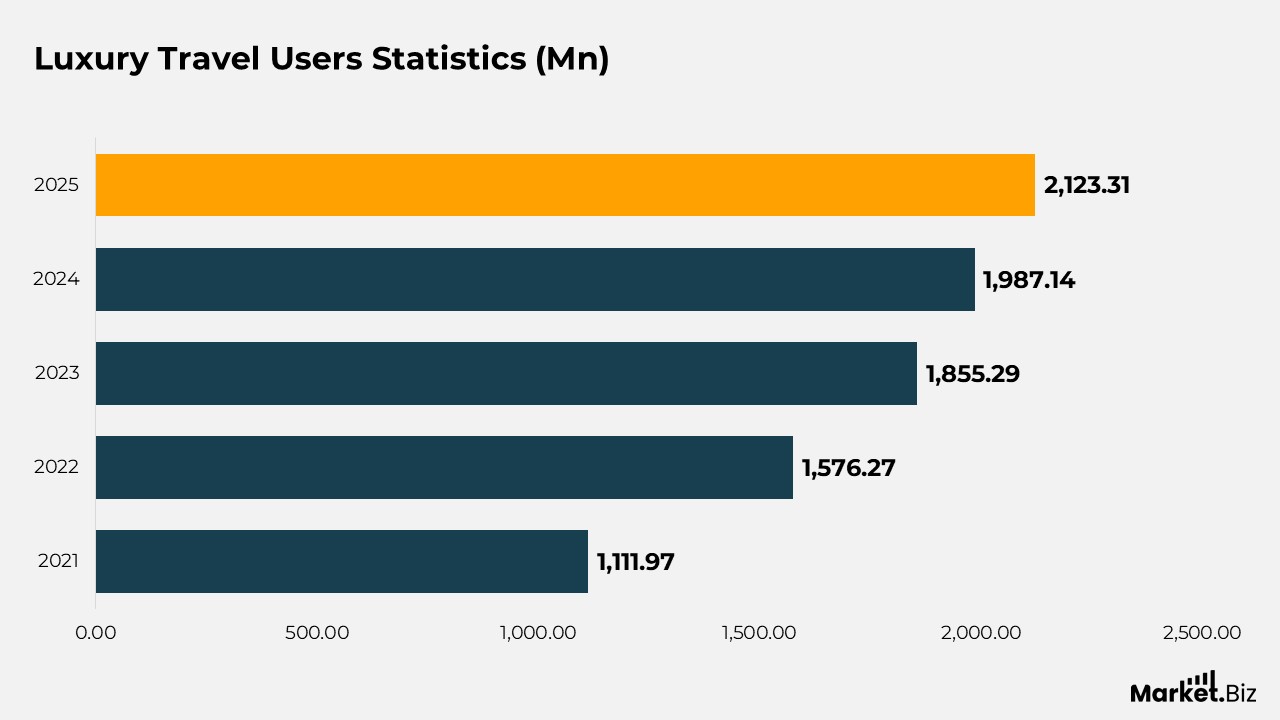
- The global travel and tourism sector is anticipated to experience substantial growth in user numbers from 2020 to 2029.
- In 2020, the sector recorded around 879.18 million users globally.
- This figure rose to 1,111.97 million in 2021, demonstrating a strong rebound after the pandemic.
- The upward trend persisted into 2022, with the user base increasing to 1,576.27 million.
- By 2023, the user count is projected to reach 1,855.29 million.
- This positive trajectory is expected to continue in the following years. The user count is forecasted to grow to 1,987.14 million in 2024 and further to 2,123.31 million in 2025.
- This expansion is anticipated to carry on through the latter part of the decade, with projections of 2,277.18 million users in 2026, 2,414.38 million in 2027, and 2,541.19 million in 2028.
- By 2029, the global travel and tourism sector is expected to accommodate approximately 2,672.22 million users, indicating strong and sustained growth in user engagement throughout the industry.
Revenue of Travel Destinations Statistics
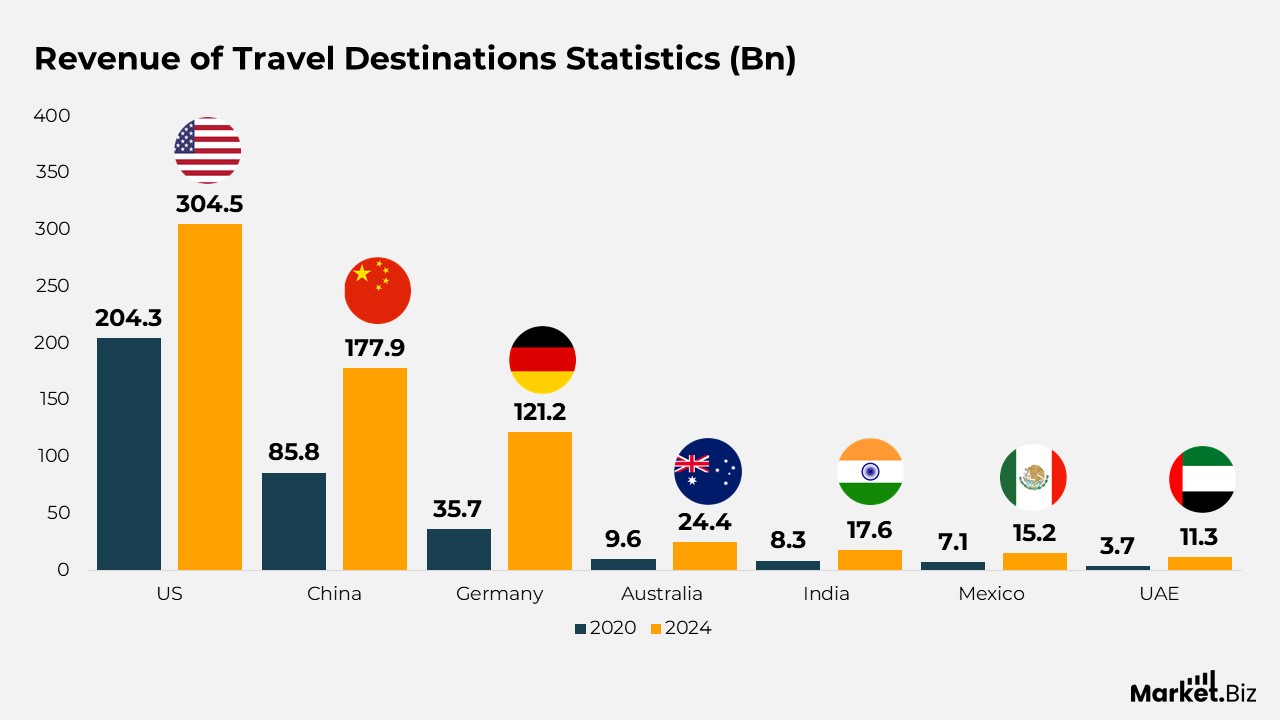
- The United States is anticipated to sustain its leadership role. Revenue is projected to rise from $204.3 billion in 2020 to $304.5 billion by 2024.
- China is also expected to witness significant growth, with its revenue increasing from $85.8 billion in 2020 to $177.9 billion in 2024.
- Germany’s luxury tourism revenue is forecasted to expand from $35.7 billion in 2020 to $121.2 billion in 2024, reflecting a robust growth in this sector.
- Australia is predicted to experience a revenue increase from $9.6 billion in 2020 to $24.4 billion in 2024.
- India and Mexico are also projected to nearly double their revenues, with India rising from $8.3 billion to $17.6 billion and Mexico from $7.1 billion to $15.2 billion.
- The United Arab Emirates is expected to see its revenue triple, growing from $3.7 billion in 2020 to $11.3 billion in 2024.
- South Africa and Morocco, despite starting from a lower revenue base, are also anticipated to experience growth. South Africa’s revenue is expected to increase from $1.2 billion to $2.2 billion, while Morocco’s revenue is projected to rise from $0.7 billion to $1.3 billion during the same timeframe.
Luxury Tourism Revenue Growth Statistics
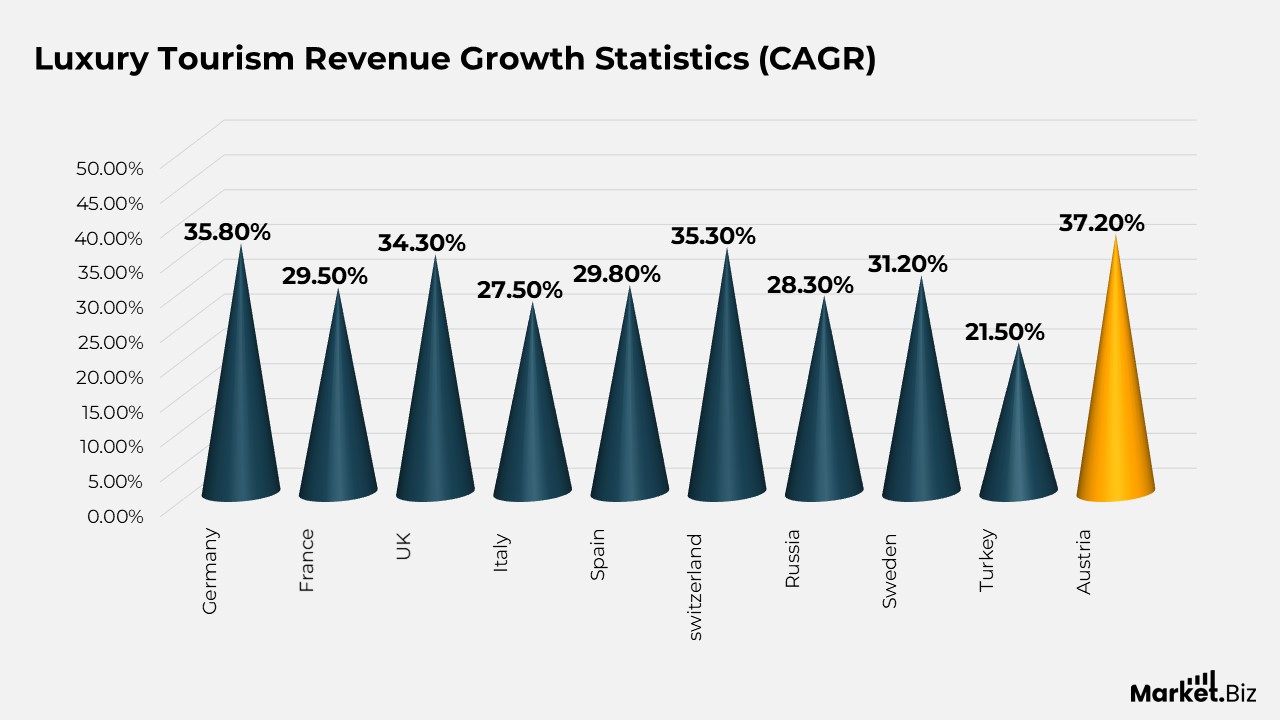
- Germany is anticipated to achieve an impressive CAGR of 35.80% from 2020 to 2024. This is in stark contrast to the modest CAGR of 2.30% projected for the period from 2019 to 2024.
- Similarly, France is forecasted to experience a growth in its luxury tourism revenue at a CAGR of 29.50% during the 2020–2024 timeframe. This is significantly higher than the mere 1.40% expected over the extended 2019-2024 period.
- The United Kingdom is also expected to witness a considerable increase, with a CAGR of 34.30% from 2020 to 2024, a notable rise from just 1% when the year 2019 is included.
- Italy and Spain are projected to have CAGRs of 27.50% and 29.80%, respectively, for the 2020-2024 period, compared to only 0.10% and 3% for the 2019-2024 timeframe.
- Switzerland’s luxury tourism market is expected to grow at a CAGR of 35.30% during the 2020-2024 period, which is significantly higher than the 2% CAGR for the 2019-2024 timeframe.
- In the Russian Federation and Sweden, the expected CAGRs for the 2020-2024 period are 28.30% and 31.20%, respectively. Both figures indicate a substantial increase compared to their 2019-2024 CAGRs of 2.20%.
- Turkey’s luxury tourism sector is projected to grow at a CAGR of 21.50% from 2020 to 2024, which is lower than its 3.90% CAGR for the 2019-2024 period.
- Lastly, Austria is expected to experience the highest growth, with a CAGR of 37.20% during the 2020-2024 period, compared to just 1.90% over the 2019-2024 timeframe.
Luxury Travel Locations Statistics
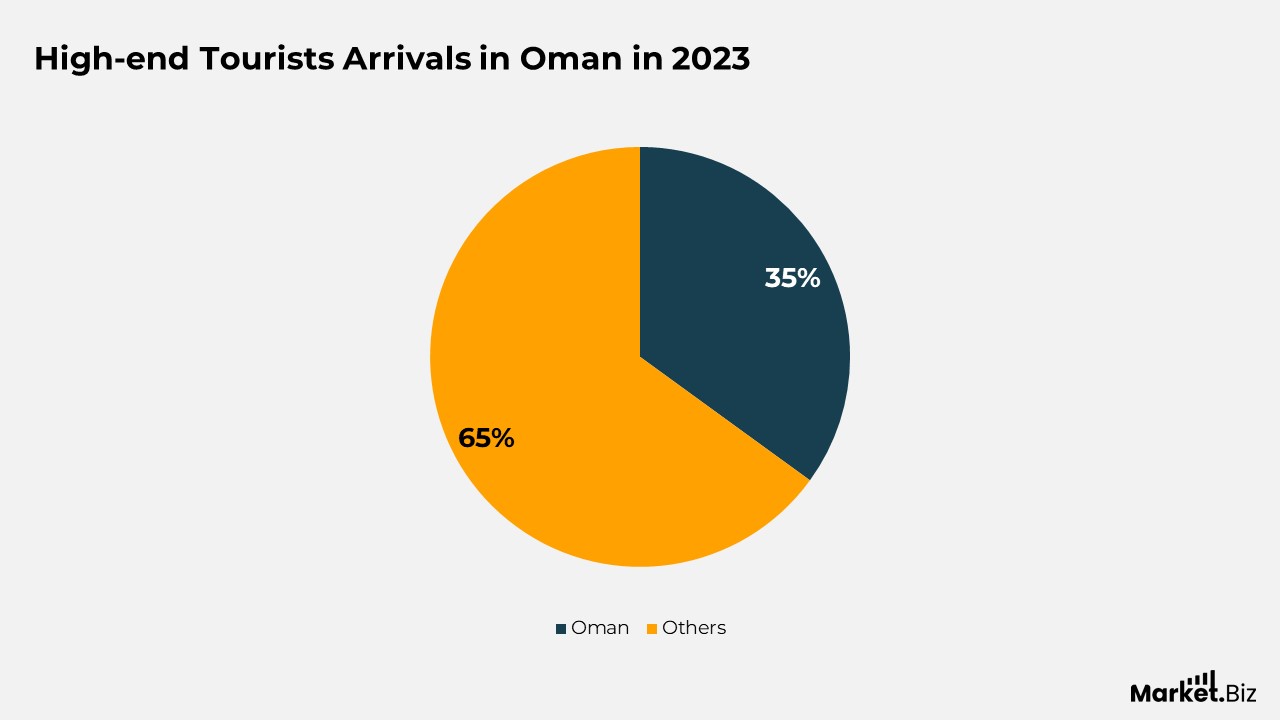
- Oman experienced a 35% rise in high-end tourist arrivals in 2023.
- Rwanda and Bhutan are becoming prominent luxury travel destinations, offering unique experiences and opportunities for cultural immersion. The average cost for Rwanda’s mountain gorilla trekking experience is approximately $15,000 per trip.
- Bhutan is recognized for its cultural immersion and sustainable practices, with an average expenditure of $5,000 per trip.
- Luxury cruises to the Arctic and Antarctic are also witnessing a surge in popularity, with Silversea Cruises reporting a 20% year-on-year increase in bookings.
- Research conducted in 2023 indicates that private islands are gaining traction, with a 45% rise in private island rentals since 2020.
- The Maldives, Belize, Mexico, and Canada are among the most sought-after destinations for luxury travel in 2024.
Mobile Travel Booking Statistics
- In 2023, 68% of online traffic to travel and hospitality websites originated from mobile devices, reflecting a significant demand for enhanced mobile accessibility and booking options.
- While mobile devices account for approximately 60% of online travel traffic, desktop computers represent about 62% of sales. Despite the fact that travellers conduct more research on mobile, they still prefer to use a desktop for making bookings.
- 39% of users would opt for an app instead of a mobile website due to its speed, whereas 30% appreciate the added functionality that a mobile app provides.
- Since 2020, the average online order value for mobile users has increased by 29%.
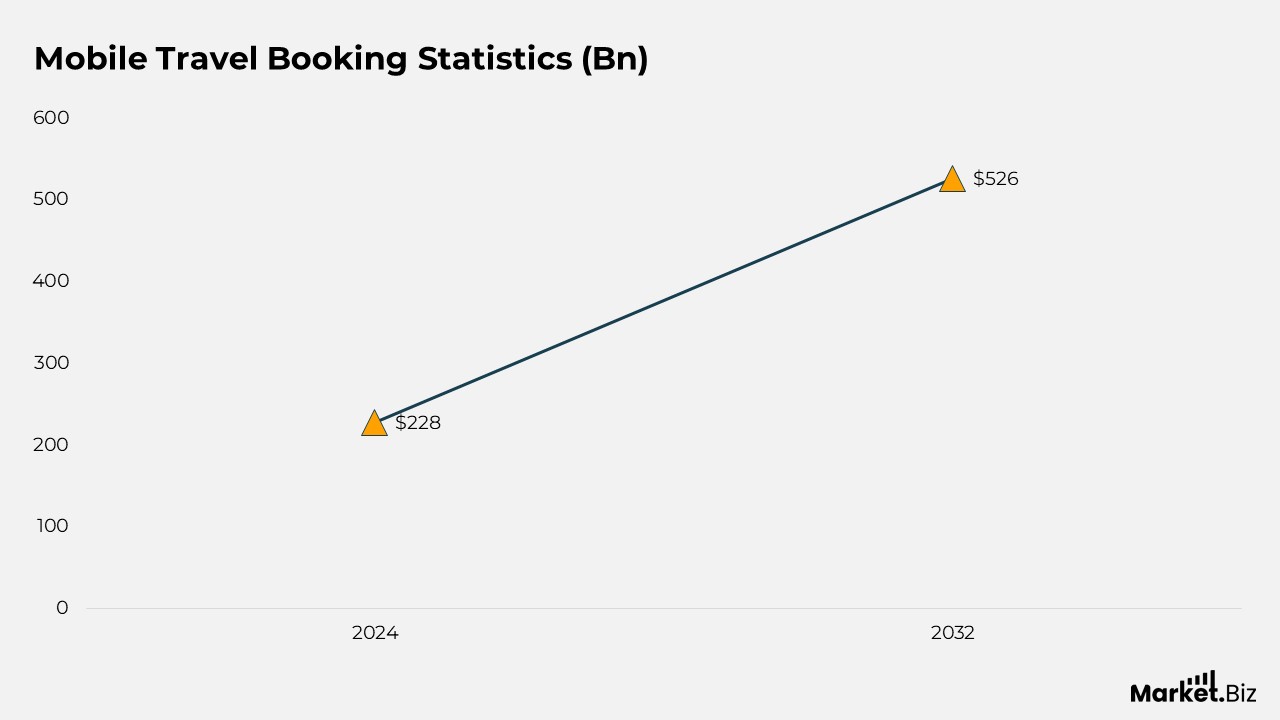
- The mobile travel booking market is esteemed at $228 billion in 2024 and is projected to expand to over $526 billion by 2032.
- In 2020, the disparity between desktop and mobile booking sales was 75%, but by 2022, this gap had narrowed to 40%.
Luxury Travel Bookings Statistics
- In 2012, 36.8% of agents noted an increase in bookings compared to the prior year, whereas 44.8% reported that bookings remained unchanged.
- In the subsequent year, 2013, there was a significant increase in the percentage of agents reporting higher bookings, which reached 46.3%, although the share of agents who noted no change in bookings fell to 39.9%.
- By 2014, the trend experienced a slight shift, with 39.2% of agents indicating an increase in luxury tour bookings, marking a decline from the previous year.
- At the same time, the percentage of agents who reported no change in bookings rose considerably to 50.1%.
Recent Developments
- The interest in sustainable luxury travel is increasing, as more travelers are looking for eco-friendly alternatives. In 2024, it is anticipated that sustainable travel options will expand by 20%.
- In 2025, it is estimated that 40% of luxury travel firms will adopt AI-driven personalization tools to improve customer experiences.
- In 2025, experiential travel is projected to represent 50% of the luxury travel sector, reflecting the increasing demand for meaningful and distinctive travel experiences.
- In March 2024, Four Seasons broadened its portfolio in Mexico with the introduction of the new Cabo Hotel. Residences Cabo San Lucas at Cabo Del Sol and the Four Seasons Resort are scheduled to open their doors to guests in May.
- In May 2025, Singapore Airlines launched its new “Suites Class,” which includes private suites equipped with sliding doors, a 32-inch HD television, and a personal butler. This notable technological advancement in luxury air travel is part of the airline’s strategy to set itself apart and meet the rising demand for premium travel experiences.
Conclusion
Luxury Travel Statistics: Luxury travel has demonstrated significant resilience and adaptability in the face of challenges such as economic fluctuations, sustainability issues, and the COVID-19 pandemic. Affluent travellers persist in their pursuit of personalized, exclusive experiences, with a growing emphasis on sustainability and responsible tourism.
The industry is transforming, influenced by younger travellers who are shaping trends, and destinations that provide authentic, eco-friendly experiences are well-positioned for growth. As the market recovers and expands, luxury travel providers must adjust to evolving consumer expectations. Incorporating new technologies and upholding high service standards will be essential for success in the future.
FAQs
The emerging middle class represents a significant market for luxury travel. This demographic possesses disposable income and seeks to invest it in exclusive experiences. Older Millennials are particularly inclined to allocate their funds towards luxury travel.
The luxury hospitality industry has experienced a robust recovery in the post-pandemic period, driven by a shift in consumer preferences from material possessions to experiential opportunities. This trend is especially evident among high-net-worth individuals (HNWIs) from Gen Z and Millennial generations, who now prioritize immersion, purpose, and authenticity in their travel choices.
25% of Baby Boomers indicate that they spend over $6,000 on average during their travels, in contrast to only 17% of Millennials and 16% of Generation X. Conversely, 32% of Millennials report that they spend $1,000 or less on their travel experiences.