









Introduction
Male and Female Doctor Statistics: Male and female doctors play a crucial role in the medical industry, significantly impacting healthcare across various fields. Traditionally, the profession has been male-dominated, but in recent years, gender dynamics have shifted noticeably. The increasing number of women in healthcare has led to more gender diversity, especially in clinical and leadership roles.
Recent statistics indicate a steady increase in the proportion of female doctors, gradually narrowing the gender gap that once favoured men. However, male doctors continue to dominate in certain fields, particularly those that require physical strength, and maintain a stronger presence in senior leadership positions within healthcare organisations. These shifting gender trends are impacting the future of the medical profession, influencing patient care and the broader structure of healthcare delivery.
Editor’s Choice
- The World Health Organization (WHO) reported that women represent approximately 70% of the global healthcare workforce, although this includes a broad range of healthcare professions, not just medical doctors.
- The financial contribution of women to health systems is estimated to exceed US$3 trillion annually.
- In 2022, the number of female first-year medical students in the U.S. rose slightly to 12,630, making up 55.6% of all first-year medical students in the country.
- In 2022, a total of 51,890 female students were enrolled in U.S. medical schools, accounting for 53.8% of the total medical school enrollment.
- Approximately 43% of all medical school applicants were accepted in 2022, with 13,286 female applicants gaining acceptance. This resulted in an acceptance rate of 42.6% for women, compared to 44% for male applicants.
- The mortality rate for female patients was 8.15% when preserved by female physicians, compared to 8.38% when treated by male doctors.
- For male patients, the mortality rate was 10.15% when treated by female doctors, slightly lower than the 10.23% rate for those treated by male physicians.
(Source: Association of American Medical Colleges, World Health Organization)
Private Nursing Services Market Size
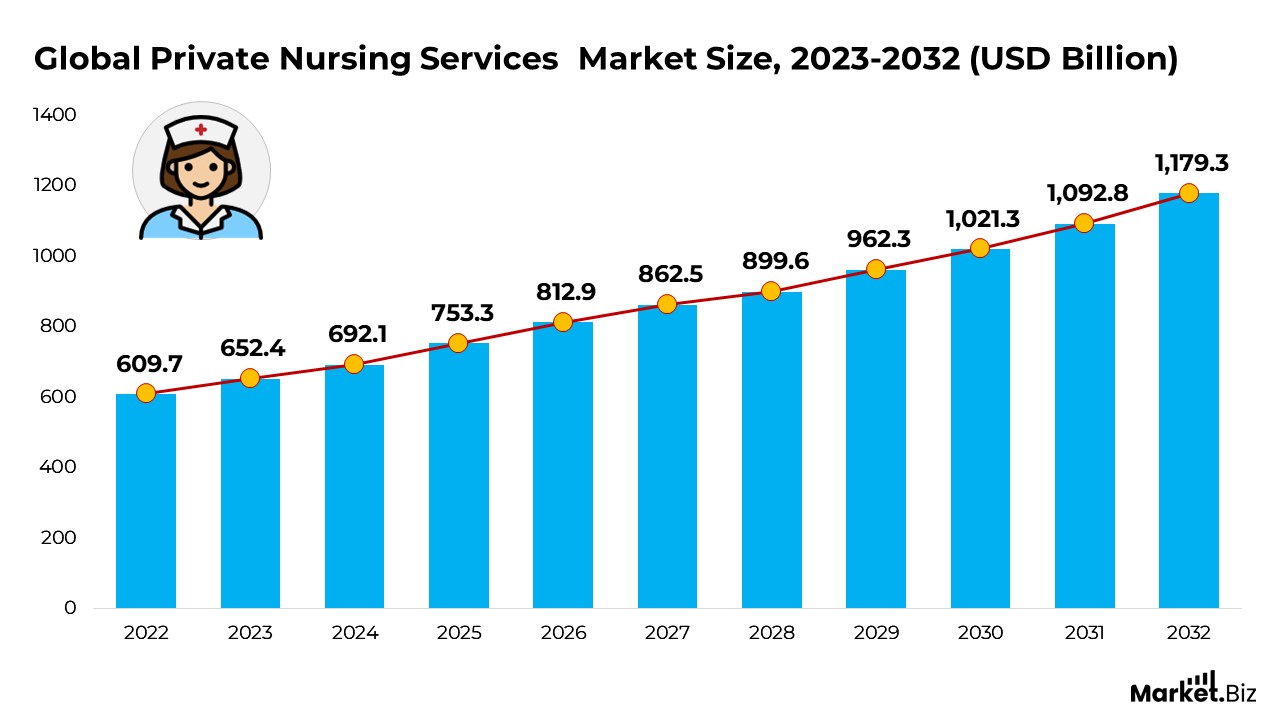
- According to Market.us, the global private nursing services market is projected to grow from $753.3 billion in 2025 to $1,179.3 billion by 2032, representing a compound annual growth rate (CAGR) of 7.0% from 2022 to 2032.
- The market is growing due to the rising aging population and the increasing prevalence of chronic diseases.
- Home healthcare providers lead the service type segment, with Home Health Assistants (HHAs) offering a wide range of services, including medical monitoring, caregiver education, and wound care.
- The female nursing care segment dominates the global private nursing services market, as patients prefer female nurses due to their caring nature and attentiveness, which drives demand for private nursing services.
- North America holds the largest revenue share in the private nursing services market, driven by an ageing population, the prevalence of chronic illnesses, a growing healthcare workforce, and an increase in healthcare services.
(Source: Market.us)
Medical School Graduation and Enrollment Rates for Males and Females
The continuous movement towards a more balanced gender representation in the medical field is evident, with women steadily comprising a larger share of medical students and practising physicians. This increase reflects the broader societal shift toward greater gender equality across various professional industries.
- In the 2024-2025 academic year, women once again constituted the majority of medical school applicants, matriculants, and overall enrollment, marking the 6th consecutive year of this trend.
- In the 2024-2025 academic year, women represented 55% of matriculants, 57% of medical school applicants, and 5% of total enrollment. The percentage of female matriculants saw a slight increase of 0.2% compared to the previous year.
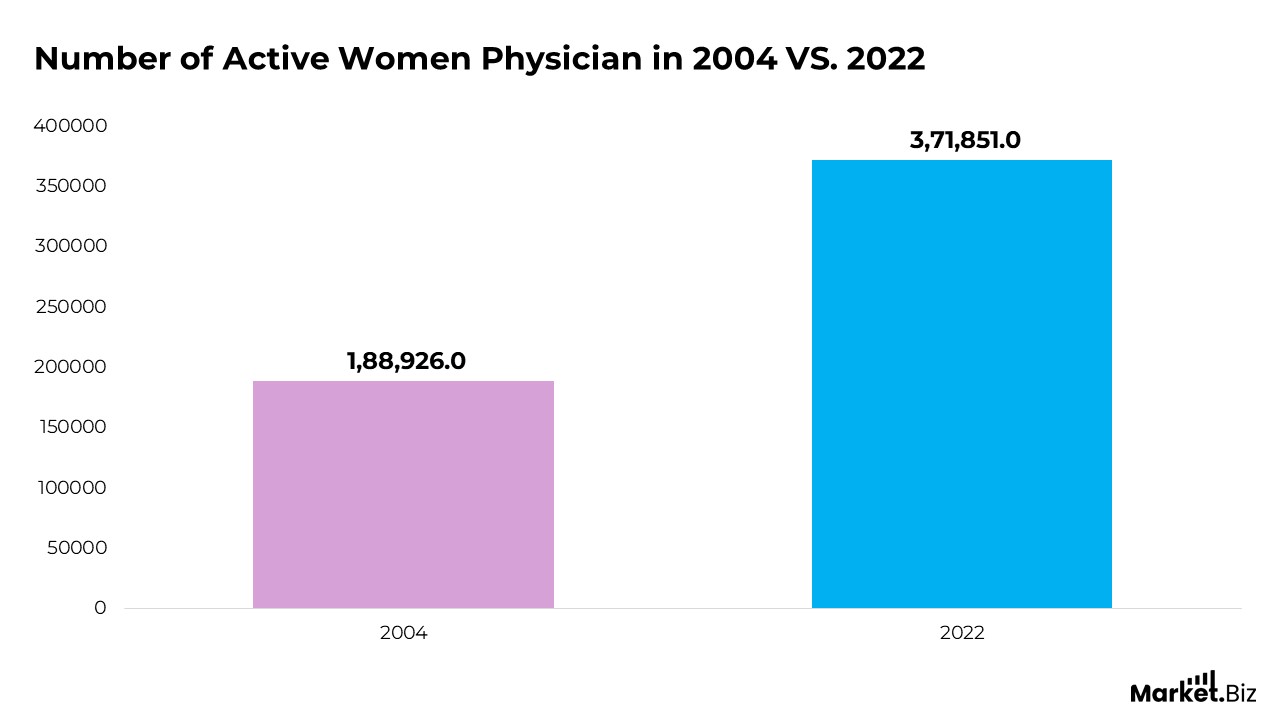
- Between 2004 and 2022, the number of women in the active physician workforce grew by 97%, reaching 371,851 female physicians, representing 38% of the total workforce. This is a significant increase from 26% in 2004, when there were only 188,926 women in practice.
Moreover
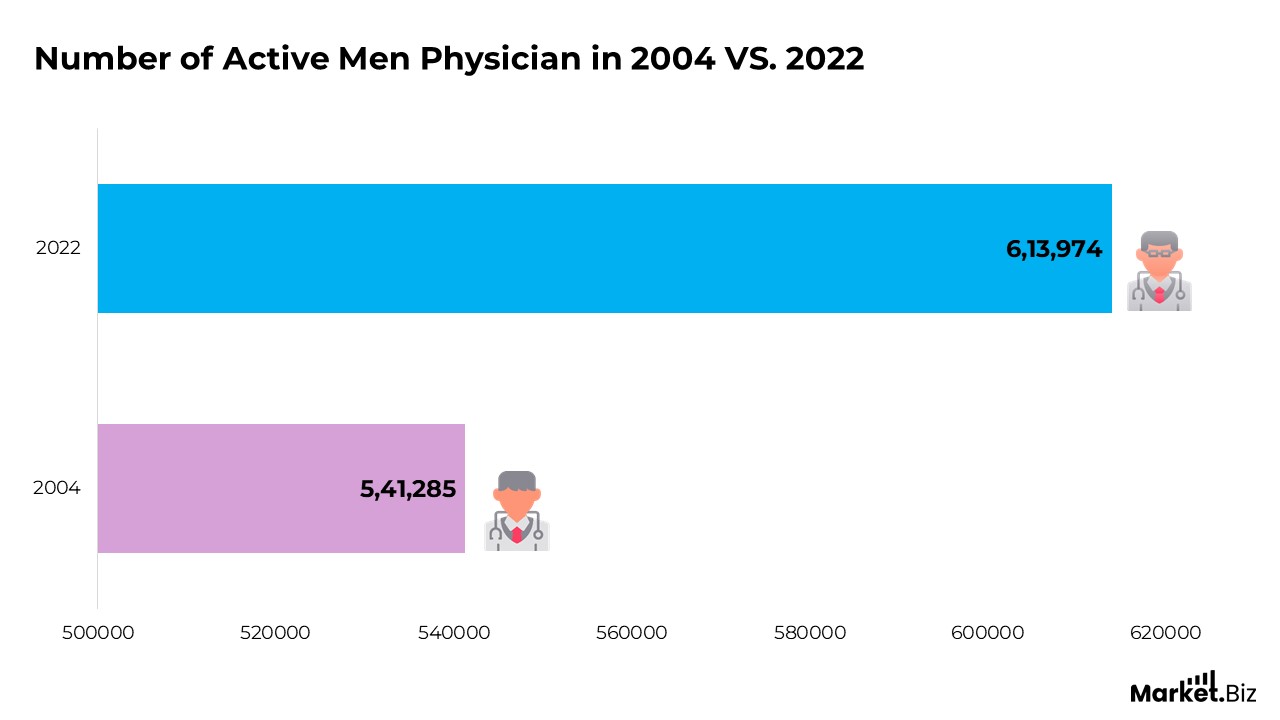
- In contrast, the number of male physicians increased by only 13%, with men accounting for 62% of active physicians in 2022 (613,974). This represents a decline from 74% in 2004 when there were 541,285 male doctors in the field.
- From 2013 to 2022, the percentage of female medical school applicants rose from 46.2% to 56.5%.
- In the 2022-2023 academic year, the number of women applying to medical school exceeded that of men by 13.1%.
- In the 2023-24 academic year, 72% of U.S. medical schools awarded more medical doctor degrees to women than to men.
- In the 2023-24 academic year, out of 193 super-specialist physicians graduating from 11 medical colleges registered under the Maharashtra University of Health Sciences (MUHS), 120 were male and 73 were female.
- During the same year, a total of 1,973 MBBS doctors were listed for postgraduate (PG) courses, including MD/MS, across 48 medical colleges under MUHS.
- Out of these, 1,784 were female doctors, highlighting the significant representation of women in postgraduate medical Education.
(Source: Association of American Medical Colleges, Adtalem Global Education, Inc., World Health Organization, WebMD LLC., Inspira Advantage, Maharashtra University of Health Sciences)
Exploring Gender Trends in Medical Residencies
In 2023, male physicians represented the majority, with several specialties exhibiting a dominant male presence in the resident workforce. These include:
- Orthopedic surgery: 79.6% male
- Interventional radiology (integrated): 77.5% male
- Neurological surgery: 76.2% male
- Radiology-diagnostic: 71.8% male
- Urology: 67.7% male
Residency specialty choice trends among women have remained largely consistent with those of previous years. In specialities with a minimum of 100 active residents, women represent a higher percentage of the resident population in the following fields:
- Obstetrics and gynecology: 87.2% female
- Pediatrics/psychiatry/child and adolescent psychiatry (combined): 75.5% female
- Pediatrics: 73.6% female
- Allergy and immunology: 65.8% female
- Public health and general preventive medicine: 65.2% female
- Dermatology: 61.7% female
(Source: American Medical Association)
Gender Distribution in Medical Specialties
- In cardiology, 82% of doctors are male, with similar proportions of men in gastroenterology and hepatology (73%) and respiratory medicine (63%).
- Overall, 58% of consultants and advanced speciality trainees (years 3-8) are men.
- However, certain large specialities exhibit a more balanced gender distribution, such as geriatric medicine, where women account for 51% of practitioners.
- In total, 5,859 substantive consultants (37% of the roles) and 3,677 higher speciality trainees (51% of these roles) responded.
- The U.S. Physician Workforce Data Dashboard reveals that women comprise only about 17% of cardiologists, making it one of the specialties with the lowest female representation.
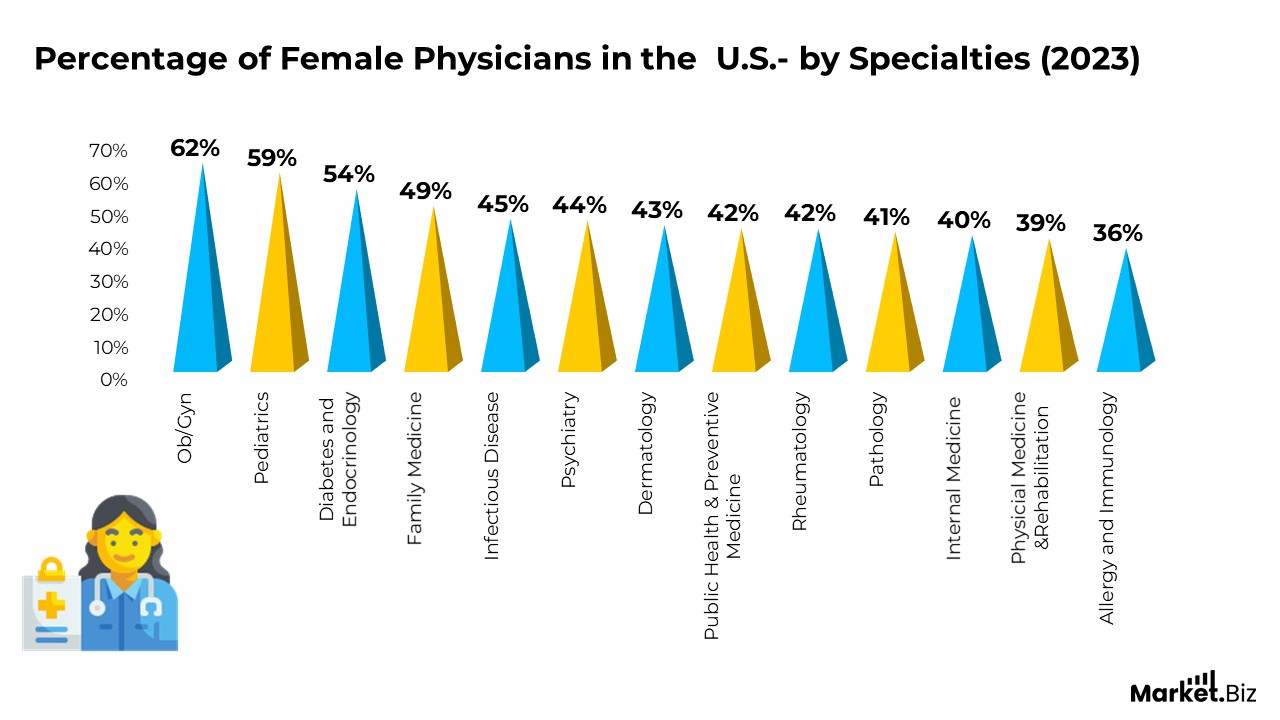
Percentage of Female Physicians in the U.S.- by Specialties
(Source: Royal College of Physicians, The U.S. Physician Workforce Data Dashboard, Statista)
Gender and Specialty Trends Among U.S. First-Year Residents
- The primary care specialties with the largest numbers of first-year residents and fellows in 2023 were internal medicine (10,379), family medicine/general practice (4,456), and pediatrics (2,993).
- Women made up 45.8% of residents and fellows in ACGME-accredited programs. The percentage of women in the top 47 specialities varied, ranging from a high of 83.8% in obstetrics and gynaecology residency programs to a low of 12.9% in sports medicine (orthopaedic surgery) residency programs.
- Between 2014 and 2019, the number of first-year residents and fellows increased in specialties like sports medicine (up by 29.1%) and neurology (up by 25.2%). In contrast, there were significant declines in fields such as ophthalmology (down 10.9%), plastic surgery (down 10.8%), and vascular and interventional radiology (down 10.5%).
(Source: American Association of Medical Colleges)
Global Gender Disparities in Medicine
- As of 2022, 52.8% of physicians in the European Union were women, with countries like Latvia and Estonia reporting over 70% female physicians. In contrast, Cyprus had the highest proportion of male physicians, with 60% of doctors being male.
- In Africa, female physicians represented only 28% of the total physician workforce, while in Europe, 53% of physicians were female, highlighting significant regional gender disparities in the medical profession.
- By 2025, in the United Kingdom, out of the 395,000 registered doctors, 202,000 were men, and 193,000 were women.
- A notable gender gap remained among specialist doctors, with 69,000 male specialists compared to nearly 44,000 female specialists. However, women outnumbered men in general practice, with over 45,000 female GPs compared to nearly 35,000 male GPs.
- For the first time in the UK, female doctors outnumbered their male counterparts, with 164,440 women (50.04%) registered to practice, compared to 164,195 men (49.96%), according to the General Medical Council (GMC).
- As of 2023, 42.7% of active physicians in Canada were women, a proportion that has been steadily increasing. Graduating classes have been predominantly female for the past two decades.
- In the U.S., male physicians outnumber female physicians in most specialties. The exceptions are found in pediatrics, child and adolescent psychiatry, and obstetrics and gynecology, where female physicians are in the majority. In family medicine and general practice, for instance, there were approximately 68,400 male doctors compared to 50,000 female doctors in 2021.
(Source: Eurostat, General Medical Council, Statista, National Institute of Health, Canadian Medical Association)
Work-Life Balance in Female and Male Doctors
- In the U.S., male physicians outnumber female physicians in most specialties. The exceptions are found in pediatrics, child and adolescent psychiatry, and obstetrics and gynecology, where female physicians are in the majority. In family medicine and general practice, for instance, there were approximately 68,400 male doctors compared to 50,000 female doctors in 2021.
- On average, female physicians worked 48.1 hours per week, while male physicians worked 52.2 hours weekly.
- A survey by the Medical Women’s Federation in 2018 found that female doctors in the UK were more likely to work part-time or with reduced hours due to reasons such as family obligations and the desire for better work-life balance. As a result, male doctors tended to work more hours on average.
(Source: Statista, National Institute of Health, JAMA Network, Medical Women Foundation)
Gender Preferences in Doctor Selection
- A survey conducted at four clinics with 185 adult patients found that 45% of respondents had a preference for the gender of their physician. Among them, 12% of men and 43% of women preferred a female physician, while 9% of women and 31% of men preferred a male physician.
- The preference for male physicians among female patients varies significantly, with figures ranging from 11% to 75%. Studies suggest that between 16% and 34% of women prefer a female physician. It has also been noted that women under the age of 20 are more likely to prefer female doctors.
(Source: Gale Academic, Research Gate, National Institute of Health )
Earnings of Male and Female Doctors
- According to 2021 data from the National Institute of Health, over a simulated 40-year career, male physicians earned an average adjusted gross income of $8,307,327, while female physicians earned $6,263,446 on average. This resulted in an adjusted earnings difference of $2,043,881, representing 24.6% of the total.
- The largest gender earnings gap was observed in surgical specialties, where male surgeons earned $2.5 million more than their female counterparts. The gap was also significant among nonsurgical specialists ($1.6 million difference) and primary care physicians ($0.9 million difference).
- On average, female physicians in the U.S. were estimated to earn over $2 million less than male physicians throughout their careers.
- A 2024 survey found that female primary care physicians in the U.S. earned an annual compensation of $253,000. While male primary care physicians earned $295,000, illustrating a gender pay gap.
- The pay gap was even wider among specialists, with female specialists earning, on average, over $100,000 less than their male counterparts.
Salaries of Doctors all over the world (in 1,000 U.S. Dollars)
| Country | Male | Female |
|---|---|---|
| Portugal | 55 | 34 |
| Brazil | 55 | 36 |
| France | 104 | 73 |
| Germany | 176 | 121 |
| Argentina | 24 | 17 |
| Italy | 72 | 51 |
| Canada | 303 | 219 |
| The U.S. | 386 | 300 |
| U.K. | 129 | 102 |
| Spain | 64 | 54 |
| Mexico | 20 | 17 |
(Source: Statista, National Institute of Health )
Female Empowerment Programs and Initiatives
- In June 2024, the Biotechnology Industry Research Assistance Council, supported by the Ministry of Science and Technology, Department of Biotechnology, Government of India, and the Bill & Melinda Gates Foundation, in collaboration with WomenLift Health, launched the inaugural 2024 Women Leadership in STEM (WLS) program to promote gender equality in STEM leadership across India.
- In March 2024, Wockhardt Hospitals Group conducted the “I Am Fearless” campaign on International Women’s Day. Featuring awareness workshops on Obstetrics and Gynecology, as well as Breast Cancer, led by in-house specialist doctors to empower women.
- In February 2024, IAVI and WomenLift Health signed a Memorandum of Understanding to promote gender equity, mentorship, and training, aiming to expand the power and influence of women in science.
- A group of medical students at Washington University School of Medicine in St. Louis launched a new initiative, “500 Women in Medicine.” The initiative was founded by Jane Hayes, Iris Kuo, Kate Gerull, Maren Loe, and Tamara Sanchez-Ortiz to unite and connect female physicians both nationally and internationally. It aims to empower women to reach their full potential in medicine and advocate for gender and health equity.
Conclusion
Male and Female Doctor Statistics: Gender disparities continue to exist in the medical profession across various dimensions, such as career earnings, specialty selection, and overall representation. Although the number of female physicians is steadily increasing, particularly in primary care and certain other specialities, notable gaps still exist in areas such as compensation and leadership positions. Male physicians continue to dominate higher-paying specialities, such as surgery and cardiology, where the earnings disparity remains significant.
However, efforts to promote gender equality through mentorship, leadership development, and targeted initiatives for women in the medical field are gaining traction. These initiatives are crucial to promoting a more inclusive medical field, ensuring equal opportunities for both male and female doctors to thrive and excel. Addressing these disparities will not only support individual professionals but will also lead to more equitable healthcare outcomes worldwide.
FAQ’s
Yes, male physicians dominate several high-paying and physically demanding specialities, including cardiology, surgery, and gastroenterology. For instance, 82% of cardiologists are male, whereas specialities such as obstetrics and gynaecology tend to have a higher proportion of female physicians.
The gender pay gap in medicine is driven by factors such as the underrepresentation of women in high-paying specialities, differences in work hours, and career interruptions due to family obligations. Additionally, women are more likely to work part-time or take career breaks, which affects their overall earnings.
Yes, studies show that female doctors are more inclined to work part-time or opt for flexible working hours due to family commitments and the need for better work-life balance. This contributes to the gender pay gap, as part-time positions typically result in lower earnings than full-time roles.
To address gender disparities, several initiatives are being introduced, including mentorship programs, leadership development opportunities for women, and advocacy for equal pay and better opportunities in specialities where women are underrepresented. These efforts are essential in achieving gender equality in the medical profession.