








Introduction
Sportswear Statistics: The estimated size of the global sportswear market was USD 335.92 billion in 2023, with projections indicating it will reach USD 646.01 billion by 2030, reflecting a compound annual growth rate (CAGR) of 9.9% from 2024 to 2030. This global market is influenced by various factors, including an increase in health awareness, a rise in participation in sports and fitness activities, and the growing popularity of sports apparel, which is often worn in casual environments.
Sportswear refers to casual attire designed for comfort and athletic activities. It is intended for use during exercise or sports participation. Examples of sportswear include tracksuits, T-shirts, hoodies, shorts, polo shirts, and swimsuits. These garments are typically lightweight, allowing for unrestricted movement. For specific activities, such as cycling, it is essential that sportswear does not create drag or impede speed. Flexibility is a crucial characteristic of sportswear, enabling the body to move freely.
Certain sports, such as karate, necessitate a specific uniform known as a keikogi. Additionally, high-intensity sports like American football or ice hockey require protective equipment to ensure the safety of athletes. Individuals don sportswear for various activities, including jogging, biking, golfing, hiking, tennis, cricket, football, and basketball.
Editor’s Choice
- The global sportswear market is anticipated to generate USD 855.3 billion in revenue by the year 2033.
- According to Sportswear Statistics, approximately 53% of individuals indicated that comfort was their top priority.
- From 2028 to 2033, the market is expected to experience even more rapid growth.
- In 2022, the global sportswear market displayed a varied regional distribution of market share, with North America significantly leading at 45.0%.
- By the end of 2025, the market size is projected to further increase to USD 379.56 billion, followed by USD 402.05 billion in 2026.
- The global market for women’s sportswear has exhibited a variable yet mostly positive trajectory since 2018, and it is anticipated to maintain its growth through 2027.
- In 2024, a survey conducted among Generation Z in the UK revealed that Adidas was the most well-known sportswear brand, with 95% of participants being familiar with it.
- New Era had 37% of users, and Umbra to 32%.
- From 2019 to 2029, it is expected that the average price per unit for both men’s and women’s performance sports apparel in the United States will see a gradual rise.
General Sportswear Statistics
- The global sportswear market is anticipated to generate USD 855.3 billion in revenue by the year 2033.
- The sports apparel sector is expected to achieve USD 293.73 billion by 2030, while the activewear segment is projected to reach USD 451.1 billion by 2028.
- As of 2024, Nike, Inc. holds the leading position in the global sportswear market, valued at USD 150.24 billion. This underscores its robust standing in athletic apparel, footwear, and accessories.
- In 2021, when U.S. consumers purchased sporting goods such as sportswear, footwear, and equipment, comfort emerged as the primary consideration.
- According to Sportswear Statistics, approximately 53% of individuals indicated that comfort was their top priority.
- By January 2024, in China, the majority of consumers purchased sportswear for gym workouts, with 56.18% citing this as their main motivation for buying.
- In France, the Anti-waste and Circular Economy Law mandates that sportswear labels provide clearer information regarding recyclability, the use of recycled materials, and the presence of harmful substances.
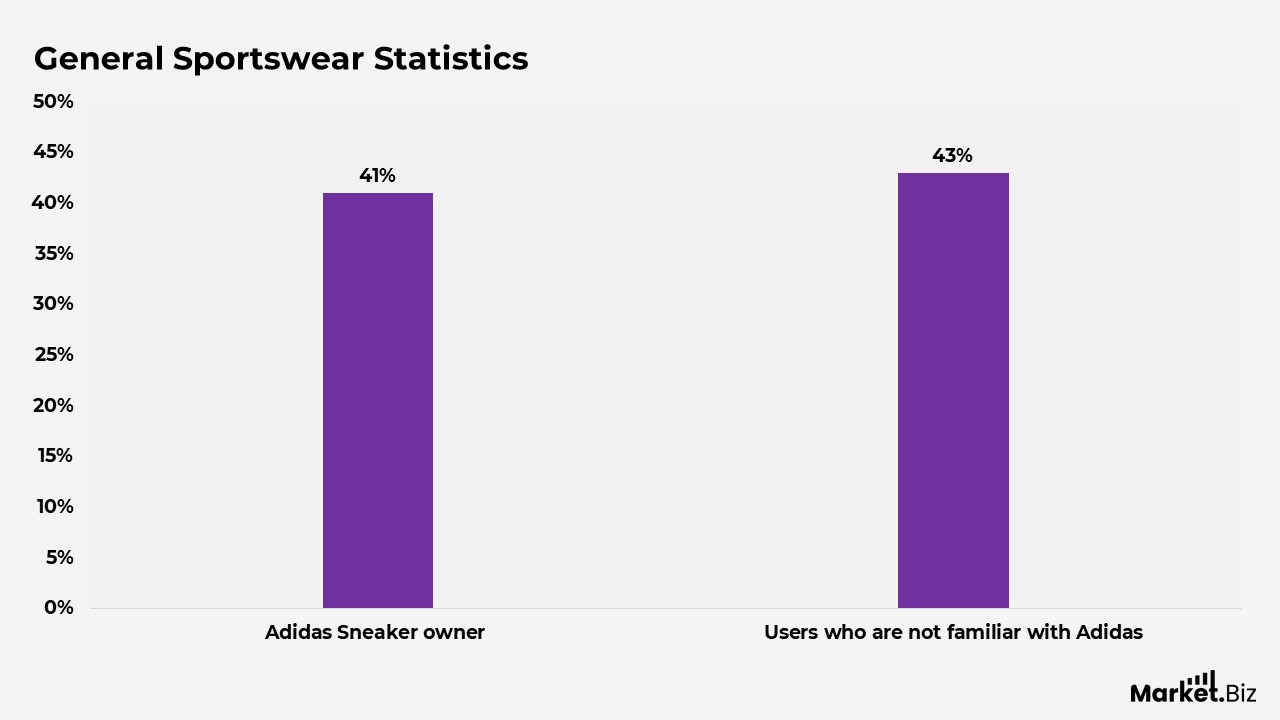
- Adidas accounts for sneaker owners, holds 41% of the sneaker market in the U.S., and this figure rises to 43% among those familiar with the brand.
- As of 2024, the company employs 83,700 individuals globally. In 2020, its valuation exceeded $32 billion, establishing it as the most valuable brand in the sports industry.
- The global women’s sportswear market is projected to witness significant growth during the forecast period.
- Sportswear Statistics noted that Athleisure sportswear, which merges functionality with style, has become increasingly popular among women across all age demographics.
- The evolving lifestyle, rising disposable income, and heightened health consciousness are contributing to the growing demand for women’s sportswear worldwide.
Sportswear Market Growth
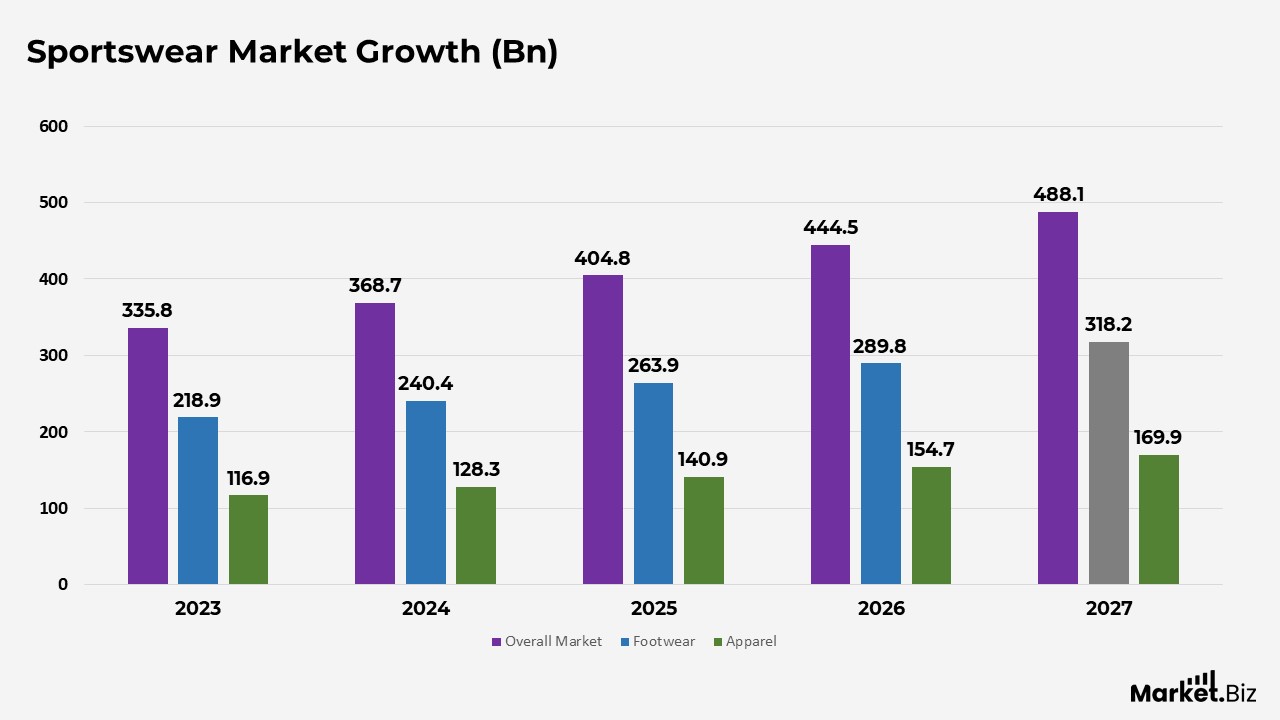
- From 2023 to 2027, a significant growth is anticipated in the global sportswear market, encompassing both footwear and apparel.
- In 2023, the overall market valuation stands at $335.8 billion, with footwear accounting for $218.9 billion and apparel for $116.9 billion.
- In 2024, the market is projected to rise to $368.7 billion, with footwear valued at $240.4 billion and apparel at $128.3 billion.
- The growth trajectory continues, as by the end of 2025, the market is expected to reach $404.8 billion, with footwear at $263.9 billion and apparel at $140.9 billion.
- Further growth is anticipated, and by 2026, the market is expected to attain $444.5 billion, with footwear at $289.8 billion and apparel at $154.7 billion.
- In 2027, the market is projected to be $488.1 billion, with footwear at $318.2 billion and apparel at $169.9 billion.
- From 2028 to 2033, the market is expected to experience even more rapid growth.
- By 2028, it is anticipated to reach $535.9 billion, with footwear at $349.4 billion and apparel at $186.5 billion. By 2029, the market is forecasted to achieve $588.4 billion, with footwear at $383.6 billion and apparel at $204.8 billion.
- In 2030, the market is expected to grow to $646.1 billion, with footwear at $421.3 billion and apparel at $224.8 billion.
- By 2031, it is projected to reach $709.4 billion, with footwear at $462.5 billion and apparel at $246.9 billion.
- By 2032, the market is expected to be valued at $778.9 billion, with footwear at $507.8 billion and apparel at $271.1 billion.
- Finally, in 2033, the market is anticipated to reach $855.3 billion, with footwear at $557.7 billion and apparel at $297.6 billion.
Sportswear Market Growth by Region Statistics
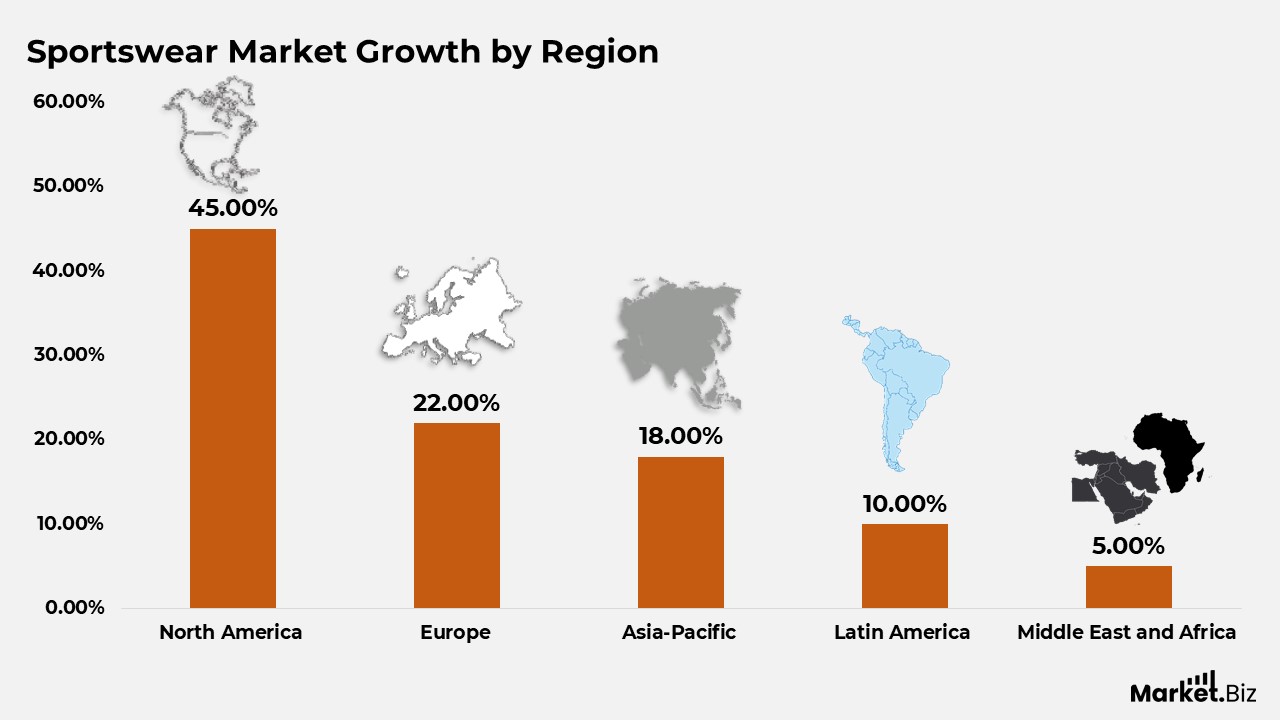
- In 2022, the global sportswear market displayed a varied regional distribution of market share, with North America significantly leading at 45.0%.
- This dominance illustrates the region’s strong consumer base and preference for active lifestyles, along with the presence of major global brands.
- Europe follows, representing 22.0% of the market share, indicative of the region’s established demand for sportswear and the impact of athleisure trends.
- The Asia-Pacific (APAC) region holds an 18.0% share, driven by increasing health consciousness and a growing interest in sports and fitness, especially in emerging economies.
- Latin America accounts for 10.0% of the market, demonstrating steady growth as consumer interest in sportswear rises across various segments.
- The Middle East and Africa (MEA) region, holding a 5.0% share, rounds out the distribution, indicating a smaller but steadily growing market as awareness of fitness and involvement in sports rises.
Global Active Wear Market Size
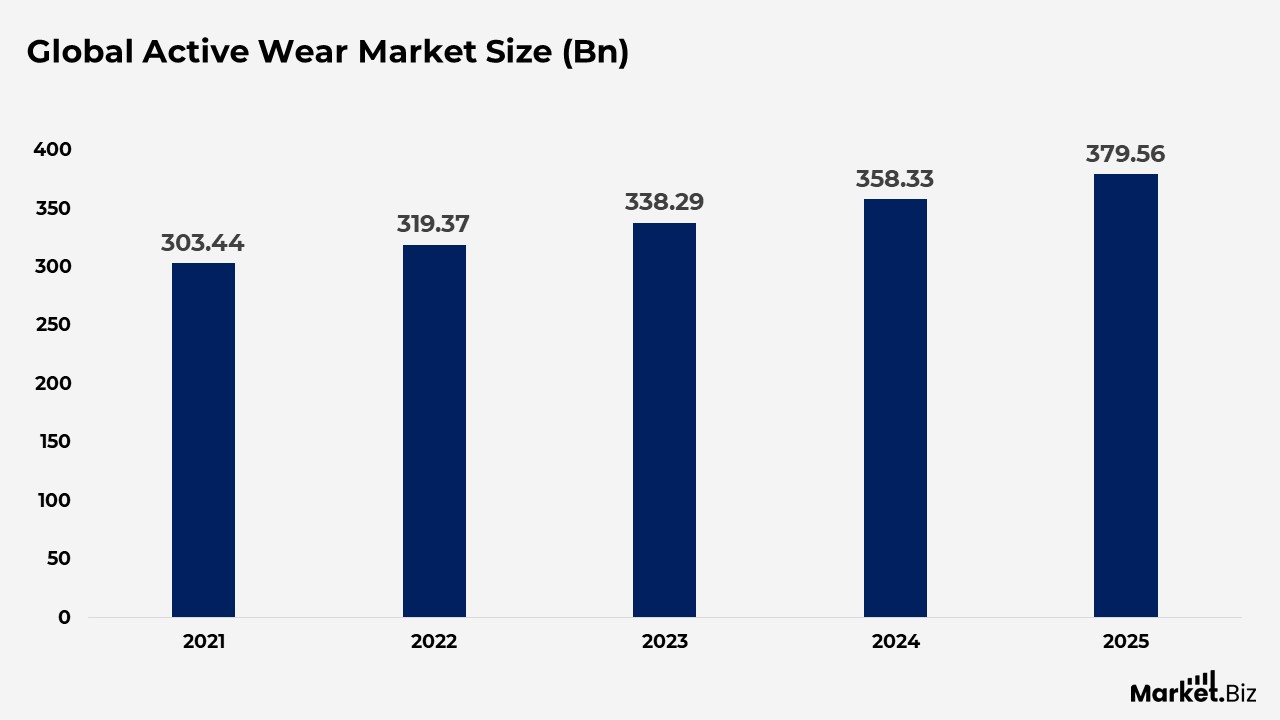
- The global active wear market has been witnessing steady growth since 2021 and is expected to maintain this upward trajectory until 2028.
- In 2021, the market was valued at USD 303.44 billion, which rose to USD 319.37 billion in 2022.
- This growth pattern is predicted to continue, with the market anticipated to reach approximately USD 338.29 billion in 2023 and USD 358.33 billion in 2024.
- By the end of 2025, the market size is projected to further increase to USD 379.56 billion, followed by USD 402.05 billion in 2026.
- By 2027, the active wear market is forecasted to attain USD 425.87 billion, culminating in an estimated valuation of USD 451.1 billion by 2028.
Women’s Sportswear Market Statistics
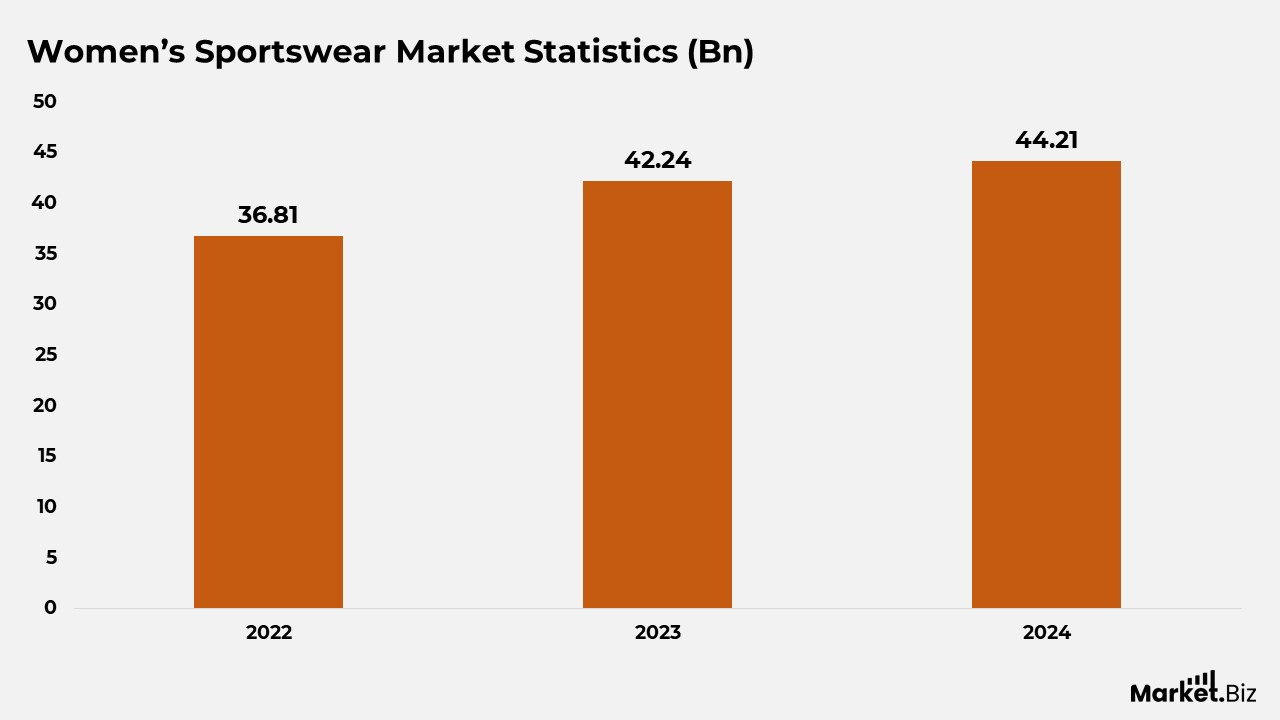
- The global market for women’s sportswear has exhibited a variable yet mostly positive trajectory since 2018, and it is anticipated to maintain its growth through 2027.
- In 2018, the market was assessed at USD 34.82 billion, with a slight increase to USD 35.55 billion in 2019.
- Nevertheless, in 2020, the market faced a downturn, dropping to USD 32.73 billion, likely due to global disruptions.
- A recovery commenced in 2021, with the market size reaching USD 36.7 billion, followed by a modest rise to USD 36.81 billion in 2022.
- Significant expansion is expected in the forthcoming years, with projections indicating the market will attain USD 42.24 billion in 2023 and continue to grow to USD 44.21 billion in 2024.
- By 2025, the valuation of the women’s sportswear market is anticipated to reach USD 46.1 billion, further increasing to USD 47.92 billion in 2026.
- The projected market size for 2027 stands at USD 49.67 billion, reflecting a sustained demand for women’s sports apparel.
Top Sportswear Brands
Nike
At the forefront of the rankings for the chosen sportswear brands is the multinational corporation Nike. Celebrated for its collaborations with prominent athletes, the brand achieved $366M in MIV® through 142K placements from August to September 2022.
Adidas
Ranking second among the ten major sportswear brands featured in this report, Adidas amassed $347M in Media Impact Value™ across 106K placements during the period from August to September 2022.
New Balance
Initially established as an orthopaedic footwear company aimed at providing customers with improved “balance” and support, New Balance now confidently occupies the third position in the rankings of selected sportswear brands. With a total of $79.8M in MIV® from 36.4K placements between August and September 2022, it is noteworthy that the Media Voice played a significant role, contributing $50.5M, which accounts for more than half of the total Media Impact Value™.
Puma
Similar to Nike, Puma has effectively showcased the benefits of partnering with reputable high-profile athletes. Notably, Neymar Jr’s Instagram post generated $1.01M in MIV® for Puma, while Usain St. Leo Bolt’s Instagram reel also achieved a remarkable $384K in MIV®.
Sportswear Brands Statistics Amongst Gen Z
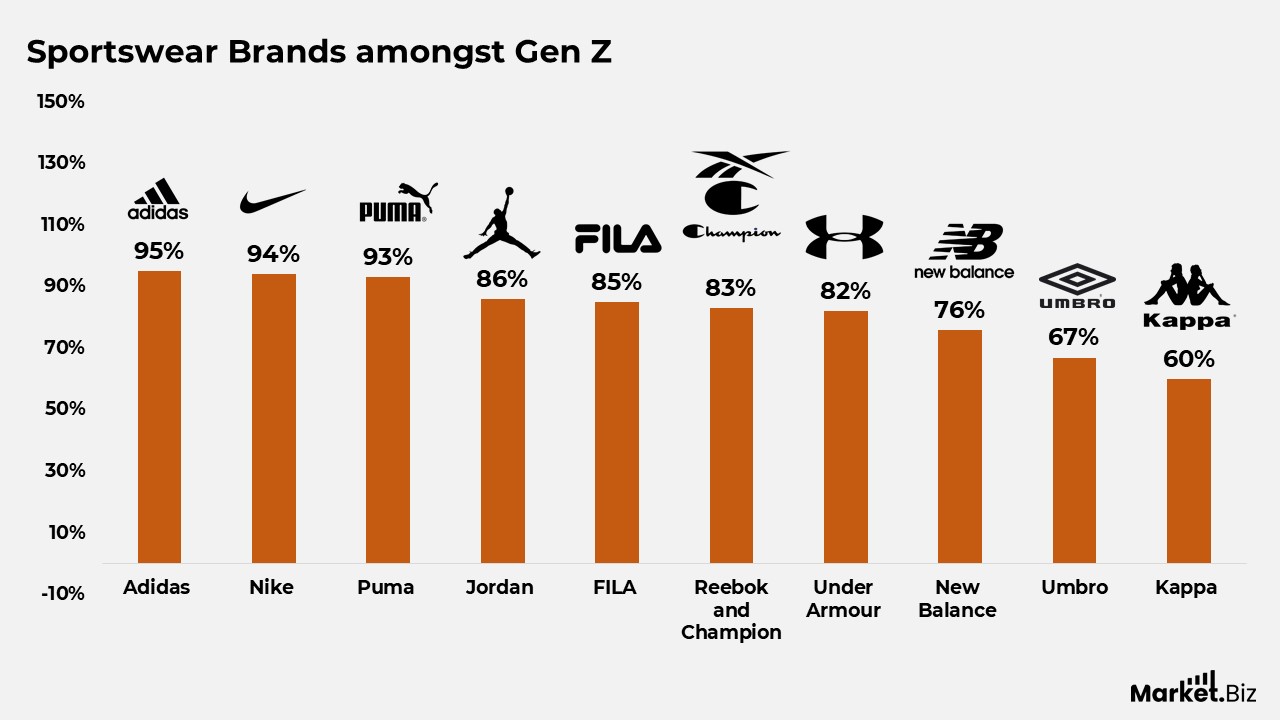
- In 2024, a survey conducted among Generation Z in the UK revealed that Adidas was the most well-known sportswear brand, with 95% of participants being familiar with it.
- Nike followed closely in second place, recognized by 94% of respondents, while Puma was acknowledged by 93%.
- Other brands that demonstrated strong recognition included Jordan at 86%, FILA at 85%, and both Reebok and Champion, each known by 83%.
- Under Armour was known by 82%, and New Balance had a recognition rate of 76%.
- Umbro was familiar to 67% of those surveyed, whereas Kappa achieved a recognition rate of 60%.
- Brands such as ASICS, Decathlon, and Speedo were known by 52%, 55%, and 52%, respectively.
- Wilson had the lowest recognition rate at 37%, while New Era and Hummel were both recognized by 30%.
- Other brands, including ARENA, Callaway, and Mizuno, had appreciation rates of 28%, 29%, and 27%, respectively.
- Significantly, every respondent recognized at least one brand, indicating that no one was entirely unfamiliar with all of them. This highlights that Nike and Adidas are the most projecting brands among Generation Z in the UK, while various global brands and niche sportswear brands also enjoy considerable awareness.
Sportswear Brand Trends Statistics
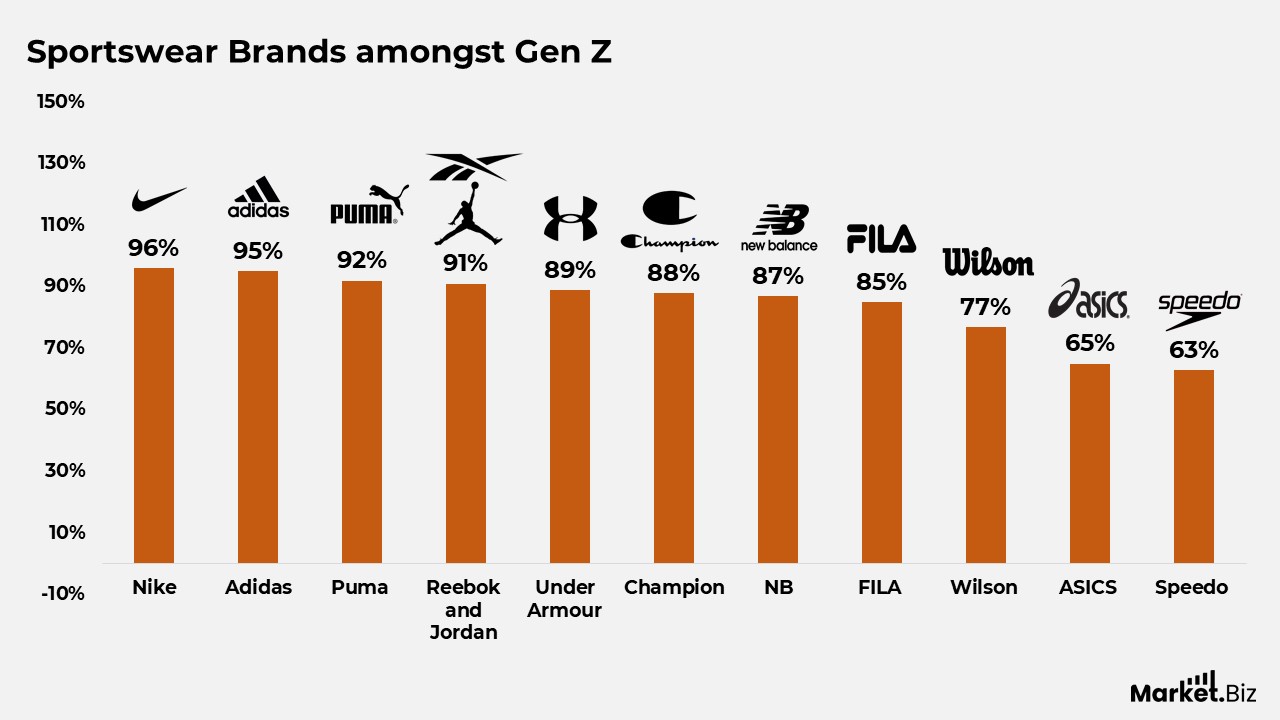
- In 2024, the leading sportswear brands in the United States saw Nike dominate brand awareness, recognized by 96% of respondents, closely trailed by Adidas at 95%.
- Puma maintained a robust position with 92% awareness, while both Reebok and Jordan were acknowledged by 91% of those surveyed.
- Under Armour and Champion also demonstrated significant awareness levels, at 88% and 89%, respectively.
- New Balance was recognized by 87% of users, and FILA had a responsiveness rate of 85%.
- Wilson garnered a notable 77% recognition, whereas Speedo and ASICS were known to 63% and 65% of respondents, respectively.
- Lower awareness levels were noted for Russell Athletic (45%) and Titleist (44%), followed by Callaway with 41% awareness.
- New Era had 37% of users, and Umbra to 32%.
- Decathlon, ARENA, and Kappa recorded the lowest awareness levels among the top brands, with recognition rates of 18%, 20%, and 27%, respectively.
Sales Statistics of Sportswear Companies
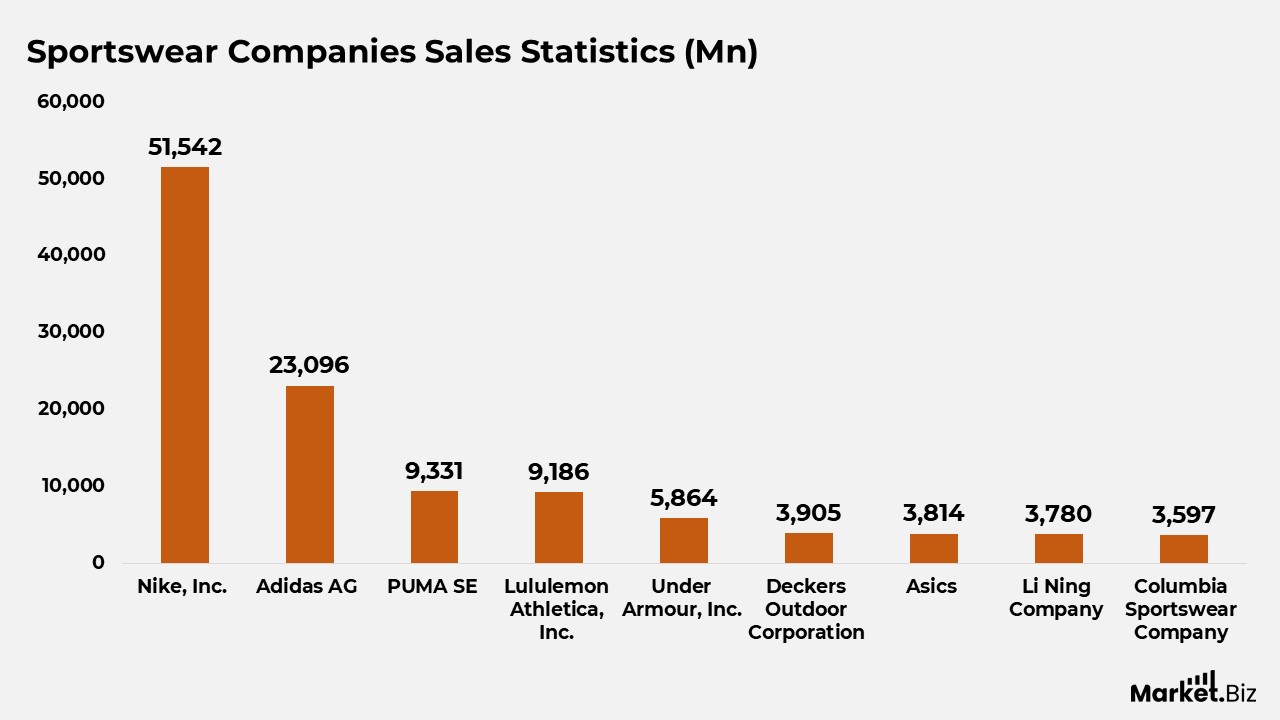
- In 2023, Nike, Inc. dominated the global market for athletic apparel, accessories, and footwear, achieving sales of USD 51,542 million. This underscores its status as the leading entity in the industry.
- Adidas AG ranked as the second-largest firm, with sales amounting to USD 23,096 million, demonstrating its significant presence in the market.
- Lululemon Athletica, Inc. and PUMA SE both reported comparable sales figures of USD 9,186 million and USD 9,331 million, respectively, highlighting their robust performance in the sector.
- Under Armour, Inc. recorded sales of USD 5,864 million, establishing itself as a notable competitor in the industry.
- Deckers Outdoor Corporation and Li Ning Company posted sales of USD 3,905 million and USD 3,780 million, respectively, indicating their increasing impact in the global market.
- Columbia Sportswear Company followed with sales of USD 3,597 million, while Asics achieved sales of USD 3,814 million, reflecting its consistent demand among consumers.
- FILA Holdings Corporation and Gildan Activewear reported sales of USD 3,077 million and USD 3,133 million, respectively.
Sportswear Price Statistics
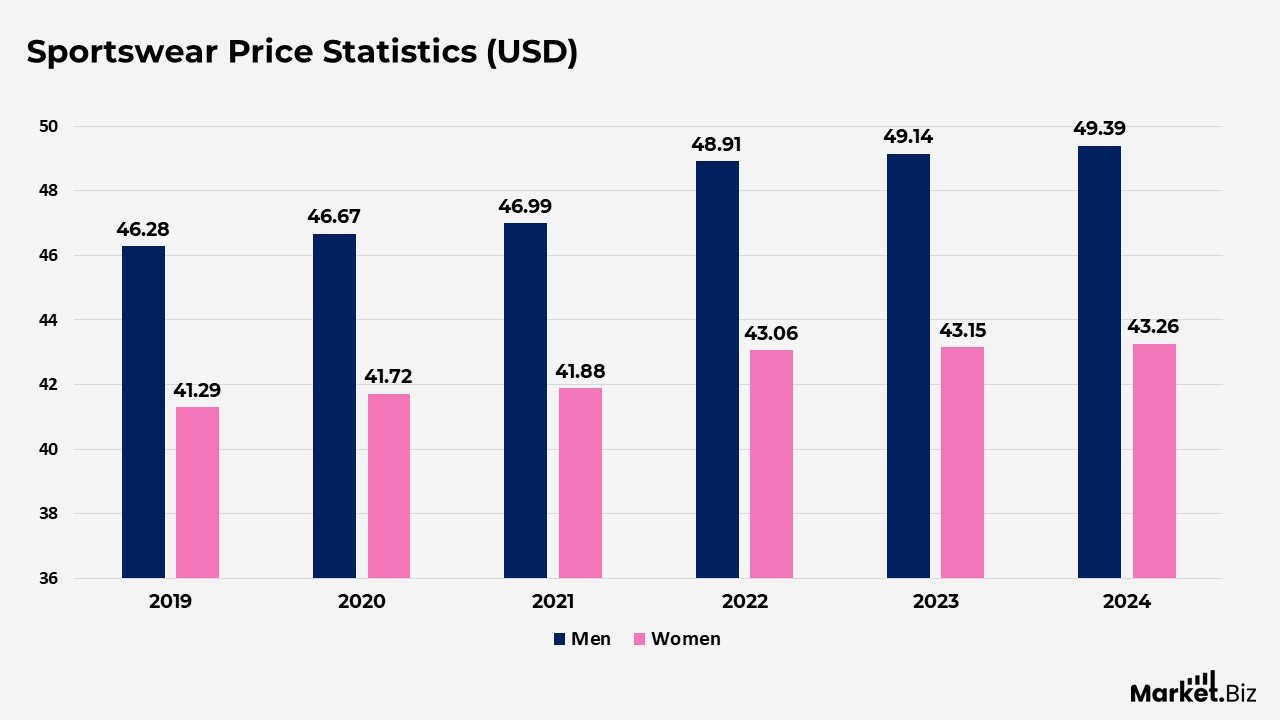
- From 2019 to 2029, it is expected that the average price per unit for both men’s and women’s performance sports apparel in the United States will see a gradual rise.
- In 2019, the average price for men’s performance apparel was USD 46.28, while for women, it was USD 41.29.
- The prices showed slight annual increases, with men’s performance apparel rising to USD 46.67 in 2020 and USD 46.99 in 2021. Likewise, women’s apparel increased to USD 41.72 and USD 41.88 during the same years.
- In 2022, the average price for men’s show apparel jumped to USD 48.91 and continued to grow to USD 49.14 in 2023. Women’s apparel followed a similar path, reaching USD 43.06 in 2022 and USD 43.15 in 2023.
- This upward trend is expected to continue, with men’s show apparel expected to reach USD 49.39 in 2024 and USD 49.87 by 2026. Conversely, women’s apparel is anticipated to rise to USD 43.26 in 2024 and USD 43.48 in 2026.
- By the end of the forecast period in 2029, the average price for men’s show apparel is anticipated to hit USD 50.47, while women’s performance apparel is expected to increase to USD 43.74.
Gym Apparel Statistics
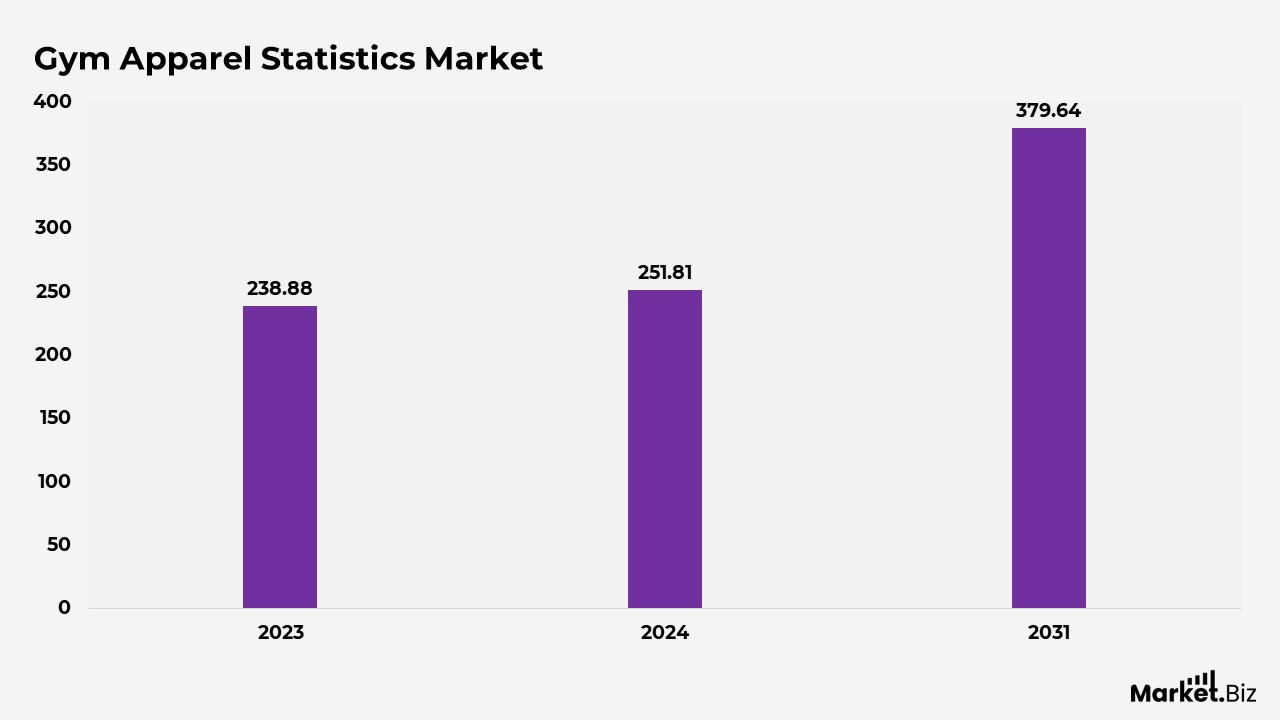
- The global gym apparel market was valued at $238.88 billion in 2023 and is projected to expand to $251.81 billion in 2024, ultimately reaching $379.64 billion by 2031.
- This growth signifies an annual increase of 6.04% from 2024 to 2031. The market’s expansion is attributed to the rising popularity of athleisure fashion and a growing emphasis on health and fitness.
- The report includes brands such as Nike, New Balance, Adidas, Puma, Columbia Sportswear, Gymshark, FILA, MASSBRO SPORTS, ASICS India, and Under Armour, among others.
- Additionally, the gym apparel market is experiencing a significant transition towards eco-friendly and sustainable materials.
- In response to this demand, brands are incorporating materials like organic cotton, recycled polyester, and bamboo, providing consumers with an environmentally friendly alternative to conventional synthetic fabrics.
- This trend presents companies with an opportunity to differentiate themselves by appealing to environmentally conscious consumers.
- The gym apparel market is categorized into various segments based on product type, material, end users, and geographical regions.
Moreover
- Regarding product type, the market encompasses shirts, pants, shorts, tank tops, and more. In 2023, pants constituted the largest share at 41.05%, as they are favored for their versatility across different fitness activities.
- In 2023, polyester emerged as the leading material, generating USD 91.96 billion in sales, owing to its strength, lightweight nature, and durability during rigorous physical activities.
- The market is also segmented by end users: men, women, and unisex. The unisex category is anticipated to experience the fastest growth, with a projected annual growth rate (CAGR) of 7.87%. This trend reflects a growing demand for gender-neutral clothing that can be worn by anyone, indicating a shift towards more inclusive fashion.
- In 2023, the Asia-Pacific region captured a significant portion of the market, accounting for 36.25% and valued at USD 86.59 billion.
- Countries such as China, India, Japan, and South Korea are at the forefront of this growth as their middle class increasingly prioritizes health and fitness.
Recent Developments
- In June 2024, Reebok launched its inaugural pickleball shoe, the Nano Court. This shoe is specifically designed for sports, including pickleball, padel, and tennis, emphasizing grip, stability, and durability.
- It boasts Flexweave Pro uppers, which feature Reebok’s most robust Flexweave knit to date, along with zoned stability yarns that offer targeted support.
- Moreover, the shoe is equipped with a ToeTection Guard at the toe box to enhance durability, and a 360 Comfort Booty anatomical upper construction to ensure a secure fit.
- In June 2024, Stack Athletics, a prominent brand in performance apparel specifically for pickleball, revealed its summer 2024 performance collection aimed at pickleball enthusiasts.
- This collection showcases new colors, patterns, and items that incorporate innovative technology, including the Women’s Rush Skirt, Men’s Flowstate Zip Tee, and Men’s Tourney Short.
- In February 2024, Puma established a long-term partnership with Bundesliga soccer club RB Leipzig, which will commence in the 2024/25 season, to supply equipment for all men’s, women’s, and youth teams.
Conclusion
Sportswear Statistics: The sportswear sector is witnessing significant growth driven by changing consumer preferences, where comfort, quality, durability, and brand loyalty serve as key factors influencing purchases. Consumers, particularly among younger age groups, are placing greater emphasis on ethical issues, such as sustainability and fair labor practices.
Regional spending trends indicate that consumers in the Americas and Europe allocate more funds to sportswear compared to their counterparts in Asia, with younger consumers generally spending more than older generations. Engagement in activities such as gym workouts, ball games, and yoga acts as a primary motivator, while familiarity and trust in brands play a crucial role in shaping purchasing decisions.
FAQs
Synthetic fabrics such as polyester and nylon are favored for sportswear because of their ability to wick moisture and dry quickly. While cotton can provide comfort, it tends to hold onto moisture, making it less suitable for vigorous workouts. Eco-friendly materials like recycled polyester or organic cotton are also becoming increasingly popular.
Sportswear is specifically crafted for physical activities and performance, featuring attributes such as moisture-wicking capabilities and flexibility. In contrast, athleisure merges style with functionality, enabling garments to be worn comfortably for both exercise and casual occasions.
Premium sportswear is constructed from performance-oriented materials that are durable, moisture-wicking, and tailored for comfort and flexibility. Additionally, factors such as research and development, advanced technology, and brand prestige contribute to the elevated prices.