









Introduction
Smart Lock Statistics: A smart lock is a sophisticated electronic locking mechanism that enables keyless entry and remote management through smartphone applications, biometric identification, keypads, or proximity sensors. These locks enhance security with features such as access logs, encryption, and customizable temporary access codes.
Numerous models are compatible with smart home systems, offering further automation and voice control capabilities. Although they provide convenience and heightened security, smart locks necessitate regular battery upkeep and may present privacy concerns if not adequately secured. They come in various forms, including deadbolts, lever handle locks, and padlocks, making them appropriate for both residential and commercial applications.
Editor’s Choice
- The worldwide revenue for the smart lock market is anticipated to hit USD 10.9 billion by the year 2029.
- The revenue for the smart door lock market is estimated to have reached USD 10.9 billion by 2033.
- The average revenue per installed Smart Home is currently estimated at US$20.28.
- The United States is in the lead with revenues amounting to USD 1,723 million, followed closely by China at USD 1,562 million.
- In 2023, the market size was estimated to be USD 2.3 billion, with forecasts suggesting an increase to USD 2.7 billion in 2024 and USD 3.1 billion in 2025.
- In 2006, the production level was noted at 1,074,303 units, which rose to 1,232,406 units in 2007.
- The level of security, especially in terms of protection against burglary, was regarded as highly significant by 90% of the participants, while only 9% considered it to be somewhat significant and a mere 1% viewed it as insignificant.
What is the Smart Lock market?
The Smart Locks market encompasses devices that enable users to secure and open doors without relying on conventional keys. These locks frequently connect with smartphones, tablets, or other intelligent devices, allowing for remote access and management via Bluetooth, Wi-Fi, or various other wireless communication methods.
Additionally, Smart Locks can be integrated into larger home automation systems, offering improved convenience and security. This section is dedicated exclusively to the locks, omitting supplementary accessories such as smart home hubs or controllers (refer to Control & Connectivity).
General Smart Lock Statistics
- The worldwide revenue for the smart lock market is anticipated to hit USD 10.9 billion by the year 2029.
- In 2024, it is expected that the smart lock market will generate substantial revenue across multiple nations, with the United States at the forefront, projected to reach USD 1,723 million.
- The revenue for the smart door lock market is estimated to have reached USD 10.9 billion by 2033.
- In 2022, biometric door locks were the predominant segment in the global smart door lock market, capturing the largest share at 35%.
- In 2023, Xiaomi emerged as the leader in the smart lock market within China, securing a notable market share of 23.6%.
- Revenue within the Smart Locks industry is expected to attain US$7.1 billion by 2025.
- It is anticipated that the revenue will demonstrate an AGR (CAGR 2025-2029) of 11.52%, resulting in an estimated market volume of US$10.9 billion by 2029.
- In the Smart Locks industry, the number of active families is predicted to reach 433 million users by 2029.
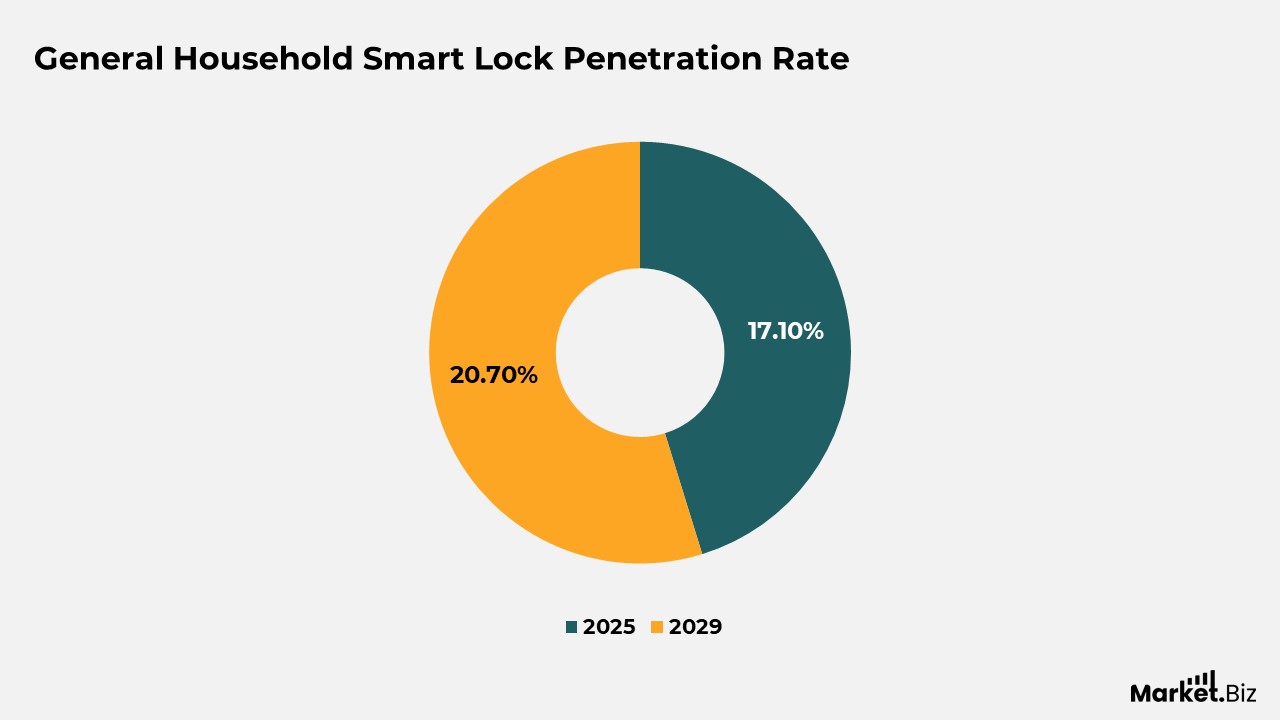
- Household penetration is projected to be 17.1% in 2025, with an expected increase to 20.7% by 2029.
- The average revenue per installed Smart Home is currently estimated at US$20.28.
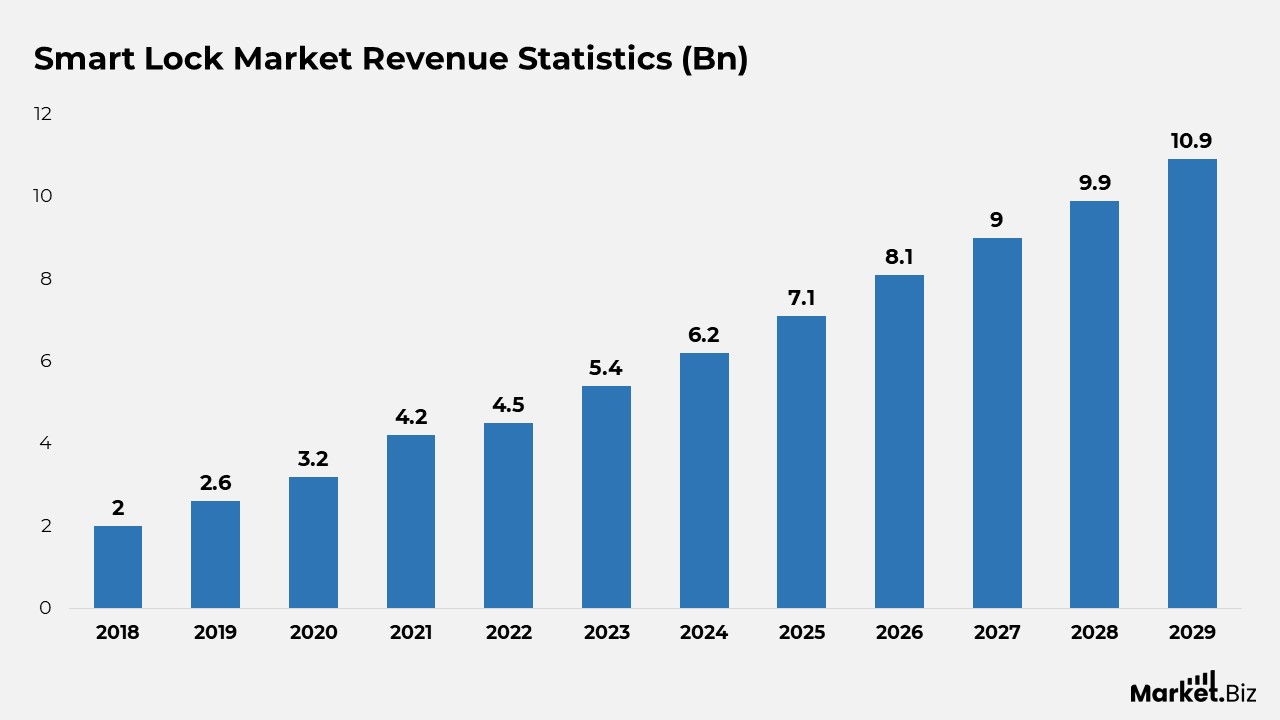
Smart Lock Market Revenue Statistics
- In 2018, the market revenue was estimated at USD 2 billion.
- This figure increased to USD 2.6 billion in 2019 and further to USD 3.2 billion in 2020.
- The upward trend continued, with revenues reaching USD 4.2 billion in 2021 and USD 4.5 billion in 2022.
- The market maintained its growth trajectory, achieving a valuation of USD 5.4 billion in 2023.
- Forecasts suggest continued expansion, with expectations for the market to reach USD 6.2 billion in 2024, USD 7.1 billion in 2025, and USD 8.1 billion in 2026.
- By 2027, the market is projected to grow to USD 9 billion, followed by USD 9.9 billion in 2028, culminating in a revenue of USD 10.9 billion by 2029.
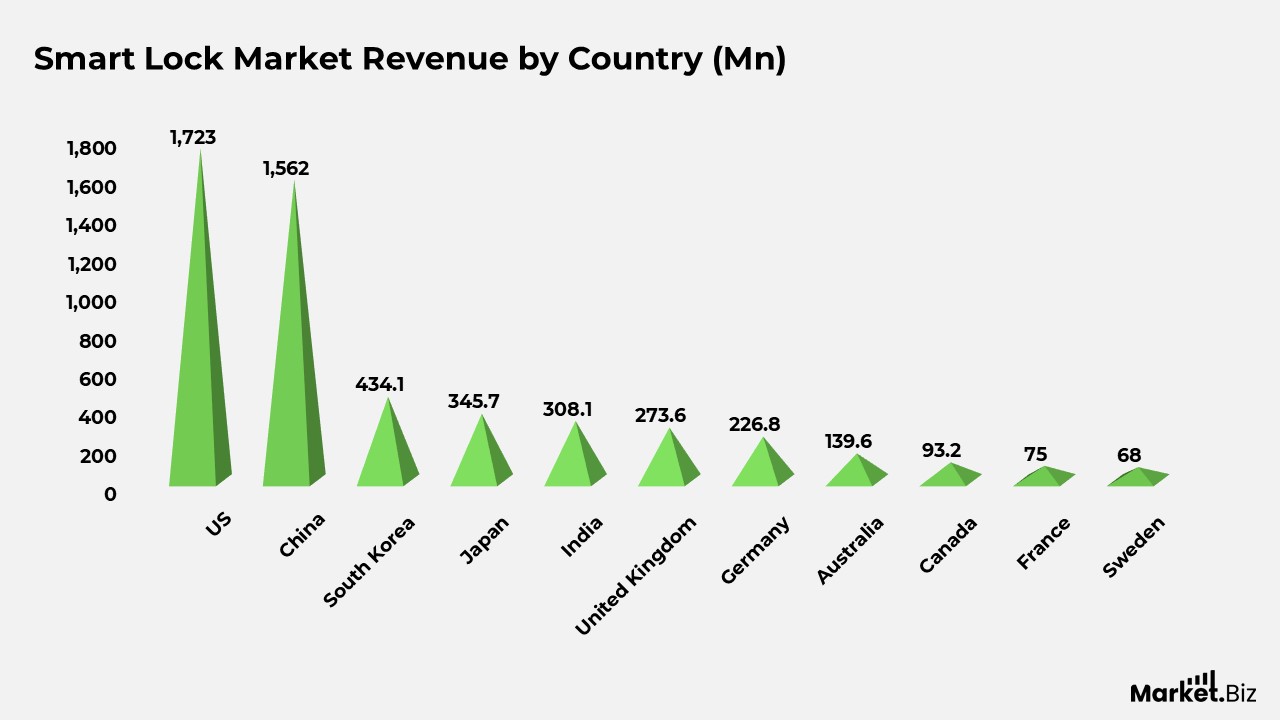
Revenue by Country of Smart Lock Market
- The United States is in the lead with revenues amounting to USD 1,723 million, followed closely by China at USD 1,562 million.
- South Korea is projected to secure the third position, contributing USD 434.1 million. Japan and India follow, generating revenues of USD 345.7 million and USD 308.1 million, respectively.
- The United Kingdom and Germany also make significant contributions, with revenues of USD 273.6 million and USD 226.8 million, respectively.
- Additional important markets include Australia (USD 139.6 million), Canada (USD 93.2 million), and France (USD 75 million).
- Sweden (USD 68 million), Brazil (USD 61.6 million), the Netherlands (USD 60.3 million), Russia (USD 54.6 million), and Mexico (USD 46.2 million) also exhibit consistent market performance.
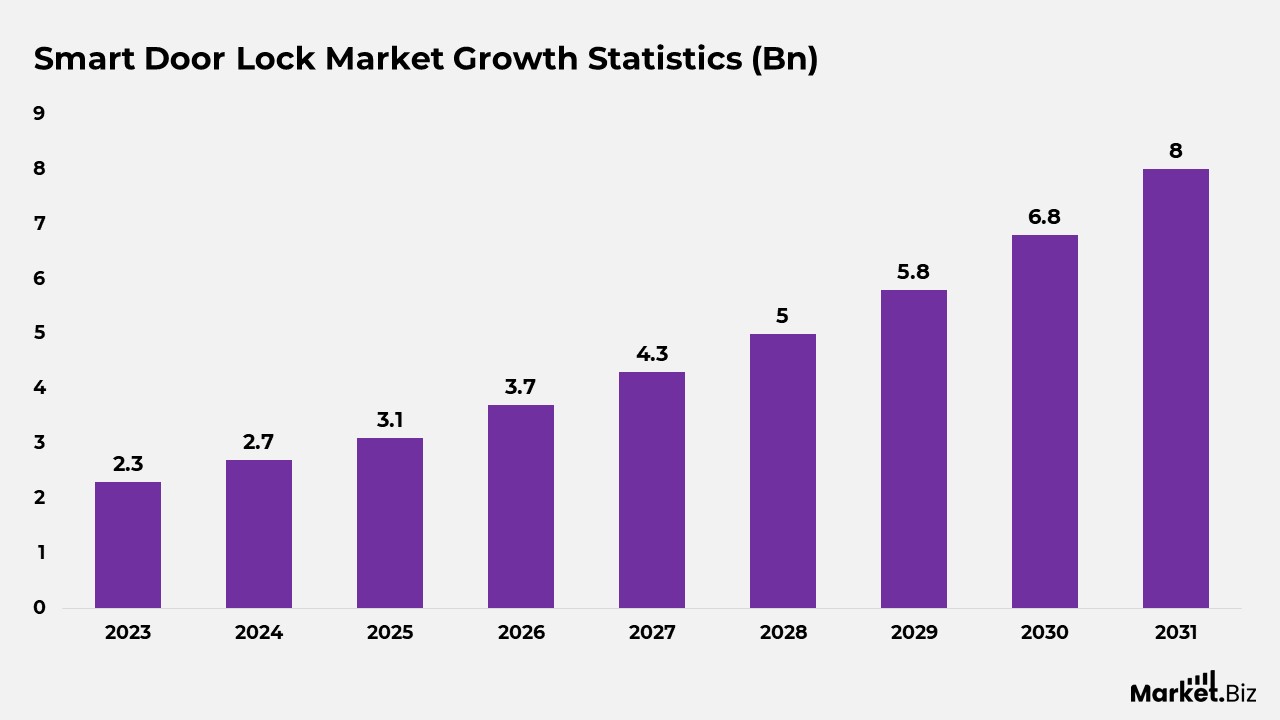
Smart Door Lock Market Growth Statistics
- In 2023, the market size was estimated to be USD 2.3 billion, with forecasts suggesting an increase to USD 2.7 billion in 2024 and USD 3.1 billion in 2025.
- By 2026, the market is expected to attain USD 3.7 billion, followed by USD 4.3 billion in 2027 and USD 5 billion in 2028.
- The upward trajectory is projected to persist, with the market size anticipated to grow to USD 5.8 billion in 2029, USD 6.8 billion in 2030, and USD 8 billion in 2031.
- The rising adoption of smart home technology, featuring capabilities such as remote access and voice control, is propelling the growth of smart locks, especially in residential settings.
- The increasing demand for improved home security without the inconvenience of mechanical keys is enhancing the popularity of smart locks among homeowners.
- The global expansion of smart home technology and the emergence of businesses providing home automation solutions are further stimulating the demand for smart locks.
- Manufacturers are incorporating smart locks with voice assistants, facilitating voice control, which is gaining traction among consumers.
- The surge in smartphone usage is supporting the proliferation of connected devices, allowing remote access to smart locks via mobile applications. Currently, there are 3.5 billion smartphone users worldwide, with a penetration rate of 45.4%.
- Additional growth is anticipated, with the market projected to reach USD 9.3 billion in 2032 and USD 10.9 billion in 2033.
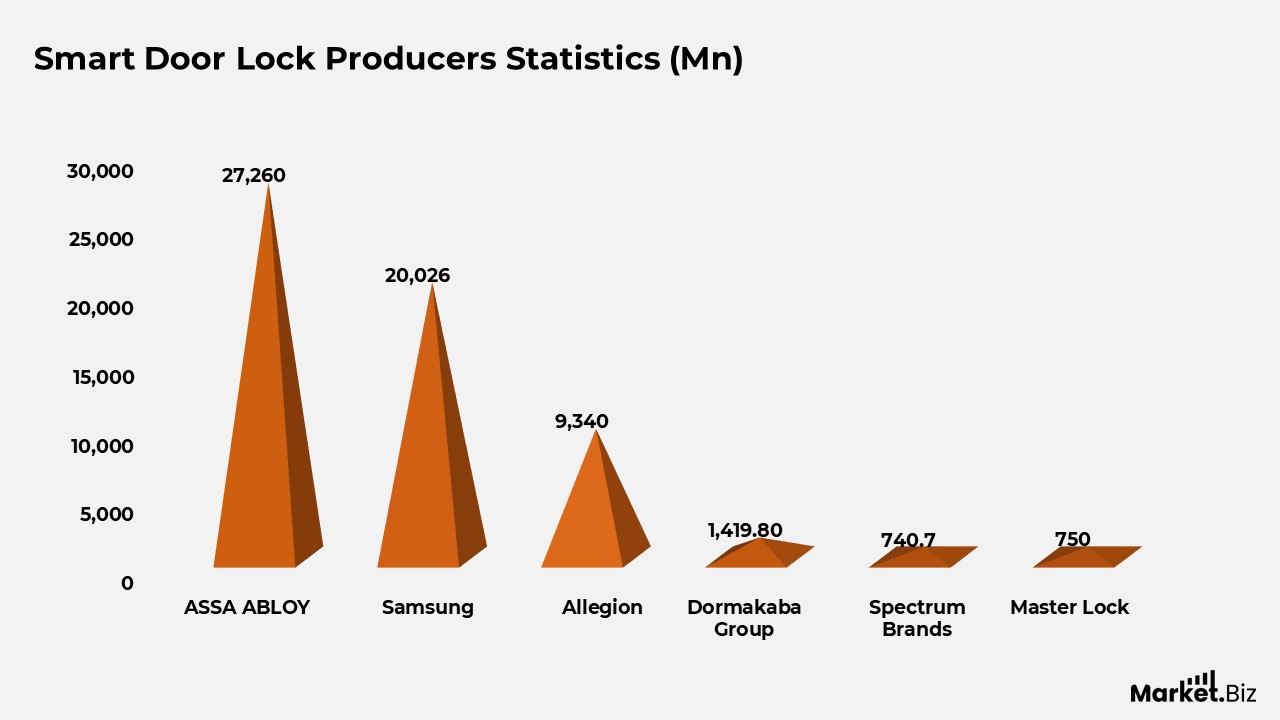
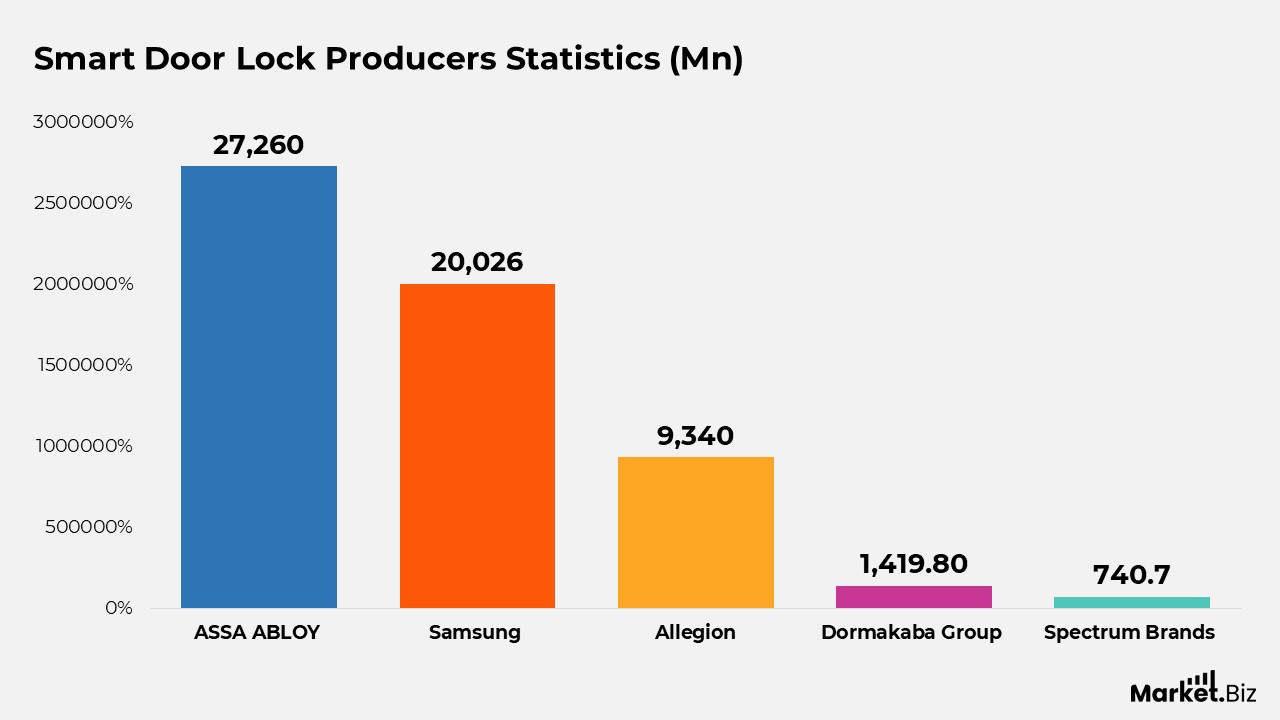
Smart Door Lock Producers Statistics
- ASSA ABLOY possesses a net worth of USD 27.26 billion.
- Samsung reported total revenue of USD 200.26 billion for the last twelve months, which is a decline from the previous year’s USD 240.71 billion.
- Allegion’s market capitalization stood at USD 9.34 billion, accompanied by an enterprise value of USD 10.99 billion.
- Dormakaba Group disclosed net sales amounting to CHF 1,419.8 million, with an adjusted EBITDA of CHF 184.6 million.
- Spectrum Brands recorded revenue of USD 740.7 million for the quarter ending in September 2023.
- Master Lock achieved an annual revenue of USD 750 million.
- Sargent and Greenleaf reported annual revenue of USD 32 million.
- Dessmann announced total revenue of INR 12,308 crores for the quarter ending on September 30th, 2023.
- MIWA Lock declared revenues of USD 5 million.
Digital Door Locks Statistics
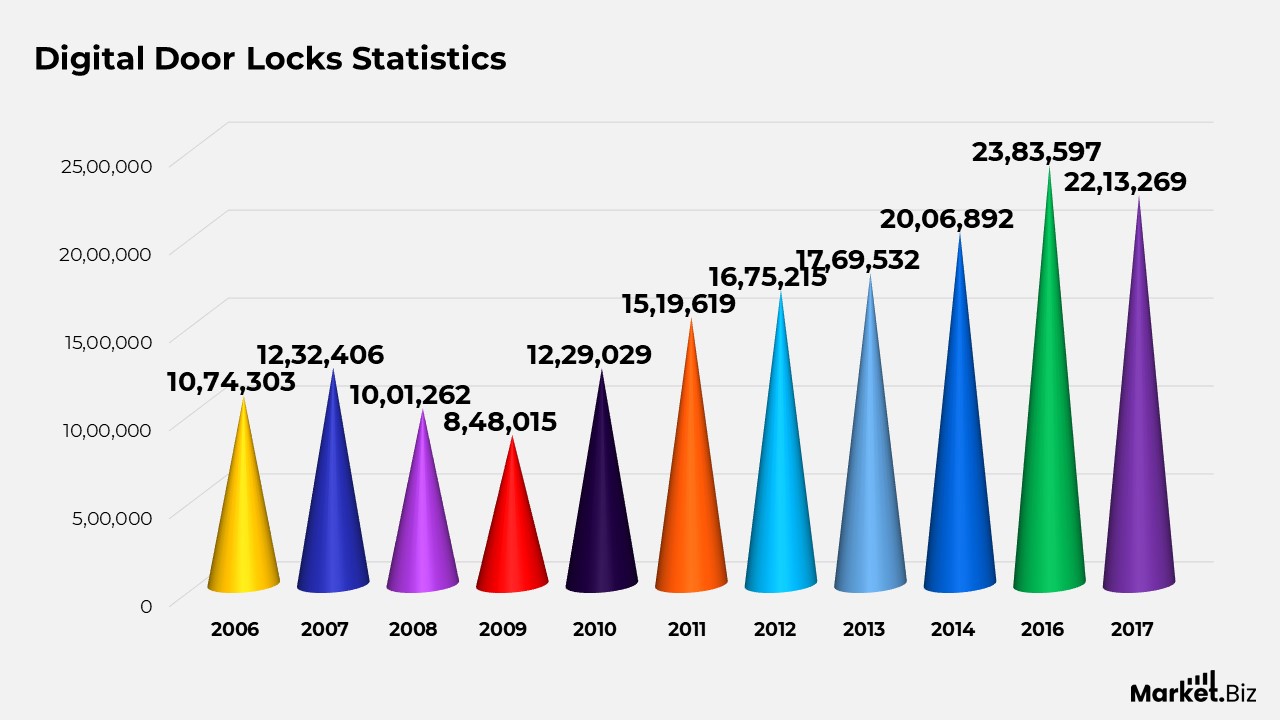
- In 2006, the production level was noted at 1,074,303 units, which rose to 1,232,406 units in 2007.
- However, there was a reduction in production to 1,001,262 units in 2008, followed by an additional drop to 848,015 units in 2009.
- A rebound happened in 2010, with production reaching 1,229,029 units.
- This favorable trend continued, culminating in 1,519,619 units in 2011 and 1,675,215 units in 2012.
- By 2013, production had surged to 1,769,532 units, and in 2014, it surpassed the 2-million mark, achieving 2,006,892 units.
- Production reached its highest point in 2016 at 2,383,597 units before experiencing a minor decline to 2,213,269 units in 2017.
Smart Home Security Market Growth
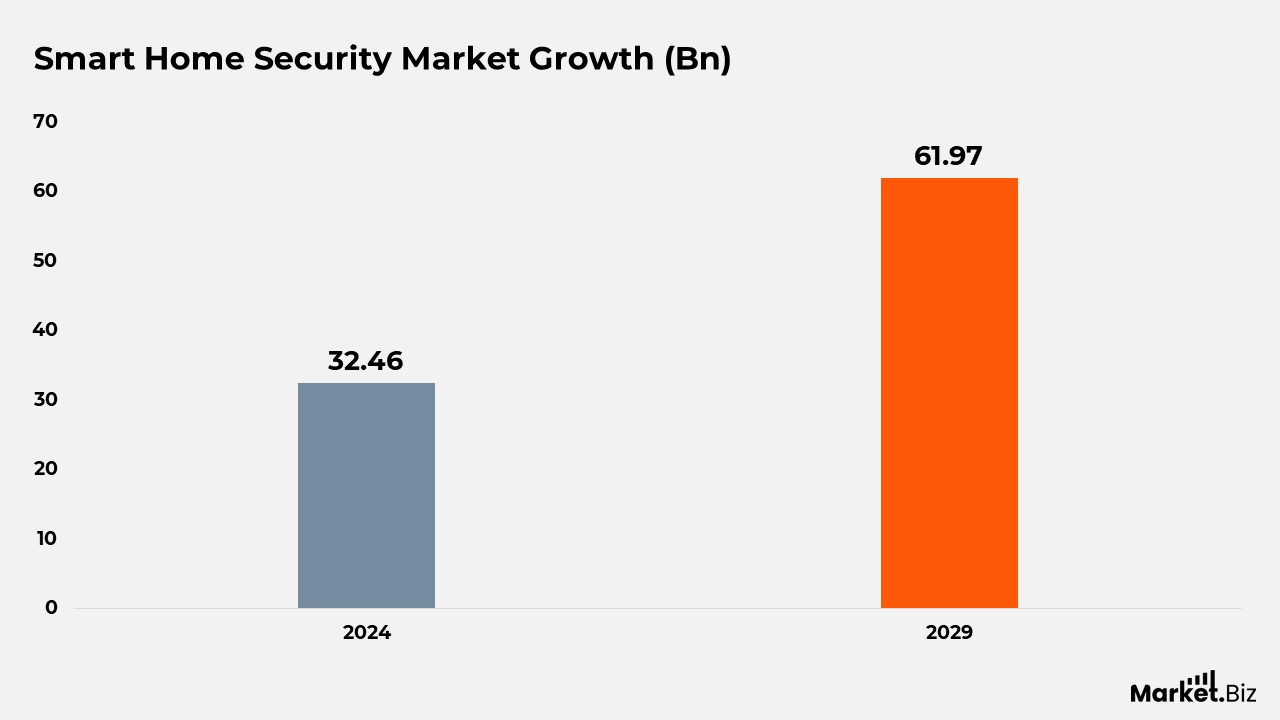
- In 2024, the market size is anticipated to attain USD 32.46 billion, propelled by a growing consumer demand for integrated security solutions and progress in IoT technology.
- By 2029, the market is projected to almost double, achieving USD 61.97 billion.
Smart Home Security Market Revenue by Country
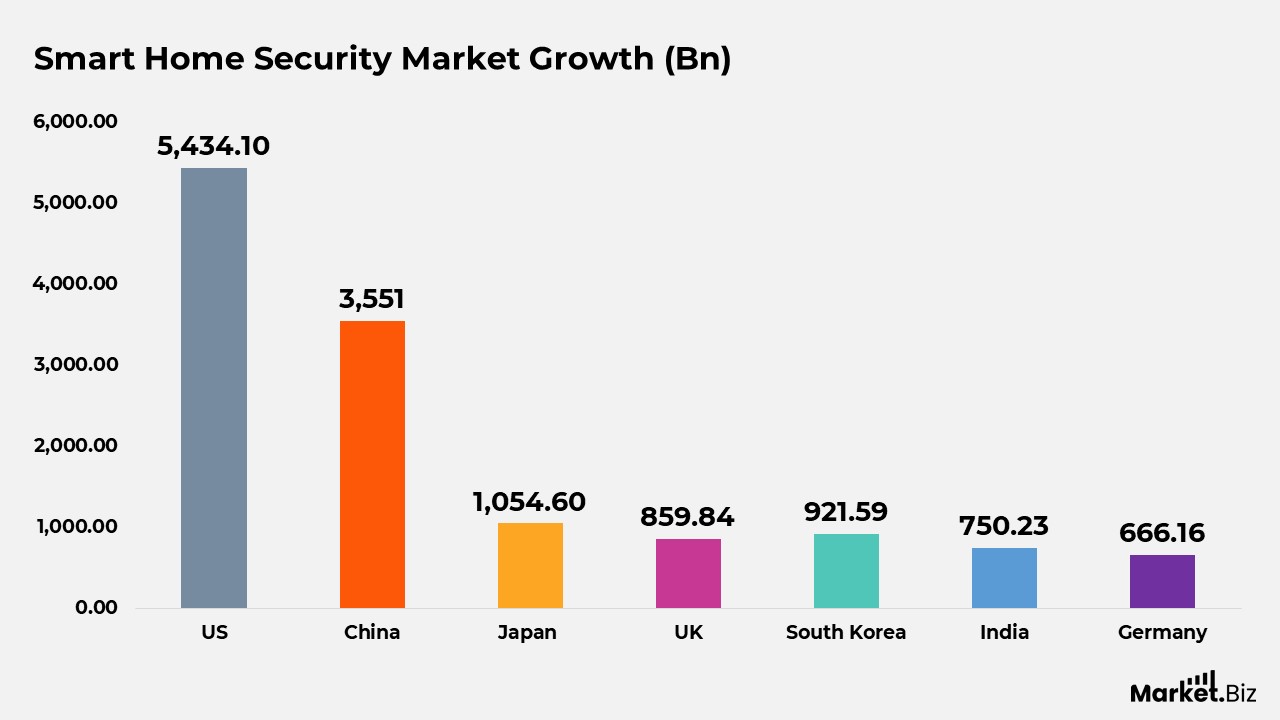
- The United States is in the lead with a total of USD 5,434.1 million.
- China follows in second place with USD 3,551 million, while Japan holds the third position with USD 1,054.6 million.
- The United Kingdom and South Korea contributed USD 859.84 million and USD 921.59 million, respectively.
- India has also emerged as a significant market with revenue amounting to USD 750.23 million, followed closely by Germany at USD 666.16 million.
- Other noteworthy contributors included France with USD 277.64 million, the Netherlands with USD 206.78 million, Sweden with USD 163.47 million, and Russia with USD 149.94 million.
- Norway, Italy, Switzerland, and Denmark generated revenues of USD 113.21 million, USD 115.79 million, USD 105.26 million, and USD 103.4 million, respectively.
- Furthermore, Turkey (USD 86.22 million), Austria (USD 80.93 million), South Africa (USD 80.53 million), and Spain (USD 72.45 million) exhibited consistent market performance.
Brands Statistics of Smart Lock
- In the year 2023, Xiaomi led the smart lock market in China, possessing a substantial market share of 23.6%.
- Kaadas secured the second position with a 12.4% share, while Dessmann represented 10.6% of the market.
- Sjjlock and Huan Lv maintained smaller shares at 5.2% and 4.3%, respectively.
Sales Statistics of Smart Door Lock
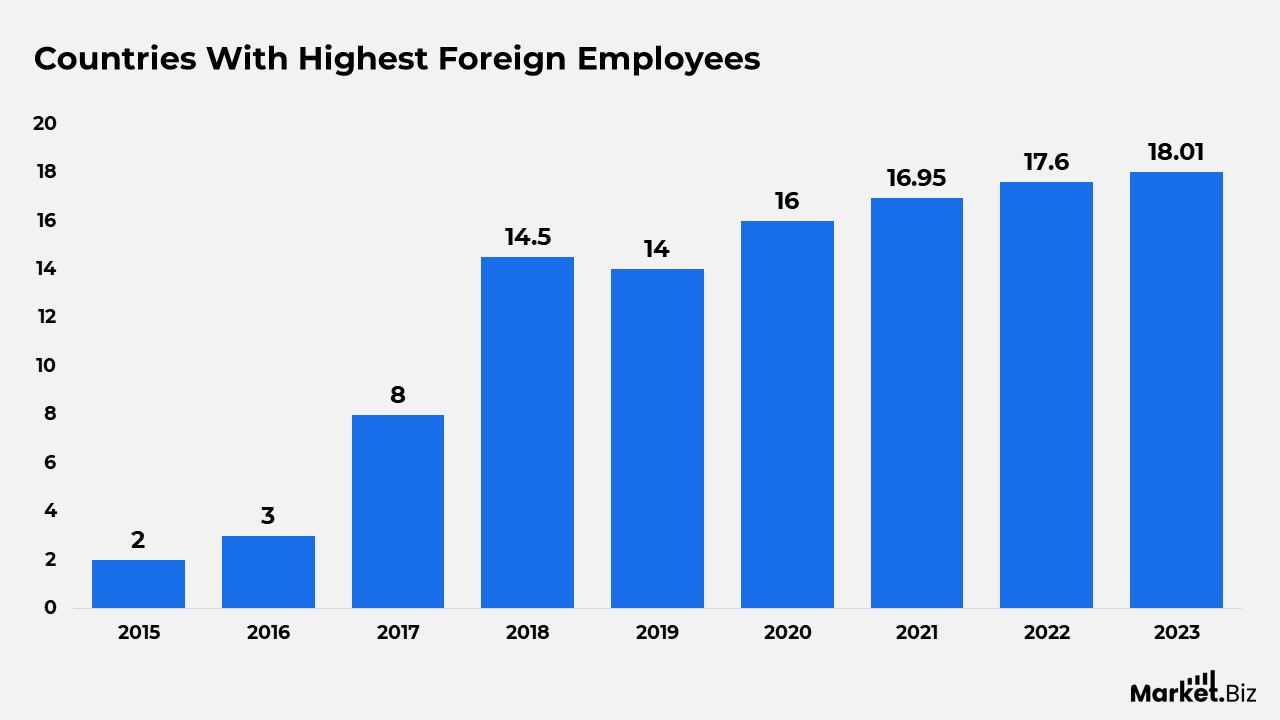
- In 2015, sales were relatively modest at 2 million units, rising to 3 million in 2016.
- By 2017, sales had more than doubled, reaching 8 million units.
- This growth accelerated in 2018, with sales surging to 14.5 million units.
- In 2019, the market slightly stabilized with 14 million units sold, followed by a further increase to 16 million units in 2020.
- The upward trend continued, with sales reaching 16.95 million units in 2021, 17.6 million in 2022, and an estimated 18.01 million units in 2023.
Smart Lock Features Statistics
- The level of security, especially in terms of protection against burglary, was regarded as highly significant by 90% of the participants, while only 9% considered it to be somewhat significant and a mere 1% viewed it as insignificant.
- The mechanical key override feature was assessed as very significant by 74% of the participants, with 22% finding it somewhat significant and 4% regarding it as insignificant.
- The management of access rights at the door lock was prioritized by 65%, whereas 25% deemed it somewhat significant.
- The ease of installation without the need for drilling or cabling was considered very significant by 61% of users, and compatibility with smartphone systems was similarly important, with 60% rating it as very significant.
- The management of access rights through an application was also valued by 60%, and 53% placed importance on the design, style, and color of the smart lock.
- Remote access and opening capabilities were rated as very significant by 50%, somewhat significant by 37%, and insignificant by 13%.
Recent Developments
- In February 2025, Salto Systems launched the XS4 One S Keypad, a sophisticated smart locking solution that incorporates PIN code access control. This device accommodates various credentials, such as PIN codes, smart keycards, and mobile access, delivering a versatile and secure entry experience. Its backlit, capacitive touch-enabled keypad guarantees intuitive use, while Salto’s BLUENet Wireless technology ensures uninterrupted online connectivity.
- In January 2025, Onity, Inc. revealed a partnership with Tenant, Inc. aimed at improving security and operational efficiency within the self-storage sector. Onity’s Passport smart locks will now integrate seamlessly with Tenant, Inc.’s property management software, allowing self-storage facilities to provide mobile credentials to tenants.
- In August 2024, Salto Systems, S.L. unveiled IQ Mini, the company’s newest compact wireless device crafted to enhance access control solutions. This device was designed to leverage the company’s BlueNet technology for seamless integration with various systems and to offer dependable wireless connectivity. It was intended to bolster security in settings where space is constrained.
Conclusion
Smart Lock Statistics: The market for smart locks is experiencing rapid growth, driven by technological advancements, a rising demand for home security, and the integration of IoT. Consumers emphasize features such as robust security, compatibility with smartphones, remote access capabilities, and straightforward installation, although concerns regarding data privacy remain.
Prominent brands are expanding their global reach, and the industry outlook is optimistic as the adoption of smart home technology continues to increase. Manufacturers must prioritize security, transparency, and user-friendly design to effectively capture market share. Simultaneously, innovations in biometrics and access control will further enhance the attractiveness of smart locks within contemporary security solutions.
FAQs
Sensors such as PIR and optical sensors are employed to detect and read objects. The PIR (Passive Infrared) sensor is the most frequently used motion sensor in smart locks.
Smart locks, being IoT devices, depend on battery power to sustain their wireless connectivity.
A smart sensor functions by gathering data from its physical surroundings, converting this data into electrical signals, and then utilizing an embedded microprocessor to analyze and interpret the information.