









Introduction
Golf Ball Statistics: Golf balls play a crucial role in the game of golf, engineered with a core that provides initial velocity and a cover that contributes to feel and durability. The cores are generally made from synthetic rubber or resin, which significantly impacts distance, while the covers, often composed of Surlyn or urethane, influence spin and control. The dimples on the surface serve to reduce drag and improve flight stability.
There are two primary types of golf balls: two-piece balls, which prioritize distance and durability, and multi-layer balls, which offer enhanced spin and feel. Regulatory bodies such as the USGA impose regulations to maintain fairness in the game.
Selecting the appropriate ball is contingent upon the player’s skill level and the conditions of the course. Beginners typically prefer balls that emphasize distance and durability, whereas advanced players tend to prioritize spin and feel.
Editor’s Choice
- The worldwide revenue for the golf ball market is anticipated to hit USD 1.357 billion by the year 2032.
- The worldwide golf ball market is divided geographically, with North America commanding the largest market share at 35.0%.
- Typically, a standard golf ball measures 1.68 inches (42.67 mm) in diameter and weighs a maximum of 1.62 ounces (45.93 grams) according to the Rules of Golf.
- The United Kingdom topped the list with 933,076 registered golfers, with 1,688 total golfers for each course, and around 301 registered golfers.
- Troon Golf dominated the market with an impressive collection of 630 golf courses.
- In 2012, Acushnet stated revenues amounting to USD 1,477.22 million, whereas Topgolf Callaway Brands made USD 834.07 million.
General Golf Ball Statistics
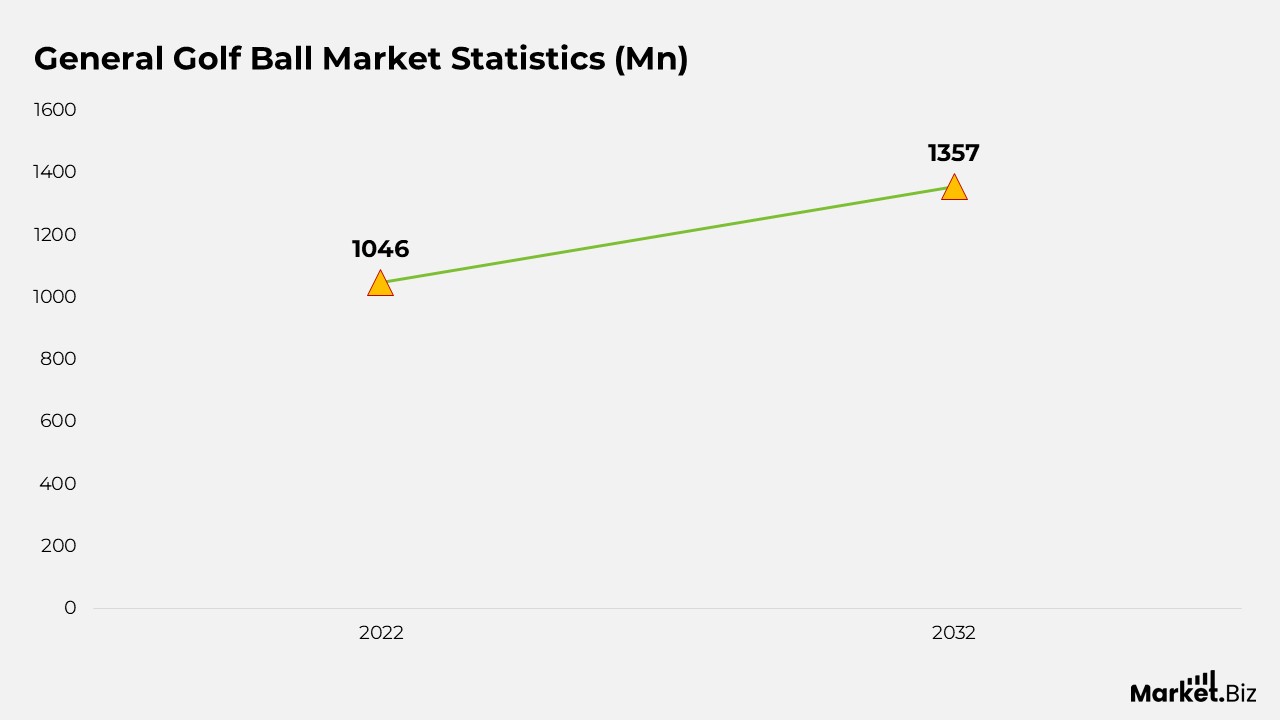
- The worldwide revenue for the golf ball market is anticipated to hit USD 1.357 billion by the year 2032.
- The global golf ball market is primarily led by a few major companies. Callaway Golf Co. holds the top position with a 21% market share.
- According to the most recent statistics, leisure uses dominate the market, representing 65% of the overall market share.
- This indicates the extensive appeal of golf as a leisure pursuit among both amateur and casual players.
- The worldwide golf ball market is divided geographically, with North America commanding the largest market share at 35%.
- In 2022, Chinese Taipei led the global export market for golf balls, exporting golf balls esteemed at USD 295 million, representing 31.3% of the total export share.
- In 2022, the United States was the leader in the global golf ball import market, with a total import value of USD 350 million, which accounted for 37.1% of the market share.
- Regulations concerning golf balls are mainly overseen by the United States Golf Association and the Royal and Ancient Golf Club of St Andrews (R&A), ensuring uniformity and fairness in the sport worldwide.
Growth Statistics By Golf Ball Market
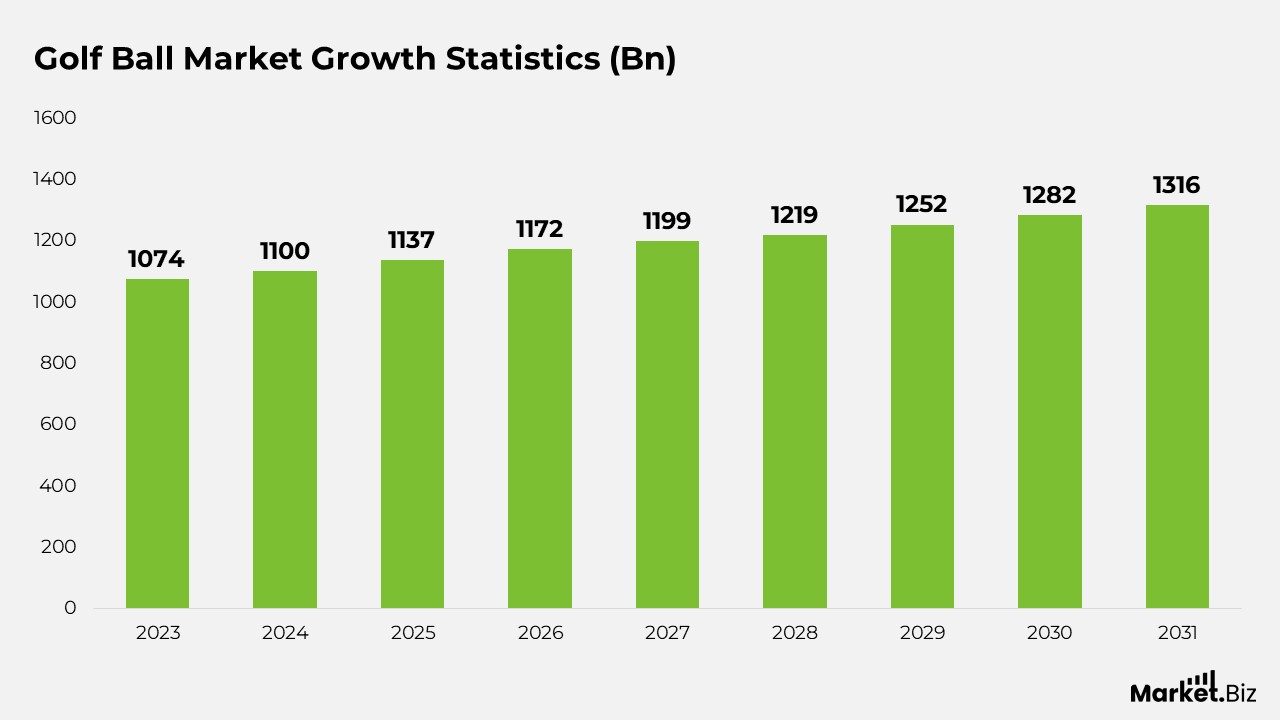
- The worldwide golf ball market has shown consistent growth in recent years, achieving a compound annual growth rate of 2.70%, with revenues amounting to USD 1.046 billion in 2022.
- This positive trend is expected to persist, with the market projected to generate USD 1.074 billion in 2023 and further increase to USD 1.100 billion in 2024.
- By 2025, revenues are expected to reach USD 1.137 billion, followed by USD 1.172 billion in 2026.
- The market is predicted to sustain this growth path, with revenues rising to USD 1.199 billion in 2027, USD 1.219 billion in 2028, and USD 1.252 billion in 2029.
- Forecasts for 2030 suggest revenues of USD 1.282 billion, escalating to USD 1.316 billion by 2031.
- By 2032, the global golf ball market is projected to reach a significant milestone, achieving revenues of USD 1.357 billion.
Golf Ball Market Growth by Region
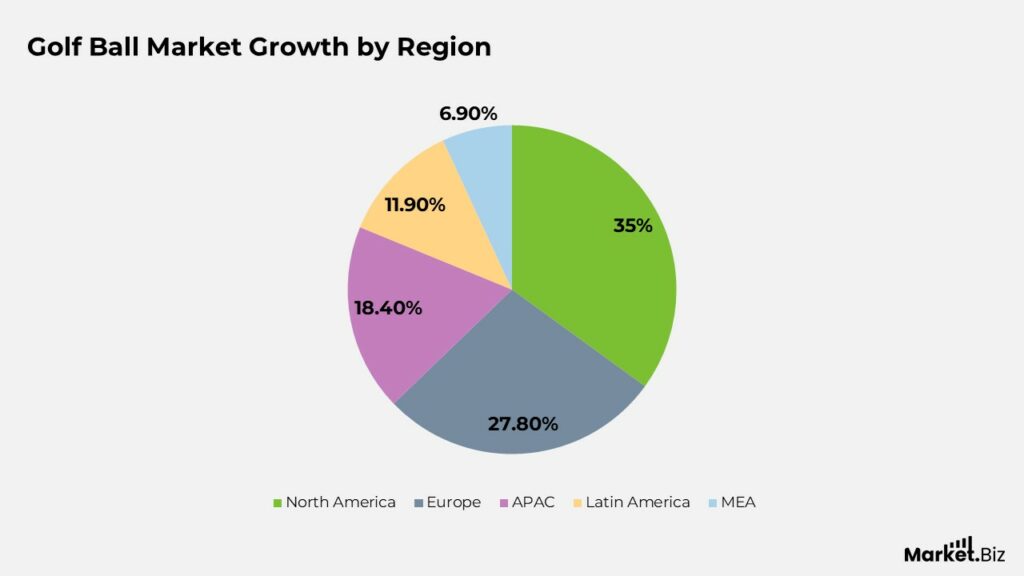
- The worldwide golf ball market is divided geographically, with North America commanding the largest market share at 35.0%.
- Europe comes next with a significant 27.8% share, demonstrating a robust presence in this area as well.
- The Asia-Pacific (APAC) region represents 18.4% of the market, highlighting its increasing significance in the sector.
- Latin America possesses an 11.9% share, whereas the Middle East and Africa (MEA) region makes up 6.9% of the market.
Golf Ball Facts
- Golf balls are engineered to fulfill specific performance standards, with their specifications encompassing various parameters that impact their playability.
- Typically, a standard golf ball measures 1.68 inches (42.67 mm) in diameter and weighs a maximum of 1.62 ounces (45.93 grams) according to the Rules of Golf.
- The core of the ball, which may consist of materials such as rubber or synthetic polymers, is designed to enhance energy transfer and influence compression and distance.
- Golf balls can be categorized as two-piece, three-piece, or even more intricate in design, featuring multiple layers intended to improve distance, spin, and control.
- The cover of the ball is frequently constructed from materials like urethane or Surlyn, and it features a dimple pattern that affects aerodynamics, thereby influencing the ball’s stability and flight path.
- For example, the Titleist Pro V1, a well-known model, boasts a three-piece construction with a urethane elastomer cover and 388 dimples engineered for a lower trajectory and a softer feel.
- Conversely, the Callaway ERC Soft utilizes a hybrid cover and a high-speed mantle layer to optimize energy transfer and enhance greenside control.
Player by Country Statistics
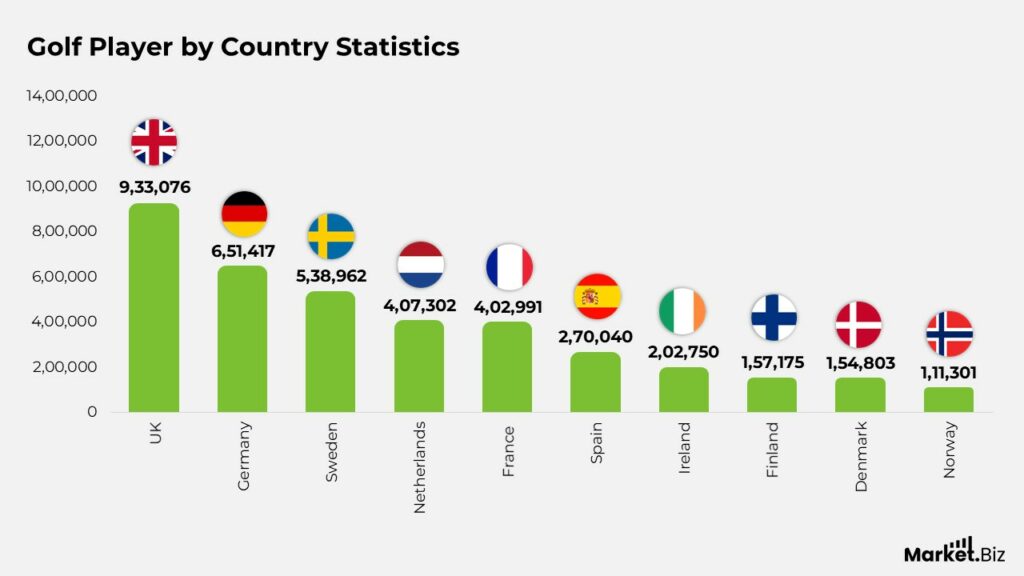
- The United Kingdom topped the list with 933,076 registered golfers, with 1,688 total golfers for each course, and around 301 registered golfers.
- Germany came in second with 651,417 registered golfers, demonstrating a greater number of 618 registered golfers and 1,091 total golfers per course.
- Sweden recorded 538,962 registered golfers, featuring 923 total golfers per course and 829 registered golfers.
- In the Netherlands, there were 407,302 registered golfers, boasting the highest density of 1,164 registered golfers and 1,314 total golfers per course.
- France documented a total of 402,991 registered golfers, resulting in 986 total golfers for each course and an average of 497 registered golfers.
- Spain recorded 270,040 registered golfers, which translates to 609 total golfers per course and an average of 548 registered golfers.
- Ireland had 202,750 registered golfers, averaging 1,479 total golfers per course and 555 registered golfers.
- Finland indicated 157,175 registered golfers, with an average of 827 registered golfers and 1,053 total golfers per course.
- Denmark had 154,803 registered golfers, averaging 594 total golfers per course and 446 registered golfers.
- Lastly, Norway recorded 111,301 registered golfers, with 648 total golfers per course and 577 registered golfers.
Golf Course Management Companies
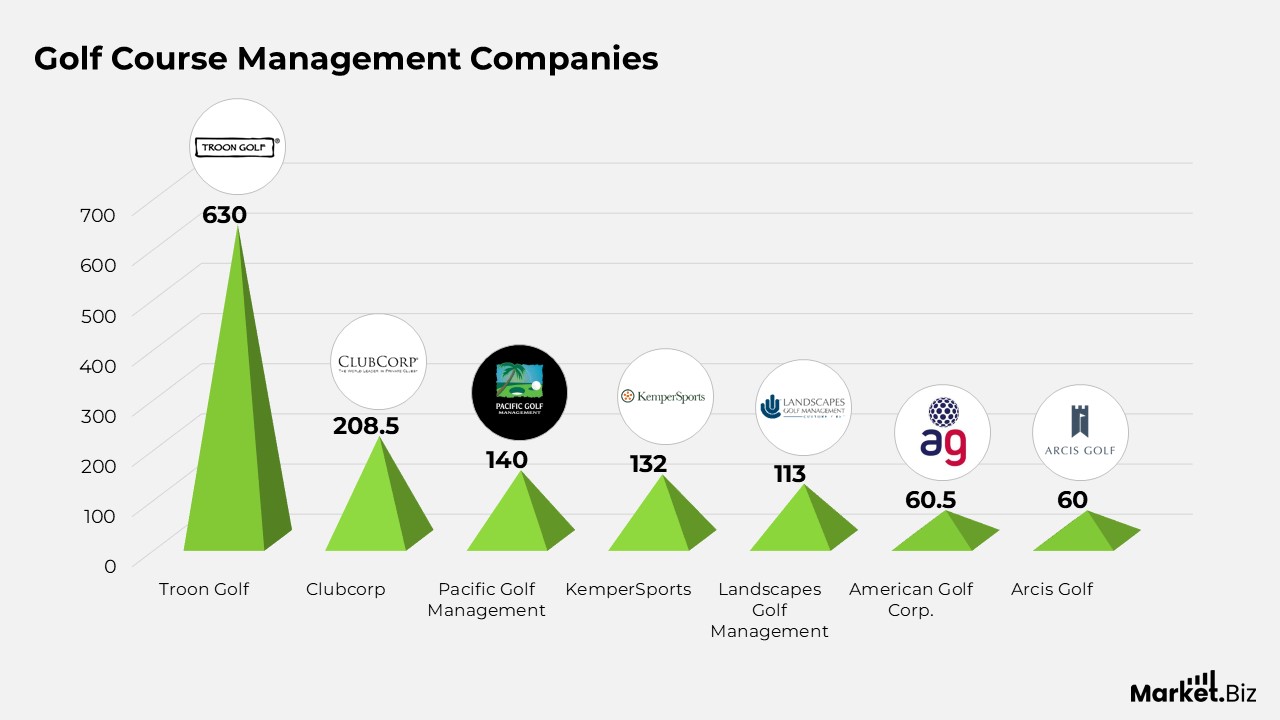
- Troon Golf dominated the market with an impressive collection of 630 golf courses.
- ClubCorp followed closely with 208.5 courses under its management.
- In Japan, Kemper Sports managed 132 courses while Pacific Golf Management oversaw 140 courses.
- American Golf Corp. managed 60.5 courses, and Landscapes Golf Management was in charge of 113 courses.
- Arcis Golf closely follows with 60 courses, and UGOLF France is responsible for 59 courses.
- ClubLink managed 53 courses, while GreatLIFE Golf and Fitness operated 58 courses.
- Blue Green Groupe Saur succeeded 47 courses, which is the exact same number as Touchstone Golf, and Marriott Golf was responsible for 52 courses.
- The PGA TOUR Golf Course managed 40 courses, and CourseCo, Inc. managed 42 courses.
- Lindsey Management Co. was responsible for 33.5 courses, while ClubSpecialists International (CSI) managed 38.5 courses.
- Hampton Golf runs 20 courses, and Century Golf Partners manages 31 courses.
Golf Ball Companies Statistics
Acushnet
- In 2012, Acushnet stated revenues amounting to USD 1,477.22 million, whereas Topgolf Callaway Brands made USD 834.07 million.
- Over the subsequent years, Acushnet experienced a consistent increase in revenue. It reached USD 1,503.00 million in 2015, USD 1,537.60 million in 2013, and USD 1,572.28 million in 2016.
- By 2017, Acushnet’s revenue experienced a slight decline to USD 1,560.26 million but rebounded in 2018 to USD 1,633.72 million.
- The company maintained its upward trend with revenues of USD 1,681.36 million in 2019 and USD 1,612.17 million in 2020, before soaring to USD 2,147.93 million in 2021, USD 2,270.34 million in 2022, and achieving USD 2,382.00 million in 2023.
Topgolf Callaway Brands
- Topgolf Callaway Brands also witnessed significant growth. Revenues were USD 842.80 million in 2013, which increased to USD 843.80 million in 2015 and USD 871.20 million in 2016.
- A remarkable surge occurred in 2017, with revenues climbing to USD 1,048.74 million, followed by USD 1,242.28 million in 2018.
- The most considerable growth was recorded in 2019, with revenues skyrocketing to USD 1,701.06 million, although they experienced a slight decline to USD 1,589.46 million in 2020.
- The subsequent years demonstrated extraordinary growth, with revenues soaring to USD 3,995.70 million in 2022, USD 3,133.40 million in 2021, and an impressive USD 4,284.80 million in 2023.
Golf Ball Import & Export Statistics
Import
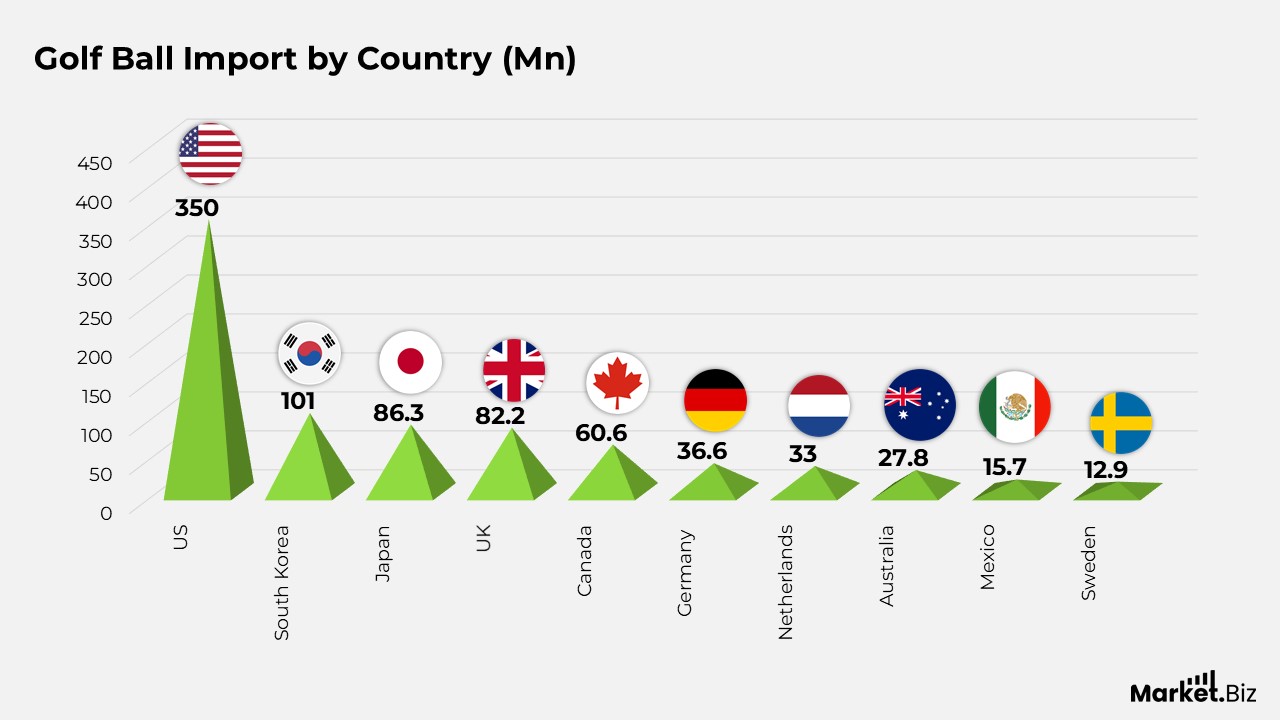
- In 2022, the United States led the golf ball import with an import rate of USD 350 million, which constituted 37.1% of the market share.
- South Korea followed in second place, importing golf balls valued at USD 101 million, representing 10.7% of the market.
- Japan’s imports of golf balls amounted to USD 86.3 million, capturing 9.16% of the market share. Meanwhile, the United Kingdom’s imports reached USD 82.2 million, or 8.72%.
- Canada’s imports of golf balls were valued at USD 60.6 million, accounting for 6.43% of the market.
- The Netherlands and Germany imported golf balls for a cost of USD 33 million and USD 36.6 million, respectively.
- Australia’s imports totaled USD 27.8 million, signifying a market share of 2.95%, while Mexico’s imports amounted to USD 15.7 million (1.66%).
- Sweden’s import value stood at USD 12.9 million, which accounted for 1.37% of the market.
Export
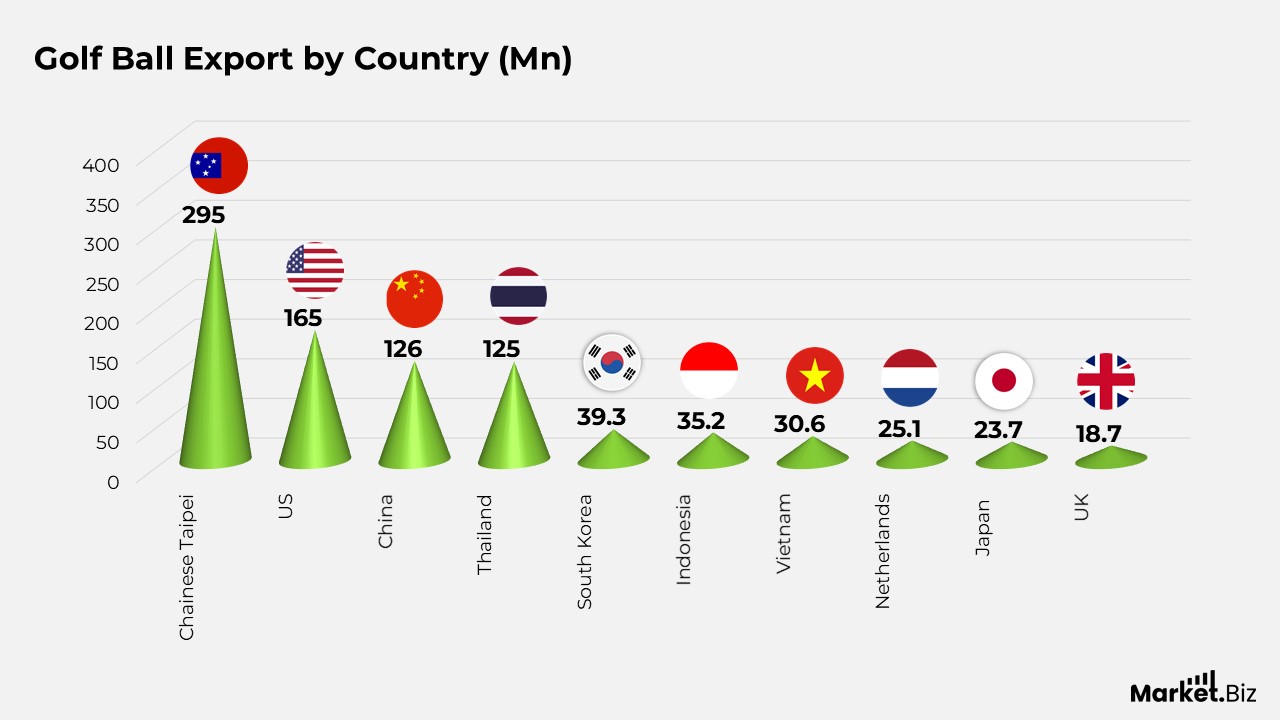
- In 2022, the global export market for golf balls was dominated by Chinese Taipei, who exported golf balls esteemed at USD 295 million, representing 31.3% of the total export share.
- The United States followed closely with exports amounting to USD 165 million, accounting for 17.5% of the market share.
- Thailand and China also made substantial contributions, with export values of USD 125 million and USD 126 million, respectively.
- South Korea’s exports of golf balls reached USD 39.3 million, taking a market share of 4.16%; however, Indonesia’s exports were valued at USD 35.2 million, or 3.74%.
- Vietnam exported golf balls worth USD 30.6 million, which constituted 3.24% of the market share.
- Japan, the Netherlands, and the United Kingdom also played significant roles in this market, with export values of USD 23.7million, USD 25.1 million, and USD 18.7 million, respectively.
Spending on Golf Ball Statistics
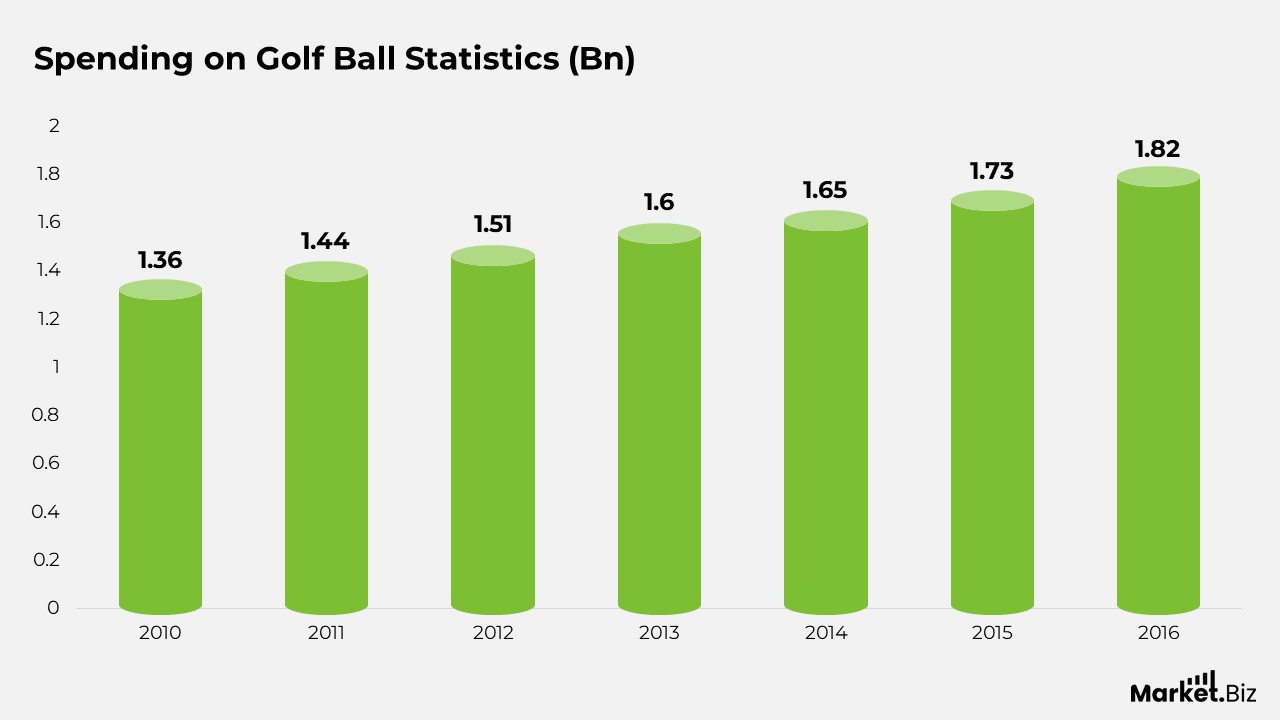
- In 2010, the overall expenditure on sponsorship amounted to USD 1.36 billion.
- This amount increased to USD 1.44 billion in 2011 and further rose to USD 1.51 billion in 2012.
- The upward trend persisted in 2013, achieving USD 1.6 billion.
- By 2014, the spending on sponsorship had escalated to USD 1.65 billion, followed by a rise to USD 1.73 billion in 2015.
- The growth trajectory peaked in 2016, with sponsorship expenditure reaching USD 1.82 billion.
Recent Developments
- The worldwide golf ball market is anticipated to expand at a compound annual growth rate (CAGR) of 5.3% from 2023 to 2028. This growth is fueled by a rise in golf participation, advancements in golf equipment technology, and an increase in disposable incomes that enable consumers to purchase premium products.
- In early 2024, the USGA and R&A revised their equipment standards to ensure that emerging golf ball technologies adhere to the regulations of the game. Thereby promoting fairness and consistency within the sport.
- Snell Golf, a company that sells golf balls directly to consumers, secured $10 million in early 2024 to enhance its production capacity and create new golf ball models, with the goal of providing high-performance balls at competitive prices.
Conclusion
Golf Ball Statistics: The global golf ball market is experiencing significant growth. Driven by an increase in participation in the sport, particularly in the Asia-Pacific and Latin American regions. Advances in technology related to aerodynamics and materials are improving ball performance to meet the varied needs of golfers.
Additionally, there is a marked trend towards environmentally friendly designs in response to heightened awareness of environmental issues. The competition among leading brands is intense, with companies striving to differentiate themselves through innovation and strategic collaborations.
Consumer preferences are leaning towards personalized options and balls that enhance both distance and control. Looking ahead, the market presents promising growth prospects, propelled by innovation, demographic shifts, and rising disposable incomes in developing markets.
FAQs
In the context of golf, the 80/20 rule, commonly referred to as the Pareto Principle, indicates that approximately 80% of your outcomes are derived from 20% of your actions or efforts. This principle can be utilized in various facets of the game, including swing mechanics, practice routines, and course strategy.
Golf enhances leg strength, stability, and power over time. The action of swinging back and then driving forward engages your back, shoulders, and arms significantly. With regular swings, your upper body muscles become toned and firm. Prepare to enhance both your game and physique.
The sport can lead to repetitive, one-sided twisting of the spine. It involves bending over repeatedly to lift weights ranging from 10 to 40 pounds. This can result in chronic wear and tear on the shoulder and elbow joints, as well as muscle and tendon tears that may lead to scar tissue.