









Introduction
Sweetener Statistics: These are compounds utilized to impart sweetness to food and beverages. They exist in various forms, including natural sweeteners such as stevia and honey, artificial sweeteners like aspartame and sucralose, and sugar alcohols such as xylitol and sorbitol. These sweeteners are extensively employed in a range of products, including soft drinks, baked goods, pharmaceuticals, and personal care products.
While natural sweeteners are sourced from plants, artificial sweeteners are synthetically manufactured, and sugar alcohols provide lower-calorie alternatives. Regulations oversee their usage and labeling to guarantee consumer safety and awareness. Comprehending sweeteners is essential for product formulation and adherence to industry regulations.
Editor’s Choice
- The global revenue of the sweetener market reached 174.0 billion USD in 2023.
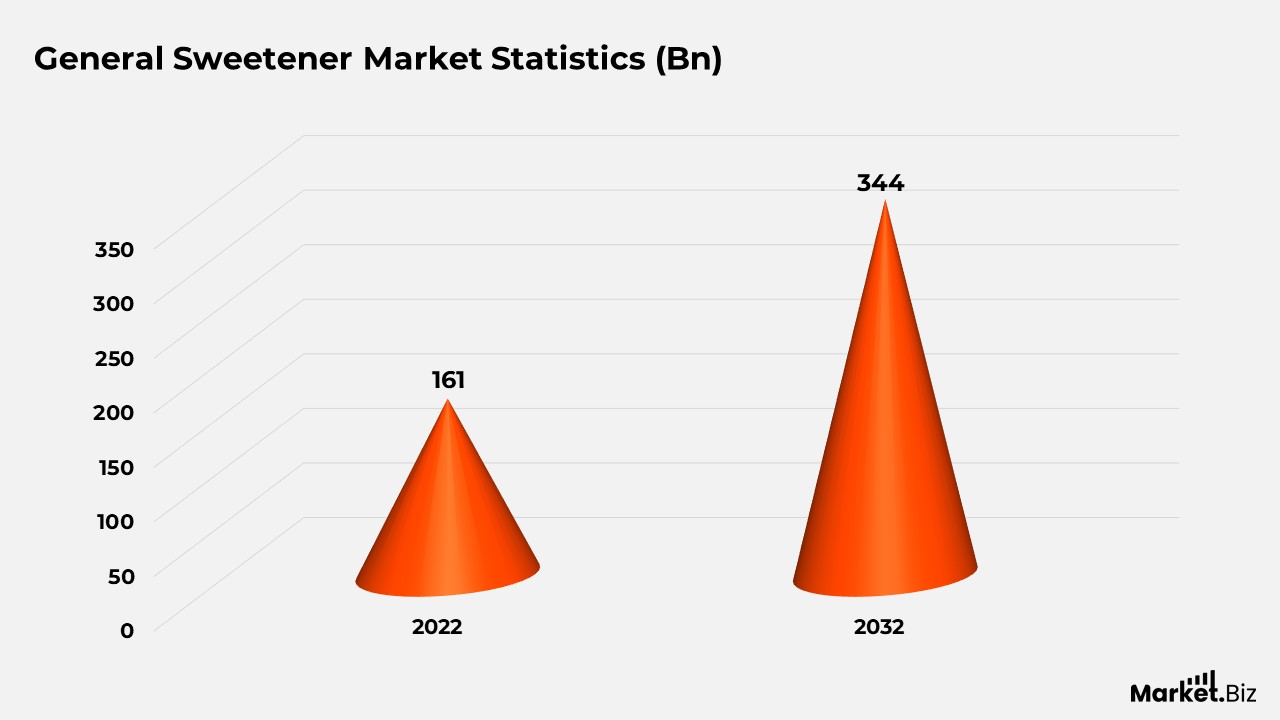
- Starting at 161 billion USD in 2022, the market experienced gradual increases, reaching 174 billion USD in 2023 and further advancing to 186.0 billion USD in 2024.
- In 2022, the overall revenue of the sweetener market was recorded at USD 161.0 billion, which included a variety of product types.
- At the forefront is China, which boasts a significant revenue of USD 125.1 billion, emphasizing its leading role in the industry.
- Advantame is recognized as the sweetest of the sweeteners listed, being around 20,000 times sweeter than sugar.
- In the United States, the consumption of various sugar substitutes among consumers differs, with Splenda being the most widely used, reported by 51.4 million consumers.
General Sweetener Statistics
- The global revenue of the sweetener market reached 174.0 billion USD in 2023.
- Sucrose led the market in 2022, generating revenues of USD 56.67 billion. This was followed by natural sweeteners, which accounted for USD 45.72 billion, and artificial sweeteners, which brought in USD 24.15 billion.
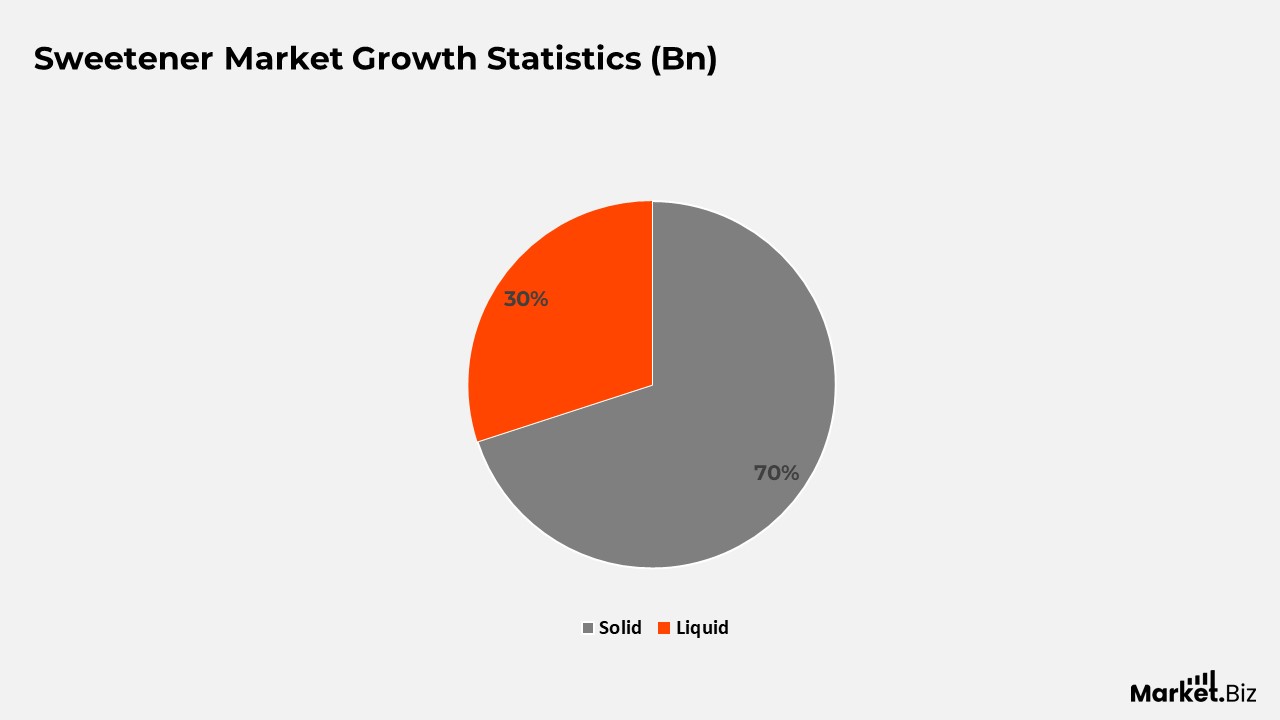
- According to the most recent data, solid sweeteners hold a dominant market share of 70%.
- China, with a significant revenue of USD 125.1 billion, highlights its key role in the sweetener sector.
- Advantame is recognized as the sweetest of the sweeteners listed, being roughly 20,000 times sweeter than sugar.
- On a scale from 1 to 10, which measures the likelihood of consuming foods and beverages containing different sweeteners, respondents rated honey the highest, achieving a score of 7.1.
Sweetener Market Growth Statistics
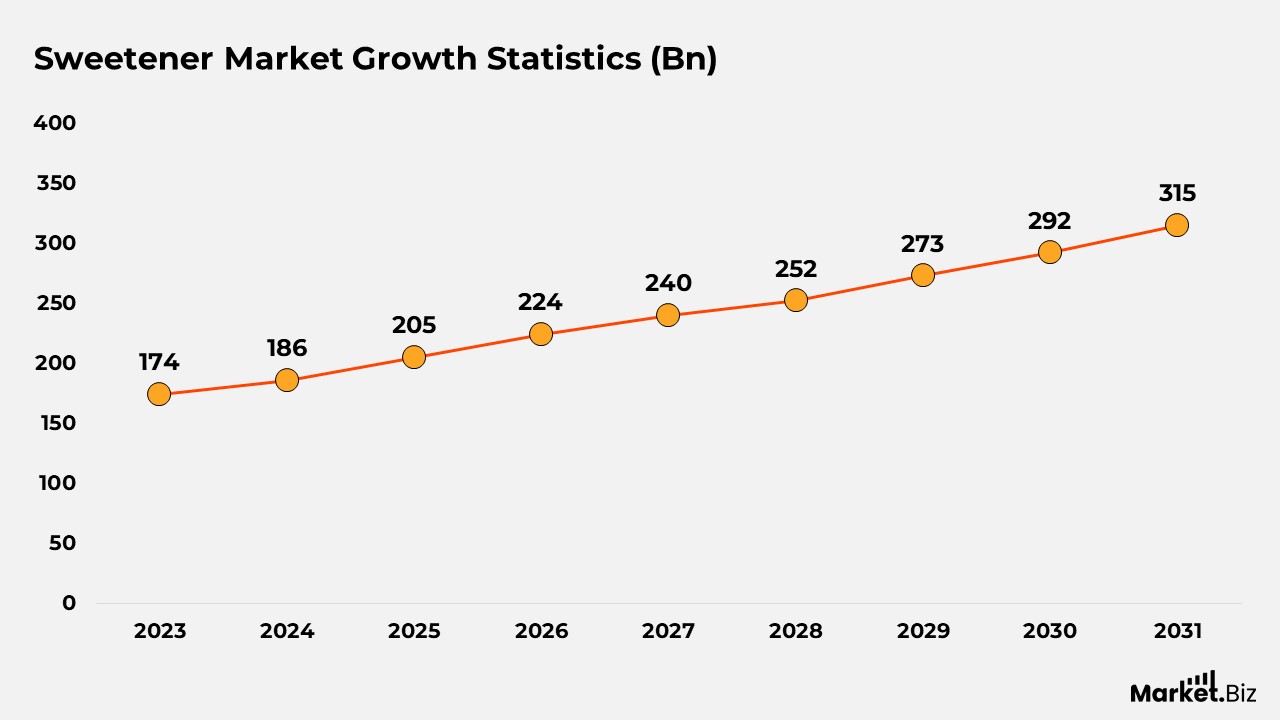
- The global sweetener market has shown consistent revenue growth over the last ten years, achieving a compound annual growth rate (CAGR) of 8.13%. A clear upward trend is anticipated for the near future.
- Starting at 161.0 billion USD in 2022, the market experienced gradual increases, reaching 174.0 billion USD in 2023 and further advancing to 186.0 billion USD in 2024.
- The growth pattern persisted with revenues of 205.0 billion USD in 2025 and 224.0 billion USD in 2026.
- Looking forward, the market is projected to sustain its upward trajectory, with anticipated revenues of 240.0 billion USD in 2027, 252.0 billion USD in 2028, and 273.0 billion USD in 2029.
- By 2030, the market is expected to attain 292.0 billion USD, followed by substantial growth to 315.0 billion USD in 2031 and 344.0 billion USD in 2032.
Type of Sweetener
- In 2022, the overall revenue of the sweetener market was recorded at USD 161.0 billion, which included a variety of product types.
- Sucrose led the market with revenues amounting to USD 56.67 billion. This was followed by natural sweeteners, which generated USD 45.72 billion, and artificial sweeteners, which accounted for USD 24.15 billion.
- Moreover, sugar alcohols contributed USD 17.71 billion, while other product categories added USD 16.74 billion. The market is projected to grow to USD 344 billion by 2032, reflecting significant expansion.
- Sucrose is expected to retain its dominant position, with revenues forecasted to reach USD 121.09 billion. Natural sweeteners are anticipated to follow with USD 97.70 billion, and artificial sweeteners are expected to generate USD 51.60 billion.
- Both sugar alcohols and other product types are also expected to experience considerable growth, with projected revenues of USD 37.84 billion and USD 35.78 billion, respectively.
Country Statistics of the Sweetener Market
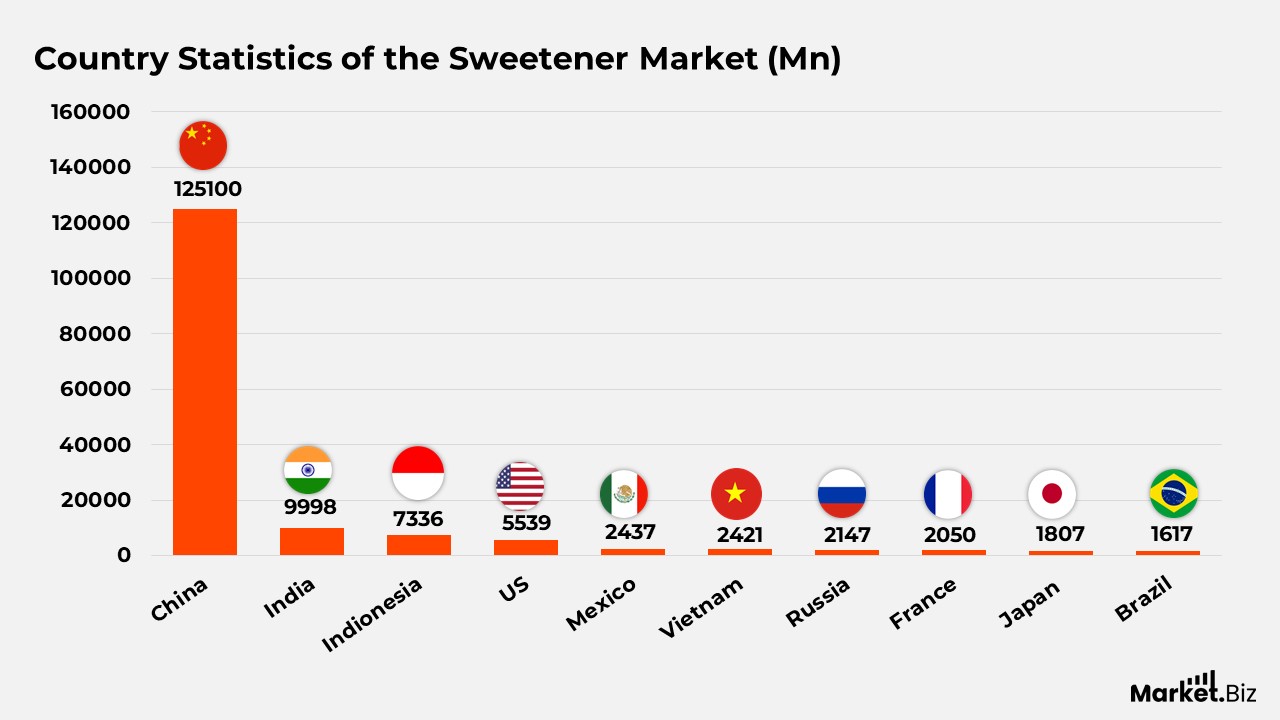
- At the forefront is China, which boasts a significant revenue of USD 125.1 billion, emphasizing its leading role in the industry.
- Close behind is India, achieving a remarkable revenue of USD 9.998 billion, illustrating its important contribution to the market.
- Indonesia stands out as another strong contender, with a revenue of USD 7.336 billion, indicating its expanding influence in the sweetener sector.
- The United States, with a revenue of USD 5.539 billion, retains a robust presence in the market, reflecting the ongoing demand for sweetening agents.
- Mexico and Vietnam follow, each contributing USD 2.437 billion and USD 2.421 billion, respectively, to the total revenue.
- Meanwhile, Russia, France, Japan, and Brazil complete the list with revenues ranging from USD 2.147 billion to USD 1.617 billion, underscoring their notable yet somewhat lesser impact on the global sweetener market.
Sweetness in Sweeteners Statistics
- Advantame is recognized as the sweetest of the sweeteners listed, being around 20,000 times sweeter than sugar.
- Neotame comes next, with a sweetness level ranging from 7,000 to 13,000 times sweeter, while thaumatin is positioned between 2,000 and 3,000 times sweeter.
- Saccharin has a sweetness range of 200 to 700 times sweeter, whereas sucralose is roughly 600 times sweeter.
- Steviol glycosides demonstrate a sweetness intensity of 200 to 400 times sweeter, and Luo Han Gou varies from 100 to 250 times sweeter.
- Aspartame and acesulfame potassium (Ace-K) both possess a sweetness intensity of 200 times sweeter than sugar.
Price of Sweeteners
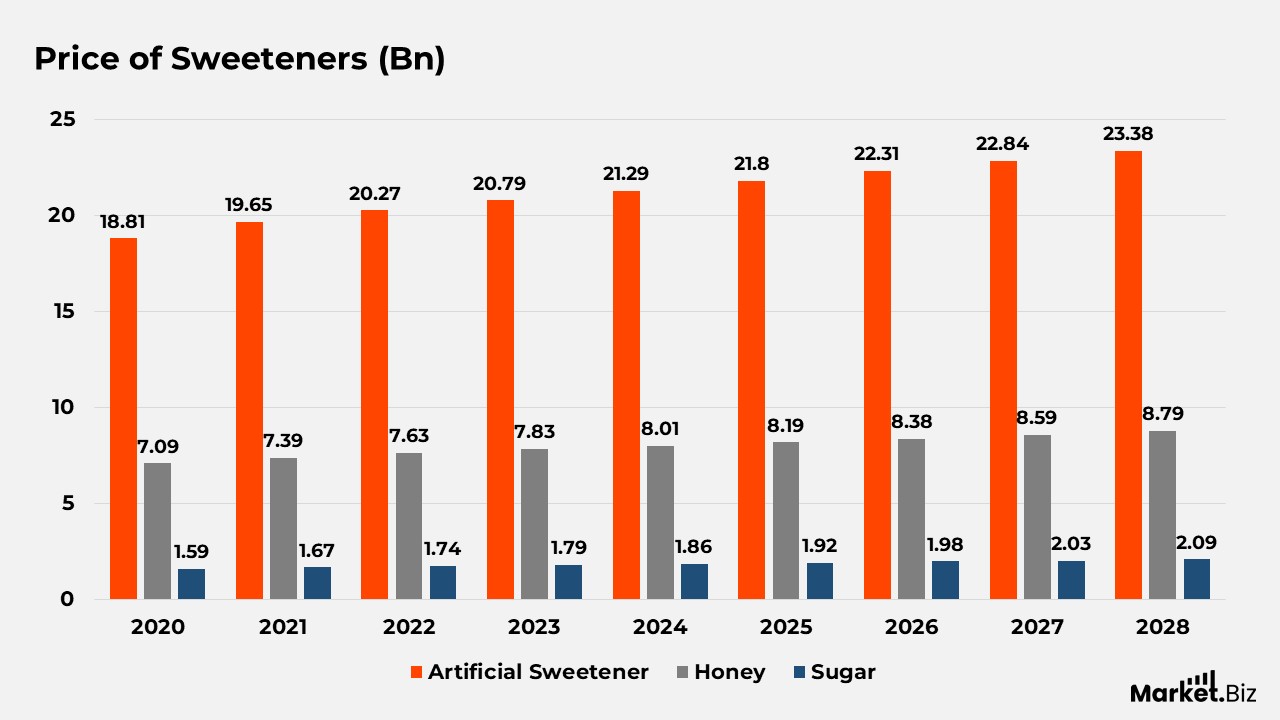
- Artificial sweeteners demonstrated a consistent increase from 17.82 USD in 2018 to 22.84 USD in 2027, indicating a steady upward trend.
- Likewise, honey experienced a gradual price increase from 6.74 USD in 2018 to 8.59 USD in 2027.
- In comparison, sugar exhibited a relatively stable trend, with slight variations, beginning at 1.18 USD in 2018 and culminating at 2.03 USD in 2027.
Low-Calorie Sweetener Statistics
- Low-calorie sweeteners, commonly referred to as artificial sweeteners, provide a sugar-free option for those aiming to lower their calorie consumption or regulate their blood sugar levels.
- Popular brand names include Equal®, NutraSweet®, and Sugar Twin® for aspartame, Sunett® and Sweet One® for Acesulfame-K, as well as Sweet’N Low®, Sweet Twin®, and Necta Sweet® for saccharin.
- These sweeteners are considerably sweeter than sugar, with aspartame, Acesulfame-K, and saccharin being roughly 200 times sweeter, sucralose 600 times neotame, and sweeter between 7,000 and 13,000 times sweeter.
- Advantame, which does not have a specific brand name, is the sweetest of all, being about 20,000 times sweeter than sugar.
- The acceptable daily intake, indicated by the maximum number of sweetener packets one can consume in a day, differs for each type of sweetener, ranging from 23 packets for aspartame, Acesulfame-K, and sucralose to 45 packets for saccharin and an impressive 4,920 packets for advantame.
Sugar Substitutes Statistics
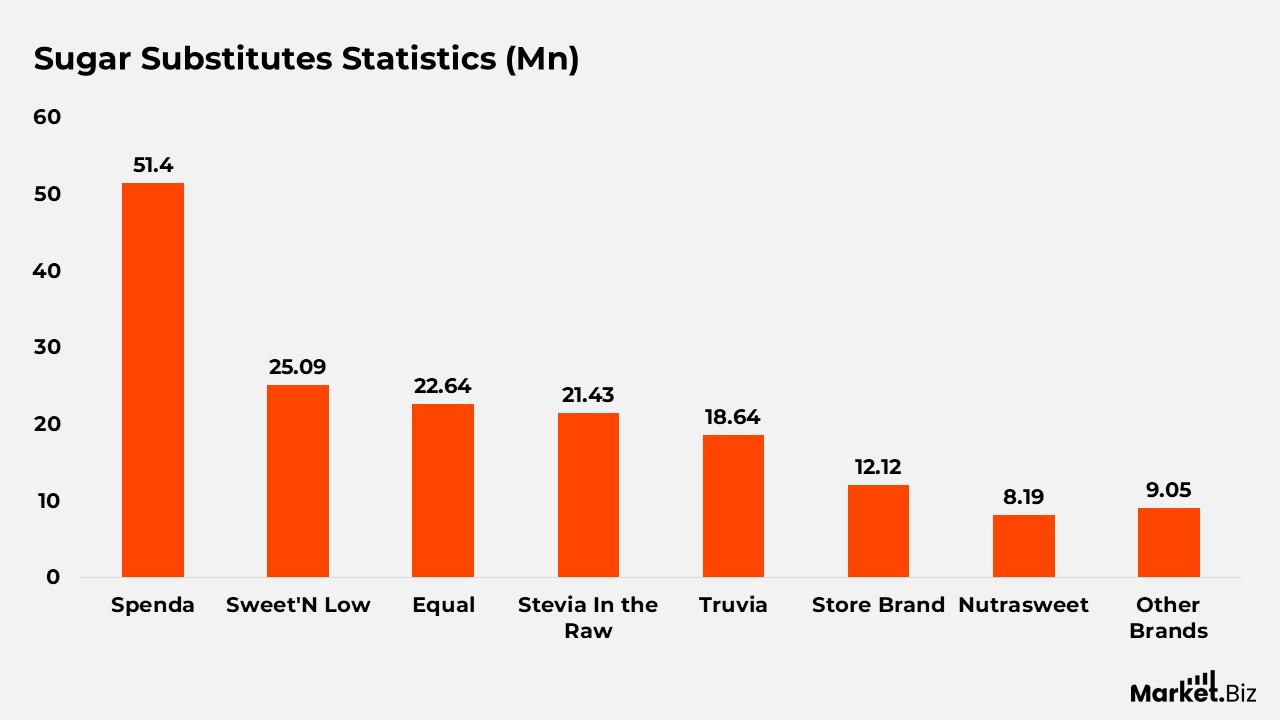
- In the United States, the consumption of various sugar substitutes among consumers differs, with Splenda being the most widely used, reported by 51.4 million consumers.
- Following closely is Sweet’N Low, chosen by 25.09 million consumers, and Equal, preferred by 22.64 million consumers.
- Truvia and Stevia In the Raw are also favored options, with 18.64 million and 21.43 million consumers, respectively.
- Store brands constitute a significant segment of the market, with 12.12 million consumers selecting these alternatives.
- 8.19 million consumers use Nutrasweet, while other brands together account for 9.05 million consumers.
Health Effects of Sweetener Statistics
- Health-focused websites are typically regarded as reliable by 18% of those surveyed, whereas registered dietitians appearing in the media are considered trustworthy by 13%.
- Fitness professionals also possess credibility for 13% of respondents, akin to the trust given to friends and family.
- In contrast, only 8% of participants trust the website or social media accounts of a food or beverage brand, while social media influencers or bloggers lacking medical or nutritional credentials are trusted by just 6%.
- For respondents who are caregivers or parents of children under 18 years, trust in registered dietitians as portrayed in the media rises to 20%, while trust in fitness professionals increases to 25%.
- In contrast, trust in health-oriented websites experiences a slight decline to 16%, and trust in family and friends decreases to 11%.
- Among respondents not belonging to this demographic, trust in health-oriented websites, registered dietitians, fitness professionals, and media sources falls to 13%, 10%, and 8%, respectively.
Recent Developments
- SteviaX has launched a new range of zero-calorie sweeteners aimed at health-conscious consumers, with expectations of a 20% increase in market share in the upcoming quarter. SweetBliss has introduced a natural sweetener sourced from monk fruit, addressing the rising demand for alternative sweeteners, and anticipates a 30% growth in sales during the first year.
- Truvia Enterprises has secured $30 million in Series B funding, led by a Venture Capital Firm, to support its expansion into new geographical markets and diversify its product offerings. PureSweet Inc. has raised $15 million in a seed funding round led by an Angel Investors Group, with plans to expedite research and development for innovative sugar substitutes, targeting a 50% reduction in production costs over the next two years.
- Low-calorie and zero-calorie sweeteners continue to be favored options among individuals managing diabetes and those conscious of their weight, contributing to a consistent year-on-year growth of 8% in this segment.
Conclusion
In summary, the sweetener market offers a wide variety of choices, including natural options such as honey and stevia, as well as artificial alternatives like aspartame and sucralose. These sweeteners address different consumer preferences and dietary requirements, providing options for individuals looking to lower their sugar consumption or manage health issues such as diabetes.
The regulatory framework, managed by organizations like the FDA, is vital in guaranteeing the safety and accurate labeling of sweetener products. As consumer awareness regarding health and wellness continues to increase, the demand for low-calorie and natural sweeteners is anticipated to foster innovation and market expansion in the years ahead.
Nevertheless, it is crucial to stay alert to potential health risks linked to certain sweeteners and to make well-informed decisions based on personal dietary needs and preferences.
FAQs
Artificial sweeteners can serve as a temporary solution for some individuals aiming to reduce their sugar intake and manage or lose weight. Generally, sugar substitutes are considered safe for healthy adults. However, it is important to understand how these substitutes influence your food and beverage selections. These components may condition your taste buds to expect sweetness.
While research is ongoing, aspartame frequently faces allegations of being linked to various long-term health issues. IARC has categorized aspartame as a Group 2B carcinogen, signifying that it may have the potential to cause cancer in humans.
There is no definitive “healthiest” sweetener, as the optimal choice varies based on your personal goals and preferences. Whole fruits and fruit purées are outstanding for providing nutrients such as fiber and vitamins, whereas for those seeking to reduce calorie intake, stevia and monk fruit sweetener are excellent, low-calorie, natural alternatives.