









Introduction
AI customer service statistics offer a data-driven view of how artificial intelligence is transforming customer support and engagement across industries. These statistics track adoption levels, performance outcomes, and the impact on customer experience of AI-driven tools such as chatbots, virtual assistants, sentiment analysis, and automated ticketing systems, highlighting improvements in response times, resolution rates, personalization, and operational efficiency.
From a strategic standpoint, the data illustrates a clear shift from traditional human-only support models toward hybrid service frameworks where AI augments agent capabilities, helping organizations scale service delivery, optimize costs, and deliver more consistent, experience-focused customer interactions.
Editor’s Choice
- A strong majority of consumers, around 75%, believe generative AI is set to transform how customer service experiences are delivered significantly.
- Retail transactions enabled through chatbot interactions are projected to grow sharply, reaching USD 72 billion by 2028, up from USD 12 billion in 2023, reflecting the rapid commercialisation of conversational AI.
- Adoption of AI-driven customer service tools has delivered measurable experience gains, with 70% of mid-sized businesses reporting customer satisfaction improvements exceeding 40% within just 3 months.
- Customer expectations continue to rise, with 84% of customers now placing equal importance on the service experience and the core product itself.
- AI-powered self-service bots are increasingly effective, resolving 54% of overall customer issues and up to 96% of simple queries. In comparison, nearly 50% of customers perceive AI agents as capable of showing empathy during interactions.
- A large share of customer experience leaders, approximately 70%, view chatbots as evolving into sophisticated tools that design and deliver highly personalized customer journeys.
- More than two-thirds of customer experience organizations believe generative AI enables them to deliver warmth and familiarity at scale, even when serving millions of customers simultaneously.
- Around 69% of organizations see generative AI as a key enabler for making digital customer interactions feel more human and relatable.
- Looking ahead, 72% of customer experience leaders expect AI agents to function as an extension of brand identity, consistently reflecting brand values, tone, and voice across customer touchpoints.
Growing Influence of Generative AI on Customer Experience Strategy
- A significant share of customer experience leaders, around 70%, state that generative AI has prompted their organizations to reassess and redesign existing customer experience models.
- Looking ahead, 57% of CX leaders expect chat-based customer support to be strongly shaped by generative AI over the next 2 years.
- Internal adoption pressure is rising, as 62% of CX leaders report that their teams feel increasing expectations to use generative AI in daily workflows.
- Strategic integration plans are accelerating, with 70% of CX leaders planning to embed generative AI across multiple customer touchpoints within the next two years.
- Investment momentum remains strong, with 64% of CX leaders planning to increase spending on AI and related technologies in the coming year.
- Among CX leaders who view AI as an amplifier of human intelligence, 81% plan to integrate AI directly into the tools already used by customer service agents within the next year.
- Organizational focus on customer intent is expanding, with 70% actively investing in technologies that automatically capture and analyze intent signals across customer interactions.
- Voice channels are also evolving, as 42% of CX leaders anticipate that generative AI will influence voice-based customer interactions within the next 2 years.
- High-performing support teams show stronger voice channel innovation, as CX leaders reporting high ROI are 62% more likely to prioritize enhancements such as speech analytics, voice AI, and natural language processing.
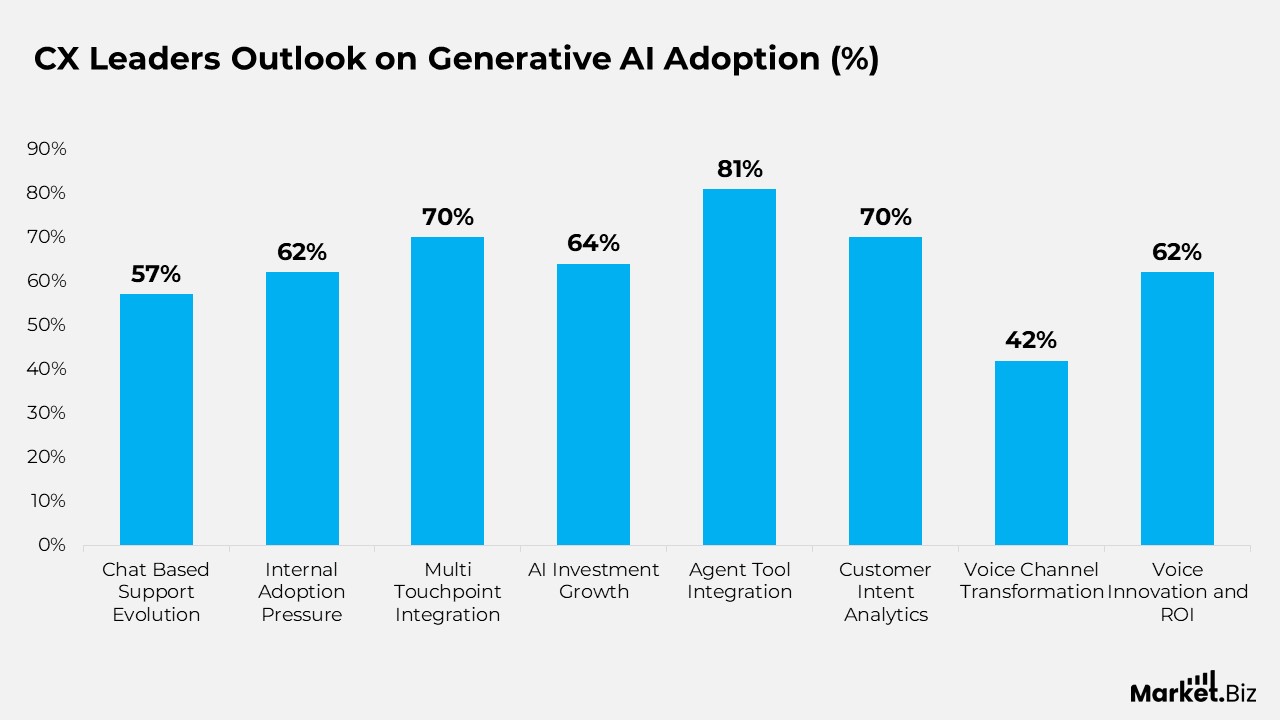
(Source: Zendesk, Statista)
Consumer Trust and Advancing Capabilities of AI-Powered Customer Service Bots
- A growing share of consumers, about 51%, indicate a preference for interacting with bots rather than human agents when immediate assistance is required.
- Confidence among service leaders is increasing, as 58% of CX leaders believe chatbot capabilities will become more advanced during 2024.
- Customer expectations continue to evolve, with 56% of consumers believing bots will be capable of holding natural, human-like conversations by 2026.
- Quality benchmarks are rising, as 68% of consumers expect chatbots to deliver the same level of expertise and service quality as highly skilled human agents.
- Investment momentum remains strong, with 64% of CX leaders planning to increase spending on chatbot development and enhancement within the next year.
- Usage patterns are broadening, as 67% of consumers report asking AI bots a wider range of questions than they did previously.
- Emotional engagement is gaining importance, with 67% of CX leaders believing bots can foster stronger emotional connections with customers.
- Perceptual boundaries are narrowing, as 48% of customers say distinguishing between AI-driven agents and human service representatives is becoming increasingly difficult.
(Source: Zendesk, Statista)
Gaps Between AI Potential and Operational Readiness in Customer Experience
- Among customer experience leaders who view AI as a driver of human intelligence, 71% believe agents require AI capabilities to be embedded directly into their existing tool sets.
- Frontline adoption remains limited, with only about 20% of agents reporting access to generative AI tools in their daily workflows.
- Automation maturity is still developing, with only 30% of CX leaders reporting that they use AI or machine learning to identify customer intent automatically.
- Data accessibility continues to constrain personalization, as more than 60% of agents state they would perform better if they had richer customer data to tailor interactions.
- Experience delivery gaps persist, with 62% of CX leaders acknowledging they fall short of customer expectations for instant service.
- Workforce planning remains complex, as 69% of CX leaders identify forecasting future labor needs as a major operational challenge.
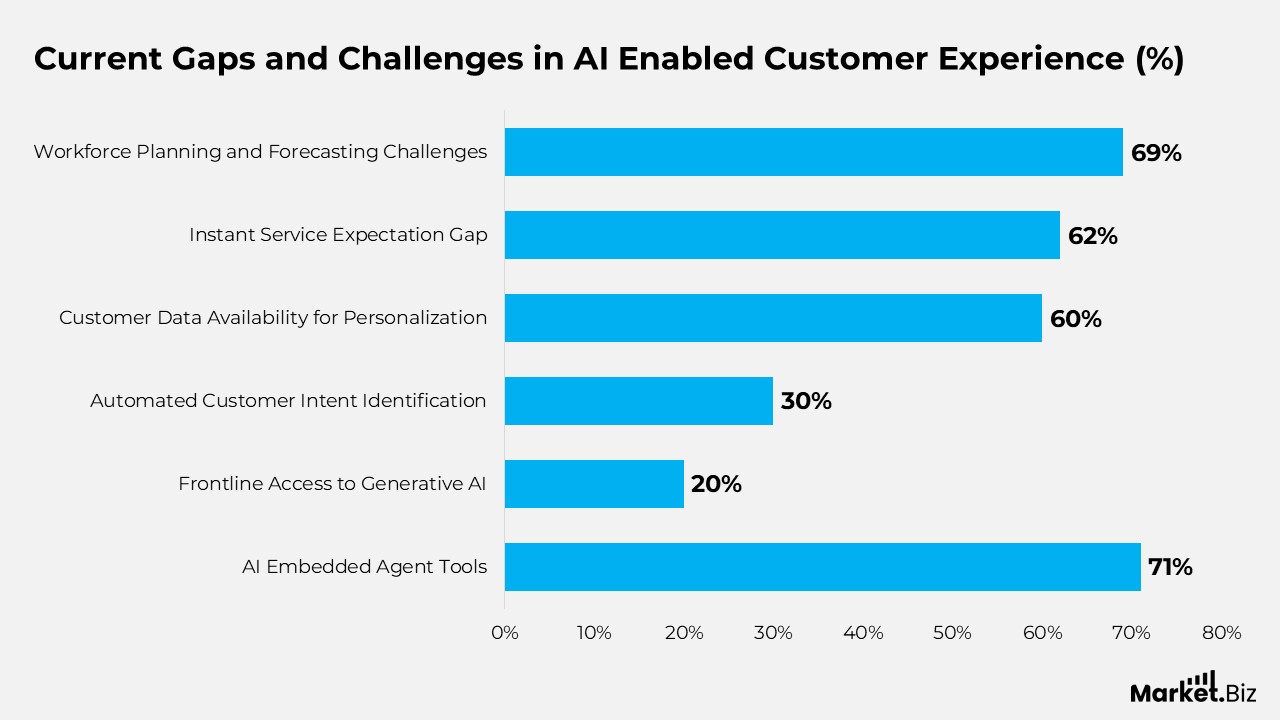
(Source: Zendesk, Statista)
Strategic Importance of AI and Automation in Customer Services Role Statistics
- A large majority of customer service specialists, around 79%, consider AI and automation to be essential components of their overall service strategy.
- The strategic value of AI spans business models, with 56% of professionals in B2B environments and 54% in B2C settings recognizing its importance.
- Deeper customer insight is a key benefit, as 62% report that AI technologies improve their understanding of buyer behavior and needs.
- Task prioritization improves with automation, with 78% stating that AI helps them concentrate on the most critical aspects of their roles.
- Job satisfaction shows a positive impact, as 71% indicate AI enables them to spend more time on work they find engaging and meaningful.
- Productivity gains are widely reported, with 78% of specialists believing that automation makes them more efficient in their day-to-day responsibilities.
- Collaboration quality also improves, as 75% say AI-driven tools enhance teamwork and data sharing across functions.
(Source: Hubspot, Master of Code)
Contact Center Leader Expectations from Conversational AI Adoption
- A strong majority of contact center leaders, about 87%, expect conversational AI to improve workforce productivity significantly.
- Conversational AI is viewed as a near-term necessity, with 80% of leaders considering these capabilities essential for future contact center operations.
- Business communication models are undergoing change, as 76% believe AI and chatbots are transforming how organizations interact with customers.
- Financial outcomes are expected to improve, with 72% of leaders anticipating higher profitability and revenue through conversational AI adoption.
- Risk mitigation is another perceived benefit, as 57% report that AI helps reduce overall business and operational risks.
- Competitive pressure is increasing, with 41% of leaders believing that delaying or avoiding AI adoption may cause organizations to fall behind peers.
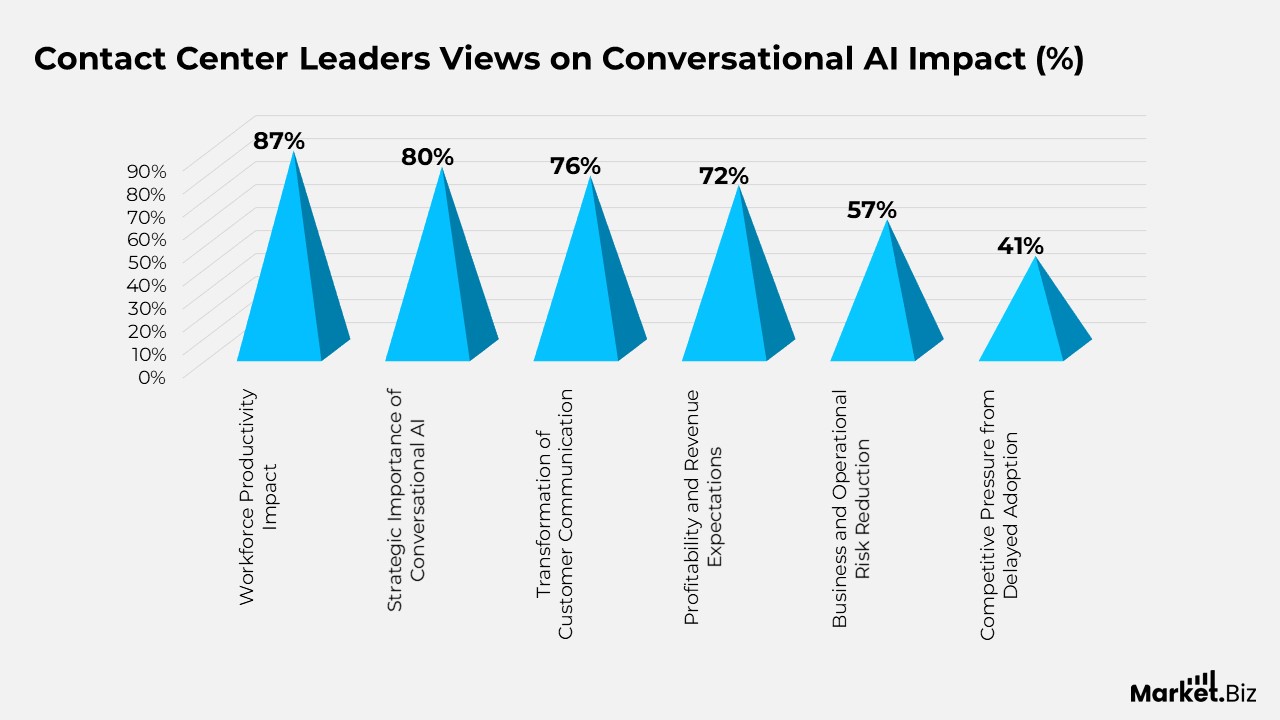
(Source: Hubspot, Master of Code)
Perspectives on the Impact of AI in Customer Engagement and Service Optimization
- A large share of senior leadership, around 84%, actively uses AI-driven technologies to interact and engage with clients.
- Customer loyalty benefits are widely recognized, with 88% of executives believing automated systems that deliver quick resolutions strengthen user retention.
- Overall sentiment toward AI adoption remains highly favourable, with 91% of businesses expressing positive views on using AI for consumer engagement.
- Confidence in next-generation technologies is especially strong, with 96% believing that generative AI will significantly enhance the quality of customer interactions.
- The speed of information access is a key advantage, as 67% of organisations rely on AI to deliver faster answers and insights.
- Service efficiency improvements are evident, with 62% using AI to reduce customer wait times.
- Data quality enhancement remains a priority, as 53% expect AI to improve the accuracy of customer-related information.
- The benefits of standardisation are acknowledged, with 42% leveraging AI to create more consistent customer interactions.
- Personalization capabilities continue to expand, as 41% use AI to deliver more tailored responses.
- Cost-efficiency gains are also recognized, with 28% of organisations using AI to reduce overall operational expenses.
(Source: Hubspot, Master of Code)
Rapid Acceleration of AI Adoption in Customer Service Operations
- AI is becoming central to customer engagement, with projections indicating that by 2025, nearly 95% of customer interactions may be handled by AI-driven systems.
- Consumer acceptance continues to strengthen, as 69% of customers prefer AI-powered self-service tools for fast issue resolution, reflecting growing trust in automated agents.
- Automation capabilities are expanding, with around 75% of customer inquiries now resolvable through AI tools without requiring human involvement.
- Adoption across customer service teams is advancing steadily, with nearly 50% of support units already implementing AI, while additional investments are planned through 2024.
- Conversational AI adoption is gaining momentum, with 52% of contact centers already investing in these technologies and another 44% planning future deployment.
- Common AI use cases in customer service include intelligent request routing (29%), customer feedback analysis (28%), and chatbots or self-service solutions (26%).
- Leading enterprises are actively deploying AI at scale, with telecom, retail, banking, aviation, and nutrition-focused companies using virtual assistants and chatbots to improve response speed, consistency, conversion rates, and customer satisfaction.
- Business objectives for AI adoption remain experience-focused, with 62% aiming to enhance customer service quality, 42% seeking workflow efficiency, 36% targeting higher customer satisfaction, and 33% prioritising reduced wait times.
- Customer experience transformation is accelerating, with 83% of organizations pursuing measurable CX improvements and 41% rolling out or upgrading generative AI, virtual assistants, and bot-based solutions.
- Automation priorities continue to evolve, with 25% of businesses focusing on AI-driven routing to the right agent, 21% on self-service resolution tools, 20% on customer feedback analytics, and 20% on systems that prioritise requests by urgency.
(Source: Hubspot, Master of Code)
AI Adoption in Customer Service
- Companies adopting artificial intelligence primarily focus on improving customer service quality, cited by 62% of organisations.
- Workflow efficiency remains a major driver, with 42% using AI to streamline internal service operations.
- Enhancing overall customer satisfaction motivates 36% of AI investments in customer service functions.
- Reducing customer wait times represents a key objective for 33% of businesses deploying AI tools.
- About 83% of organizations actively transform customer experience strategies to achieve measurable business outcomes.
- Nearly 41% of enterprises are updating or introducing Generative AI, virtual assistants, and chatbot solutions into their CX frameworks.
- Intelligent call and case routing ranks as the top automation priority, with 25% planning to adopt AI to connect customers to the right representative faster.
- AI-powered self-service solutions attract 21% of businesses seeking to enable independent issue resolution for customers.
- Around 20% of organisations leverage AI to collect, analyse, and interpret customer feedback at scale.
- Another 20% prioritize AI tools that automatically classify and sort customer requests by urgency.
- Customer support chatbots enhance digital service journeys for 84% of users, making them the most impactful AI application in customer service.
- Personalized interactions improve for 46% of users through chatbot and Generative AI-driven engagements.
- Among B2B and B2C service professionals, 48% express confidence in the accuracy of Generative AI-generated responses.
- Business leaders increasingly apply AI for operational efficiency, with 68% using it for process optimization.
- Advanced data analysis and insight generation motivate 49% of leaders to integrate AI into customer service ecosystems.
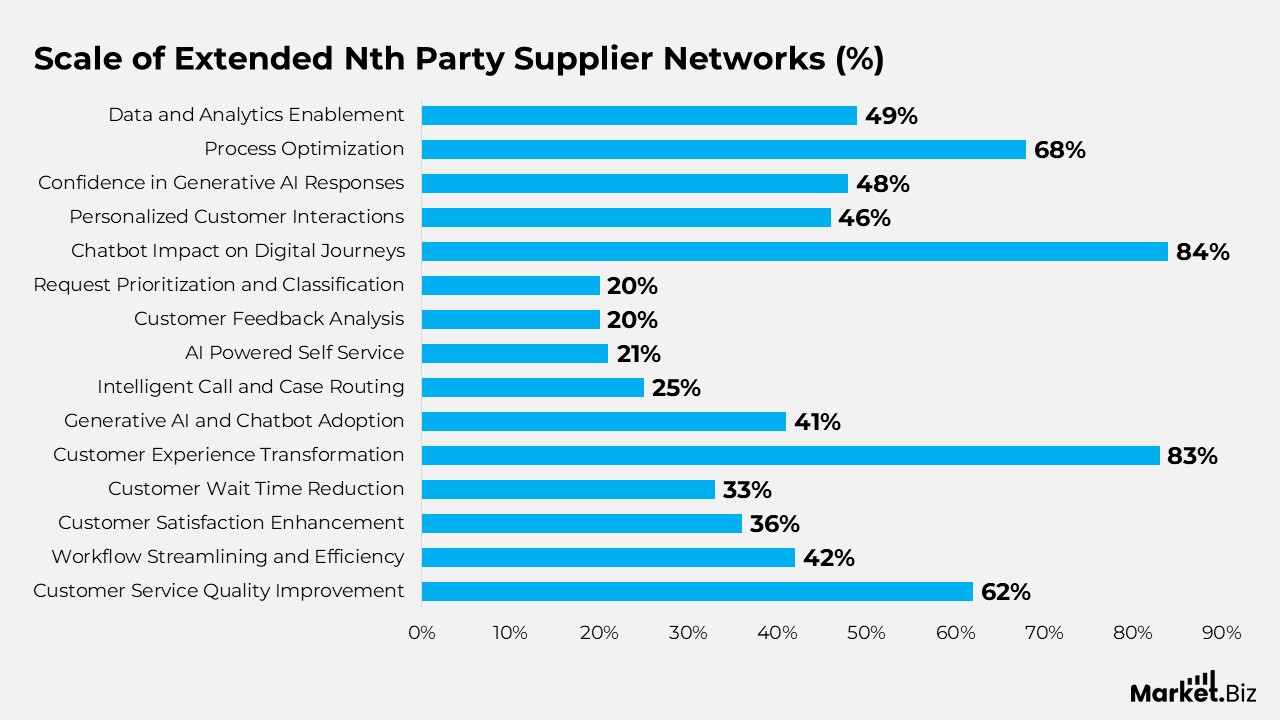
(Source: Hubspot, Master of Code)
Customer Experience Leads AI Adoption Priorities Across Key Industries
- In the banking, financial services, and insurance sector, 80% of organisations prioritise customer experience as a core focus of their AI implementation.
- The travel, transport, and hospitality industry places strong emphasis on AI-driven customer experience, with 79% ranking it as a top priority.
- Retail and consumer packaged goods companies show a similar trend, as 79% highlight customer experience as central to their AI strategies.
- Manufacturing and energy, and utilities organizations increasingly align AI adoption with customer experience goals, reflected by 72% prioritization.
- Within communications, media, and technology industries, 68% of companies focus AI initiatives on improving customer interactions and engagement.
- Healthcare and life sciences organizations also recognize the value of AI in experience management, with 69% prioritizing customer experience outcomes.
(Source: Hubspot, Master of Code)
Conclusion
AI customer service statistics underscore a decisive move toward intelligent, experience-led service environments where responsiveness, personalisation, and consistency shape customer expectations. The data reflects growing consumer acceptance of AI interactions, increased confidence in chatbots for real-time support, and rising expectations that AI agents deliver expertise, empathy, and service quality comparable to that of skilled human representatives.
Simultaneously, organisations are repositioning AI as a strategic priority, driving the redesign of customer journeys, increased investment in conversational technologies, and broader adoption of AI across digital and voice-based channels. At the same time, the statistics point to a clear gap between AI ambition and operational execution.
Despite strong leadership’s confidence in AI’s ability to enhance human performance and reinforce brand identity, limited agent-level access to generative AI, partial automation of customer intent detection, and data constraints continue to restrict impact.
Challenges around instant service delivery and workforce forecasting further highlight the need for deeper integration of AI into daily service operations. Overall, the findings indicate that sustainable AI-driven customer service success depends on closing adoption gaps, strengthening data foundations, and aligning AI capabilities with human-centric service models.
FAQ’s
In customer service, artificial intelligence is understood as a system of computational methods that simulate human cognitive functions, such as understanding, reasoning, and learning, to support service interactions and decision-making.
AI serves as an enabling layer that connects customer inputs, service processes, and organisational knowledge, enabling customer service systems to operate with greater consistency, adaptability, and responsiveness.
Customer experience serves as the primary outcome variable in AI-driven service models because service quality emerges from interactions, perceptions, and responsiveness rather than from transactions alone.
AI shifts customer service from linear, agent-dependent workflows toward dynamic, data-driven ecosystems where interactions continuously inform system learning and service optimization.
Generative AI operates on probabilistic language modelling and contextual reasoning, while rule-based automation relies on deterministic logic and predefined decision trees.

