








Introduction
Chatbot Statistics: Chatbots have become a vital component of today’s digital landscape, providing businesses with an innovative means to improve customer service, streamline operations, and offer 24/7 assistance. Thanks to advancements in artificial intelligence (AI) and natural language processing (NLP), these intelligent systems are now capable of offering personalized, dynamic interactions.
Increasingly adopted across industries such as e-commerce, healthcare, and finance, chatbots play a crucial role in tasks like responding to inquiries, handling transactions, and guiding users through intricate procedures. The ongoing evolution of chatbot technology is poised to transform the way businesses interact with customers, enhancing both customer satisfaction and operational effectiveness.
As companies continue to adopt automation, chatbots are becoming increasingly indispensable in digital transformation initiatives, delivering unmatched convenience and scalability to businesses worldwide.
Editor’s Choice
- Over 987 million people currently utilize AI chatbots.
- The cost of developing and deploying a chatbot can range from $5,000 to $500,000, depending on factors such as complexity, industry, and specific use cases.
- 87.2% of consumers rate their experiences with chatbots as either neutral or positive, with 62% preferring digital assistants for customer service over waiting for human agents.
- Chatbots can automate up to 30% of tasks typically handled by contact centre employees, potentially saving $23 billion in the U.S. alone.
- In 2023, 88% of consumers were related to at least one chatbot.
- Bots can manage up to 30% of live chat interactions and handle approximately 80% of routine tasks. Response times are significantly faster, with chatbots providing answers 3 times quicker on average.
- In 2022, 88% of customers interacted with an AI chatbot.
- The most common uses of digital assistants are in sales (41%) and customer service (37%), with marketing following at 17%.
- 96% of consumers are aware of chatbots.
- 29% of consumers expect chatbots to be available 24/7.
- Nearly half of chatbot users (47%) have reported mistaking a chatbot for a human during interactions.
Chatbot Preferences and Adoption
- 87.2% of consumers report having neutral or positive experiences with chatbots.
- 62% of consumers prefer using a chatbot rather than waiting for a human customer service representative.
- 38.12% of customers find it frustrating when a live chat’s chatbot fails to understand context.
- 69% of consumers were satisfied with their most recent chatbot interaction.
- When checking the status of an order, 71% of consumers would rather interact with a chatbot.
- 69% of customers would be willing to use a chatbot if they were assured it could resolve their issue more quickly.
- 40% of consumers are indifferent about whether a human or a chatbot handles their query.
- 88% of individuals engaged in at least one conversation with a chatbot in the past year.
- In 2023, 35% of consumers used chatbots instead of search engines to find answers to their questions. Additionally, 80% of users found their chatbot interactions to be generally positive.
- 60% of consumers favor messaging as a communication method over email or phone calls.
Moreover
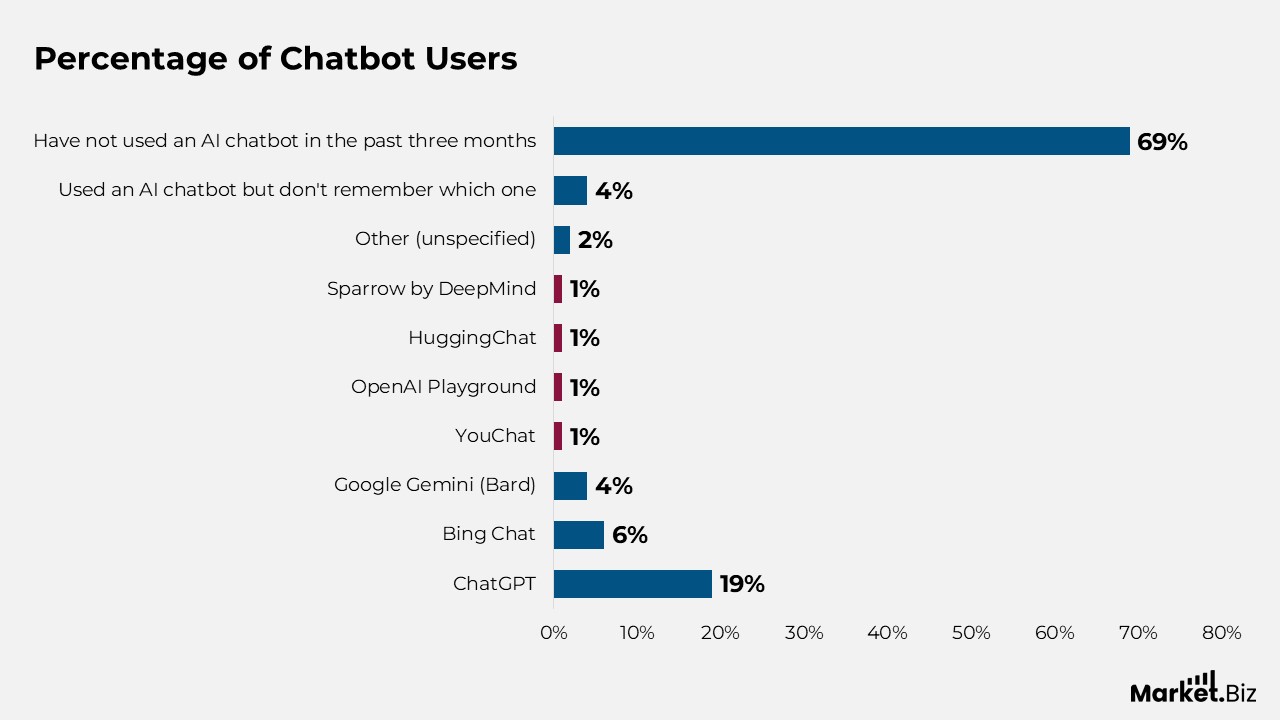
- One-third of Americans report having used an AI chatbot in the past three months.
- Above 987 million people use AI chatbots, with many more interacting with chatbot software on business websites.
- 69% of respondents mentioned they have not used an AI chatbot in the last three months.
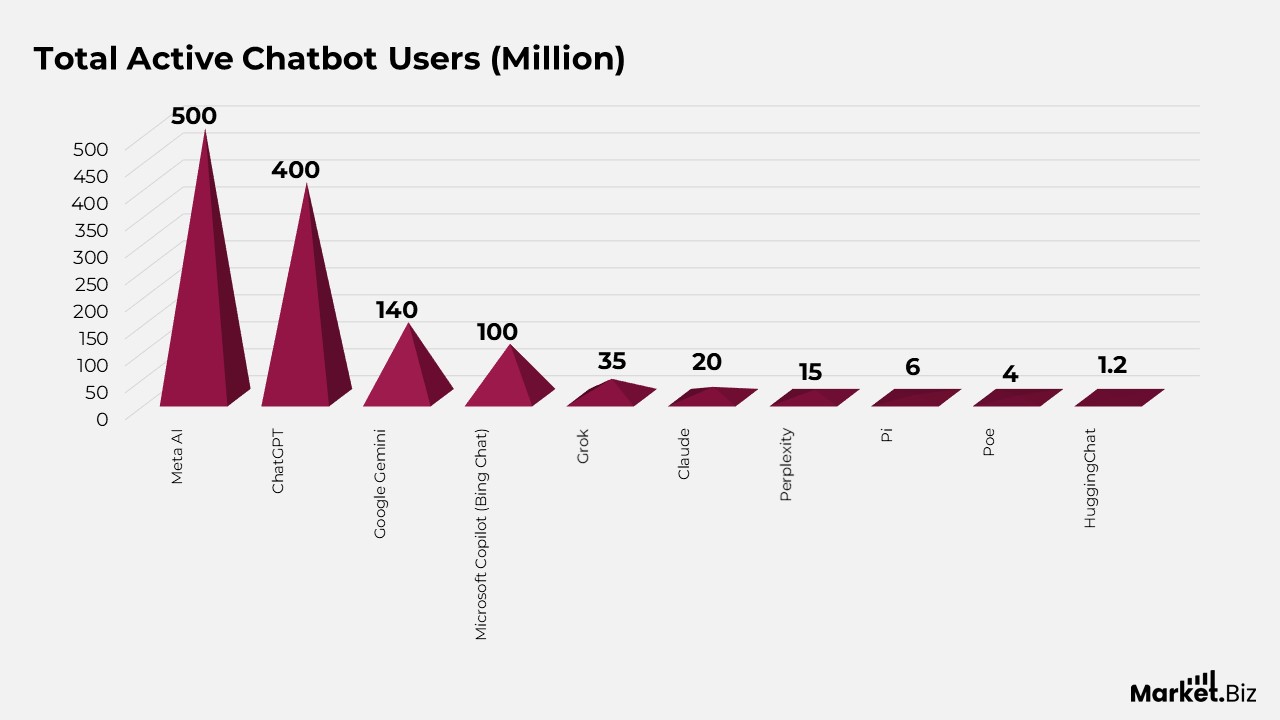
- Google Gemini has 140 million users, while Microsoft Copilot (Bing Chat) has 100 million.
- ChatGPT has 400 million users nearby.
- Meta AI leads in user base, boasting 500 million active users, more than any other AI chatbot.
- Grok is among the fastest-growing chatbots, now with over 35 million active users.
- 1.4 billion people actively use messaging apps.
- Over 300,000 chatbots are currently active on Facebook Messenger.
- In 2022, 88% of users had at least one interaction with a chatbot.
- Chatbot usage has surged by 92% since 2019.
- Approximately 40% of millennials interact with digital assistants daily.
- Only 9% of consumers are opposed to businesses using chatbots.
- 73% of buyers expect websites to have digital assistants for seamless interactions.
- On average, users ask 4 questions per chatbot session.
- Chatbots account for 39% of all conversations between businesses and consumers.
(Source: Zoho Corporation Pvt. Ltd., Consumer Reports, Uberall, Tidio, Semrush Inc., Exploding Topics, Master of Global)
Chatbot Users
- Meta AI leads with 500 million active users.
- ChatGPT has 400 million active users.
- Google Gemini has 140 million active users.
- Microsoft Copilot (Bing Chat) boasts 100 million active users.
- Grok is rapidly growing with 35 million active users.
- Claude has 20 million active users.
- Perplexity has gained 15 million active users.
- Pi currently has 6 million active users.
- Poe maintains 4 million active users.
- HuggingChat has 1.2 million active users.
(Source: Semrush Inc., Exploding Topics)
Global Chatbot Trends
- In 2022, 88% of customers had at least one interaction with a chatbot (Shopify).
- 87% of users worldwide provided positive feedback on chatbots in online stores, leading to fewer negative reviews (Drift).
- The healthcare sector saw an immediate 10% increase after integrating chatbots, according to Chatbot Life.
- 46% of customers still prefer human agents over chatbots, even if chatbots save time, as revealed by Usabilla.
- Opus Research reported that $4.5 billion was invested in chatbot integration across various sectors to enhance customer support.
- The chatbot industry is projected to reach $994 million by 2024, according to ClickZ.
- 67% of the global population has used chatbots for customer support, as recorded by Invesp.
- PwC found that 27% of customers using customer support were unsure whether they were interacting with a chatbot or a human agent.
- Statista estimates that global chatbot revenue will reach $455 million by 2027, driven by ongoing adoption.
- A survey by Facebook revealed that 79% of users feel more confident speaking directly with a brand’s customer agent rather than a chatbot.
- A 2018 report by Kindly highlighted $41 million in chatbot revenue, which has since increased significantly.
- According to a 2021 Gartner study, most brands focused more on improving their chatbots than on developing mobile applications.
(Source: Gartner, Statista, PwC, Shopify, DemandSage, Drift, Chatbot Life, Invesp)
Chatbot Market Size
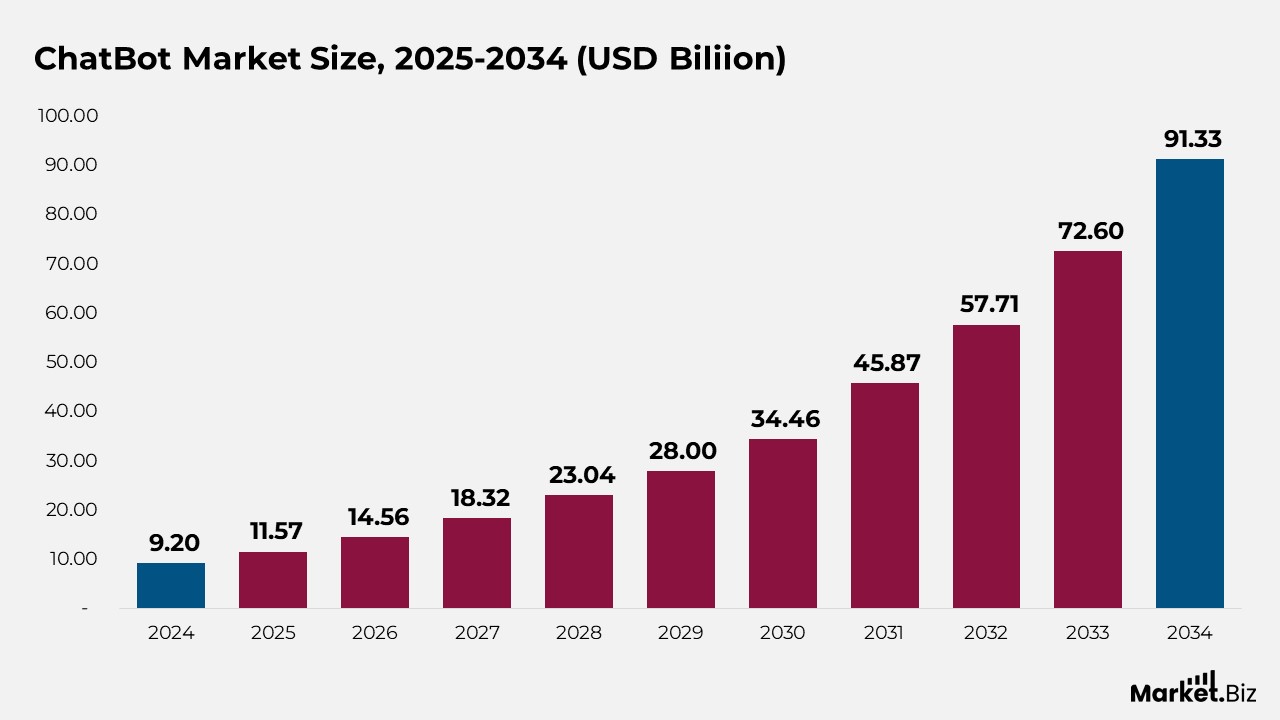
- According to Market.us, the Chatbot market is projected to grow from $11.57 billion in 2025 to $91.33 billion by 2034, representing a CAGR of 25.8% from 2025 to 2034.
- The demand for efficient customer service solutions, digital transformation, and increasing user comfort with AI interactions drives the growth of the chatbot market.
- In 2024, the solutions segment led the market, holding 68.6% of the share due to its versatility in automating customer interactions.
- The menu-based chatbots segment captured 32.5% of the market share in 2024, attributed to their simplicity and efficiency in handling routine customer service tasks.
- The text-based chatbot segment dominated the market, accounting for a 38.8% share in 2024, thanks to its ease of adoption and integration across various digital platforms.
- The mobile apps segment led the market, accounting for 42.2% of the share in 2024, driven by the growing use of smartphones and the increasing integration of chatbots into mobile applications.
- The contact centers segment accounted for 30.7% of the chatbot market share in 2024, highlighting the impact of chatbots on transforming traditional contact center operations.
- The retail and e-commerce segment held a 34.8% market share in 2024, largely due to the significant role of chatbots in enhancing customer shopping experiences.
- In 2024, North America accounted for 37.5% of the chatbot market, generating USD 3.4 billion in revenue, driven by early adoption and the strong presence of leading tech companies.
(Source: Market.us)
Natural Language Processing Market Size
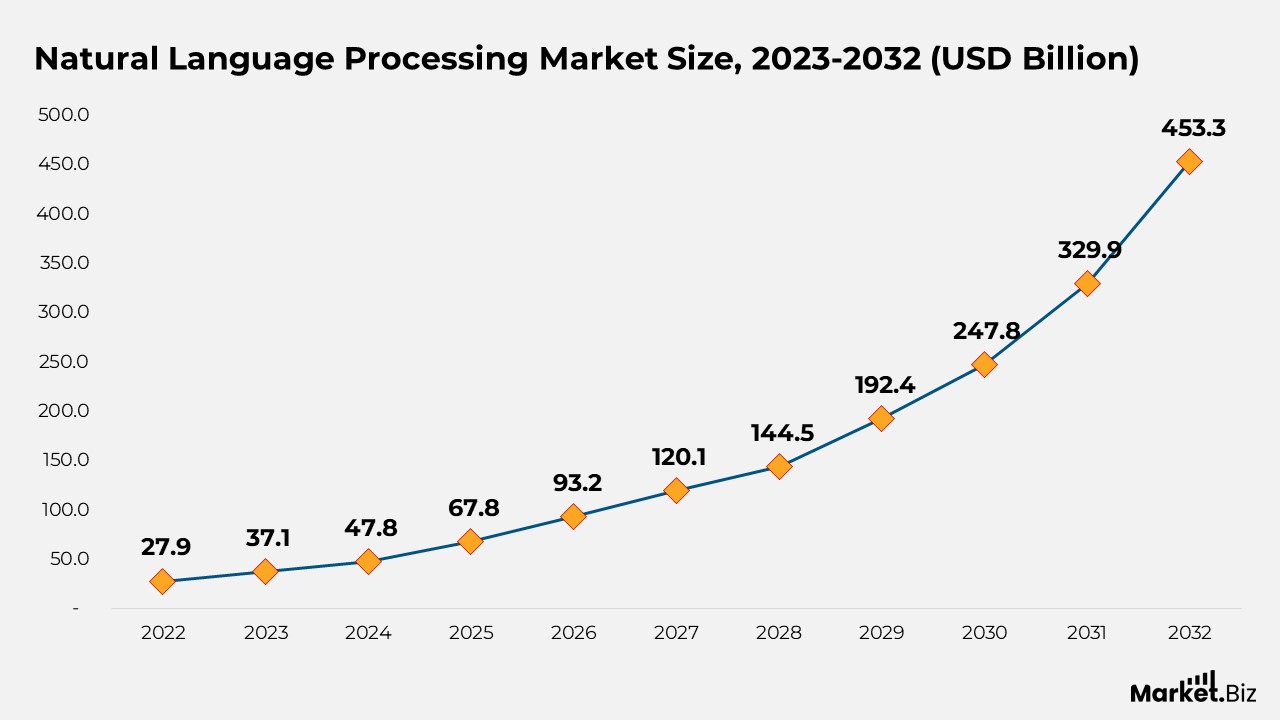
- According to Market.us, the global natural language processing market is projected to grow from $67.8 billion in 2025 to $453.3 billion by 2032, representing a compound annual growth rate (CAGR) of 8.10% from 2023 to 2032.
- The market growth is fueled by the increasing adoption of NLP technologies, driven by the need for better data handling and management of unstructured data from digital sources.
- In 2022, the Statistical NLP segment led the market with a 39.3% share, primarily due to its effectiveness in processing large datasets for various applications, including voice-operated GPS, chatbots, and virtual assistants.
- The On-Premises segment dominated the NLP market in 2022, driven by demand for enhanced security and control, particularly in sensitive sectors such as finance, healthcare, and government.
- The Automatic Summarization segment held a prominent market position in 2022, driven by the growing need for tools that condense large amounts of text into concise summaries for efficient decision-making.
- In 2022, large enterprises captured 62.1% of the NLP market share, benefiting from the operational needs and technological resources of large-scale organizations.
- The healthcare segment dominated the NLP market in 2022, with a 23.1% share, driven by increasing demand for improved patient care and operational efficiency optimisation.
- North America held a dominant 30.7% share of the NLP market in 2022, generating approximately USD 8.56 billion in revenue, supported by rapid AI advancements and a strong tech presence.
(Source: Market.us)
Benefits of Chatbots for Businesses
- Response rates for digital assistants vary, ranging from 35% to 40% for less engaging experiences to 80% to 90% for the most engaging ones.
- Chatbots have the potential to automate 30% of tasks currently handled by contact centre staff, potentially saving $23 billion in the U.S.
- 29% of chatbot interactions happen outside of regular store hours.
- 64% of internet users consider 24/7 service an essential feature of chatbots.
- 61% of respondents believe that bots can enhance productivity by automating follow-ups on tasks.
- Chatbots can manage up to 30% of live chat communications and handle approximately 80% of routine tasks and inquiries.
- 90% of businesses experienced faster complaint resolution with the use of digital assistants.
- 57% of users believe chatbots can enhance communication within organisations.
- In 2022, chatbots contributed to $11 billion in total cost savings, with businesses saving up to 30% on customer support expenses alone.
- Drift reports that chatbots are specifically designed to provide 24/7 customer support, accommodating customers from various time zones worldwide.
- According to IBM, chatbots can help businesses save up to 30% in total costs by reducing the need for human chat support workers.
- Nearly 42% of potential customers use chatbots when purchasing products online for a seamless experience without any doubts.
- Chatbots have achieved an 80% consumer satisfaction rate, primarily because they are programmed to deliver accurate responses.
- Most customers prefer interacting with a chatbot rather than a human corporate agent to resolve their queries.
- Chatbot Marketing states that high-quality chatbots can achieve response rates of 80-90%, offering a more seamless customer service experience than human agents.
(Source: Invesp, International Business Machines Corporation, Outgrow, MIT Technology Review, Accenture Digital, Master of Code Global, Shopify, Drift, Userlike, DemandSage)
Chatbot Insights for eCommerce
- Chatbots can boost conversion rates for e-commerce businesses by as much as 30%.
- E-commerce companies can significantly reduce customer service costs, with chatbot interactions costing an average of $0.50, compared to $6.00 for human customer service interactions.
- By 2025, it’s expected that 80% of e-commerce businesses will be utilizing chatbots.
- eCommerce chatbots can reduce cart abandonment by 20-30% by encouraging customers to return and complete their purchases.
- Stores that use Facebook Messenger, combined with an abandoned cart chatbot, saw a revenue increase of 7-25%.
- There was a 30% increase in order tracking, and chatbots enhanced the user experience by providing a seamless purchase process on e-commerce websites.
- Chatbots are projected to contribute $112 billion in retail sales.
(Source: Shopify, Zendesk, Haptik, Yellow.ai, DemandSage)
Role of Chatbots in Customer Support
- Companies save approximately 30% on customer support costs by utilizing chatbots.
- Chatbots are skilled at handling up to 79% of routine queries.
- 42% of support leaders foresee the creation of a chatbot analyst role within support teams shortly.
- 30% of C-level executives in support departments consider the implementation of automated support through chatbots a top priority for 2024.
- 53% of customers abandon interactions within the first 10 minutes of waiting for an agent to respond.
- Gen Z consumers prefer brands that engage them in real-time, offering personalized experiences.
- 65% of consumers use social media messaging apps to contact a company’s customer service team.
- 28% of leading companies leverage AI for marketing purposes.
- Chatbots manage conversations from start to finish about 70% of the time.
- 39% of companies implement chatbots to enhance the interactivity of their websites for users.
- 90% of businesses report faster complaint resolution after implementing chatbots.
- Chatbots are mainly used for customer service and after-sales tasks, accounting for over 77% of their applications.
- In the past year, 67% of global consumers used a chatbot to seek customer support.
- 64% of businesses believe chatbots enable them to deliver a more personalized support experience for customers.
- 64% of AI-powered agents focus on solving complex issues, compared to 50% of non-AI agents.
Moreover
- 53% of service organizations expect to adopt chatbots within the next 18 months, representing a 136% increase from the previous 18 months.
- 90% of customers desire an immediate response to support inquiries, with 60% defining immediate as under 10 minutes.
- 34% of retail customers are comfortable using AI chatbots for customer service rather than live chat.
- 34% of online shoppers prefer interacting with chatbots or virtual assistants to answer their questions.
- Virtual customer assistants help businesses reduce call, chat, and email inquiries by 70%.
- Chatbots help brands save up to 30% on customer support costs.
- 27% of consumers were unsure whether their last customer support interaction was with a human or a chatbot.
- The leading use case for chatbots is to provide quick answers in emergencies, followed by resolving complaints and answering questions.
- 48% of users prefer chatbots that resolve issues efficiently over those with a more conversational personality.
- 71% of users are fulfilled with the voice assistants on their mobile devices.
- 43% of users between the ages of 16 and 64 use voice search and commands across various devices.
- By 2023, 70% of consumers are expected to replace visits to physical stores or banks with voice assistants.
- 49% of users prefer voice assistants to complete human interactions in shops and call centers due to their speed and convenience.
(Source: PwC, Statista, Gartner, International Business Machines Corporation, HubSpot Research, Forbes, Accenture, MIT Technology Review, Botpress Technologies, Inc., Statista, Drift, Voicify, Capgemini)
Chatbot Trends
- According to Google Trends, interest in voice AI has grown nearly threefold over the past five years.
- By 2025, 95% of customer interactions will be powered by AI, meaning that AI will assist 19 out of every 20 interactions.
- Gartner predicts that by 2024, chatbots will manage 85% of all customer interactions without requiring human intervention.
- Only 8% of customers interacted with a chatbot during their most recent customer service experience.
- A study by Facebook reveals that 53% of consumers prefer shopping with businesses they can directly message, highlighting the advantage for companies adopting platforms like WhatsApp early.
- The value of chatbot transactions is expected to exceed $112 billion by 2024.
- Chatbots are most frequently used for customer support (37%), sales (41%), and marketing (17%).
- 67% of businesses trust that by 2025, chatbots will surpass mobile apps in usage.
- By 2025, 77% of customers expect chatbots to alter their expectations of brands significantly.
- The countries with the highest number of chatbot users are India (11%), the U.S. (36%), and Germany (4%).
(Source: Gartner, Forbes, The Base, Techreport, HubSpot, Warrington, Intercom, Google Trends)
Challenges of Using Chatbots
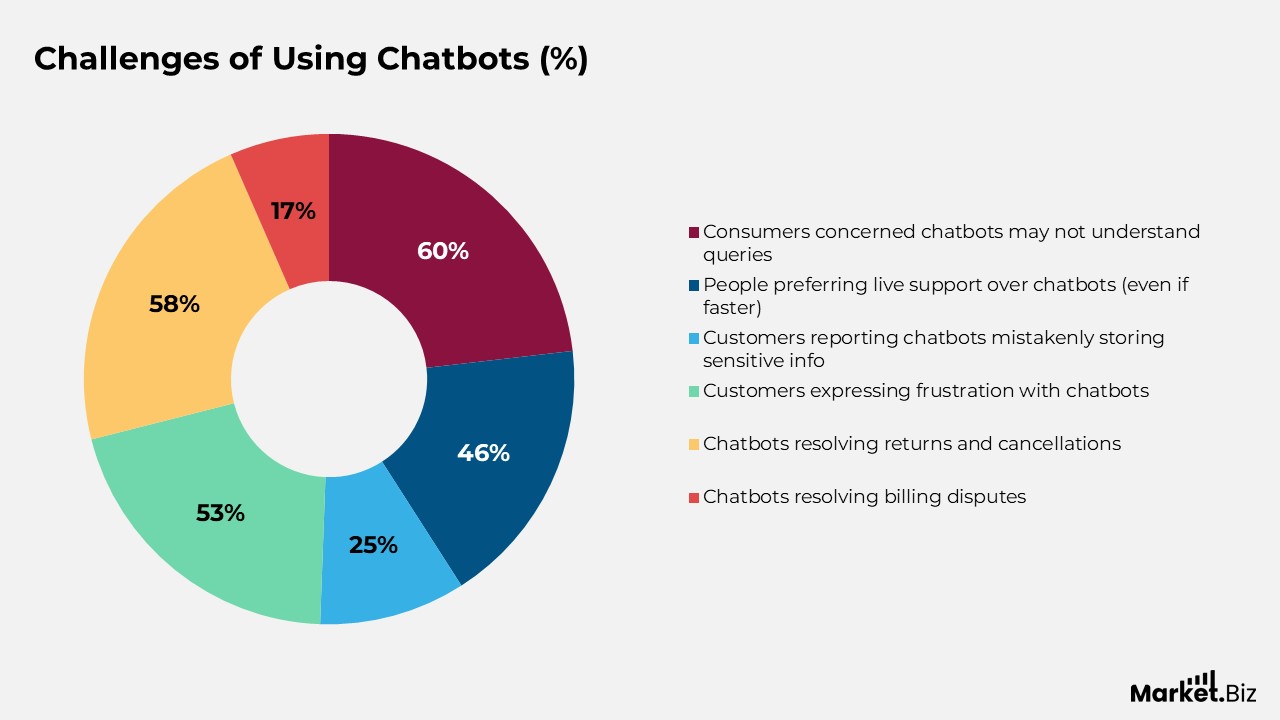
- 60% of consumers are concerned that chatbots may not fully understand their queries.
- 46% of people prefer live support over chatbots, even if the chatbot is faster.
- 25% of customers have reported that chatbots have mistakenly stored sensitive information such as passwords or credit card details.
- 53% of customers have expressed frustration when interacting with chatbots.
- Chatbots can resolve 58% of returns and cancellations, but only 17% of billing disputes.
(Source: DemandSage, Chatbots Magazine, Medium, Gartner)
Conclusion
Chatbots and AI-driven customer interactions have emerged as a powerful force, transforming industries worldwide. As consumer expectations shift increasingly towards quicker and more efficient service, businesses are turning to chatbots to fulfil these demands.
The growing need for 24/7 support, cost reduction, and the automation of routine tasks is driving chatbots to redefine customer service, sales, and marketing approaches.
Although challenges remain, such as concerns over chatbots’ ability to fully comprehend complex queries and the preference for human agents in certain cases, the overall impact of chatbots has been overwhelmingly positive.
As AI technology continues to advance, there is significant potential for even more seamless, personalized, and sophisticated chatbot experiences. With the rise of voice AI and increased consumer adoption, chatbots will continue to play a central role in shaping the future of interactions between businesses and customers.
FAQ’s
In 2022, 88% of customers interacted with at least one chatbot (Shopify). Additionally, 87% of users worldwide shared positive feedback about their chatbot experiences (Drift).
Chatbots can reduce customer support costs by 30% and automate 30% of tasks typically performed by contact center staff, potentially saving $23 billion in the U.S. alone.
Chatbots are widely used in various industries, including customer support, sales, marketing, and healthcare. For example, in healthcare, the adoption of chatbots led to a 10% increase in operational efficiency (Chatbot Life).
Chatbots enhance the customer experience by providing 24/7 support, reducing wait times, automating common inquiries, and offering fast response times. Some chatbots resolve issues three times faster than human agents.
The main challenges with chatbots include their ability to fully understand complex queries, limitations in handling certain issues (like billing disputes), and customers’ preference for human agents in specific scenarios.
Chatbots manage various customer service tasks, including responding to common queries, handling live chat communications, and processing transactions. Approximately 70% of conversations are managed by chatbots from start to finish, and bots handle 39% of all business-to-consumer chats.
Around 67% of the global population has used chatbots for customer support, with the highest adoption rates seen in countries such as the U.S., India, and Germany.

