









Introduction
Customer Experience Management Statistics: Customer experience management (CEM) has become essential for businesses striving to create enduring, meaningful connections with their customers. As consumer expectations evolve, companies are placing a greater emphasis on delivering personalized and smooth experiences across various touch points.
The advancement of digital transformation, driven by technologies such as artificial intelligence (AI), data analytics, and machine learning, is empowering organizations to gain deeper insights into customer behaviors and preferences. This understanding enables businesses to provide customized solutions, enhance satisfaction, and build brand loyalty.
As expectations grow more complex, businesses are increasingly adopting omnichannel strategies and customer-centric models to maintain a competitive edge and ensure long-term success.
Editor’s Choice
- Phone support and email assistance are the most common customer support methods, used by 51% and 42% of businesses, respectively.
- Companies demonstrating a connection between customer satisfaction and growth, margins, and profitability are 29% more likely to attract additional CX funding.
- 86% of customer service leaders across all major industries report that improving customer experience is their top priority.
- 62% of customers prefer human interaction for customer support over digital solutions.
- For 63% of consumers, poor customer experience results in negative word-of-mouth, potentially causing the company to lose not just the customer, but their family and friends as well.
(Source: Zoom Communications, Inc., Gartner, Qualtrics, Verint)
Loyalty Management Market Size
- Loyalty management software accounted for more than 50% of the total revenue, becoming a key component for organizations focusing on customer service and engagement analysis.
- Customer loyalty played a significant role in 2021, with loyalty influencing buying decisions and encouraging referral programs that offer rewards like discounts or free subscriptions.
- The on-premise deployment mode held more than 50% of revenue in 2021, driven by data security concerns and the desire for control over systems and customer data.
- The consumer goods and retail segment contributed significantly to global revenue in 2021, with loyalty programs such as points, cashbacks, and discounts encouraging repeat purchases.
- North America accounted for 36% of the revenue in 2021, driven by loyalty-based retail preferences and consumer demand for financial benefits like cashback, rebates, and product discounts.
(Source: Market.us)
General Customer Experience Management Statistics
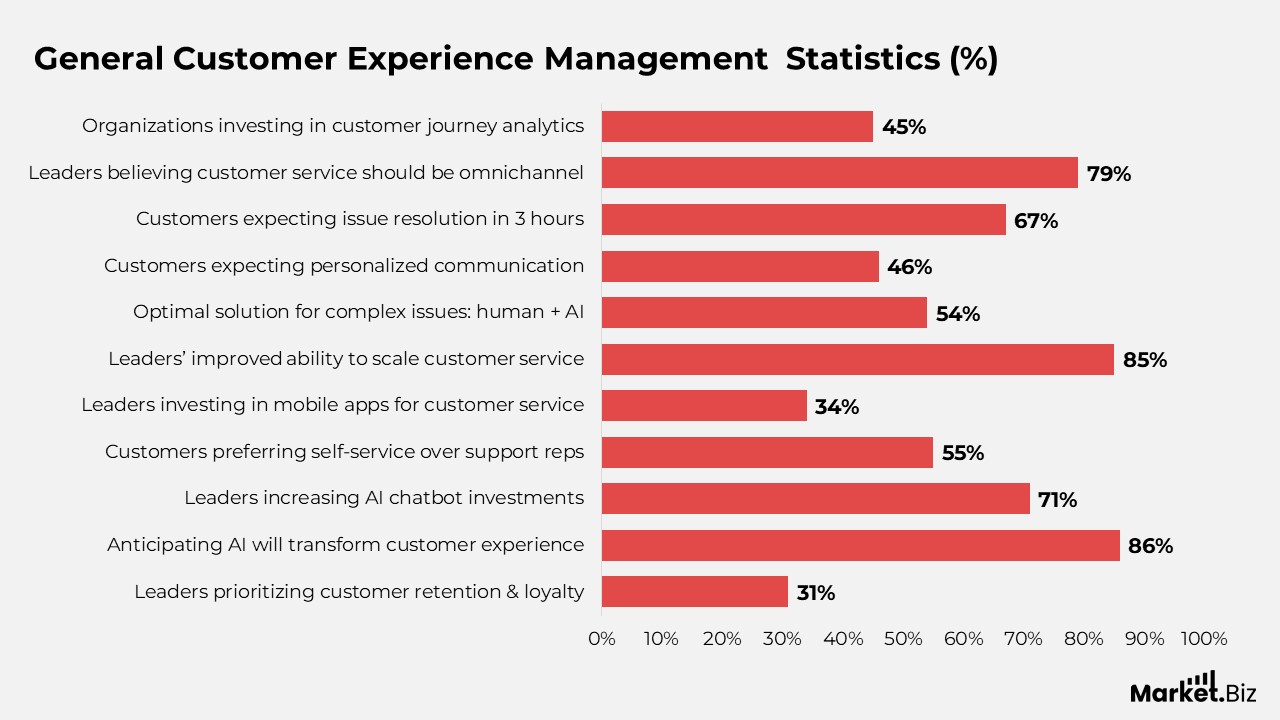
- 31% of customer service leaders prioritize enhancing customer retention and loyalty.
- One of the major challenges in delivering an exceptional customer experience is understanding customer needs.
- 86% of respondents anticipate that AI will significantly transform customer experience.
- 71% of leaders intend to increase investments in AI chatbots for customer service.
- Self-service options and customer intelligence are key investment areas for utilizing AI in customer service.
- A majority of leaders seek better alignment between customer success teams and other departments.
- 55% of customers prefer using self-service channels over speaking to a support representative.
- In 2024, AI chatbots and live chat are the most widely used service channels.
- 34% of customer service leaders plan to invest in developing a mobile app for customer service.
- 85% of leaders believe their ability to scale customer service operations with business growth has improved to some degree.
- 54% of leaders believe that a human supported by AI is the optimal solution for handling complex support issues.
- 46% of customers expect more personalized communication to trust a brand.
- 67% of customers expect a resolution to their issue within three hours.
- 79% of leaders believe customer service should be available on all channels used by customers.
- 45% of organizations are planning to invest in customer journey analytics.
(Source: HubSpot, Inc., Statista, DemandSage)
Customer Experience Management Trends
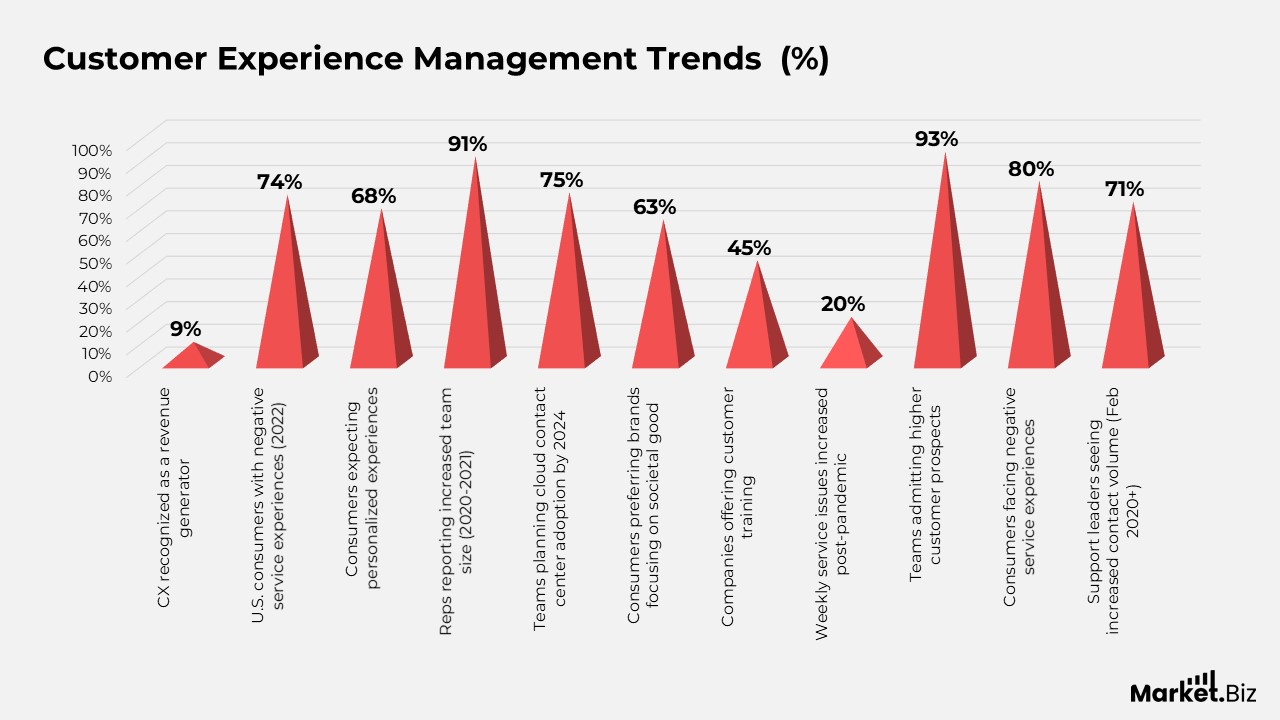
- 9% of companies now recognize customer experience (CX) as a revenue generator, rather than just a cost center.
- 74% of U.S. consumers reported having a negative customer service experience with a product or service in 2022, marking an 8% increase compared to 2021.
- Customer satisfaction dropped during the pandemic, with the American Customer Satisfaction Index showing a score of 73.4 in Q4 of 2022. Tracking customer satisfaction can highlight areas needing improvement and help optimize the overall experience.
- Consumers have become prime targets for fraud post-pandemic, with over $10 billion lost to fraud in 2023, further eroding trust in unfamiliar sources.
- 68% of consumers expect brands to provide personalized experiences in every interaction, including customer support.
- 91% of customer service representatives reported an increase in their team size between 2020 and 2021, reflecting greater investment in customer success.
- The shift to cloud technology by customer service teams accelerated due to the pandemic, with 75% planning to adopt a cloud contact center by 2024.
- 63% of consumers are drawn to brands that focus on societal improvements, showing a preference for brands that emphasize collective well-being over individualism.
- 45% of companies provide customer training, with the majority agreeing it strengthens client relationships.
- Since the pandemic’s onset, weekly customer service issues have increased by 20%.
- 93% of customer service teams admit that customer prospects are now higher than ever.
- 80% of consumers regularly face negative customer service experiences, desiring better pricing, product features, and user-friendly interfaces.
- 71% of customer support leaders have seen an increase in overall contact volume since February 2020, with expectations that this trend will continue.
(Source: Nextiva, WSJ, ACSI, FTC, Acxiom, Totango, Deloitte, Edelman, Docebo, Zendesk, HubSpot, Qualtrics, FreshWorks)
Importance of Customer Experience in Business Success
- In 2024, 87% of customer service teams acknowledged a surge in customer expectations—up from 83% in 2023 and 75% in 2022, highlighting growing pressure to enhance service quality.
- 61% of customers indicated a preference for faster assistance through AI over waiting for human agents, underlining a shift toward instant service.
- Consequently, 45% of support teams have integrated AI into their operations to meet this rising demand.
- AI’s key benefits include faster problem resolution (44%), time efficiency (45%), and 24/7 availability (50%).
- Additional advantages such as cost savings, smarter feedback analysis, and improved service consistency and quality were cited by 35% of teams.
(Source: Intercom, Notta, Statistics)
Customer Experience Management Market Size
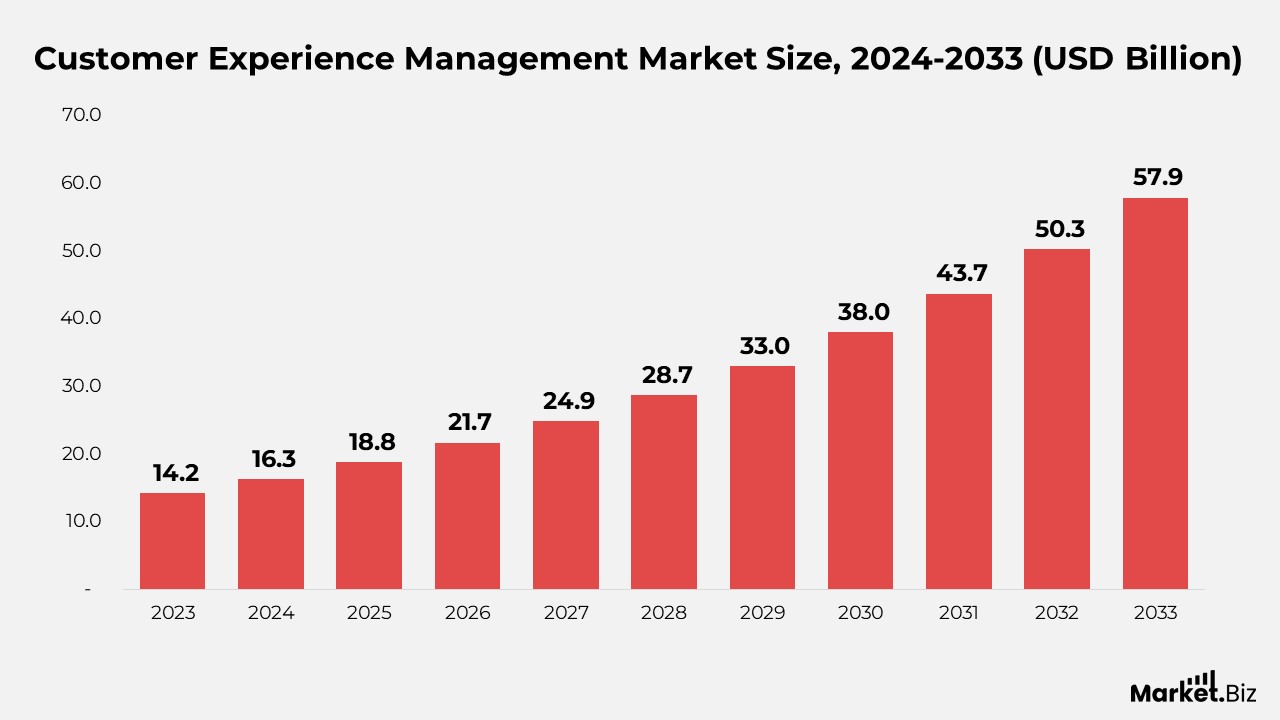
- According to Market.us, the global customer experience management market is expected to increase from $16.3 billion in 2024 to $57.9 billion by 2033, representing a compound annual growth rate (CAGR) of 15.1% from 2024 to 2033.
- The growth of the Customer Experience Management (CEM) market is fueled by an increased focus on customer retention and loyalty in a competitive market environment.
- 42.7% of the CEM market share in 2023 was held by the Text Analytics segment, highlighting the importance of textual data in understanding customer interactions and sentiments.
- 33.4% of the market share in 2023 was captured by the Call Centers segment, underscoring their critical role in shaping customer perceptions and satisfaction.
- The On-Premise segment led the market in 2023 with a 61.3% share, offering advantages in control, security, and customization for organizations.
- The Retail segment commanded 26.2% of the CEM market share in 2023, reflecting the vital role of customer experience in the retail industry.
- North America dominated the CEM market in 2023, holding 38.9% of the market share with revenues of USD 5.5 billion, driven by strategic and technological factors.
(Source: Market.us)
CX for Customer Loyalty
- As per PwC, 1 in 3 customers are willing to walk away from a brand they love after just a single negative experience, and 92% would completely sever ties after two to three bad encounters.
- Nearly 60% of consumers say they would end their relationship with a brand if they received unfriendly or poor service.
- Around 40% of customers report that their future buying decisions are directly influenced by the experiences they have with a brand today.
- According to Emplifi, 50% of surveyed consumers admitted to switching from a brand they had been loyal to within the past year due to disappointing experiences.
- Approximately 74% of customers are at least somewhat inclined to make purchases based solely on the quality of the experience, even more than the product or price.
(Source: PwC, Emplifi)
How AI is Transforming Customer Satisfaction and Experience?
- 8% of consumers now expect a higher degree of personalized interaction than ever before, signaling a shift in service expectations.
- In response, 84% of CRM leaders consider AI essential for engaging today’s digitally savvy customers.
- CRM platforms play a key role in delivering tailored experiences, and 75% of CRM leaders report that AI has helped accelerate their service response times.
- Among those using AI, 86% say it has led to improved customer satisfaction, proving its effectiveness in enhancing the customer journey.
- Looking ahead, 56% of forward-thinking CX Trendsetters plan to deepen AI-driven personalization efforts, while only 22% of more conservative “CX Traditionalists” intend to follow suit.
- 72% of frequent chatbot users are more inclined to leave a positive review following their interaction.
- 53% of consumers reported favorable feelings toward companies that utilize AI in customer support after understanding its benefits.
- Brands that deploy conversational AI tools see an average self-service rate of 61%.
- 58% of consumers now expect AI to enhance customer support through 24/7 availability.
- Nearly 48% of companies have experienced improved customer experiences as a result of AI integration.
- Around 92% of businesses have adopted AI-driven personalization strategies to deliver more individualized experiences.
- 47% of marketing leaders currently leverage AI to identify the most frequent customer journey patterns.
- 35% of organizations are actively training and reskilling their workforce to adapt to AI and automation technologies.
(Source: Notta, Zendesk, Statista, HubSpot, Zoom, IBM, Medallia, Statista. )
Customer Connection and Convenience
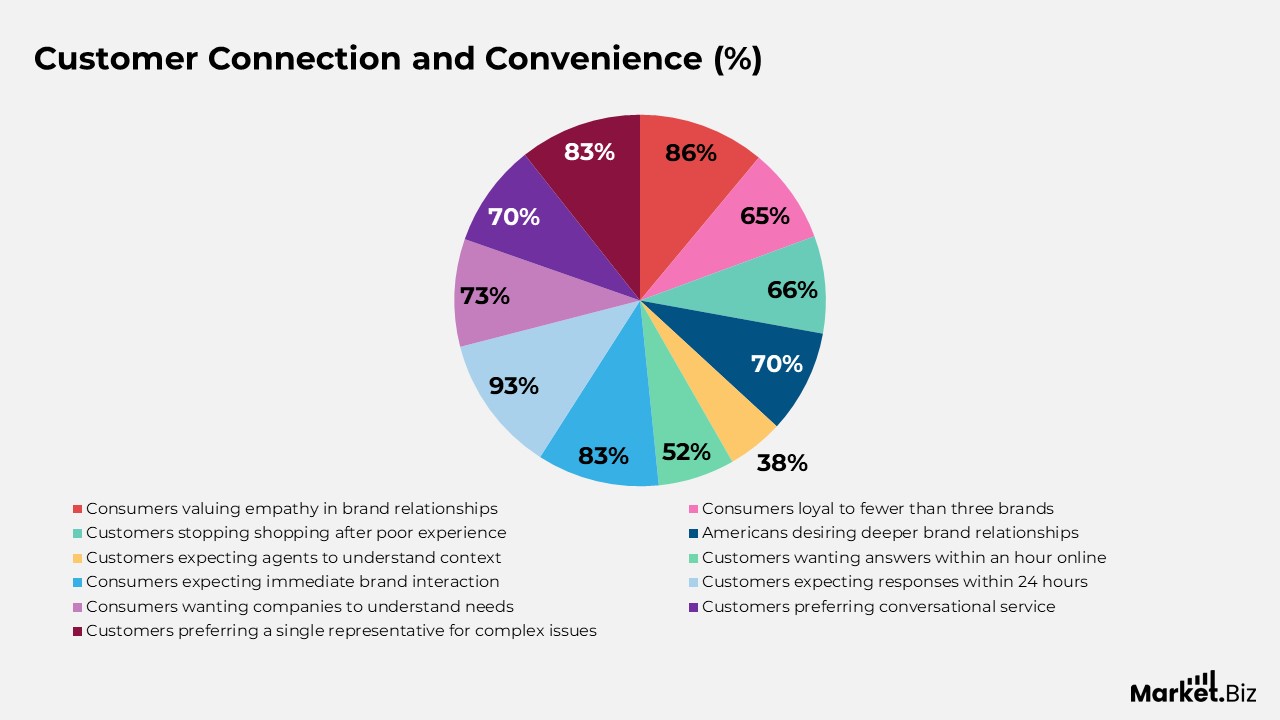
- 86% of consumers believe that empathy plays a vital role in strengthening their relationship with a brand.
- Only 65% of consumers say they are truly loyal to fewer than three brands.
- 66% of customers claim they have permanently stopped shopping with a brand after a single poor experience.
- Around 70% of Americans desire deeper, more meaningful relationships with the brands they engage with.
- 38% of customers expect support agents to understand the context of their issue already.
- 52% of customers want their questions answered within an hour of posting on digital platforms.
- 83% of consumers expect immediate interaction when reaching out to a brand.
- 93% of customers expect brands to respond within 24 hours of initial contact.
- 73% of consumers want companies to recognize and understand their specific needs and expectations.
- Over 70% of customers expect conversational-style service during every brand interaction.
- 83% of customers prefer to have complex issues resolved by a single representative rather than being transferred between multiple contacts.
(Source: Sitecore, Redpoint, Freshworks, Emplifi, Salesforce, Smart Tribune, Zendesk)
Importance of CX to Customers
- 65% of consumers have switched to a different brand due to poor customer experiences.
- After experiencing multiple negative interactions, around 80% of customers prefer to do business with a competitor.
- Only 20% of consumers would forgive a company after a bad experience if they had previously rated the customer service as very poor. In comparison, nearly 80% would forgive a bad experience if the service had been rated “very good.”
- Consumers are most likely to make phone calls when purchasing insurance (68%), telecom services (64%), financial services (60%), automotive products (61%), healthcare (67%), home services (60%), and travel (53%).
- 79% of consumers who complained about poor customer experiences online said their concerns were ignored.
- Three out of four consumers report that a negative interaction with a business can ruin their day.
- 75% of consumers are willing to spend more with businesses that provide a positive customer experience.
- More than 50% of consumers will switch to a competitor after just one poor experience.
- 91% of disappointed clients will leave without voicing their concerns.
- Around 75% of customers who rated a company’s customer experience as “very good” are likely to forgive them for a poor experience.
- Approximately 73% of consumers prefer to switch to a competitor after multiple bad experiences.
- 80% of customers value their experience with a company as much as the products or services themselves.
- Over 50% of consumers have reduced their spending after one bad experience, resulting in a global loss of $4.7 trillion in consumer spending.
(Source: Khoros, Zendesk CX Trends, Qualtrics XM Institute, Invoca, RightNow Technologies, Kolsky, Salesforce Customer Report)
Conclusion
Customer experience management plays a pivotal role in influencing consumer behavior and driving business success. The data underscores the powerful effect both positive and negative experiences have on customer loyalty, brand image, and overall revenue. A significant number of consumers quickly turn to competitors following poor interactions. Highlighting the necessity for businesses to deliver consistent and high-quality customer service.
Furthermore, personalized experiences and effective customer support channels are essential for enhancing customer satisfaction and retention. Organizations that focus on enhancing customer experiences are more likely to cultivate loyalty. Encourage higher spending, and ultimately achieve long-term growth.
As consumer expectations continue to evolve, businesses must prioritize customer experience to maintain their competitive edge and ensure continued success in a dynamic marketplace.
FAQ’s
Customer experience management is vital as it has a direct effect on customer satisfaction, loyalty, and retention. Positive experiences foster brand loyalty and drive higher revenue, while poor experiences push customers toward competitors. CEM enables businesses to understand customer needs better, enhance interactions, and offer personalized experiences, which ultimately support long-term growth.
Poor customer experiences can severely damage a business. A large percentage of consumers will turn to competitors after a negative interaction, leading to lost revenue, a tarnished brand reputation, and a decline in customer loyalty. In contrast, businesses that provide great experiences tend to encourage customers to spend more.
Consumers tend to respond strongly to negative service experiences. Around 79% of those who complained online reported that their issues were ignored. Additionally, 63% of consumers indicated that poor customer experiences lead to negative word-of-mouth, potentially causing businesses to lose not just the complaining customer but also their family and friends.
Personalization is a key aspect of customer experience management. 68% of consumers expect personalized interactions with brands, especially in customer support. By tailoring experiences, businesses can enhance customer satisfaction, strengthen relationships, and significantly boost brand loyalty.
Customer experience is directly linked to customer loyalty and retention. 65% of consumers have switched brands due to poor experiences, while 75% are willing to spend more with businesses offering positive experiences. Companies that invest in improving customer experience are more likely to build long-term loyalty, generate repeat business, and achieve consistent growth.