








Introduction
LLM Chatbots Statistics: Large Language Model (LLM) chatbots are reshaping how people, organizations, and industries engage with technology. Equipped with the ability to process natural language, deliver human-like conversations, and leverage extensive datasets, these AI solutions are increasingly embedded in education, business functions, healthcare, customer engagement, and research.
Their widespread uptake is evident through a growing body of statistics that underscore both opportunities and challenges. From being integrated into academic programs and workplace tools to sparking debates around plagiarism, data privacy, and skills gaps, the numbers illustrate how profoundly LLM chatbots are influencing digital ecosystems. These insights not only track adoption trends but also reflect shifts in user behavior, regulatory landscapes, and the expanding role of AI in daily activities.
Editor’s Choice
- Around 87.2% of users describe their interactions with chatbots as neutral to positive experiences.
- Nearly 62% of people prefer using digital assistants for customer service instead of waiting for a live human agent.
- Chatbots are capable of automating up to 30% of tasks currently handled by contact center employees, translating to potential savings of $23 billion in the U.S.
- Bots can successfully manage 30% of live chats and handle as many as 80% of repetitive tasks.
- Response efficiency has improved significantly, with chatbots providing answers three times faster on average.
- Digital assistants see their highest use in client services (37%) and sales (41%), followed by marketing (17%), as a growing application area.
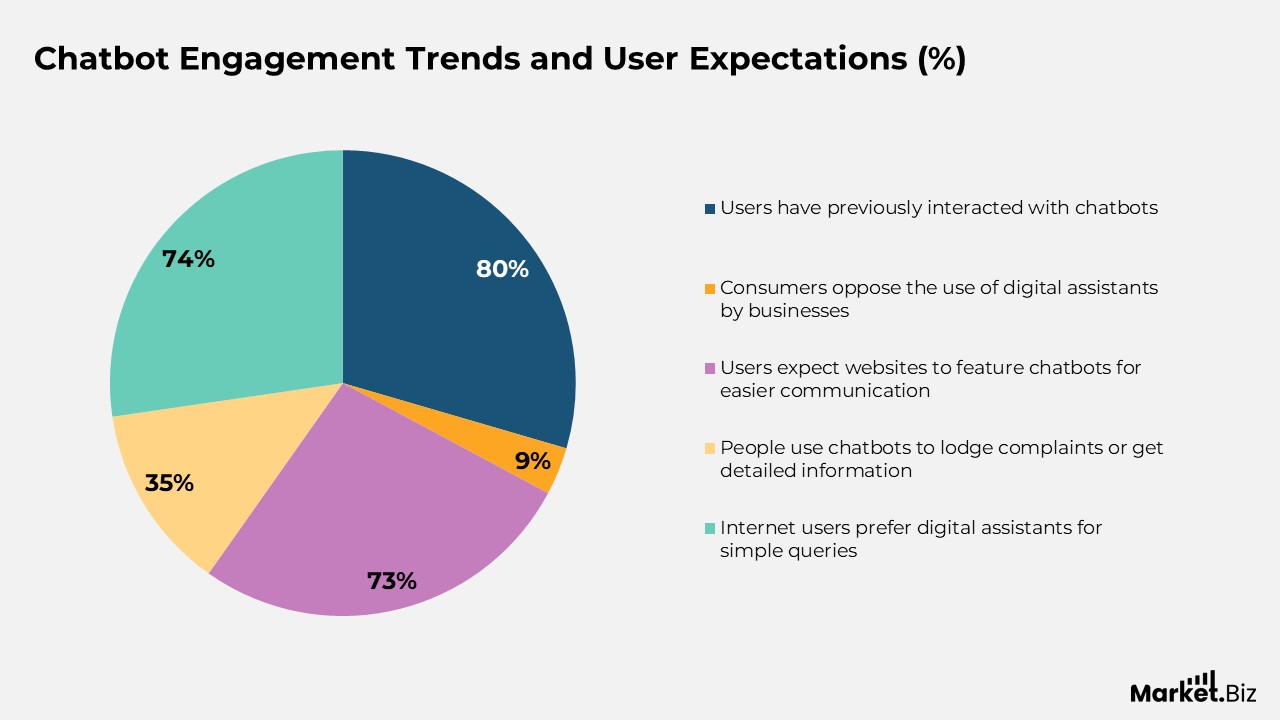
Chatbot Engagement Trends and User Expectations
- Nearly 80% of users have interacted with chatbots before.
- Only 9% of consumers are against businesses deploying digital assistants.
- About 73% of users expect websites to include chatbots for easier communication.
- Roughly 35% of people use chatbots to file complaints or seek detailed information.
- Around 74% of internet users prefer digital assistants for handling simple queries.
(Source: Statista, Master of code)
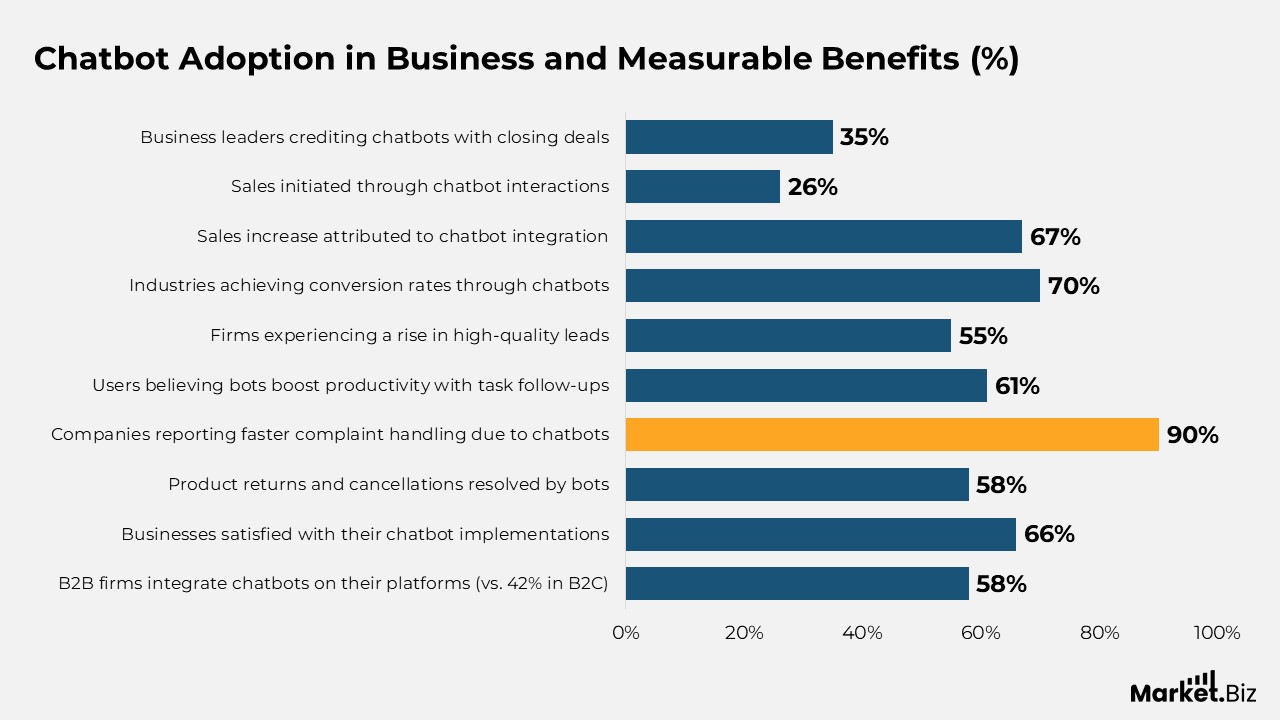
Chatbot Adoption in Business and Measurable Benefits
- 58% of B2B firms integrate chatbots on their platforms, compared to 42% in B2C.
- Nearly two-thirds of businesses are satisfied with their chatbot implementations.
- Bots successfully resolve 58% of product returns and cancellations.
- 90% of companies report nearer complaint handling thanks to chatbots.
- 61% of users believe automation through bots enhances productivity with task follow-ups.
- About 55% of firms see a rise in high-quality leads from chatbot use.
- In certain industries, chatbots achieve conversion rates up to 70%.
- Business leaders attribute a 67% sales increase to chatbot integration.
- Approximately 26% of sales begin from chatbot interactions.
- Around 35% of leaders credit chatbots with helping close deals.
(Source: Statista, Master of code)
Business Advantages of Chatbots
- Chatbots are capable of automating nearly 30% of contact center activities, offering potential savings of up to $23 billion in the U.S.
- By reducing customer support costs by as much as 30%, bots significantly enhance operational efficiency.
- Around 54% of users rate chatbot customer service as somewhat effective, while 33% view it as highly effective, showing room for improvement.
- The integration of chatbots and AI suggestions resulted in a 22% reduction in response times and a 0.45-point improvement in customer sentiment.
- Positive impacts also include 70% quicker replies and a sentiment uplift of +1.63 points.
- Response rates for bots range from 35–40% in less engaging scenarios to 80–90% in the best-performing cases.
- Roughly 64% of users value 24/7 availability as a key benefit, with 29% of interactions happening outside normal business hours.
- Nearly 90% of businesses report faster complaint resolution after deploying chatbots.
- Bots currently handle about 30% of live chat requests and up to 80% of repetitive tasks.
- According to surveys, 61% of respondents believe bots enhance productivity by automating follow-ups, and 57% say they improve internal communication.
Large Language Model (LLM) Market Size
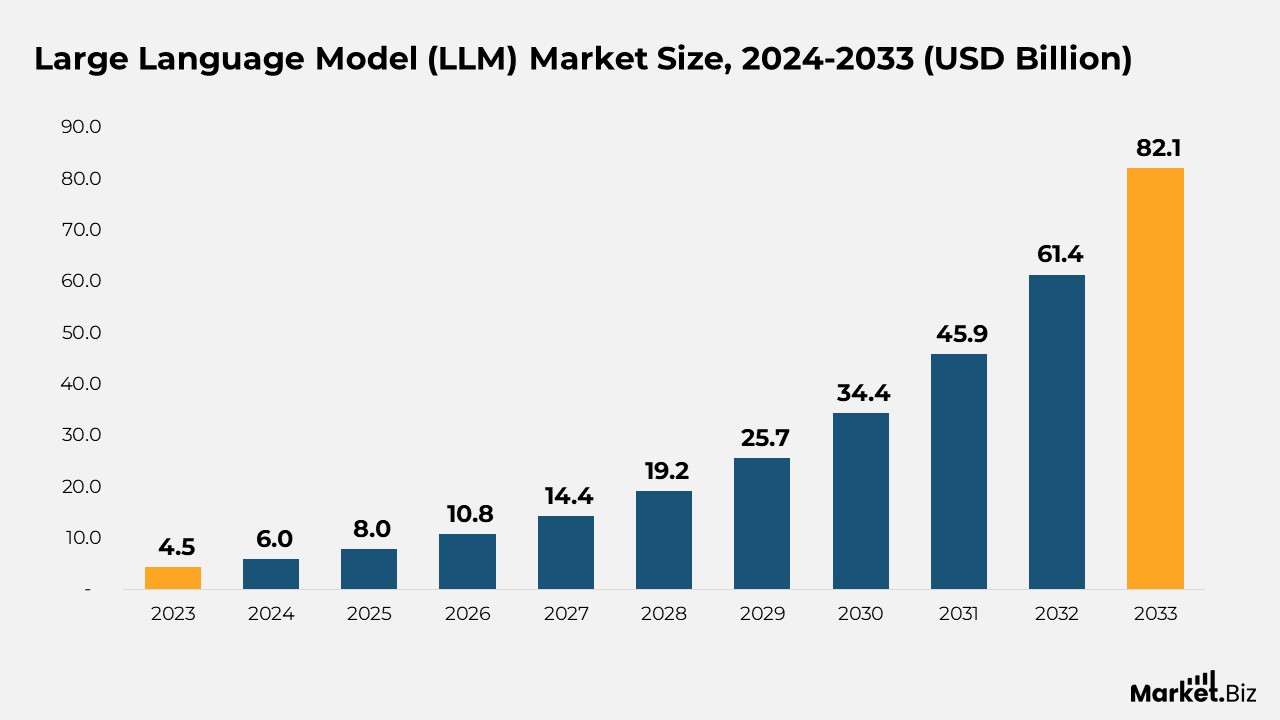
- According to Market.us, the Large Language Model (LLM) market is expected to rise from $6.0 billion in 2024 to $82.1 billion by 2033, representing a compound annual growth rate (CAGR) of 33.7% from 2024 to 2033.
- Market growth is fueled by rising demand for advanced data management and customer interaction solutions, supported by strong R&D investments.
- In 2023, the On-premise segment led the LLM market with a 57.7% share, reflecting its strong performance in a shifting tech landscape.
- In 2024, Chatbots and Virtual Assistants dominated with a 27.1% share, underscoring their importance across industries.
- In 2024, the Retail and E-commerce segment held a 27.5% share, showcasing its pivotal role in enhancing consumer engagement and efficiency.
- North America led the market with a 32.7% share valued at USD 1.47 billion, driven by heavy AI investments and robust infrastructure.
- Globally, 67% of organizations use generative AI tools powered by LLMs, reshaping sectors such as finance and customer services.
- Around 60% of Bank of America clients rely on LLM-based tools for investment and retirement planning.
- Smaller models such as Microsoft’s PHI-2 (2.7 billion parameters) outperform larger ones like Llama-2 in coding tasks, proving efficiency gains from optimization.
- Nearly 50% of organizations report being able to deploy generative AI tools within just 1–4 months.
- Privacy and ethics remain barriers, with only 23% of companies moving toward commercial LLM deployment.
(Source: Market.us)
Healthcare Chatbots Market Size
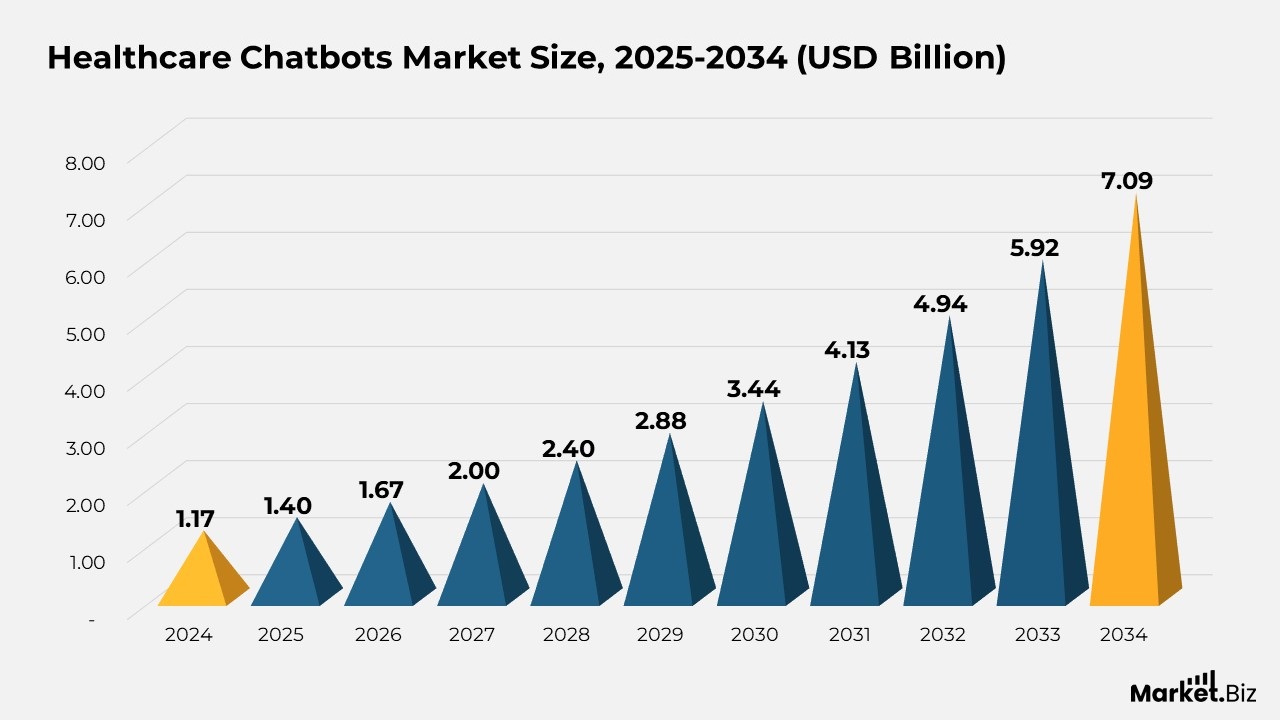
- According to Market.us, the healthcare chatbots market is expected to rise from $1.40 billion in 2025 to $7.09 billion by 2034, representing a compound annual growth rate (CAGR) of 19.8% from 2025 to 2034.
- The healthcare chatbot market is expanding rapidly, fueled by advances in NLP and ML and adoption by providers, insurers, and pharma companies.
- The Software segment dominates with a 58.5% share, driven by demand for AI-powered patient interaction and workflow automation.
- Cloud-based deployment leads with over 73.4% share, offering scalability, flexibility, and cost efficiency for healthcare organizations.
- The Symptom Checking & Medication Assistance application segment captured 39.6% share in 2024, reflecting rising demand for quick, accessible health guidance.
- Patients represent the largest end-user group with a 62.6% share, emphasizing growing reliance on chatbots for real-time health support and information.
- North America accounted for a 34.5% share in 2024, led by the U.S., with companies like Ada Health, Babylon Health, and Woebot Health driving adoption.
(Source: Market.us)
Chatbot Adoption and Usage Statistics
- More than 300,000 chatbots are currently active on Facebook Messenger.
- Messaging apps attract over 1.4 billion active users, driving chatbot interactions.
- Since 2019, chatbot usage has grown by an impressive 92%.
- In 2022, 88% of users engaged in at least one chatbot conversation.
- Only 9% of consumers express resistance to businesses adopting digital assistants.
- Nearly 40% of millennials interact with chatbots or digital assistants daily.
- On average, users submit about 4 queries per chatbot session.
- Around 73% of buyers now expect websites to provide chatbot support for seamless engagement.
- Bots account for 39% of all conversations between businesses and customers.
(Source: Statista, Master of Code)
Customer Support and AI Chatbot Effectiveness
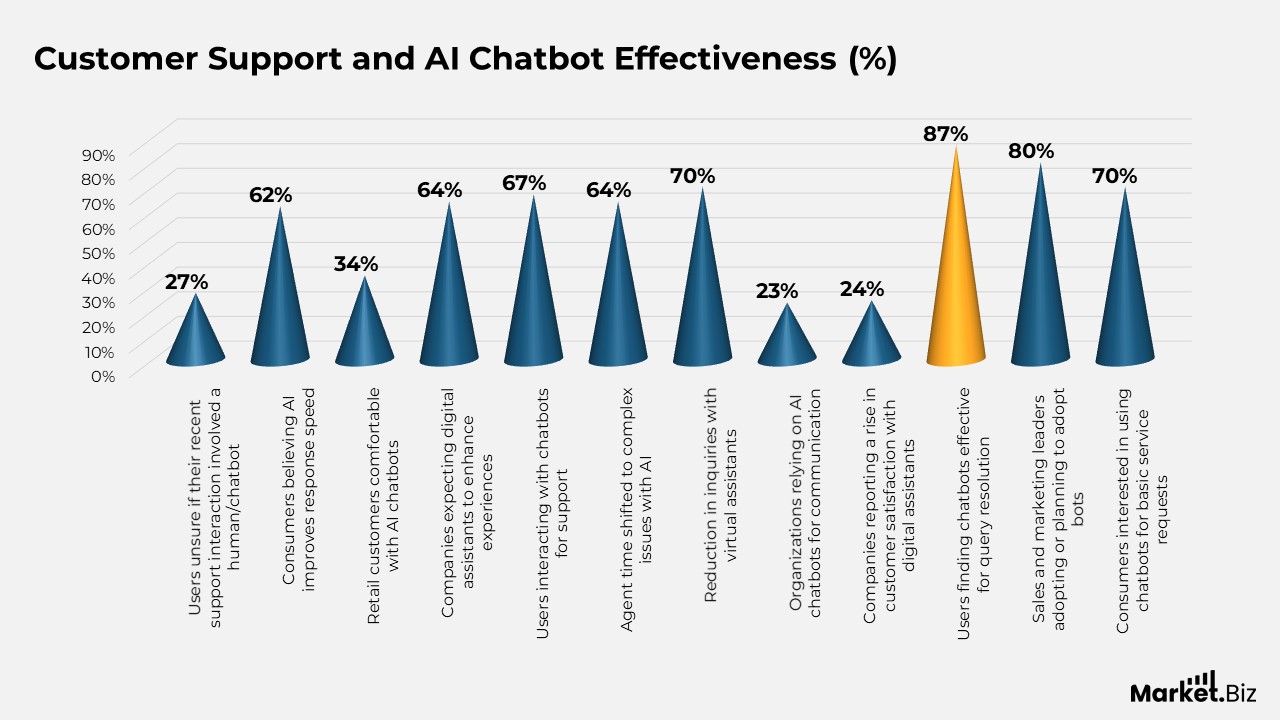
- About 27% of users were unsure if their most recent support interaction involved a human or a chatbot.
- Nearly 62% of consumers believe AI can improve response speed while tailoring interactions to individual needs.
- Around 34% of retail customers feel comfortable engaging with AI-powered chatbots for service support.
- Approximately 64% of companies expect digital assistants to enhance personalized client experiences.
- Nearly 67% of users interacted with chatbots for customer support in the past year.
- AI chatbots help businesses shift 64% of agent time to complex issues, compared with 50% without AI support.
- Virtual assistants reduce inquiries by as much as 70% across calls, chats, and emails.
- Roughly 23% of customer service organizations rely primarily on AI chatbots for communication.
- Bots deliver responses three times faster on average, significantly improving efficiency.
- Companies using digital assistants report a 24% rise in customer satisfaction scores.
- According to Statista, one-third of users find chatbots highly effective for query resolution, while 54% rate them somewhat effective and 13% not effective.
- Around 80% of sales and marketing leaders have adopted or are planning to incorporate bots into their consumer experience strategies.
- By 2020, nearly 70% of consumers showed interest in using chatbots for basic service requests.
(Source: Statista, Master of Code)
Aoption of Voice-Enabled Assistants
- The number of voice-enabled interfaces is projected to reach 8.4 billion by 2024, showing a steep rise in adoption.
- Around 72% of U.S. consumers have engaged with voice interfaces in business interactions.
- The global voice assistant market is expected to expand from USD 4.59 billion in 2022 to USD 30.72 billion by 2030, registering a strong 31.2% CAGR.
- More than 90% of people aged 18–64 seek information about voice technology, and over 70% have used it at least once.
- User satisfaction is high, with 93% of consumers satisfied and 50% highly satisfied with their voice assistants.
- Among buyers, 80% are satisfied with shopping via voice assistants, and 50% have completed purchases this way.
- At home, 74% of users rely on mobile voice assistants, and 71% prefer voice queries over typing.
- Voice shoppers primarily research products (51%), while 22% purchase directly, 17% reorder, 30% track deliveries, and 20% leave reviews.
- On mobile devices, 71% of consumers report satisfaction with voice assistant experiences.
- The top industries adopting voice assistants include banking (44%), food services (56%), and retail (35%).
(Source: Statista, Master of Code)
Future LLM Chatbots and Digital Assistants
- Larger enterprises have adopted chatbots more rapidly, commanding over 46% of market share, a figure expected to rise further by 2027.
- According to Capgemini, nearly 70% of consumers may replace in-person visits to retail stores or banks with voice assistants within the next three years.
- Retail spending through bots is projected to exceed $142 billion by 2024, a sharp increase from just $2.8 billion in 2019 (Insider Intelligence).
- Gartner forecasts that by 2027, digital assistants will serve as the primary client service channel for 25% of businesses.
- Roughly one-third of AI startup founders expect digital assistants to become the leading customer technology in the next five years.
- By 2025, AI chatbots are expected to handle 95% of customer service interactions.
- Continuous progress in ML, AI, and natural language processing is set to make chatbots more conversational and human-like.
- This shift is being accelerated by the adoption of ChatGPT and the rollout of innovative AI-driven platforms.
(Source: Statista, Master of Code)
Conclusion
The emergence of LLM chatbots represents a major transformation in how technology enhances education, business, healthcare, and daily interactions. The statistics highlight not only their rapid adoption but also the evolving expectations of users for smarter, more personalized, and efficient communication.
With universities integrating them into academic settings and enterprises embedding them into core operations, the growth trajectory remains strong. However, issues surrounding ethics, data security, and responsible usage call for thoughtful implementation.
Overall, these insights position LLM chatbots as a critical driver of the digital era, reshaping communication, efficiency, and decision-making.
FAQ’s
LLM chatbots are AI-driven conversational agents powered by Large Language Models that process natural language, generate human-like responses, and assist across industries such as education, business, and healthcare.
Their growth is driven by advances in natural language processing (NLP) and machine learning (ML), combined with rising demand for personalized, efficient, and real-time interactions in multiple sectors.
Education, healthcare, financial services, customer support, and enterprise productivity are leading adopters, with use cases ranging from academic assistance to patient care and business automation.
A significant share of universities and schools have integrated LLM-based tools into learning, with many students using them for assignments, skill development, and AI literacy programs.
Enterprises use them for automating workflows, handling customer queries, improving employee productivity, and reducing operational costs, reflected in rising adoption statistics across industries.
Key concerns include plagiarism in education, data privacy risks, lack of digital literacy, and limited training for effective chatbot usage.