









Introduction
Cybercrime Statistics: Cybercrime statistics provide crucial insights into the escalating risks within the digital landscape, highlighting the frequency, scale, and financial consequences of cybercriminal activities. As digital interactions continue to grow, cybercrime has expanded across multiple sectors, including finance, healthcare, and government.
These statistics shed light on the various types of cyberattacks, such as phishing, ransomware, and data breaches, and the increasingly advanced techniques used by criminals, offering a deeper understanding of the security challenges faced by both businesses and individuals. Analyzing these statistics is essential for shaping effective cybersecurity strategies, guiding investments in protective technologies, and addressing the broader economic and societal effects of cybercrime.
Editor’s Choice
- In 2023, 50% of UK businesses experienced some form of cyber attack.
- Approximately 1 billion emails were exposed in a single year, impacting 1 in 5 internet users.
- Data breaches cost businesses an average of $4.88 million in 2024.
- There were approximately 236.1 million ransomware attacks globally in the first half of 2022.
- 1 in 2 American internet users had their accounts breached in 2021.
- 39% of UK businesses reported experiencing a cyber attack in 2022.
- Around 1 in 10 US organizations had no insurance against cyber attacks.
- 53.35 million US citizens were impacted by cybercrime in the first half of 2022.
- Cybercrime cost UK businesses an average of £4200 in 2022.
- Malware attacks increased by 358% in 2020 compared to 2019.
- In 2022, over 422 million people were impacted by cybercrimes, with the FBI recording 800,944 complaints.
- Cybercrime costs are expected to reach $10.5 trillion by 2025.
- A hacker attack takes place every 39 seconds.
- Between 2001 and 2021, 6.5 million people were affected by cyber attacks, resulting in a loss of nearly $26 billion.
- The largest data breach reported in 2022 was by Shields Healthcare, affecting over 2 million people.
- Gen AI is emerging as a significant cybersecurity concern, with 61% of hackers planning to use it to identify vulnerabilities.
Types of Cybercrimes
Phishing Attacks
- In 2023, phishing was the second leading cause of data breaches, with an average cost of $4.91 million per incident.
- Phishing attacks are responsible for 80% of all reported cybercrimes.
- 96% of cybercriminals utilize spear-phishing techniques to collect intelligence.
- In 2021, 22% of all data breaches were caused by phishing attempts.
- Cybercrime costs are expected to reach $30 billion annually by 2025, with phishing being a significant contributor.
- Healthcare workers open 88% of phishing emails they receive, with common terms like “important,” “urgent,” “attention,” and “important updates” frequently used in these emails.
- Phishing attacks surged by 1,265% in 2023, partly due to the rise of generative AI (GenAI).
- According to the Anti-Phishing Working Group (APWG), the financial sector faced 23.5% of all phishing attacks.
(Source: FBI)
Ransomware attacks
- Ransomware attacks involve hackers locking computers or encrypting files and demanding a ransom for access.
- Victims of ransomware who involved law enforcement saved an average of $4.7 million in breach costs.
- Ransomware is projected to cost $265 billion annually by 2031.
- 74% of ransomware attacks target healthcare organizations.
- The number of ransomware victims increased by 128% between 2022 and 2023.
- The average cost of a ransomware attack on a business is $5.13 million.
- Ransomware accounts for 24% of all cyberattacks.
(Source: Dionach)
Cyber Threat Intelligence Market Size
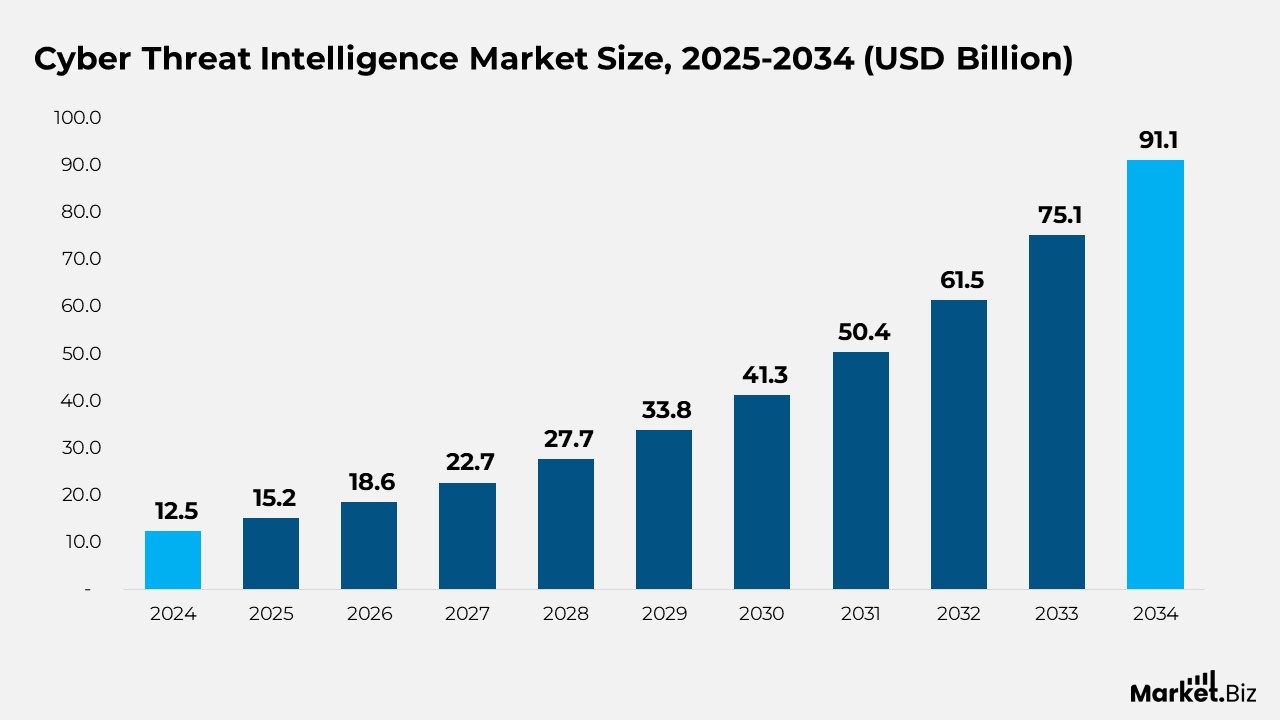
- According to Market.us, the cyber threat intelligence market is expected to rise from $15.2 billion in 2025 to $91.1 billion by 2034, representing a compound annual growth rate (CAGR) of 22.1% from 2025 to 2034.
- The surge in cyber threats, including ransomware and advanced persistent threats, and the expansion of digital transformation and cloud services, drive the growth of the Cyber Threat Intelligence (CTI) market.
- In 2024, the Solutions segment held a dominant position in the CTI market, capturing over 63% of the total market share.
- In 2024, the Cloud-Based segment held a dominant position in the CTI market, capturing over 69% of the total market share.
- In 2024, the Large Enterprises segment held a dominant position in the CTI market, capturing over 61% of the total market share.
- In 2024, the Security Information and Event Management (SIEM) segment held a dominant position in the CTI market, taking more than 34.4% of the total market share.
- In 2024, the Banking, Financial Services, and Insurance (BFSI) segment held a dominant position in the CTI market, capturing more than 20% of the market share.
- In 2024, North America dominated the global CTI market with over 38% market share and generated approximately USD 4.7 billion in revenue.
- The US CTI Market is valued at approximately USD 4.5 billion in 2024 and is expected to grow from USD 11.5 billion in 2029 to USD 29.6 billion by 2034, at a projected CAGR of 20.8% from 2025 to 2034.
(Source: Market.us)
Cyber Security Market Size
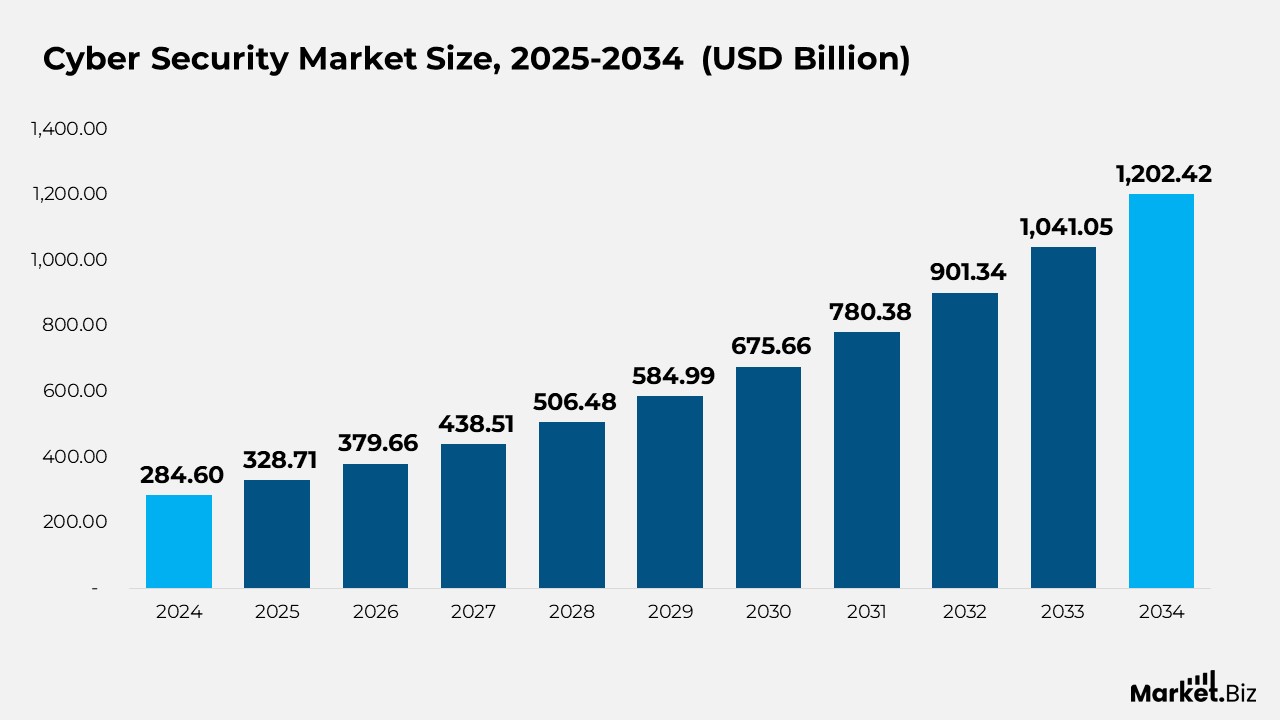
- According to Market.us, the cybersecurity market is expected to rise from $328.71 billion in 2025 to $1,202.42 billion by 2034, representing a compound annual growth rate (CAGR) of 15.5% from 2024 to 2033.
- The growth of this market is driven by the growing sophistication of cyber threats, which induces continuous advancements and informs the development of security technologies. Government regulations and compliance value that order enhanced data protection measures.
- The Hardware segment captured more than 58.7% of the Global Cyber Security Market in 2024 due to its essential role in securing infrastructure.
- The Endpoint Security segment held over 33.7% of the market in 2024, safeguarding devices like laptops, smartphones, and servers.
- The On-premises deployment segment dominated the market with a share of more than 62.5% in 2024, driven by organizations’ need to control sensitive data.
- Large Enterprises accounted for more than 70.3% of the Global Cyber Security Market in 2024 due to their vulnerability to advanced cyber threats.
- The IT & Telecom sector held over 28.6% of the global market in 2024, as these industries face increasing digital infrastructure threats.
- North America led the Global Cyber Security Market with more than 38.0% of the share in 2024, thanks to a concentration of leading firms like IBM and McAfee.
- The US Cyber Security Market was valued at USD 91.93 Billion in 2024, with a robust CAGR of 12.6% driven by rising cyber threats and regulatory demands.
(Source: Market.us)
Healthcare Cybersecurity Market Size
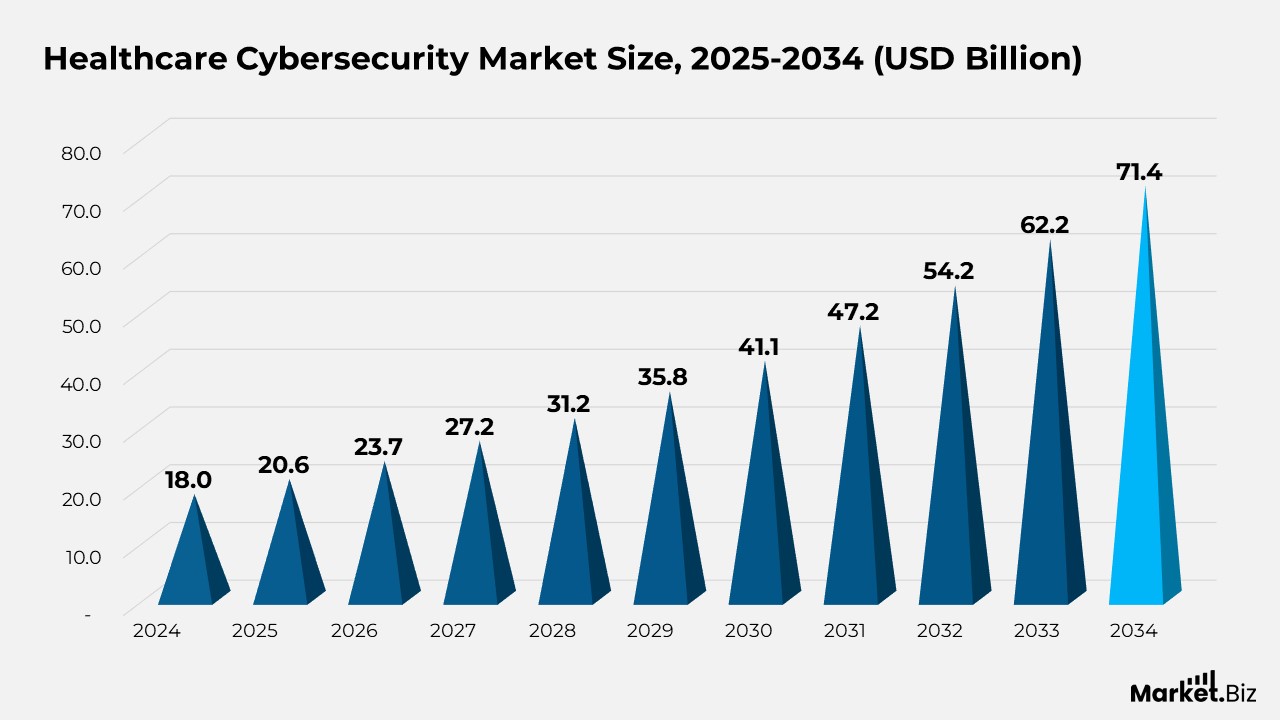
- According to Market.us, the healthcare cybersecurity market is anticipated to grow from $20.6 billion in 2025 to $71.4 billion by 2034, representing a compound annual growth rate (CAGR) of 14.8% from 2025 to 2034.
- The growth of the healthcare cybersecurity market is driven by increasing healthcare data breaches, increasing adoption of IT solutions, and demand for cloud-based security.
- The Services segment dominated the Healthcare Cybersecurity Market in 2024 with a 55.6% market share, driven by demand for managed security services.
- Identity and Access Management (IAM) held the largest market share of 19.7% in 2024, ensuring authorized access to sensitive patient data.
- Malware was the dominant threat, accounting for 25.9% of the market share in 2024, with ransomware being a significant concern for healthcare.
- Network Security led the market with a 30.5% share in 2024, crucial for protecting the increasingly interconnected healthcare networks.
- Cloud-Based deployment dominated with a 56.8% market share in 2024, fueled by the healthcare industry’s shift toward scalable, cost-efficient cloud solutions.
- Hospitals represented the largest end-user segment, catching 40.2% of the market share in 2024, due to their vast patient data and critical services.
- North America led the healthcare cybersecurity market with a 30% share in 2023.
- The growth of the North American healthcare cybersecurity market is driven by escalating cyber threats, regulatory requirements, and the rapid digitalization of healthcare services
(Source: Market.us)
Employment in Cybersecurity
- By 2024, there will be 3.4 million unfilled cybersecurity jobs, a significant increase from 1 million in 2014.
- Information security job growth is projected to rise by 32% between 2022 and 2032.
- The increasing dependence on digital technologies is driving the need for more skilled cybersecurity professionals.
- The cybersecurity sector is facing a major skills gap, with around 5.5 million people currently employed globally, yet approximately 4 million additional professionals are needed.
- 71% of organizations have unfilled cybersecurity roles, and 44% manage teams with less than three years of experience.
(Source: G2.com, Inc., Statista)
Cyber Insurance Awareness and Barriers in the US
- 66% of US adults are generally familiar with cyber insurance. Among those who have experienced cybercrime, 59% are somewhat to very familiar with it, compared to 35% of those who have not encountered cybercrime.
- The primary reason individuals haven’t purchased cyber insurance is the need for more research, cited by 40% of respondents, followed by 34% who believe it is too expensive.
- 43% of US adults believe that annual premiums for personal cyber insurance policies costing up to $25,000 cost under $100, while only 7% estimate the cost to be above $200.
(Source: G2.com, Inc., Statista, Demand Sage)
Cost of Cyber Crime
- Since 2001, the number of data breach victims has risen from 6 victims per hour to 97, reflecting a 1517% increase over 20 years.
- The average cost of data breaches per hour has grown from $2054 in 2001 to $787,671 in 2021.
- Due to increasing cyber threats, 73% of SMBs agree that immediate action on cybersecurity is needed, with 78% planning to boost their cybersecurity investment in the next 12 months.
- 67% of SMBs feel they lack the in-house skills to handle data breaches, yet 89% are now working with Managed Service Providers for cybersecurity, up from 74% in 2020.
(Source: Statista, AAG)
Cybercrime in Healthcare
- The HCA Healthcare breach in early 2023 impacted 11 million patients due to unauthorized access to sensitive patient data.
- In June 2022, hackers stole 20 GB of guest information from Marriott Hotels.
- Shields Healthcare Group experienced a breach in 2022, affecting over 2 million individuals.
- 45% of global organizations are projected to be impacted by supply chain attacks as early as 2025.
- Broward Health reported a breach in January 2022, affecting 1 million people.
- Novant Health experienced a misconfiguration in Meta’s pixel code, potentially exposing information for 1 million individuals.
- In 2021, Facebook was compromised in a data breach that affected 533 million users.
(Source: Statista, DemandSatge, G2.com, Inc.)
Global Economic Impact
- Global cybercrime costs are projected to hit $10.5 trillion annually by 2025.
- Cybercrime costs are increasing by 15% per year as we approach 2025.
- By 2027, cybercrime is expected to cost the global economy $23 trillion, marking a 175% increase from 2022.
- Cybercrime ranks as the third-largest economy globally, following only the United States and China.
- In 2023, Americans reported $12.3 billion in cybercrime losses.
- The average cost of a data breach is projected to decrease to USD 4.44 million in 2025, down from USD 4.88 million in 2024, a 9% decline.
- Ransom payments have surged by 500%, with the average payment now at $2 million.
- Cyber insurance premiums are expected to double from $14 billion in 2023 to $29 billion by 2027.
- Ransomware damages are projected to reach $265 billion annually by 2031.
- Claims from businesses with revenues under $25 million dropped by 4%, averaging $73,000 per incident, while businesses earning between $25 million and $100 million saw a 23% rise, with average losses reaching $129,000.
- Investment scam losses increased by 38%, from $3.31 billion in 2022 to $4.57 billion in 2023.
- Business Email Compromise (BEC) led to losses exceeding $2.9 billion in 2023, with 21,489 complaints.
Moreover
- In ransomware attacks, only 32% of the total financial impact comes from the ransom itself, while the rest stems from other damages.
- Nearly 80% of large enterprises globally plan to increase their cybersecurity budgets to manage rising breach costs.
- Small and medium-sized businesses allocate 5% to 20% of their IT budgets to cybersecurity.
- The average ransom payment in Q4 2023 was $568,705.
- Companies are spending an average of $2,700 per employee yearly on cybersecurity measures.
- For the seventh consecutive year, the technology industry was the most targeted by hackers.
- The median ransom demand in 2024 was 1.34% of the victim organization’s revenue, with 80% of demands ranging between 0.13% and 8.30% of revenue.
- Only 4% of ransomware complaints in the FBI’s IC3 data difficult actual financial loss, down from 7% last year.
- 62% of financially motivated breaches were driven by ransomware/extortion.
- Financial penalties from phishing attacks surged by 144% year-over-year.
- According to an Accenture survey of 600 bank cybersecurity executives, 80% believe generative AI is enabling hackers faster than their banks can respond.
- The global average cost of a data breach rose by 10%, reaching $4.88 million in 2024, up from $4.45 million in 2023.
(Source: Cybersecurity Ventures, Cybercrime Magazine, MSSP Alert, World Economic Forum, FBI IC3, Bright Defense, Info Security Magazine, Munich RE, Veeam Ransomware Trends Report, Gartner, Strong DM, Deloitte, Varonis, Elisity, CrowdStrike Global Threat Report, Verizon 2024 Data Breach Investigations Report, Proofpoint State of the Phish Report, IBM 2024 Cost of a Data Breach Report)
Cybersecurity Workforce Challenges
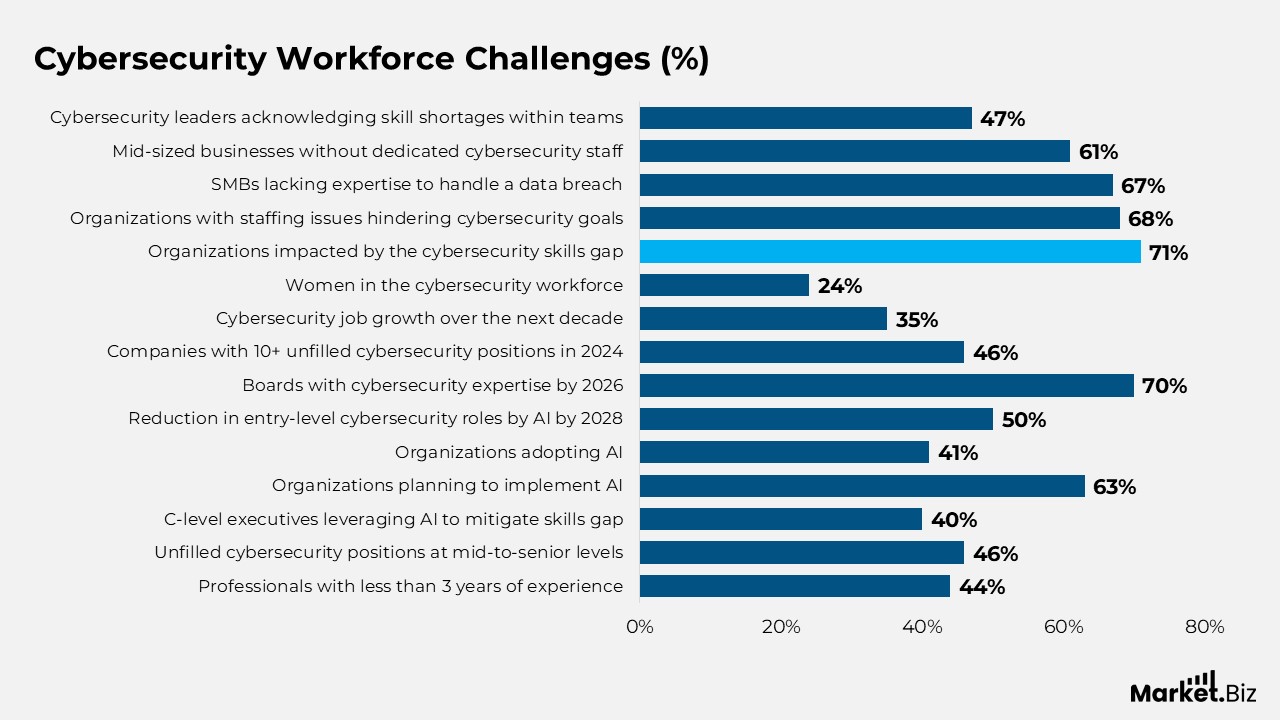
- The global cybersecurity workforce currently consists of 5.5 million professionals, but there is a need for an additional 5 million experts to address the skills gap.
- 44% of cybersecurity professionals have less than three years of experience, a result of high turnover rates and intense competition in recruitment.
- 46% of organizations report having unfilled cybersecurity positions at mid-to-senior levels, highlighting a significant talent shortage.
- Around 40% of C-level executives plan to leverage AI to help mitigate the shortage of critical cybersecurity skills.
- 63% of organizations are planning to implement emerging technologies, such as AI, to alleviate the cybersecurity workforce shortage.
- The demand for cybersecurity experts is highest in regions such as the Asia-Pacific, the Middle East, Africa, and North America.
- The employment growth for IT security analysts is projected to be 29% higher than the average demand for all other jobs entering 2023.
- 41% of organizations have already adopted AI to help address the growing cybersecurity skills gap.
- Projections estimate that 17,300 IT security analyst positions will open each year over the next decade.
- By 2028, it is predicted that AI will reduce the essentials for entry-level cybersecurity roles by up to 50%.
Moreover
- By 2026, 70% of boards are expected to include at least one member with cybersecurity expertise.
- In 2023, the global cybersecurity workforce faced a shortage of 3.5 million unfilled jobs.
- Cybersecurity Security Specialists, an entry-level role, earn an average salary of $102,677.
- 46% of companies reported having more than 10 unfilled cybersecurity positions as of 2024, according to a Cisco survey.
- Cybersecurity job growth is projected to increase by 35% over the next decade.
- Women represent just 24% of the cybersecurity workforce.
- 71% of organizations report being impacted by the cybersecurity skills gap.
- 68% of organizations identify staffing issues as the biggest threat to achieving their cybersecurity goals.
- 67% of small and medium businesses lack the in-house expertise to handle a data breach.
- 61% of mid-sized businesses operate without dedicated cybersecurity staff, and 47% of cybersecurity leaders acknowledge training gaps or critical skill shortages within their teams.
(Source: Asseco, Gartner, Cybercrime Magazine, Monster, Arctic Wolf, Cisco, Monster, AAG IT, Help Net Security)
Conclusion
Cybercrime statistics reveal the increasing and evolving nature of digital threats impacting individuals, businesses, and governments globally. As cyberattacks grow more sophisticated, the financial and personal costs continue to rise, highlighting the urgent need for stronger cybersecurity defenses.
With phishing, ransomware, and data breaches leading the charge, industries must prioritize investments in cybersecurity infrastructure, employee training, and advanced threat intelligence solutions. The escalating costs of cybercrime, combined with a shortage of skilled cybersecurity professionals, emphasize the need for proactive measures.
To effectively tackle these challenges, enhanced collaboration between businesses, governments, and cybersecurity experts will be vital to safeguard sensitive data and minimize risks.
FAQ’s
Cybercrime statistics provide insights into the frequency, impact, and various types of cybercriminal activities such as phishing, ransomware, and data breaches. These statistics help assess the scale of cybercrime and its financial, social, and personal consequences.
Over the years, cybercrime statistics have shown a notable rise in the frequency and sophistication of cyberattacks. As cybercriminals have advanced their tactics, the number of victims and the costs associated with these crimes have significantly increased, emphasizing the need for stronger cybersecurity measures.
Phishing, ransomware, data breaches, identity theft, and financial fraud are the most common types of cybercrime. Phishing remains a leading threat, followed closely by ransomware attacks and data breaches.
Cybercrime is expected to cost the global economy $10.5 trillion annually by 2025, factoring in direct financial losses, recovery costs, reputational damage, and legal liabilities.
Sectors such as healthcare, financial services, and government are particularly vulnerable to cybercrime. This vulnerability is largely due to the sensitive nature of the data they manage and the critical importance of their infrastructure.