









Introduction
Diabetes Care Statistics: Diabetes continues to pose a significant global health concern, impacting millions and exerting considerable pressure on healthcare systems worldwide. Having accurate and current diabetes care statistics is crucial for comprehending the disease’s prevalence, pinpointing management shortcomings, and guiding effective healthcare policies and interventions.
These statistics cover prevalence rates, patient demographics, treatment compliance, complications, and health outcomes, offering a detailed overview of diabetes care today. Through thorough data analysis, healthcare professionals and policymakers can optimize resource allocation, enhance patient education, and design focused strategies to improve care quality and minimize diabetes’s long-term effects…
Editor’s Choice
- By 2025, more than 537 million adults across the globe are living with diabetes, underscoring an escalating worldwide health concern.
- Nearly half of all people with diabetes go undiagnosed, revealing major shortcomings in early screening and detection programs.
- Medication adherence is inconsistent, with close to 30% of patients facing challenges in following prescribed treatment plans regularly.
- Complications linked to diabetes, such as heart disease, kidney impairment, and nerve damage, remain key contributors to illness and death.
- The global cost of managing diabetes surpasses US$ 1 trillion, including direct healthcare expenses and losses in workforce productivity.
(Source: World Heart Federation, National Institute of Health )
Diabetes Treatment Devices Market Size
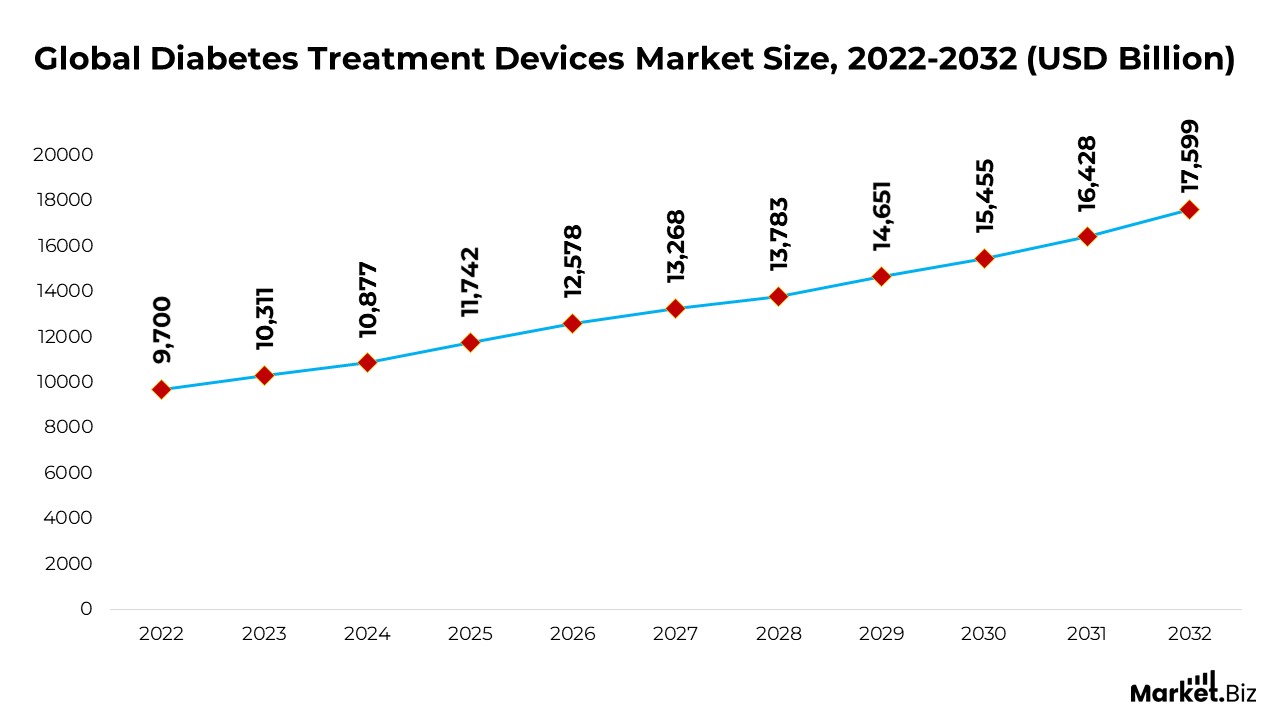
- As per Market.us, the global market for diabetes treatment devices is anticipated to expand from $11,742 billion in 2025 to $17,599 billion by 2032, reflecting a compound annual growth rate (CAGR) of 6.3% from 2022 to 2032.
- Market expansion is fueled by the rising prevalence of diabetes, increasing obesity rates, enhanced awareness campaigns focused on disease prevention, and supportive government policies.
- The insulin delivery devices segment dominated with a 55.8% revenue share in 2022, driven by the growing incidence of both type 1 and type 2 diabetes worldwide, alongside lifestyle factors contributing to poor health.
- Hospitals accounted for 40.9% of the market in 2021, while the homecare segment is projected to grow at a robust CAGR of 7.4%. The rising hospital admissions of diabetic patients, who are three times more likely to be hospitalized compared to non-diabetics, have boosted demand. Rapid technological advancements in diabetes care have increased the adoption of insulin pumps in clinical and hospital settings.
- North America held a substantial 35.4% share of the diabetes devices market revenue, propelled by a large diabetic population and favorable insurance reimbursement frameworks. Factors such as high per capita income and escalating healthcare spending in the U.S. further drive market growth in this region.
(Source: Market.us)
Global Diabetes Statistics
Diabetes continues to be a profound global health concern, affecting millions of individuals and imposing a significant economic burden worldwide. According to the International Diabetes Federation (IDF), the Diabetes Atlas released in 2024:
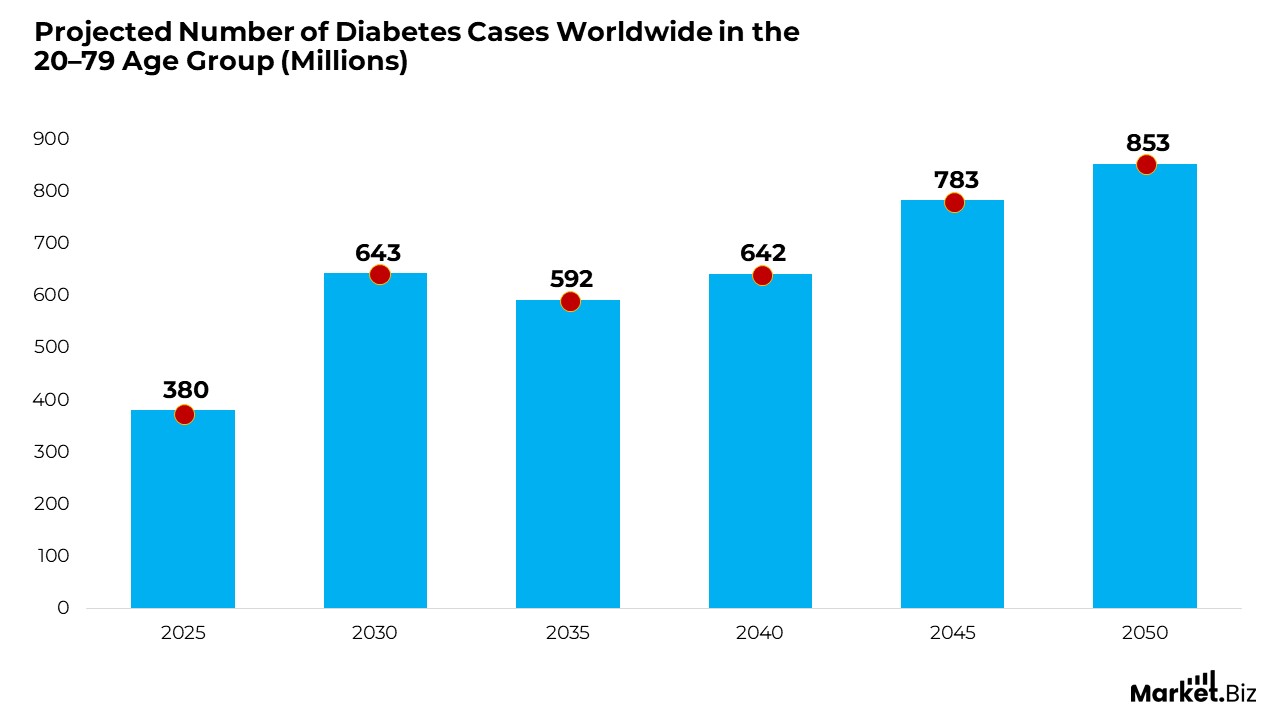
- Approximately one in every ten adults globally, about 589 million people, is living with diabetes. This number is expected to increase to 852.5 million cases by 2050.
- Alarmingly, half of these adults remain undiagnosed, underscoring challenges in early detection.
- Diabetes accounts for 11.5% of global health expenditures, translating to an estimated cost of US$966 billion.
- Gestational diabetes impacts one in every seven births, highlighting risks for both mothers and infants.
- Around 75% of people with diabetes reside in low- and middle-income countries, reflecting disparities in healthcare access and resources.
- Nearly 648,000 children are affected by type 1 diabetes worldwide.
- Tragically, every five seconds, a person dies due to diabetes-related complications, resulting in approximately 6.7 million deaths annually.
Looking ahead, IDF projections indicate an increasing trend:
- By 2030, one in nine adults (around 643 million people) is expected to have diabetes.
- The global financial burden of diabetes care is projected to surpass US$1,028 billion by the same year.
Further extending to 2045, the forecast anticipates:
- One in eight adults worldwide, totaling approximately 783 million people, will be living with diabetes.
- Diabetes-related health expenditures will continue to rise, exceeding US$1,054 billion globally.
(Source: Market.us, Zippa, Inc., National Institute of Health, S2S Global, Genworth, Organisation for Economic Co-operation and Development)
Types of Diabetes
- Type 1 diabetes
- Type 2 diabetes
- Gestational diabetes
- Neonatal diabetes
- Cystic fibrosis diabetes..
- Maturity-onset diabetes of the young (MODY)
- Latent Autoimmune diabetes in Adults (LADA)
- Wolfram Syndrome
- Steroid-induced diabetes
- Type 3c diabetes
(Source: Diabetes UK)
Common Symptoms of diabetes
- Experiencing increased thirst beyond normal levels.
- Frequent urination.
- Unexplained weight loss without dieting or exercise.
- Detection of ketones in the urine is a sign that the body breaks down muscle and fat due to insufficient insulin.
- Feeling unusually fatigued and weak.
- Experiencing irritability or other mood fluctuations.
- Blurred or impaired vision.
- Slow recovery of wounds or sores.
- Frequent infections, including those affecting the skin, gums, and vaginal area.
(Source: Mayo Foundation for Medical Education and Research (MFMER)
Demographics of Diabetes
Age:
- Age is a significant factor influencing the prevalence of diabetes, with higher rates observed in older populations, particularly for Type 2 diabetes, which develops gradually over time. Understanding the age distribution of diabetes cases is crucial for targeted prevention and management strategies.
- Among U.S. adults aged 18 and above, diabetes prevalence increases with age: approximately 2.4% of those aged 18–44 have diabetes, rising sharply to 12.5% in the 45–64 age group, 19.5% among individuals aged 65–74, and peaking at 20.6% for those 75 and older.
- In the pediatric population, there are about 352,000 diagnosed cases of diabetes in individuals under 20 years old, with Type 1 diabetes accounting for 304,000 of these cases.
- Undiagnosed diabetes remains a concern across age groups, with prevalence rates recorded at 2.2% for adults aged 18–44, increasing to 3.8% for those aged 45–64, and 2.7% for adults aged 65 and older.
- Prediabetes affects nearly 98 million Americans, distributed as follows: 32.8 million individuals aged 18–44, 37.5 million in the 45–64 bracket, and 27.2 million who are 65 years or older.
(Source: Centers for Disease Control and Prevention, National Institute of Diabetes and Digestive and Kidney Diseases)
Ethnicity:
- The prevalence of diabetes among U.S. adults by ethnicity is as follows:
- 13.6% of American Indian/Alaska Native adults
- 12.1% of non-Hispanic Black adults
- 11.7% of Hispanic adults
- 9.1% of Asian adults
- 6.9% of non-Hispanic white adults
- The number of diagnosed prediabetes cases by ethnic group is:
- 61.8 million non-Hispanic white adults
- 15 million Hispanic adults
- 12.3 million non-Hispanic Black adults
- 5.8 million Asian Americans
(Source: American Diabetes Association, SingleCare Administrators, Centers for Disease Control and Prevention)
Cost of Diabetes
- In 2022, the total annual cost of diabetes in the United States reached approximately $412.9 billion.
- Healthcare expenditures for individuals with diabetes account for 25% of the total U.S. healthcare spending.
- People living with diabetes incur average annual medical expenses of $19,736, with $12,022 of this amount spent directly on managing the disease.
- On average, individuals with diabetes face 2.6 times higher medical costs compared to those without the condition.
(Source: American Diabetes Association, Diabetes Care)
Diabetes Care Statistics – By Country
- China leads with nearly half (49.7%) of its diabetic population undiagnosed, amounting to approximately 73.5 million people.
- India has an undiagnosed rate of 43.0%, corresponding to about 38.6 million individuals.
- Indonesia exhibits the highest undiagnosed proportion at 73.2%, representing roughly 15 million people.
- The United States reports 24.8% undiagnosed cases, equating to 9.6 million individuals.
- Pakistan follows with 26.9% undiagnosed, approximately 9.3 million people.
- In Egypt, 62.0% of diabetes cases remain undiagnosed, impacting around 8.2 million individuals.
- Mexico has a 41.3% undiagnosed rate, translating to about 5.6 million people.
- Bangladesh shows 39.1% undiagnosed, affecting 5.4 million individuals.
- Brazil has 31.9% of its diabetic population undiagnosed, roughly 5.3 million people.
- Lastly, Turkey reports 45.5% undiagnosed diabetes cases, totaling 4.4 million individuals.
(Source: International Diabetes Federation)
Impaired Glucose Tolerance Prevalence by Region (Ages 20–79, 2024)
| Region | Prevalence of IGT in 2024 (%) | Individuals with IGT in 2024 (millions) | Projected Prevalence of IGT in 2050 (%) | Projected Individuals with IGT in 2050 (millions) |
|---|---|---|---|---|
| Southeast Asia (SEA) | 13.8 | 145.7 | 14.6 | 204.9 |
| Western Pacific (WP) | 13.5 | 251.3 | 14.3 | 267.8 |
| North America & Caribbean (NAC) | 11.6 | 46.6 | 12.6 | 55.3 |
| Africa (AFR) | 11.5 | 56.8 | 13.7 | 135.1 |
| South & Central America (SACA) | 11.0 | 38.7 | 11.9 | 51.9 |
| Middle East & North Africa (MENA) | 11.0 | 49.7 | 11.6 | 85.3 |
| Europe (EUR) | 5.9 | 45.9 | 6.2 | 46.2 |
(Source: International Diabetes Federation)
Diabetes Treatment Devices
- Blood Glucose Monitoring (BGM) Devices: BGM devices are vital tools for individuals with diabetes to check their blood sugar levels daily. Typically, these devices require a small drop of blood from a finger prick and provide instant results, enabling users to make timely diet, physical activity, and medication decisions.
- Self-Monitoring Blood Glucose Devices: This category includes conventional glucose meters and test strips used multiple times a day to monitor blood sugar levels. These devices are fundamental for self-management in both Type 1 and Type 2 diabetes, assisting users in adjusting insulin doses and dietary intake based on real-time readings.
- Continuous Glucose Monitoring (CGM) Devices: CGM systems offer ongoing tracking of glucose levels around the clock, revealing trends that help predict fluctuations. These devices involve a sensor placed beneath the skin, which transmits data to a receiver or smartphone. CGMs reduce the need for frequent fingerstick tests and provide comprehensive insights into glucose patterns, improving management.
- Insulin Delivery Devices: Insulin administration methods range from traditional syringes to sophisticated insulin pumps. Syringes require multiple manual injections daily, while insulin pumps deliver a continuous flow of insulin via a catheter, maintaining baseline levels and allowing for additional doses at mealtimes. Pumps enhance blood sugar control and offer greater lifestyle flexibility.
- Testing Strips and Sensors: Testing strips, used with glucose meters, measure blood sugar at specific moments. Sensors, integral to CGM systems, continuously monitor glucose levels, offering dynamic data essential for fine-tuning treatment in real-time. These tools help prevent high and low blood sugar episodes by enabling timely therapy adjustments.
- Transmitters: In CGM setups, transmitters send glucose data from the sensor to a display device such as a smartphone or receiver. This real-time data transmission supports continuous monitoring and alerts, facilitating immediate therapeutic decisions.
(Source: American Diabetes Association, Market.us)
Emerging Trends in Diabetes Management
- Advancements in Closed-Loop or “Artificial Pancreas” Systems: Significant progress has been made in developing closed-loop technologies that integrate insulin pumps with continuous glucose monitors and smart algorithms. These systems automatically regulate insulin delivery based on real-time glucose data, easing the daily management burden for patients and improving glycemic stability.
- Integration of Digital Technologies in Diabetes Care: Recent developments highlight a growing emphasis on incorporating digital solutions into diabetes management. Innovations such as smart insulin pens that log dosage and timing, alongside mobile applications providing real-time glucose monitoring, are designed to boost patient compliance and optimize blood sugar control by offering personalized and convenient care options.
- WHO’s Global Diabetes Compact Initiative: The World Health Organization introduced the Global Diabetes Compact, intending to expand access to essential diabetes treatments worldwide. This program prioritizes increasing the availability and affordability of insulin and glucose monitoring devices while establishing ambitious global targets to improve diabetes diagnosis and treatment outcomes by 2030.
- Global Diabetes Coverage Goals: The WHO has set ambitious targets for diabetes care by 2030, aiming for at least 80% of diagnosed individuals to achieve effective blood sugar and blood pressure control. These objectives are part of a comprehensive strategy to integrate diabetes management into broader national programs addressing noncommunicable diseases, enhancing health outcomes at scale.
(Source: Market.us)
Case Studies
- Remote Patient Monitoring in Chronic Diabetes Care: Devices designed for remote monitoring have become integral to the effective management of chronic diabetes. Continuous glucose monitors (CGMs) and smart insulin pumps transmit real-time data directly to healthcare professionals, enabling timely therapeutic adjustments. This proactive approach helps reduce emergency interventions and hospital admissions by identifying irregularities early, proving especially beneficial for managing Type 1 and advanced Type 2 diabetes.
- Seamless Integration with Telehealth Platforms: The rise of telemedicine during the COVID-19 era has transformed diabetes care. Devices that sync with telehealth systems allow patients to access thorough medical support remotely. For instance, clinicians can analyze data from CGMs and insulin pumps during virtual appointments, facilitating tailored treatment modifications without requiring face-to-face visits.
- Focus on Preventive Care and Lifestyle Management: Wearable diabetes technology that tracks various health indicators encourages patients to adopt healthier habits. By monitoring glucose levels, physical activity, and nutrition, these devices offer actionable insights that help prevent disease progression or better control existing diabetes, particularly impactful in lifestyle-sensitive Type 2 diabetes.
- Advancements in Pediatric Diabetes Monitoring: For children living with diabetes, especially Type 1, continuous glucose monitoring devices provide vital alerts to caregivers about risks like nocturnal hypoglycemia. This continuous oversight alleviates parental concerns and enhances the quality of life by ensuring safety through constant monitoring.
- Data-Driven Personalized Treatment Approaches: Cutting-edge diabetes devices equipped with advanced analytics can forecast individual glucose trends and potential complications. This predictive capability empowers healthcare providers to tailor treatment plans proactively, moving beyond reactive care to deliver more precise and effective disease management with reduced risk of adverse outcomes.
Conclusion
Diabetes remains a major and growing global health issue, impacting hundreds of millions of people and exerting substantial strain on healthcare systems and economies around the world. Current data reveal significant shortcomings in timely diagnosis, treatment compliance, and equitable healthcare access, particularly in low- and middle-income countries.
As the prevalence of diabetes and its complications continues to rise, it becomes increasingly crucial to bolster prevention strategies, promote early diagnosis, and adopt innovative technologies to enhance patient care. Sustained efforts through awareness initiatives, effective policies, and customized healthcare solutions are essential to reducing the long-term consequences of diabetes and improving the lives of those affected.
FAQ’s
The rising demand for nursing home care is mainly due to the aging population, a higher prevalence of chronic conditions like heart disease, Alzheimer’s, and cancer, and a greater awareness of the need for elder care. Additionally, healthcare advancements
Recent data indicate that more than 537 million adults are affected by diabetes globally, with projections showing a significant increase in the coming years.
Nearly half of all people living with diabetes remain unaware of their condition, highlighting ongoing challenges in early diagnosis and screening efforts.
Diabetes often leads to severe complications such as heart disease, kidney damage, nerve disorders, and impaired wound healing.
Technologies like continuous glucose monitors and telemedicine enhance disease monitoring and patient treatment outcomes.
Healthy habits such as balanced nutrition, consistent physical activity, and maintaining a healthy weight are vital in preventing and managing diabetes, especially type 2.