









Introduction
E-Learning Statistics: E-learning has swiftly transitioned from a supplementary resource to a fundamental aspect of modern education, harnessing digital technologies and online platforms to offer flexible, accessible learning opportunities.
As internet usage, smartphone adoption, and the demand for skill development continue to rise, e-learning has emerged as a global trend, impacting both educational institutions and corporate training programs.
The COVID-19 pandemic further accelerated this shift, driving widespread adoption of online learning solutions. These statistics provide valuable insights that shed light on the current state, growth prospects, and key trends within the e-learning sector, underscoring its transformative role and the opportunities it creates for stakeholders across the globe.
Editor’s Choice
- Nearly 49% of students globally have engaged in some form of online learning.
- Online learning is the fastest-growing segment in the education sector, experiencing a 900% growth since its inception in 2000.
- A significant 70% of students believe online learning offers a better experience than traditional classroom settings.
- By 2027, the number of online learners is expected to rise to 57 million.
- 80% of companies now provide online learning or training programs for their employees.
- 63% of students in the U.S. participate in online learning activities daily.
- Online education can improve student and employee retention rates by up to 50%.
- The time required to master a subject can be reduced by 40% to 60% through online learning.
- The global online learning industry is forecasted to exceed $370 billion by 2026.
- Online learning can enhance employee performance by 15% to 25%.
- In 2022, 10.1 million U.S. college students (about 54%) enrolled in at least one online class.
- Compared to traditional classroom learning, eLearning reduces course completion time by 40% to 60%.
- Over 40% of Fortune 500 companies utilize e-learning platforms for employee training.
Moreover
- 70% of Learning and Development teams intend to integrate social learning platforms by 2025.
- Gamification plays a key role in eLearning, with 67.7% of organizational behavior students finding gamified courses more engaging than traditional ones, regardless of their demographic.
- 59% of studies on statistics have shown that adaptive learning and personalized approaches significantly boost academic outcomes.
- Online learning helps students retain 25% to 60% more information compared to traditional methods.
- Approximately 40% of Fortune 500 companies use eLearning to train their employees.
- 73% of U.S. students express a desire to continue online classes even after the pandemic.
- AI adoption in online learning has led to an 80% increase in student engagement.
- 85% of teachers now use digital tools to improve student interaction and engagement.
- 93% of businesses worldwide are planning to implement eLearning solutions.
- Employee engagement has surged by 18% with the use of eLearning platforms.
- About 4.9 million students (or 26%) take their college courses exclusively online.
- 4.5% of colleges primarily offer courses through online platforms.
- 1.1 million students (approximately 6.1%) attend fully online colleges.
- A remarkable 96% of graduates from online programs recommend online learning to others.
General E-Learning Statistics
- Several Asian countries, including India, Thailand, China, and the Philippines, are experiencing 30% annual growth in their e-learning markets.
- From 2020 to 2025, the e-learning market is expected to grow by 200% in usage.
- Asia is anticipated to see a 20% annual revenue growth in the e-learning sector.
- In 2020, mobile e-learning was valued at $38 billion, and it is expected to rise by an additional $6 billion from 2017 to 2022.
- The use of scheduled learning was expected to lead to a decline in the e-learning market in 2021.
- Innovations in virtual reality (VR) and augmented reality (AR) have been driving the expansion of virtual classes, contributing to $300 million in revenue, growing since 2020.
- In 2018, microlearning, a compact form of e-learning, accounted for 69.7% of e-learning cases.
- 60% of web workers have participated in e-learning at some point, due to the flexibility it offers.
- Both 50% of students and 80% of businesses rely on online learning applications for education and training.
- Web-based learning can save 40% to 60% of the time typically spent in traditional learning methods.
- Many businesses are embracing e-learning, with 42% of organizations seeing increased revenue as a result.
- Increased use of e-learning in businesses could lead to an 18% increase in employee engagement.
- The European Higher Education Area, with 48 nations, is exploring e-learning solutions to enhance student learning experiences.
Moreover
- Retention rates for e-learning learners range from 25% to 60%, compared to 8% to 10% for traditional in-person teaching.
- 28% companies use e-learning or online training programs for compliance training.
- In 2021, 75% schools planned to expand their online operations, while 57% of U.S. students relied on digital tools for lessons, including 64% of middle school students, 45% of elementary school students, and 63% of high school students.
- 80% of schools plan to invest in more technology for students, including e-learning tools.
- Since 2020, 98% of colleges and universities have transitioned to online classes.
- Before 2020, 19.5% of undergraduate students had enrolled in at least one online course.
- 49% of college professors view online learning positively.
- Since 2020, 98% of corporate training has shifted to online learning formats.
- E-learning has helped students absorb 25% to 60% information compared to traditional methods.
- Some studies show a 30% rise in failing grades due to challenges faced by some students in using e-learning effectively.
- 25% to 33% of students lack the necessary tools to access e-learning resources, creating a gap between different socio-economic groups.
(Source: Cross River Therapy, Statista)
Online Education Market Size
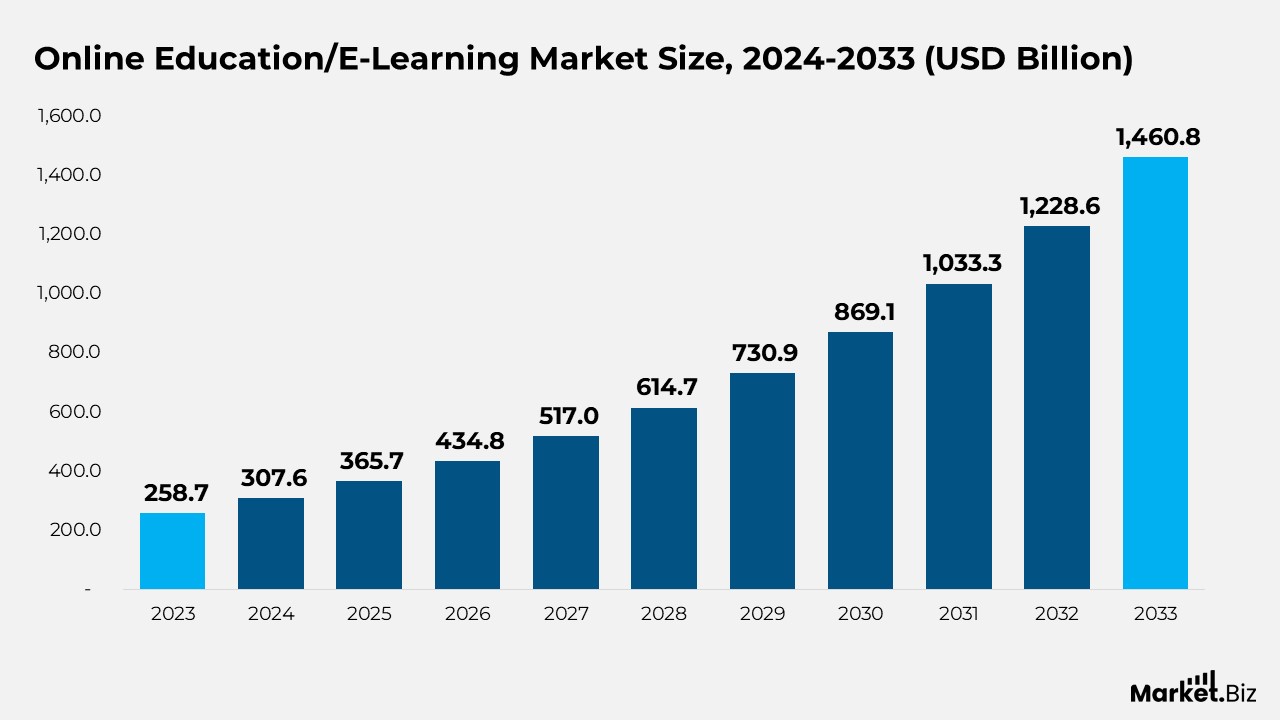
- According to Market.us, the online education market is expected to rise from $365.7 billion in 2025 to $1,460.8 billion by 2033s, representing a compound annual growth rate (CAGR) of 18.9% from 2024 to 2033.
- The growth of the online education market is fueled by the increasing use of the internet and digital technology, offering flexibility and accessibility for learners globally.
- In 2023, the custom e-learning segment captured over 31% of the online education market, driven by its ability to cater to specific learner needs.
- In 2023, the Primary and Secondary Education segment held more than 29% of the market, largely due to the rise of digital learning platforms during health crises like COVID-19.
- In 2023, the Instructor-Led Virtual Courses segment dominated with over 58% of the market, thanks to its structured learning environment resembling traditional classrooms.
- In 2023, the Academic segment captured over 46% of the online education market, driven by the growing adoption of digital platforms in educational institutions.
- In 2023, North America led the market with over 37% of the global share, valued at USD 95.71 billion, with significant growth expected in the future.
- North America’s technological infrastructure supports widespread access to high-speed internet and advanced digital devices, enabling seamless online education delivery.
(Source: Market.us)
E-Learning VR Market Size
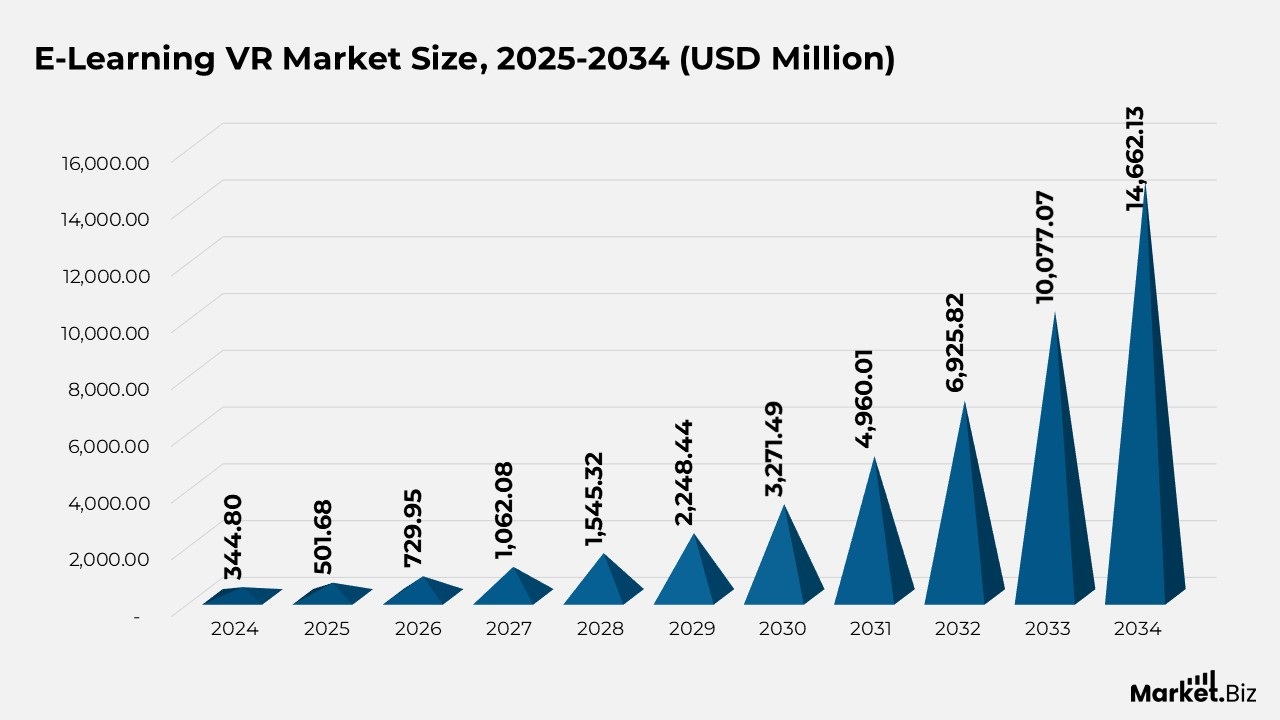
- According to Market.us, the e-learning VR market is expected to rise from $501.68 million in 2025 to $14,662.13 million by 2034, representing a compound annual growth rate (CAGR) of 45.50% from 2025 to 2034.
- The growth of the VR-based learning market is driven by increasing adoption across educational institutions, corporate training, and healthcare sectors, with benefits like better retention and engagement.
- In 2024, the Hardware segment dominated the market, capturing over 54% of the total market share, thanks to the crucial role of VR components like headsets and motion sensors.
- In 2024, the Educational Institutions segment held more than 40% of the market share, driven by rising demand for immersive learning experiences in schools, colleges, and universities.
- North America leads the E-Learning VR market, with the U.S. holding USD 112.0 million in market share and a projected CAGR of 43.1% in the coming years.
- In 2024, North America captured over 35% of the global E-Learning VR market, generating USD 120.68 million in revenue, fueled by technological advancements and investment in VR development.
- The U.S. market is projected to grow at a CAGR of 43.1%, driven by the adoption of VR in schools, universities, and corporate training programs.
- Europe holds around 25% of the global market share, with growth driven by government initiatives and VR adoption in vocational training, though challenges remain in infrastructure and budgets.
(Source: Market.us)
Online Learning Technology
- In the U.S., each school district accesses an average of 2,739 educational technology tools. As online learning continues to evolve, it naturally integrates more technology, and as education technology advances, e-learning is poised for further transformation.
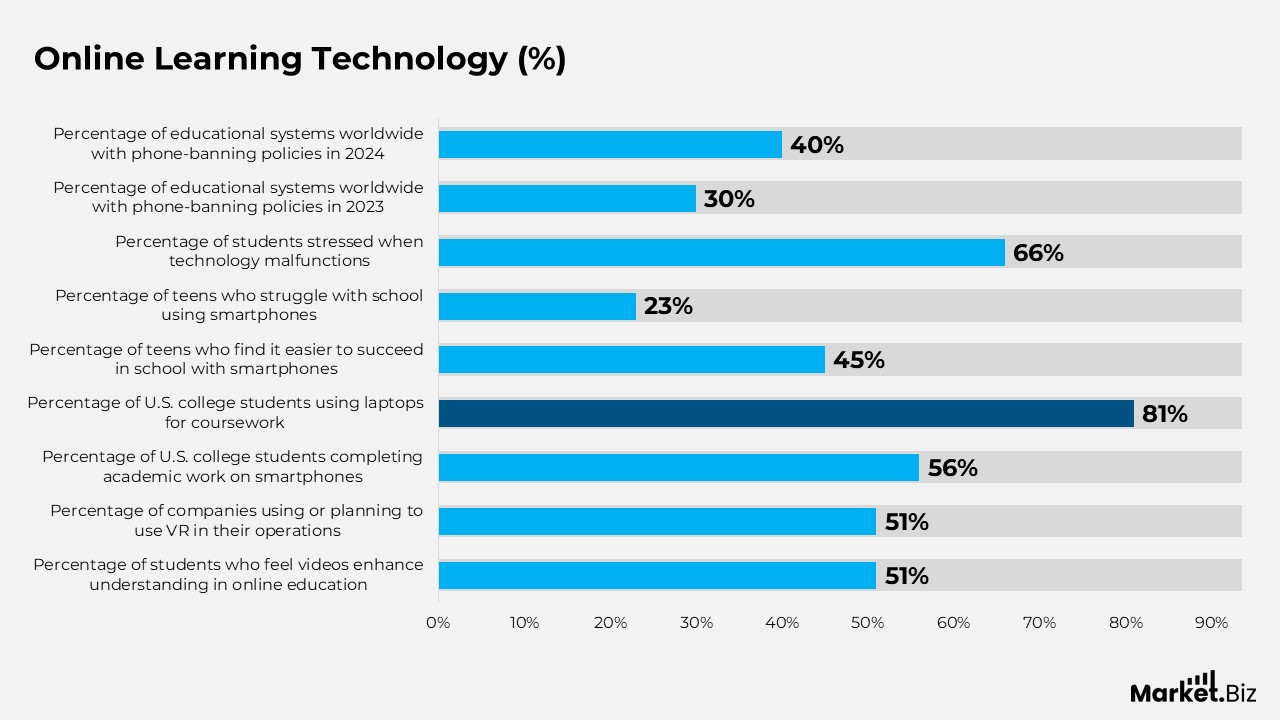
- Among the most impactful content elements in online education today are videos. Research has shown that 51% of students feel that watching videos enhances their understanding and comprehension of the material.
- Currently, 51% of companies either already use or are working to incorporate VR into their operations.
- In terms of device usage, a significant 56% of U.S. college students complete academic work on their smartphones, while 81% use laptops for their coursework. A survey reveals that 45% of teens find it easier to succeed in school with the help of smartphones, while 23% struggle with them.
- However, 66% of students report feeling stressed when technology malfunctions, showing concerns about the reliability of these devices.
- In 2023, 30% of educational systems worldwide had phone-banning policies in place, and this number rose to 40% in 2024, affecting 79 school systems globally.
(Source: Dixit, Azar & Tan, The Franklin Institute PwC, n.d., Robert, Pew Research Center, UNESCO, Bauer et al.)
Global Online Learning Revenue
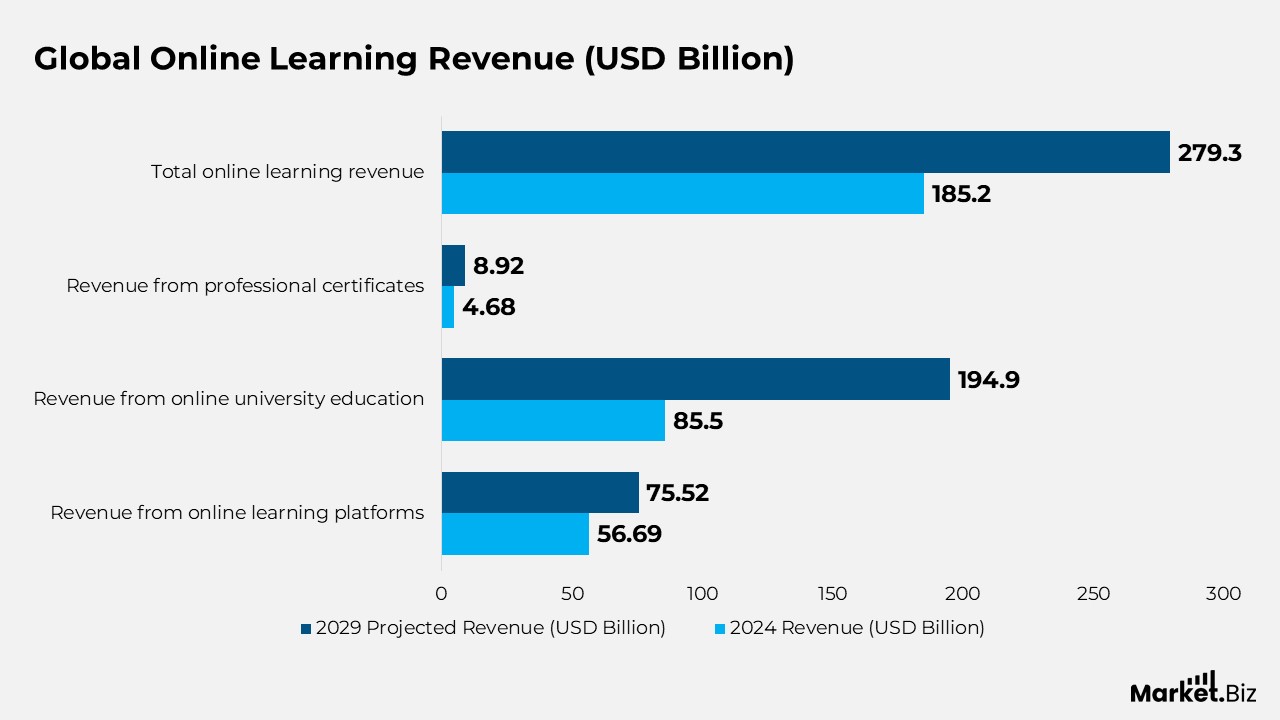
- The global online learning market is expected to see significant growth in the coming years. By 2024, the revenue from online learning platforms is projected to reach $56.69 billion, and by 2029, it is forecasted to grow to $75.52 billion.
- For online university education, the revenue will rise from $85.50 billion in 2024 to an estimated $194.90 billion by 2029, reflecting a substantial increase in demand for digital higher education.
- The market for professional certificates is also expected to grow, with revenue projected to increase from $4.68 billion in 2024 to $8.92 billion in 2029.
- Overall, the total online learning revenue is set to expand from $185.20 billion in 2024 to $279.30 billion by 2029, indicating a steady increase in the global adoption of online education.
(Source: DemandSage, Statista)
Benefits of E-learning
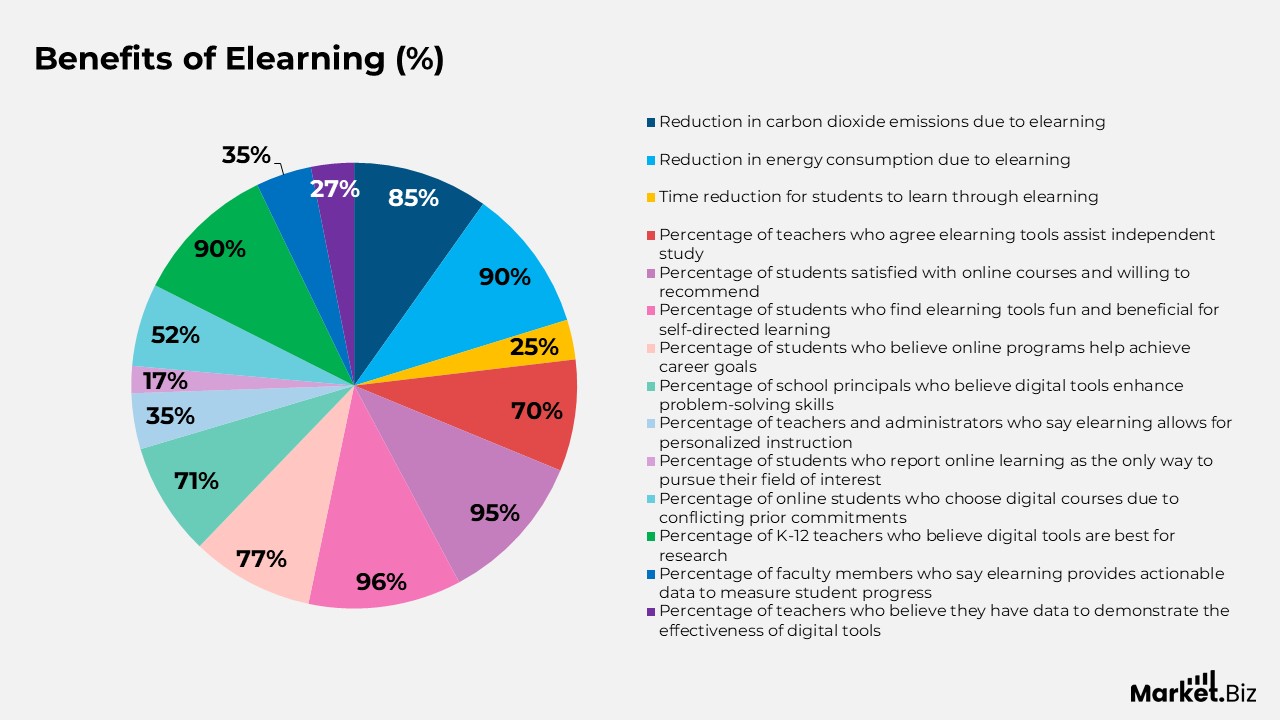
- E-learning helps reduce 85% of carbon dioxide emissions, making it environmentally friendly.
- Studies show that e-learning can cut energy consumption by about 90%.
- E-learning can shorten the time required for students to learn by 25% to 60% compared to traditional methods, such as completing a degree in two years instead of four.
- 70% of teachers agree that e-learning tools assist students in independent study.
- 95% of students express satisfaction with their online courses and are willing to recommend online education to others.
- 96% of students, particularly children, find e-learning tools fun and beneficial for self-directed learning.
- 77% of students believe online programs help them achieve their employment and career goals.
- E-learning allows students to learn up to five times more material per hour compared to traditional learning.
- 71% of school principals believe digital learning tools enhance students’ real-world problem-solving skills.
- 35% of teachers and administrators say e-learning enables more personalised instruction tailored to individual skill levels.
- 17% of students report that online learning is the only way to pursue their field of interest.
- 52% of online students choose digital courses due to prior commitments that conflict with in-person attendance.
- 90% of K-12 public school teachers believe digital learning tools are the best for conducting research and gathering information.
- 35% of faculty members say e-learning tools provide instant, actionable data to measure student progress accurately.
- 27% of teachers believe they have ample data to demonstrate the effectiveness of the digital learning tools they use.
(Source: DemandSage, Statista, Research.com, National Center for Education, Deloitte)
E-learning in K-12 Schools
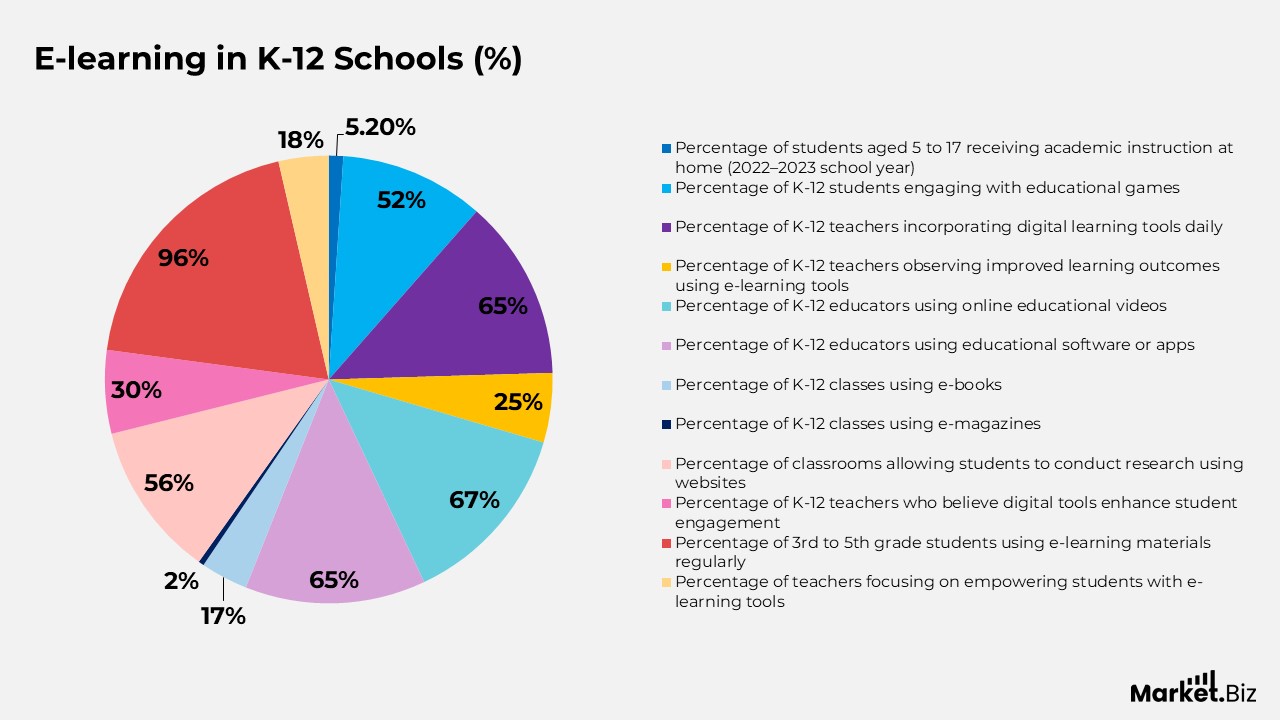
- During the 2022–2023 school year, 5.2% of students aged 5 to 17 received their academic instruction at home, either through full-time virtual education or homeschooling.
- 52% of K-12 students engage with educational games designed to focus on specific skills or content as part of their e-learning experience.
- 65% of K-12 teachers incorporate digital learning tools into their daily teaching practices.
- 25% of K-12 teachers observe improved learning outcomes in their students when using e-learning tools.
- In K-12 classrooms, 67% of educators frequently use online educational videos, making them the most common learning resource, followed by educational software or apps at 65%. Only 17% of classes use e-books, and just 2% use e-magazines.
- 56% of classrooms that use e-learning materials allow students to conduct research using websites.
- 30% of K-12 teachers believe that digital learning tools play a key role in boosting student engagement with both learning and school activities.
- An impressive 96% of students in 3rd to 5th grade report regularly using e-learning materials to help them learn in class.
- 18% of teachers are focused on empowering their K-12 students to take charge of their learning by using e-learning tools.
(Source: DemandSage, Statista, Cross River Therapy)
Online Learning in Higher Education
- In fall 2021, around 9.4 million undergraduate students were enrolled in at least one distance education course.
- About 4.4 million undergraduate students were exclusively enrolled in distance education courses in fall 2021.
- During the same period, approximately 1.8 million postbaccalaureate students took at least one distance education course, with 1.3 million enrolled exclusively in online courses.
- Among those enrolled exclusively in distance education courses in fall 2021, 74% of undergraduate students and 47% of postbaccalaureate students were attending institutions located in their home state.
- 67.82% of students rely on email for communication and sharing materials with professors or peers.
- 34% of graduates consider the quality of the faculty to be the most important factor when selecting online courses.
- Millennials make up about 50% of online college students, with one-third from Gen X.
- 60% of undergraduates choose an online program based on its affordability, while 39% prioritize the reputation of the school or program.
- 17% of students enrolled in e-learning courses use VR platforms and other simulation systems in their studies.
- 56% of online college students use a smartphone or tablet to complete course-related activities.
- 26% of undergraduates are most interested in online courses related to business, while 15% are drawn to IT and computer programs.
- 65% of U.S. faculty members support the use of open educational resources.
- By the end of 2019, over 13,500 MOOCs were launched or offered by more than 900 universities globally, setting the stage for online degree programs like those in cybersecurity.
- Currently, 110 million students are enrolled in MOOC programs worldwide.
- Coursera, the largest MOOC provider, serves 45 million learners, offering 3,800 courses, 420 micro-credentials, and 16 degree programs.
- One major challenge for MOOCs is that 73% of students are unaware of their availability, which hinders their effectiveness.
(Source: DemandSage, Statista, Cross River Therapy)
Challenges of Using E-learning
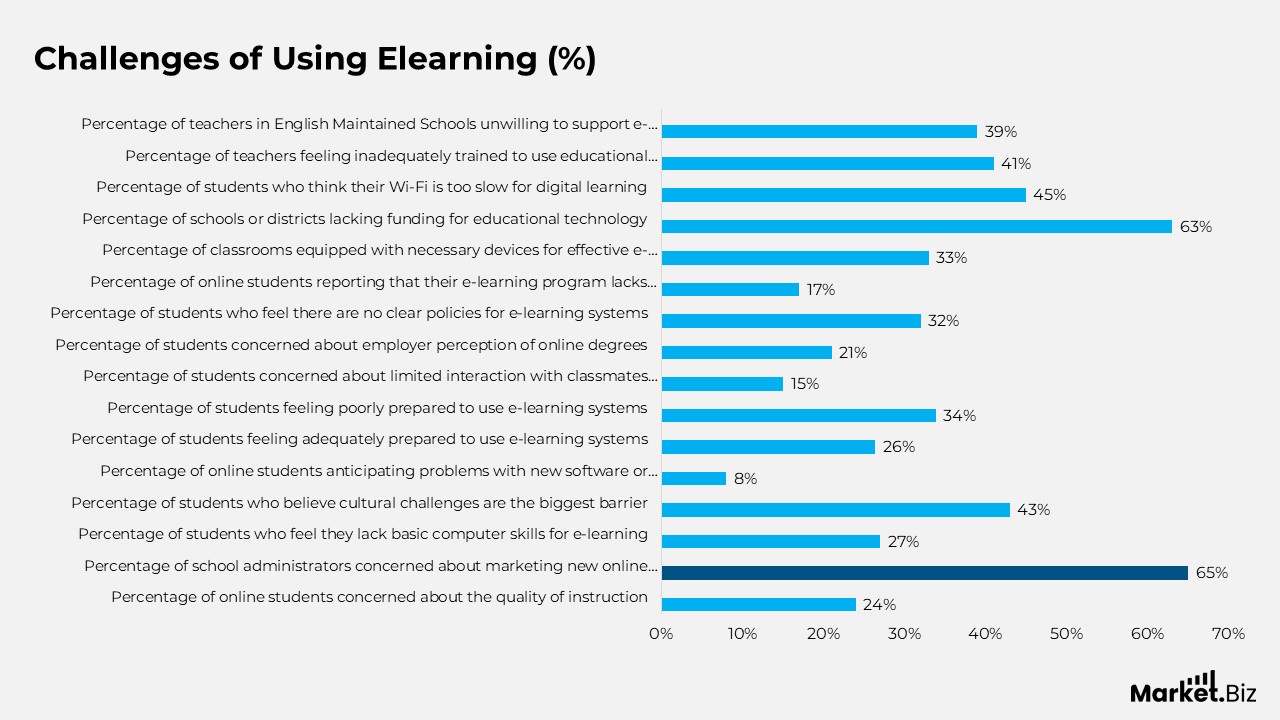
- 24% of online students are concerned about the quality of instruction and academic support compared to on-campus education.
- 65% of school administrators worry about the difficulty of marketing new online programs to prospective students.
- 27% of students feel they lack the basic computer skills needed to use an e-learning system effectively.
- 43% of students believe cultural challenges are the biggest barrier to implementing e-learning systems.
- 8% of online students anticipate that using new software and technologies for digital learning could become a problem.
- Only 26.4% of students feel adequately prepared to use e-learning systems, while 33.9% think they are poorly prepared.
- 15% of students worry that limited interaction with classmates and professors in online learning could negatively affect their education.
- 21% of students are concerned that employers may have an unfavourable perception of degrees earned through online learning.
- Full-time students are required to dedicate around 30 hours per week to their studies, which can be a significant commitment for those also working full-time.
- 32% of students feel that there are no clear policies and guidelines in place for their e-learning system.
- Despite many courses being available on mobile devices, 17% of online students report that their e-learning program does not support mobile access.
- Only one-third of classrooms are equipped with the necessary devices for effective e-learning.
- 63% of schools or districts lack the funding required for educational technology.
- 45% of students think their Wi-Fi connections are too slow for effective digital learning.
- 41% of teachers feel they are not adequately trained to make full use of educational technology.
- 39% of teachers in English Maintained Schools are not willing to support the use of e-learning tools in their teaching.
(Source: DemandSage, Statista, Research.com, National Center for Education, Deloitte)
Conclusion
Several key factors, such as the increasing availability of digital technologies, the rising demand for flexible learning options, and the growing necessity for continuous skill development in an ever-evolving job market, propel the e-learning sector. These factors have led to the widespread adoption of e-learning across both educational institutions and corporate settings.
Nevertheless, challenges persist, including the need to bridge the digital divide, address technological limitations in underserved regions, and sustain learner engagement in online environments.
Looking to the future, e-learning offers vast opportunities, such as the growth of personalized learning paths, the incorporation of advanced technologies like AI and VR, and the potential for global partnerships. As these developments unfold, e-learning is poised to reshape the educational landscape, providing innovative solutions to meet the dynamic needs of learners worldwide.
FAQ’s
E-learning refers to the use of digital technologies, particularly the internet, to provide educational content and training programs. It allows learners to access learning materials remotely at any time and from anywhere using devices such as computers, tablets, and smartphones.
The expansion of e-learning has been driven by several key factors, including the widespread availability and affordability of digital devices, enhanced internet connectivity, the rise of mobile learning, and a growing demand for flexible, on-demand learning. Furthermore, the need for continuous skill enhancement and the impact of the COVID-19 pandemic have significantly accelerated its adoption across the globe.
E-learning statistics offer crucial insights into industry trends, growth trajectories, and learner preferences. This data helps businesses and educational institutions make informed decisions about content creation, technology adoption, and market expansion. Additionally, it enables organizations to understand the changing needs of learners better, allowing them to develop more effective and engaging learning programs.
While the e-learning industry continues to expand, it encounters several challenges, including ensuring equitable access to technology, overcoming infrastructure issues in underdeveloped regions, and maintaining learner engagement in virtual environments. Additionally, a lack of adequate digital literacy and internet access in some areas continues to hinder the effectiveness of e-learning programs.
The e-learning market has been growing rapidly, with its global value reaching billions of dollars in recent years. Projections indicate continued growth as investments in technology rise, mobile learning becomes more prevalent, and the global trend toward digital education solutions expands. This dynamic market is expected to continue its upward trajectory as e-learning adoption increases across various sectors.