









Introduction
Interactive learning statistics: Offers valuable insights into the impact and engagement of modern teaching methods that actively involve students. As digital tools and online platforms continue to grow, interactive learning has become a key component in educational strategies across different fields. By examining data on learner engagement, participation, assessment results, and feedback, institutions can enhance their teaching approaches to boost learning outcomes.
These statistics highlight trends such as the increasing popularity of gamified learning, the role of interactive simulations, and the effectiveness of real-time feedback. Recognizing these trends is crucial for improving educational experiences, ensuring that learners are engaged participants rather than passive recipients of knowledge.
Editor’s Choice
- The eLearning market is the fastest-growing segment in the education industry, experiencing a 900% growth since 2000.
- Mobile Learning stands out as one of the most rapidly expanding sectors within eLearning, growing at an annual rate of 23%.
- The online learning platform market, although growing at a slower pace of 5.26% annually, is projected to reach $58.45 billion by the end of 2024.
- In 1995, only 4% of organizations utilized online learning, but today, 90% of organizations incorporate eLearning into their training programs.
- More than 40% of Fortune 500 companies regularly integrate online learning into their employee training strategies.
- 99% of organizations now offer eLearning to their employees, up from 76% just five years ago.
- Online learning reduces employee training time by 40% to 60% compared to traditional face-to-face learning methods.
- Retention rates in online learning may increase by up to 60%, significantly higher than the typical 8-10% retention rate seen with conventional classroom training.
- 90% of students prefer eLearning over traditional classroom-based learning due to its flexibility and accessibility.
General Interactive Learning Statistics
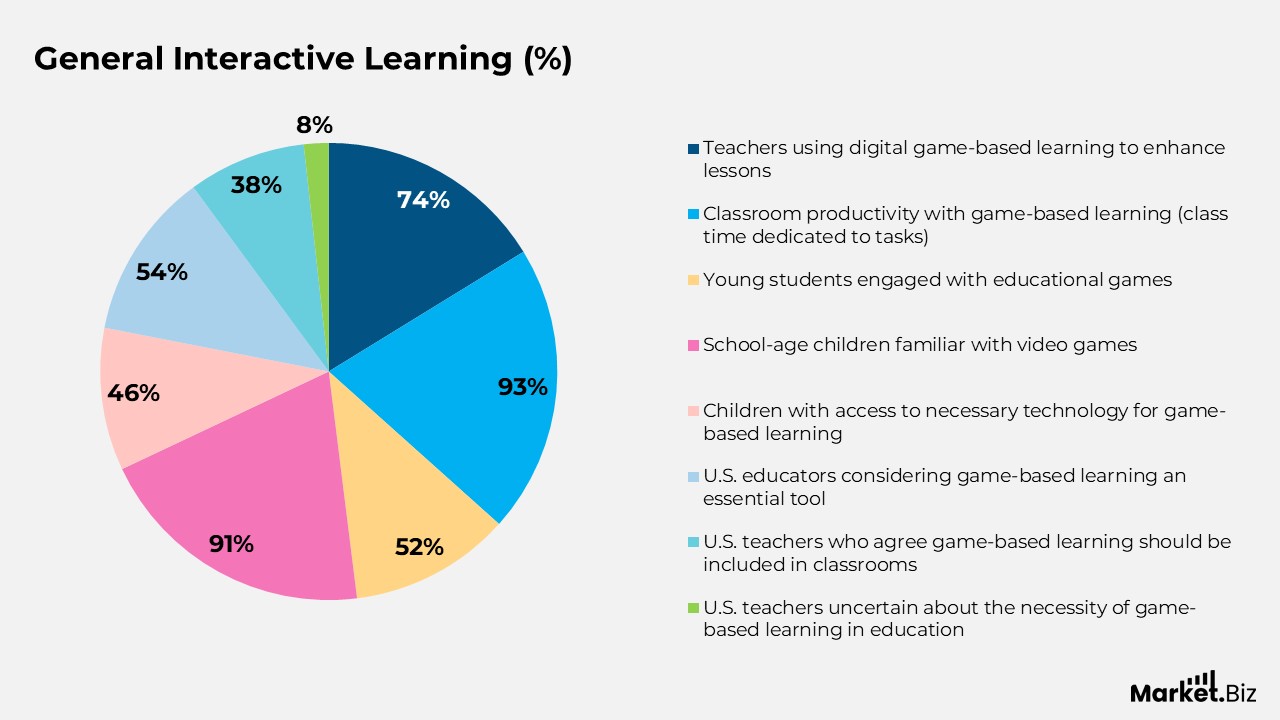
- 74% of teachers use digital game-based learning to enhance their lessons.
- Game-based learning boosts classroom productivity, with 93% of class time dedicated to tasks when using these methods.
- 52% of young students have engaged with educational games.
- Video games are effective learning tools, as 91% of school-age children are familiar with them. However, only 46% of children have access to the necessary technology for game-based learning.
- 54% of U.S. educators consider game-based learning an essential tool, and 38% agree it should be included in classrooms.
- Just 8% of U.S. teachers are uncertain about its necessity in education.
(Source: Kooc Media Ltd., Statista, Coolest Gadgets)
K-12 Learning Management Systems Market Size
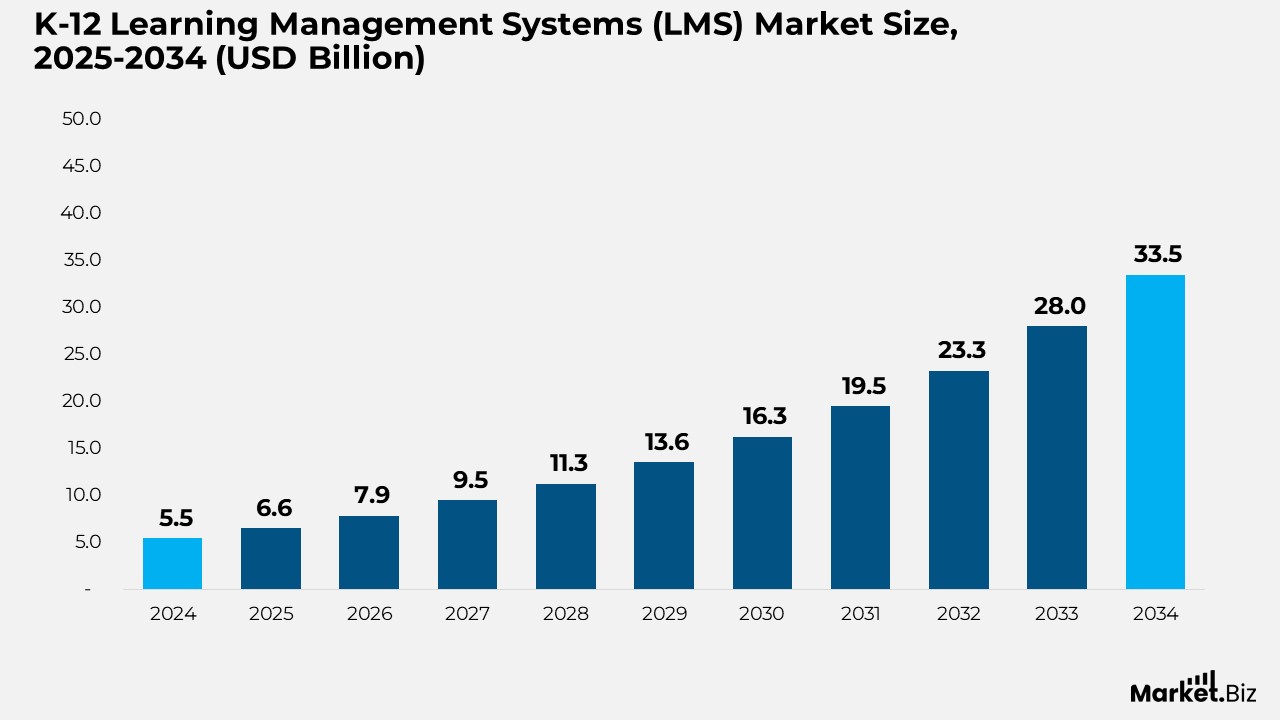
- According to Market.us, the K-12 learning management systems market is expected to rise from $6.6 billion in 2025 to $33.5 billion by 2034, representing a compound annual growth rate (CAGR) of 19.8% from 2025 to 2034.
- The market is expanding due to the increasing integration of digital technologies in classrooms, with schools adopting tech solutions to improve engagement, flexibility, and support for remote learning. This transformation enhances interactive learning, streamlines resource management, and meets the growing demand for flexible education models.
- In 2024, North America holds the leading position in the Global K-12 LMS Market, capturing over 36% of the market share and generating USD 1.98 billion in revenue. This dominance is supported by extensive technology adoption, significant investments in educational technology, and robust infrastructure development in the region.
- The Cloud-Based segment leads the Global K-12 LMS Market with an 82% share, driven by the increasing demand for flexible, scalable, and cost-effective solutions that can be seamlessly integrated into various educational settings. Cloud technology enables better accessibility and resource management, making it the preferred choice for schools.
- In 2024, North America maintained a leading market position, accounting for above 34.2% of the global share and making USD 4.34 billion in revenue.
- The U.S. Gamified Learning market is experiencing rapid growth, currently valued at USD 3.69 billion with an anticipated CAGR of 28.5%. The increasing adoption of digital educational technologies, including mobile apps, artificial intelligence, and cloud computing, is driving the scalability and accessibility of gamification solutions.
(Source: Market.us)
Gamified Learning Market Size
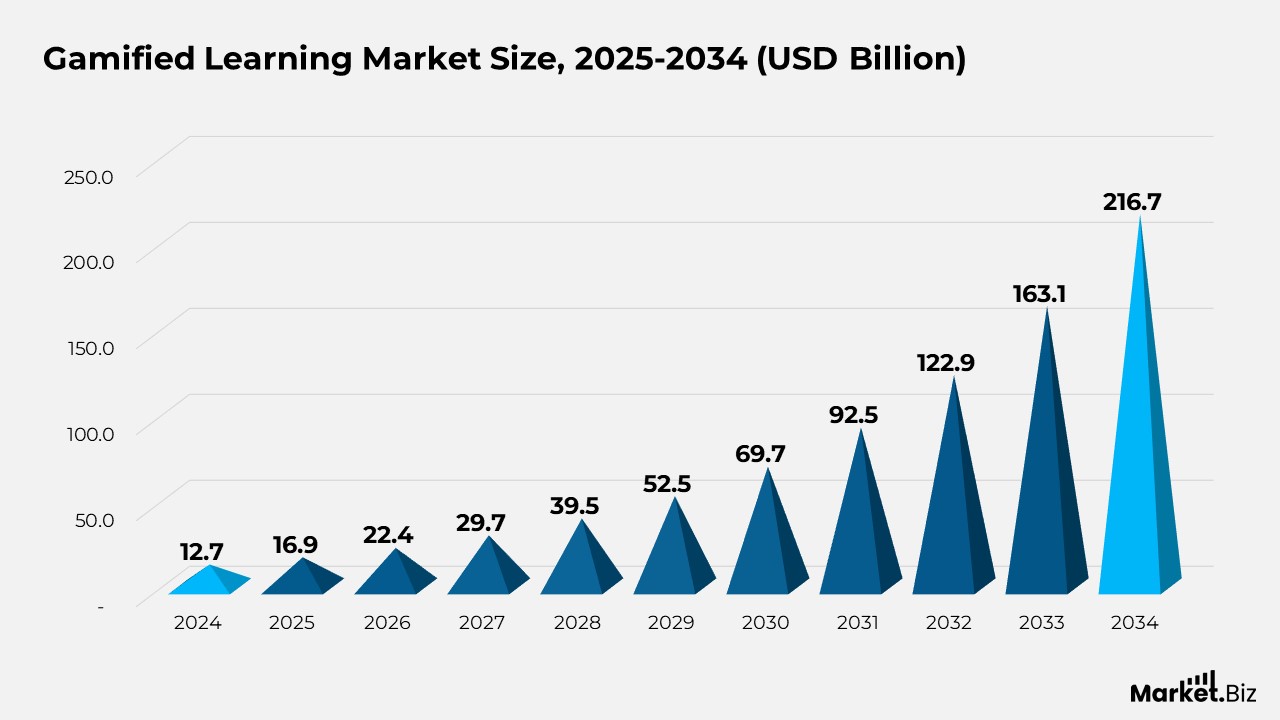
- According to Market.us, the gamefied learning market is expected to rise from $16.9 billion in 2025 to $216.7 billion by 2034, representing a compound annual growth rate (CAGR) of 32.8% from 2025 to 2034.
- The market growth is fueled by the growing adoption of digital learning platforms, the increasing demand for personalized education, and the need for ongoing workforce skill development. Gamified elements are being incorporated to enhance engagement and improve learning outcomes in educational and corporate settings.
- The Solution segment dominated the Global Gamified Learning Market in 2024, holding a 75.5% market share, driven by the demand for interactive, customizable platforms that improve learning experiences and outcomes in both academic and corporate environments.
- In 2024, the Cloud segment held a leading position in the Global Gamified Learning Market, capturing a 55.8% share, driven by the increasing demand for scalable, flexible, and cost-effective solutions for remote and hybrid learning environments.
- The Online segment held a dominant market position in 2024, accounting for 58.7% of the Global Gamified Learning Market share, fueled by the growing preference for flexible, convenient, and scalable online learning platforms.
- The Location-Based Games segment captured 25.6% of the market in 2024, driven by the rising demand for interactive, real-world learning experiences that combine gaming elements with physical locations.
- The IT & Telecom segment held 28.8% of the Global Gamified Learning Market in 2024, due to the ongoing need for upskilling and reskilling in rapidly evolving technologies and processes within the sector.
- North America maintained a dominant position in the Global Gamified Learning Market in 2024, capturing more than 34.2% of the market share and generating USD 4.34 billion in revenue, driven by advanced technology adoption and widespread digital resource integration.
(Source: Market.us)
Interactive Learning Business in Sectors
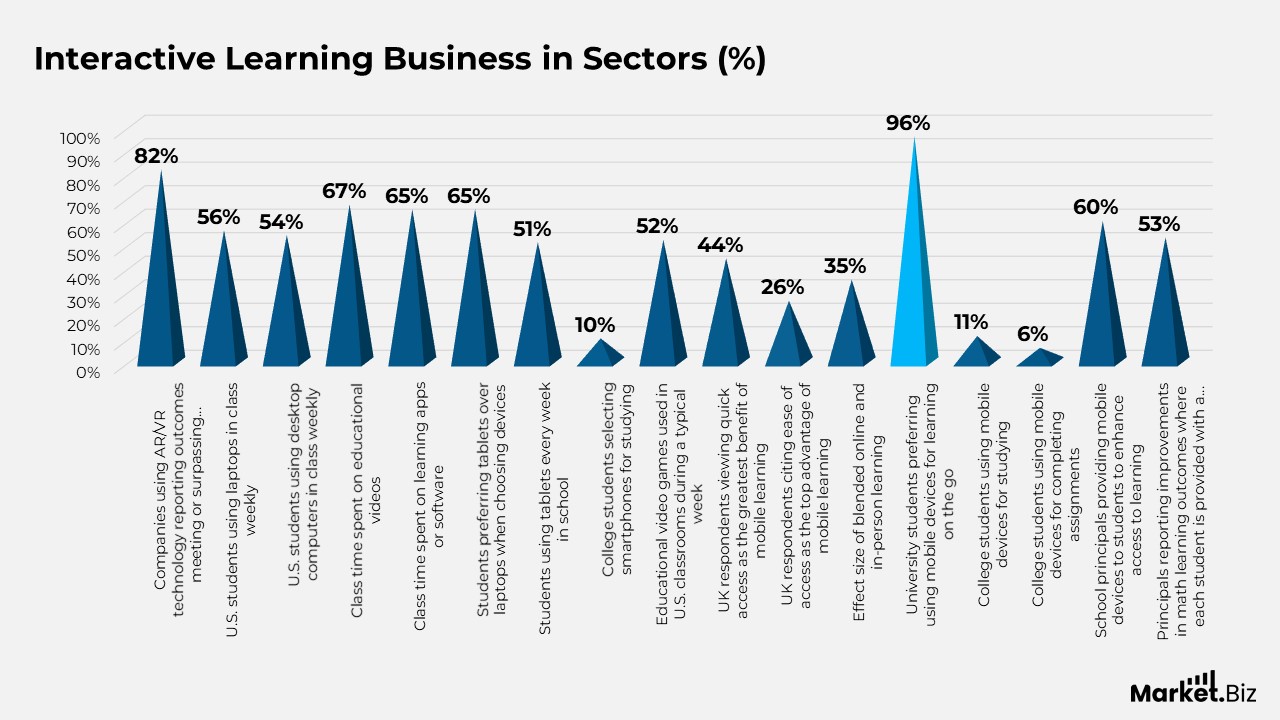
- 82% of companies using AR/VR technology report that the outcomes either meet or surpass their expectations.
- In the U.S., 56% of students use laptops in class weekly, while 54% use desktop computers.
- Educational videos are integrated into 67% of class time, and 65% of class time is spent on learning apps or software.
- When choosing devices, 65% of students prefer tablets over laptops, and 51% use tablets every week in school.
- Only 10% of college students select smartphones for studying.
- Educational video games are used 52% of the time in U.S. classrooms during a typical week.
- In the Czech Republic, students who used an English-learning app scored an average of 43.9 out of 60, while those who didn’t use the app recorded 31.8.
- A survey in the UK revealed that 44% of respondents view quick access as the greatest benefit of mobile learning, while 26% cited ease of access as the top advantage.
- Research indicates that a blended approach to online and in-person learning yields an average effect size of +0.35, p < .001.
- Around 10 million K-12 students are expected to participate in virtual learning during the 2024-2025 school year.
- A recent study found that 96% of university students prefer using mobile devices for learning on the go.
- 11% of college students use mobile devices for studying, and 6% use them for completing assignments.
- A study on Facebook’s role in learning revealed that 81.9% of students engaged with their course’s Facebook page, 51% found it helpful, and 76.4% recommended its use in future courses.
- 60% of school principals in the Speak Up Research Project provided mobile devices to students, aiming to enhance access to learning.
- In schools where each student is provided with a device, 53% of principals reported improvements in math learning outcomes.
(Source: Kooc Media Ltd., Statista, Coolest Gadgets)
Interactive Learning Statistics – by Industry Sector
Education Sector
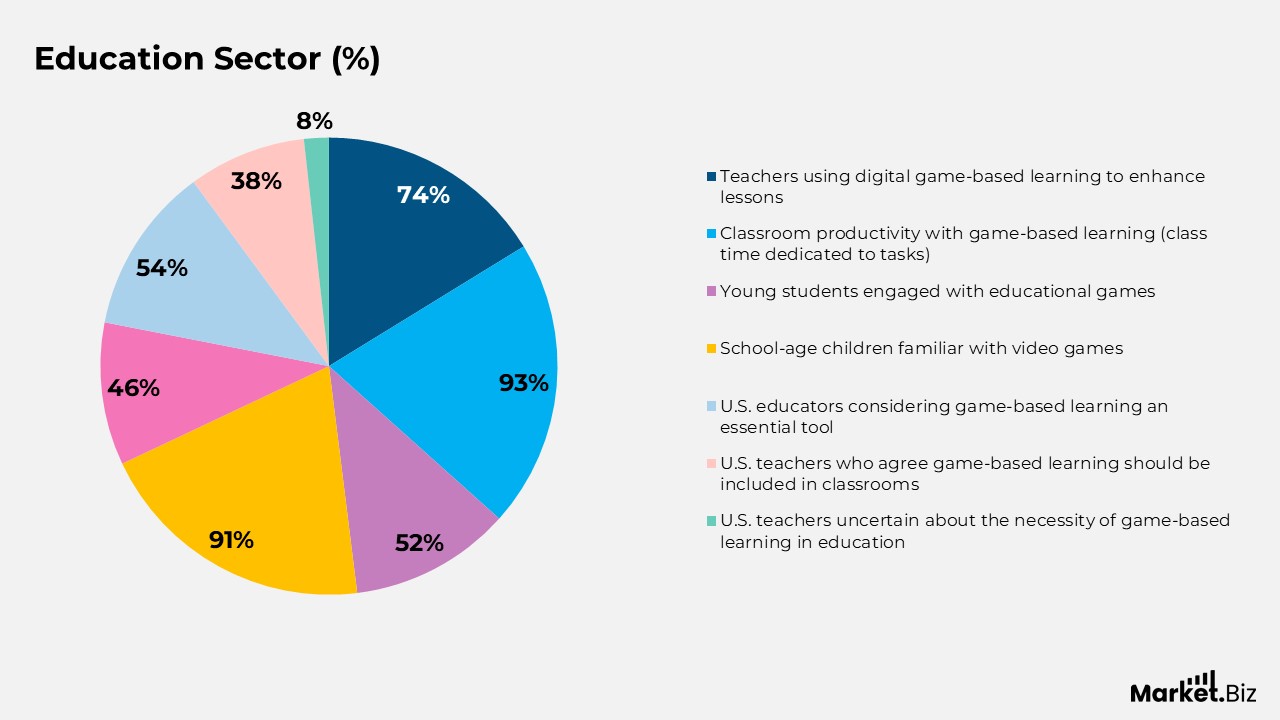
- 74% of teachers use digital game-based learning to enhance their lessons.
- Game-based learning boosts classroom productivity, with 93% of class time dedicated to tasks when using these methods.
- 52% of young students have engaged with educational games.
- Video games are effective learning tools, as 91% of school-age children are familiar with them. However, only 46% of children have access to the necessary technology for game-based learning.
- 54% of U.S. educators consider game-based learning an essential tool, and 38% agree it should be included in classrooms.
- Just 8% of U.S. teachers are uncertain about its necessity in education.
Workplace Sector
- Game-based learning in the workplace has a compound annual growth rate (CAGR) of 53.4%.
- Microlearning has shown a 17% improvement in learner performance and a 50% increase in engagement.
- The Pentagon invested $479 million in a contract with Microsoft for VR, AR, and AI technology for soldier training.
- 82% of companies implementing AR/VR report that the benefits met or exceeded their expectations.
Device Usage in Education
- 56% of U.S. students use laptops weekly in class.
- 54% of learners usage desktop computers in U.S. classrooms.
- Educational videos are utilized 67% of the time, and educational apps 65% in U.S. classrooms.
Tablet Usage
- 65% of students prefer tablets over laptops and desktops when first introduced.
- 51% of U.S. students use tablets regularly in school.
- 52% of U.S. classrooms usage educational video games weekly.
Smartphone Usage
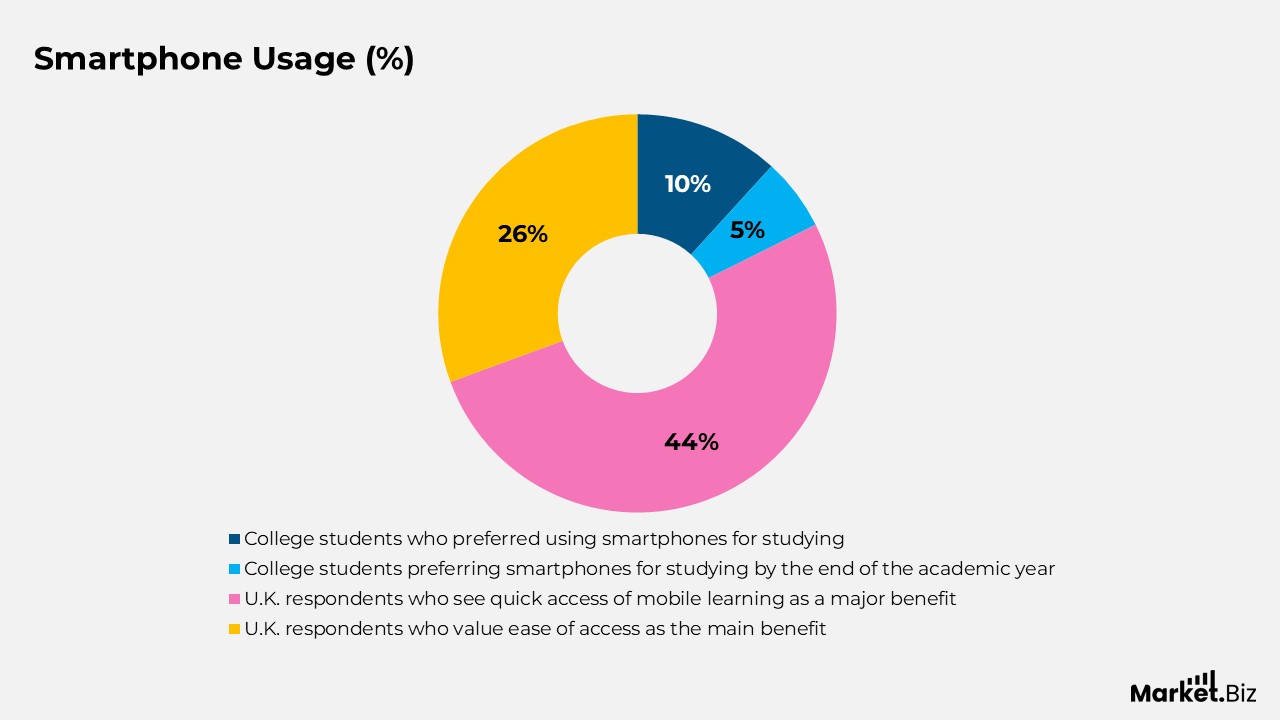
- 10% of college students preferred using smartphones for studying, which decreased to 5% by the end of the academic year.
- Students in the Czech Republic who used an app for English learning scored 43.9 out of 60 points on average, compared to 31.8 points for those who didn’t.
- 44% of U.K. respondents see the quick access of mobile learning as a major benefit, while 26% value ease of access.
K-12 Education Statistics
- Preschool children exposed to gesture-based interactive game learning performed better in motor skills and learning.
- Studies show positive results with interactive learning for eighth-grade and fourth-grade students.
- In the 2015-2016 school year, 5 million K-12 students participated in online or virtual classes.
Higher Education Statistics
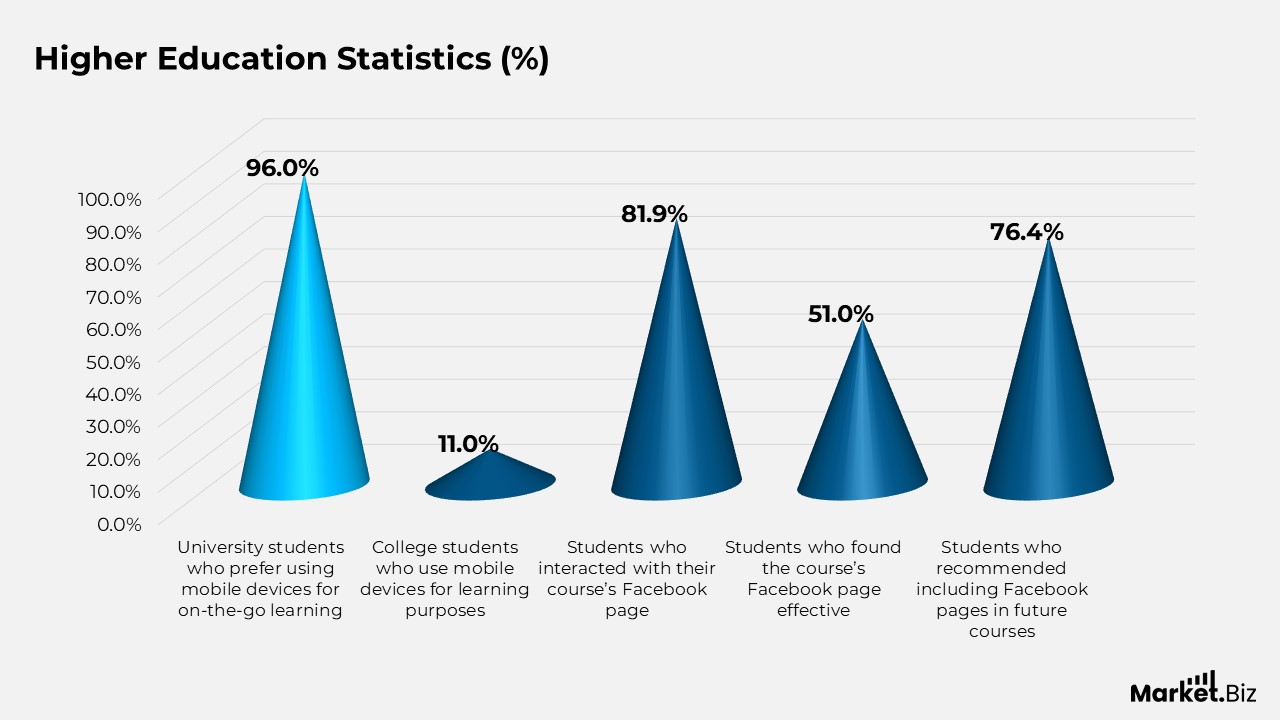
- 96% of university students prefer using mobile devices for on-the-go learning.
- 11% of college students use mobile devices for learning purposes.
- 81.9% of students interacted with their course’s Facebook page, although only 51% found it effective.
- 76.4% of students recommended including Facebook pages in future courses.
(Source Juraschka, Murray; Ibañez; Fatemi; Fowler, Deloitte, Namuddu & Watts, Klimova, Teodorescu, Irwin, Ball, Desbrow, & Leveritt)
Conclusion
Interactive learning statistics emphasize the growing impact of technology in transforming education. The widespread adoption of digital tools, gamification, and personalized learning platforms is changing how students interact with content, resulting in better learning outcomes.
As the need for flexible, scalable, and accessible educational solutions increases, institutions are incorporating more interactive elements to enhance student engagement. These statistics highlight significant trends, such as the rise of online learning, the dominance of cloud-based platforms, and the increasing use of gamification to boost participation.
Looking ahead, these trends are expected to evolve, driving innovation in educational methods and fostering the growth of adaptive learning environments.
FAQ’s
Interactive learning refers to an educational approach that actively engages students in the learning process through technology, gamification, simulations, and other interactive tools. It encourages students to participate, collaborate, and apply their knowledge in real-time.
Interactive learning statistics provide valuable insights into how digital tools and interactive elements affect student engagement, participation, and learning outcomes. These insights help educators refine teaching strategies, optimize content delivery, and foster a more engaging and effective learning environment.
Key trends include the rise of gamification, the increased use of online and cloud-based learning platforms, the growing demand for personalized learning experiences, and the shift toward remote and hybrid learning environments. These trends are reshaping how education is delivered and consumed globally.
Gamification enhances engagement by incorporating game-like elements, such as rewards, challenges, and competitive aspects, into the learning process. This approach has been shown to improve motivation, participation, and retention of knowledge among students.
Cloud-based platforms provide scalable, flexible, and cost-effective solutions for delivering interactive learning experiences. They enable seamless access to educational content and tools from anywhere, making learning more accessible and facilitating remote and hybrid learning models.
Personalized learning tailors educational content to individual students’ needs, strengths, and learning styles. By leveraging data and digital tools, personalized learning helps students progress at their own pace, ensuring better outcomes and fostering deeper engagement with the material.

