









Introduction
Interactive Kiosk Statistics: An Interactive Kiosk functions as a self-service terminal that allows users to engage through touchscreens or similar input devices. Typically, it comprises physical components such as a display, a computer, and input mechanisms, along with specialised software designed for particular tasks. These kiosks are commonly utilised for providing information, enabling self-checkout in retail environments, managing ticketing processes, and aiding in navigation.
They improve customer service, optimise operations, and lower expenses, although they require consistent maintenance and security protocols. Looking forward, upcoming trends include the incorporation of artificial intelligence, compatibility with mobile devices, and the development of touchless interfaces, rendering them a flexible technology applicable across multiple industries.
Editor’s Choice
- Two firms, Olea Kiosk Inc. and GLORY Ltd., have successfully established a robust presence, each commanding a notable 15% market share.
- The global Interactive Kiosk market is experiencing consistent growth, with a compound annual growth rate (CAGR) of 6.3%.
- The distribution of the Interactive Kiosks market varies by region, with North America leading with the largest share at 44%.
- The introduction of automated passport control kiosks at JFK and Newark Airports in 2013 led to an impressive 22% decrease in wait times by 2014.
General Interactive Kiosk Statistics
- The global Interactive Kiosk market is experiencing consistent growth, with a compound annual growth rate (CAGR) of 6.3%.
- In 2023, the market for Interactive Kiosks was assessed at USD 31 billion.
- Olea Kiosk Inc. and GLORY Ltd. have successfully established a robust presence, each holding a significant 15% share of the market.
- The distribution of Interactive Kiosks is varied across regions, with North America holding the largest share at 44%.
- By 2027, the Self-service Kiosk market is projected to achieve an impressive revenue of USD 21,415.4 million, reflecting the growing demand and adoption of self-service kiosk solutions in various sectors.
- According to a research study, around 73% of surveyed shoppers indicated a preference for retail self-service technologies, such as self-checkout, over engaging with in-store associates.
- A survey conducted by PYMTS revealed that 49.4% of retail customers utilize self-service checkouts primarily for their speed, while 34.7% prefer them due to shorter lines. Additionally, hotel guests may value the flexibility to check in or out at their own convenience.
Interactive Kiosk Market Size Statistics
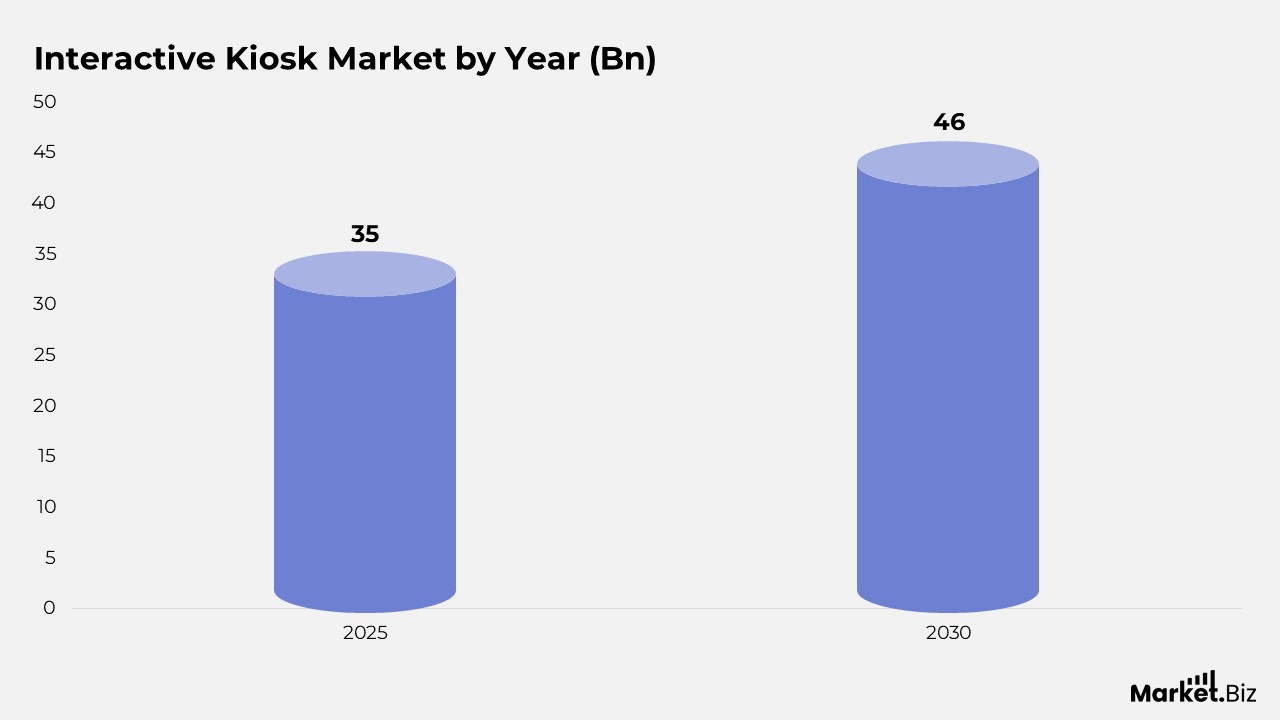
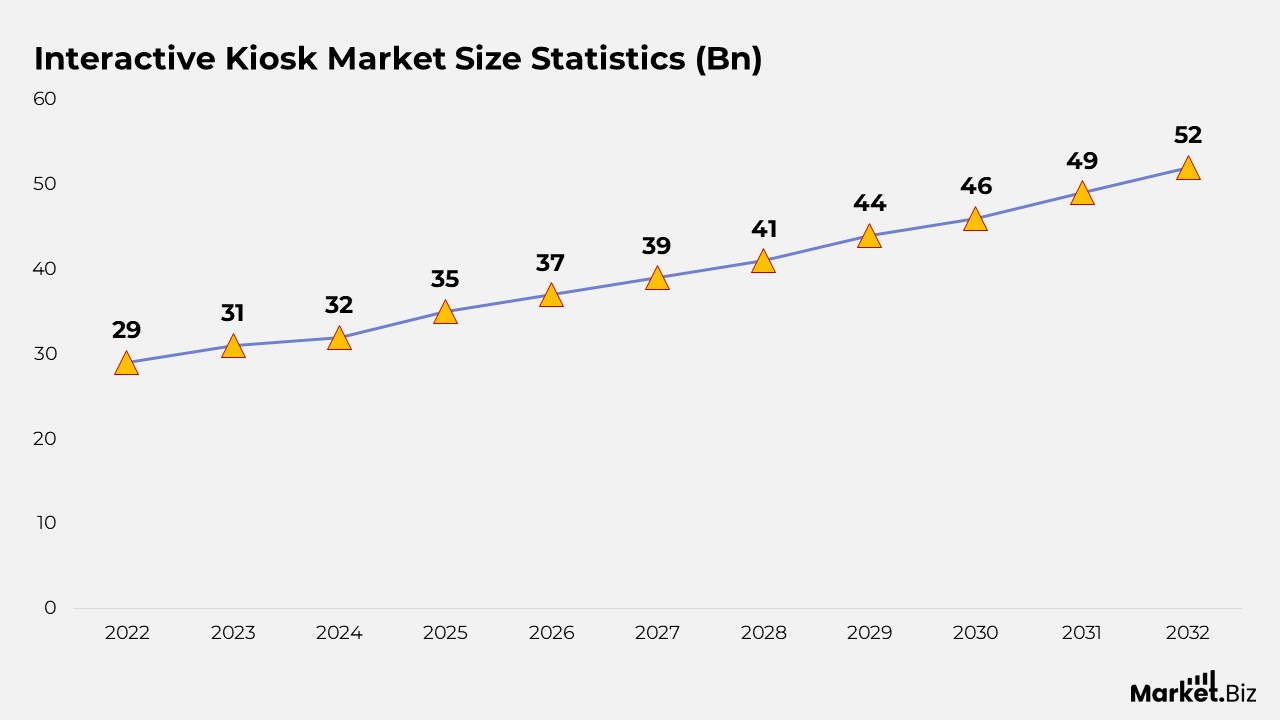
- In 2022, the market was assessed at USD 29 billion, and it is projected to increase to USD 31 billion in 2023, followed by a further rise to USD 32 billion in 2024.
- The upward trend persists, with projections indicating that the market will attain USD 35 billion in 2025 and USD 37 billion in 2026.
- Looking forward, the market is expected to grow even more, reaching USD 39 billion in 2027, USD 41 billion in 2028, and USD 44 billion in 2029.
- By 2030, the market is anticipated to reach a valuation of USD 46 billion, with the following years indicating ongoing growth, potentially achieving USD 49 billion in 2031 and USD 52 billion in 2032.
Market Players Statistics of Interactive Kiosk
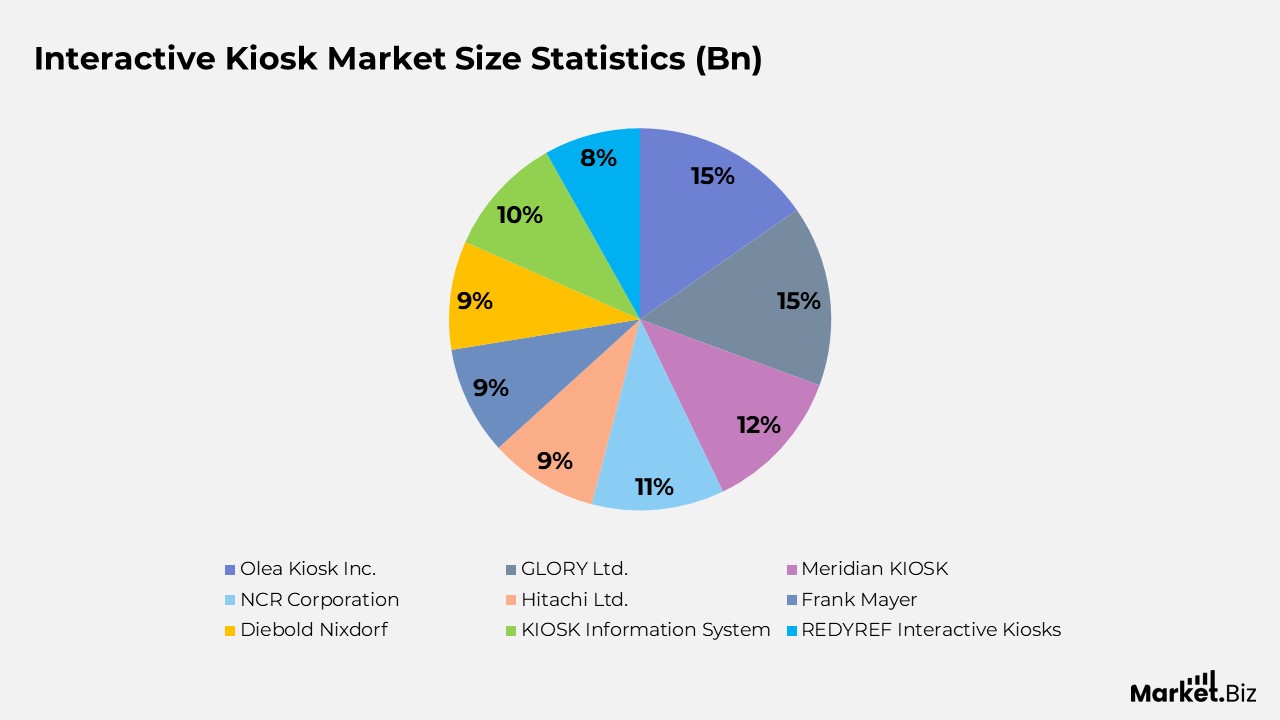
- Two firms, Olea Kiosk Inc. and GLORY Ltd., have successfully established a robust presence, each commanding a notable 15% market share. This reflects their considerable market influence and competitive advantage.
- Following closely, Meridian KIOSK possesses a 12% market share, highlighting its status as a significant player in the sector.
- NCR Corporation is not far behind, with an 11% market share, reinforcing its competitive position.
- Frank Mayer and Hitachi Ltd. both make substantial contributions, each holding a 9% market share, which is significant within the context of market dynamics.
- Diebold Nixdorf also maintains a 9% share, underscoring its presence in the market.
- Furthermore, KIOSK Information System and REDYREF Interactive Kiosks are important contributors, accounting for 10% and 8% of the market, respectively.
Interactive Kiosk Market by Regional Statistics
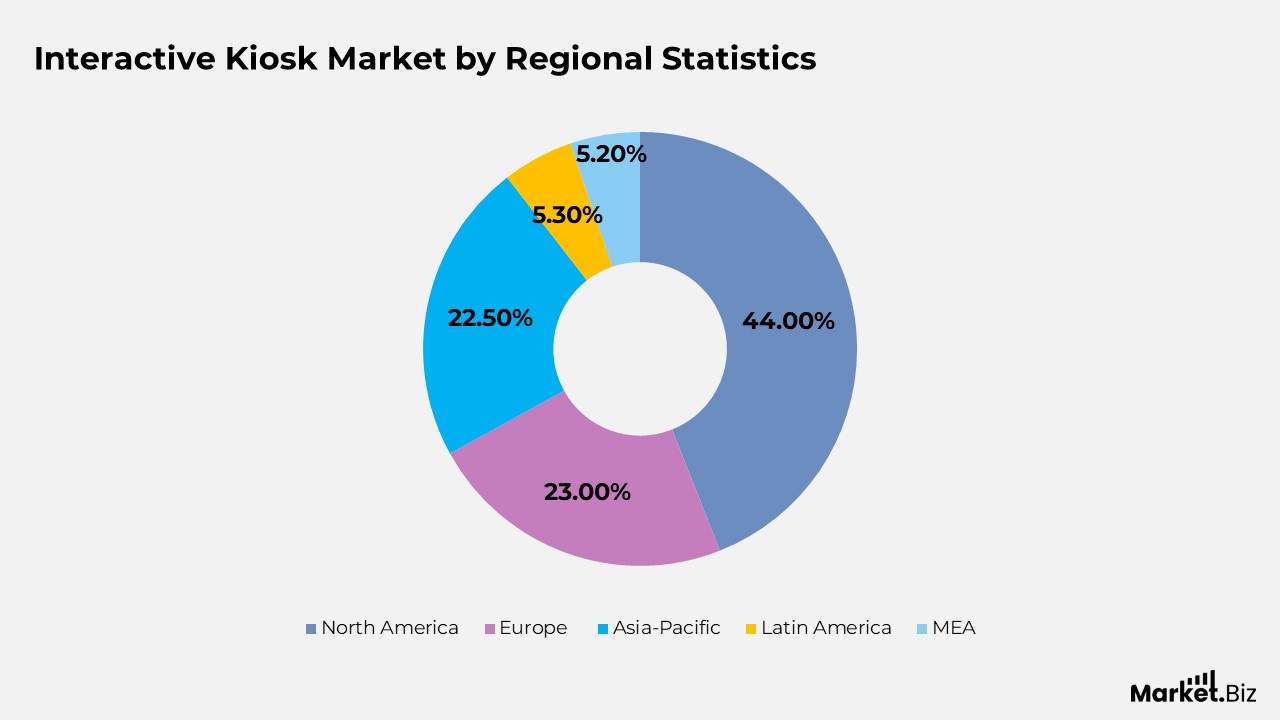
- The distribution of the market for Interactive Kiosks varies by region, with North America leading by holding the largest share at 44%.
- Europe ranks as the second-largest market, possessing a considerable share of 23%.
- The Asia-Pacific (APAC) region also plays a significant role, contributing a noteworthy market share of 22.5%.
- Meanwhile, the Middle East & Africa (MEA) and Latin America regions represent smaller but still important shares, with Latin America at 5.2% and MEA at 5.3%.
Self-Service Kiosk Market Size Statistics
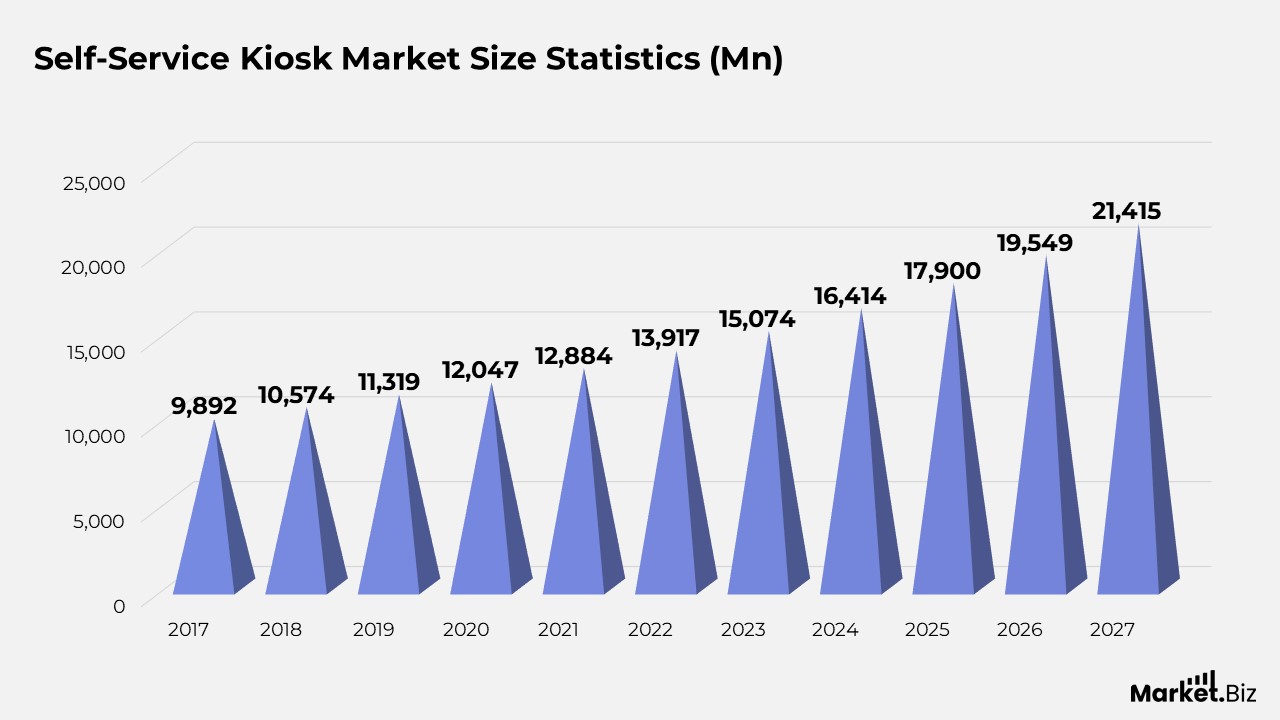
- Starting in 2017 with a revenue of USD 9,892.3 million, the market demonstrated consistent growth, achieving revenue figures of USD 10,573.8 million in 2018 and USD 11,319.3 million in 2019.
- The market maintained its upward trend, exceeding the USD 12 billion threshold in 2020, with a reported revenue of USD 12,047.1 million.
- In 2021, the market experienced further growth, reaching a revenue of USD 12,884.4 million.
- Future projections appear optimistic, as the market is anticipated to sustain its growth path. In 2022, it is projected to attain USD 13,916.5 million, followed by an expected revenue of USD 15,074.3 million in 2023.
- Looking forward to 2024, the self-service kiosk market is predicted to generate USD 16,414.4 million in revenue, with a favorable outlook for the years to come.
- By 2027, it is forecasted to achieve an impressive revenue figure of USD 21,415.4 million.
Type of Kiosks in Operation Statistics
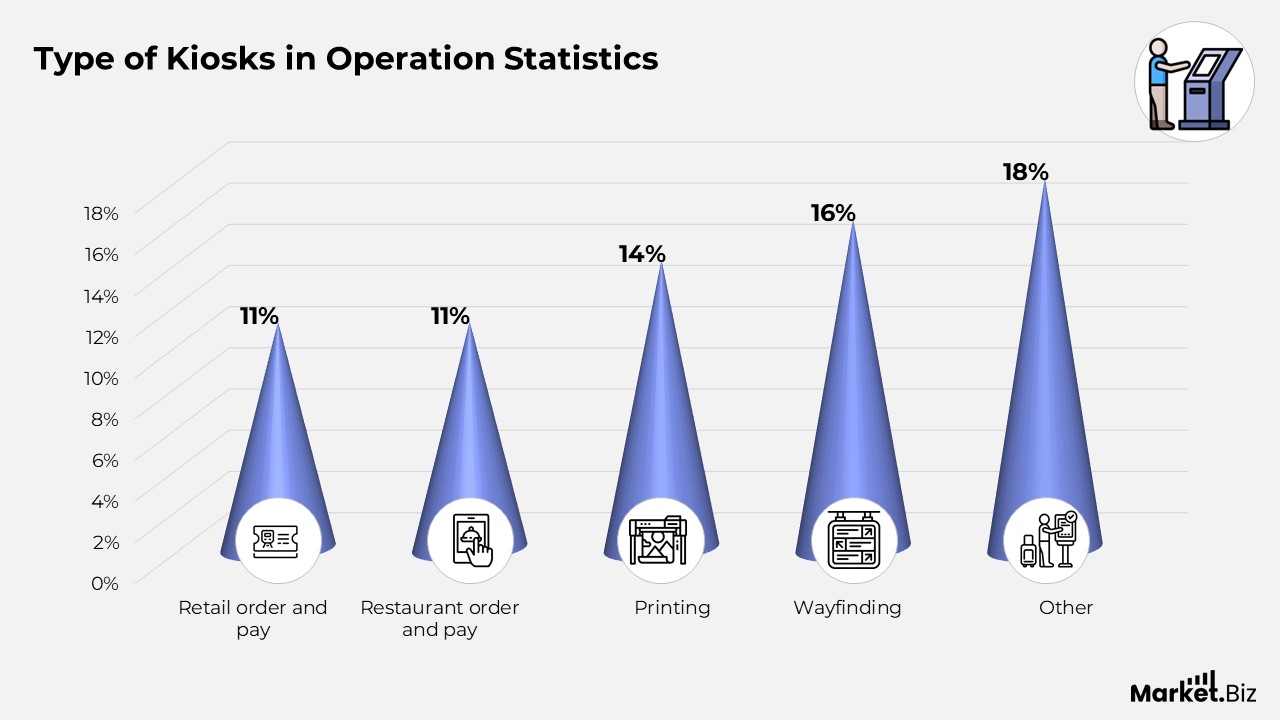
- These kiosks comprise printing kiosks at 14% and Wayfinding kiosks at 16%. Restaurant order and pay kiosks account for 11%, along with Retail order and pay kiosks, which also represent 11%.
- Moreover, there are kiosks for Photo processing, Wi-Fi access, Bill payment, Pharmacy self-service, Parking, Price checking, Phone charging, HR/employee self-service, Gaming/entertainment, Tourist information, and Coupon dispensing and redemption, each constituting 9% of the kiosk distribution.
- In addition, specialised kiosks are available for Hospital check-in, Airport/transportation check-in, and Gift dispensing at 5%, as well as for DVD rental, Rental payment, Vehicle license/registration renewal, and Locker pickup (referred to as “smart” lockers) at 2%.
Consumer Preferences for Interactive Kiosk Statistics
- The introduction of automated passport control kiosks at JFK and Newark Airports in 2013 led to an impressive 22% decrease in wait times by 2014.
- In contrast, other airports lacking these kiosks experienced no enhancements.
- This pattern is similarly observed in the hotel sector, where self-service alternatives improve check-in efficiency and boost guest satisfaction.
- A study conducted in 2019 indicated that in fast-food establishments, 30% of patrons favoured kiosk orders when the queues were of equal length. Likewise, hotel guests are expected to value self-service options.
- A study carried out by PYMTS revealed that 49.4% of retail consumers prefer self-service checkouts due to their efficiency, while 34.7% select them for the reduced wait times.
- Hotel patrons may also value the ability to check in or out at their own convenience.
- When Dodger Stadium implemented kiosks for concessions, there was a 20% increase in the average order value.
- The incorporation of kiosks in hotels can enhance average spending in food and beverage services and improve additional sales.
- In supermarkets, almost 50% of shoppers utilise self-checkout for 75% of their shopping trips, and 30% choose it for half of their visits.
Interactive Kiosk Recent Development
- In the year 2023, NCR Corporation, recognised as a leader in financial and retail technology, purchased Zynstra, a firm that specialises in edge virtualisation software for kiosks, for a sum of $140 million.
- In 2023, Zebra Technologies, renowned for its innovative kiosks and digital signage solutions, successfully raised $150 million to enhance its interactive kiosk offerings.
- At the beginning of 2024, Frank Mayer and Associates, a prominent manufacturer of kiosks, obtained $50 million to boost production capacity and broaden its product range, with a particular emphasis on interactive kiosks tailored for the banking and retail industries.
Interactive Kiosk Future Predictions
- By the year 2026, it is anticipated that 40% of kiosks within the retail and healthcare industries will utilise artificial intelligence to provide personalised experiences, including customised recommendations, real-time data analysis, and improved customer interactions.
Conclusion
Interactive Kiosk Statistics: Interactive Kiosks have emerged as essential tools in various industries, streamlining processes, reducing wait times, and improving customer satisfaction.
The significant increase in market share and revenue reflects their widespread use. Customers are progressively opting for self-service solutions, highlighting the necessity for businesses to adopt this technology.
However, it is crucial to recognise that traditional customer interactions still hold significance. In a culture that prioritises convenience and efficiency, Interactive Kiosks will continue to play a pivotal role in revolutionising multiple sectors by boosting service quality and operational effectiveness.
FAQ’s
At the core of every Eflyn kiosk is a robust yet energy-efficient framework. The newest models are equipped with high-brightness LED displays designed for minimal power usage while maintaining clarity and responsiveness, even in well-lit or outdoor settings.
An interactive kiosk is a dedicated computer terminal that facilitates communication, commerce, entertainment, or educational services through a specific combination of hardware and software.
A kiosk is a self-service touchscreen terminal that enables customers to explore the menu, customise their orders, and make payments without direct interaction with staff. In conjunction, a QSR kiosk enhances the ordering process, decreases wait times, and boosts operational efficiency.

