








Introduction
Multi-factor authentication statistics provide a data-driven view of how organizations and users are strengthening identity verification to address escalating cyber threats as digital transactions, remote work, and cloud adoption expand.
As reliance on single-password authentication continues to decline due to rising breach risks, multi-factor authentication has gained prominence by combining multiple verification factors such as passwords, biometrics, hardware tokens, and one-time passcodes.
From an analytical standpoint, these statistics highlight adoption levels, implementation trends, and security outcomes across industries, enterprise sizes, and regions, while also reflecting the influence of regulatory compliance requirements and zero-trust security frameworks.
Additionally, multi-factor authentication statistics shed light on user behavior, authentication preferences, and usability challenges, enabling enterprises and policymakers to evaluate how effectively security measures are being balanced with user experience in modern digital environments.
Editor’s Choice
- The technology industry records the highest multi-factor authentication adoption rate, with 87% of organizations implementing MFA.
- Multifactor Authentication (MFA) Market represents a compelling cybersecurity investment opportunity, expanding from USD 25.72 billion in 2025 to nearly USD 125.76 billion by 2035.
- Software-based authentication methods, such as mobile applications, are preferred by 95% of MFA users over hardware-based options.
- Large enterprises demonstrate significantly higher MFA adoption, with 87% of companies with more than 10,000 employees adopting it.
- In contrast, MFA adoption drops to 34% among medium-sized organisations with 26 to 100 employees.
- Small businesses with up to 25 employees have the lowest MFA penetration, at 27%.
- Despite increased MFA usage, 28% of users continue to face advanced attack methods, including SIM-jacking, MFA fatigue attacks, and adversary-in-the-middle threats.
Moreover
- Password hygiene remains weak, with 62% of individuals admitting to writing down passwords in notebooks that are often left in visible locations.
- More than 50% of IT professionals rely on time-based one-time passwords as their primary MFA method, according to industry research.
- SMS-based time-based one-time passwords are the most widely used MFA format, adopted by 55.96% of respondents.
- Approximately 25% of organizations implemented MFA only after experiencing a cybersecurity breach.
- Awareness remains a challenge, as over 55% of small businesses report being unfamiliar with multi-factor authentication.
- Consumer resistance persists, with nearly 33% of users avoiding MFA due to perceived inconvenience.
- Adoption momentum is accelerating geographically, as Germany saw a more than 1.5x increase in MFA usage in a single year.
- A majority shift in perception is underway, with nearly 50% of IT and cybersecurity leaders expecting MFA to replace traditional passwords eventually.
- A global survey of over 47,000 organisations found that 57% currently use MFA as part of their security strategy.
- User preference trends indicate that 73% of individuals favor smartphones as their primary MFA authentication device.
Multi-Factor Authentication and Password Security Trends
- A recent IT trends assessment indicates that 83% of organizations continue to rely on password-based authentication for certain IT systems. At the same time, the same proportion also enforces MFA, and 66% additionally require biometric verification, despite 67% of IT professionals acknowledging that layered security can increase user friction.
- On average, employees manage 3-5 passwords to access workplace systems, while nearly 15% report managing 10 or more, increasing the risk of poor password practices.
- Enterprise-scale threat activity remains intense, with leading cloud platforms experiencing more than 1,000 password attacks per second and over 99.9% of compromised accounts lacking MFA protection.
- Public sentiment toward stronger authentication is largely positive, with more than 50% of users supporting MFA adoption, including 67% of respondents in the UK who associate MFA-enabled services with stronger personal data protection.
- User-level MFA adoption is accelerating, with nearly two-thirds of users actively using MFA as of early 2023, reflecting growing acceptance of enhanced authentication controls.
- Security posture varies significantly by organisation size: 62% of small- to mid-sized organisations do not deploy MFA, compared with only 38% of large enterprises.
- Password governance maturity remains higher in large organisations, where almost 97% enforce strict password policies, compared with just under 88% in small- to mid-sized firms.
- Confidence in existing password policies is mixed, with 49% of large enterprises considering their policies inadequate for current threat levels.
- In contrast, 48% of small- to mid-sized organisations believe their existing password policies are sufficient, suggesting an underestimation of security risk.
(Sources: Jump Cloud, Statista, Microsoft Security Intelligence, Okta Authentication Trends Survey (2023), KnowBe4 Security Awareness and Password Management Survey)
Enterprise Multi-factor Authentication Adoption and Usage Patterns Statistics
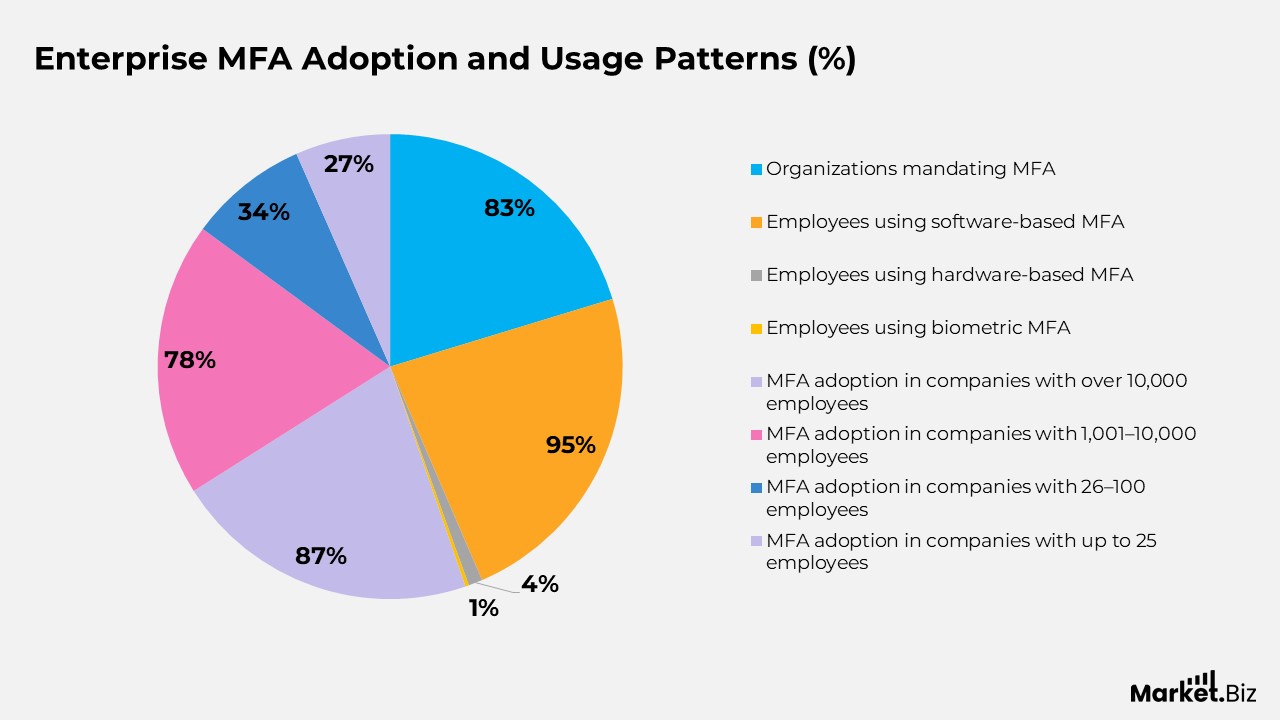
- A 2024 survey of more than 1,000 small- and mid-sized enterprise IT professionals shows that 83% of organisations mandate MFA for employee access to all IT resources.
- Software-based authentication dominates MFA, with 95% of employees relying on mobile apps rather than physical or biometric options.
- Hardware-based MFA remains limited, used by just 4% of employees, while biometric authentication methods account for only 1% of adoption.
- MFA adoption increases with organization size, reaching 87% in companies with over 10,000 employees and 78% among firms employing 1,001 to 10,000 people.
- Smaller organisations trail significantly, with MFA usage dropping to 34% in companies with 26 to 100 employees and to 27% in businesses with up to 25 staff members.
(Sources: Jump Cloud, Statista)
Workplace Password Hygiene and Security Risks
- Common workplace passwords remain highly predictable, including widely used combinations such as 123456, qwerty, and password, increasing exposure to credential-based attacks.
- Weak password management practices persist, as 57% of individuals write down passwords on sticky notes, and 67% of those users report misplacing them.
- Traditional storage habits continue, with 62% of employees keeping passwords in notebooks that are often left in visible locations near work devices.
- Digital password storage also presents risks: 49% of users store work passwords in cloud-based documents, and 51% save them locally on their computers.
- Mobile devices add another layer of vulnerability, with 55% of individuals storing passwords on smartphones that may be lost or compromised.
- These practices highlight the limitations of password-only security and reinforce the importance of layered authentication methods.
(Sources: Jump Cloud, Workplace Password Malpractice Report)
MFA Software vs Hardware Adoption Trends
- Software-based MFA solutions dominate enterprise environments, with 95% of users preferring mobile app-based authentication due to convenience and scalability.
- Hardware tokens are used by only 4% of employees, typically in high-security or compliance-driven use cases.
- Biometric MFA adoption remains limited at 1%, reflecting challenges related to cost, infrastructure readiness, and user familiarity.
- The strong preference for software-based MFA highlights organisational focus on usability and rapid deployment.
(Sources: Jump Cloud, Workplace Password Malpractice Report)
MFA Adoption and Industry Trends
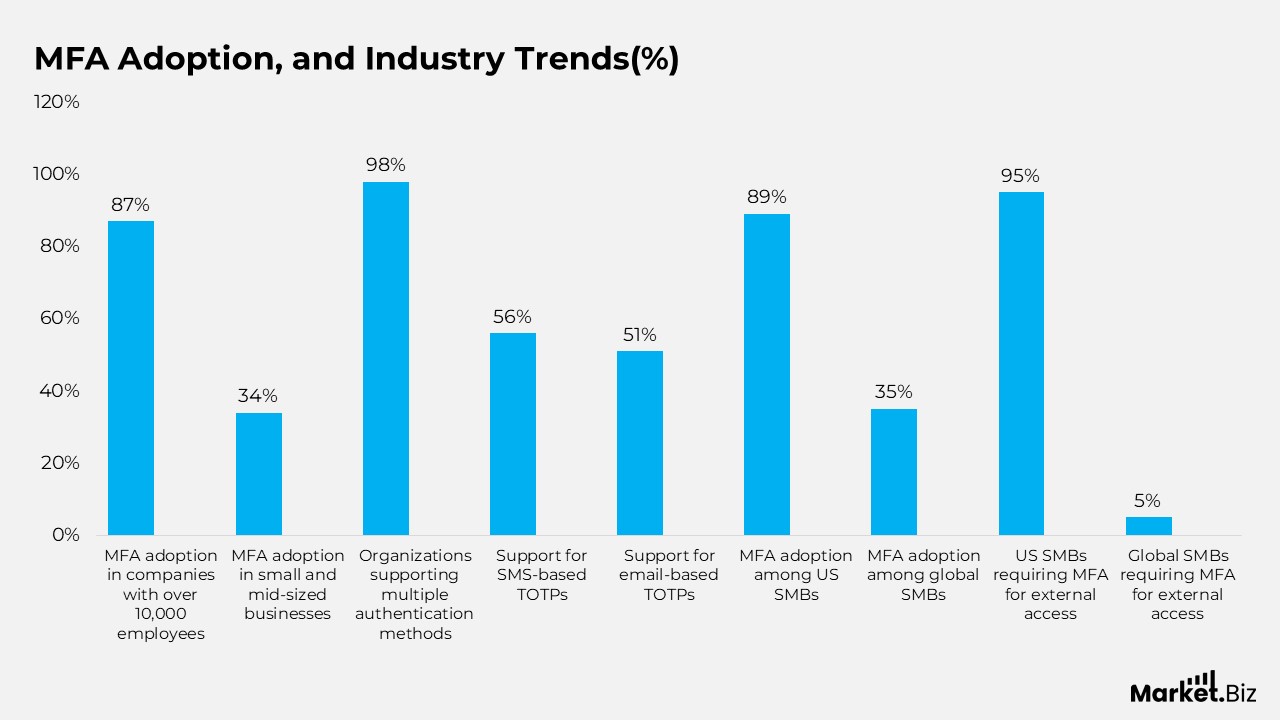
- According to JumpCloud, 87% of companies with more than 10,000 employees use MFA, while small and mid-sized businesses typically have significantly lower adoption rates, typically 34% or less.
- Statista reports that at least 98% of organizations worldwide support multiple authentication methods, with 56% supporting SMS-based TOTPs and 51% supporting email-based TOTPs.
- The global MFA market size reached approximately USD 18.12 billion in 2024, reflecting strong demand from enterprises and the cloud security market.
- A global MFA usage gap is evident: 89% of US SMBs implement MFA, compared to only 35% worldwide.
- MFA enforcement for external access also differs sharply: 95% of US SMBs require MFA for customers or suppliers, compared with just 5% globally.
- Highly regulated sectors such as government and education saw MFA adoption grow by more than 5% in a single year.
(Sources: JumpCloud, Statista, Cyber Readiness Institute, Okta
Multi-factor Authentication Methods and User-Level Adoption Behavior Statistics
- In MFA-enabled environments, 95% of users still use traditional passwords alongside additional factors.
- Push notifications represent the most common secondary authentication factor at 29%, followed by SMS at 17% and soft tokens at 14%.
- The technology sector continues to lead global MFA adoption, with an 88% implementation rate.
- Industries with the lowest MFA usage include transportation and warehousing at 38%, and retail at 43%, although adoption has increased year over year.
- MFA usage differs by role: 91% of administrators use MFA, compared to 66% of non-administrators.
(Sources: Okta, Statista)
Threat Landscape and MFA Effectiveness
- External threat actors accounted for 65% of data breaches in 2024, while internal threats accounted for the remaining 35%, marking a notable year-over-year increase.
- Ransomware or extortion techniques were involved in 32% of all reported breaches.
- Human-related factors continue to dominate breach causes, accounting for 68% of incidents, with non-malicious human actions such as phishing or configuration errors.
- Errors alone contributed to 28% of breaches, highlighting persistent operational security gaps.
(Sources: Verizon 2024 Data Breach Investigations Report, Google Mandiant M-Trends 2024)
Cloud Security, Identity Risks, and Multi-factor Authentication Gaps Statistics
- Cloud breaches frequently originate from compromised credentials, with credential stuffing identified as the most common initial access vector.
- Newer techniques, such as malicious OAuth consent abuse and AI-ATM attacks, are gaining traction in cloud environments.
- A significant 61% of organizations have at least one root or account owner without MFA enabled, primarily due to the operational difficulty of managing shared accounts.
- Cloud security incidents rose sharply, with 61% of organizations reporting breaches in the past year, up from 24% the previous year.
- Data breaches were the most common cloud incident type, affecting 21% of organizations, while 23% lacked visibility into breach details.
(Sources: Datadog 2024 State of Cloud Security, Orca Security 2024 Report, Check Point 2024 Cloud Security Report)
Breach Costs, Financial Impact, and Security Economics
- Financial gain remains the dominant motivation behind cyberattacks, accounting for 95% of reported breaches.
- The average cost of a data breach reached USD 4.88 million in 2024, up 10% year over year.
- Approximately 75% of the rise in breach costs stemmed from lost business and post-incident response activities.
- Breaches involving public cloud data incurred the highest average cost at USD 5.17 million, particularly when data spanned multiple environments.
- The average breach lifecycle remains lengthy at roughly 270 days, increasing to 292 days when identity and credential issues are involved.
- Organisations that leverage AI and automation in security operations reduce breach costs by an average of USD 2.2 million.
(Sources: IBM Cost of a Data Breach Report 2024, Verizon 2023 Report)
Barriers to MFA Adoption and Passwordless Transition
- Resistance to MFA adoption persists: 33% of organisations find MFA annoying, 23% consider it too complex, and another 23% believe it slows workflows.
- Legacy systems remain a major obstacle, with over 40% of IT and cybersecurity professionals identifying password-dependent infrastructure as a barrier to passwordless adoption.
- Additional challenges include skills shortages, internal disagreement, and budget constraints, despite growing awareness of identity-related risks.
(Sources: IBM Cost of a Data Breach Report 2024, Verizon 2023 Report)
Most Common MFA Methods by Usage
- SMS-based time-based one-time passwords remain the most widely adopted MFA method, with 55.96% of users relying on them for authentication.
- Email-based time-based one-time passwords are nearly as common, used by 51.38% of respondents.
- Mobile device push notifications are adopted by 36.7% of users, reflecting a growing preference for app-based approvals.
- Non-time-based email and SMS OTPs are each used by 30.28% of respondents.
- Alternative methods such as email web links (26.61%), QR code-based authentication (26.61%), and SMS web links (25.69%) show moderate usage.
- Advanced and hardware-centric options remain niche, including PC push notifications (21.1%), hardware tokens (20.18%), FIDO security keys (16.51%), and FIDO mobile authenticators (13.76%).
(Sources: ExplodingTopics)
Global MFA Adoption and Enterprise Size Trends
- A 2024 survey of over 1,000 SME IT professionals found that 83% require employees to use MFA across all organizational resources.
- MFA adoption is strongest among large enterprises, with 87% of companies with more than 10,000 employees using it.
- In contrast, MFA usage among small and mid-sized businesses remains limited, typically 34% or lower.
- On a global scale, nearly 65% of SMBs do not use MFA and have no immediate plans to implement it.
- Across organizations worldwide, approximately 98% use more than one authentication method, with 56% relying on SMS-based OTPs and 51% using email-based OTPs.
(Sources: JumpCloud, Cyber Readiness Institute, Statista)
MFA Adoption by Industry
- As of 2024, the technology sector leads global MFA adoption, with an implementation rate of 87%.
- The insurance industry follows closely, reporting an adoption level of 77%.
- The professional services and education sectors show strong uptake of 75% and 64%, respectively.
- The financial services and banking report shows MFA usage of 60%, reflecting regulatory and compliance-driven security needs.
- The healthcare and government sectors trail slightly, with adoption rates of 56% and 48%, respectively.
(Sources: JumpCloud, Statista)
Organizational MFA Usage and Tool Preferences
- A global study covering more than 47,000 organisations found that 57% currently use MFA, up 12 points year over year.
- Among employees, 95% prefer software-based MFA solutions, primarily mobile apps, while only 4% use hardware devices and 1% rely on biometric authentication.
- Popular MFA tools include LastPass Authenticator (39%), Duo Security (31%), and Google Authenticator (24%), with limited use of YubiKey (4%) and Microsoft Authentication (1%).
- Adoption rates increase with organization size, reaching 87% in firms with over 10,000 employees and 78% in companies with 1,001 to 10,000 workers.
- Usage declines sharply in smaller firms, falling to 34% for businesses with 26 to 100 employees and 27% for those with up to 25 employees.
(Sources: JumpCloud, Statista, LastPass)
MFA Adoption by Authentication Type
- Authenticator applications are the most common MFA method, used by 57.8% of companies due to flexibility and ease of deployment.
- SMS-based verification codes are used by 39.1% of organisations, remaining popular despite known security limitations.
- 37.4% of companies use one-time passwords for time-sensitive authentication.
- Hardware security keys are adopted by 30% of organizations seeking stronger device-based protection.
- Secondary email authentication is used by 14.7%, while 7.3% rely on alternative MFA methods.
(Sources: JumpCloud, Statista, LastPass)
MFA Security Impact and Breach Response
- Among developers, 41% prioritize adopting two-factor authentication as their primary security focus.
- Strengthening password security is the next priority for 33% of organizations, while 12% focus on improving overall user security.
- Another 12% aim to simplify authentication experiences, and only 2% view authentication improvements as a low priority.
- Approximately 26% of organisations adopted MFA only after experiencing a cyberattack, highlighting its reactive implementation.
- MFA can block more than 99.9% of account compromise attempts, significantly reducing the risk of unauthorised access.
- Adding a recovery phone number alone can stop 99% of mass phishing attacks and nearly all automated bot attacks.
(Sources: ButterCMS, llcbuddy.com, Google Security)
MFA Software Usage Trends
- Software-based MFA dominates user preference, with 95% of employees choosing mobile apps for authentication.
- Hardware-based MFA is used by only 4% of users, reflecting deployment and cost challenges.
- Biometric MFA remains minimal at 1%, limited by higher implementation costs and lower user familiarity.
(Sources: ButterCMS, llcbuddy.com, Google Security)
Consumer and Employee Perspectives on MFA
- Most users (73%) prefer smartphones for MFA, while 17% favor built-in authenticators.
- Nearly all IT security leaders (91%) agree that MFA is critical for protecting organizational systems.
- A strong majority of consumers (87%) believe MFA should be provided free of charge.
(Sources: ButterCMS, llcbuddy.com, Google Security)
Password Security Gaps Driving MFA Demand
- Weak, predictable passwords such as “123456,” “qwerty,” and “password” remain widely used, posing significant security risks.
- Around 57% of individuals write passwords on sticky notes, and 67% report losing them.
- Physical storage practices persist: 62% of users keep passwords in notebooks near their work devices.
- Digital storage also poses risks, as 49% save passwords in cloud documents, 51% on computers, and 55% on mobile phones.
(Sources: ButterCMS, llcbuddy.com, Google Security)
Conclusion
In summary, multi-factor authentication statistics underline its expanding importance as a core element of modern cybersecurity frameworks. Higher adoption across large enterprises, technology-led sectors, and highly regulated industries reflects growing confidence in MFA’s ability to mitigate identity-based attacks and reduce unauthorized access. However, comparatively lower uptake among small and mid-sized organisations, continued reliance on weak password practices, and user concerns about convenience indicate that implementation challenges persist.
At the same time, strong market growth, widespread preference for software-based and mobile authentication methods, and rising awareness of identity risks point to continued momentum in MFA adoption. Overall, the data shows that while MFA is not a complete security solution on its own, it remains one of the most effective and widely adopted measures for strengthening access control and safeguarding digital ecosystems.
FAQ’s
Multi-factor authentication is a security method that requires users to verify their identity using two or more factors, such as a password, a one-time code, a mobile push notification, biometrics, or a hardware token, before accessing an account or system.
MFA statistics help measure adoption levels, effectiveness, and user behavior across industries and regions. They provide insight into how organisations respond to rising cyber threats and how identity security practices evolve.
Global studies indicate that over half of organizations currently use MFA, with adoption rates exceeding 85% in large enterprises. In contrast, small and mid-sized businesses show lower adoption, often below 40%, mainly due to cost, complexity, and awareness challenges.
Software-based MFA methods, such as mobile authenticator apps and SMS-based one-time passwords, are the most commonly used. Hardware tokens and biometric authentication methods are less widely adopted due to higher implementation costs and infrastructure requirements.
Yes, statistics consistently show that MFA can prevent more than 99% of automated account compromise attempts by adding an extra verification layer beyond passwords, especially against phishing and credential-stuffing attacks.