









Introduction
AI Cybersecurity Statistics And Facts: Artificial intelligence (AI) is transforming the cybersecurity landscape, enhancing capabilities in threat detection, incident response, and predictive analytics, while also enabling cybercriminals to develop more sophisticated and elusive attacks. As more organizations adopt AI-driven security solutions, it becomes essential to examine the statistical trends shaping this dynamic field.
This report delivers a focused, data-centric analysis of AI’s growing role in cybersecurity, covering adoption levels, investment trends, emerging threats, and global defense measures, providing key insights for leaders facing the challenges of an increasingly intelligent and complex cyber threat environment.
Editor’s Choice
- Approximately 74% of IT security professionals report that their organizations are facing significant challenges due to AI-driven threats.
- Around 75% of cybersecurity professionals have adjusted their strategies in the past year to address incidents caused by AI-generated attacks.
- 60% of IT professionals believe their organizations are not sufficiently prepared to defend against AI-driven threats.
- While 79% of IT security executives have taken steps to address AI-related risks, only 54% of frontline practitioners share that same level of confidence.
- 44% of organizations are confident in their ability to identify ways AI can improve their cybersecurity infrastructure.
- 62% of organizations acknowledge the potential of machine learning to enhance their overall security systems.
- 67% of cybersecurity professionals use AI primarily to create rules based on known threat patterns and indicators.
Cost and Frequency of AI-Driven Cyberattacks
- Security professionals identify the most concerning AI-driven cyber threats as malware distribution, vulnerability exploitation, exposure of sensitive data through generative AI, social engineering, zero-day attacks, and reconnaissance activities used for attack planning.
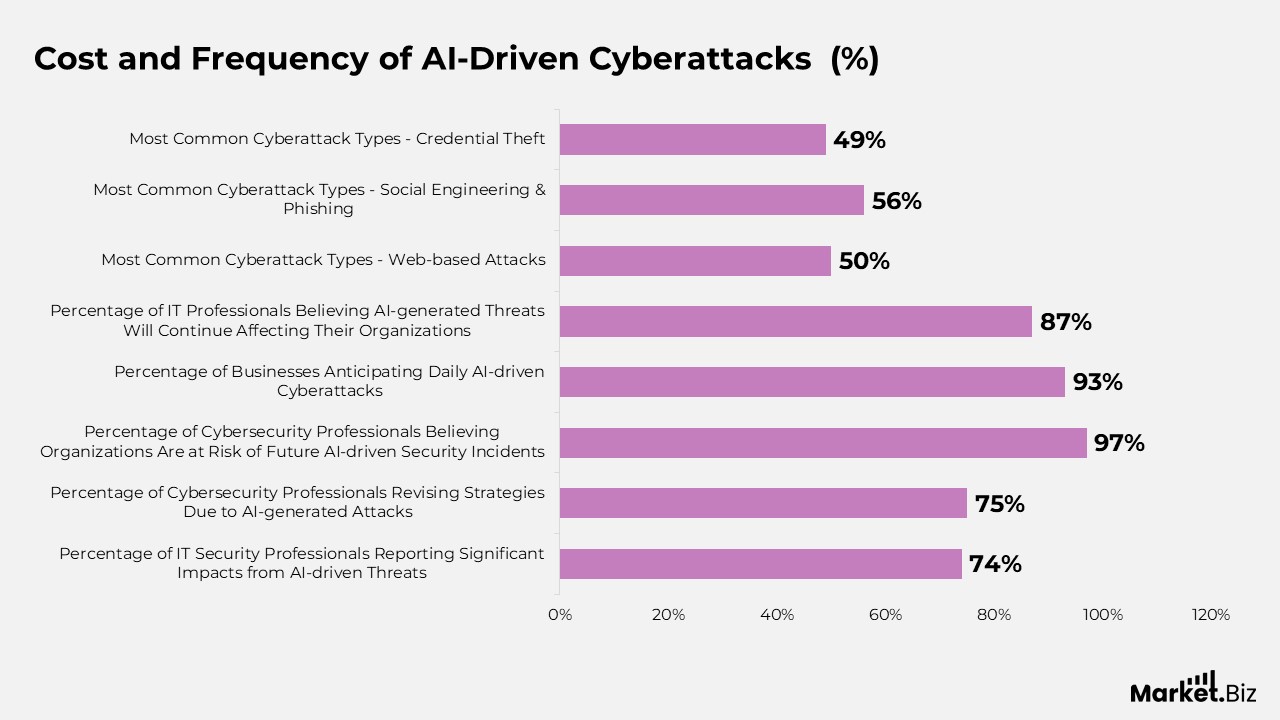
- Approximately 74% of IT security professionals report that their organizations are experiencing significant impacts from AI-driven threats.
- Around 75% of cybersecurity professionals revised their strategies in the past year to address incidents caused by AI-generated attacks.
- Nearly 97% of cybersecurity professionals believe their organizations are at risk of future AI-generated security incidents.
- About 93% of businesses anticipate facing daily AI-driven cyberattacks in the coming year.
- An estimated 87% of IT professionals believe AI-generated threats will continue affecting their organizations for the foreseeable future.
- The global average cost of a data breach has reached $4.88 million over the past year, marking a 10% increase and the highest recorded level to date.
- The most common cyberattack types reported include web-based attacks (50%), social engineering and phishing (56%), and credential theft (49%).
(Source: Deep Instinct, Netacea, Darktrace, IBM, Ponemon Institute)
Gaps in Addressing AI-Driven Cybersecurity Risks
- 60% of IT professionals believe their organizations are not adequately prepared to defend against AI-generated threats.
- While 79% of IT security executives report taking action to address AI-related risks, only 54% of frontline practitioners share that level of confidence.
- 41% of organizations continue to rely on endpoint detection and response (EDR) strategies to combat AI-based attacks, even though earlier research suggests many find EDR ineffective against emerging threats.
- Despite concerns about EDR’s limitations, 31% of organizations still plan to increase their investments in EDR technologies.
(Source: Deep Instinct, Statista, Netacea, Darktrace, Ponemon Institute)
AI in Cybersecurity Market Size
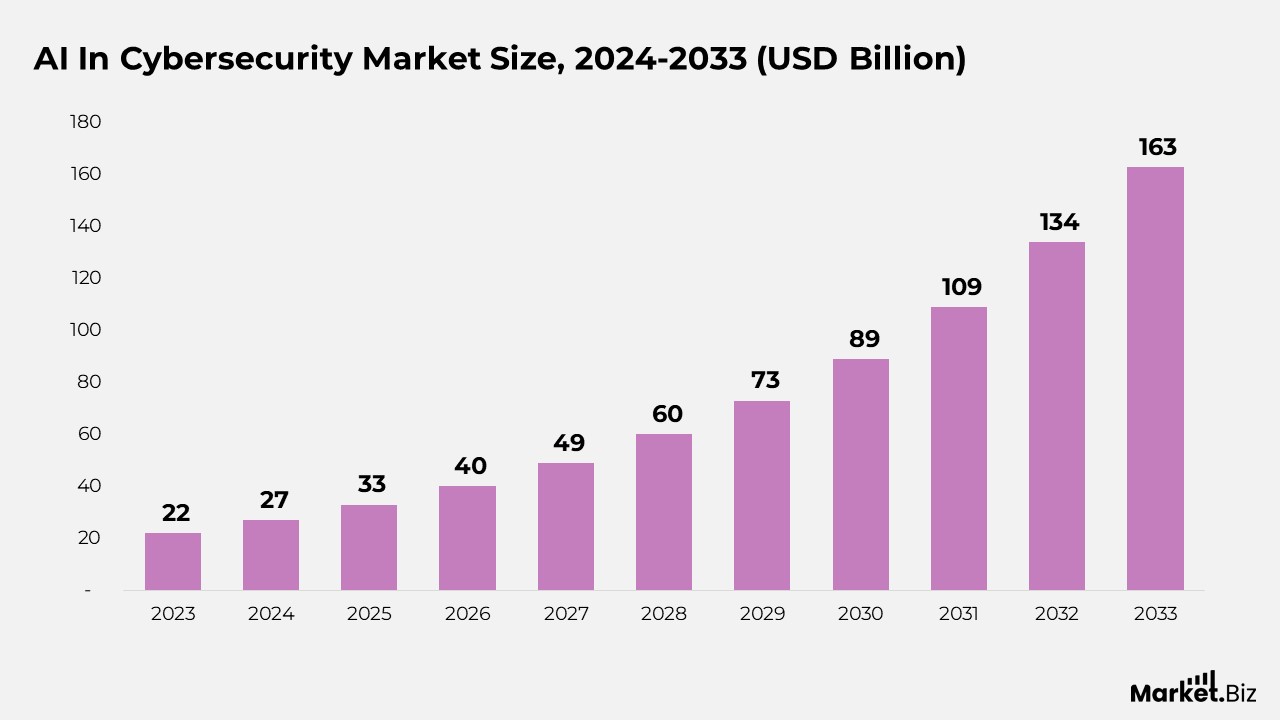
- According to Market.us, the AI in cybersecurity market is expected to rise from $27 billion in 2024 to $163 billion by 2033, representing a compound annual growth rate (CAGR) of 22.3% from 2024 to 2033.
- The growing complexity of cyber threats is driving demand for AI-based cybersecurity solutions, as organizations seek automated, real-time, and proactive defense mechanisms.
- The average cost of a data breach rose to $4.35 million in 2022, a 2.6% increase from 2021, highlighting the financial urgency for stronger security infrastructures.
- In 2023, the services segment led with a 35% market share, driven by the need for specialized expertise, continuous monitoring, and incident response support.
- The network security segment accounted for over 38% in 2023, propelled by increased digital transformation and a surge in sophisticated network attacks.
- Machine Learning (ML) captured more than 47% market share in 2023, owing to its high efficiency in threat identification with minimal human intervention.
- The fraud detection/anti-fraud segment secured over 20% of the market in 2023, driven by rising financial fraud, phishing, and identity theft activities.
- The BFSI sector held a 28% share in 2023, as financial institutions require robust AI-driven systems to combat high-value cyber threats and regulatory pressures.
- North America dominated the global market with a 36% share in 2023, supported by a strong presence of AI innovators and cybersecurity providers.
- The North American AI cybersecurity market was valued at $4.8 billion in 2023, with growth fueled by R&D investment, frequent cyberattacks, and early adoption of emerging technologies.
(Source: Market.us)
Edge AI for Cybersecurity Market Size
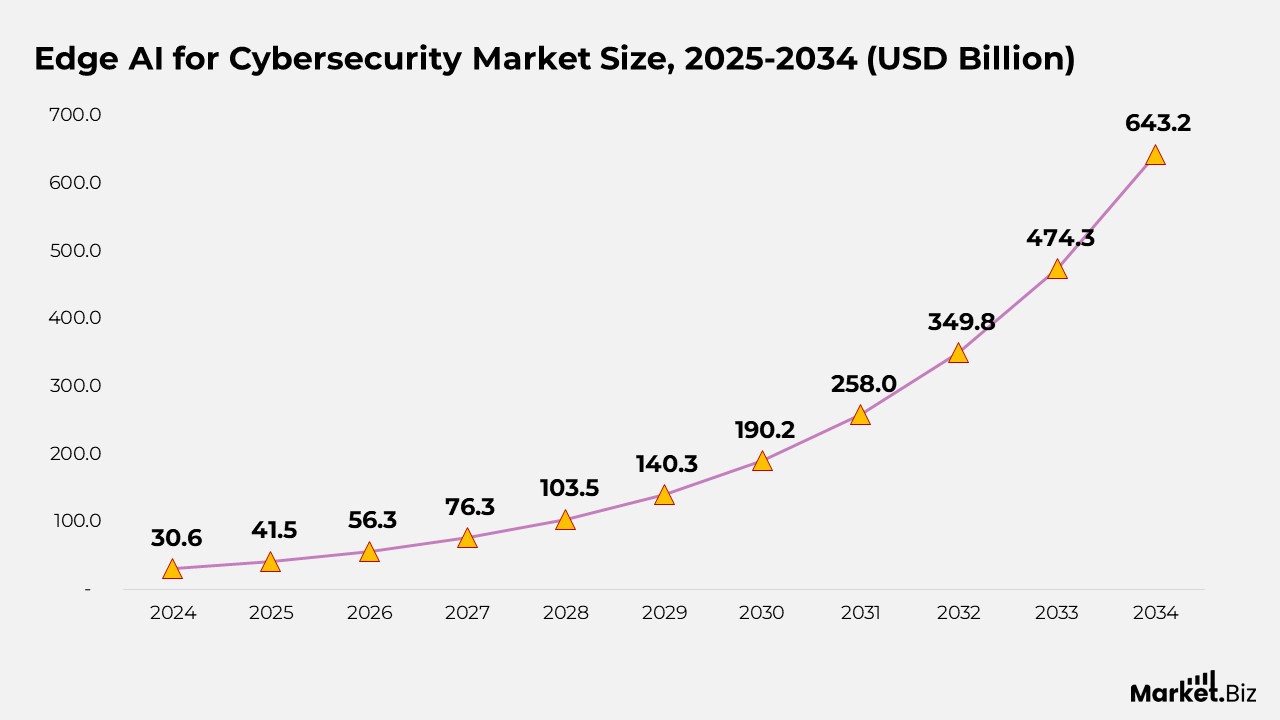
- According to Market.us, the edge AI for cybersecurity market is expected to rise from $41.5 billion in 2025 to $643.2 billion by 2034, representing a compound annual growth rate (CAGR) of 35.6% from 2025 to 2034.
- The growth of the edge AI for cybersecurity market is driven by the proliferation of IoT devices and the need for real-time processing, localized data handling, and enhanced privacy protection.
- In 2024, the network security segment led the market with a 37.4% share, due to the rising complexity and frequency of cyberattacks on network infrastructures.
- The hardware segment held a 35.6% share in 2024, as specialized hardware remains essential for enabling edge AI operations with speed and efficiency.
- Machine learning dominated the technology segment in 2024 with a 42.8% share, driven by its effectiveness in improving threat detection and automated response capabilities.
- The fraud detection/anti-fraud segment captured over 30.7% of the market in 2024, due to the rising sophistication of cyber and financial fraud demanding real-time solutions.
- The BFSI sector led the market in 2024 with more than a 40.0% share, driven by the sector’s need to protect vast volumes of sensitive financial data and transactions.
- North America held the top regional position in 2024 with a 36.5% market share and revenues of approximately $11.1 billion, supported by its advanced cybersecurity ecosystem.
- The U.S. market alone was valued at $8.93 billion in 2024, reflecting a strong 33.5% CAGR, fueled by the rapid adoption of edge AI to strengthen cybersecurity infrastructure.
- By 2025, about 36 million people, roughly 22% of the U.S. workforce, are expected to work remotely, an 87% increase from pre-pandemic levels, making Edge AI a critical enabler of secure remote operations.
(Source: Market.us)
AI and Automation in Cybersecurity Operations
- In 2024, 2 out of 3 organizations reported deploying security AI and automation across their security operations centers, reflecting a 10% increase from the previous year.
- Organizations that extensively implemented AI in prevention workflows, such as attack surface management, red teaming, and posture management, experienced an average reduction of $2.2 million in data breach costs compared to those not using AI in these areas.
- The proportion of organizations using security AI and automation extensively rose from 28% in 2023 to 31% in 2024, marking a 10.7% increase.
- Limited adoption of AI and automation also increased, with usage rising from 33% to 36%, representing a 9.1% growth.
- The percentage of organizations not using any security AI or automation declined from 39% in 2023 to 33% in 2024, indicating a steady shift toward AI-driven security strategies.
(Source: International Business Machines Corporation, Secureframe)
AI Integration in Cybersecurity
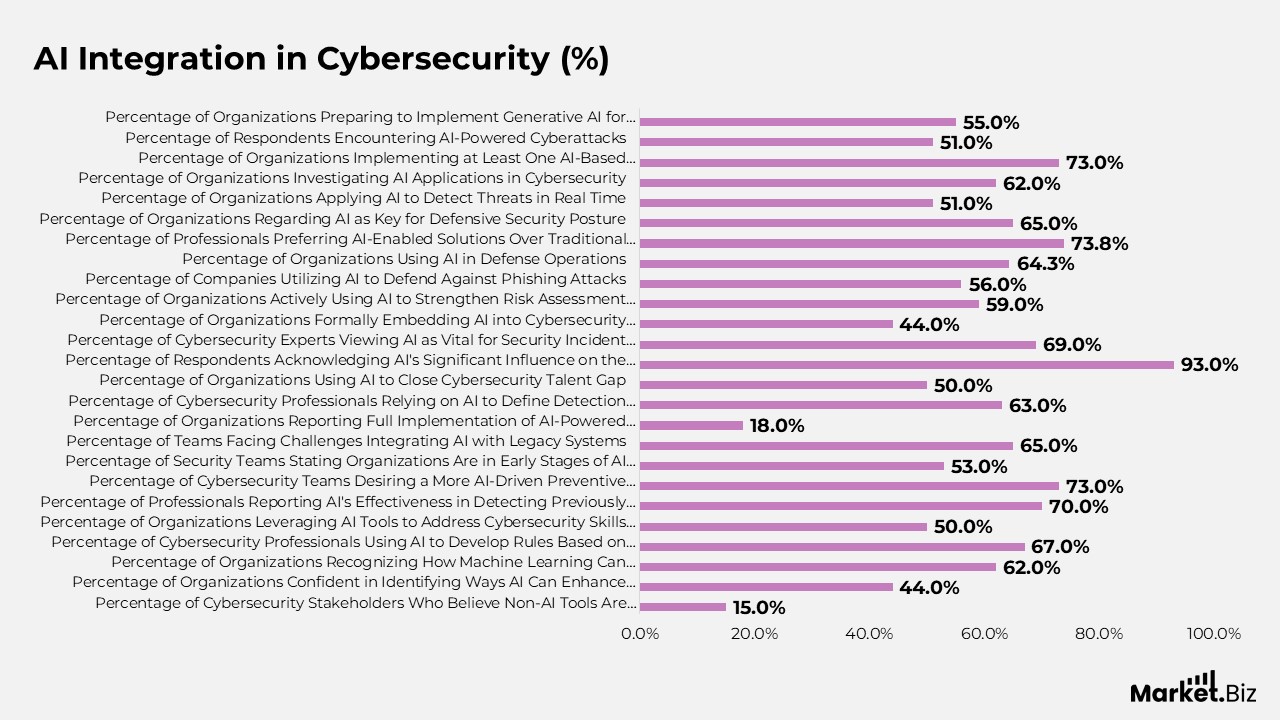
- Only 15% of cybersecurity stakeholders believe non-AI tools are sufficient to detect and block AI-generated threats.
- 44% of organizations are confident in identifying ways AI can enhance their cybersecurity infrastructure.
- 62% of organizations recognize how machine learning can strengthen their overall security systems.
- 67% of cybersecurity professionals mainly use AI to develop rules based on known threat patterns and indicators.
- 50% of organizations are leveraging AI tools to address the ongoing cybersecurity skills shortage.
- 70% of professionals report that AI is highly effective in detecting threats that previously went unnoticed.
- 73% of cybersecurity teams express a desire to transition toward a more AI-driven preventive security strategy.
- 53% of security teams state that their organizations are still in the early phases of adopting AI cybersecurity solutions.
- 65% of teams face difficulties integrating AI tools with existing legacy systems.
- Only 18% of organizations report having fully implemented and operational AI-powered cybersecurity tools.
- 63% of cybersecurity professionals rely on AI to define detection rules based on known attack signatures and behaviors.
- 50% of organizations are using AI to help close the cybersecurity talent gap.
- An overwhelming 93% of respondents acknowledge the significant influence AI has on shaping the current cyber threat landscape.
Moreover
- 69% of cybersecurity experts view AI as a vital component for managing and responding to security incidents effectively.
- Just 44% of organizations have formally embedded AI into their overall cybersecurity strategies.
- 59% are actively using AI to strengthen their risk assessment capabilities and minimize potential vulnerabilities.
- 56% of companies utilize AI-driven tools to identify and defend against phishing attempts.
- AI is integrated into defense operations by 64.3% of organizations, demonstrating widespread operational use.
- A notable 73.8% of professionals favor AI-enabled cybersecurity solutions over traditional methods.
- 65% of organizations regard AI as a foundational element in reinforcing their defensive security posture.
- 51% are applying AI to detect threats in real time and to monitor network activities.
- 62% are in the process of investigating how AI can be applied within their cybersecurity frameworks.
- 73% have already implemented at least one AI-based product to enhance their cybersecurity capabilities.
- 51% of respondents have encountered AI-powered cyberattacks, reflecting the dual use of AI by both defenders and threat actors.
- 55% of organizations are preparing to implement generative AI technologies as part of their future cybersecurity initiatives.
(Source: Darktrace, Ponemon Institute, Cobalt, Deep Instinct, allaboutai.com)
AI-Driven Phishing
- 40% of phishing emails targeting productions are now created using AI tools.
- 60% of recipients fall for AI-generated phishing messages, matching the success rate of traditional phishing emails.
- Cybercriminals can reduce phishing campaign costs by as much as 95% using large language models to generate content.
- The average cost of a phishing-related data breach is estimated at $4.88 million.
(Source: VIPRE Security Group, Harvard Business Review, IBM)
AI-Enhanced Deepfake Attacks
- 61% of organizations reported an increase in deepfake incidents over the past year.
- Deepfake attacks are expected to rise by 50% to 60% in 2024, potentially reaching 140,000 to 150,000 global cases.
- 75% of deepfakes are used to impersonate CEOs or other senior executives.
- Generative AI is projected to drive losses from deepfakes and similar attacks up by 32%, reaching $40 billion annually by 2027.
- Impersonation scams accounted for $12.5 billion in losses across the U.S. in 2023.
(Source: Deep Instinct, VPNRanks, Deloitte, Federal Bureau of Investigation)
AI in Ransomware Attacks
- 48% of security professionals expect future ransomware campaigns to be AI-driven.
- The average cost of a ransomware incident is approximately $4.45 million.
- Ransomware activity increased 13-fold in the first half of 2023, based on its share of overall malware detections.
(Source: Netacea, Fortinet, Bitget)
AI in Cryptocurrency-Related Crimes
- Deepfakes are projected to be responsible for 70% of crypto crime activity by 2026.
- Losses from cryptocrime reached $5.6 billion nationwide in 2023, making up 50% of all reported financial fraud.
- Cryptocurrency-related losses surged 53% from 2022 to 2023.
(Source: Bitget, Federal Bureau of Investigation, Cobalt)
Generative AI Statistics
- 67% of organizations have increased their investments in generative AI after recognizing strong value from early adoption.
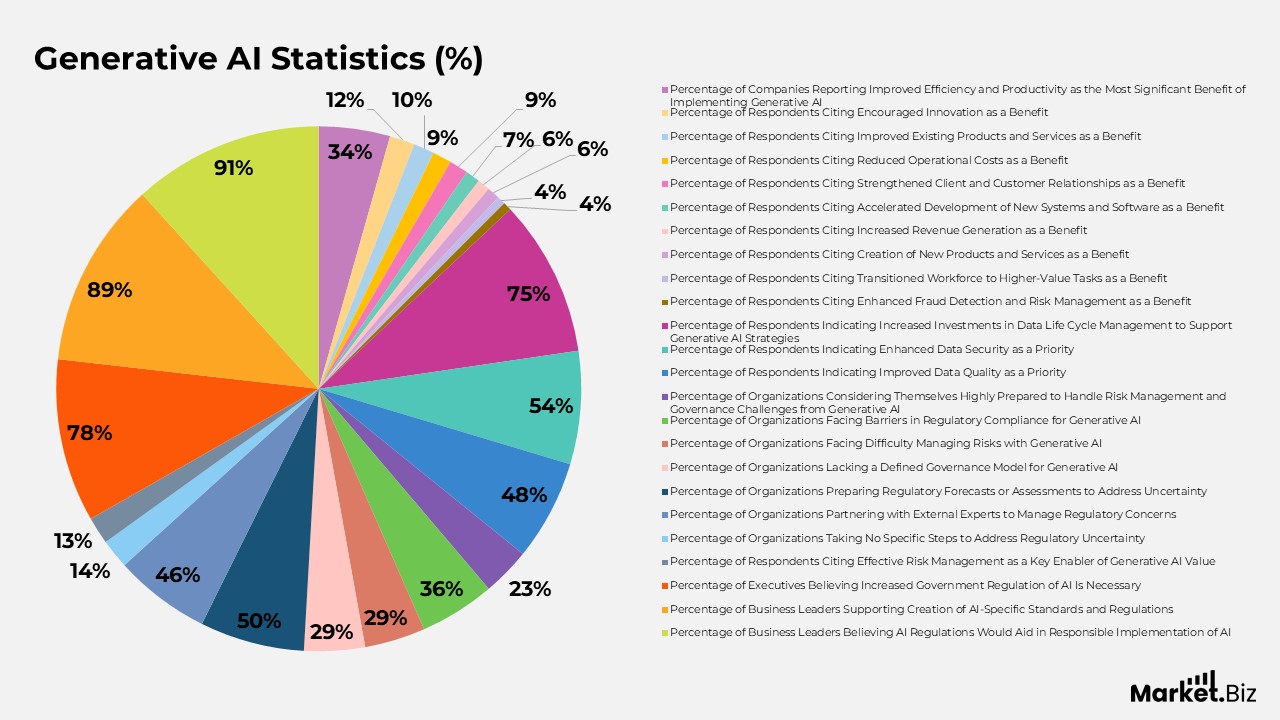
- 34% of companies reported improved efficiency and productivity as the most significant benefit of implementing generative AI.
- Additional benefits cited by organizations include:
- Encouraged innovation (12%)
- Improved existing products and services (10%)
- Reduced operational costs (9%)
- Strengthened client and customer relationships (9%)
- Accelerated development of new systems and software (7%)
- Increased revenue generation (6%)
- Creation of new products and services (6%)
- Transitioned workforce to higher-value tasks (4%)
- Enhanced fraud detection and risk management (4%)
- 75% of respondents indicated an increase in investments related to data life cycle management to support generative AI strategies. With top priorities being enhanced data security (54%) and improved data quality (48%).
- Only 23% of organizations consider themselves highly prepared to handle the risk management and governance challenges posed by generative AI.
- Key barriers to deploying generative AI tools include concerns over regulatory compliance (36%), difficulties managing risks (29%), and the absence of a defined governance model (29%).
- About 50% of organizations are actively preparing regulatory forecasts or assessments to address uncertainty.
- 46% of organizations are partnering with external experts to manage regulatory concerns better.
- 14% of companies reported taking no specific steps yet to address regulatory uncertainty.
- When asked how to unlock greater value from generative AI, 13% of respondents cited effective risk management as a key enabler.
- 78% of executives believe that increased government regulation of AI is necessary.
- 89% of business leaders support the creation of AI-specific standards and regulations within their industries, and 91% believe such frameworks would aid in the responsible implementation of AI.
(Source: Deloitte, Alteryx)
AI and Data Breaches
- Leveraging AI and machine learning was the second most effective factor in reducing average data breach costs, with breaches at these organizations averaging $4.6 million, or $258,538 less than the overall average of $4.88 million.
- Organizations with extensive use of security AI and automation experienced average breach costs that were $1.88 million lower than those without any AI or automation, representing a 33% cost reduction.
- Organizations with limited AI and automation use had an average breach cost of $4.64 million in 2024, which is 19% lower than non-users and 17% higher than those with extensive use.
- When AI and automation were used extensively across all 4 key functions, prevention, detection, investigation, and response, average breach costs were significantly reduced. For example, in prevention alone, costs dropped to $3.76 million compared to $5.98 million for organizations not using AI, a 45.6% difference.
- Cost savings in the other three functions for organizations using AI extensively were:
- Detection: $1.88 million
- Investigation: $1.74 million
- Response: $1.68 million
- AI also accelerated breach response. Without AI in prevention, it took organizations 312 days on average to identify and contain a breach. Those using AI extensively in prevention were 111 days faster.
- Organizations extensively using AI and automation reduced breach identification and containment time by nearly 100 days compared to those not using these tools.
- Organizations with limited AI and automation capabilities reduced breach containment time to 241 days on average, which is 66 days faster than those not using AI at all.
(Source: International Business Machines Corporation)
Conclusion
AI Cybersecurity Statistics: The integration of artificial intelligence into cybersecurity has become a critical necessity, driven by the rising volume, complexity, and sophistication of cyber threats. As demonstrated by the statistics, AI is playing a pivotal role in improving the speed, precision, and efficiency of threat detection, response, and prevention across industries and geographies.
The widespread use of machine learning, increasing reliance on specialized services and hardware, and strong momentum in sectors like BFSI all highlight the transformative impact of AI on cybersecurity practices.
Additionally, the leadership of regions such as North America emphasizes the global shift toward intelligent, AI-powered defense systems. As cyber risks continue to evolve, AI will remain essential in shaping secure, adaptive, and forward-looking cybersecurity frameworks.
FAQ’s
AI is instrumental in modern cybersecurity, offering real-time threat detection, automated incident response, anomaly recognition, and predictive analytics to help prevent cyberattacks before they happen.
In 2022, the average cost of a data breach reached approximately $4.35 million, marking a 2.6% rise compared to the previous year, underscoring the growing financial impact of cyber incidents.
Machine Learning (ML) led the AI cybersecurity space in 2023, with a market share exceeding 47%. Thanks to its ability to efficiently detect and respond to threats with minimal human input.
AI is widely applied in network security, fraud detection, endpoint protection, threat intelligence, and automated response areas where speed and accuracy are crucial.
The Banking, Financial Services, and Insurance (BFSI) sector accounted for over 28% of the market in 2023. Driven by its high vulnerability to cyber threats and the need for stringent data protection.
North America dominated the global AI cybersecurity market in 2023, securing over 36% market share, due to its advanced technology landscape, significant R&D investments, and early adoption of AI innovation.