









Introduction
Predictive AI Statistics: Predictive AI is a technique based on data analysis that employs both historical and current data to accurately forecast future developments and trends. It relies on advanced statistical methods and mathematical algorithms to identify patterns, generate predictions, and improve decision-making processes.
This methodology has been widely adopted across various industries, enabling organisations to enhance efficiency, reduce costs, and gain valuable insights for informed decision-making. However, it is crucial to carefully address concerns related to data accuracy, the interpretability of models, and data security to ensure effective application.
Predictive AI utilises machine learning and statistical models to scrutinise extensive historical datasets, uncovering patterns to anticipate future behaviours and occurrences.
It enhances operational efficiency and the accuracy of decision-making, frequently applied in areas such as demand forecasting, predictive maintenance, and risk evaluation. Although it cannot guarantee 100% accuracy, it facilitates proactive, data-driven approaches.
Editor’s Choice
- Technologies related to Big Data and Artificial Intelligence (AI) solutions have empowered organisations to efficiently analyse vast amounts of data, capturing 57% of focus.
- AI and ML were instrumental in fraud detection, with a 27% focus in 2020. This figure is projected to rise to 46% in 2021, indicating an increasing demand for security measures.
- Among the tasks that can be easily automated, predictable physical work ranks highest, receiving a significant 78% focus.
- A notable 51% of their initiatives are aimed at predicting customer-level future behaviours, which facilitates customised marketing strategies.
- EY has realised substantial time savings amounting to 250,000 hours through the adoption of intelligent document automation.
General Predictive AI Statistics
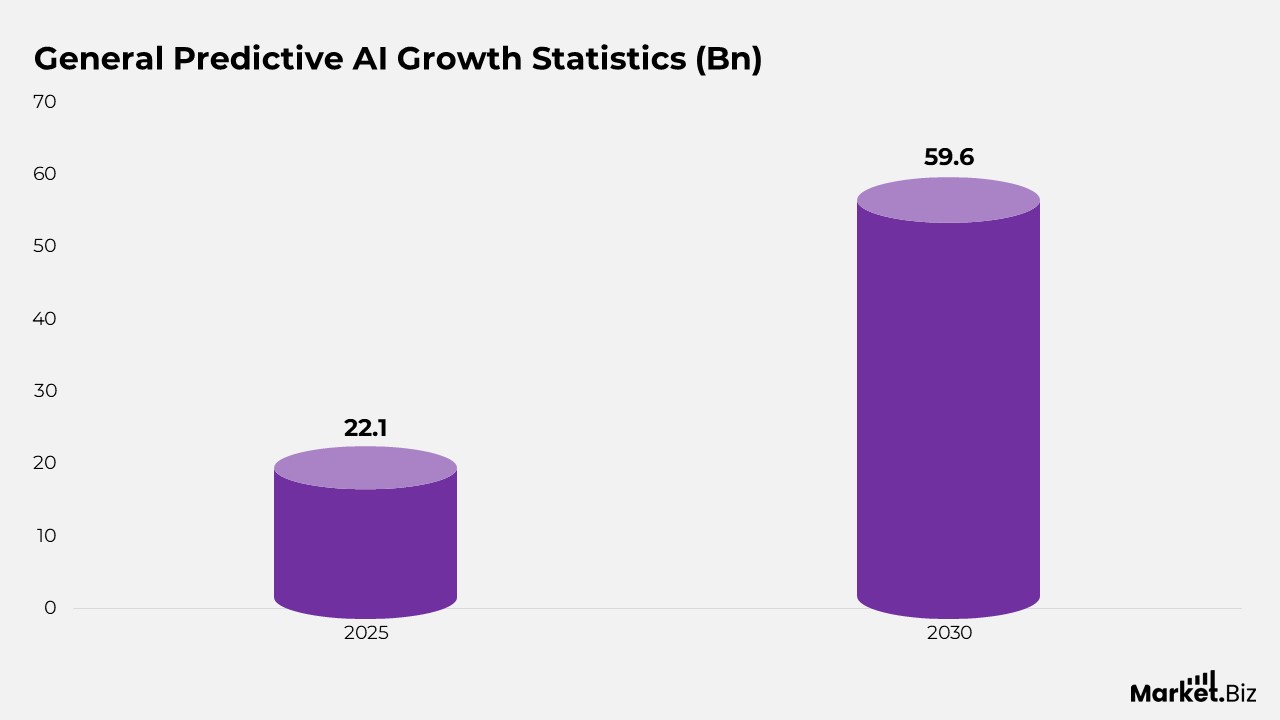
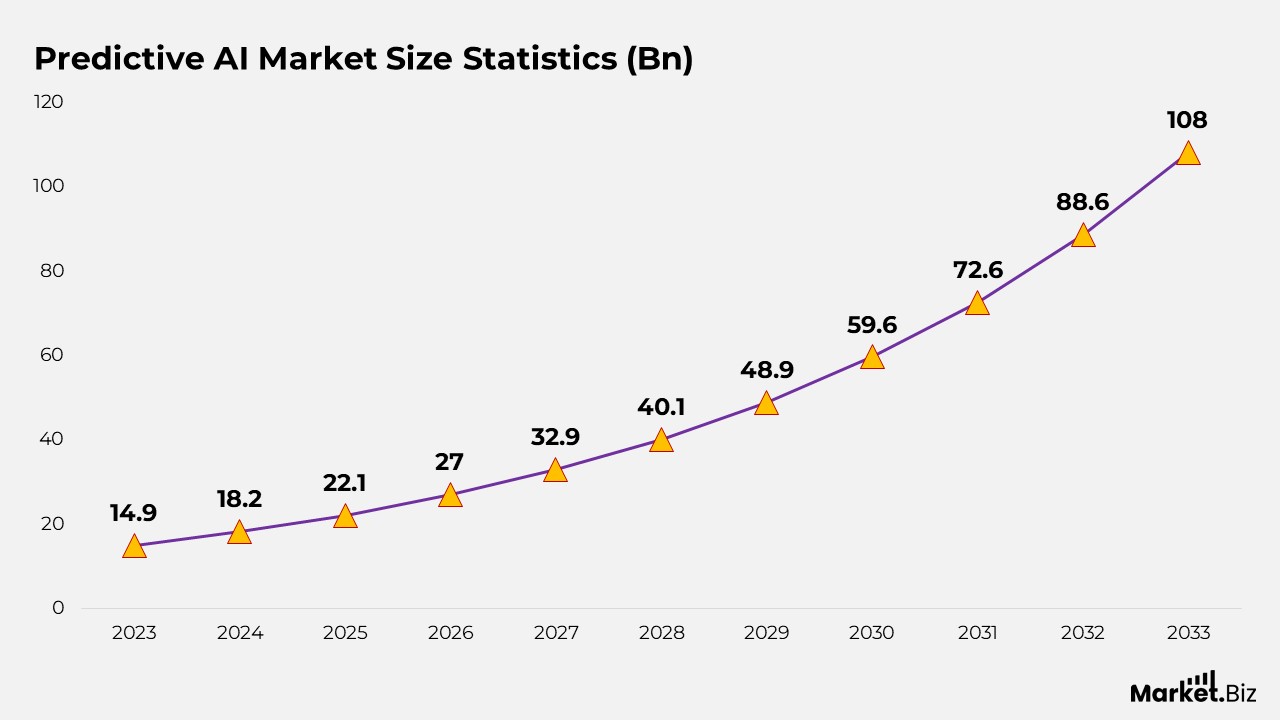
- The Predictive AI Market is anticipated to reach a value of approximately USD 108 billion by the year 2033, increasing from USD 14.9 billion in 2023.
- The global market for predictive analytics is set for considerable growth, with forecasts suggesting that by 2028, its revenue will rise to USD 41.52 billion.
- Technologies related to Big Data and Artificial Intelligence (AI) solutions have empowered organisations to efficiently analyse vast amounts of data, capturing 57% of focus.
- Among the various tasks that can be automated, predictable physical work is prioritised, receiving a significant 78% of attention.
- Marketing organisations allocate 51% of their efforts towards predicting customer behaviour at an individual level, facilitating customised marketing strategies.
- Despite the general recognition of the significance of consumer data in predicting future purchases and enhancing customer retention, over 80% of marketing executives encounter difficulties in making data-driven decisions.
- PepsiCo has effectively transitioned around 4,300 workdays each year from routine tasks to more strategic activities by utilising predictive AI for inventory management.
- Obstacles to the implementation of predictive analytics within marketing teams include the high costs associated with manual data science, which is a concern for 40% of those surveyed.
Predictive AI Market Size Statistics
- The worldwide predictive analytics market has experienced significant growth in recent years. In 2020, it achieved a revenue of USD 5.29 billion.
- Nevertheless, the market is set for considerable expansion, with forecasts suggesting that by 2028, its revenue is anticipated to rise to USD 41.52 billion.
Use Cases of AI & ML Statistics
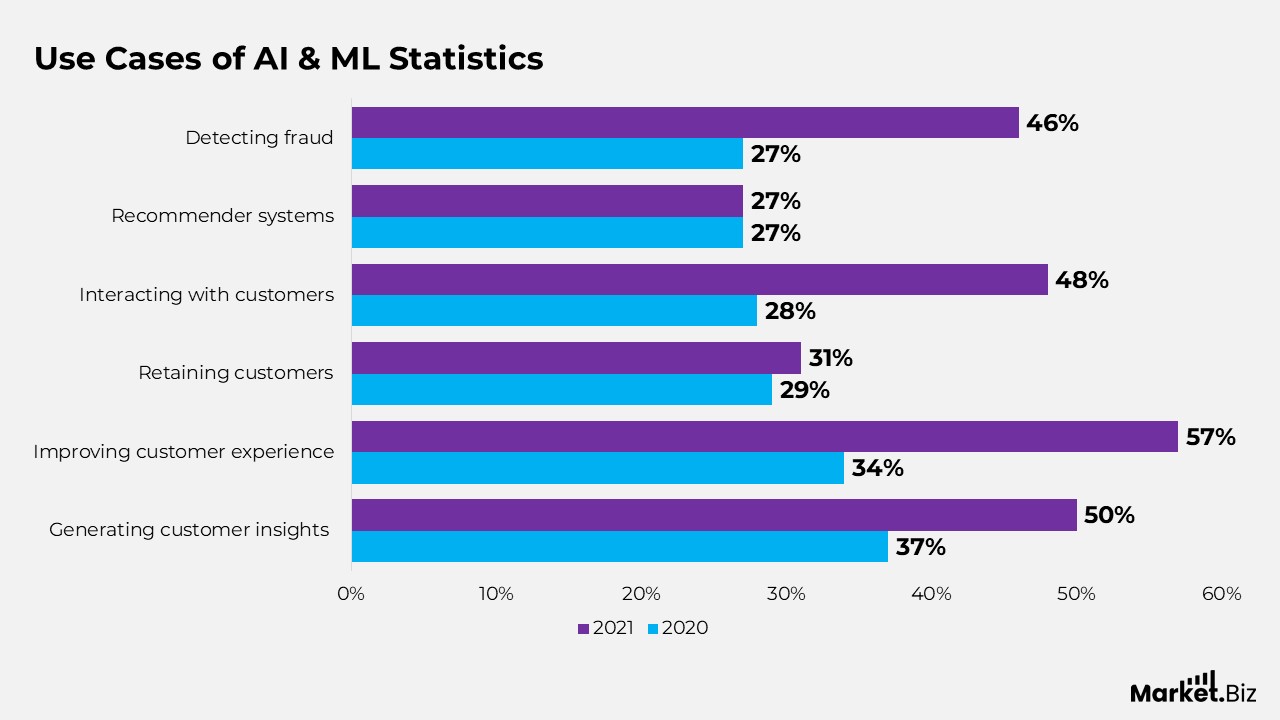
- In both 2020 and 2021, the primary applications of Artificial Intelligence (AI) and Machine Learning (ML) technologies have revolved around enhancing customer-focused elements of businesses.
- In 2020, 37% of the emphasis was placed on generating intelligence and customer insights, while 34% was dedicated to enhancing the overall customer experience.
- Additionally, retaining customers, effectively engaging with them, and implementing recommender systems were also significant priorities.
- Moving to 2021, this trend continued to escalate, with 50% of the focus directed towards generating customer insights and a notable increase to 57% aimed at improving the customer experience.
- AI and ML were instrumental in fraud detection, with a 27% focus in 2020. This figure is projected to rise to 46% in 2021, indicating an increasing demand for security measures.
Easily Automated Tasks by Machines
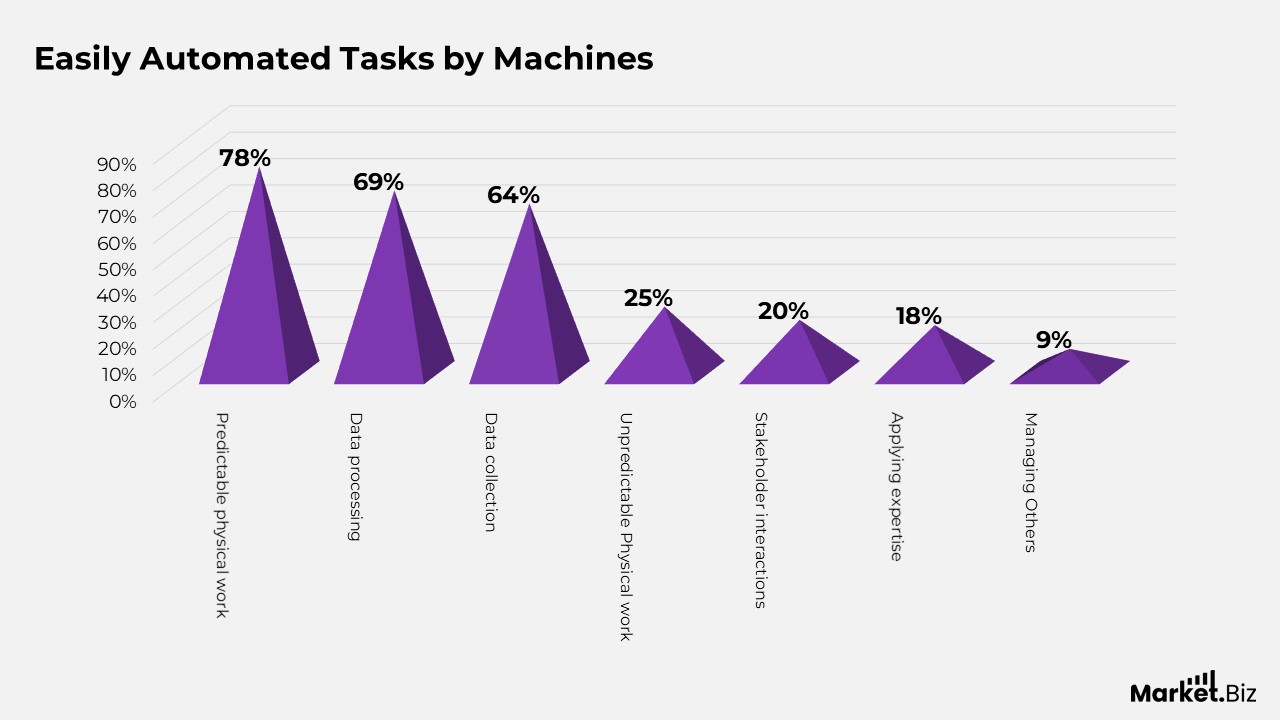
- Among the tasks that can be easily automated, predictable physical work ranks highest, receiving a significant 78% focus.
- Data processing closely follows, with 69% acknowledging the effectiveness of machines in managing this aspect of work.
- Data collection, another task related to data, also emerges as highly suitable for automation, at 64%.
- In contrast, unpredictable physical work is perceived as less appropriate for automation, attracting only 25% of attention.
- Stakeholder interactions and the application of expertise, tasks that frequently necessitate human judgment, received scores of 20% and 18%, respectively.
- Finally, the management of others seems to be less favorable for automation, with merely 9% recognizing its potential for automation.
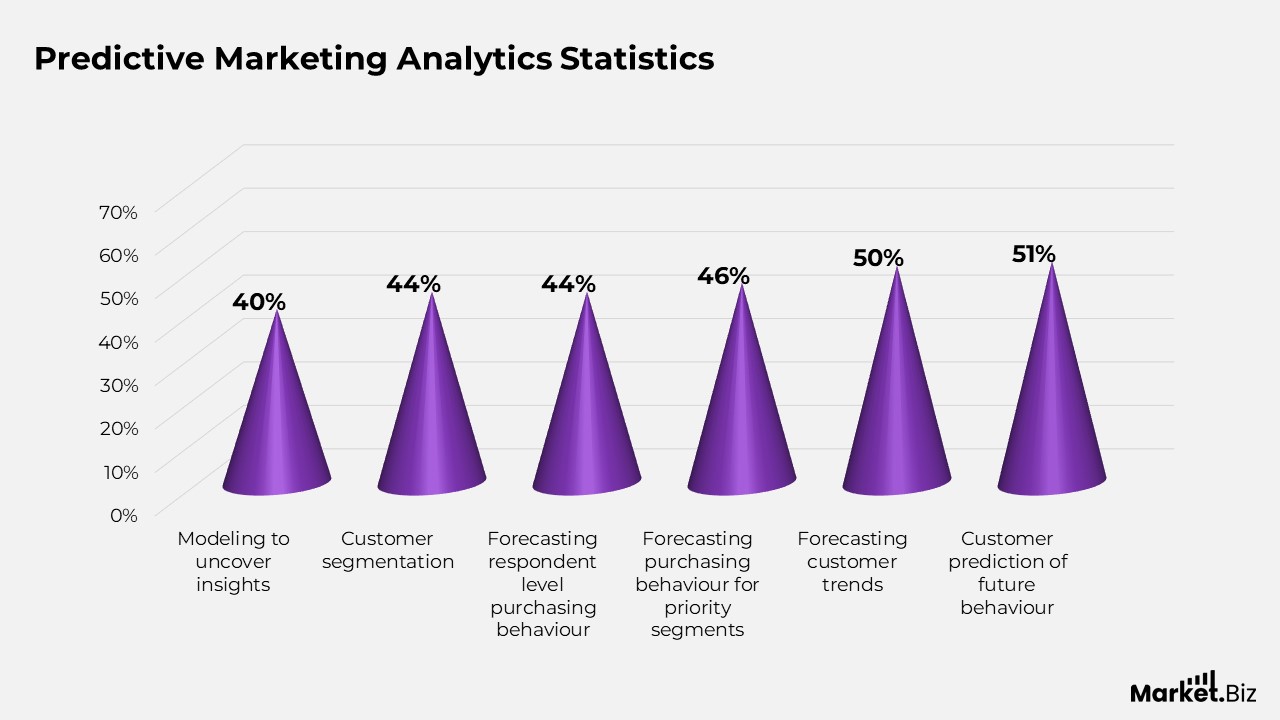
Predictive Marketing Analytics Statistics
- A notable 51% of their initiatives are aimed at predicting customer-level future behaviours, which facilitates customised marketing strategies.
- Following closely, at 50%, is the prediction of customer trends, which enables companies to anticipate market changes.
- The forecasting of purchasing behaviours for key segments, an essential component of marketing, receives 46% of the focus, while a nearly equivalent 44% is dedicated to predicting respondent-level purchasing behaviours and customer segmentation.
- Additionally, predictive analytics is crucial in modelling to reveal significant insights, with 40% of marketing organisations depending on this method to guide their decision-making and enhance their marketing strategies.
Statistics By Predictive AI Integration
- Despite the broad recognition of the significance of consumer data in areas such as forecasting future purchases and enhancing customer retention, over 80% of marketing executives encounter difficulties in making decisions based on data.
- These challenges are acknowledged by 84% of those surveyed, who believe that their capacity to anticipate consumer behaviour often lacks precision and resembles mere speculation.
- Moreover, a considerable 95% of organisations have now integrated AI-driven predictive analytics into their marketing approaches, with 44% reporting complete integration.
- Notably, among the companies that have fully adopted AI predictive analytics, 90% face obstacles in making informed decisions based on data on a daily basis.
- These obstacles include delays in data updates (38%), lengthy model development timelines (35%), overwhelmed data scientists (42%), a disconnect between model creators and marketing goals (40%), and the use of inaccurate or incomplete data for model development (37%).
Predictive AI Applications Statistics
- EY has realised substantial time savings amounting to 250,000 hours through the adoption of intelligent document automation.
- PepsiCo has effectively transitioned around 4,300 workdays each year from mundane tasks to more strategic initiatives by leveraging predictive AI for inventory management.
- Amadeus employs predictive AI to handle an impressive 100,000 transactions every second, thus minimising data fragmentation in the travel sector.
- This advancement has resulted in enhanced experiences for both travellers and industry clients.
- Johnson & Johnson accelerated their COVID-19 vaccine development by utilising predictive AI to pinpoint the most suitable clinical trial locations, which facilitated an earlier commencement of vaccine trials.
Predictive AI Trends Statistics
- In the field of hyper-personalisation, a recent survey conducted by Ascend2 indicates that open-ended chatbots are the least preferred among the various AI-driven tools, with merely 18% of participants choosing them.
- In contrast, predictive analytics stands out as the favoured option, with a notable 56% of respondents selecting it, exceeding conversational strategies by more than three times.
- Following closely are user experience (UX) applications, which 46% of respondents identified as the second most effective choice.
- Predictive analytics has recently attracted considerable attention, with research from Harvard Business Review revealing that 61% of enterprise business leaders currently regard it as “highly significant.”
- Moreover, an even larger 74% expect its significance to increase over the next two years.
Recent Developments
- In 2023, Microsoft finalised its acquisition of Nuance Communications, a prominent entity in AI-driven speech recognition and predictive analytics, for a total of $19.7 billion.
- In early 2024, Google Cloud introduced Vertex AI Forecast, a tool aimed at providing predictive analytics across various sectors.
- In 2023, C3.ai, a frontrunner in enterprise AI, secured $100 million to broaden its predictive AI platform, concentrating on sectors such as energy, manufacturing, and healthcare.
- In late 2023, H2O.ai, a cloud-based AI company, obtained $72.5 million in Series D funding to improve its H2O Driverless AI platform.
Conclusion
In conclusion, predictive AI holds considerable promise across various sectors and applications. It enables organisations to make data-driven decisions, forecast future trends, and improve operational efficiency. However, as highlighted by the information provided, numerous challenges and complexities continue to impede the full realisation of predictive AI.
Despite its growing significance, certain issues, such as implementation challenges and the need for technical expertise, remain. Nonetheless, the demand for predictive analytics is robust and is expected to increase further. As companies tackle these challenges, they should also proactively investigate the opportunities that predictive AI offers to maintain competitiveness and enhance customer service.
FAQ’s
Predictive analytics refers to the methodology of utilising data to anticipate future results. This methodology employs data analysis, machine learning, artificial intelligence, and statistical models to identify patterns that may indicate future behaviour.
Predictive AI, also known as predictive artificial intelligence, is a form of technology that leverages algorithms and machine learning methods to examine both historical and real-time data, enabling it to forecast future events or outcomes with a significant degree of accuracy.
Predictive AI operates by training models on historical datasets, recognising patterns and correlations within the data, and subsequently applying these identified patterns to new datasets to generate predictions. These models are designed to continuously learn and adjust based on new information.