








Introduction
Pressure Sensors Statistics: Pressure sensors are essential for measuring mechanical pressure and transforming it into an electrical signal. They function based on principles such as piezoresistive, capacitive, or piezoelectric methods, ensuring precise pressure measurement.
These sensors are utilised across multiple industries, including automotive, healthcare, industrial processes, consumer electronics, and aerospace. Their accuracy, compact size, durability, and capability to provide digital data are highly valued.
The market for pressure sensors is expanding due to the rise in automation and their integration with IoT, reinforcing their importance as a crucial instrument for monitoring and managing processes in various fields.
Editor’s Choice
- The global pressure sensors market is experiencing a steady growth trend, with a compound annual growth rate (CAGR) of 8.4%.
- APAC stands out as the leading force in the global market, securing the largest share at 38.0%.
- Membrapor AG. and Dynament Ltd. each command a considerable 15% market share, highlighting their influential roles in the pressure sensor sector.
- An absolute sensor that has a 10mV/V output produces a 0 – 50 mV output when supplied with 5.0 VDC.
- In October 2019, Melexis unveiled a specialised integrated circuit (IC) for pressure sensing, specifically designed for the engine’s EVAP (Evaporative Emission Control) system.
General Pressure Sensors Statistics
- The global pressure sensors market is experiencing a steady growth trend, with a compound annual growth rate (CAGR) of 8.4%.
- In the year 2023, this market achieved a revenue of USD 16 billion.
- The Asia-Pacific (APAC) region stands out as the leading player in the global market, securing the largest market share at 38.0%.
- Dynament Ltd. and Membrapor AG both command a significant 15% share of the market, highlighting their influential roles in the pressure sensor industry.
- An absolute sensor that provides a 10mV/V output generates an output range of 0 to 50 mV when supplied with 5.0 VDC.
- Typically, these sensors are compact, featuring pads or legs designed for soldering onto circuit boards.
- Optical pressure sensors offer a measurement range from 0 to 100 bar, with an impressive resolution of 0.1% of the full scale.
- Capacitive sensors are adept at measuring pressures ranging from vacuum levels of 2.5 mbar (or 250 Pa) to high pressures reaching approximately 10,000 psi (70 MPa).
Pressure Sensors Market Size Statistics
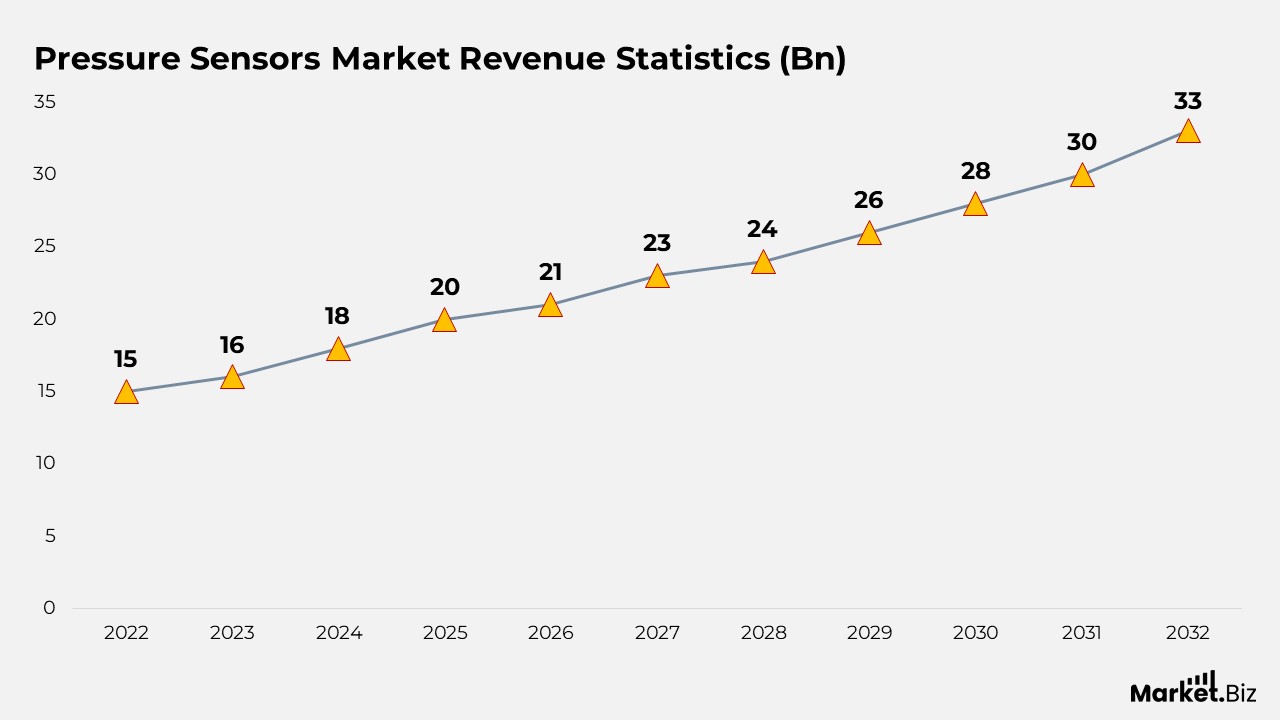
- In 2022, the market achieved a revenue of USD 15 billion, which consistently rose to USD 16 billion in 2023, indicating a positive beginning.
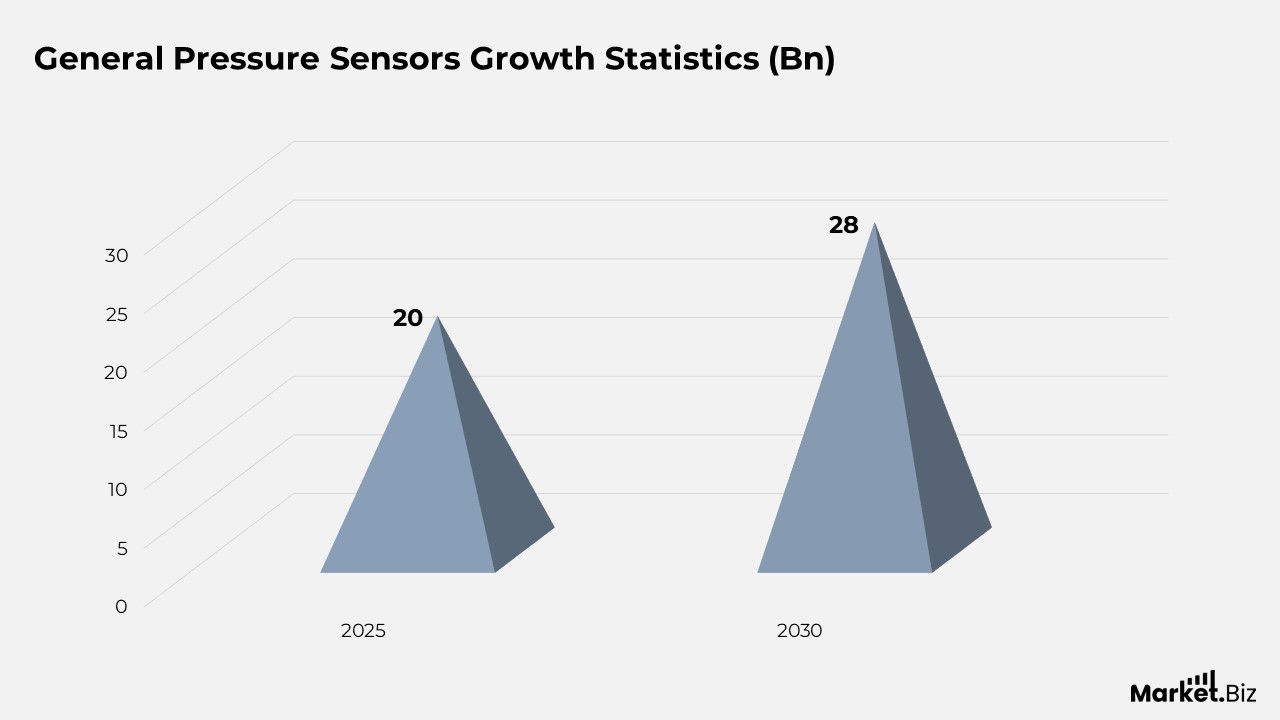
- The upward trend persisted, with revenues climbing to USD 18 billion in 2024 and USD 20 billion in 2025.
- Looking forward, the market is expected to sustain its growth trajectory, with projected revenues of USD 21 billion in 2026, USD 23 billion in 2027, and USD 24 billion in 2028.
- The growth is anticipated to further accelerate, with revenues reaching USD 26 billion in 2029, USD 28 billion in 2030, and a significant USD 30 billion in 2031.
- By 2032, the global pressure sensors market is predicted to reach a revenue milestone of USD 33 billion.
Regional Market Statistics for Pressure Sensors
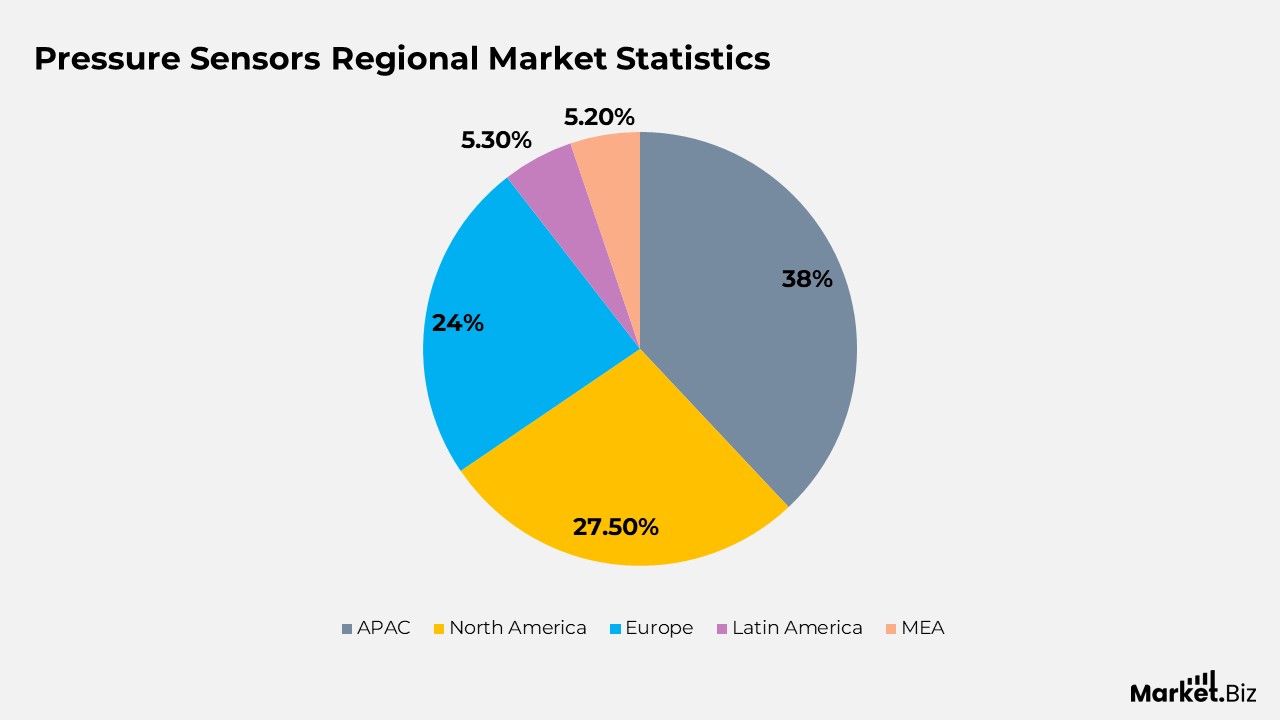
- North America holds a significant market share of 27.5%.
- This region’s robust position can be ascribed to its advanced technological industries, a strong manufacturing base, and considerable consumer demand for products and services that incorporate pressure sensors.
- Europe closely follows with a market share of 24%.
- The European market is distinguished by a varied industrial landscape, which includes automotive, healthcare, and industrial sectors, all of which depend heavily on pressure sensor applications.
- APAC stands out as the leading force in the global market, securing the largest share at 38.0%.
- The impressive market share of this region is fueled by its vast manufacturing capabilities, especially in nations such as China, Japan, and South Korea.
- Latin America possesses a relatively smaller market share of 5.3%.
- MEA represents a similar market share of 5.2%.
Pressure Sensors Market Players Statistics
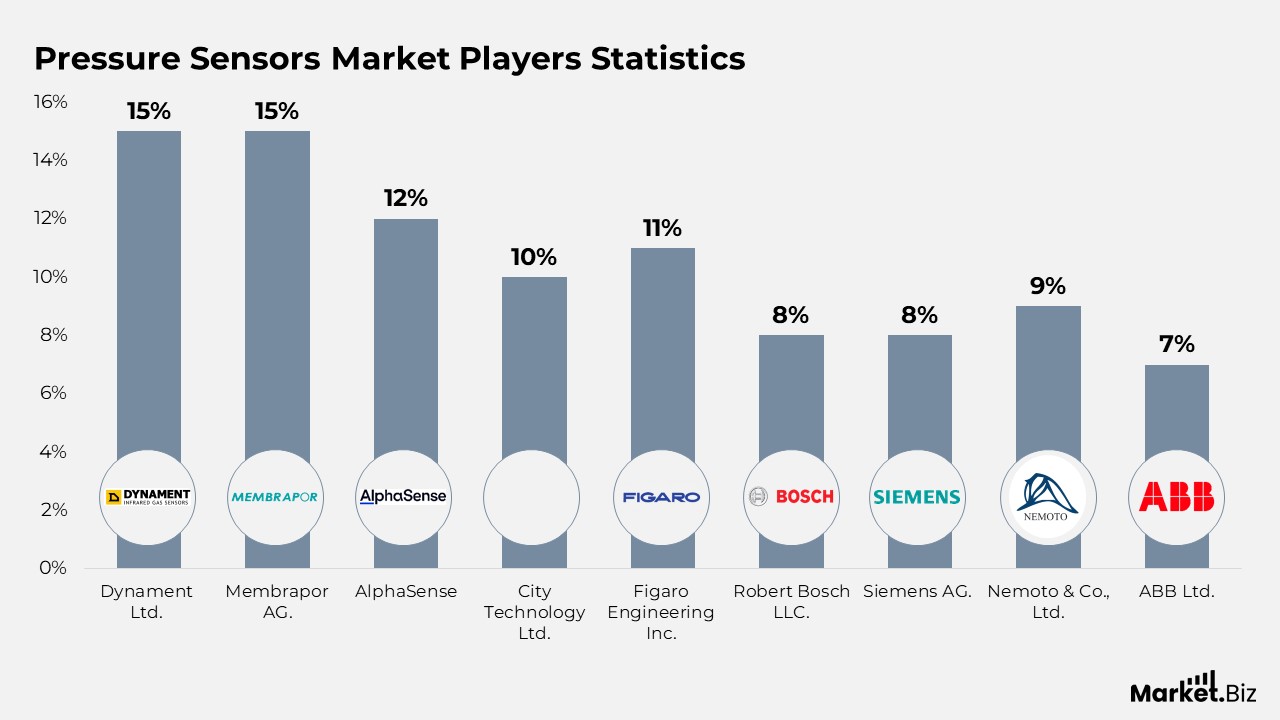
- Membrapor AG. and Dynament Ltd. each command a considerable 15% market share, highlighting their influential roles in the pressure sensor sector.
- AlphaSense achieves a significant 12% market share, indicating its important presence in the industry.
- City Technology Ltd. possesses a commendable 10% market share.
- Figaro Engineering Inc. accounts for 11% of the market share.
- Both Siemens AG. and Robert Bosch LLC. each hold 8% of the market share.
- ABB Ltd. and Nemoto & Co., Ltd. sustain prominent standings with 7% and 9% market shares, respectively.
Types of Pressure Sensors Statistics
Absolute Pressure Sensors
- To measure air pressure, particularly in contexts such as weather barometric readings and altimeters, absolute pressure sensors are the preferred option.
- They provide absolute measurements by comparing the target pressure against the known pressure of an absolute vacuum, akin to measuring temperature in Kelvin, which begins at 0 °K.
- An absolute sensor that has a 10mV/V output produces a 0 – 50 mV output when supplied with 5.0 VDC. These sensors are typically compact, featuring pads or legs that are appropriate for soldering onto circuit boards.
- Conversely, a ‘transducer’ is a more complex sensor that includes built-in signal conditioning, making it suitable for direct application in industrial environments.
- Generally, it offers a voltage output that corresponds to pressure, frequently within the 0 – 10V range, or it may generate an alternating signal within the 1 – 6 kHz range in certain instances.
Optical Pressure Sensors
- The optical pressure sensors deliver precise pressure readings while integrating temperature compensation.
- They feature a measurement range extending from 0 to 100 bar, boasting an exceptional resolution of 0.1% of the full scale.
- These sensors exhibit remarkable accuracy, with deviations of under 1% of the full scale.
Pressure Sensors Reliability and Repeatability Statistics
- For the majority of applications, it is essential to utilize a differential pressure sensor that adheres to stringent standards of accuracy, repeatability, reliability, and stability.
- The goal is to guarantee that HVAC systems function at optimal efficiency with minimal interruptions.
- Consequently, pressure measurement devices must integrate reliable sensor technology that can detect even the smallest pressure variations while ensuring accuracy and dependability over time.
- Although you may strive to conserve energy by accurately regulating temperature, the precision of the differential sensor is critical.
- Should the sensor’s accuracy deviate from +/- 0.25% to +/- 1.0% or greater at any moment, it could disrupt the meticulous control of the process and result in heightened energy expenses.
Latest Trends in Pressure Sensor Technology
- In October 2019, Melexis unveiled a specialised integrated circuit (IC) for pressure sensing, specifically designed for the engine’s EVAP (Evaporative Emission Control) system.
- This relative pressure-sensing IC, intended for shallow pressure measurements within automotive applications, underscores the company’s dedication to enhancing hybrid vehicle technology.
- Functioning as the key element of the EVAP system, the MLX90821 can identify even the smallest vapor leaks.
- In January 2020, the Indian tire manufacturer JK Tire introduced a tire pressure monitoring system (TPMS) utilising TREEL mobile solutions that they had previously acquired. These TREEL sensors are engineered to monitor critical tire information, including pressure and temperature.
Pressure Sensors: Recent Developments
- TE Connectivity, acknowledged as a worldwide leader in connectivity and sensor technology, completed the acquisition of First Sensor AG, a German firm that specializes in pressure sensors, for a total sum of $320 million in 2023.
- In 2023, Amphenol Corporation successfully acquired MTS Systems, a prominent provider of testing and sensing solutions, for the sum of $1.7 billion.
- In 2023, Sensirion, a manufacturer of sensors based in Switzerland, secured $50 million to enhance its product line of pressure sensors.
Pressure Sensors Future Predictions
- By the year 2026, it is anticipated that 40% of newly developed pressure sensors will be miniature in size, specifically aimed at applications in wearables, drones, and medical devices, all while ensuring high levels of precision and reliability.
- By 2032, it is forecasted that the worldwide market for pressure sensors will achieve a revenue milestone of USD 33 billion.
Conclusion
In conclusion, pressure sensors are essential elements utilised across various industries for accurate measurements, based on principles such as capacitive, piezoresistive, or piezoelectric effects. They provide versatility, extensive measurement ranges, and excel in precision and low energy consumption.
These sensors are employed in automotive, healthcare, industrial operations, and consumer electronics, aiding in effective monitoring and control. Selecting the appropriate sensor technology is vital for ensuring accuracy and dependability, especially in critical systems such as HVAC or hybrid vehicle EVAP systems.
Consistent and repeatable measurements can result in energy savings and minimised downtime, thereby guaranteeing long-term efficiency and cost-effectiveness. As technology progresses, pressure sensors will persist in playing a crucial role in process optimisation.
FAQ’s
A pressure sensor is an instrument that quantifies mechanical pressure and transforms it into an electrical signal for a range of applications.
The 7 common types of pressure sensors, classified by their working principle, often include Strain Gauge, Capacitive, Piezoresistive, Piezoelectric, Inductive, Manometer/Bourdon Tube, and often either Vacuum (Pirani) or specific MEMS types, all convert pressure into electrical signals, with popular ones like strain gauges using resistance changes, while capacitive sensors measure diaphragm flex for high accuracy, and piezoresistive sensors are compact for automotive use.
The primary category of pressure sensor used is a transducer, which encompasses piezoelectric and strain gauge sensors. These instruments are utilised in a range of applications to track parameters including flow, level, airspeed, pump systems, or altitude.

