

![Software as a Service [SaaS] Statistics](https://market.biz/wp-content/uploads/2026/01/Software-as-a-Service-SaaS-Statistics-1024x576.png)







Introduction
Software as a Service statistics provide a data-driven view of how cloud-based software adoption, spending patterns, and deployment models are evolving across organizations worldwide. As enterprises accelerate digital transformation, SaaS has become the dominant software delivery model due to its scalability, subscription-based pricing, rapid deployment, and continuous innovation cycles.
Tracking Software as a Service statistics helps stakeholders understand shifts in application portfolios, consolidation trends, AI-driven adoption, cloud spending allocation, and enterprise usage behavior across company sizes and industries. These metrics offer critical insight into market maturity, growth momentum, and how SaaS is reshaping IT strategies, operational efficiency, and long term technology investments at a global level.
Editor’s Choice
- The average organization used 106 SaaS applications in 2024, down from 112 in 2023, while the SaaS consolidation rate declined sharply from 14% to 5% year over year.
- The global SaaS market is projected to reach around $300 billion by 2025, with the adoption of artificial intelligence as a major growth catalyst.
- Global SaaS revenue is anticipated to expand at a compound annual growth rate of 18.7% through 2030
- Worldwide SaaS end-user spending increased 19.1% year over year, reflecting strong enterprise demand.
- SaaS applications are expected to account for more than 40% of public cloud spending in 2024, supported by a projected CAGR of 16.5% through 2028
- Mid-sized enterprises with 1,500–4,999 employees are projected to reduce their SaaS application portfolios by 29% in 2025 as rationalization efforts intensify.
- Approximately 75% of enterprise applications were SaaS-based in 2025, while the remaining 25% continued to operate on-premises infrastructure.
- Experts anticipate that by 2028, generative AI will reduce the risk of noncompliance in software and cloud contracts by 30%
Moreover
- By 2026, more than 80% of organizations are expected to deploy AI-enabled applications across their IT environments, compared with just 5% in 2023
- More than 50% of enterprise organizations are projected to depend on industry-specific cloud platforms by 2028.
- Nearly 90% of IT professionals consider automation essential for managing SaaS operations, while 64% of organisations report that automation has significantly reduced manual workloads.
- End-user SaaS spending is projected to exceed $1 trillion by 2027, accounting for a substantial share of total public cloud expenditure.
- Global software buyers rank integrations as the #3 evaluation priority, following security at #1 and ease of use at #2
- A delay of just 1 second in mobile page load time can lead to a 26% decline in conversion rates.
- U.S.-based SaaS companies collectively serve nearly 14 billion users worldwide, underscoring their strong global reach and market influence.
- Around 81% of organizations have automated at least one business process using SaaS solutions, driving operational efficiency and lowering manual effort.
Further
- Companies used an average of 106 SaaS applications in 2024, reflecting continued adoption alongside a growing focus on application consolidation.
- Global SaaS spending is projected to reach approximately $300 billion by 2025, highlighting sustained enterprise investment in cloud software.
- B2B SaaS providers report an average churn rate of 3.5% in 2025, making customer retention a key priority for long term growth
- By 2025, about 95% of organizations are expected to adopt AI-powered SaaS applications, with more than 50% already leveraging generative AI.
- The global AI market is projected to expand to $1.81 trillion by 2030, supported by a compound annual growth rate of 36.6%
- AI emerged as the leading SaaS category in 2021, serving nearly 3 billion users worldwide.
- ChatGPT reached 1 million users within just 5 days of launch, demonstrating rapid adoption of generative AI platforms.
- Analytics software is the second-largest SaaS category, followed by e-commerce and security software, each serving approximately 1.9 billion users.
- The top-funded SaaS sectors in the first half of the year include financial services software, artificial intelligence software, and analytics software.
Global Public Cloud End-User Spending Outlook by Service Category
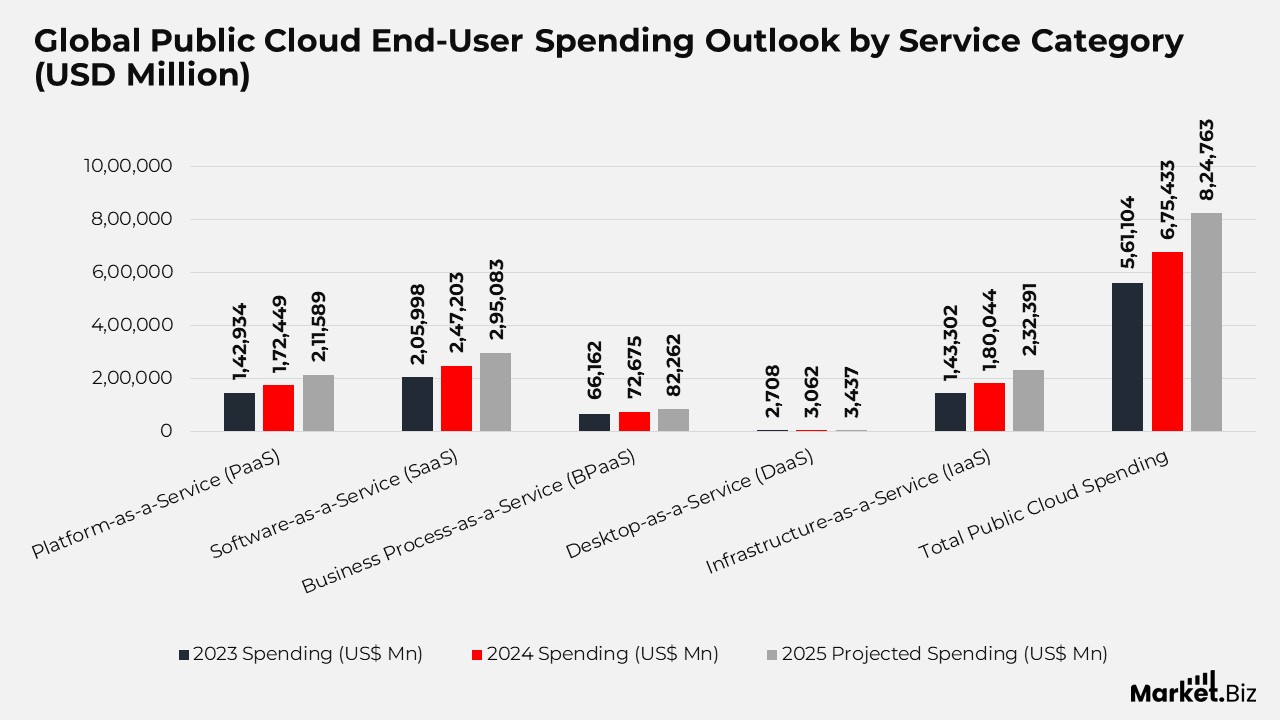
- Spending on cloud application infrastructure services (PaaS) increased from $142,934 million in 2023 to $172,449 million in 2024, and is projected to reach $211,589 million by 2025, with growth accelerating from 19.5% to 22.7%
- Cloud application services (SaaS) recorded end-user spending of $205,998 million in 2023, rising to $247,203 million in 2024, and are expected to expand further to $295,083 million in 2025, supported by steady growth rates of 18.1%–20.0%
- Cloud business process services (BPaaS) spending grew from $66,162 million in 2023 to $72,675 million in 2024, and is forecast to reach $82,262 million by 2025, with growth improving from 7.5% to 13.2%
- Cloud desktop-as-a-service (DaaS) represented a smaller segment, increasing from $2,708 million in 2023 to $3,062 million in 2024, and is projected to reach $3,437 million in 2025, with growth remaining in the 11.4%–13.1% range.
- Cloud system infrastructure services (IaaS) showed strong momentum, rising from $143,302 million in 2023 to $180,044 million in 2024, and are expected to reach $232,391 million by 2025, driven by growth rates climbing from 19.1% to 29.1%
- Total worldwide public cloud end-user spending increased from $561,104 million in 2023 to $675,433 million in 2024, and is projected to reach $824,763 million by 2025, reflecting overall market growth accelerating from 17.3% to 22.1%.
(Sources: Zylo, Statista)
AI Adoption in SaaS Applications: From Early Adoption to Rapid Growth
- Nearly 95% of companies have already invested in AI-driven use cases across their operations.
- Organizations use an average of 7.3 SaaS applications with embedded AI functionality in 2025.
- Only 7% of total SaaS applications are AI-enabled in 2025, indicating large headroom for adoption.
- More than 60% of enterprise SaaS products now include embedded AI capabilities
- Around 40% of organizations use AI-powered SaaS tools for customer service and support automation.
- Nearly 45% deploy AI within IT service management SaaS platforms
- About 76% of SaaS vendors are either actively using or exploring AI for operational improvements in 2025.
- As many as 92% of SaaS companies plan to expand AI usage across their product portfolios in 2025.
(Sources: BetterCloud, Inc., Statista)
Shadow IT and SaaS Sprawl: An Ongoing Enterprise-Wide Challenge
- By 2027, nearly 75% of employees are expected to acquire or modify technology without IT oversight, up from 41% in 2022.
- About 55% of employees adopt SaaS applications without security team involvement.
- Shadow IT accounts for roughly 30%–40% of total IT spending in large enterprises.
- Around 15% of employees routinely use unsanctioned generative AI tools on corporate devices
- Nearly 46% of organizations struggle to track and manage non-human identities
- About 59% of IT teams remain concerned about Shadow IT risks in 2025
- Roughly 21% of organizations identified unauthorized SaaS applications added or expensed by users in 2025
- Around 23% discovered new SaaS apps storing sensitive data without approval
- Nearly 72% of employees using generative AI on corporate devices rely on personal email accounts.
- About 17% use corporate email accounts for GenAI without proper authentication controls, such as SSO.
- Nearly 90% of organisations report that employees use chatbots, with most usage hidden from IT teams.
(Sources: BetterCloud, Inc., Statista)
SaaS License Management and Spend Optimization Trends
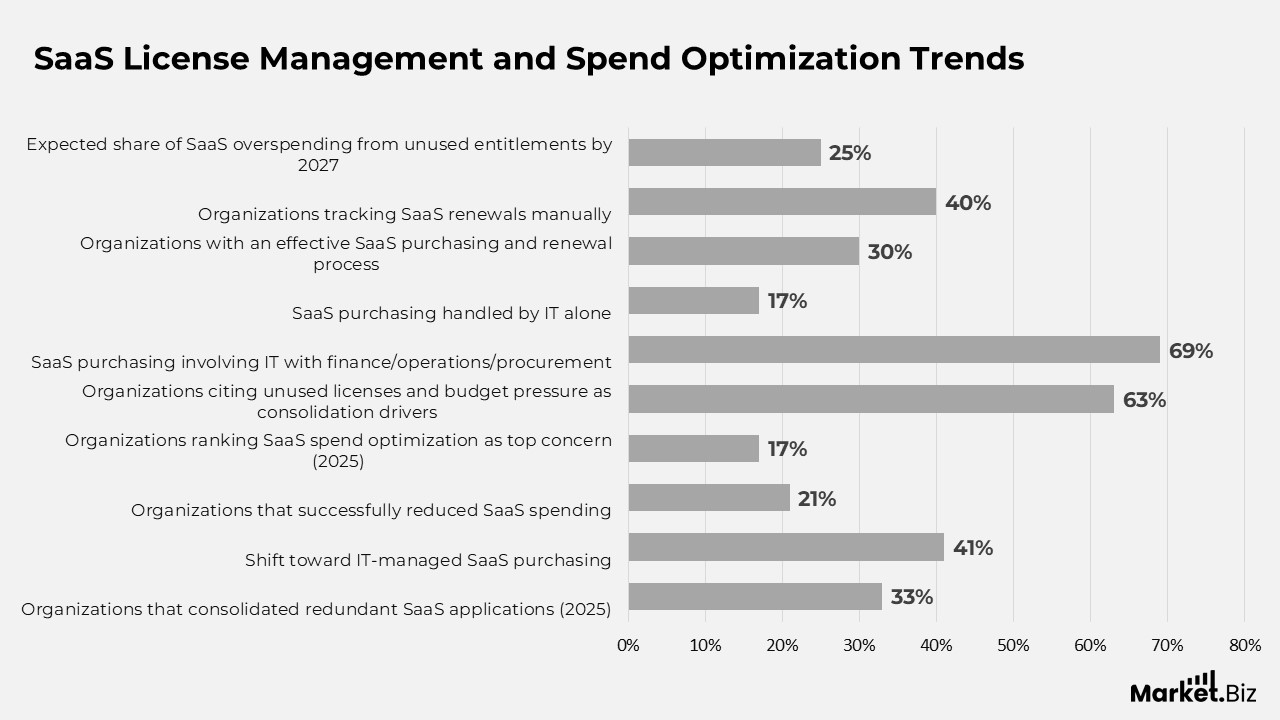
- About 33% of organisations consolidated redundant SaaS applications in 2025
- Roughly 41% shifted more control to IT-managed purchasing, although budget pressures limit full automation
- Around 21% of organizations successfully reduced SaaS spending
- Nearly 17% rank SaaS spend optimization as their top concern in 2025
- About 63% cite unused licenses and budget pressure as key drivers for SaaS consolidation
- Roughly 69% involve IT working alongside finance, operations, or procurement in SaaS purchasing decisions, while 17% rely on IT alone
- Only 30% report having an effective SaaS purchasing and renewal process
- Nearly 40% still track SaaS renewals manually using calendars or spreadsheets
- By 2027, about 25% of SaaS overspending is expected to stem from unused entitlements and overlapping tools.
(Sources: BetterCloud, Inc., Statista)
Scaling SaaS Operations Through Centralized SaaS Management Platforms
- Nearly 70% of IT teams prefer all-in-one SaaS management platforms to automate discovery, security, and spend optimization
- About 51% of IT professionals find managing SaaS with point solutions more difficult than using a unified platform
- Around 65% of SaaS applications are IT-managed, representing roughly 60 applications per organization
- Nearly 60% of IT teams report that manual tasks block strategic initiatives such as AI adoption, while unified platforms could free 40%–50% of routine effort
- About 36% of organizations are building or using enterprise SaaS marketplaces of approved applications
- More than 70% of organizations are expected to centralize SaaS management using a single platform by 2028, up from under 30% in 2025
(Sources: BetterCloud, Inc., Statista)
Accelerating Efficiency Through Automation in SaaS Management
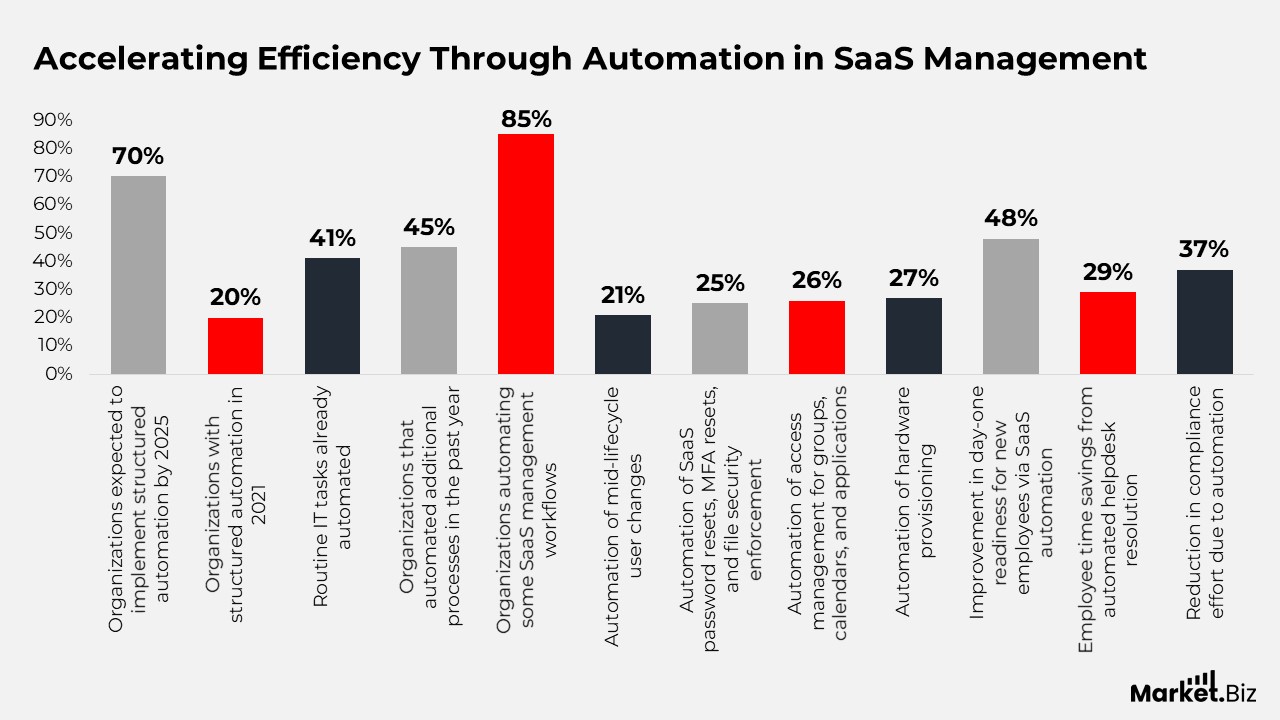
- By 2025, about 70% of organizations are expected to implement structured automation, up from 20% in 2021
- Roughly 41% of routine IT tasks are already automated across organizations
- Nearly 45% automated over the past year
- Around 85% automate at least some SaaS management workflows
- About 21% automate mid lifecycle user changes
- Nearly 25% automate SaaS password resets, MFA resets, and file security enforcement.
- Around 26% automate access management for groups, calendars, and applications.
- About 27% automate hardware provisioning.
- A nearly 48% improvement in day-one readiness for new employees is reported through SaaS automation.
- Organizations report 29% employee time savings from automated helpdesk resolution and 37% reduction in compliance effort.
(Sources: BetterCloud, Inc., Statista)
User Lifecycle Automation: High Impact but Underutilized
- About 54% of organizations still lack automation for user lifecycle management
- Nearly 33% experienced delays in offboarding ex-employees beyond 24 hours
- Roughly 40% report that onboarding new employees takes more than one day
- Only 34% automate onboarding, and 40% automate offboarding
- Automation delivers up to 78% reduction in onboarding time and 88% reduction in offboarding time
(Sources: BetterCloud, Inc., Statista)
SaaS Security Priorities and Risk Landscape
- Around 86% of organizations now consider SaaS security a high priority
- Nearly 76% are increasing budgets for threat detection and SaaS security posture management
- About 78% of IT teams are responsible for protecting sensitive data in SaaS applications
- Nearly 98% plan to increase cybersecurity spending in 2025
- Roughly 75% of organizations experienced a SaaS security incident in the past year
- About 88% of breaches involve stolen credentials, while 80%+ stem from misconfigurations
- Nearly 33% of breaches are linked to Shadow IT and 63% to SaaS misconfigurations
(Sources: BetterCloud, Inc., Statista)
The Future of SaaS Management Beyond
- In 2025, within 3 years, 100% of routine, rules-based SaaS tasks are expected to be automated using AI agents and APIs
- By 2027, about 50% of organizations will adopt SaaS management platforms with AI governance features.
- Nearly 75% of enterprises will prioritize SaaS application backups by 2028
- Around 73% of routine SaaS management tasks are expected to be automated by 2028
- Agentic AI spending is projected to exceed 26% of global IT spending, reaching $1.3 trillion by 2029
(Sources: BetterCloud, Inc., Statista)
How Cloud Budgets Are Allocated Across Service Types
- Software-as-a-Service accounts for the largest share of cloud spending, at 35% of total end-user expenditure, reflecting its central role in day-to-day business operations.
- Infrastructure-as-a-Service follows with a 26% share, highlighting sustained investments in scalable computing, storage, and networking resources.
- Platform-as-a-Service captures 23% of cloud budgets, driven by demand for faster application development, deployment, and integration capabilities.
- Business Process-as-a-Service accounts for around 10% of overall spending, indicating selective adoption of standardised, repeatable enterprise processes.
- Management and security services account for approximately 5% of cloud expenditure, underscoring growing yet still targeted investments in governance, monitoring, and protection.
- Desktop-as-a-Service accounts for the smallest portion at about 1%, suggesting limited adoption compared to core application and infrastructure services.
(Sources: BetterCloud, Inc., Vena Solutions, Gartner, Statista)
SaaS Pricing and Commercial Strategy Trends
- 39% of SaaS companies apply value-based pricing models, leveraging product flexibility to align pricing with customer-perceived outcomes.
- 24% of SaaS firms benchmark and mirror competitor pricing rather than developing differentiated pricing strategies.
- SaaS pricing transparency remains divided: 45% of providers publicly list prices, while 55% keep pricing undisclosed.
- Discount discipline remains strong, as 68% of SaaS vendors apply discounts in fewer than 25% of sales deals, while 29% report minimal discounting overall.
- Between August 2022 and August 2023, 73% of SaaS providers implemented price increases, averaging a 12% uplift.
- In Q4 2023, new software acquisitions represented 11% of total SaaS spending and were projected to decline to 8% by the end of Q1 2024.
(Sources: BetterCloud, Inc., Vena Solutions, Gartner, Statista)
SaaS Adoption and Churn Behavior
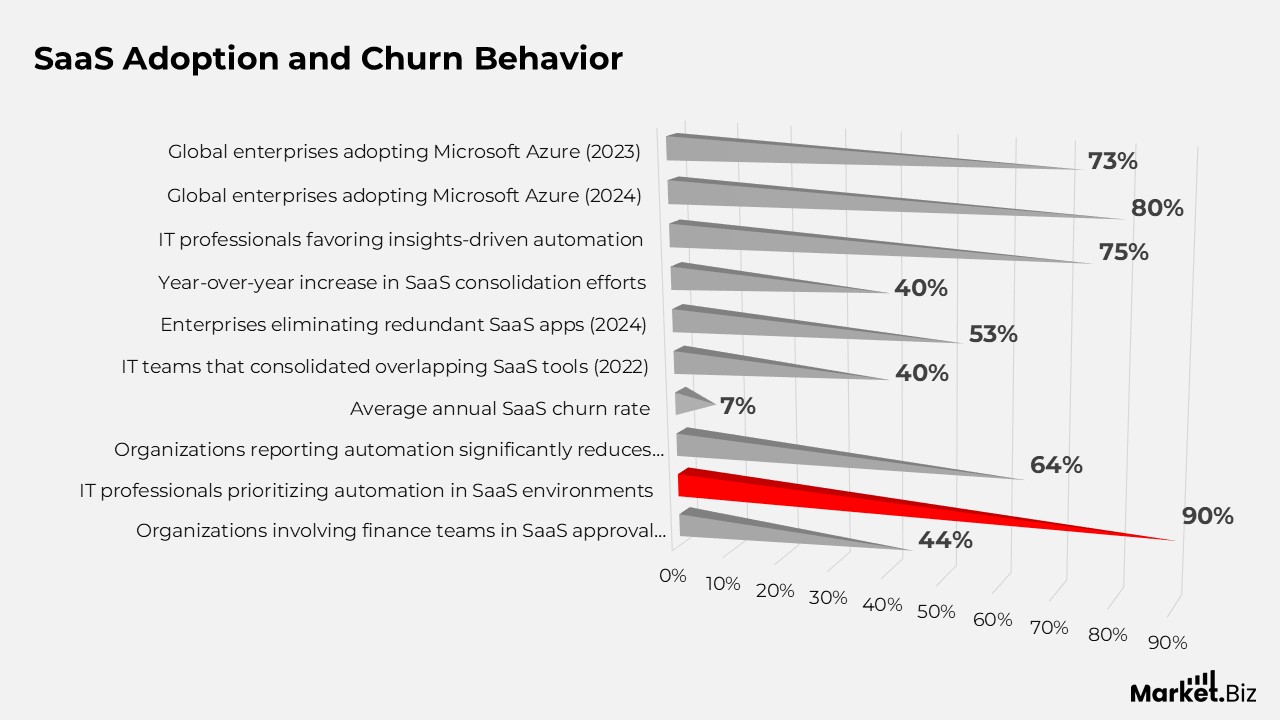
- SaaS procurement decisions typically involve an average of 5 stakeholders, and 44% of organisations regularly include finance teams in approval workflows.
- Nearly 90% of IT professionals within SaaS-driven environments identify automation as a priority, with 64% confirming it significantly lowers manual workloads.
- The average annual churn rate across SaaS providers remains stable, ranging between 5% and 7%.
- Organizations reduced their SaaS application footprint to an average of 220 apps in 2024, down sharply from 371 apps in 2023.
- Application sprawl slowed as 40% of IT teams consolidated overlapping SaaS tools during 2022.
- In 2024, 53% of enterprises actively eliminated redundant SaaS applications, reflecting a 40% year-over-year increase in consolidation efforts.
- Demand for intelligence-led platforms is rising, with 75% of IT professionals favouring SaaS tools that support insights-driven automation.
- Public cloud momentum continued, as 80% of global enterprises adopted Microsoft Azure services in 2024, up from 73% in 2023.
(Sources: BetterCloud, Inc., Vena Solutions, Gartner, Statista)
Shifting Enterprise Perspectives on SaaS Usage
- Shadow IT usage declined from 53% to 48% between 2022 and 2023, signalling improved SaaS governance and visibility.
- Operations teams expanded SaaS usage from 74 to 87 applications, though growth lagged behind IT, Sales, and Product teams.
- Customer success functions recorded the slowest SaaS expansion rate at 5%, maintaining an average portfolio of 61 applications.
(Sources: BetterCloud, Inc., Vena Solutions, Gartner, Statista)
Key Challenges Facing SaaS Businesses
- Venture capital investment in tech startups rose 21% year over year from 2023 to 2024, reaching $184 billion, reinforcing funding volatility.
- Financial data influences strategic decisions more than three times as much as customer data across surveyed organizations, including SaaS firms.
- Sales data has only 50% of the decision-making influence as financial metrics among surveyed businesses.
- 39% of business leaders reported lacking agile planning frameworks to navigate future uncertainty.
- 41% of organizations admitted they do not consistently use internal data to guide decision-making.
- 55% of companies do not revise forecasts when new information becomes available, limiting financial responsiveness.
- 60% of respondents stated finance leaders lack strategic decision authority, with only 28% granting them final approval rights.
(Sources: BetterCloud, Inc., Vena Solutions, Gartner, Statista)
Cost Structures and Growth Pressures in SaaS
- In 2023, 5.3% of SaaS firms reported flat or declining growth, up from 3.1% in 2022, reflecting rising market pressure.
- Average SaaS spend per employee reached $5,607, up 7% from 2023.
- Median R&D expenditure as a share of ARR declined to 18%, down from 24% in 2023.
- General and administrative spending fell to a median of 11%, compared with 15% the previous year.
- Equity-backed SaaS firms spend 90% more on sales, 82% more on general administration, 58% more on marketing and R&D, and 18% more on customer success than bootstrapped peers.
(Sources: BetterCloud, Inc., Vena Solutions, Gartner, Statista)
Visibility and Governance Gaps in SaaS Security
- 73% of organizations identify limited visibility into security risks within business-critical SaaS applications as the most complex aspect of SaaS security management.
- Dedicated SaaS security ownership is expanding, with 70% of organizations now maintaining specialized teams or assigned personnel.
- Over the past year, 39% of enterprises increased budget allocations specifically for SaaS security initiatives.
- Configuration errors remain a dominant threat vector, as SaaS misconfigurations contribute to as much as 65% of enterprise security incidents.
(Sources: BetterCloud, Inc., Vena Solutions, Gartner, Statista)
Monitoring Limitations and Misconfiguration Risks
- Nearly 46% of organisations conduct SaaS misconfiguration checks only monthly or less frequently, while 5% report no routine checks at all.
- Security oversight challenges persist as 45% of IT professionals report difficulty in securing user activity across SaaS environments.
- Sensitive data exposure risks continue to rise, with 33% of IT teams deploying SaaS applications that store confidential or regulated information within the last year.
(Sources: BetterCloud, Inc., Vena Solutions, Gartner, Statista)
External Pressures and Contract-Related Risks
- Geopolitical instability is expected to trigger a rise in SaaS contract defaults, directly affecting more than 50% of subscribers.
- Security considerations influence purchasing decisions, as 38% of businesses cite cybersecurity concerns when evaluating investments in new software.
(Sources: BetterCloud, Inc., Vena Solutions, Gartner, Statista)
Shadow IT and Insider Threat Concerns
- Shadow IT remains a significant risk factor, with 69% of organisations ranking unauthorised SaaS use among their top security challenges in 2024.
- Post-employment access issues persist, with 31% of companies reporting that former employees retain access to SaaS-hosted corporate assets.
- Insider-driven threats linked to former employees account for 22% of SaaS-related security incidents.
- Offboarding failures continue to raise executive concern, with 59% of SaaS leaders identifying de-provisioning of ex-employees as a critical security priority.
(Sources: BetterCloud, Inc., Vena Solutions, Gartner, Statista)
Conclusion
Software as a Service statistics reflect a market that has progressed from rapid adoption to a more measured, efficiency-driven phase. Enterprises continue to prioritize SaaS within their cloud spending, supported by structured pricing strategies, restrained discounting, and targeted price adjustments. At the same time, organizations are streamlining their application portfolios, reducing overlap, and concentrating investments on platforms that deliver clear productivity gains, automation, and data-driven insights.
Churn levels remain contained, yet renewal decisions are increasingly influenced by transparency, demonstrable value, and cost justification. Finance teams are becoming more involved in SaaS oversight, reinforcing stronger governance and budget control across subscription investments. In parallel, shifting cost allocations and the widening operational gap between equity-backed and bootstrapped SaaS providers underline a growing emphasis on sustainable growth and margin discipline.
Overall, SaaS adoption is transitioning from volume-driven expansion to strategic optimization. The data suggests that long-term performance in the SaaS market will depend on pricing maturity, operational efficiency, intelligent automation, and closer alignment between software investments and measurable business outcomes.
FAQ’s
Software as a Service Statistics illustrate the transition from an expansion-led phase to a maturity-driven stage characterised by efficiency optimisation, portfolio rationalisation, and value-based decision-making. This shift reflects broader enterprise priorities around cost control, governance, and measurable outcomes.
Pricing-related SaaS data highlights a structural shift from competition-based pricing toward value-oriented frameworks. The statistics suggest that SaaS providers are increasingly designing pricing strategies to reflect product flexibility, usage intensity, and business impact, rather than relying solely on market benchmarks.
SaaS adoption metrics indicate that enterprises are moving from aggressive tool accumulation toward strategic utilization. Organisations increasingly emphasize consolidation, interoperability, and functional depth, signalling a more deliberate approach to software deployment.
From a theoretical perspective, churn statistics serve as a proxy for product-market alignment, customer value realisation, and lifecycle management effectiveness. Stable churn levels suggest maturity, while variability reflects changing buyer expectations and economic sensitivity.
Governance-related Software as a Service Statistics imply a rebalancing of authority across IT, finance, and business functions. The growing involvement of finance teams reflects a conceptual shift toward accountability, forecast discipline, and enterprise-wide control over subscription-based investments.