









Introduction
Video Game Statistics: The video game industry has evolved from a niche hobby into a global entertainment giant, impacting technology, culture, and economics. With millions of players across the globe and a market worth billions, understanding video game statistics is vital for developers, investors, marketers, and enthusiasts.
These statistics offer valuable insights into player behavior, market trends, sales performance, and emerging technologies, enabling the identification of patterns, forecasting growth, and shaping strategies within the industry. This statistics will delve into the latest trends in video game sales, platform popularity, gamer engagement, and industry innovations, providing a data-driven overview of the gaming landscape today and in the future.
Editor’s Choice
- There are an estimated 3.32 billion dynamic video game players worldwide.
- The United States is home to more than 3,000 esports players.
- Asia has nearly 1.5 billion gamers.
- 53% of males identify as gamers.
- Over 52% of gamers have at least one gaming subscription service.
- The number of online gamers in the UK is projected to reach 11.56 million by 2027, reflecting a 6.64% increase from 10.84 million in 2023.
- A significant 83% of gamers aged 16-24 play online.
- While online gaming usage is lower among older people, 49% of gamers aged 65 and above still engage in online play.
- In the UK, more than half of both men (53%) and women (51%) consider themselves gamers.
- Mobile phones are the leading platform for gaming, with 34% of players using them as their primary device.
- Approximately 70% of UK gamers admit that playing games makes them feel happier.
Moreover
- The global esports market is anticipated to reach a value of $10.91 billion by 2032.
- Dota 2 holds the title of the most popular esports game globally, with a cumulative tournament prize pool of $30.82 million.
- Esports players from China are the highest earners, having accumulated nearly $300 million in winnings.
- Mobile continues to lead as the highest-earning platform, driven by mobile ads, in-app purchases, and free-to-play games.
- Around 40% of the global population are gamers, with 80% of them aged 18 and older.
- Global esports viewership is rapidly growing, particularly in the Asia-Pacific region, which now accounts for 30% of all esports revenue.
- PC gaming has reached 1.86 billion users, yet consoles still generate a larger share of revenue, totaling $51.9 billion.
- Activision Blizzard earned $8.7 billion, EA brought in $7.46 billion, and Sony’s gaming division generated $31 billion.
- Despite strong overall sales, Nintendo’s annual shipments dropped to 11 million units as the company shifts its focus toward the upcoming Switch 2.
Video Game Addiction Statistics
- A study by Canada’s Centre for Addiction and Mental Health (CAMH) found that nearly 12% of Ontario University students show signs of video game addiction.
- Research from the Department of Psychological Medicine at Nepean Hospital in Sydney indicates that up to 10% of Australian gamers struggle with video game addiction.
- In the United Kingdom, over 36 million people regularly engage in video gaming, with estimates suggesting that 700,000 to 1 million UK gamers may be addicted.
- A study from the United Arab Emirates (UAE) revealed that during lockdowns, up to 50% of people spent more time gaming.
- Around 1-2% of gamers in Germany are believed to be addicted to video games.
- In South Korea, approximately 10% of the population is thought to suffer from video game addiction.
- Research from China estimates that between 6%-10% of gamers in the country are addicted to video games.
- In Japan, it is estimated that 4-5% of the population experiences video game addiction.
(Source: Centre for Addiction and Mental Health, AddictionHelp.com)
Top-Selling Video Games
- Wii Sports is the best-selling game of all time by a wide margin, with 82.65 million copies sold worldwide as of January 2021. It has sold more than twice as many copies as its closest competitor, the original Super Mario Bros. from the NES, which sold 40.24 million copies.
- The top four spots are completed by Mario Kart Wii and Wii Sports Resort, which together have sold a combined total of 69.88 million copies.
- In total, seven Wii-exclusive games are among the top 20 best-sellers of all time. Mario Kart 8 Deluxe currently holds the title of the best-selling game on the Nintendo Switch.
- Wii Sports (Nintendo) leads the list with 82.65 million copies sold since its release in 2006.
- Super Mario Bros. (Nintendo) follows with 40.24 million copies sold, originally launched in 1985.
- Mario Kart Wii (Nintendo) has sold 35.98 million copies since its 2008 release.
- Wii Sports Resort (Nintendo) reached 32.90 million copies by 2009.
- Pokémon Red/Green/Blue (Nintendo) has sold 31.37 million copies since its release in 1998.
Moreover
- Tetris (Nintendo) sold 30.26 million copies in 1989.
- New Super Mario Bros. (Nintendo) achieved 29.85 million copies sold after its 2006 release.
- Wii Play (Nintendo) reached 28.92 million copies sold, launched in 2007.
- New Super Mario Bros. Wii (Nintendo) sold 28.51 million copies by 2009.
- Duck Hunt (Nintendo) sold 28.31 million copies from its 1985 release.
- Nintendogs (Nintendo) reached 24.68 million copies sold since 2005.
- Mario Kart DS (Nintendo) sold 23.26 million copies in 2005.
- Pokémon Gold/Silver (Nintendo) has sold 23.10 million copies since 2000.
- Wii Fit (Nintendo) achieved 22.70 million copies by 2008.
- Kinect Adventures! (Microsoft Game Studios) sold 22.10 million copies by 2010.
- Wii Fit Plus (Nintendo) reached 21.81 million copies by 2009.
- Grand Theft Auto: San Andreas (Rockstar Games) sold 20.81 million copies in 2004.
- Super Mario World (Nintendo) has sold 20.61 million copies since its release in 1991.
(Source: VGChartz, NintendoLife, Statista, Semrush Inc.)
Shooting Games Market Size
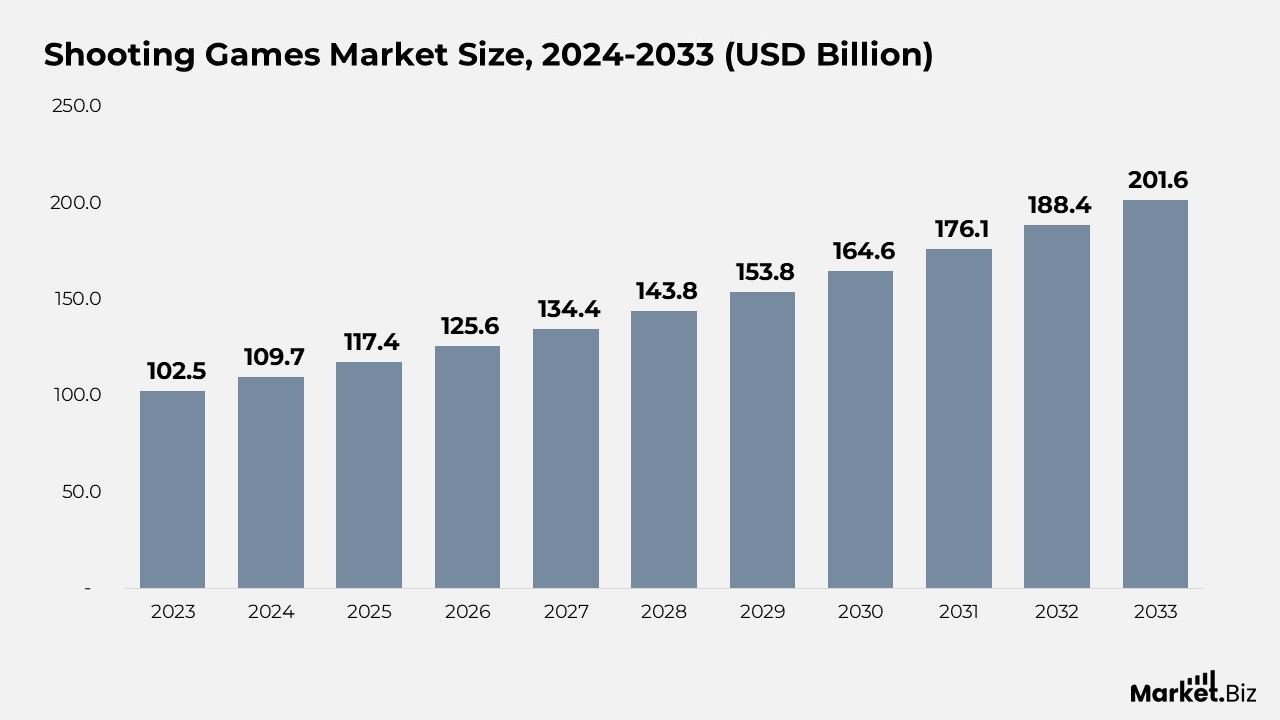
- According to Market.us, the shooting games market is expected to rise from $109.7 million in 2024 to $201.6 million by 2033, representing a compound annual growth rate (CAGR) of 7.0% from 2024 to 2033.
- The growth of the video game market is fueled by increasing adoption of gaming as a mainstream entertainment source and technological advancements like VR and enhanced graphics.
- FPS games lead the segment with a 38% market share, offering immersive first-person perspectives that deepen player engagement.
- Gaming consoles dominate with a 40% market share, offering high-performance gaming, ease of use, and exclusive titles unavailable on other platforms.
- North America leads the shooting games market with a 31% share, totalling USD 31.78 million, supported by a strong gaming culture and advanced tech infrastructure.
- League of Legends World Championship 2023 attracted 6.4 million peak viewers, emphasizing the growing audience and commercial value of shooting games.
- Free Fire World Series 2021 garnered 5.41 million viewers, highlighting the large audience for shooting games and lucrative opportunities for developers.
- The Asia-Pacific region leads global esports viewership with 57%, while North America and Europe account for 12% and 16%, respectively.
(Source: Market.us)
Strategy Games Market Size
- According to Market.us, the strategy games market is expected to grow from $19.0 billion in 2024 to $38.4 billion by 2033, representing a compound annual growth rate (CAGR) of 8.1% from 2024 to 2033.
- The growth of the strategy games market is fueled by artificial intelligence, enhancing gameplay complexity, and the increasing popularity of multiplayer and competitive formats.
- In 2023, mobile devices led the Strategy Games Market with over 42.3% market share, driven by the accessibility and enhanced performance of smartphones.
- Freemium business models captured more than 54.0% market share in 2023, attracting a broad audience by offering free access with monetization through in-game purchases.
- The Asia-Pacific region dominates the Strategy Games Market with a 40.1% share, valued at USD 7.05 billion, driven by strong gaming cultures in countries like South Korea, Japan, and China.
- The UK government has allocated over £3 million in grants to 22 video game studios through the UK Games Fund, recognizing the sector’s potential for growth and technological innovation.
(Source: Market.us)
Esports Expansion Statistics
- Annual global revenue from esports has surpassed $1 billion.
- The prize pools for top-tier esports events now exceed $30 million.
- The global esports audience is projected to exceed 500 million by 2024.
- In 2023, there were 474 million viewers of esports events, and this number is expected to grow to 577.2 million in 2024, an increase of over 100 million.
- Several esports organizations are now valued at more than $100 million.
- Three prominent esports organizations have been valued at over $300 million: Cloud9 ($350 million), Team Liquid ($310 million), and FaZe Clan ($305 million).
(Source: Dotesports, e-Sports Earnings, VentureBeat, Forbes, Semrush Inc)
Gamer Preferences Statistics
- Over 143 million gamers in the United States report that they play video games to relax.
- Additionally, 112 million gamers play video games while taking a break or waiting for someone.
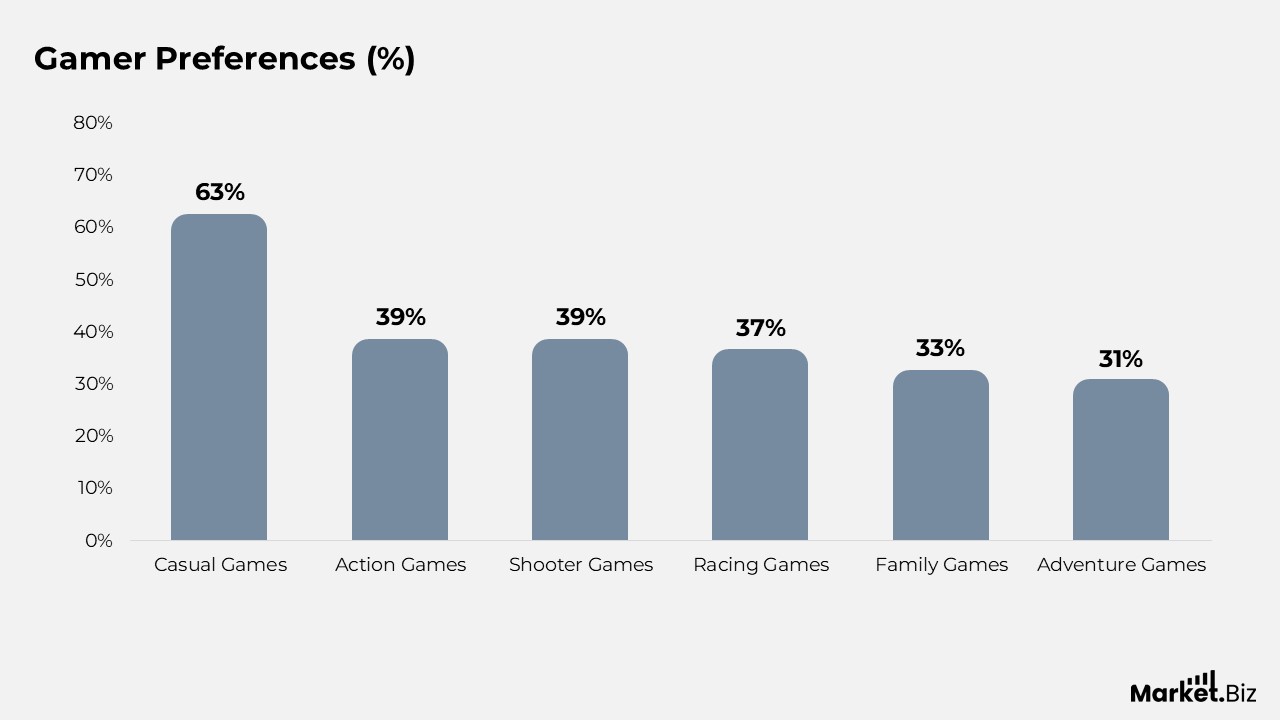
- In this section, we will explore key statistics regarding gamer preferences.
- 66% of gamers in the US say that relaxation is their primary reason for playing video games, which equates to approximately 2.04 billion gamers globally.
- 66% of gamers play video games to relax and unwind.
- 52% of gamers use video games as a way to pass the time while taking a break or waiting for someone.
- 51% of gamers play to seek entertainment and enjoyment.
- 48% of players choose video games as a way to spend time alone.
- 37% of gamers play because it gives them a sense of comfort.
- 32% of players enjoy gaming because it provides them with a soothing and familiar experience.
- 1.61 billion gamers engage in video games as a way to make the most of their time while on a break or waiting for others.
(Source: DemandSage, Statista, Data Portal)
Gaming Device Usage Statistics
- 1.29 billion gamers worldwide use smartphones to play video games, making them the most popular gaming device.
- 676 million gamers use PCs to engage in video gaming.
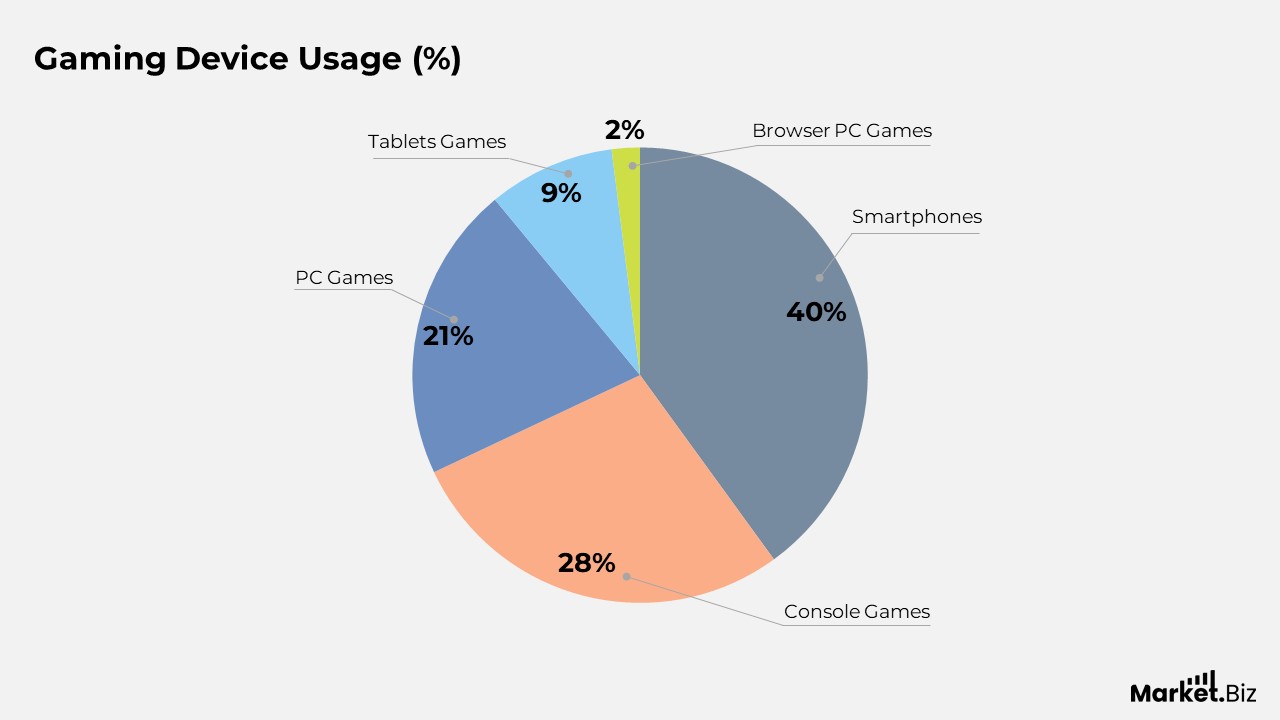
- Smartphone gaming holds a 40% share of the global gaming market, making it the leading platform.
- Console games drive 28% of the gaming market.
- 21% of gamers play on PCs, reflecting a strong presence in the gaming industry.
- 9% of the market is dedicated to gaming on tablets.
- 2% of gamers enjoy playing browser-based PC games.
- PC gaming is the top choice for game developers, with 63% of developers targeting this platform.
(Source: DemandSage, Exploding Topics, Finance Online, Data Portal)
Gaming Subscription Statistics
- According to Exploding Topics, 1.67 billion gamers globally subscribe to at least one gaming service.
- 2.29 billion console gamers are more likely to subscribe to gaming services.
- 52% of gamers worldwide have at least one gaming subscription.
- 74% of console gamers are more inclined to subscribe to gaming services.
- 66% of PC gamers are more likely to subscribe to gaming services.
- Around 2.04 billion PC gamers are expected to subscribe to gaming services.
- There are 100 million active Xbox Live users worldwide, a significant increase from just 39 million in 2016.
- Sony had 47.3 million PlayStation Plus subscribers in 2022.
(Source: DemandSage, Exploding Topics, Finance Online)
Demographics of Video Gaming
Age
- 618 million gamers are under 18 years old.
- The 18 to 34-year age group is the largest, with 1.17 billion gamers.
- There are 433 million gamers in the 35 to 44-year age range.
- The 45 to 54-year age group consists of 371 million gamers.
- 278 million gamers belong to the 55 to 64-year bracket.
- 216 million gamers are aged 65 and above.
(Source: DemandSage, Exploding Topics, Finance Online)
Gender
- 59% of video game players in the US are male, and 41% are female.
- On weekdays, men in the US spend an average of 51 minutes on leisure activities like gaming and computer use, while women spend 29 minutes.
- On average, female gamers spend $359 annually on downloadable content and game accessories, whereas male gamers spend $335 per year on the same items.
- 49.1% of male gamers in the US identify as committed gamers, while 48.8% of female gamers do the same.
(Source: ESA, US BLS, Treasure Data, AdColony)
Race
- 54% or 1.4 billion global players are from the Asia Pacific.
- 14% (377 million) of players are from the Middle East and Africa, while 14% (386 million) come from Europe.
- Only 8% or 210 million players are from North America.
- Players in Germany spend an average of 6.92 hours per week playing video games, followed by the UK with 6.89 hours and Japan with 6.64 hours.
- Players from Japan have the longest average duration of consecutive gaming sessions at 5.33 hours.
- African Americans spend 32 minutes on weekdays playing games and using computers for leisure, while Asians spend 62 minutes, and Hispanics spend 37 minutes on the same activity.
(Source: Newzoo, Limelight Networks, US BLS, FinancesOnline)
Video Game Statistics by Country/Region
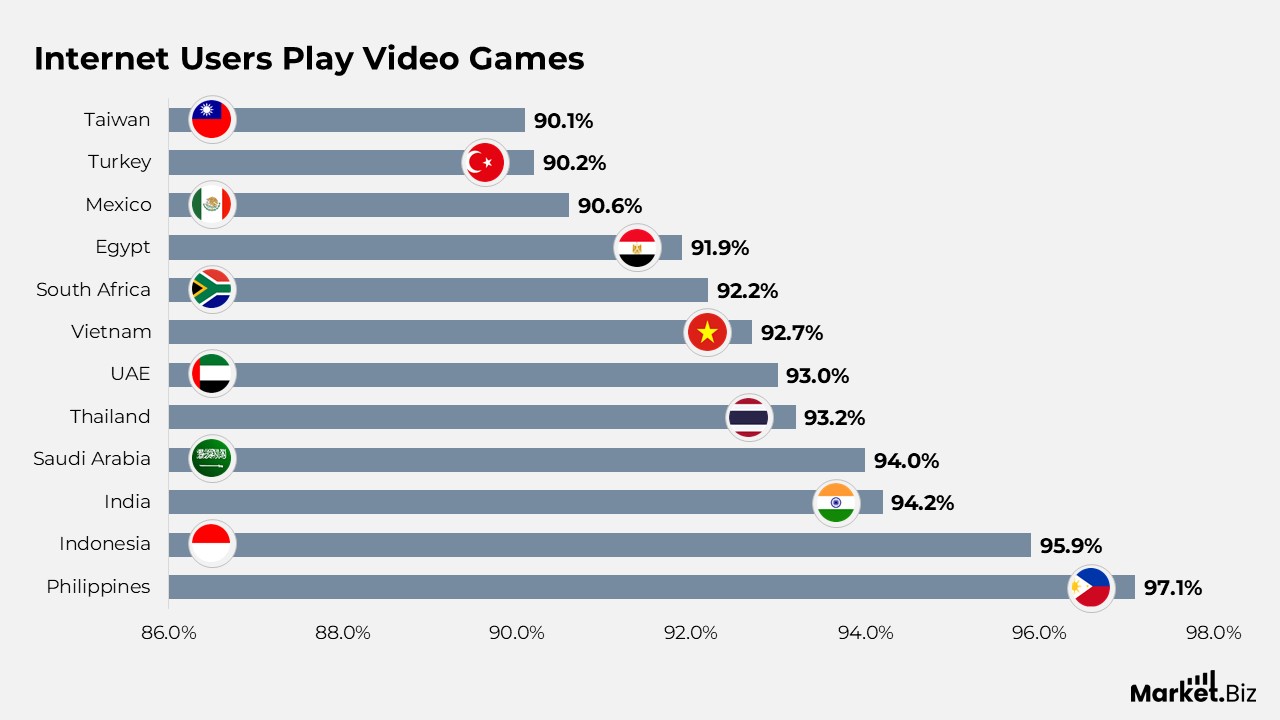
- Asia leads the world with the highest number of gamers, boasting 1.48 billion players.
- Europe ranks second, with 715 million gamers.
- Latin America has a gamer population of 420 million.
- North America is home to 285 million gamers.
- The MENA (Middle East and North Africa) region has 168 million gamers.
- Sub-Saharan Africa is reported to have around 144 million gamers.
- Oceania has 32 million gamers.
(Source: DemandSage, Exploding Topics, Statista)
Factors Influencing Game Selection
- Players consider simple gameplay as the most important factor, with a score of 2.59. Other key factors include fast performance (2.62), the ability to play offline (2.48), and an interesting storyline (2.47).
- 54% of players aged 18 and above in the US prefer playing as part of a team when competing against others. Meanwhile, 33% prefer multiplayer/online mode over single-player games.
- 68% of men aged 18 to 34 in the US prefer playing with friends. In contrast, 77% of men aged 65 and above prefer playing solo.
- 58% of women aged 35 to 54 prefer playing with friends, while 81% of women aged 65 and above enjoy playing alone.
(Source: Limelight Network, ESA, Finances Online)
Conclusion
The video game industry is witnessing significant growth, driven by a global audience expansion and rising market value. Mobile platforms are dominating revenue generation, while esports viewership continues to soar.
Technological advancements and an ever-expanding player base are shaping the future of gaming, with more players adopting competitive formats and immersive experiences. As gaming behaviors evolve across regions, age groups, and platforms, these trends offer valuable insights for developers, marketers, and industry stakeholders to seize new opportunities and drive further success in the sector.
FAQ’s
The global video game market was valued at over $159 billion in 2020, with projections indicating continued growth driven by the rise of mobile gaming, esports, and digital gaming.
Approximately 3.32 billion people around the world are active video game players, with a significant portion of them aged 18 and older.
Around 40% of the world’s population actively engages in video gaming, showcasing the widespread popularity of the medium.
Mobile platforms lead in revenue generation, thanks to in-app purchases, mobile advertising, and free-to-play models. Consoles and PC gaming also contribute significantly to the market’s earnings.
The average age of gamers varies by region, but studies show that approximately 80% of players are 18 years or older.
The global esports audience is expected to surpass 500 million viewers by 2024, with major events attracting millions of live-streamed viewers from around the world.
Some of the highest-selling video games include Wii Sports (82.65 million copies sold), Super Mario Bros. (40.24 million copies), and Mario Kart Wii (35.98 million copies).
Many leading esports events offer prize pools exceeding $30 million, with high-profile tournaments such as The International (Dota 2) and the League of Legends World Championship drawing immense global viewership and sponsorship.
The gaming industry has become a significant economic powerhouse, contributing notably to global GDP through game sales, in-game purchases, esports, streaming, and associated sectors like merchandise.