









Introduction
Machine Learning Statistics: In recent years, machine learning has become a game-changer, transforming various industries by enabling systems to analyze data, detect patterns, and make decisions with minimal human input. Central to machine learning are statistical methods, which form the backbone of data analysis, model creation, and prediction.
By leveraging algorithms that learn from data, machine learning facilitates the development of predictive models that continuously improve. The incorporation of statistics into machine learning not only supports data-driven decision-making but also improves the precision and clarity of models.
This powerful combination of machine learning and statistics has driven significant progress in fields such as healthcare, finance, marketing, and technology, enabling organisations to unlock valuable insights from vast datasets and foster innovation.
Editor’s Choice
- 57% of businesses utilize machine learning to enhance customer experience.
- 1 in 4 companies is adopting artificial intelligence to address labor and skills shortages.
- 49% of companies incorporate machine learning and AI into marketing and sales strategies.
- In 2023, the industry developed 51 significant machine learning models, while academia contributed 15, and 21 models were created through collaborations between academia and industry.
- Netflix saved $1 billion by leveraging machine learning algorithms for personalized recommendations and content suggestions.
- Machine learning demonstrates 62% accuracy in predicting stock market highs and lows.
- The introduction of GNMT, a machine learning-powered translation algorithm, resulted in a 60% reduction in errors for Google Translate.
- By January 2024, the Google Cloud Platform marketplace featured 281 machine learning solutions, with the majority (195) falling under software as a service (SaaS) and API categories.
(Source: Statista, Stanford University, International Business Machines Corporation, G2.com, Inc.)
Machine Learning Statistics
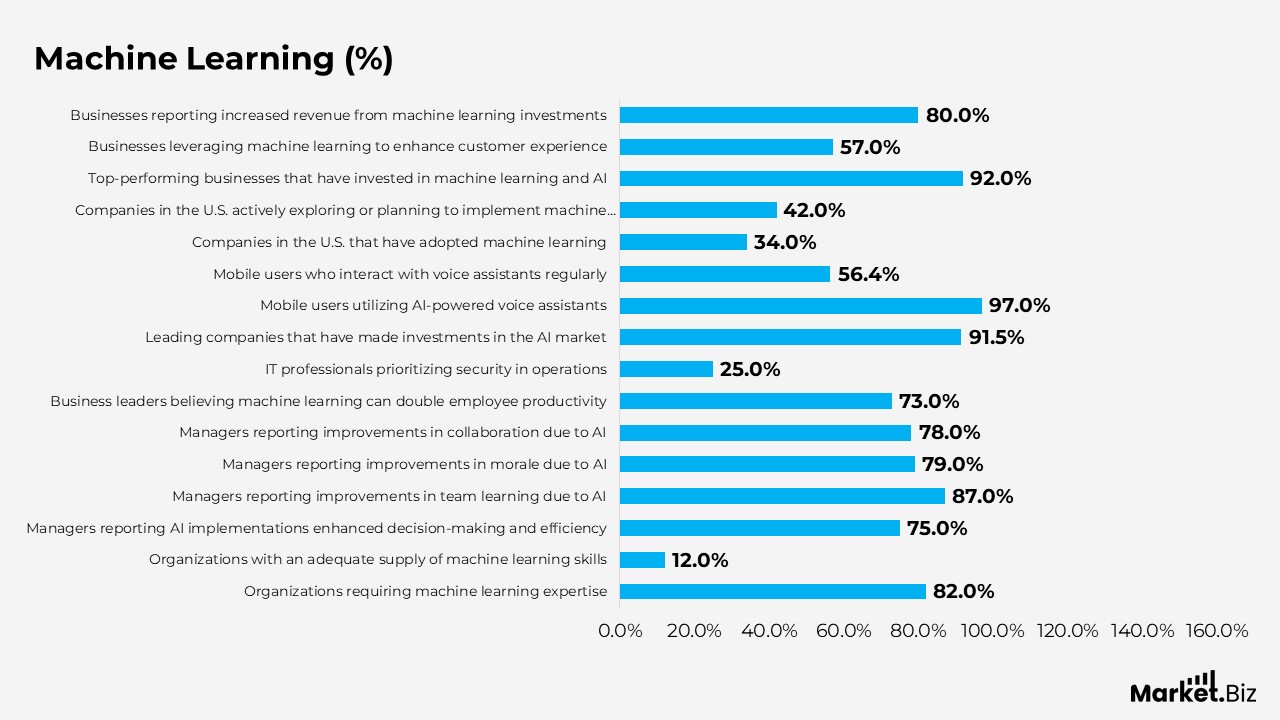
- 82% of organizations require machine learning expertise, but only 12% report having an adequate supply of these skills.
- Over 75% of managers who reported that AI implementations enhanced decision-making and efficiency also experienced improvements in team learning (87%), morale (79%), and collaboration (78%).
- 73% of business leaders believe that machine learning has the potential to double employee productivity.
- Security remains a top priority for businesses, with around 25% of IT professionals prioritizing it in their operations.
- 91.5% of leading companies have made investments in the AI market.
- 97% of mobile users are utilizing AI-powered voice assistants, and over 56.4% interact with them regularly.
- 34% of companies in the U.S. have already adopted machine learning, while 42% are actively exploring or planning to implement it.
- OpenAI is the most heavily funded machine learning platform, securing over $11 billion in investments.
- Nearly 92% of top-performing businesses have invested in machine learning and AI technologies.
- 57% of businesses leverage machine learning to enhance customer experience.
- 80% of businesses report that investments in machine learning have led to increased revenue.
(Source: Statista, Boston Consulting Group, TrueList, Master of Code Global, DemandSage)
Machine learning adoption
The adoption of machine learning (ML) is growing rapidly across various industries, revolutionizing business operations and driving global growth.
- The global GDP is expected to increase by $15.7 trillion by 2030, largely due to the adoption of AI.
- North America leads with an 80% adoption rate for machine learning, followed by Asia at 37% and Europe at 29%.
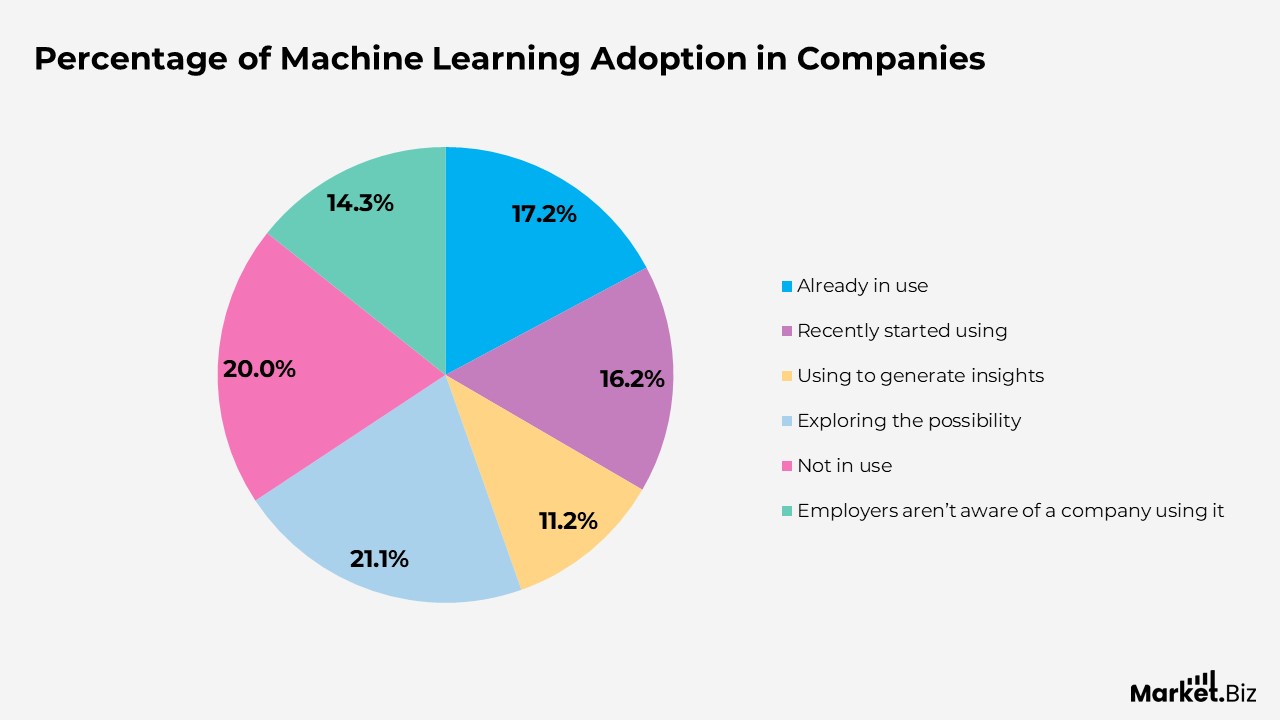
- In the U.S., 34% of organizations have already adopted machine learning, while 42% are exploring or planning to implement it.
- 65% of organizations intending to leverage machine learning cite it as a tool to streamline decision-making processes.
- 80% of individuals report that AI and machine learning algorithms have significantly boosted their revenue.
- 49% of organizations use machine learning and AI for marketing and sales initiatives.
- 33% of IT leaders plan to adopt machine learning to enhance business analytics capabilities.
- 25% of IT leaders aim to utilize ML for improving security measures.
- 80% of respondents believe AI has contributed to increased revenue.
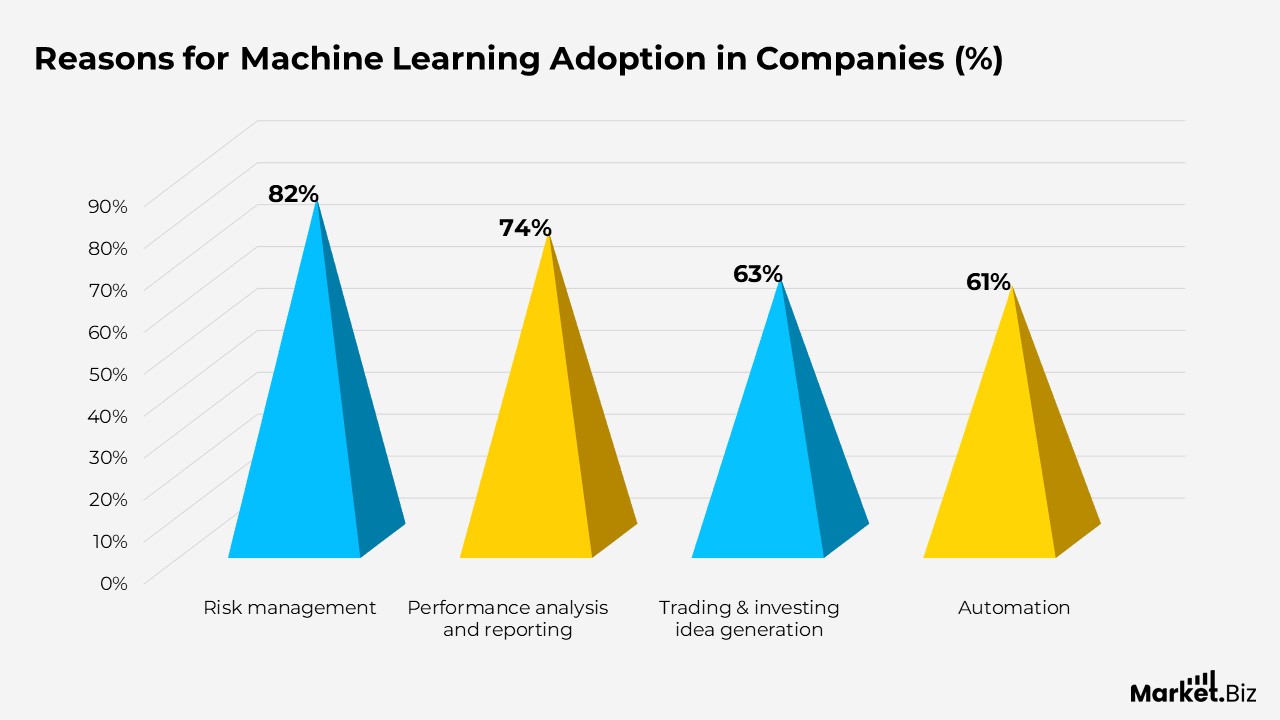
- 74% of data scientists and C-level executives use machine learning for performance analysis and reporting.
- About 80% of industries, including finance, healthcare, retail, education, and genetics, claim that machine learning has led to revenue growth.
- According to the Refinitiv AI/ML Survey:
- 46% of respondents have implemented machine learning across multiple areas, making it a core part of their business.
- 44% have deployed ML in specific areas, while 10% are still in the experimentation phase, investing in infrastructure and talent.
(Source: PWC, Radixweb, Refinitiv, DemandSage, G2.com, Inc., Kaggle )
Machine Learning in Business Analytics
- 15% of businesses are considered advanced users of machine learning (ML).
- 54% of executives report that AI solutions have already boosted productivity within their organizations.
- A total of $3.1 billion has been raised for machine learning companies, with over 4,400 companies contributing to these investments.
- By 2026, more than 80% of enterprises are expected to adopt generative AI (GenAI) application programming interfaces (APIs) or models.
- $3.1 billion in funding has been raised for machine learning companies through investments from more than 4,400 firms.
- AI investment is anticipated to grow by over 300% in the upcoming years.
- 45% of end-users prefer using chatbots as their primary method of communication for customer service inquiries.
- 62% of IT leaders acknowledge that their data systems are not fully equipped to handle AI, with challenges such as data silos and skills gaps hindering their AI objectives.
- Executives are leveraging AI and ML to eliminate repetitive tasks, such as 79% for scheduling, 78% for timesheets, and 82% for paperwork.
(Source: G2.com, Inc., PWC, Gartner, Edge Impulse, NASSCOM Community, Radixweb)
Machine Learning Market Size
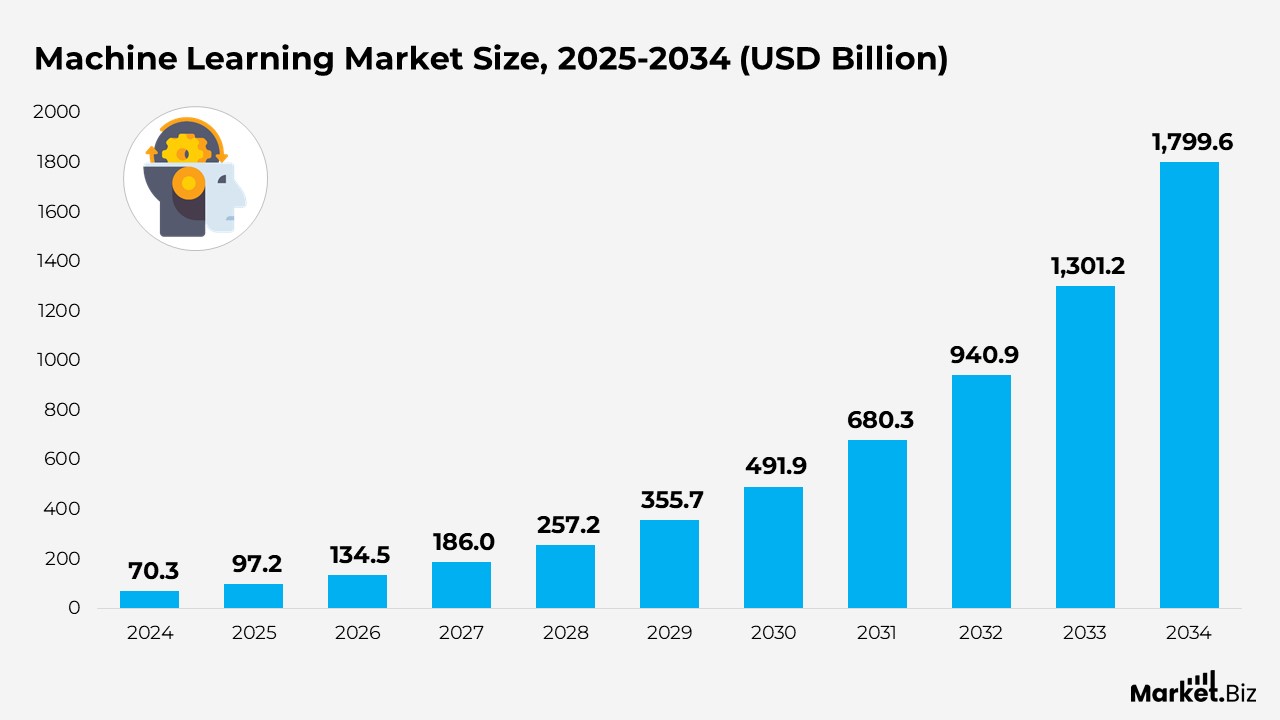
- According to Market.us, the global machine learning market is projected to grow from $97.2 billion in 2025 to $1,799.6 billion by 2034, representing a compound annual growth rate (CAGR) of 38.3% from 2025 to 2034.
- The growth of the machine learning market is driven by the increasing generation of data, advancements in computing power, and the widespread adoption of AI technologies.
- Businesses need to automate processes, enhance decision-making, and provide personalized customer experiences, which are key drivers of market growth.
- The Services segment led the ML market in 2024, accounting for over 51% of the total market share, driven by growing demand for ML integration services.
- Large Enterprises dominated the ML market in 2024, capturing more than 65.3% of the market share, backed by their financial and technological resources.
- The Advertising & Media sector secured over 20.3% of the ML market share in 2024, driven by the increasing need for data-driven insights.
- In 2024, North America held a dominant market position, capturing more than a 31% share and generating USD 21.9 billion in revenue.
(Source: Market.us)
Machine Learning Operations (MLOps) Market Size
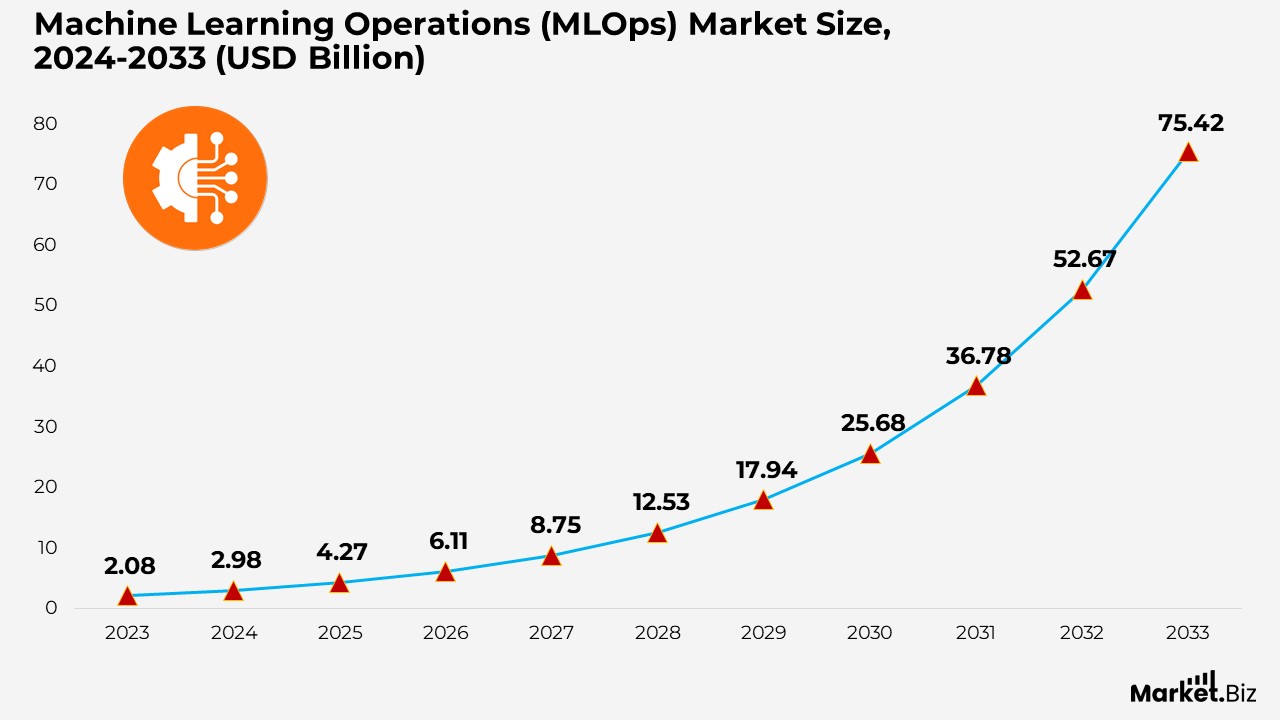
- According to Market.us, the global Machine Learning Operations (MLOps) market is projected to grow from 2.98 billion in 2024 to $75.42 billion by 2033, representing a compound annual growth rate (CAGR) of 43.2% from 2024 to 2033.
- Market growth is driven by the increasing adoption of machine-learning technologies and the need to streamline the deployment and management of machine-learning models.
- In 2023, the Platform segment led the MLOps market, securing over 70% of the market share due to the growing demand for integrated MLOps solutions.
- The Cloud segment dominated the MLOps market in 2023, accounting for more than 68% of the market share, thanks to its scalability, flexibility, and cost-effectiveness.
- Large Enterprises commanded over 71% of the MLOps market in 2023, leveraging their extensive resources to implement and benefit from MLOps solutions.
- The BFSI sector accounted for over 20% of the MLOps market in 2023, driven by the need for enhanced data analytics, risk management, and personalized customer service.
- North America captured more than 41% of the MLOps market in 2023, primarily due to its advanced technology infrastructure and the presence of leading AI and ML companies.
(Source: Market.us)
Machine Learning in Banking
- Almost 60% of respondents in the financial services sector recognize the value of AI and machine learning.
- AI-driven automation in middle-office tasks is projected to help North American banks save $70 billion by 2025.
- By 2025, North American banks could realize savings of $70 billion through the automation of middle-office operations via AI.
- AI platform revenues in the insurance sector are expected to grow by 23% from 2019 to 2024, reaching $3.4 billion.
- According to a Statista report, 76% of respondents see AI and ML technology as valuable for enhancing stock market workflows.
- 80% of banks recognize the significant benefits of AI and machine learning, with 75% of banks holding over $100 billion in assets already incorporating AI strategies into their operations.
(Source: Northern Bengal University, McKinsey, SUBEX, Flair HR, Deloitte)
Machine Learning in Voice Assistants
Voice assistants have emerged as a key application of machine learning, revolutionizing the way users engage with technology.
- Approximately 20.5% of people globally use voice search as a primary method of interaction.
- By 2024, the global number of voice assistants is projected to reach 8.4 billion, surpassing the world’s population.
- In the United States, around 153.5 million people are expected to use voice assistants by the end of the forecast period.
- The adoption rate of voice assistants has stabilized, with 50-60% of the global population now using these devices.
- According to Voicebot.ai, 74.7% of consumers aged 30-44 use voice assistants on their smartphones, while 68.8% of consumers in the 45-60 age group also engage with voice assistant technology.
- By 2023, an estimated 8 billion people worldwide are expected to have used voice assistants, reflecting the widespread integration of this technology into daily life.
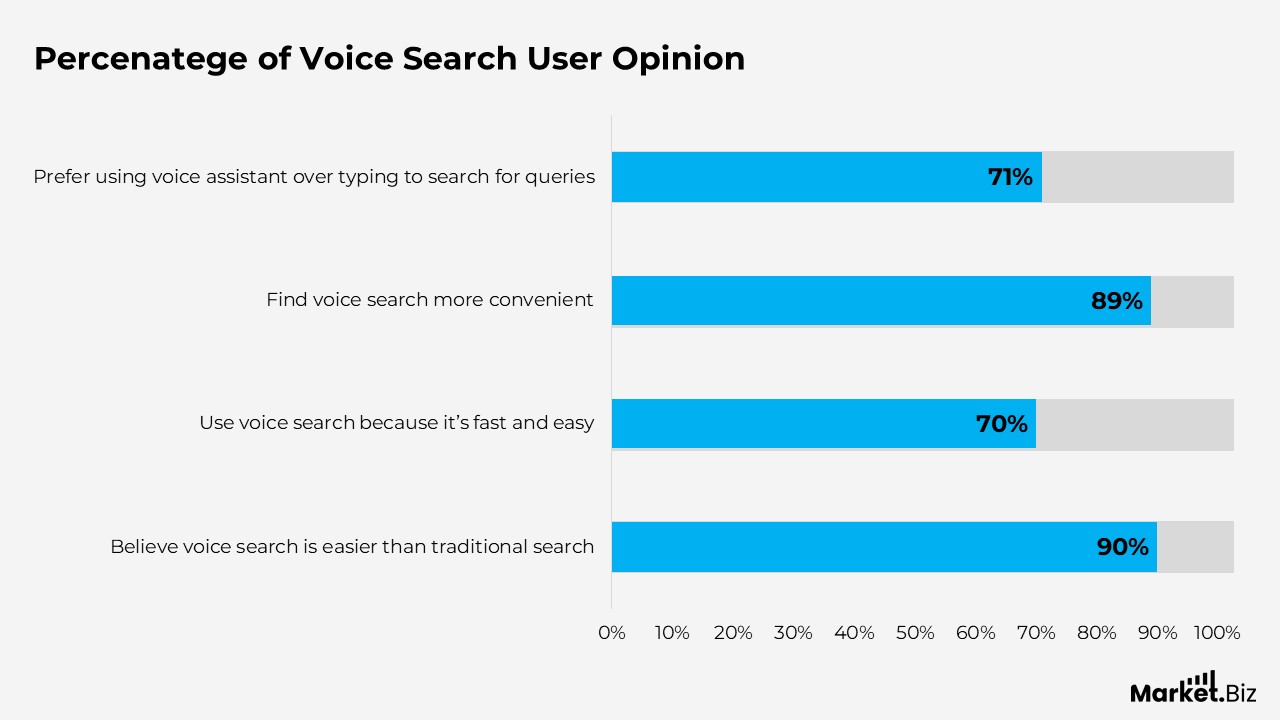
- 90% of individuals find voice search more convenient than traditional online searches.
- 70% of people use voice search primarily because it is quick and effortless.
What Makes Voice Search So Popular?
(Source: Statista, Voicebot.ai, DemandSage)
Machine Learning in Sales and Marketing
Machine learning (ML) and artificial intelligence (AI) are revolutionizing sales and marketing, equipping businesses with innovative tools to enhance their strategies and gain a competitive edge.
- 49% of organizations apply machine learning and AI to identify potential sales leads.
- 48% use these technologies to gain a deeper insight into their prospects and customers.
- 61% of marketers consider artificial intelligence to be a crucial component of their data strategy.
- 67% of respondents believe that machine learning and AI will be essential for maintaining a competitive edge in marketing and sales.
- Over 56.5% of businesses report using machine learning to personalize their sales and marketing content.
- Amazon has reduced its average ‘click to ship’ time by 225%, from 60-75 minutes to just 15 minutes.
- Marketing leaders are more than twice as likely to report that their organizations are investing in automation and machine learning.
(Source: Softweb Solutions Inc., Venture Harbour, Quin AI, CMO Survey, Think with Google, Edge Impulse)
Public Perception of AI and Machine Learning
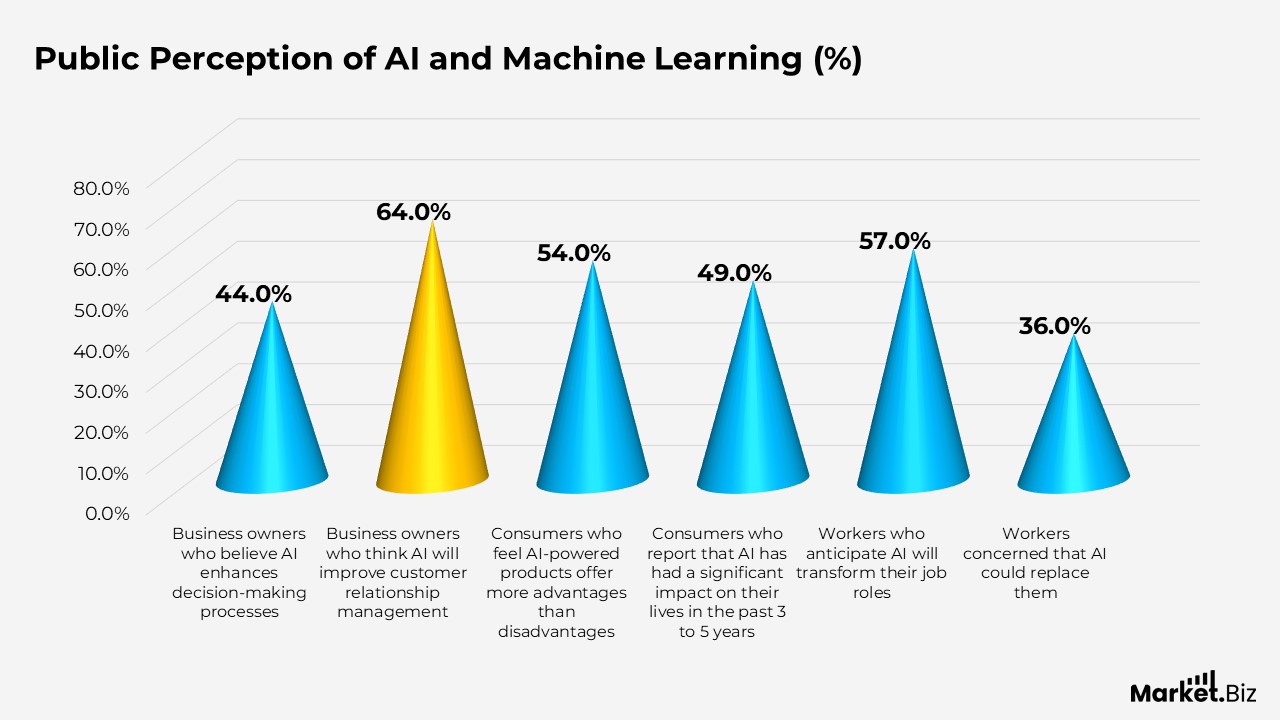
- 44% of business owners believe AI enhances their decision-making processes.
- 64% of business owners think AI will improve customer relationship management.
- On a global scale, only 54% of consumers feel that AI-powered products offer more advantages than disadvantages.
- Just 49% of consumers across 31 countries report that AI has had a significant impact on their lives in the past 3 to 5 years.
- 57% of workers anticipate that AI will transform their job roles, while 36% are concerned that AI could replace them.
(Source: Encord, Cord Technologies, Inc.)
Machine Learning Talent and Trends
- Artificial Intelligence ranks as the 2nd most in-demand job today.
- Machine learning, natural language processing (NLP), and deep learning are the top 3 most in-demand skills on platforms like Monster.com.
- 82% of companies and businesses require employees with diverse machine-learning skills.
- In the U.S., only 4.5% of self-reported data scientists or researchers work specifically as machine learning engineers.
- Over 98,000 job listings on LinkedIn require machine learning as a key skill.
- Job titles focused on machine learning are increasingly prevalent in organizations with significant experience in this field, including machine learning engineer (39%), data scientist (81%), and deep learning engineer (20%)
- Only 20% of executives believe their data science teams are prepared for AI.
- 39% of companies are ramping up their hiring efforts to build larger data science teams.
- The average annual salary for a full-time data scientist in the U.S. was $120,000 in 2021.
- In terms of company staffing, 50% of respondents report that their companies employ between 1 and 10 data scientists, a decrease from 58% in 2018.
- The proportion of companies employing 11 or more data scientists has increased significantly, from 18% in 2018 to 39% in 2020, indicating a growing trend in hiring more data science professionals.
(Source: O’Reilly, Kaggle, Algorithmia, Enterprise Engineering Solutions, AIMultiple)
Top Machine Learning Certifications
- AWS Certified Machine Learning – Specialty
- Google Cloud Certified – Machine Learning Engineer
- Microsoft Certified: Azure Data Scientist Associate
- IBM Machine Learning Specialization
- Andrew Ng’s Machine Learning Specialization
- Databricks Certified Machine Learning Professional
- eCornell Machine Learning Certificate
(Source: Encord, GeeksforGeeks)
Fundings for Machine Learning
- In October 2024, Relyance AI secured $32.1 million in a Series B funding round to expand its operations and address the growing demand for artificial intelligence in enterprises.
- In September 2024, the Department of Energy (DOE) allocated $68 million in funding across 11 multi-institutional projects, with 43 awards aimed at advancing the development of foundation models, machine learning, or deep learning models designed to be applicable across various fields due to their training on diverse datasets.
- In August 2024, Protect AI raised $60 million in a Series B funding round led by Evolution Equity Partners, with contributions from 01 Advisors, Samsung, and other investors, including Acrew Capital, Boldstart Ventures, Knollwood Capital, StepStone Group, Salesforce Ventures, and Pelion Ventures. The company has now raised a total of $108.5 million to safeguard machine learning systems and AI applications from emerging security risks.
- In December 2023, Chalk raised $10 million in seed funding, led by Unusual Ventures, General Catalyst, and Xfund, to enhance its platform and accelerate the growth of its engineering and market teams while expanding its customer base.
- In August 2021, Monolith AI raised £8.5 million in a Series A funding round, bringing its total capital to £10.6 million. The company’s goal is to democratize machine learning for product development by creating no-code software that allows engineers to quickly understand, predict, and optimize products using AI algorithms.
Challenges to Machine Learning
- Privacy Concerns: Datasets often contain personal data, raising significant privacy issues, especially when used for categorisation purposes.
- Data Security Risks: Data stored on servers is vulnerable to hacking, posing a risk to sensitive information.
- Job Displacement: Increased automation may lead to fewer jobs and workforce relocations, impacting employment levels.
- Economic Disparities: Technical superiority in machine learning may create a divide, with more developed economies likely to benefit more from automation advancements.
- Industry Response: The way companies and industries address these challenges will play a critical role in determining their success and capabilities in the field.
(Source: Statista)
Recent Developments
Partnerships
- In August 2024, Talentica Software was awarded the Machine Learning Partner Specialization in Google Cloud Partner Advantage. This recognition highlights Talentica’s expertise in developing customer solutions in the machine learning domain using Google Cloud technologies.
- In February 2024, D-Wave Quantum Inc. formed a partnership with Zapata Computing, Inc. to create and launch commercial applications that integrate the capabilities of generative AI/ML and quantum computing technologies.
Research and Development Initiatives:
- In March 2024, Facebook AI Research (FAIR) released a groundbreaking paper that outlines significant progress in self-supervised learning methods. The study highlights notable advancements in enhancing machine learning models’ ability to learn from unlabeled data, opening doors for more efficient and scalable AI technologies.
Industry Collaborations for Ethical AI:
- In February 2024, IBM became an official member of the Partnership on AI, a collaborative initiative aimed at advancing ethical AI practices. IBM’s involvement reinforces its commitment to promoting responsible AI development and fostering cooperation with industry leaders.
Conclusion
Machine learning is rapidly becoming a crucial component in business strategies across various sectors. The growing demand for skilled professionals, such as data scientists, machine learning engineers, and AI specialists, underscores the increasing significance of this field. As organisations seek to leverage machine learning to enhance decision-making, streamline processes, and enhance customer experiences, the demand for expertise continues to grow.
With a notable rise in job opportunities and investments in AI and machine learning, now is the ideal time to pursue a career in this evolving and fast-paced industry. Companies that adopt machine learning are positioned to gain a competitive advantage by driving innovation, boosting productivity, and enabling data-driven decision-making.
FAQ’s
Machine learning is a branch of artificial intelligence (AI) that enables systems to learn from data automatically, detect patterns, and make decisions with minimal human intervention. It works by training algorithms to improve their performance as they process more data.
Machine learning is revolutionizing businesses by automating decisions, optimizing operations, enhancing customer experiences, and fostering innovation. Organisations are leveraging machine learning (ML) to streamline workflows, forecast trends, and deliver personalised services, thereby providing them with a competitive advantage.
Key skills in demand for machine learning roles include deep learning, natural language processing (NLP), proficiency in machine learning algorithms, data analysis, Python programming, and expertise in AI application development.
Machine learning helps companies by enabling better decision-making, reducing operational costs, enhancing productivity, automating repetitive tasks, delivering personalised experiences, and building data-driven strategies that drive growth.
The demand for machine learning talent is rapidly increasing, with industries needing experts such as data scientists, machine learning engineers, and AI specialists. Over 82% of organizations require machine learning skills, and job postings for these roles have seen significant growth.
Machine learning is being widely adopted across various industries, including healthcare, finance, retail, education, manufacturing, and technology. These industries are leveraging machine learning (ML) for tasks such as predictive analytics, process automation, fraud detection, customer service enhancements, and targeted marketing strategies.