









Introduction
Business Intelligence Statistics: Recently, the global business landscape has witnessed a notable increase in the adoption of Business Intelligence (BI) technologies, driven by the growing demand for data-driven decision-making and enhanced operational efficiency.
This expansion is primarily driven by the vast amounts of data organizations generate and the rising need to harness analytics to gain a competitive advantage. Business intelligence (BI) tools have become crucial for businesses in analysing both structured and unstructured data, providing valuable insights that inform important decisions. Industries such as healthcare, retail, and finance are rapidly adopting BI solutions to streamline processes, enhance customer experiences, and drive innovation.
The integration of artificial intelligence (AI) and machine learning (ML) further enhances the capabilities of business intelligence (BI) platforms, enabling predictive analytics and more in-depth insights. As businesses increasingly recognize the power of real-time data, the adoption of business intelligence (BI) solutions is poised to grow, reshaping strategies, enhancing efficiency, and unlocking new growth opportunities across various sectors.
Editor’s Choice
- 94% of organizations consider business intelligence and analytics to be either crucial or highly important for their business success.
- Data-driven companies are 23 times more likely to acquire new customers, 6 times more likely to retain them, and 19 times more likely to achieve profitability compared to their competitors.
- Nearly 97.2% of executives have reported their organizations are investing in or planning to invest in big data and AI for decision-making enhancement.
- By 2022, 90% of corporate strategies are expected to explicitly highlight information as a key enterprise asset and analytics as a vital capability.
- 75% of employees feel that working with data can often be overwhelming.
- 54% of businesses recognize BI as being crucial for both their current and future operations.
- CEOs who use business intelligence tools are 77% more likely to meet their business objectives.
- The U.S. economy is projected to experience an annual loss of $3.1 trillion due to poor data quality.
- Business intelligence sees the highest adoption rate in manufacturing, with 58% of companies in this sector utilizing it.
(Source: Dresner Advisory Services, McKinsey, NewVantage Partners, Gartner, WebTribunal)
General Business Intelligence Statistics
- 83% of early adopters of AI have seen significant economic benefits, with 30% or more experiencing substantial improvements and 15% to 30% seeing moderate gains from their AI initiatives.
- A study by 3M Corporation reveals that visuals are processed 60,000 times faster by the brain than text, emphasizing the effectiveness of data visualization in delivering information.
- Approximately 70% of organizations regard themselves as data-driven and 75% believe that universal access to data is critical to their success.
- Revenue from public cloud infrastructure is expected to grow by 35% in 2021.
- 70% of organizations consider data discovery and visualization to be essential for their operations.
- Business Intelligence technologies have become increasingly popular since 2012, when only 10% of business owners considered them critical.
- In 2023, 33% of large enterprises employed analysts proficient in decision intelligence.
- A survey by Deloitte found that companies with CEOs who make data-driven decisions are 77% more likely to achieve success.
- According to a study by analytics platform provider Sisense, 49% of companies have increased their use of business intelligence analytics compared to pre-pandemic levels.
- Infosys reports that business intelligence platforms rank third among preferred technologies, with a 20% preference rate. In comparison, cloud technology leads with 23%, recognized for its role in driving innovation, optimizing digital experiences, and supporting net-zero goals. Digital trust follows closely with a 22% preference rate.
- According to research, by 2023, more than 33% of large organisations will have employed analysts specialising in decision intelligence, including decision modelling.
(Source: Deloitte, Tableau, 3M Corporation, PixelPlex)
Business Intelligence Adoption
- 67% of the global workforce has access to business intelligence tools, empowering employees with valuable insights.
- Industries such as logistics, healthcare, and financial services are among the most dependent on BI solutions.
- 25% of organizations utilize 10 or more BI platforms, while 61% use four or more, and 86% adopt at least two or more BI tools.
- 4% of organizations encounter challenges in adopting business intelligence solutions.
- The global adoption rate of business intelligence stands at 26%.
- 90% of R&D departments view BI as crucial for their future initiatives.
- 52% of software companies have integrated BI tools into their operations.
- 80% of manufacturers using BI for analytics report positive outcomes and success.
- 17% of organizations consider embedded BI, either within a portal, application or integrated with other systems, as vital for their operations.
- 43% of organizations regard embedded BI as important for their business needs.
- By 2024, it is expected that around 75% of businesses will have adopted cloud-based BI solutions, a significant increase from the 45% reported in 2021.
(Source: G2.com, Inc., Statista)
Business Intelligence Market Size
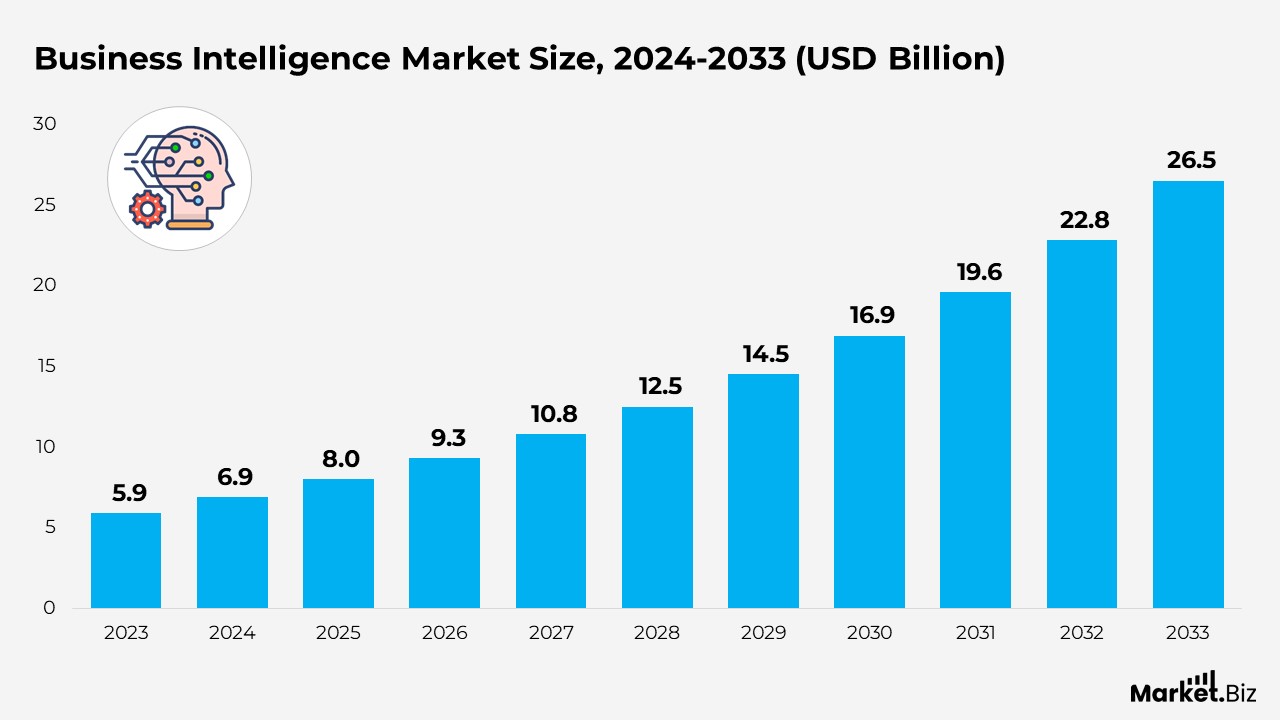
- According to Market.us, the business intelligence market is projected to grow from $6.9 billion in 2024 to $26.5 billion by 2033, representing a compound annual growth rate (CAGR) of 16.2% from 2024 to 2033.
- The growth of the Business Intelligence (BI) market is driven by the integration of AI and machine learning (ML), enabling automated data analysis and more informed decision-making.
- In 2023, the solution segment dominated the business intelligence (BI) market, capturing over 71% of the market share.
- The Cloud-Based segment held a leading position in 2023, securing more than 69.8% of the market share, driven by its scalable and cost-effective solutions.
- Large Enterprises maintained a commanding presence in 2023, with a share exceeding 67.5%, due to their need to manage extensive datasets and complex operations.
- The BFSI (Banking, Financial Services, and Insurance) segment led the BI market in 2023, capturing more than 30.2% of the share, driven by its data-driven nature.
- North America dominated the BI market in 2023, securing more than 37.5% of the market share, largely due to its robust technological infrastructure.
(Source: Market.us)
Healthcare Business Intelligence Market Size
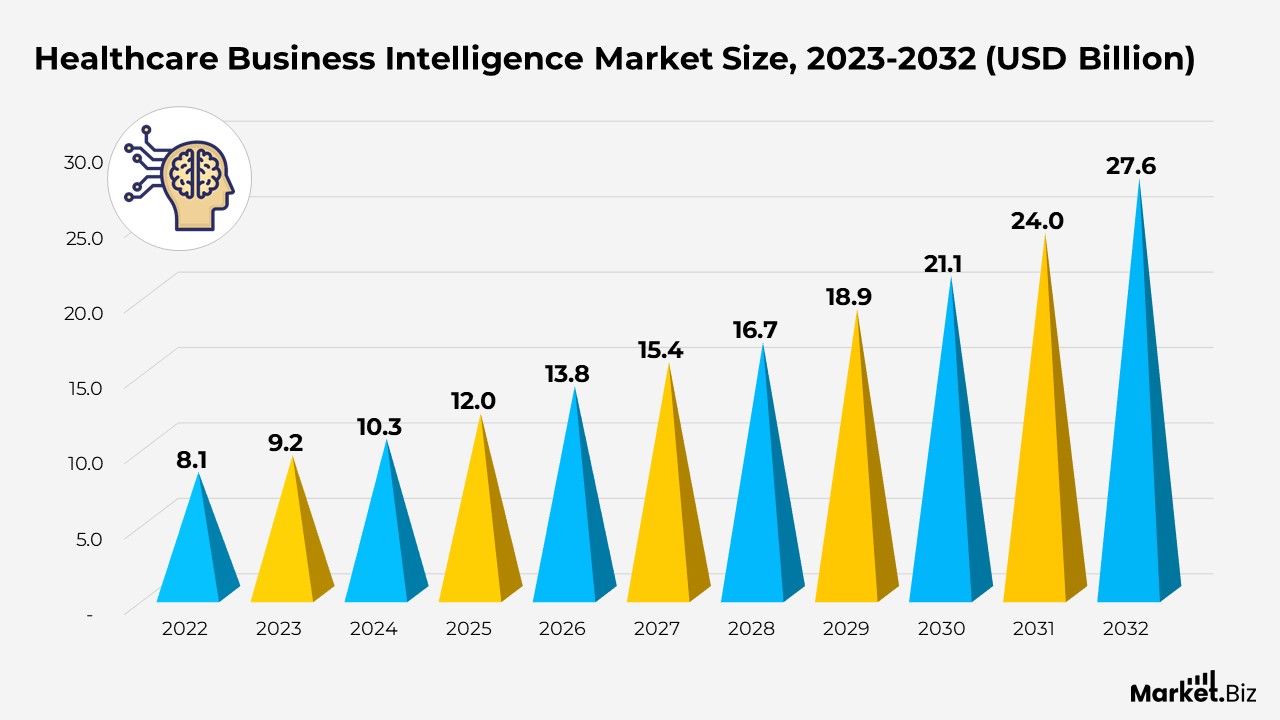
- According to Market.us, the healthcare business intelligence market is projected to grow from $9.2 billion in 2023 to $27.6 billion by 2032, representing a compound annual growth rate (CAGR) of 13.4% from 2023 to 2032.
- According to Market.us, the healthcare business intelligence market is projected to grow from $9.2 billion in 2023 to $27.6 billion by 2032, representing a compound annual growth rate (CAGR) of 13.4% from 2023 to 2032.
- The demand for Business Intelligence (BI) tools is growing as the healthcare sector transitions to a data-driven model.
- In 2022, the software segment accounted for 70% of the total revenue in the healthcare business intelligence market, playing a crucial role in monitoring and enhancing performance.
- The cloud-based segment held the top position in 2022, capturing 48% of the revenue share, driven by the need for efficient and scalable technology.
- In 2022, the financial analysis segment dominated the market, accounting for a 38% revenue share, encompassing various aspects such as cost management, cash flow, and profitability.
- Healthcare payers held the highest revenue share in 2022, with over 40%, as the demand for provider network optimization and cost-saving solutions increased.
- North America captured 47.5% of the revenue share in 2022, fueled by the rapid growth and adoption of BI technologies in the region’s healthcare industry.
(Source: Market.us)
Business Intelligence and Return on Investment (ROI)
- Implementing a BI solution can yield a 127% return on investment (ROI) over three years.
- A significant skills gap is being felt by CIOs, with 46% struggling with a shortage of data analytics expertise and 38% facing a lack of AI skills.
- The United States faced a shortage of 250,000 professionals skilled in data analytics in 2020.
- Business intelligence, big data, and analytics are the leading disruptive technologies adopted by Global 2000 companies.
- Data-driven organizations are 23 times more likely to attract new customers.
- These organizations are 6 times more likely to retain their customers.
- They are 19 times more likely to achieve higher profitability.
(Source: TCS, Data Science Central, KPMG, Kanerika, FanRuan, McKinsey)
Business Intelligence Job
- Currently, there are 118,223 business intelligence analysts employed in the United States.
- Over the next decade, 284,100 new positions for business intelligence analysts are expected to be created.
- In 2024, the average spending on BI software per employee was $7.80.
- By 2023, 33% of large enterprises employed analysts proficient in decision intelligence.
- Only 24% of executives globally are certified in data literacy.
- 32% of executives express confidence in their ability to make meaningful use of data.
- 25% of BI users are highly skilled and require greater flexibility to address complex business challenges.
- Over the past five years, salaries in BI-centric roles have increased by 10%.
(Source: G2.com, Inc., Statista)
The Financial Implications of Utilizing BI Tools
- In the United States, companies are losing approximately $12.9 million annually due to subpar data quality.
- Globally, the cost of poor data quality amounts to approximately $3.1 trillion annually, representing nearly 20% of the total value, highlighting the significant financial repercussions of unmanaged data.
- By 2025, the negative effects of poor data quality are expected to reduce labour productivity by up to 20%, as employees waste valuable time on tasks such as data cleaning, deduplication, and verification rather than focusing on high-priority strategic activities.
- Organizations that utilize BI tools experience 27% faster decision-making, enabling them to respond more swiftly in dynamic business environments.
- Companies driven by data are 23 times more likely to attract new customers and enjoy a 15% boost in profitability, underlining the strong competitive edge that BI can provide.
Source: Actian, Forbes, Neontri, TechJury.net)
Key Benefits of Business Intelligence in 2023
- Companies with CEOs who rely on data-driven decision-making are 77% more likely to achieve success.
- Organizations utilizing business intelligence are 5 times more likely to make faster decisions compared to those that don’t.
- According to an IBM study, over $3 trillion is lost annually due to poorly analyzed or incorrect data, resulting in a significant loss of productivity, engagement, and potential opportunities for nearly 90% of businesses in the United States.
- Data inaccuracies are costing American businesses more than $109 billion annually, underscoring the significant financial impact of data errors.
(Source: Deloitte, BetterBuys, Accenture, International Business Machines Corporation, DataProt)
Business Intelligence Challenges
- Between 2020 and 2022, the total volume of enterprise data doubled, with the global data volume rising from 1 petabyte in 2020 to an estimated 2.01 petabytes in 2022.
- Of this data, 570 terabytes are stored in internally managed data centers, 498 terabytes are housed in cloud repositories, 407 terabytes are in third-party data centers, and 390 terabytes are located in edge and remote areas.
- Less than 20% of executives believe they have successfully established a “data culture” within their organizations. According to a New Vantage Partners survey of 94 Fortune 1000 executives, only 19.4% reported having a data culture in place.
- 26.5% of C-level executives claimed to have created a data-driven organization.
- 39.7% stated that their companies treat data as a business asset.
- 47.4% believed their organizations are competitive in data and analytics.
- 56.5% confirmed that their companies use data to drive business innovation.
Further
- Approximately 1 in 3 business executives assert they can generate measurable value from enterprise data.
- Approximately 70-80% of business intelligence (BI) initiatives fail, underscoring the significant challenges organisations encounter when attempting to develop and implement successful BI strategies. This statistic highlights the importance of meticulous planning and execution when implementing BI solutions.
- In the United States, poor data quality results in an annual loss of up to $3.1 trillion to the economy, underscoring the significant financial impact of inadequate data management.
- 34% of BI companies and their clients consider poor data quality a major issue, while 16% of BI users highlight slow query performance as a serious concern. Additionally, 21% of BI companies cite poor data governance as a critical challenge.
- One of the biggest hurdles in the BI industry is the shortage of skilled professionals. While there is no lack of data science trainees, 35% of organizations report difficulty in finding the right experienced talent to fill data science roles.
(Source: Semrush Inc, Exploding Topics, Gitnux, Techjury, Springboard, Accord Business Solutions Pte. Ltd.)
How Business Intelligence Drives Decision-Making
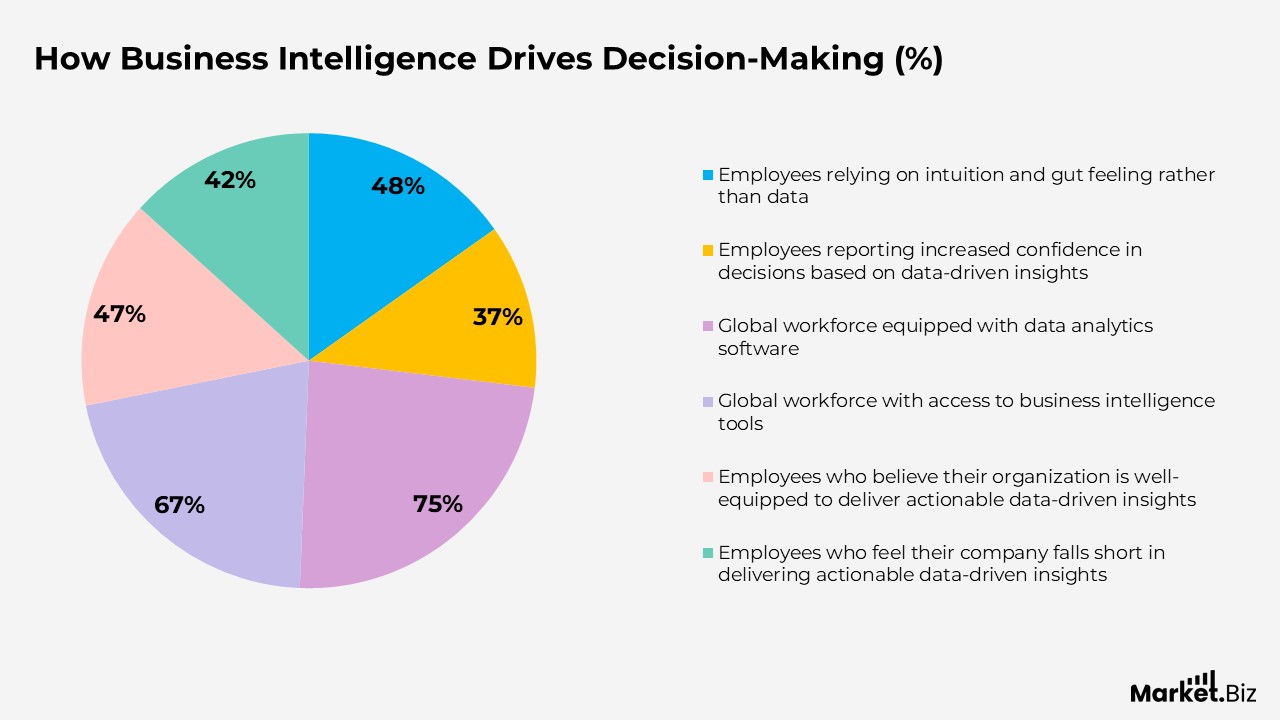
- 48% of employees tend to rely more on intuition and gut feeling rather than data when making decisions.
- Only 37% of employees report increased confidence in their decisions when based on data-driven insights.
- 75% of the global workforce is equipped with data analytics software, further facilitating data-driven decision-making processes.
- 67% of the global workforce has access to business intelligence tools, enabling more informed decision-making 47% of employees believe their organization is well-equipped to deliver actionable data-driven insights, while 42% feel their company falls short in this area.
(Source: Sisense, Accenture, TrustRadius)
Popular Business Intelligence Software Solutions
- Sisense: Known for its powerful in-chip engine and extensive data visualization capabilities, Sisense stands out as a top-tier business intelligence platform.
- Periscope Data is renowned for its interactive dashboards, which enable users to process data and perform predictive analytics easily.
- ReportPlus: This software excels at visualising data, making it easier to extract meaningful insights from key metrics.
- Looker: Powered by the proprietary LookML engine, Looker offers a unique approach to data modelling for business intelligence.
- QlikView: Featuring the exclusive Associative Data Indexing Engine, QlikView enables users to create guided analytics applications and dashboards.
(Source: FinancesOnline)
Conclusion
Business intelligence (BI) is becoming a vital tool for organisations across various industries. The extensive adoption of BI tools is improving decision-making, particularly in fields such as logistics, healthcare, and financial services. Many companies are utilizing multiple business intelligence (BI) platforms to enhance efficiency and optimise performance.
The growing demand for skilled business intelligence (BI) professionals highlights an increasing reliance on data-driven insights. While some organizations face challenges in fully implementing business intelligence (BI) solutions, the general trend indicates a growing confidence in leveraging data for informed strategic decisions. As companies continue to emphasize data literacy, the future of business intelligence looks promising, offering vast potential for growth and innovation in the coming years.
FAQ’s
Business Intelligence (BI) is essential for improving decision-making by providing actionable insights based on data analysis. It enables businesses to optimise operations, boost performance, and maintain a competitive edge across various industries, including logistics, healthcare, and finance.
Industries such as logistics, healthcare, and financial services are among the top beneficiaries of business intelligence (BI). These sectors utilize business intelligence (BI) tools to analyse large volumes of data, refine operational processes, and make informed decisions that enhance performance.
A significant portion of the global workforce now has access to BI tools. Increasingly, organizations across various sectors are adopting business intelligence (BI) solutions to support informed decision-making and drive operational efficiency.
Despite its growing adoption, some organizations face challenges like the difficulty of integrating BI tools into existing systems, a shortage of skilled professionals, and resistance to change within the workforce, which can hinder full implementation.
There is a growing demand for BI professionals as organizations become more reliant on data-driven insights. This growing need signals a strong market for BI experts to analyse and interpret complex data across various industries.
Business Intelligence (BI) enhances decision-making by providing businesses with real-time, accurate insights based on data analysis. This allows organizations to make well-informed decisions that foster business growth, improve customer satisfaction, and optimize operations.