









Introduction
Lead Generation Statistics: In recent years, lead generation has become a fundamental component of effective marketing strategies across multiple sectors. As businesses increasingly rely on digital channels, the need for efficient and impactful lead generation methods has surged. These statistics highlight a significant increase in the adoption of advanced technologies, such as AI, automation, and data analytics, to enhance lead generation processes.
As companies continue to adapt to shifting consumer behaviours and preferences, it is essential to stay informed about the latest trends and metrics in lead generation to remain competitive. These statistics provide valuable insights that can help businesses refine their strategies to attract, convert, and nurture high-quality leads, ultimately driving revenue growth and ensuring long-term success.
Editor’s Choice
- On average, organizations generate 1,877 leads each month.
- 50% of marketers prioritize lead generation as a key objective in their campaigns.
- The average cost per lead across all industries is $198.44.
- Organizations consistently generate an average of 1,877 leads per month.
- The average cost per lead across all industries is $198.44.
- 68% of marketers report that social media marketing has contributed significantly to lead generation.
- 76% of marketers utilize content to drive lead generation.
- 97% of individuals ignore cold calls.
- 44% of sales representatives cite being too busy to follow up with leads.
- 74% of marketers claim that content marketing has been effective in generating leads.
- Less than half of online shoppers engage with brand emails daily.
- 72% of successful marketers rely on paid ad campaigns for lead generation.
- 87% of marketers state that video campaigns are effective for generating leads.
- Sales reps’ top complaint is poor lead quality.
- In 2024, 85% of marketers view lead generation as their top priority.
- 91% of marketers prioritize lead generation above all else.
- Most mid-sized and large companies generate fewer than 5,000 qualified leads per month.
- For B2B companies, the average cost per lead is approximately $200 across all industries.
- 67% of marketers leverage content marketing to drive lead generation, with statistics showing that it produces 3 times the number of leads compared to outbound marketing.
- 61% of marketers identify quality lead generation as their top challenge.
- 80% of marketers believe that marketing automation plays a key role in generating and converting large-scale sales.
- Over 53% of marketers allocate more than 50% of their budget to lead generation efforts.
- Companies that publish more than 15 blogs per month generate about 1,200 new leads on average each month.
General Lead Generation Statistics
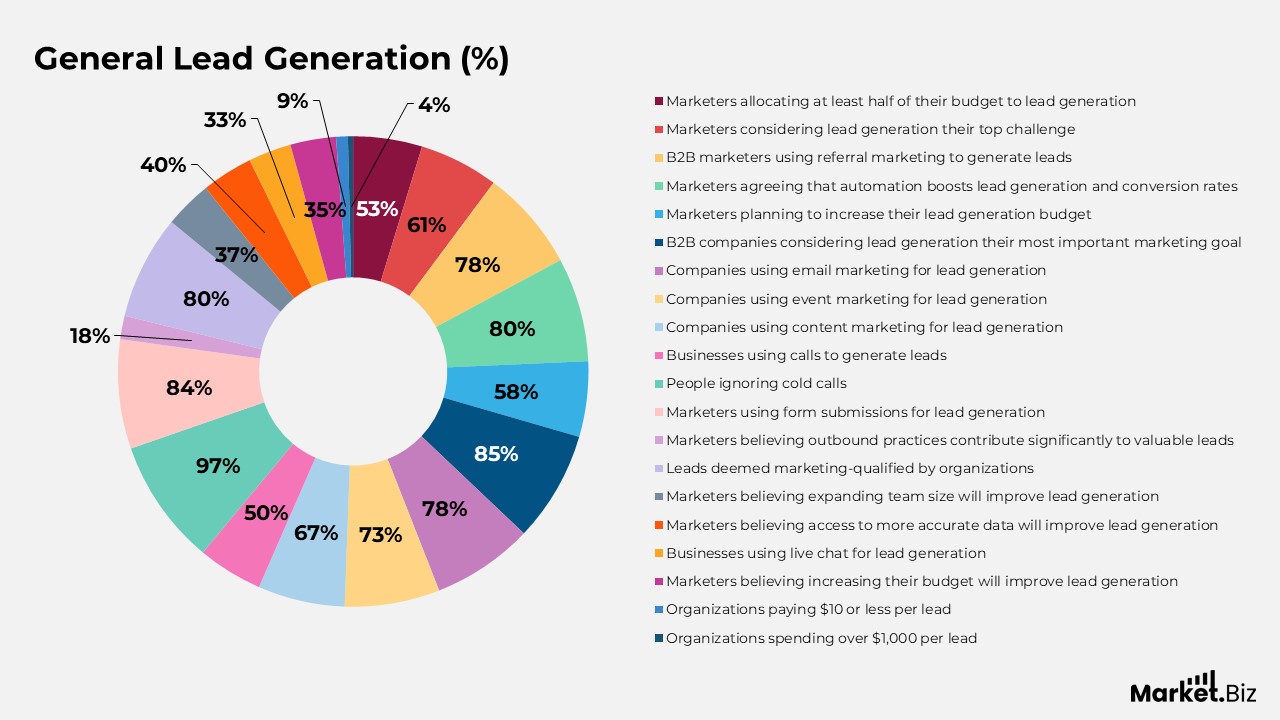
- 53% of marketers assign at least half of their budget to lead generation efforts.
- 61% of marketers consider lead generation their top challenge.
- 78% of B2B marketers utilize referral marketing to generate leads successfully.
- Fewer than 1 in 5 marketers believe outbound marketing practices generate valuable leads.
- 80% of marketers agree that automation significantly boosts lead generation and conversion rates.
- The majority of mid-sized companies generate fewer than 500 qualified leads each month.
- The likelihood of converting leads increases by 9 times when follow-ups occur within 5 minutes of contact.
- 58% of marketers plan to increase their lead generation budget in the coming years.
- 85% of B2B companies consider lead generation their most important marketing goal.
- 78% of companies use email marketing for lead generation, 73% rely on event marketing, and 67% use content marketing.
- Marketing automation software can help boost lead generation by 451%.
- 50% of businesses use calls to generate leads, although 97% of people ignore cold calls.
- 84% of marketers utilize form submissions as a method for generating leads.
- Only 18% of marketers believe outbound practices contribute significantly to gaining valuable leads.
- 80% of leads are deemed marketing-qualified according to organizations.
- The IT and service industry generates an average of 3,660 leads per month The average cost to generate leads for B2B companies across industries is $200.
- 36.6% of marketers think that expanding their team size will lead to more effective lead generation.
- 39.5% of marketers believe that access to more accurate data could enhance the lead generation process.
- 33% of businesses use live chat to generate leads.
- 35.1% of marketers believe that increasing their budget will improve marketing efforts and generate more leads.
- 9% of organizations pay $10 or less per lead, while 4% spend over $1,000 per lead.
(Source: DemandSage, Content Marketing Institute, Hubspot)
Social Media’s Influence on Lead Generation
- 19% of marketers believe social media is a strong source for lead generation.
- 66% of marketers achieve success in generating leads by spending only 6 hours per week on social media marketing.
- LinkedIn is identified as the most effective social media platform for generating B2B leads.
- 74% of social media users prefer to see 1 to 2 posts from brands they like and follow.
- 59% of marketers report success in acquiring customers via LinkedIn.
- 51% of consumers engage with posts from brands that feature their products.
- According to a survey, 87% of consumers reported discovering a product on Instagram and making a purchase decision. With a user base of over 2.3 billion, Instagram proves to be a valuable platform for video ads aimed at lead generation.
- Over 90% of the leads generated on Twitter are successfully converted into sales.
- 47% of marketers express interest in learning more about TikTok for lead generation.
- The cost of content media is 62% lower than that of traditional marketing methods.
Moreover
- Content marketing generates 3 times the leads compared to outbound marketing, while costing less than 50% of the expenses.
- Marketers with blogs are 13 times more likely to achieve higher lead conversion rates.
- 80% of B2B companies plan to leverage content marketing for lead generation over the next 12 months.
- An effective blog drives 500% more traffic to a website.
- 75% of businesses can demonstrate how content marketing impacts audience engagement.
- Marketers who combine blogging with content marketing typically generate 13 times greater positive ROI.
- B2B companies with blogs generate 67% more leads than those without a blog.
- Companies posting 15 or more blogs per month generate an average of 1,200 new leads each month.
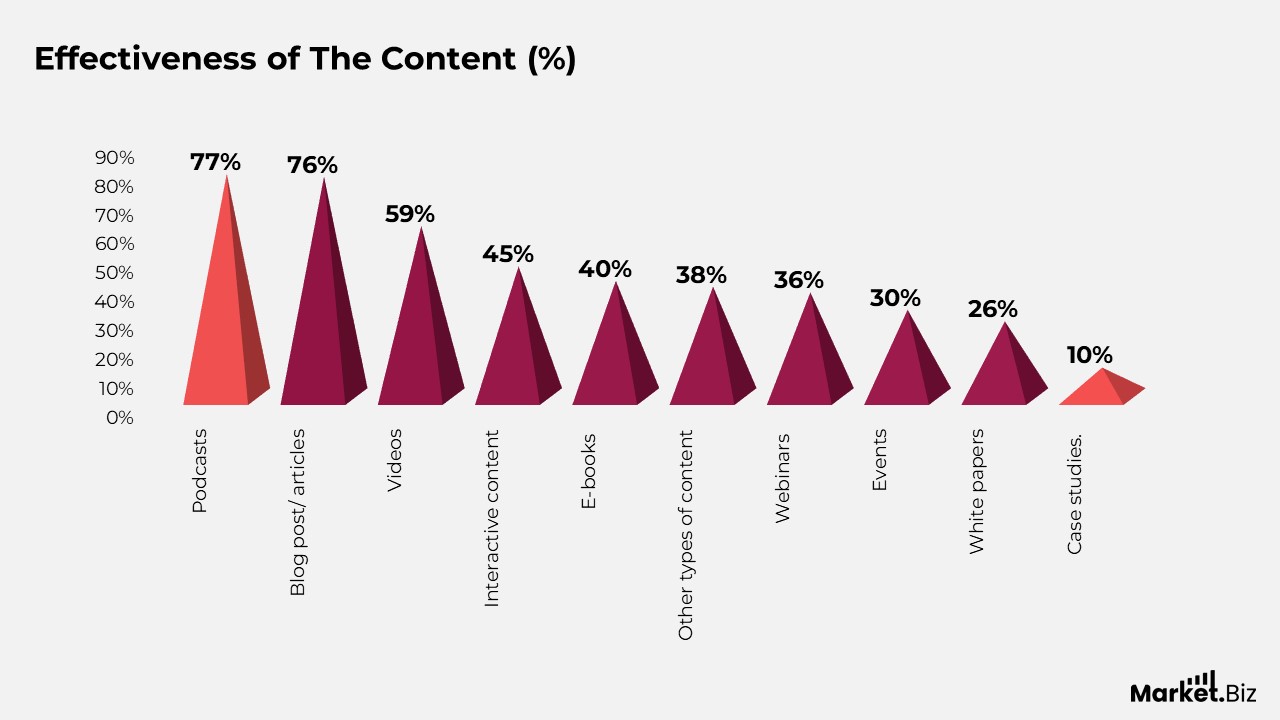
- According to 77% of marketers, podcasts are the most effective content type for lead generation.
- 78% of businesses use website traffic as a key metric to evaluate the performance of their content.
- A survey of 3,500 marketers reveals insights on the most effective content mediums for lead generation.
(Source: DemandSage, Content Marketing Institute, Hubspot, Wired)
Email Lead Generation Statistics
- Marketing emails tend to perform best when sent on Mondays, Tuesdays, or Wednesdays.
- Only about 1 in 5 marketing emails are opened by recipients.
- 42% of companies consider email one of the most crucial factors for lead generation.
- 60% of consumers report making at least one purchase per month after reading a brand’s email.
- Emails sent at 1 p.m. are reported to generate the best results, with other favorable times being 4 p.m., 8 a.m., and 6 p.m..
- 56% of marketers believe that offering compelling content at each stage of the process is key to B2B email success.
- For every $1 spent on email marketing, businesses see an average return of $36.
- 80% of marketers believe email is the most effective tool for demand generation.
- 60% of consumers confirm they make at least one purchase monthly after reading a brand’s email.
- 49% of marketers believe that providing downloadable content at each stage of the buying journey helps convert leads.
- The overall open rate for marketing emails stands at 21.5%.
- Mondays have the highest email open rates, at 22%, while Tuesday and Wednesday have a 10.8% click-to-open rate.
- Approximately 43% of online shoppers report opening branded emails at least once a day.
- 45% of marketers find behavior-based email marketing campaigns more effective.
(Source: Digital Commerce, 360Hubspot, DemandSage)
Customer Relationship Management (CRM) Software Market Size
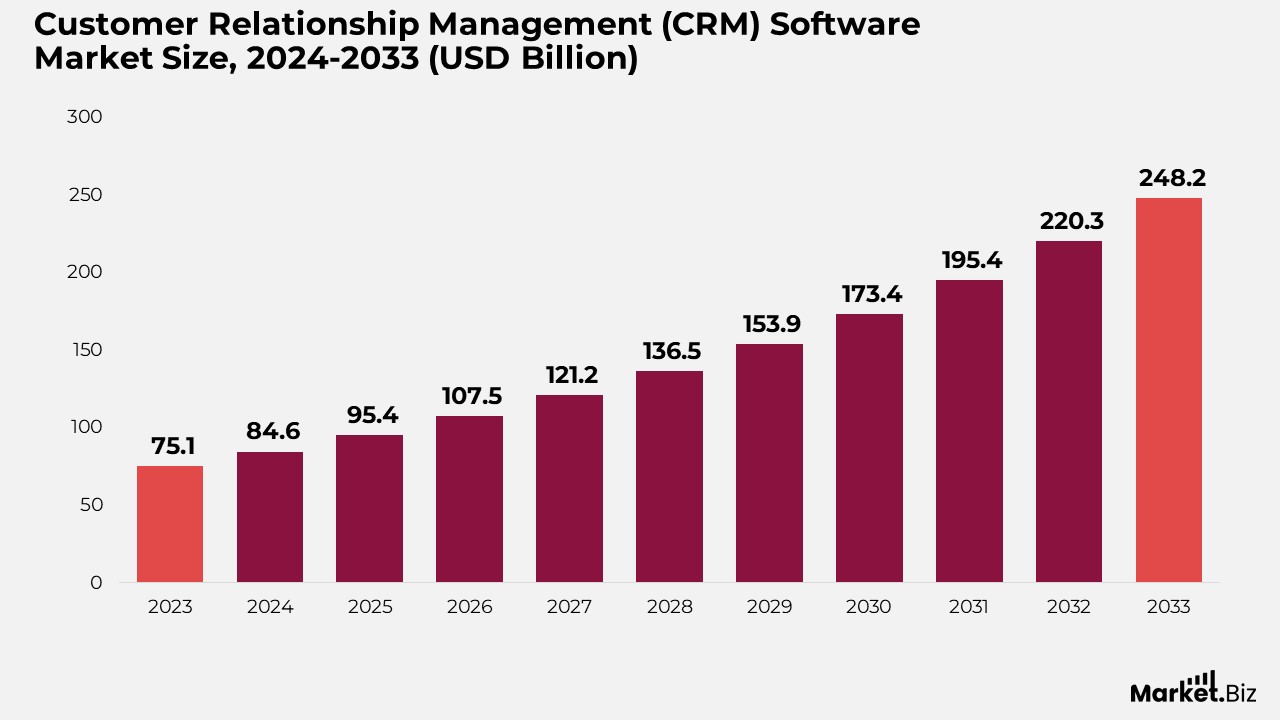
- According to Market.us, the CRM software market is estimated to rise from $84.6 billion in 2024 to $248.2 billion by 2033, representing a compound annual growth rate (CAGR) of12.7% from 2024 to 2033.
- The CRM software market growth is driven by businesses’ increasing need to enhance customer relationships, improve sales efficiency, and gain insights into customer behavior, fueled by the rising adoption of digital tools for better customer engagement.
- In 2023, the Customer Service segment led the CRM software market with a 24.5% market share, as businesses increasingly turn to CRM solutions to streamline customer support and enhance service delivery.
- In 2023, the Cloud-Based segment dominated the CRM software market, accounting for a 58.3% share, driven by the growing demand for flexible, scalable, and cost-effective cloud solutions that enable businesses to access CRM tools remotely.
- In 2023, large enterprises led the CRM software market, holding a 63.2% market share, driven by their need for comprehensive CRM systems to manage large customer bases and integrate with other enterprise technologies.
- In 2023, the BFSI segment held a 23% share of the CRM software market, securing a leading position as the sector continues to prioritize CRM to meet regulatory requirements and deliver personalised services.
- In 2023, North America led the CRM software market with a dominant share of 37.9%, driven by the region’s advanced technological infrastructure, robust business ecosystem, and a customer-centric approach that facilitated widespread adoption of CRM solutions.
(Source: Market.us)
Content Lead Generation Statistics
- 75% of content marketers use content as a strategy for lead generation.
- According to a 2025 study, 46% of respondents identified affiliate and partner marketing as one of the highest ROI channels for lead generation, followed by paid advertising (43%) and email marketing (34%).
- 28% of organizations allocate 60% or more of their digital marketing budget to lead generation, with none spending less than 10%.
- 54% of content marketers believe that early-stage content, focused on building awareness and interest, delivers the most value overall, while only 8% view content for ready-to-buy audiences as the most valuable.
- As reported by the Content Marketing Institute (CMI) in 2024:
- 74% of marketers say it plays a key role in nurturing audiences and leads, showing an 11-point increase.
- 87% of marketers report that content marketing drives demand and generates leads, representing an 11 percentage point increase from 2023.
- 52% believe it fosters loyalty among existing customers, marking a 2 percentage point decline.
(Source: Campaign Monitor, Digital Commerce 360, Semrush Inc., Ikigai Infotech)
Demand Generation Statistics
- According to the HubSpot Marketing Strategy Report, 2024, 70% of marketers consider their leads to be of high quality.
- Lead generation ranks as the 3rd most important metric for evaluating the effectiveness of content marketing strategies.
- Brand-led marketing is resurging, with 37.52% of marketers prioritizing customer experience and 28.78% creating content that aligns with their brand values.
- Marketers are increasingly targeting younger demographics, with 36% focusing on Gen Z (up from 34% in 2023), 72% on Millennials (down from 74%), 41% on Gen X (down from 67%), and 19% on Boomers (down from 27%).
- According to the Content Marketing Institute (2025), 74% of marketers claim that content marketing helped generate demand or leads, 62% say it nurtured subscribers, audiences, or leads, 52% report that it increased loyalty among existing customers, and 49% say it helped generate sales or revenue.
- 37% of marketers believe that content marketing has expanded their subscribed audience, while 9% say it has helped reduce customer support costs.
(Source: HubSpot Marketing Strategy Report, 2024, Content Marketing Institute)
Marketing Analytics Statistics
- 44% of marketers believe the data they have about their target audience is of high quality.
- 30.55% of marketers say data helps identify the most effective marketing strategies, 29.59% say it improves ROI, and 27.36% say it enhances the ability to reach their target audience more effectively.
- Marketers ranked using data to guide their marketing strategy as the 3rd most significant industry shift in 2024.
- 87% of marketers consider data to be their company’s most underutilized resource
- 22% of social media marketers list measuring and justifying their work as a top challenge.
- Nearly 1 in 3 media planners cite understanding the platforms their audiences spend time on and better analyzing content effectiveness as key challenges.
- 26% of marketers report that decision-makers do not review the marketing analytics team’s data, while 24% say these decision-makers either reject recommendations or rely on gut instincts when making decisions.
(Source: HubSpot Marketing Strategy Report, 2024, Invoca, Gartner)
B2B Lead Generation Statistics
- 68% of B2B marketers utilize strategic landing pages to capture leads.
- Events have been identified as the most effective method for generating B2B market leads.
- 44% of B2B content marketers measure content marketing performance based on lead quality, while 30% focus on lead quantity.
- 65% of B2B brands do not have a defined lead-nurturing strategy or process.
- 73% of B2B businesses incorporating video in their marketing efforts report a positive ROI.
Cost per Lead by Channel
| Channel | Average Cost Per Lead |
|---|---|
| Events and Trade Shows | $881 |
| Public Relations | $294 |
| Referrals | $73 |
| Video Marketing | $174 |
| Linkedin Advertising | $75 |
| Webinars | $72 |
| Display Advertising | $63 |
| Consumer Products | $105 |
| Content Marketing | $92 |
| Search Engine Ad | $110 |
| Social Media Ad | $58 |
| SEO | $31 |
| Email Marketing | $53 |
(Source: HubSpot, Semrush, DemandSage, Cognism, Trustmary)
Impact of Artificial Intelligence (AI) in Lead Generation
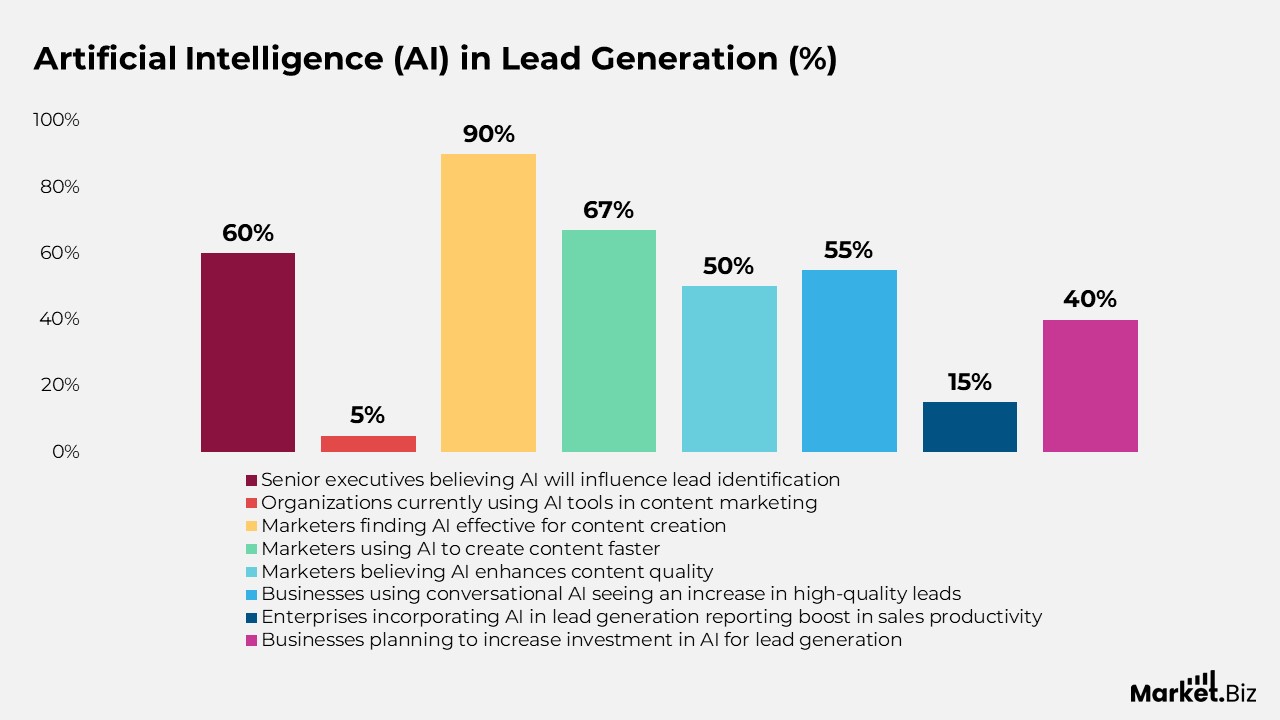
- 60% of senior executives from top global sales and marketing organizations believe AI will significantly influence lead identification.
- Only 5% of organizations currently utilize AI tools in their content marketing efforts to generate and nurture leads.
- 90% of marketers using AI find it effective for content creation, with 67% using it to create content faster, and 50% believing it enhances the quality of their content.
- 55% of businesses using conversational AI for lead generation have seen an increase in high-quality leads.
- Enterprises that incorporate AI in lead generation have reported a 15-20% boost in sales productivity.
- More than 40% of sales leaders using AI-powered lead-generation tools have seen improvements in lead prioritization, time management for sales teams, and customer insights.
- 40% of businesses are planning to increase their investment in AI for lead generation.
(Source: Content Marketing Institute, WPForms, LLC, HubSpot, Yellow.ai, SalesFuse, Salesforce) )
Challenges in Lead Generation
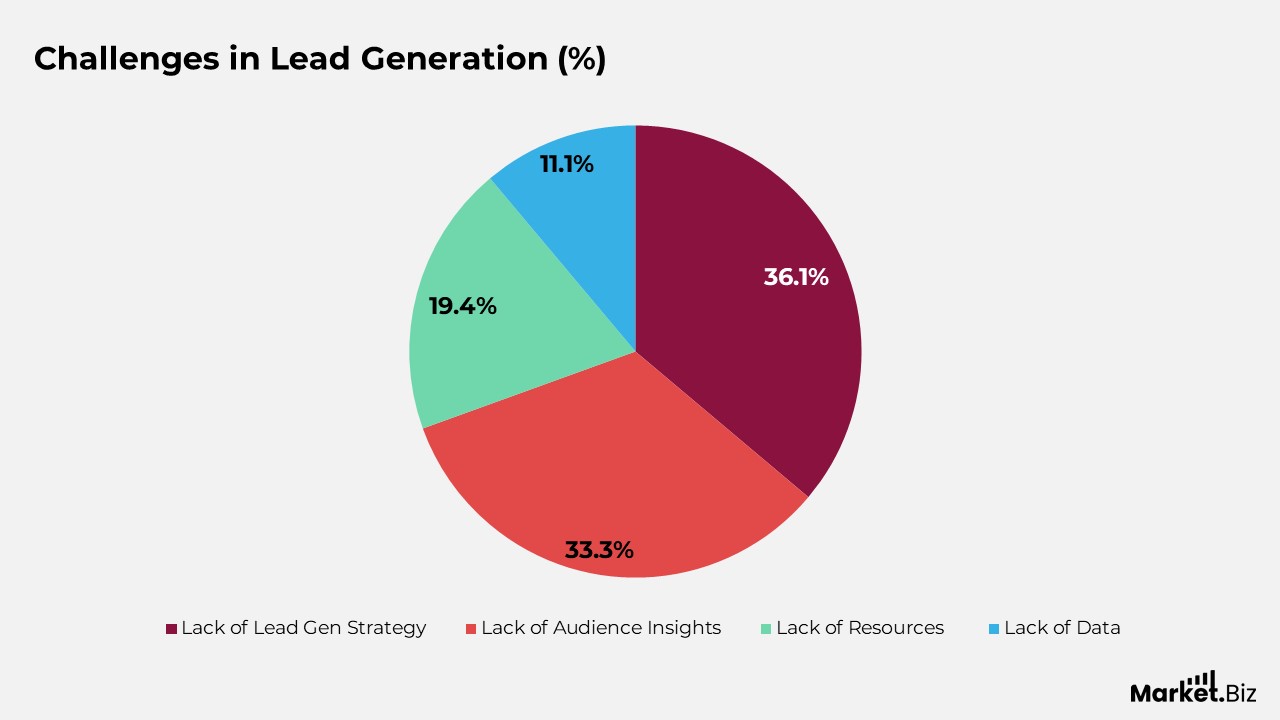
- Survey respondents identified the key obstacles in lead generation as the absence of a clear strategy and insufficient insights into the target audience.
- 36.1% cited the lack of a strategic approach as their main challenge, while 33.3% highlighted the difficulties caused by limited understanding of their audience.
- 61% of marketers view generating high-quality leads, which are more likely to convert into customers or sales, as their biggest challenge.
- 40% of marketers cite a lack of resources, poor budgeting, and insufficient staff as the biggest barriers to lead generation.
- 68% of B2B businesses struggle to identify their sales funnel accurately.
- 25% of marketers frequently face difficulties in calculating the conversion rates of generated leads.
- 31% of marketers consider tracking offline conversions one of their major challenges 65% of B2B companies lack a well-defined lead-nurturing process.
- 31% of marketers also identify proving ROI as one of the most challenging tasks when generating leads.
(Source: Hubspot, Databox, Inc., Digital media stream, Semrush.)
Conclusion
Lead Generation Statistics: Lead generation emphasizes the vital role of having a clear strategy and a deep understanding of the target audience for achieving success. Many marketers struggle with challenges such as the lack of a defined approach and limited audience insights.
The data reveals the value of strategic tools, such as landing pages and content marketing, alongside the increasing impact of video content and events in driving B2B leads.
With a significant number of businesses lacking a clear lead-nurturing strategy, there is a substantial opportunity for organizations to improve their processes and adopt more effective lead generation and nurturing practices to enhance ROI.
FAQ’s
According to recent statistics, the key challenges in lead generation include a lack of clear strategy and a limited understanding of the target audience.
Recent data indicate that 68% of B2B marketers rely on strategic landing pages to convert leads, making them a powerful tool for generating leads.
44% of B2B content marketers prioritize lead quality as the key metric, while 30% focus on the volume of leads generated.
Events and case studies have been crucial for B2B lead generation, particularly before the pandemic, as they offer valuable engagement opportunities and drive conversions.
A significant 65% of B2B brands lack a well-defined lead-nurturing strategy, highlighting a major area for improvement in lead conversion processes.
73% of B2B businesses that incorporate video into their marketing report a positive ROI, illustrating video content’s effectiveness in generating leads.
The main barriers are the absence of a solid strategy (36.1%) and a lack of audience insight (33.3%), which impede the effectiveness of lead generation efforts.
A well-defined lead generation strategy allows businesses to target their audience more effectively, enhance marketing efficiency, and increase lead conversion rates, ultimately driving better ROI.

