









Introduction
Content Marketing Statistics: Content marketing has evolved into a vital strategy for businesses seeking to engage their target audiences, enhance brand visibility, and generate leads. Recent years have witnessed notable changes in the way content is developed, shared, and consumed.
Current statistics underscore the effectiveness of content marketing, with companies allocating more resources to creating relevant and impactful content that resonates with their target audiences. Businesses prioritizing content marketing are experiencing increased web traffic, higher conversion rates, and improved customer loyalty.
Furthermore, advancements in AI-powered tools, data analytics, and content creation technologies have enabled businesses to refine their strategies and optimise their return on investment. These developments underscore the increasing importance of content marketing in the digital era, solidifying its position as a vital component of contemporary marketing strategies across diverse sectors.
Editor’s Choice
- A 3rd of marketers (33%) report that their companies reduced the marketing workforce over the past year.
- 68% of professionals believe that securing a marketing job is more difficult now compared to five years ago, 25% say it’s about the same, and 7% find it easier.
- Macroeconomic challenges are cited by 75% of marketers as a factor in the tough job market, with 69% attributing it to increased competition, while only 33% mention AI as an influencing factor.
- 67% of small business owners and marketers utilize AI for content marketing and SEO purposes.
- More than half (54.5%) of businesses plan to allocate higher budgets for content marketing shortly.
- 45% of B2B content marketers expect their budgets to grow in the coming year.
- AI is enhancing content marketing effectiveness, with 68% of companies experiencing improved ROI.
- Social media remains a crucial tool, with 90% of marketers leveraging it for content distribution.
- Blogs remain vital, with 79% of marketers maintaining an active blog.
- In 2024, 14% of businesses reported that their content marketing strategies yielded the highest ROI.
- 80% of small business owners handle content creation themselves.
- 63% of businesses are using paid media channels to amplify content distribution.
- In 2024, 45% of marketing and media leaders plan to increase their content marketing budgets within the next year.
- 92% of brands intend to increase their investments in content creators in 2024.
General Content Marketing Statistics
- 63% of content marketers believe content marketing has played a significant role in fostering customer loyalty.
- 83% of marketers consider content marketing to be the most effective strategy for generating demand.
- 92% of brands plan to increase their investment in content creators in 2024.
- 80% of small business owners manage their content creation personally.
- Nearly 49% of marketers use videos to showcase their products or services.
- Over 41% of marketers evaluate the success of their content marketing efforts through sales.
- Social media and website interactions are the most commonly tracked content metrics, each at 53%.
- 61% of marketing leaders feel they have a somewhat clear understanding of their content’s performance, while 26% have a very clear view of the metrics.
- 21% of marketers believe short-form video content will deliver the highest ROI in 2025.
- 43% of Gen Z and 45% of Millennial marketers are eager to learn how to leverage new technologies to enhance content marketing 33% of marketing and media leaders identify producing high-quality content as their primary challenge in content creation.
- 36% of marketers use AI-powered chatbots to assist with daily tasks.
- 58% of B2B marketers saw a rise in sales and revenue in 2023, due to content marketing
- 41% of marketers consider email to be their most successful marketing tool.
- In 2024, 89% of customers want to see more video content from brands.
- Niche content creators are proving more successful, with 47% of marketers reporting positive results from micro-influencer partnerships.
- 43% of small business owners plan to invest more in improving their website’s performance in 2024.
- For 66% of businesses utilizing AI, traffic is considered a crucial performance metric in content marketing.
(Source: HubSpot, Content Marketing Institute, Wyzowl, Litmus, Semrush, DemandSage)
AI Content Marketing Market Size
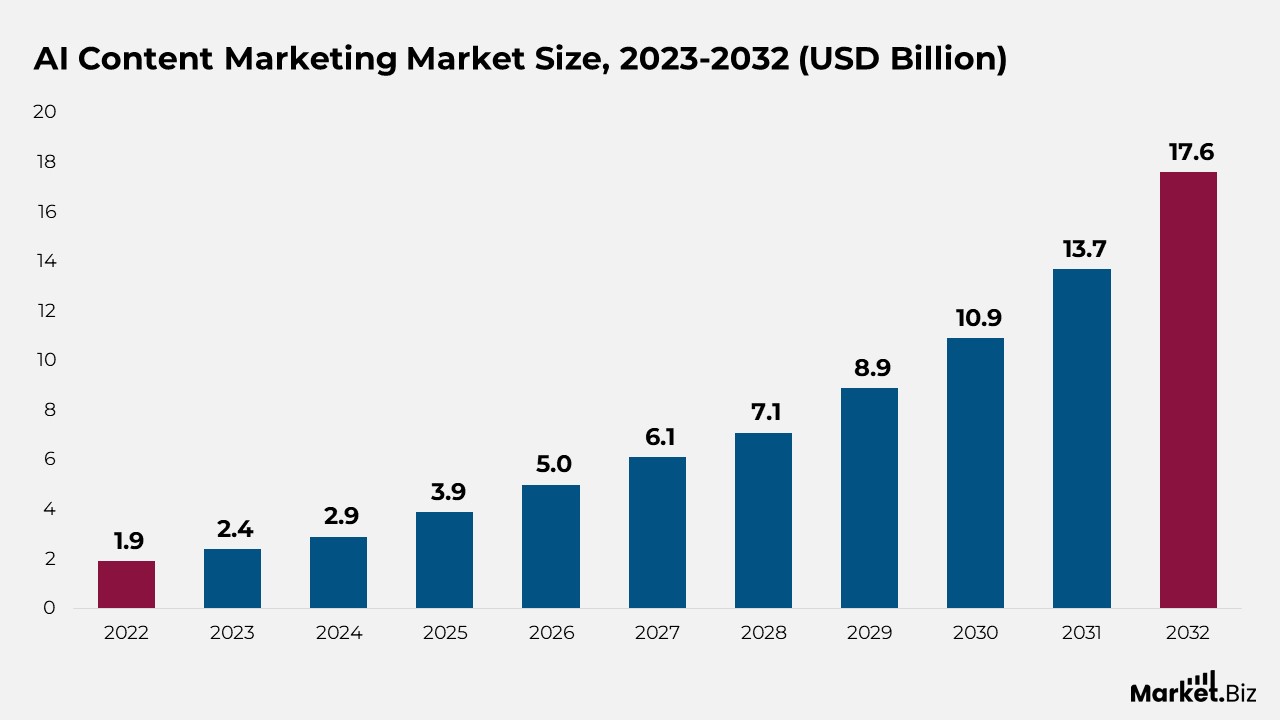
- According to Market.us, the AI content marketing market is estimated to rise from $2.4 billion in 2023 to $17.6 billion by 2032, representing a compound annual growth rate (CAGR) of 25.68% from 2023 to 2032.
- The market growth is fueled by increasing demand for personalized content, efficiency in content production, and data-driven marketing strategies.
- In 2023, the content creation segment dominated the AI Content Marketing market, driving significant growth.
- The retail sector led the AI Content Marketing market in 2023, adopting AI to improve customer engagement and marketing strategies.
- North America maintained a dominant market position in AI Content Marketing in 2023, driven by factors that promote AI adoption.
(Source: Market.us)
General Content Marketing Usage
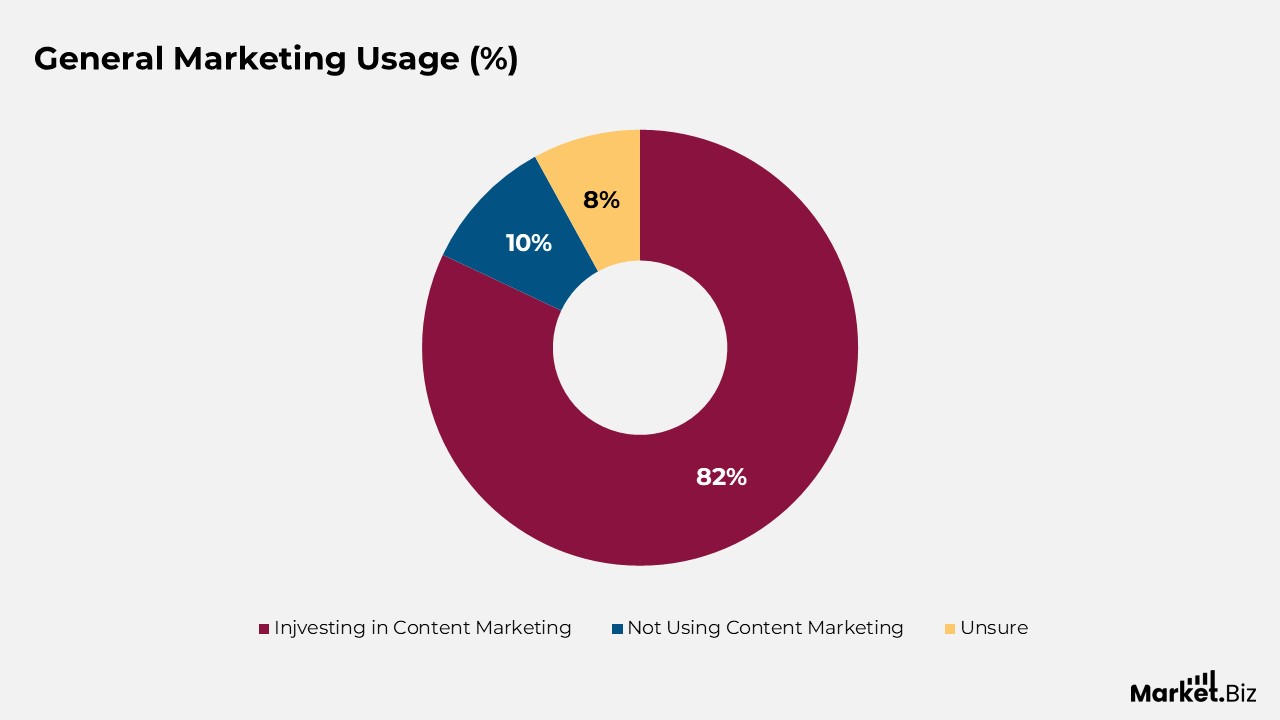
- 82% of companies incorporate content marketing into their strategies.
- 73% of B2B and 70% of B2C marketers include content marketing as a core part of their marketing efforts.
- Half of marketers report outsourcing some aspects of their content marketing initiatives.
- Blogging is emerging as a top content format for marketers to explore in 2024.
- 83% of B2C marketers generate short articles or posts, while 61% of content marketers applied video content in 2023. The use of long-form articles increased significantly, from 22% in 2022 to 42% in 2023.
- The pandemic drove a substantial 207% increase in content marketing usage.
(Source: DemandSage, WPbeginners, Content Marketing Institute, Hubspot, Search Engine Journal)
The Impact of AI on Content Creation
- The leading content types created with AI include long-form top-funnel SEO content (78%), mid-funnel SEO content (67%), product and bottom-funnel SEO content (50%), FAQ/glossary pages (48%), and landing/product pages (41%) (2024).
- Marketers who avoid using AI often cite concerns over content accuracy.
- Nearly 45% of marketers report that their companies lack formal guidelines for the use of AI.
- 85% of marketers believe that AI has significantly improved the quality of their content.
- 75% of consumers trust content generated by AI.
- 68% of marketers say that AI has played a key role in advancing their careers.
- Close to 86% of marketers say that AI saves them over 1 hour each day by automating 86% of creative tasks.
- 14% of marketers admit they don’t edit content produced by AI.
(Source: Ahrefs Pte Ltd., Flying Cat, Content Marketing Institute, Rockcontent, Capgemini, Hubspot)
Social Media Marketing Statistics
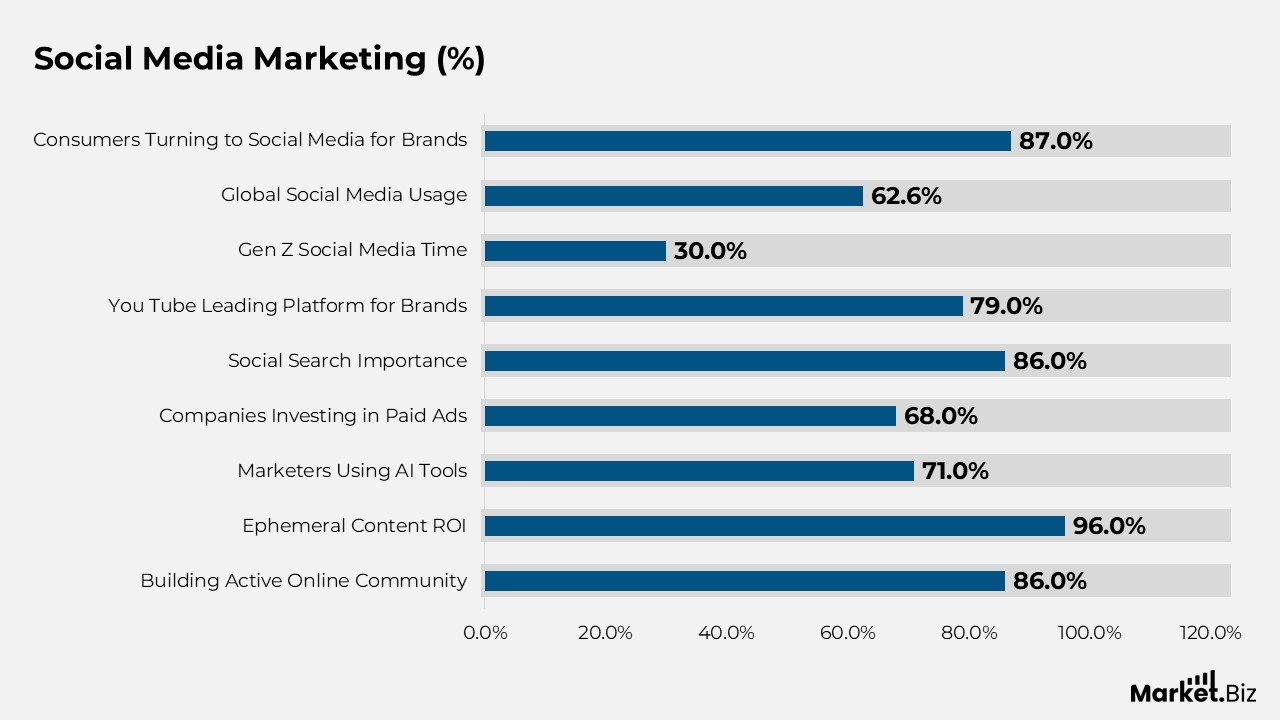
- 87% of social media marketers predict that consumers will increasingly turn to social media platforms rather than search engines to discover brands.
- Social media usage continues to rise, with 62.6% of people worldwide actively using these platforms. On average, individuals spend 2 hours and 20 minutes daily on social media.
- Gen Z is particularly active, spending an average of 2 hours and 51 minutes daily on social media, more than older generations. Nearly 30% of Gen Z use social media for inspiration.
- YouTube has become the leading platform for brands, seeing a 79% increase in usage over the past year, surpassing Instagram and Facebook. It has emerged as a critical channel for consumer engagement.
- 86% of social media marketers consider social search to be a vital part of their broader content marketing approach.
- 68% of social media marketers report that their companies are investing in paid advertising across social media platforms.
- 71% of social media marketers use AI tools in their strategies, with the same percentage noting that AI-generated content outperforms non-AI content.
- 96% of social media marketers find ephemeral content, such as polls and Instagram stories, to be a key driver of high return on investment.
- In 2024, 86% of social media marketers agree that building and maintaining an active online community is crucial to a successful social media marketing strategy.
(Source: HubSpot Social Media Trends Report, 2024, Datareportal report, GWI Social Media Trends Report, 2024, Typeface Inc)
Types of Content
- 83% of content marketers produce articles and posts, while 61% focus on creating video content. These two formats were the most commonly used by B2C marketers in 2023. The use of long-form articles, including videos, blogs, and infographics, surged to 42% from 22% the previous year.
- Short-form content, ranging from 300 to 900 words, generates 21% less traffic and 75% fewer backlinks compared to articles of 900–1200 words in length.
- 38% of marketers consider video content to be the most effective in generating results.
- Interactive content has led to a 52.6% higher engagement rate compared to static content.
- Short-form video has become the dominant content format in marketers’ strategies.
- 67% of marketers say that video content has gained the most prominence over the past year.
- 87% of marketers report that video content has significantly boosted traffic to their websites.
(Source: Search Engine Journal, Ahrefs, ColorWhistle, Content Marketing Institute)
Content Marketing Return on Investment (ROI) Statistics
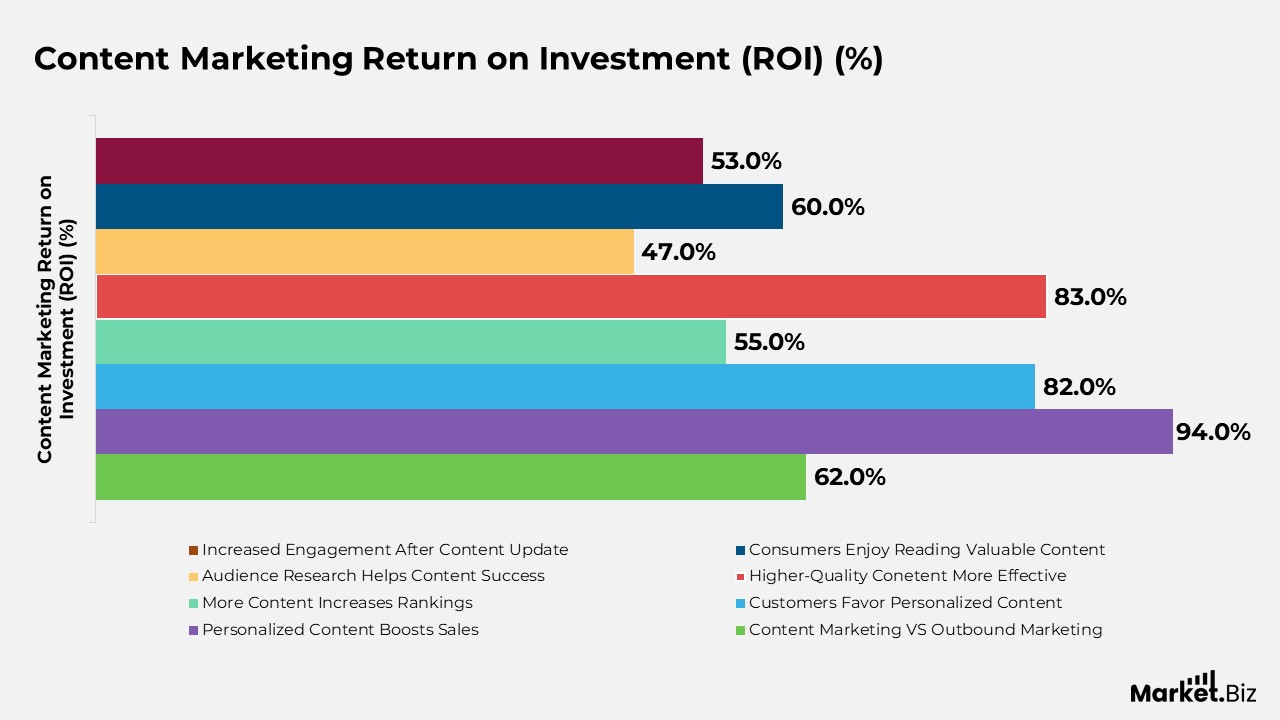
- 53% of marketers reported increased engagement after updating their content
- 60% of consumers enjoy reading valuable content provided by brands.
- 47% of marketers believe that audience research has played a crucial role in their content marketing success.
- 83% of marketers have found that producing higher-quality content less frequently is more effective than publishing lower-quality content more often.
- 55% of marketers noted that creating more content and posting it frequently helped improve their content rankings.
- 82% of customers develop a more favorable view of a business after reading its personalized content.
- 94% of marketers agree that personalized content leads to higher sales.
- Content marketing generates 3x the number of leads as outbound marketing and is 62% less costly.
(Source: Semrush, Demand Metric, HubSpot, Search Engine Journal)
Blogging Content Marketing Statistics
- As of 2023, the average blog post is around 1,416 words long
- Including a blog on your website can boost search engine rankings by 434%
- 53% of marketers consider blogging to be their primary content marketing strategy
- To improve blog rankings, 45% of marketers focus on adding related keywords to their content
- 44% of bloggers publish between 3 and 6 posts per month
- 79% of content marketers maintain an active blog
- Only 27% of readers fully engage with blog posts, while 73% skim through them
- By December 2024, approximately 7.5 million blog posts will be published daily.
- Blogs that include images see 94% more views compared to those without
- The average blog post contains 1,427 words and takes approximately 3 hours and 51 minutes to create
- Blog posts with 7 or more images generate 55% more backlinks than those without
- 74% of bloggers create how-to articles, while other popular formats include lists (50%), guides and e-books (46%), and news and trends (45%). Blogs featuring relevant images experience 94% more views compared to those without
- Articles featuring at least one video generate 70% more organic traffic
- Reader engagement tends to drop after 7 minutes of reading.
- 80% of internet users engage with both social media and blogs
- 43% of readers admit to skimming blog posts instead of reading them thoroughly
- Companies with blogs generate 67% more leads each month compared to those without.
- Websites with active blogs have 434% more indexed pages and 97% more inbound links than those without
- 68% of readers spend time reading about brands that interest them.
(Source: Optinmonster, DemandMetric, HubSpot, Ahrefs, Content Marketing Institute, Backlinko, MasterBlogging, Semrush, Sixth City Marketing)
Artificial Intelligence (AI) in Content Marketing
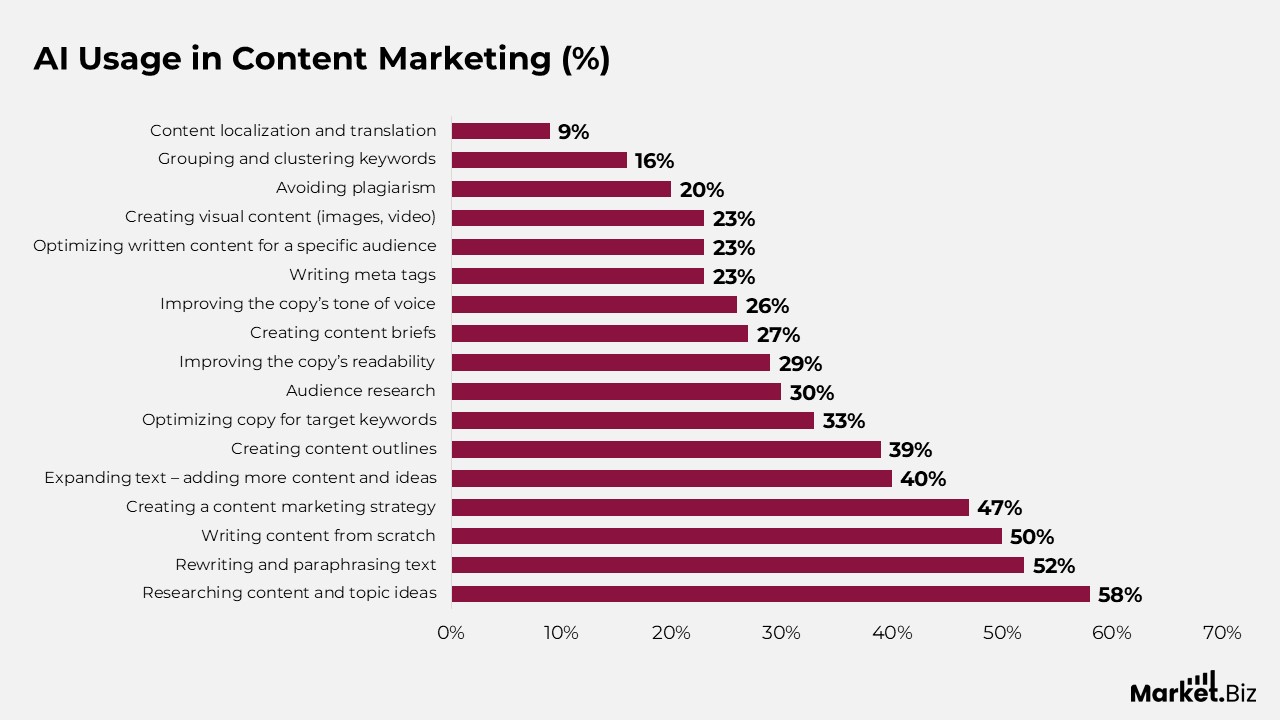
- 67% of small business owners and marketers are utilizing AI to enhance their content marketing and SEO strategies.
- 68% of businesses have reported improved marketing ROI by adopting AI for content creation and optimization.
- 79% of content marketers have observed an increase in content quality thanks to AI tools.
- 58% of marketers leverage AI for research and generating topic ideas.
- Almost 50% of content marketers use AI to brainstorm new content topics, while 46% rely on it for researching headlines and keywords. Over 36% use AI for actual content writing.
- 48% of content writers expressed that adopting new technologies, such as AI, was their most sought-after skill in 2023, followed by data analytics and data science (both at 42%), and leadership skills (also at 42%).
- 58% of marketers using generative AI for content creation cite increased performance as the primary benefit.
- 19.2% of marketers allocate over 40% of their marketing budget to AI-driven campaigns.
- 75% of consumers trust content produced by generative AI.
(Source: DemandSage, Content Marketing Institute, Ahrefs, Pecan AI, Hootsuite, Semrush)
Content Marketing Budget Trends
- 45% of B2B content marketers anticipate an increase in their content marketing budgets in 2024.
- 48% of small business owners who don’t use AI tools allocate $1,000 or less to their monthly content marketing budget.
- 54% of businesses that spend over $2,000 on a single content piece report a successful marketing strategy.
- 51% of small and micro businesses claim they do not invest additional funds in long-form content due to their use of AI writing tools, with 93% reviewing and editing AI-generated content using different approaches.
- 85% of marketers focused on video content plan to either maintain or increase their video production budgets in 2024.
- 69% of marketers include paid video ads in their campaigns.
- Approximately 57% of businesses are planning to invest more in video content in 2024.
(Source: Semrush, Wyzol, Wistia)
Careers in Content Marketing
- US-based content marketers earn an average salary of $112,000 annually.
- 48% of content marketers identify learning to work with new technologies as their primary upskilling goal for 2024.
- Content marketers typically spend 4 hours each day on administrative and operational tasks.
- The top skills for senior content marketers in the US are analytics (25%), writing (29%), and video (18%).
- The most common job titles in content marketing in the US are Content Marketing Manager (50%) and Content Marketing Specialist (26%).
- 81% of marketers use generative AI to assist with various marketing tasks.
- 16% of marketers express concerns that AI might replace their roles.
(Source: Semrush, Statista) )
Advantages of Content Marketing
- In 2023, 58% of B2B marketers reported that content marketing played a significant role in driving sales and revenue growth.
- 76% of marketers say content marketing is effective in generating demand and leads, a 9% increase from the previous year. Additionally, 63% of marketers find that content marketing is essential for nurturing leads, and 50% believe it helps strengthen loyalty with existing clients.
- Websites with blogs have 434% more indexed pages than those without, which increases visibility and drives organic traffic. Backlinks from high-quality websites further enhance traffic.
- 81% of marketers have found that content marketing significantly contributes to creating brand awareness. At the same time, 63% of respondents see it as an effective tool for building growing loyalty with existing customers.
- Content marketing generates more than 3 times the number of leads compared to outbound marketing, while costing 62% less.
- 70% of consumers prefer learning about a company through an article rather than through advertisements.
(Source: Ahrefs, DemandSage, Content Marketing Institute.)
Common Challenges in Content Marketing
- The top three content marketing challenges for B2B marketers are difficulty in measuring content marketing results (47%), lack of resources (54%), and aligning content with the customer journey (45%).
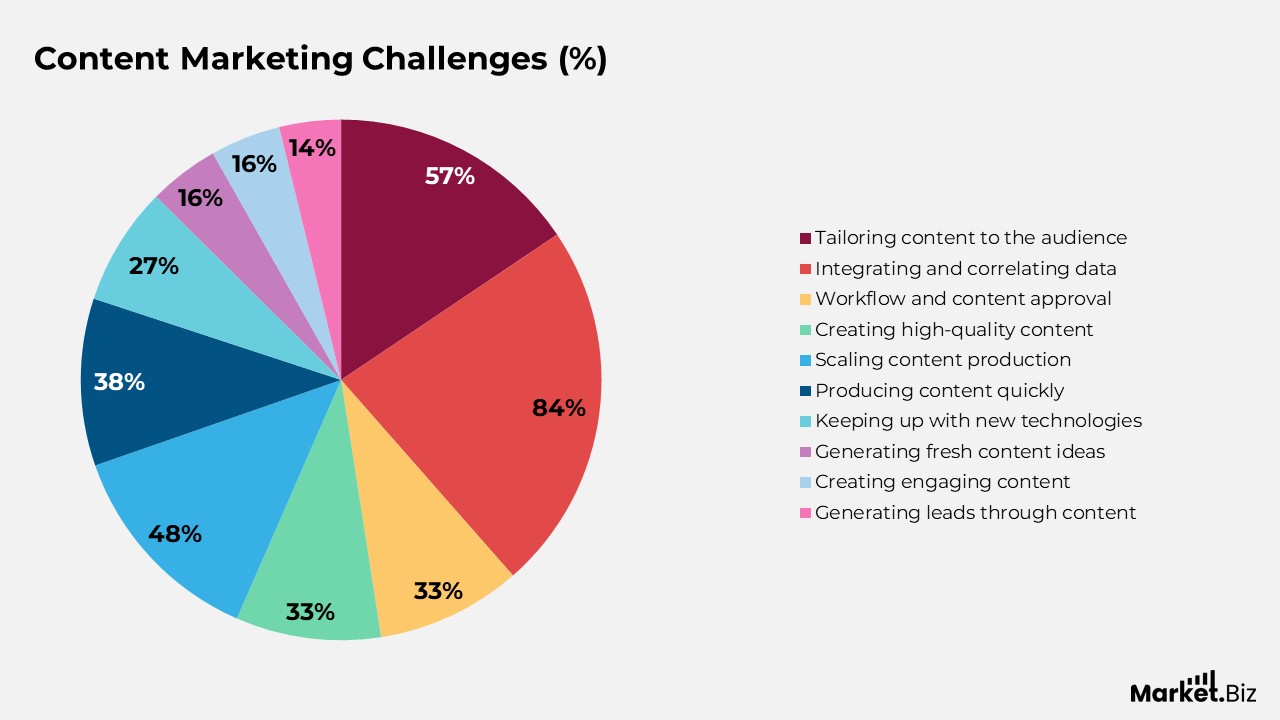
- 57% of marketers find creating the right content tailored to their audience to be a major challenge.
- 84% of B2B marketers report that integrating and correlating data across various platforms is a significant challenge when measuring content performance.
- 33% of B2B marketers identify workflow and content approval as challenges in their content marketing efforts.
- 33% of marketing leaders consider creating high-quality content to be one of their biggest content marketing obstacles.
- 48% of content marketers cite scaling content production as a common difficulty.
- 38% of marketers express challenges in producing more content quickly.
- 27% of B2B marketers face challenges in keeping up with new technologies and tools.
- 16% of marketers struggle with coming up with fresh ideas for new content.
- 16% of marketers also find it challenging to create highly engaging online content.
- 14% of marketers acknowledge that generating leads through content creation is a challenge.
(Source: Statista, WebFX, Content Marketing Institute, DemandSage, Brandfolder Digital Asset Management, Blogging Wizard)
Conclusion
Content marketing proves to be an essential strategy for driving business success. Its ability to generate significant leads while being cost-effective sets it apart from traditional marketing methods.
By creating valuable content, businesses can boost brand awareness, increase website visibility, and build long-lasting relationships with existing customers. Content marketing not only helps nurture leads but also strengthens customer loyalty, making it a cornerstone of any effective marketing strategy.
As the digital landscape continues to evolve, content marketing remains a powerful tool for sustainable growth and engagement..
FAQ’s
Content marketing is a powerful tool for lead generation, often yielding more than three times the number of leads as outbound marketing while being significantly more affordable. It enables businesses to connect with potential customers across various stages of their buying journey.
Blogs play a key role in content marketing by boosting a website’s SEO, increasing visibility, and driving organic traffic. Websites with blogs tend to have more indexed pages, which leads to higher traffic and more inbound links, ultimately enhancing the website’s overall performance.
By consistently offering valuable and relevant content, businesses can strengthen their relationships with existing customers. Content marketing fosters trust and engagement, which are essential for cultivating long-term customer loyalty.
Personalized content is vital in content marketing as it helps create a deeper connection with the audience. It enhances customer satisfaction, boosts engagement, and improves conversion rates, ultimately contributing to higher sales and long-term customer retention.
Content marketing enables businesses to demonstrate expertise, connect with their audience, and establish a strong brand identity. By producing informative and well-crafted content, companies can position themselves as industry leaders, increasing their visibility and credibility.