









Introduction
Wearable Technology statistics provide a data-driven overview of how connected devices such as smartwatches, fitness trackers, smart clothing, and health-monitoring wearables are being adopted and used across consumer and enterprise environments.
These statistics track key indicators, including device penetration, usage behaviour, application areas, and regional adoption trends, reflecting the growing integration of wearables into daily life, preventive healthcare, workplace safety, and fitness monitoring.
They also highlight advances in sensors, connectivity, and data analytics, along with shifting consumer preferences toward health-focused, always-connected devices. Overall, Wearable Technology statistics serve as a reliable reference for assessing market maturity, user engagement patterns, and long term growth opportunities within the global wearable technology ecosystem.
Editor’s Choice
- Wearable devices have become essential for many users: nearly 40% of global users consider them indispensable, and around 25% regularly wear them during sleep.
- The consumer electronics application segment accounted for the highest revenue share in 2023, contributing approximately 49% of total wearable technology revenue.
- Revenue momentum remains strong, with wearable technology revenues expected to reach around USD 79.0 billion in 2024 and further increase to USD 94.0 billion in 2025.
- Adoption levels decline significantly with age, with individuals aged 75 and above recording a wearable technology adoption rate of just 0.8%.
- Adoption of wearable devices for chronic condition management has accelerated, with usage for monitoring diabetes, hypertension, and similar conditions increasing by around 30% over the past two years.
- Remote patient monitoring enabled by wearable technologies is expected to deliver substantial healthcare savings, with projections indicating potential cost reductions of approximately USD 200 billion over the next 25 years, driven by the expansion of telemedicine and continuous health tracking.
- In 2023, wearable healthcare usage reached meaningful levels in the US, with 35% of individuals using wearable health devices and 40% relying on healthcare-related mobile applications.
- Health app usage continues to expand, with 75% of users tracking exercise, fitness, steps, or heart rate, 48% monitoring sleep, 46% tracking weight, and 41% focusing on diet management.
Smartwatch Adoption and Health Monitoring Trends
- Smartwatches are primarily used for health purposes in the US, with 92% of users in 2022 relying on them to track health-related metrics such as activity levels, heart rate, and wellness indicators.
- Global smartwatch adoption continues to rise, with an estimated 225 million users worldwide in 2024, driven largely by increasing awareness of personal health data and self-monitoring.
- Advancements in smartwatch technology have expanded their medical relevance, as many devices now include heart rate monitoring features, with select models receiving regulatory approval to detect conditions such as atrial fibrillation, which is linked to stroke risk.
- Smartwatches are increasingly used for chronic disease management and early symptom detection; however, affordability remains a barrier, as only 12% of individuals earning less than USD 30,000 annually currently use this technology.
- Regional demand continues to strengthen, with 36% of Australia’s population owning smartwatches in 2023, primarily for health monitoring and fitness tracking purposes.
Wearable Medical Device Usage by Gender
- Adoption of wearable healthcare devices shows moderate gender variation, with 16.41% of females reporting usage over the past year, compared to 13.54% of males.
- Higher adoption among women is linked to stronger engagement in health and wellness activities, increased focus on preventive care, and broader availability of health-focused wearable features.
- Despite these differences, non-use rates remain similar across genders, with approximately 34% to 36% of both males and females reporting not using wearable healthcare devices.
(Source: Deloitte, Statista, The New England Journal of Medicine, Electro IQ, National Cancer Institute Health Information National Trends Survey)
Wearable Technology Market Landscape and Key Brand Trends
- Samsung demonstrated steady market performance, recording a 7.90% share in Q4 2022 and maintaining a 7–9% share throughout 2023, reflecting consistent brand positioning.
- Smart athletic wear is gaining traction, with the global market expected to reach USD 14.74 billion by 2025.
- Smartwatches dominate the wearables ecosystem, contributing 61% of total wearable market revenue.
- Fitbit holds a leading vendor position, accounting for 28.5% of the wearable device market.
- The global wearables market is projected to expand significantly, reaching approximately USD 93.9 billion by 2026.
- Emerging subsegments are gaining momentum, including smart textiles, projected to reach USD 4.2 billion by 2024; pet wearables, projected to reach USD 2.36 billion by 2024; and smart helmets, expected to reach USD 1.2 billion by 2027.
Consumer Adoption and Usage Behavior of Wearable Technology
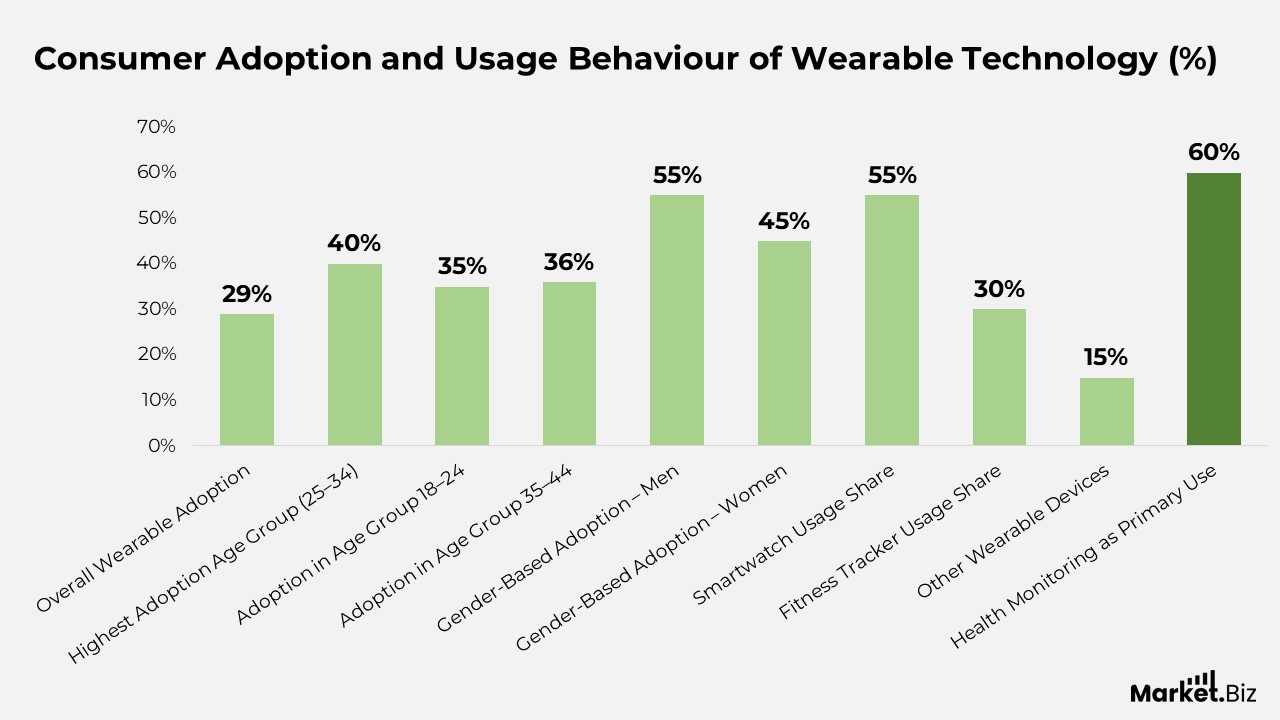
- Wearable technology adoption continues to rise, with approximately 29% of global consumers owning at least one wearable device in 2024, driven largely by growing health awareness.
- Adoption is strongest among users aged 25–34, with penetration exceeding 40%, while the 18–24 and 35–44 age groups show solid adoption levels of 30–35% each.
- Gender-based adoption remains slightly higher among men (55%) than among women (45%), though this gap continues to narrow as women increasingly integrate wearables into their wellness routines.
- Smartwatches are the most popular wearable type, accounting for 55% of usage, followed by fitness trackers at 30%, with other devices such as smart clothing and AR wearables accounting for the remaining 15%.
- Health monitoring remains the primary use case, with over 60% of users relying on wearables to track steps, heart rate, sleep, and other wellness metrics.
Key Purchase Drivers and Buying Preferences
- Health and fitness tracking is the dominant purchase motivator, cited by 70% of consumers, supported by the growing availability of advanced features such as ECG, blood oxygen, and heart monitoring.
- Convenience features such as notifications, mobile payments, and voice assistants influence 25% of buyers.
- Online channels dominate distribution, accounting for 60% of wearable purchases, while 40% still occur through physical retail stores.
- Data privacy remains a major concern, with 45% of consumers expressing concern about the security of their personal and health data.
- Battery life is another critical consideration, with 30% of users prioritising devices with longer charging intervals.
Economic Contribution and Industry Impact of Wearable Technology
- The wearable technology market continues to scale rapidly, with estimates valuing the market at USD 120.54 billion in 2023 and projections reaching USD 1,415.26 billion by 2033, reflecting strong long term growth momentum.
- Earlier benchmarks valued the market at USD 62.60 billion in 2022, with growth accelerating across healthcare, fitness, and consumer electronics applications.
- Wearable payments are expanding quickly, with user numbers rising 42.5% between 2022 and 2023 to 173.3 million, and expected to reach 278.3 million by 2025.
- The wearable industry has created approximately 400,000 jobs worldwide, underscoring its broader economic impact.
- Healthcare and fitness applications account for nearly 60% of wearable technology revenue, while consumer electronics contribute around 30%, and enterprise use cases approximately 10%.
- In 2024, global consumer spending on wearable technology is expected to exceed USD 60 billion, supporting continued innovation and retail growth.
Regional Performance and Market Distribution
- North America remains the largest wearable technology market, accounting for 33.8% of global share, driven by early adoption and strong digital infrastructure.
- Europe follows with a 25.4% share, reflecting sustained consumer interest and healthcare integration.
- The Asia-Pacific region holds a significant 30.1% share and continues to grow rapidly, driven by rising tech adoption and expanding middle-class populations.
- Latin America and the Middle East & Africa represent smaller shares at 6.9% and 3.8%, respectively, indicating untapped growth potential.
Future Outlook and Emerging Trends in Wearable Technology Statistics
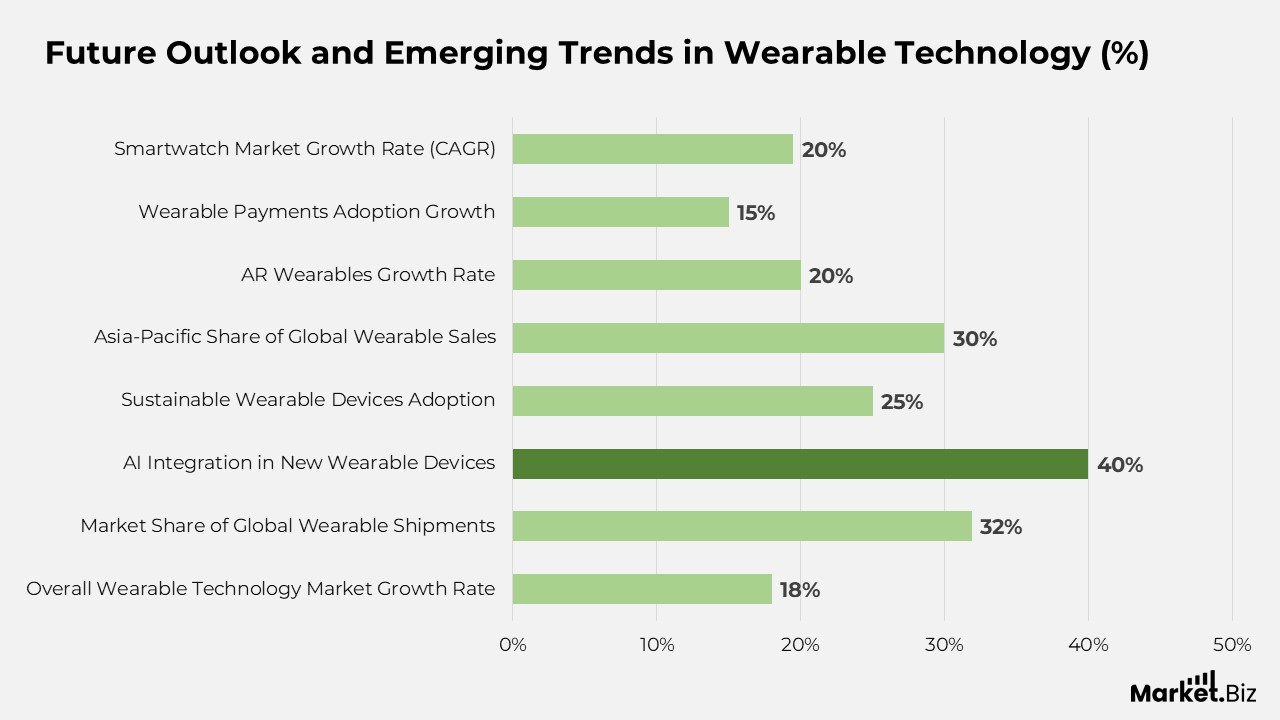
- The wearable technology market is expected to reach approximately USD 265.4 billion by 2026, growing at an annual rate of 18%.
- Global shipments are projected to reach 205.3 million units by 2027, maintaining a 31.90% market share and steady shipment growth.
- By 2026, most wearable devices are expected to integrate advanced health features, including heart rate monitoring, sleep tracking, and ECG capabilities.
- AI integration is accelerating, with around 40% of new wearable devices expected to feature AI-powered capabilities by 2026.
- Sustainability is gaining importance, as 25% of wearable devices are projected to use eco-friendly materials by 2025.
- The Asia-Pacific region is anticipated to account for nearly 30% of global wearable sales by 2026, reinforcing its role as a key growth engine.
- AR wearables are expected to grow at 20%, driven by applications in gaming, education, and professional services.
- Wearable payment adoption is projected to increase from 15% to 20% among global consumers by 2026, reflecting the expansion of contactless payment use cases.
- The global smartwatch market is forecast to grow at a CAGR of 19.5% from 2021 to 2028, while wearable health and fitness devices are expected to reach USD 75 billion by 2026.
(Source: Technavio, Global Insight Services, Market.us, Statista, Deloitte, Electro IQ)
Smart Health Watches Usage
- Smart health watches are widely adopted for comprehensive health and activity monitoring, enabling users to track heart rate, sleep cycles, blood oxygen levels, daily movement, workouts, and calorie consumption through a single device.
- The global smartwatch segment generated approximately USD 38.6 billion in revenue in 2022, reflecting strong consumer demand for multifunctional health wearables.
- Market dynamics indicate a shift in revenue distribution, with smartwatch revenues projected to reach around USD 32.05 billion by 2025, influenced by pricing competition and product diversification.
- Worldwide adoption continues to grow, with global smartwatch shipments exceeding 150 million units in 2023, highlighting sustained consumer interest across regions.
- Growth in this segment is supported by rising health awareness and ongoing technological progress, including improved battery efficiency, more accurate sensors, and better integration with smartphones and connected ecosystems.
Wearable Fitness Trackers
- Fitness trackers are gaining traction globally as consumers increasingly prioritize continuous health and fitness monitoring in their daily routines.
- The global fitness tracker market is expected to reach approximately USD 45.66 billion in revenue by 2025, driven by preventive health trends and the adoption of lifestyle-focused wellness.
- In 2022, global shipments of fitness trackers reached 101 million units, underlining widespread acceptance of these devices.
- Market growth is further supported by rising disposable incomes, higher consumer spending on personal health, and increasing awareness of long term fitness management.
Biosensors
- The biosensors market is projected to reach about USD 1.4 billion by 2027, expanding at a compound annual growth rate of 9.4%.
- Demand for connected biosensors is accelerating, with the segment expected to reach nearly USD 15.68 billion by 2025, driven by digital health integration and remote monitoring applications.
- Shipments of wearable medical sensors have increased rapidly, rising from 85 million units in 2021 to an estimated 160 million units by 2024, reflecting growing clinical and consumer adoption.
Wearable Blood Pressure Monitors
- Hypertension remains the most prevalent cardiovascular risk factor worldwide, affecting nearly 1 billion people, with prevalence expected to increase to 1.5 billion by 2025.
- In the UK, high blood pressure ranks as the third leading risk factor for disease, following smoking and poor diet, with approximately one in three adults affected.
- Rising awareness of cardiovascular health is encouraging the adoption of wearable blood pressure monitors for early detection, daily tracking, and long-term condition management.
Wearable ECG Monitors: Advancing Cardiac Surveillance
- Cardiac arrhythmias affect an estimated 1.5% to 5% of the global population, creating demand for continuous and accessible heart monitoring solutions.
- Wearable ECG monitors support ongoing cardiac surveillance, enabling early identification of irregular heart rhythms and timely medical intervention.
- By providing continuous data access and encouraging proactive healthcare behavior, wearable ECG devices have the potential to improve long term cardiac outcomes.
(Source: Statista, Patent PC, Market.us, National Institute of Health (NIH), Blood Pressure UK)
Conclusion
Wearable technology statistics demonstrate a clear shift from optional consumer gadgets to widely adopted solutions that support health monitoring, fitness management, and connected daily living. The rising use of smartwatches, fitness trackers, biosensors, and medical wearables reflects an increasing consumer focus on preventive care and real-time health insights.
Continuous improvements in sensor accuracy, battery performance, connectivity, and data processing are further enhancing device capabilities and reliability across both consumer and clinical applications. From a broader market perspective, the data indicates sustained momentum fueled by growing health awareness, deeper integration with digital health platforms, and expanding use cases such as remote monitoring and contactless payments.
Regional adoption trends and evolving consumer preferences point to long term demand, while emerging areas, including AI-enabled wearables, smart textiles, and advanced medical sensors, highlight future growth opportunities. Overall, wearable technology statistics suggest a resilient and expanding market, with wearables becoming an integral part of modern healthcare, lifestyle management, and the connected digital ecosystem.
FAQ’s
Wearable technology statistics show strong and growing adoption across consumer, healthcare, and enterprise segments. Devices such as smartwatches, fitness trackers, and medical wearables are increasingly used for health monitoring, fitness tracking, and daily connectivity, reflecting rising health awareness and the integration of digital lifestyles.
Smartwatches are the most widely used wearable devices, followed by fitness trackers and health-monitoring wearables. Medical-grade wearables such as ECG monitors and blood pressure trackers are also gaining traction due to their role in preventive healthcare and remote patient monitoring.
Key adoption drivers include increasing focus on health and wellness, availability of advanced features such as heart rate monitoring and sleep tracking, improved battery life, better connectivity with smartphones, and growing acceptance of digital health solutions.
Wearable technology plays a critical role in healthcare by enabling continuous monitoring of vital signs, early detection of health conditions, and support for remote patient monitoring. These capabilities contribute to improved patient outcomes and potential reductions in healthcare costs.
North America and Europe currently hold the largest shares of the wearable technology market due to early adoption and strong digital infrastructure. However, the Asia Pacific region is experiencing rapid growth driven by expanding consumer bases and rising health awareness.