









Introduction
5G Chipset Statistics: 5G chipsets are crucial components in 5G networks, acting as the primary processing units for communication. These chipsets are made up of key elements such as modems, baseband processors, and RF front-ends. This configuration enables them to manage high data rates, reduce latency, and operate across various frequency bands, including sub-6 GHz and millimetre-wave.
They are utilised in smartphones, IoT devices, automotive technology, and various industries, facilitating features such as high-speed internet, responsive gaming, and self-driving capabilities. Leading semiconductor manufacturers like Qualcomm, MediaTek, Intel, and Samsung are at the forefront of producing these chipsets.
The challenges faced include the effective management of heat, signal processing, and the complexities of network compatibility. Looking forward, we expect advancements in 6G technology, closer integration with artificial intelligence, and an expanding array of applications across different sectors.
Editor’s Choice
- In 2022, the 5G chipset market achieved a revenue of USD 19.2 billion, which is anticipated to increase steadily in the following years.
- By 2032, the 5G chipset market is expected to achieve a remarkable revenue milestone of USD 171.2 billion.
- North America commands the largest market share at 30%, propelled by the swift rollout of 5G networks and robust consumer demand for high-speed connectivity.
- Samsung Electronics CO., Ltd. is recognised as a leader in the industry, holding a significant 16% market share.
- The energy consumption of 5G is influenced by several factors, such as radio configuration, hardware specifications, and traffic load, with over 70% of the overall energy usage occurring within the Radio Access Network (RAN).
General 5G Chipset Statistics
- The revenue generated by the 5G chipset market is expected to experience substantial growth in the upcoming years, with a compound annual growth rate (CAGR) of 24.67%.
- In 2022, the 5G chipset market achieved a revenue of USD 19.2 billion, which is anticipated to increase steadily in the following years.
- Samsung Electronics CO., Ltd. emerges as a leader in this sector, holding a significant market share of 16%.
- North America possesses the largest market share at 30%, propelled by the swift rollout of 5G networks and robust consumer demand for high-speed connectivity.
- The MediaTek Helio M70 is a multifunctional chipset that accommodates 2G, 3G, 4G, and 5G networks, providing a wide range of connectivity options.
- There are three primary ISM bands designated for RF and wireless chips: 902 – 928 MHz, 2.400 – 2.500 GHz, and 5.725 – 5.875 GHz.
- 5G chipsets offer significantly faster data speeds compared to 4G, achieving peak rates of up to 20 gigabits per second (Gbps).
5G Chipset Market Size Statistics
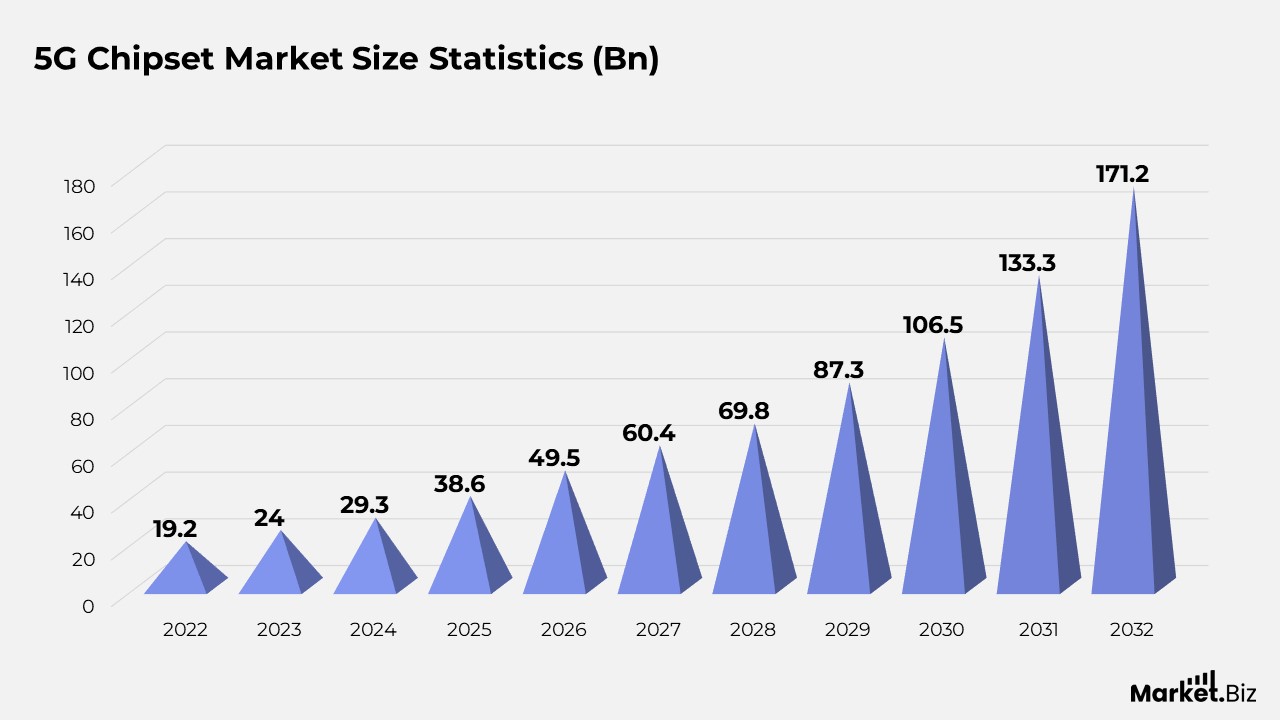
- The revenue generated by the 5G chipset market is anticipated to experience substantial growth in the upcoming years, with a compound annual growth rate (CAGR) of 24.67%.
- In 2022, the market achieved a revenue of USD 19.2 billion, which is expected to increase steadily in the following years.
- By 2023, the market is projected to reach USD 24 billion, indicating a significant rise.
- The growth trend is expected to persist as we advance, with revenues estimated to reach USD 29.3 billion in 2024 and USD 38.6 billion in 2025.
- As the demand for 5G technology continues to escalate, the market is poised for considerable gains, with revenue forecasts of USD 49.5 billion in 2026, USD 60.4 billion in 2027, and USD 69.8 billion in 2028.
- The upward trend continues with even more impressive figures, reaching USD 87.3 billion in 2029, USD 106.5 billion in 2030, and USD 133.3 billion in 2031.
- By 2032, the 5G chipset market is expected to achieve a remarkable revenue milestone of USD 171.2 billion.
Market Players Statistics of 5G Chipsets
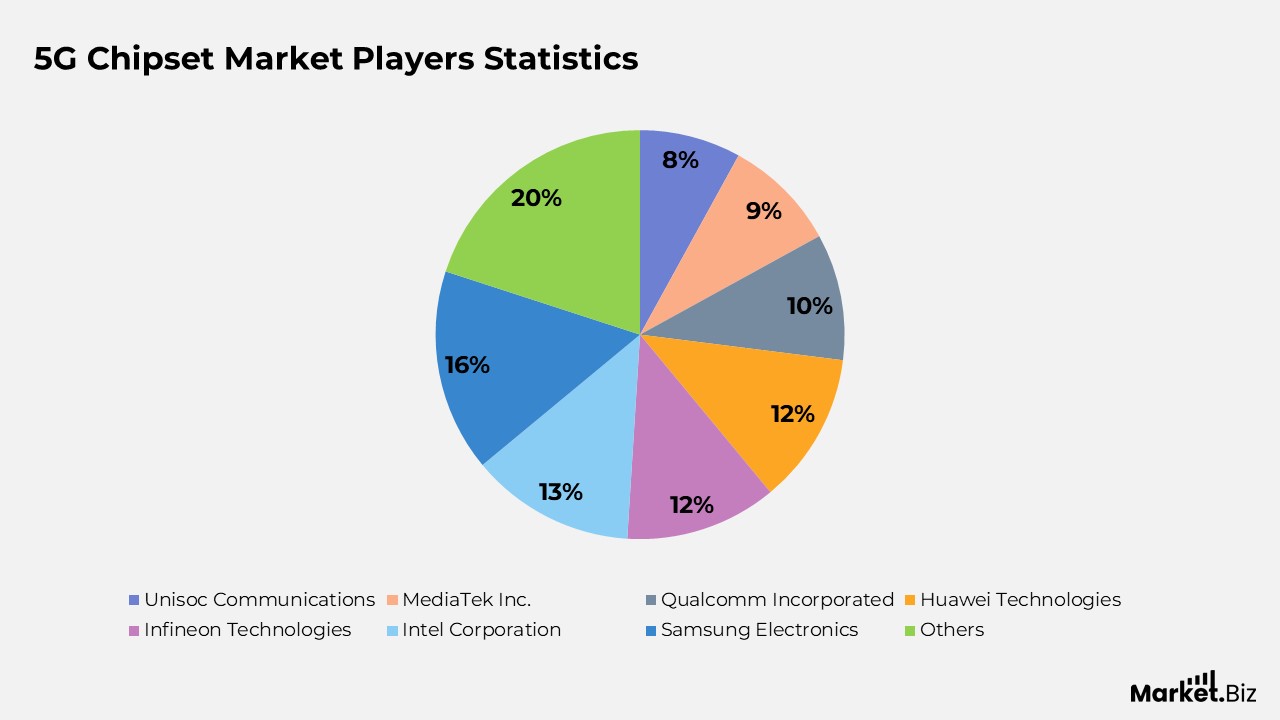
- Samsung Electronics CO., Ltd. is recognised as a leader in the industry, holding a significant 16% market share.
- Qualcomm Incorporated closely trails with a 10% share, celebrated for its groundbreaking advancements in wireless technologies.
- Huawei Technologies Co., Ltd. and Infineon Technologies AG each command a 12% share, highlighting their global influence and innovative efforts.
- Intel Corporation stands as a significant competitor, holding a 13% market share, leveraging its expertise in semiconductor technology.
- MediaTek Inc. and Unisoc Communications, Inc. achieve 9% and 8%, respectively, demonstrating their contributions to 5G solutions.
- Furthermore, a variety of other significant players collectively represent 20% of the market.
5G Chipset Market by Regional Statistics
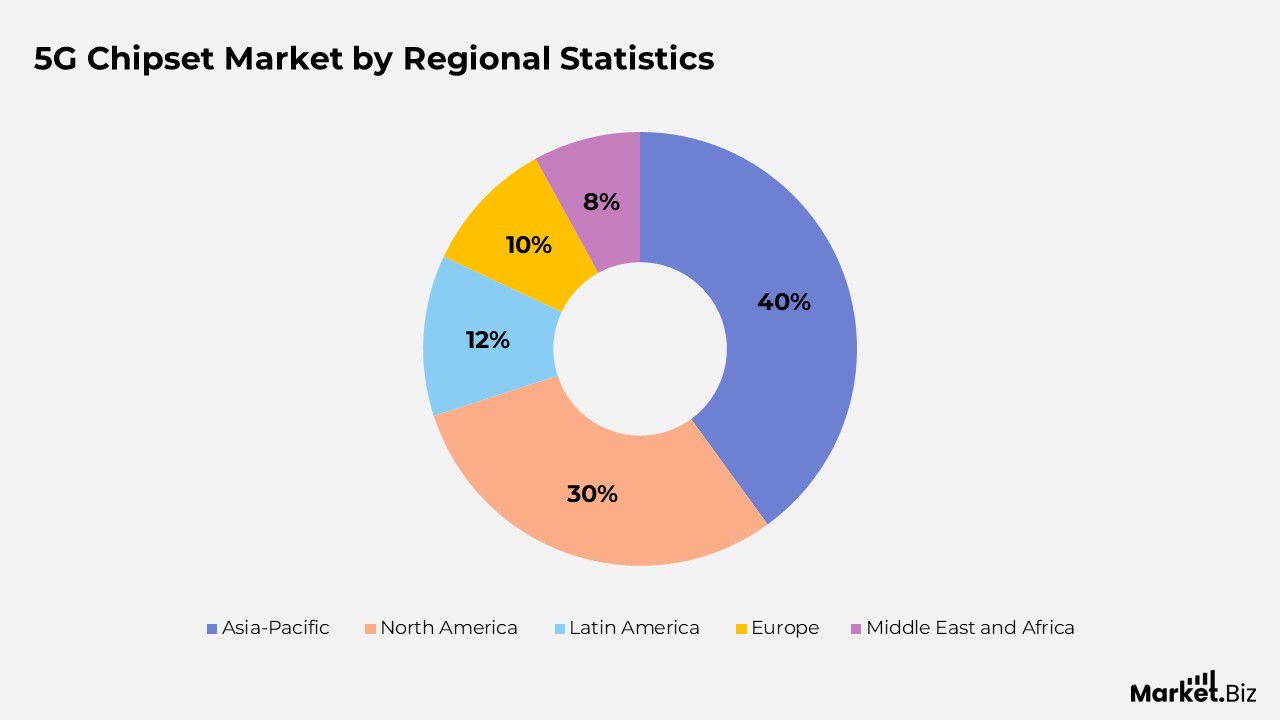
- North America commands the largest market share at 30%, propelled by the swift rollout of 5G networks and robust consumer demand for high-speed connectivity.
- In Europe, the market share is recorded at 10%, which indicates a relatively slower adoption rate compared to North America.
- Conversely, the Asia-Pacific (APAC) region leads the market with a significant 40% share, driven by its large population, rising smartphone usage, and a strong emphasis on technological progress.
- Latin America represents 12% of the market share, demonstrating potential for growth as the 5G infrastructure continues to develop.
- Lastly, the Middle East and Africa (MEA) region accounts for 8% of the market share, reflecting an increasing interest in 5G technology within these areas.
Modem Chipset Statistics
- The 1st generation Balong 5G01 modem is specifically engineered for 5G connectivity. In contrast, the second-generation Balong 5000 modems provide compatibility with both LTE and 5G networks.
- They also feature a 5G variant of their Kirin processor, known as the Kirin 990.
- Mediatek showcases the Helio M70 modem along with a flexible multi-mode 5G system-on-chip that incorporates the M70 modem.
- Qualcomm offers the Snapdragon 855 mobile platforms, enhanced by the Snapdragon X55 and X50 modems.
- Samsung has launched the Exynos 5100 (S5T5100) modem and has recently unveiled the Exynos 980 mobile processor along with the supporting Exynos 5123 modem.
- UNISOC, formerly recognised as Spreadtrum, has attracted interest for its IVY510 5G modem chipset, which is also sometimes referred to as IVYO510.
5g Chipset Energy Efficiency Statistics
- A study conducted by the global technology intelligence company ABI Research indicates that a 5G base station utilises three times the energy of a 4G network to deliver comparable coverage.
- However, ABI Research indicates that improvements in hardware optimisation are expected to significantly reduce power consumption. The most recent generation of chipsets is said to offer typical energy savings ranging from 30% to 70%.
- Further, the energy consumption of 5G is influenced by several factors, such as radio configuration, hardware specifications, and traffic load, with over 70% of the overall energy usage occurring within the Radio Access Network (RAN).
- In a standard situation, a 5G Radio Access Network (RAN) may demand up to 2.7 kilowatts (kW) of power when utilising 64T64R massive MIMO configurations, while a Long-Term Evolution (LTE) radio typically consumes approximately 0.8 kW.
Recent Developments
- In early 2023, Qualcomm finalised its acquisition of Nuvia for $1.4 billion, a startup recognised for its advanced computing technology.
- Moreover, in mid-2023, Intel and MediaTek revealed a collaboration aimed at jointly developing 5G chipsets for laptops.
- In 2023, the Chinese semiconductor firm Unisoc secured $500 million to bolster its 5G chipset development and increase its market presence, particularly in the budget 5G smartphone sector.
- In 2024, Qualcomm introduced its newest Snapdragon 8 Gen 3 chipset, tailored for flagship smartphones.
- Skyworks Solutions, a prominent supplier of analog semiconductors, obtained $200 million in 2024 to expedite its 5G chipset manufacturing.
5G Chipset Future Predictions
- The market is anticipated to experience a Compound Annual Growth Rate (CAGR) surpassing 20% from 2024 to 2030, fuelled by the growth of 5G infrastructure and the rising adoption of 5G-enabled devices.
- The 5G chipset market is witnessing swift growth, with a projected CAGR between 18% and over 32% through 2029.
- By 2029, it is expected that nearly 60% of smartphones will incorporate dedicated Neural Processing Units (NPUs) and support for Large Language Models (LLMs) directly on the 5G chipset.
Conclusion
In summary, 5G chipsets are fundamental to 5G technology, driving its development and enhancing its capabilities. These crucial components are the engine behind the rapid and low-latency connections that 5G networks promise. Their adaptability in accommodating various frequencies and network configurations renders them essential for a wide range of 5G applications.
Key players in the 5G chipset market, including Qualcomm, Samsung, Huawei, and MediaTek, play a significant role in fostering industry innovation and competition. These chipsets revolutionise mobile communication and create opportunities in IoT, smart cities, autonomous vehicles, and beyond. As 5G networks evolve, 5G chipsets will continue to be pivotal in shaping our interconnected world, propelling technological advancement, and enhancing our everyday experiences.
FAQ’s
The Snapdragon X55 5G Modem-RF System delivers impressive multi-gigabit speeds of up to 7.5 Gbps and accommodates all major regions and frequency bands, including 5G mmWave and sub-6, TDD and FDD, as well as SA and NSA modes.
A 5G chipset refers to a dedicated hardware component that facilitates 5G connectivity in smartphones, tablets, and IoT devices. It is essential for processing and transmitting data across 5G networks.
A 5G chipset links a device to a 5G network, enabling rapid data transfer, low-latency communication, and effective power management. It is responsible for processing and overseeing the data flow between the device and the network.