









Introduction
Agentic AI in Enterprise IT Statistics: Agentic AI is emerging as a transformative force in enterprise IT, shifting artificial intelligence from passive analytics to autonomous decision-making and action execution across complex digital environments. Unlike conventional AI systems that operate within fixed rules or predefined prompts, agentic AI can plan tasks, coordinate with other systems, adapt to changing conditions, and act independently with limited human oversight.
This capability is becoming increasingly important as enterprises manage highly distributed IT landscapes spanning hybrid infrastructure, multi-cloud platforms, and growing cybersecurity demands. Organizations are using agentic AI to automate incident response, optimize resource utilization, improve software development workflows, and maintain system reliability at scale.
Enterprise IT statistics on adoption rates, investment levels, operational efficiency gains, and risk mitigation illustrate that agentic AI is moving rapidly from experimentation to core deployment, positioning it as a foundational component of modern enterprise IT strategies and long-term digital transformation efforts.
Editor’s Choice
- Agentic AI in the Enterprise IT Market size is expected to be worth around USD 182.9 Billion By 2034
- 94% of respondents consider AI systems trustworthy, reflecting high confidence in enterprise AI adoption.
- 45% of organizations currently operate as semi to fully autonomous enterprises, with this share projected to reach 74% within five years.
- Productivity, efficiency, and ROI remain the primary KPIs for evaluating AI success, with AI implementations generating a median return of US$175 million.
- 61% of IT leaders view agentic AI as intelligent collaborators that enhance human capabilities rather than simple automation tools.
- The need for human intervention remains a key limitation for 47% of organizations, while a shortage of technical skills constrains AI adoption for 33%.
Enterprise AI Tool Adoption Snapshot
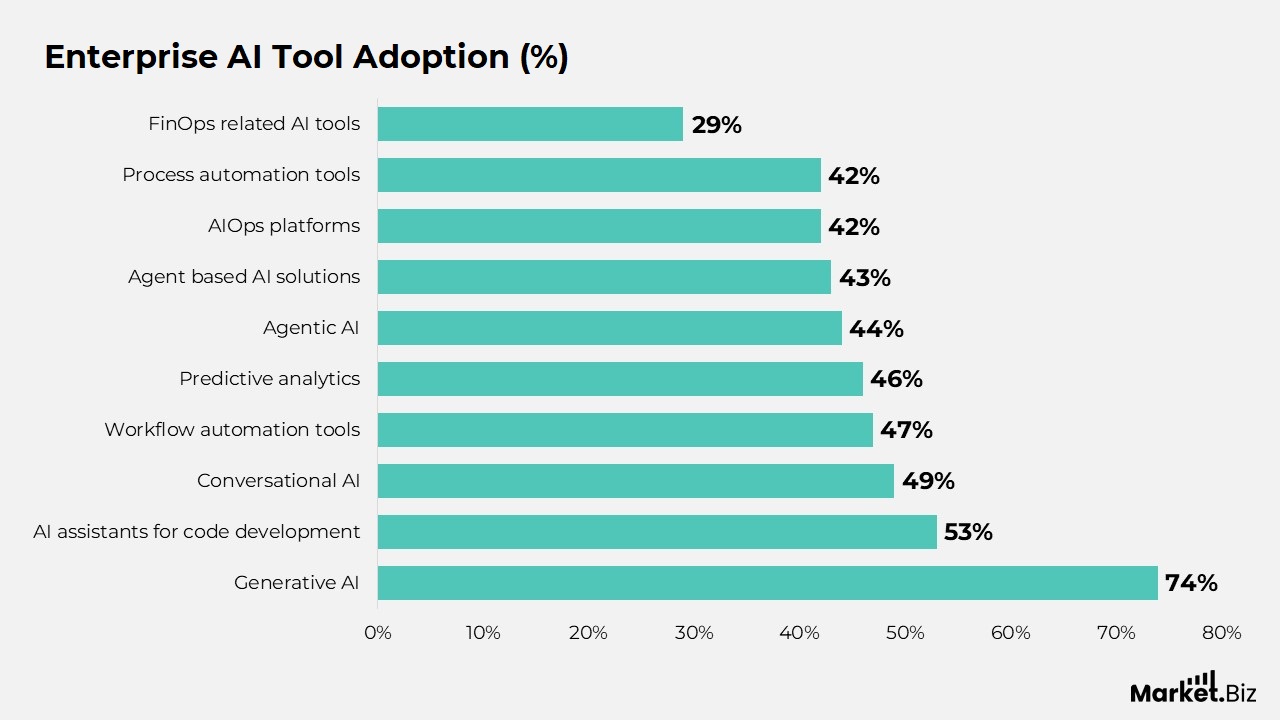
- Organizations report using an average of 5 AI tools, highlighting broad, diversified AI adoption across enterprise IT environments.
- Generative AI is leading adoption, with 74% of enterprises leveraging it for content creation, reasoning, and decision-support use cases.
- AI assistants for code development are widely used by 53% of organizations, reflecting strong demand for faster software development and DevOps efficiency.
- Conversational AI solutions are deployed by 49% of enterprises, supporting customer service automation and internal employee interactions.
- Workflow automation tools have a 47% adoption rate, highlighting the role of AI in streamlining repetitive operational processes.
- 46% of organisations use predictive analytics to enhance forecasting, risk management, and data-driven planning.
- Agentic AI adoption stands at 44%, indicating growing interest in autonomous systems capable of executing tasks with limited human input.
- Agent-based AI solutions are used by 43% of enterprises, supporting multi-agent collaboration and complex system orchestration.
- AIOps platforms have a 42% adoption rate, driven by the need for automated monitoring, incident detection, and IT operations optimization.
- 42% of organizations adopt process automation tools, reinforcing efficiency gains across finance, HR, and supply chain functions.
- FinOps-related AI tools are recording 29% usage, reflecting early but increasing focus on AI-driven cloud cost management and financial governance.
(Sources: Digitate, Statista)
Enterprise AI Investment Momentum and Maturity Progress
- AI investment across enterprises continues to accelerate, with organizations reporting an average AI implementation spend of US$187 million.
- The financial upside from AI remains strong, with respondents reporting an average realized return of US$221 million, reinforcing AI’s value beyond pilot use cases.
- These investment and return levels position AI as a board-level strategic priority rather than an experimental technology initiative.
- Year-over-year ROI from AI initiatives has increased by roughly 30%, reflecting improved deployment maturity and clearer business alignment.
- In 2023, automation-driven AI deployments delivered measurable efficiency improvements across enterprise operations.
- During 2024, European enterprises reported average AI-driven returns of approximately US$170 million, indicating growing regional maturity.
- By 2025, North American organisations will consistently report AI returns exceeding US$175 million, highlighting strong commercialisation outcomes.
- Enterprise AI adoption reached 90% in 2023, demonstrating widespread initial implementation across industries.
- Adoption levels increased to 92% in 2024, showing sustained momentum in enterprise AI deployment.
- By 2025, enterprise AI adoption is expected to reach 100%, signalling near universal usage.
- The share of semi-autonomous enterprises stood at 26% in 2023, reflecting early-stage autonomy.
- Semi-autonomous enterprise adoption rose sharply to 51% in 2024, driven by advanced automation and AI orchestration.
- By 2030, semi-autonomous enterprises are projected to account for 74% of organizations as agentic and autonomous systems mature.
(Sources: Digitate, Statista)
Shifting Priorities for AI Use in Enterprise IT Operations
- AI adoption in network monitoring is set to expand, increasing from 56% today to 60% over the next 12 months as enterprises seek real-time visibility and faster issue detection.
- Cloud visibility and cost optimisation are showing strong growth momentum, rising from 52% to 64%, reflecting increased focus on controlling cloud spend and improving resource efficiency.
- AI-driven event management is expected to moderate slightly, moving from 48% today to 42%, as organizations refine and consolidate alert management tools.
- Cybersecurity applications of AI are gaining traction, with adoption projected to grow from 43% to 50% as threat complexity and attack surfaces expand.
- AI-based incident resolution is poised for significant growth, increasing from 39% to 53%, driven by demand for faster recovery times and reduced downtime.
- Ticket management automation is expected to decline modestly from 35% to 32% as enterprises shift toward proactive rather than reactive support models.
- Proactive problem management using AI is anticipated to rise from 34% to 47%, highlighting a move toward prevention over remediation.
- Business SLA prediction capabilities are projected to grow from 32% to 44%, enabling better performance forecasting and service assurance.
- AI tools designed for site reliability engineers and CIOs are expected to expand sharply from 29% to 43%, supporting data-driven operational decisions.
- Observability platforms leveraging AI are set to increase from 23% to 32%, improving end-to-end system transparency.
- Patch management adoption using AI is projected to rise from 21% to 31%, reflecting a stronger emphasis on automation and security hygiene.
(Sources: Digitate, Statista)
Evolving Enterprise Expectations from Agentic AI Capabilities
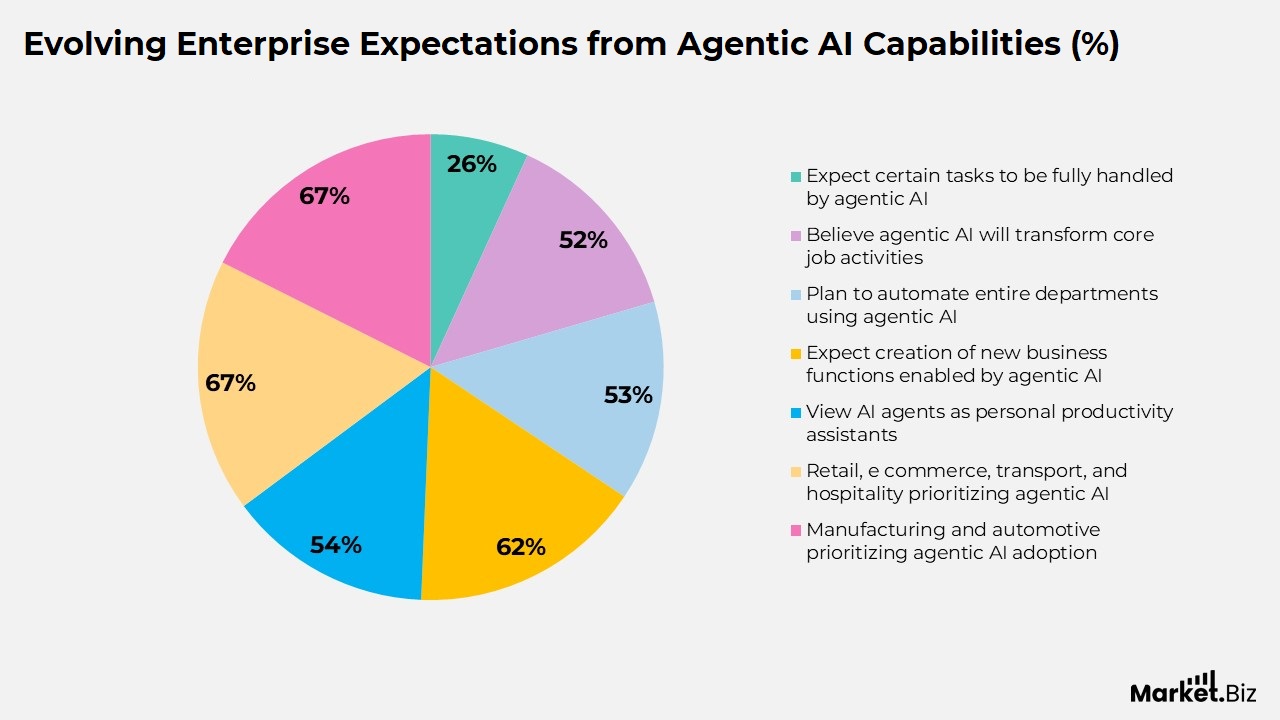
- 26% of respondents believe they will no longer need to perform certain tasks, as agentic AI is expected to manage those responsibilities independently.
- 52% indicate that agentic AI will significantly transform the core activities of their roles, reshaping how daily work gets done.
- 53% state that their organizations plan to automate entire departments using agentic AI to drive efficiency and scalability.
- 62% expect their organizations to identify and implement entirely new business functions enabled by agentic AI capabilities.
- 54% view AI agents as personal assistants that will support individual productivity, decision making, and task coordination.
- The retail, e-commerce, transport, and hospitality sectors rank agentic AI as a top priority, with 67% of respondents highlighting its strategic importance.
- Manufacturing and automotive industries also place strong emphasis on agentic AI adoption, with 67% identifying it as a leading focus area for operational transformation.
(Sources: Digitate, Statista)
Business Impact and Strategic Value of Agentic AI
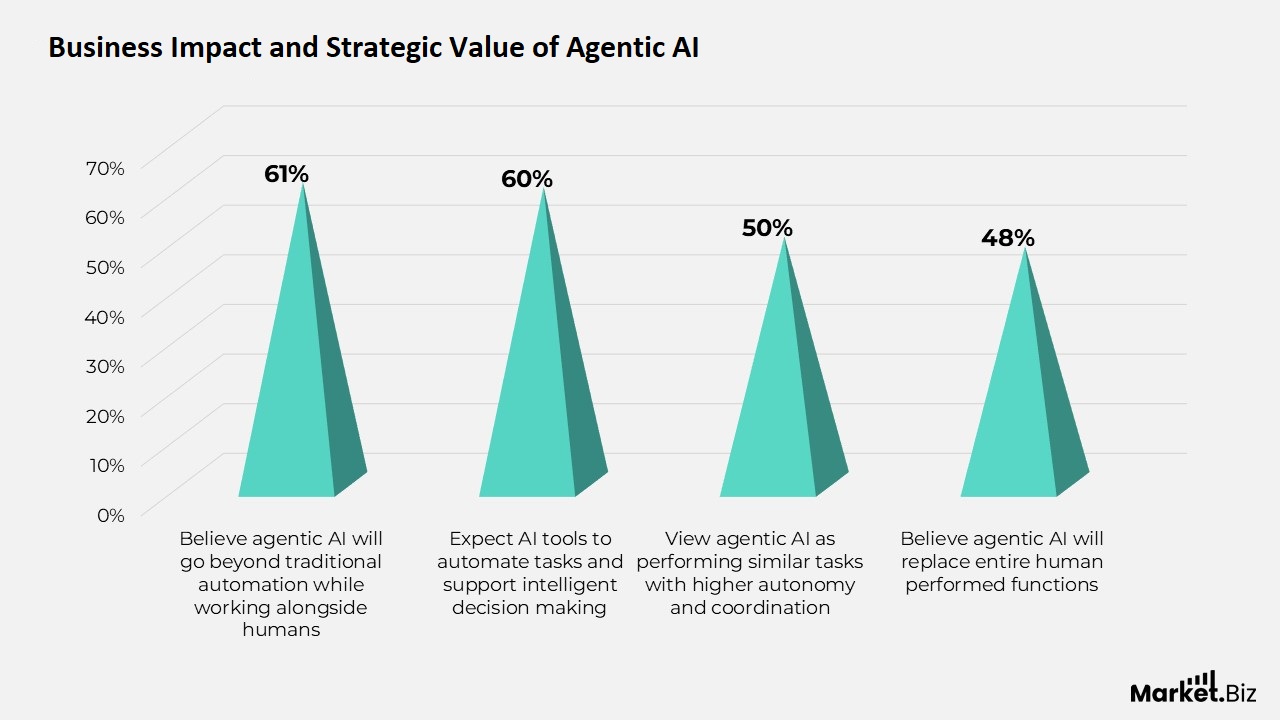
- 61% of respondents believe agentic AI will move beyond traditional automation by handling complex functions while humans continue to work alongside these systems.
- 60% expect AI tools to automate a wide range of tasks and support intelligent decision-making across enterprise operations.
- 50% indicate that agentic AI will perform tasks similar to those of other AI systems, while delivering greater efficiency through autonomy and coordination.
- 48% believe agentic AI will eventually replace entire functions that humans currently perform and that conventional AI tools cannot handle effectively.
- Manufacturing, automotive, technology, government, healthcare, and life sciences sectors rank agentic AI as a top priority for driving operational transformation and decision intelligence.
(Sources: Digitate, Statista)
External and Internal Risks Shaping Enterprise AI Strategies
- Cybersecurity stands out as the leading external risk, with 49% of respondents identifying it as the most significant threat to enterprise operations.
- Rising technology costs rank second at 42%, driven by inflationary pressure on infrastructure investments, cloud computing, and AI model development.
- Macroeconomic uncertainty follows closely, with 36% of organizations preparing for risks linked to inflation, recession, and broader economic volatility.
- To address these pressures, 39% of enterprises are using AI to mitigate security risks, while 28% are leveraging AI to control escalating technology costs.
- Workforce-related challenges remain notable, with 32% of organisations citing rising labour costs as a key risk.
- In response, 22% are deploying AI to offset workforce cost pressures by automating manual processes and scaling employee productivity.
- Internally, IT complexity emerges as the top concern, cited by 37% of respondents as a major operational risk.
- Profitability and cost efficiency rank jointly second among internal risks at 31%, alongside concerns about organisational resistance to change and trust in new technologies.
- Nearly 28% of enterprises have already implemented AI to simplify complex IT environments, while 22% are using AI to improve financial performance.
- Across both external and internal risk areas, organisations increasingly view AI as a structural solution to reduce operational risk and strengthen long-term resilience.
(Sources: Digitate, Statista)
Operational and Organizational Challenges Limiting AI Impact
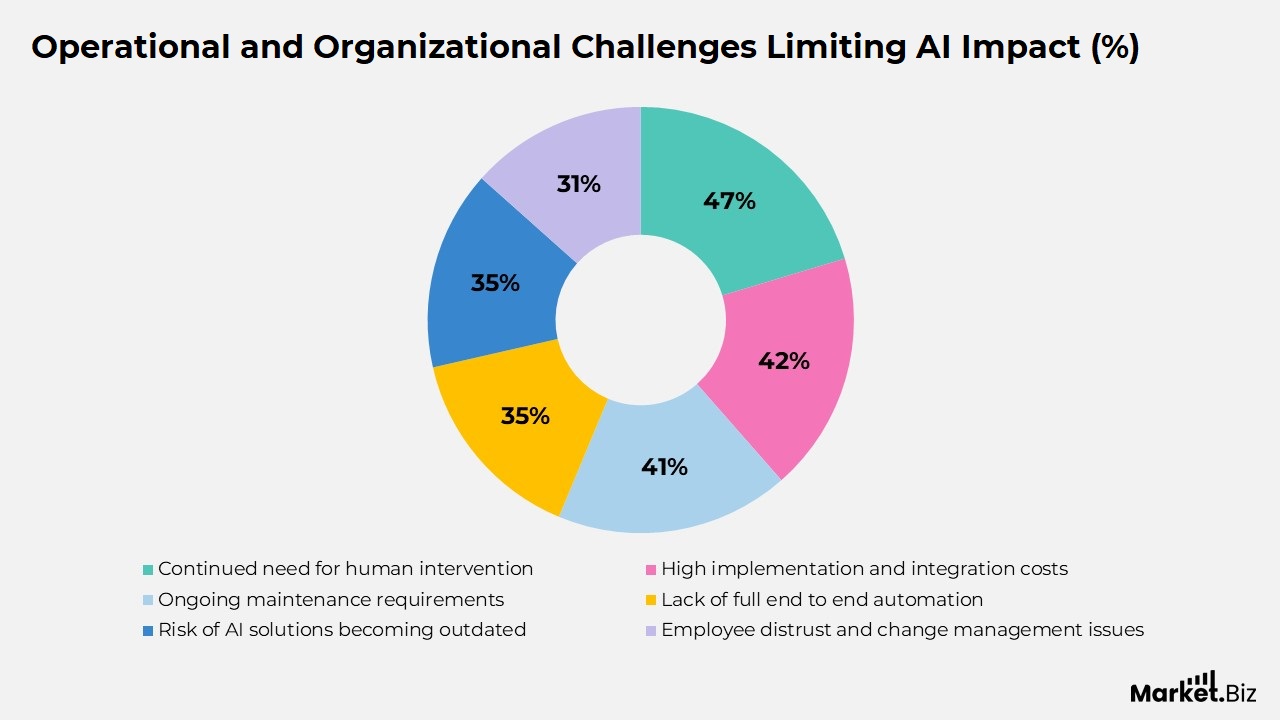
- The continued need for human intervention remains the most cited limitation. With 47% of organizations indicate that AI systems still require significant manual oversight.
- High implementation costs present a major challenge for 42% of respondents, reflecting concerns around upfront investment and integration expenses.
- Ongoing maintenance demands affect 41% of enterprises, underscoring the resource-intensive nature of managing and updating AI systems.
- 35% of organisations note a lack of full automation, signalling gaps between AI capabilities and end-to-end process autonomy.
- 35% of respondents believe AI solutions can quickly become outdated. Raising concerns about technology obsolescence and the need for frequent upgrades.
- Distrust among employees affects 31% of enterprises, indicating cultural and change-management barriers to AI adoption.
- AI-related constraints are seen as hindering business improvements by 25% of organizations, limiting the pace of innovation.
- Reduced operational flexibility is cited by 23% of respondents, suggesting rigidity in some AI-driven workflows.
- A small share (7%) reports other unspecified challenges associated with AI adoption.
- Only 6% of organizations state that none of these issues apply, indicating that most enterprises face at least one barrier when deploying AI.
(Sources: Digitate, Statista)
Challenges Shaping AI Deployment Over the Next 12 Months
- A shortage of technical skills and the need to upskill staff are the most common obstacles, cited by 33% of organizations.
- Data-related challenges, including poor data quality and data management issues, affect 32% of enterprises planning AI adoption.
- The availability of suitable AI tools and solutions remains a concern for 31% of respondents, hindering decision-making.
- Budget constraints for implementing automation initiatives are reported by 31% of organizations.
- Employee resistance to change is a key barrier for 31% of enterprises. Reflecting challenges with cultural adoption.
- Human interaction-related concerns affect 29% of respondents as organisations balance automation with human involvement.
- 29% of organisations cite employee fear that AI may eliminate jobs, which influences internal acceptance.
- Integrating AI with legacy technologies presents difficulties for 28% of enterprises.
- Misconceptions about AI capabilities hinder adoption for 28% of respondents.
- Resistance to organizational change continues to affect 26% of enterprises.
- Concerns about technical sprawl and the management of multiple AI tools are noted by 24% of organisations.
- 23% of respondents view lengthy deployment timelines as a barrier.
- A lack of clearly defined AI use cases limits progress for 23% of enterprises.
- Difficulty in measuring ROI from AI initiatives is cited by 23% of organizations.
- Limited executive support or sponsorship is reported by 23% of respondents.
- Only 4% of organisations indicate they face no obstacles to AI adoption over the next 12 months.
(Sources: Digitate, Statista)
Key Metrics Used to Measure the Success of Enterprise AI Initiatives
- Productivity and efficiency gains are the top success measures. With 46% of organizations prioritize them when assessing AI initiatives.
- Return on investment remains a critical benchmark, as 41% of respondents focus on ROI to justify and guide AI spending decisions.
- Enhanced analytics capabilities that support data-driven decision-making are emphasized by 36% of enterprises.
- Cost savings generated through automation and operational optimization are tracked by 35% of organizations as a key performance indicator.
- Improvements in overall profitability are considered important by 33% of respondents evaluating the impact of AI.
- Service performance improvements, reflected through better SLA achievement, are monitored by 31% of enterprises.
- Sustainability improvements, including energy efficiency and resource optimization, are prioritized by 30% of organizations.
- Faster time-to-market enabled by AI-driven workflows is measured by 25% of respondents as part of the AI success evaluation.
(Sources: Digitate, Statista)
Enterprise Adoption Stages of AI Agents
- 79% of organizations report adopting AI agents in some form. Indicating broad early-to-mid-stage penetration across enterprises.
- 35% of companies are currently running pilot programs or testing AI agent use cases to evaluate feasibility and business impact.
- 25% of organizations use AI agents in isolated or limited scenarios. Focusing on specific tasks rather than enterprise-wide deployment.
- 19% of enterprises have moved beyond experimentation and are deploying AI agents at scale across multiple functions.
(Sources: Digitate, Statista, Multimodal)
Conclusion
Agentic AI is rapidly redefining the enterprise IT landscape, transitioning AI from a supporting technology into an active operational partner capable of autonomous decision-making, coordination, and execution.
The statistics clearly indicate strong trust in AI systems, accelerating investment, and widespread adoption across core IT functions, including operations, security, cloud management, and productivity. Enterprises are no longer viewing agentic AI as an experimental layer but as a structural capability that drives efficiency, resilience, and scalability in increasingly complex IT environments.
At the same time, the data highlights practical challenges, including skills gaps, cost pressures, cultural resistance, and the continued need for human oversight, underscoring that the shift toward autonomy is evolutionary rather than immediate.
Overall, enterprise IT statistics reflect a clear trajectory toward semi-autonomous and eventually autonomous operations, with agentic AI positioned as a foundational pillar for long-term digital transformation, risk mitigation, and sustained business performance.
FAQ’s
Agentic AI is a class of artificial intelligence designed to operate with a high degree of autonomy within enterprise IT environments. It is characterized by its ability to reason, plan, make decisions, and execute actions across systems without continuous human input, differentiating it from rule-based automation and traditional AI models.
Traditional AI typically focuses on prediction, classification, or rule-driven automation within predefined boundaries. Agentic AI extends these capabilities by enabling systems to set goals, evaluate multiple action paths, adapt to changing conditions, and coordinate with other AI agents or enterprise tools to achieve outcomes.
An agentic system is defined by autonomy, context awareness, adaptability, and the ability to act across interconnected IT environments. These systems observe real-time data, reason through complex scenarios, and take the initiative to optimize processes or resolve issues without explicit step-by-step instructions.
Agentic AI represents a structural shift because it embeds decision-making and execution directly into IT operations. Instead of IT teams reacting to alerts and dashboards, agentic systems continuously manage, optimize, and coordinate infrastructure, enabling more resilient and self-governing enterprise IT architectures.
Agentic AI builds on earlier stages of digital transformation, including automation, analytics, and machine learning. It serves as the next evolutionary layer, where intelligent systems move from supporting human decisions to actively driving outcomes, laying the foundation for semi-autonomous and autonomous enterprise operations.