








Introduction
Artificial Intelligence in Military Statistics: The incorporation of Artificial Intelligence (AI) into military operations signifies a significant transformation in defence, utilising machine learning, robotics, natural language processing, and computer vision to improve decision-making, efficiency, and tactical advantages. These technologies support a diverse range of applications, including autonomous drones, cybersecurity measures, predictive logistics, and sophisticated training simulations.
They fundamentally change the landscape of military strategies and operations. While providing considerable advantages in operational accuracy and risk mitigation, the use of AI in the military domain also prompts important ethical and legal concerns.
This is especially true regarding autonomous weapon systems and the transfer of critical decision-making to machines. This progression necessitates careful consideration of ethical guidelines, regulatory frameworks, and strategic factors. It highlights the crucial role of AI in influencing future defence strategies and international security dynamics.
Editor’s Choice
- The revenue generated by the global artificial intelligence market in the military sector reached USD 8.9 billion in 2023.
- In the distribution of market share by platform within the military sector’s artificial intelligence domain, space platforms take the lead with a notable 33% share.
- In 2018, hardware services generated $960.7 million, which soared to $2601.4 million by 2024, demonstrating a significant increase.
- In terms of military spending, the United States holds the top position worldwide with an astonishing $877 billion, which represents 3.5% of its GDP.
- 59% of respondents recognise the absence of data-science specialists as the principal barrier to the implementation of big-data-driven AI technologies.
- 44% of organisations employed AI to identify and prevent security breaches, underscoring the essential function of AI in protecting digital infrastructures.
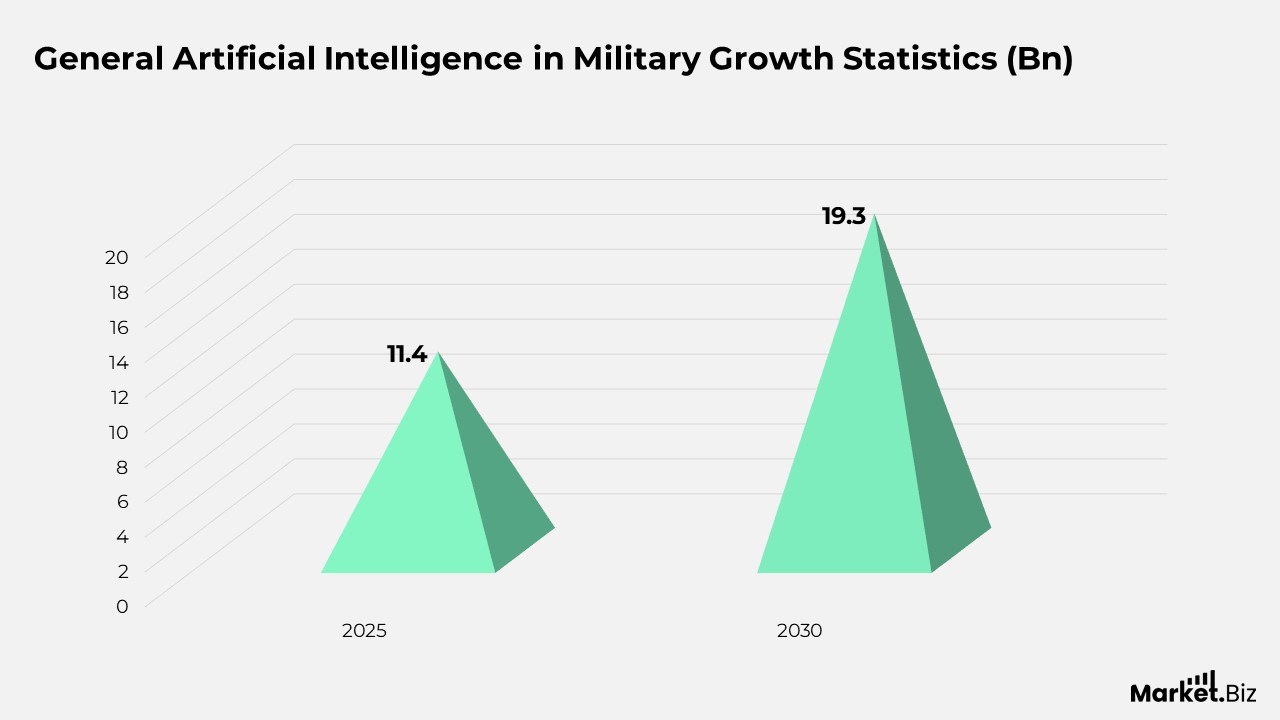
General Artificial Intelligence in Military Statistics
- The revenue generated by the global artificial intelligence market in the military sector reached USD 8.9 billion in 2023.
- By the year 2032, it is anticipated that the market will expand to USD 24.7 billion, with revenues from software, hardware, and services projected to be USD 10.52 billion, USD 8.00 billion, and USD 6.18 billion, respectively.
- In terms of market share distribution by platform within the military artificial intelligence sector, space platforms dominate with a significant 33% share.
- In 2018, 44% of organisations employed AI technologies to identify and prevent security breaches, underscoring the essential function of AI in protecting digital infrastructures.
- Regarding military spending, the United States holds the top position globally with an impressive $877 billion, which represents 3.5% of its GDP.
- Importantly, the Pentagon has updated its policy on autonomous weapons to incorporate developments in AI since the initial policy was established in 2012.
- A significant 59% of survey participants cite the shortage of data-science professionals as the primary obstacle to the adoption of big-data-driven AI technologies.
Artificial Intelligence in Military Market Revenue Statistics
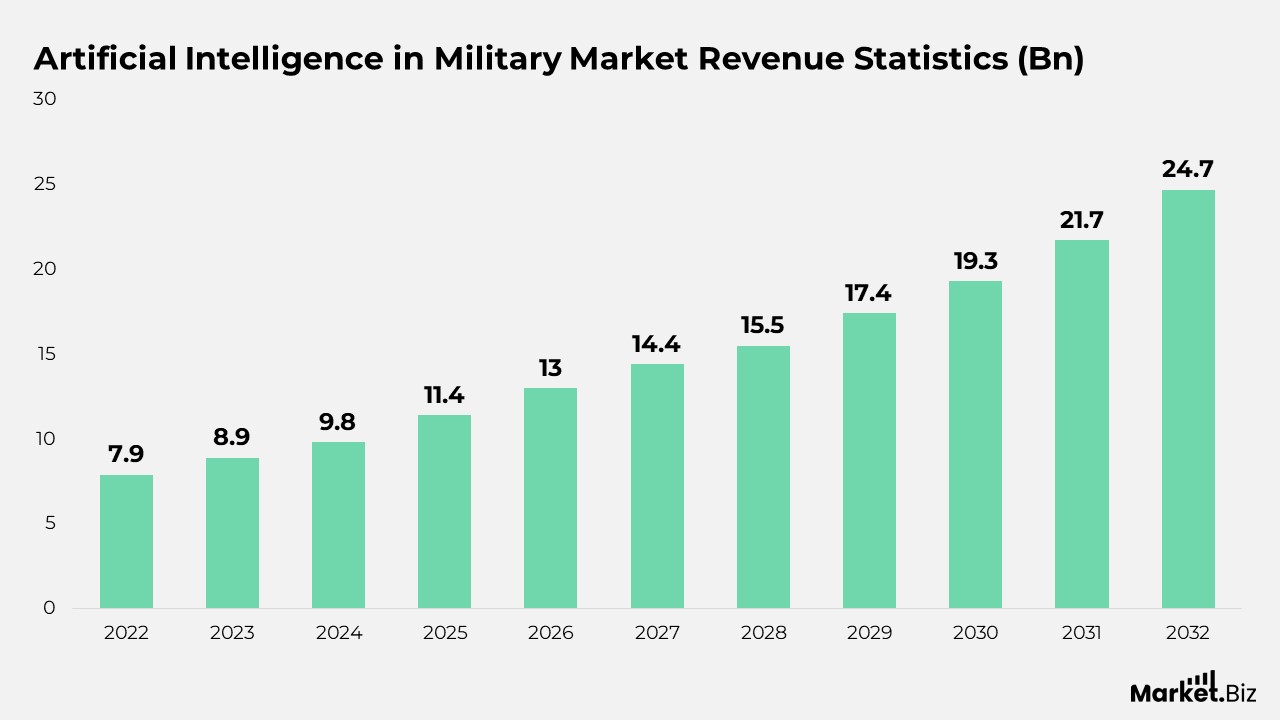
- The global military artificial intelligence market has demonstrated a consistent growth pattern from 2022 to 2032, with a compound annual growth rate (CAGR) of 12.4%.
- Beginning with a revenue of USD 7.9 billion in 2022, the market saw annual increases. It reached USD 8.9 billion in 2023 and further progressed to USD 9.8 billion in 2024.
- This positive trend persisted, with the market size growing to USD 11.4 billion in 2025. This was followed by a rise to USD 13.0 billion in 2026 and subsequently to USD 14.4 billion in 2027.
- The growth momentum continued, with the market value increasing to USD 15.5 billion in 2028, USD 17.4 billion in 2029, and USD 19.3 billion in 2030.
- Looking ahead, the market is anticipated to reach USD 21.7 billion in 2031, culminating in a significant rise to USD 24.7 billion by 2032.
AI in Military by Platform Statistics
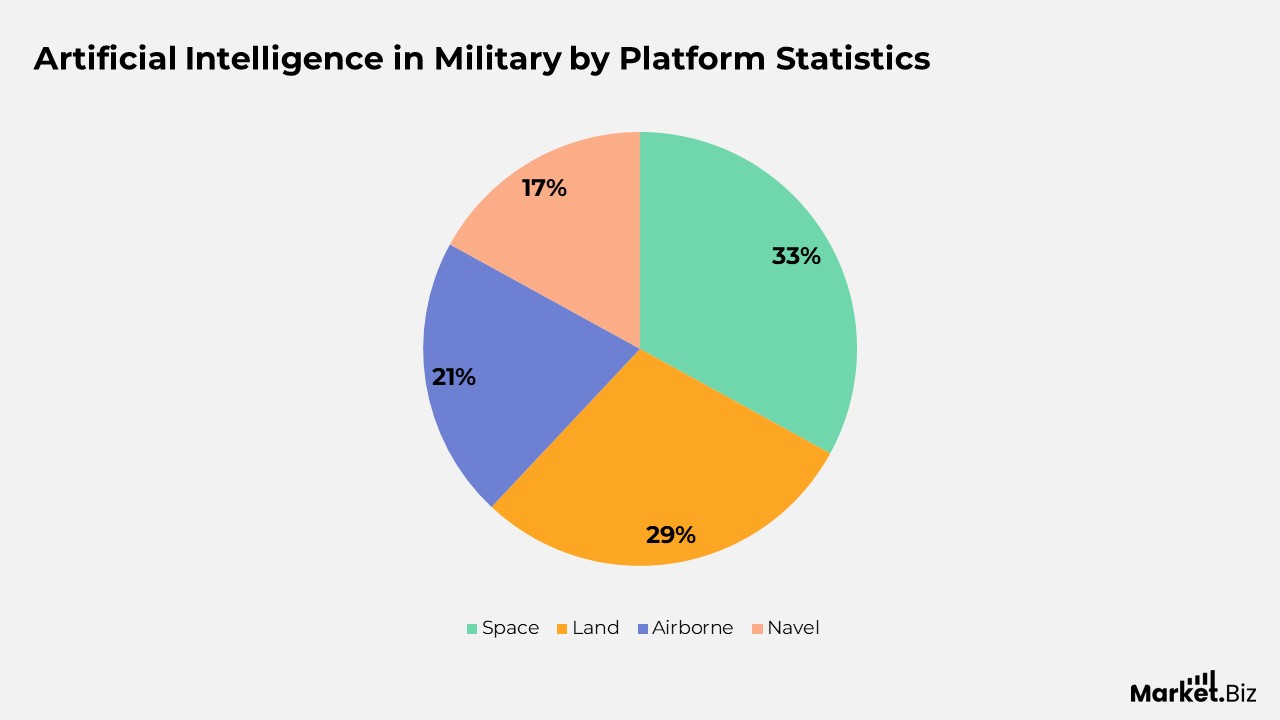
- In the distribution of market share by platform within the military sector’s artificial intelligence domain, space platforms take the lead with a notable 33% share.
- Land platforms closely follow, capturing a 29% share, which reflects the significant integration of AI in ground operations, such as autonomous vehicles, robotics, and surveillance systems.
- Airborne platforms represent 21% of the market, underscoring the critical role of drones, fighter jet support systems, and other aerial applications in contemporary military strategies.
- Finally, naval platforms make up 17% of the market share, demonstrating a strong investment in AI for unmanned underwater vehicles, shipboard systems, and maritime surveillance.
Artificial Intelligence in Military and Cybernetics by Service Statistics
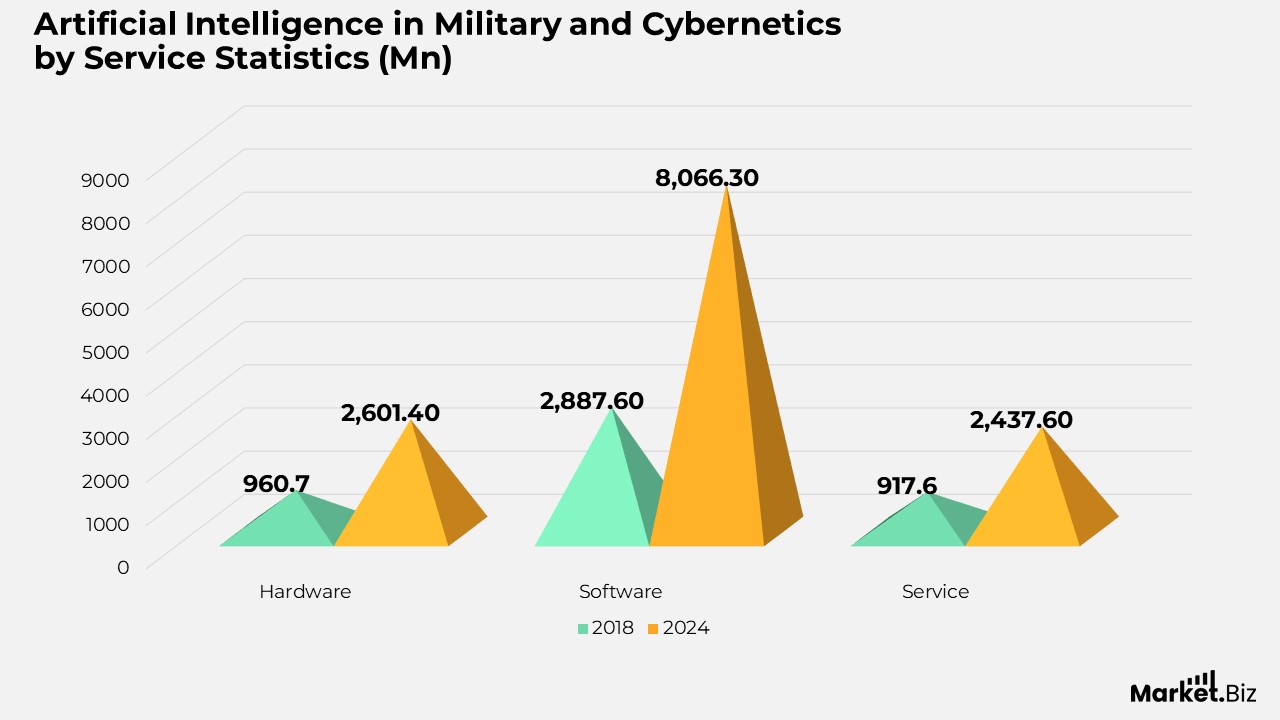
- In 2018, hardware services generated $960.7 million, which soared to $2601.4 million by 2024, demonstrating a significant increase.
- Similarly, software services experienced considerable growth, rising from $2887.6 million in 2018 to $8066.3 million in 2024.
- Additionally, services such as consulting and maintenance also saw a remarkable increase in revenue, advancing from $917.6 million in 2018 to $2437.6 million in 2024.
Military Spending of Various Nations Statistics
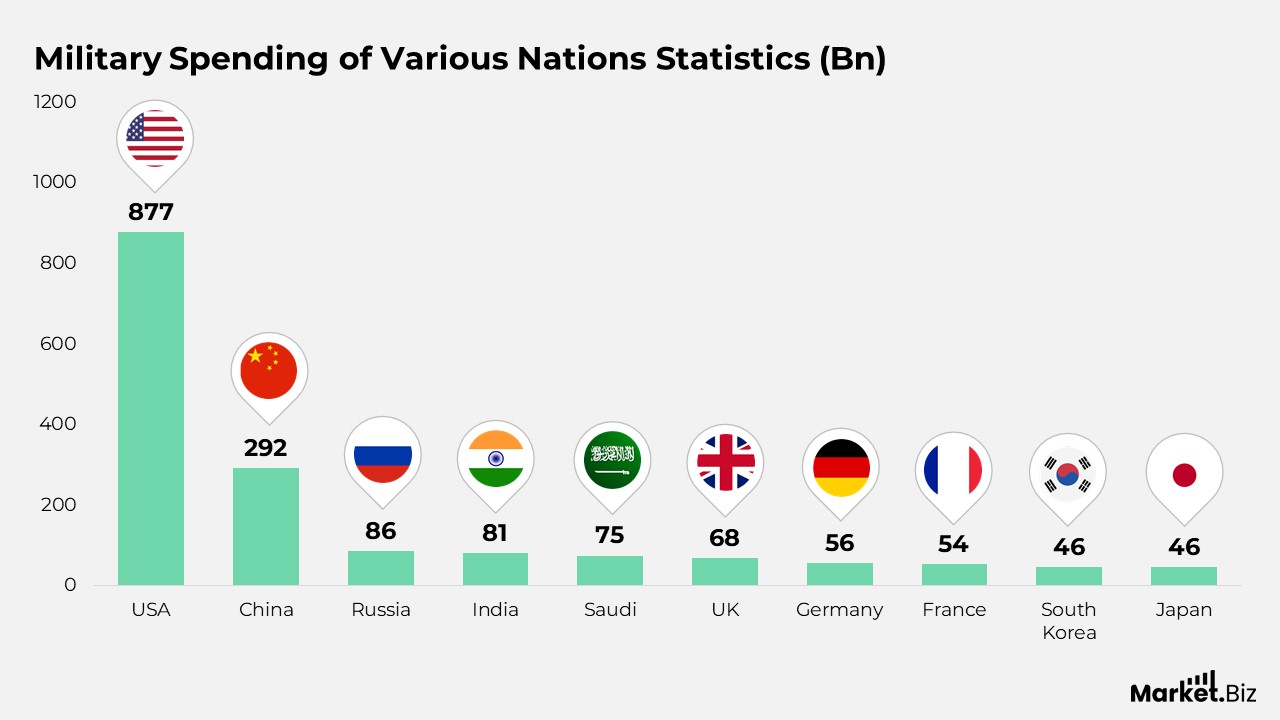
- In terms of military spending, the United States holds the top position worldwide with an astonishing $877 billion, which represents 3.5% of its GDP.
- China follows closely, dedicating $292 billion to its military, although this accounts for a smaller GDP percentage of 1.6%. Russia, on the other hand, invests $86 billion, which is a notable 4.1% of its GDP towards defense.
- India’s military expenditure is $81 billion, making up 2.4% of its GDP.
- Interestingly, Saudi Arabia allocates $75 billion, which is the largest GDP share among the countries mentioned, at 7.4%.
- The United Kingdom and Germany have military expenditures of $68 billion and $56 billion, respectively, with GDP shares of 2.2% and 1.4%.
- France is next with $54 billion, corresponding to 1.9% of its GDP. Japan and South Korea each allocate $46 billion, with GDP shares of 2.7% and 1.1%, respectively.
Challenges and Concerns Statistics
- 59% of respondents recognise the absence of data-science specialists as the principal barrier to the implementation of big-data-driven AI technologies.
- Meanwhile, 76% of business leaders consider data bias and transparency challenges as their foremost concerns related to AI adoption.
- Additionally, 40% of executives point to costs and a lack of adequate expertise as the key impediments to investing in AI.
- Furthermore, 37% of business leaders believe their managers do not possess the necessary understanding of cognitive technologies such as AI to ensure a favourable return on investment.
Artificial Intelligence in Military Organisations
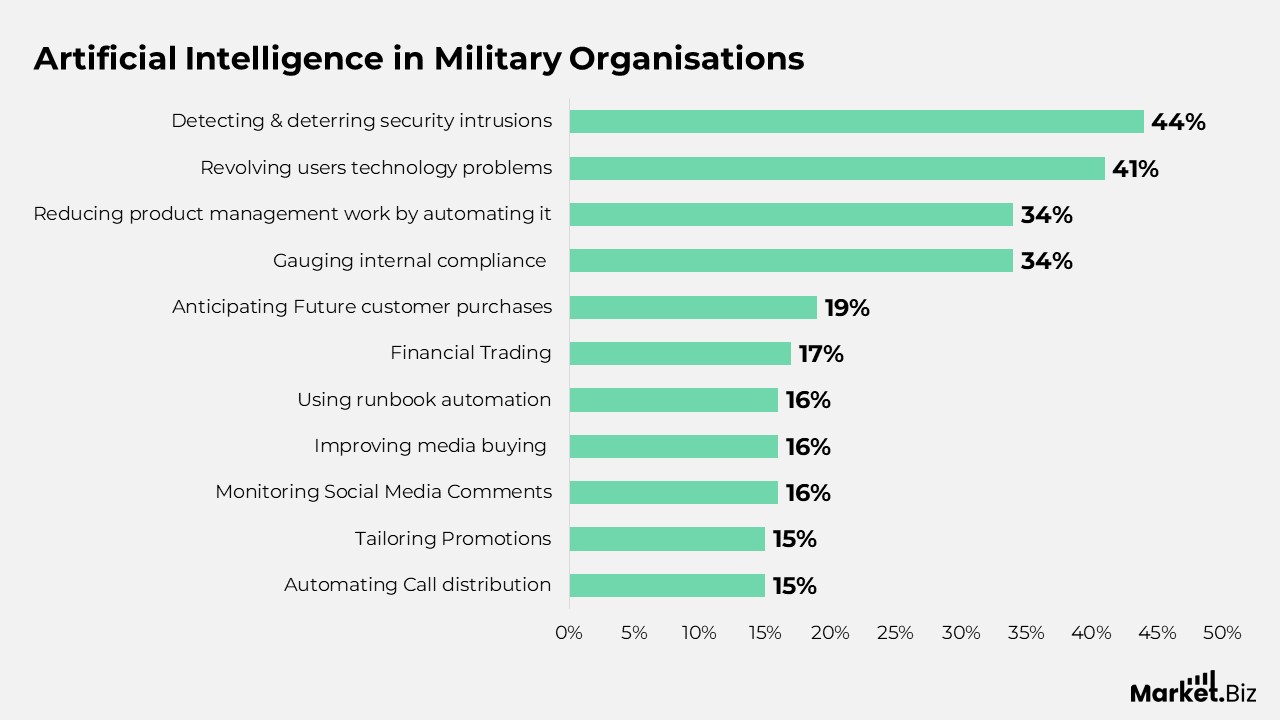
- 44% of organisations employed AI to identify and prevent security breaches, underscoring the essential function of AI in protecting digital infrastructures.
- Close behind, 41% implemented AI solutions to address user technology issues, thereby streamlining IT support and improving user experience.
- Additionally, 34% of organisations prioritised reducing product management tasks and assessing internal compliance through automation, highlighting AI’s ability to simplify complex processes and ensure adherence to regulations.
- Furthermore, 19% of organizations utilized AI to predict future customer purchases, showcasing AI’s strength in predictive analytics for understanding consumer behaviour.
- Financial trading and runbook automation were recognised by 17% and 16% of organisations, respectively, as sectors that benefit from AI’s capabilities in real-time analysis and process automation.
- In a similar vein, enhancing media buying, monitoring social media feedback, and customising promotions each engaged 16% of organisations, reflecting AI’s increasing impact on marketing and social engagement strategies.
- Finally, 15% of organisations leveraged AI for automating call distribution, indicating its role in optimising customer service operations.
AI Military Applications Statistics
Warfare Systems
- The incorporation of AI into military systems such as weaponry, sensors, and surveillance is improving operational effectiveness and lessening reliance on human operators, potentially resulting in lower maintenance requirements.
- The automation capabilities offered by AI reduce the likelihood of human mistakes and enable personnel to concentrate on essential responsibilities.
- Importantly, the Pentagon has updated its policy on autonomous weapons to account for developments in AI since the initial policy was established in 2012.
- This revision guarantees the responsible and ethical use of autonomous weaponry, which represents one of the most crucial military applications of AI.
- It introduces more rigorous review and testing procedures and creates a specialized working group to advise the Department of Defense regarding autonomous weapon systems.
Threat Monitoring
- AI-powered unmanned systems and drones improve threat surveillance and situational awareness during military operations.
- These technologies can be controlled remotely or set to navigate specific routes. They aid defense personnel in identifying threats and enhancing their overall situational awareness.
- Drones equipped with AI are especially effective for monitoring border areas, detecting possible threats, and alerting response teams.
- Additionally, they play a significant role in securing military facilities and ensuring the safety of soldiers in combat environments.
Artificial Intelligence in Military: Recent Developments
- In 2023, venture capital investments in AI military startups reached a total of $3.5 billion, primarily targeting companies that provide innovative AI solutions for defense purposes.
- Strategic collaborations and acquisitions among defense contractors, technology companies, and research institutions represented 60% of the overall investment activity within the AI military sector in 2023.
- A Series C funding round for an AI defense contractor took place in February 2024, successfully raising $100 million to enhance the production of AI-enabled military systems and to enter new markets.
- In April 2024, seed funding was secured for a defense AI research institute, amounting to $20 million, aimed at advancing AI algorithms for military use and facilitating collaborative research with government entities.
Conclusion
Artificial Intelligence in Military Statistics: The incorporation of Artificial Intelligence (AI) into military operations presents considerable opportunities to enhance operational effectiveness, decision-making, and technological superiority.
AI has been instrumental in improving functions such as autonomous operations, surveillance, logistics, and threat detection, thereby minimizing human risk and boosting efficiency. Nevertheless, its swift implementation introduces significant ethical, legal, and operational challenges.
As AI progresses, military leaders and policymakers are required to formulate robust ethical guidelines and frameworks to address these challenges and ensure the responsible use of AI. The ongoing advancement of AI will be vital in influencing future military strategies and demands continuous assessment and adaptation to emerging developments and concerns.
FAQ’s
Artificial intelligence in the military pertains to the application of AI technologies, including machine learning, natural language processing, robotics, and computer vision, to improve decision-making, operational efficiency, and tactical capabilities within military environments.
AI is employed across a range of military operations, such as autonomous vehicle navigation, surveillance, target recognition, threat analysis, cybersecurity, logistic optimisations, and more. It facilitates the rapid and accurate processing of extensive data, thereby enhancing response times and strategic decision-making.
The advantages of implementing AI in the military encompass heightened operational efficiency, diminished human casualties, improved precision in targeting and intelligence operations, enhanced data processing and situational awareness, as well as the capability to execute complex tasks autonomously.