








Introduction
Space Tourism Statistics: Space tourism signifies a revolutionary venture within the aerospace and travel industries, enabling everyday individuals to venture into outer space. Additionally, this initiative encompasses the commercial transport of paying passengers beyond the confines of Earth’s atmosphere, providing them with a unique opportunity to experience weightlessness.
Witnessing stunning views of our planet and engaging in an extraordinary journey through space. Although it may seem like a contemporary concept, the roots of space tourism can be traced back to the pioneers of the early 20th century, such as Konstantin Tsiolkovsky, and it gained momentum during the era of the Space Race.
In the early 2000s, projects like SpaceShipOne brought the dream of commercial space travel to fruition. Moreover, in recent years, companies such as SpaceX, Blue Origin, and Virgin Galactic have emerged, competing to make space tourism accessible to a broader audience, signalling a significant shift in the industry’s dynamics.
Editor’s Choice
- The space tourism market has experienced extraordinary expansion in recent years, achieving a compound annual growth rate (CAGR) of 36.6%, with its revenue reaching unprecedented levels.
- In 2022, the sector generated around USD 847.7 billion, representing a significant beginning for this emerging industry.
- Sub-orbital tourism is anticipated to reach USD 9,350.2 billion, while orbital tourism is estimated to represent USD 8,392.1 billion.
- SpaceX, formally referred to as Space Exploration Technologies Corp., was founded by Elon Musk in March 2002.
- In 2019, Blue Origin announced its plans for a lunar lander named “Blue Moon.” This lander is designed for missions to the Moon and is part of NASA’s Artemis program.
- More than 55% of American adults anticipate that within the next 50 years, space travel for tourism will become commonplace.
General Space Tourism Statistics
- The space tourism sector has experienced extraordinary expansion in recent years, achieving a compound annual growth rate (CAGR) of 36.6%, with its revenue reaching unprecedented levels.
- By the year 2027, the space tourism market is projected to exceed USD 4,162.3 billion, and this positive trend is anticipated to persist in the subsequent years, ultimately reaching an astonishing USD 17,742.4 billion by 2032.
- In this evolving industry, commercial companies hold a substantial market share of 57%.
- SpaceX introduced the Dragon spacecraft, which became the first commercial spacecraft to transport cargo to the International Space Station (ISS) in 2012.
- On July 11, 2021, VSS Unity successfully completed its inaugural fully crewed test flight, transporting Sir Richard Branson along with other Virgin Galactic personnel to the brink of space. This event represented a significant achievement for the company.
- The orbital space travel and tourism sector is anticipated to generate around USD 555 million in revenue by 2030.
- More than 55% of American adults believe that within the next 50 years, it will be commonplace for individuals to embark on space travel for tourism purposes.
Space Tourism Market Size Statistics
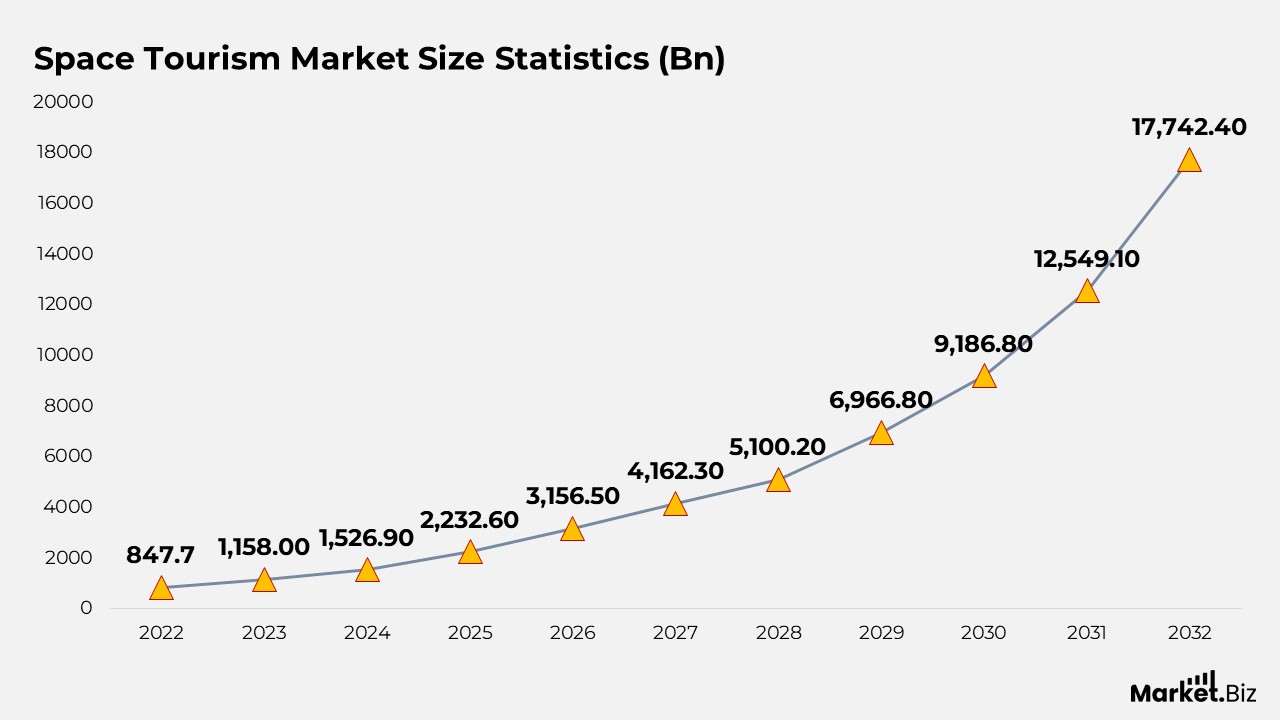
- The space tourism sector has experienced extraordinary growth in recent years, achieving a compound annual growth rate (CAGR) of 36.6%, with its revenue reaching unprecedented levels.
- In 2022, the sector generated around USD 847.7 billion, representing a significant beginning for this emerging industry.
- This upward trend persisted into 2023, as market revenue soared to USD 1,158.0 billion, indicating a swift increase in consumer interest and investment.
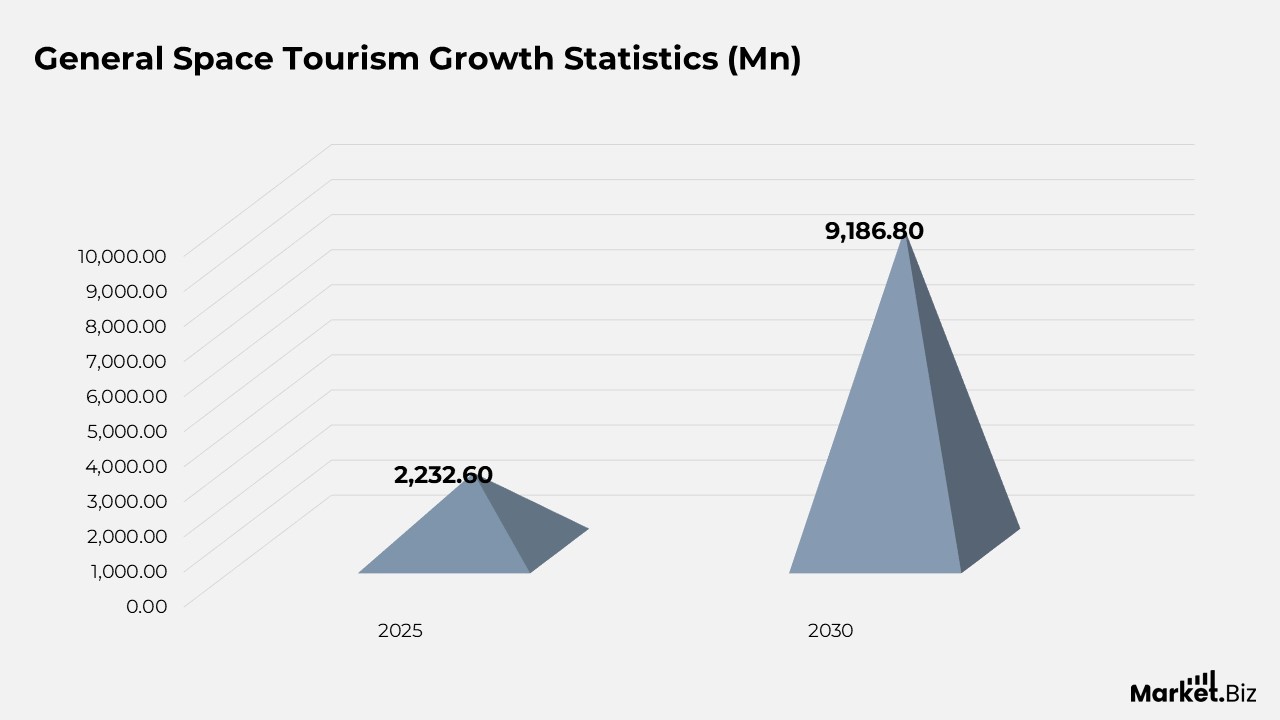
- Looking forward, the market is anticipated to undergo exponential growth, with projections estimating revenues of USD 1,526.9 billion in 2024, USD 2,232.6 billion in 2025, and USD 3,156.5 billion in 2026.
- By 2027, the space tourism market is forecasted to exceed USD 4,162.3 billion, and this positive trend is expected to continue in the subsequent years, culminating in an astonishing USD 17,742.4 billion by 2032.
Type Statistics by Space Tourism
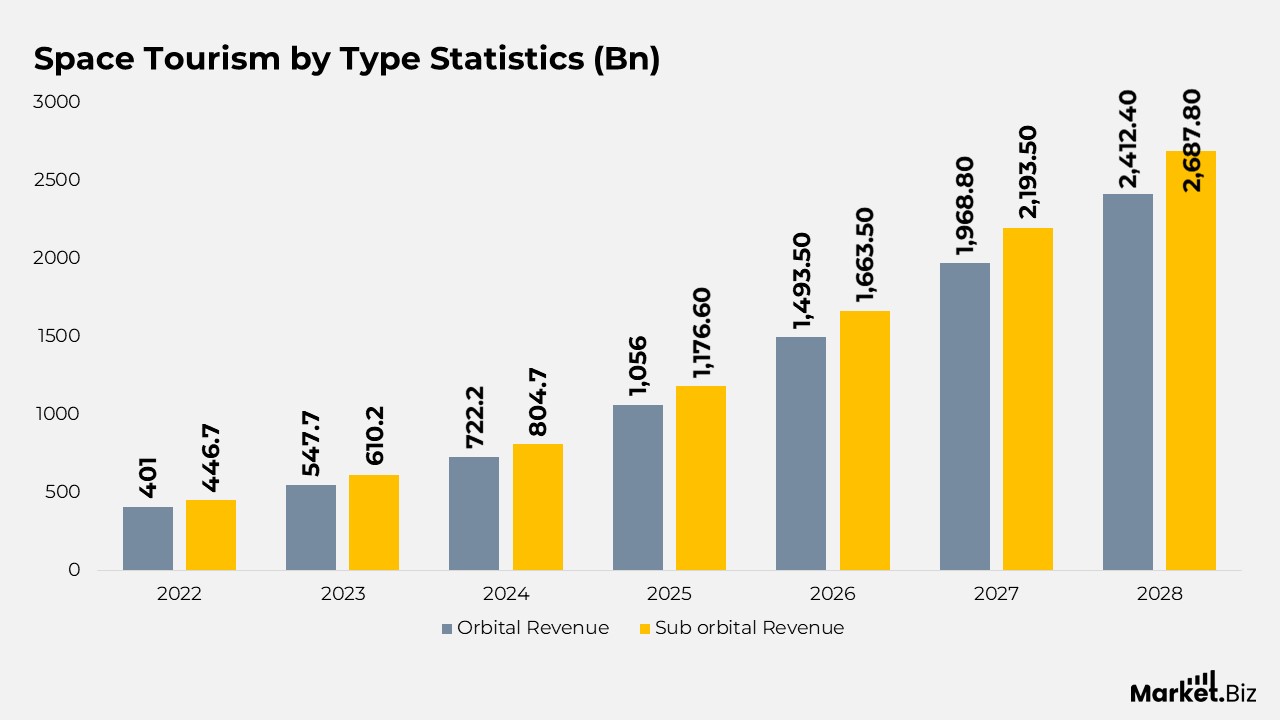
- In 2022, the market recorded a total revenue of USD 847.7 billion. Sub-orbital tourism was responsible for USD 446.7 billion, whereas orbital tourism added USD 401 billion to this total.
- This positive trend continued into 2023, with total revenue rising to USD 1,158 billion. Sub-orbital tourism accounted for USD 610.2 billion, while orbital tourism produced USD 547.7 billion in revenue.
- The market for space tourism is set to experience significant growth, as projected revenue figures indicate continued expansion in both the sub-orbital and orbital sectors.
- Additionally, by the year 2024, total revenue is projected to hit USD 1,526.9 billion, with sub-orbital tourism making USD 804.7 billion and orbital tourism funding USD 722.2 billion.
- This upward trend is expected to continue, and by 2032, the market is forecasted to achieve a remarkable total revenue of USD 17,742.4 billion.
- Sub-orbital tourism is anticipated to reach USD 9,350.2 billion, while orbital tourism is estimated to represent USD 8,392.1 billion.
Space Tourism by Players Statistics
SpaceX
- SpaceX, formally referred to as Space Exploration Technologies Corp., was founded by Elon Musk in March 2002.
- The company’s headquarters are situated in Hawthorne, California, USA.
- In 2008, SpaceX made history by becoming the first privately funded organisation to launch a liquid-fueled rocket into orbit with the Falcon 1.
- The company successfully launched the Falcon 9 rocket, which is noted for its reusability, thus reducing the cost of access to space.
- SpaceX also developed the Dragon spacecraft, which became the first commercial spacecraft to deliver cargo to the International Space Station (ISS) in 2012.
- In 2020, SpaceX’s Crew Dragon spacecraft transported astronauts to the ISS as part of NASA’s Commercial Crew Program, marking the first crewed orbital launch conducted by a private company.
- SpaceX has attracted significant investments, estimated to surpass $100 billion.
Blue Origin
- Blue Origin was established by Jeff Bezos in the year 2000.
- The company is based in Kent, Washington, USA.
- Blue Origin mainly concentrates on the New Shepard suborbital rocket system, which is intended for space tourism and research missions. As of 2021, New Shepard had successfully completed several test flights, including those with crew.
- In 2019, Blue Origin announced its plans for a lunar lander named “Blue Moon.” This lander is designed for missions to the Moon and is part of NASA’s Artemis program.
- Blue Origin is also in the process of developing the New Glenn orbital launch vehicle, a large reusable rocket aimed at transporting payloads into orbit.
Orbital Space Tourism Statistics
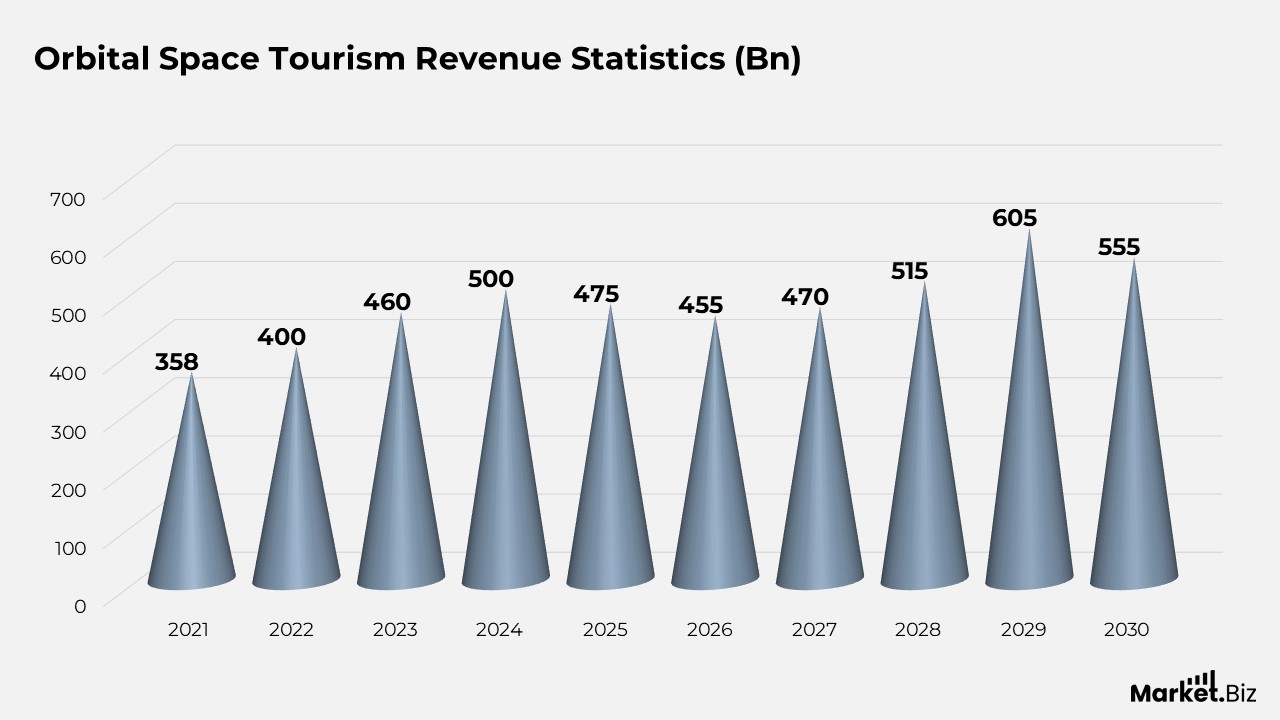
- In 2021, the market generated roughly USD 385 million in revenue, marking the onset of commercial interest in orbital space travel experiences.
- This upward trend persisted into 2022, with revenues climbing to USD 400 million. Forecasts for the subsequent years remain positive, anticipating revenues of USD 460 million in 2023 and USD 500 million in 2024.
- Nevertheless, there was a minor decline in revenue to USD 475 million in 2025, followed by a further stabilization at approximately USD 455 million in 2026.
- The market experienced a rebound in 2027, reaching USD 470 million, and continued to rise, with revenues totaling USD 515 million in 2028 and USD 605 million in 2029.
- The year 2030 is projected to generate revenue of around USD 555 million.
Space Tourism Consumer Demographics Statistics
- More than 55% of American adults anticipate that within the next 50 years, space travel for tourism will become commonplace.
- About 35% of those surveyed indicated a desire to travel to space and orbit the Earth in a spacecraft.
- Conversely, 65% of respondents expressed a lack of interest in space tourism.
- Nearly 44% of participants believe that by 2073, space tourism will not be a regular occurrence.
- The survey was conducted among 10,329 adults in the United States from May 30 to June 4, aiming to gauge American perspectives on space, including private space enterprises, NASA, and future expectations regarding space.
- Approximately 70% of Americans deem it crucial for the United States to maintain its leadership in space exploration. 65% believe that NASA should continue its involvement in space exploration, even with the growing participation of private companies such as SpaceX and Blue Origin.
- A notable 69% of those surveyed express concern about human-generated space debris, including rockets and satellites, over the next 50 years.
- Only 58% of respondents are assured that we will not find intelligent life or establish colonies on other planets within the next 50 years.
- According to the participants, monitoring asteroids (60%) and the Earth’s climate system (50%) are the primary priorities for NASA.
Recent Developments
- In 2023, SpaceX proclaimed a partnership with Axiom Space to deliver transportation services for private missions to the International Space Station (ISS).
- In 2023, Space Perspective, a firm focused on space tourism that offers balloon-assisted trips to the edge of space, raised $60 million in Series B funding.
- In early 2024, Zero 2 Infinity, a Spanish startup in the space tourism sector, acquired $40 million to enhance its balloon-based space tourism platform.
Space Tourism Future Predictions
- By the year 2027, it is anticipated that the space tourism industry will exceed USD 4,162.3 billion, with this growth trend expected to persist in the subsequent years. It is projected to reach an astonishing USD 17,742.4 billion by 2032.
- Moreover, the Chinese commercial space enterprise CAS Space has declared that its “space tourism vehicle” is scheduled for its inaugural flight in 2027, aiming to reach the edge of space by 2028.
Conclusion
In summary, space tourism represents an exciting new frontier within the aerospace and travel industries. It provides civilians with an unparalleled experience beyond the confines of Earth, filled with the wonders of weightlessness and stunning views of celestial bodies.
Although it is grounded in the imaginative visions of the early 20th century, space tourism has transformed into a tangible reality thanks to the groundbreaking initiatives of companies like SpaceX, Blue Origin, and Virgin Galactic. These organisations have achieved significant milestones, including the launch of private rockets into orbit and the transportation of paying customers on both suborbital and orbital journeys.
The space tourism sector is set for considerable expansion, supported by forecasts of increasing revenues in the coming years. However, this rapidly growing industry faces significant obstacles, including safety issues, regulatory challenges, and environmental concerns, which require a careful balance between commercial objectives and responsible exploration of space.
As we look to the future, space tourism has the potential to transform travel and initiate a new chapter in space exploration and habitation, thereby influencing humanity’s future connection with the universe.
FAQ’s
Only about 60 individuals have travelled to space as tourists, and the overwhelming majority have participated in brief suborbital excursions that offer only a few minutes of weightlessness.
Space tourism refers to a commercial endeavour that enables private citizens to journey to space for adventure, leisure, or scientific exploration.
The potential for spacecraft malfunctions, including navigation, failures in life support, or communication systems, presents considerable dangers to the safety of space tourists. Additionally, environmental threats such as micrometeoroid collisions, radiation exposure, and extreme temperature variations are also significant concerns.